
Galvanized Utility Pole vs Communication Tower Packages
Galvanized Utility Pole vs Communication Tower Packages
A galvanized steel utility pole package and a communication tower package share a material and a coating standard, but they are not interchangeable accessory bundles. The utility pole package exists to carry conductors and transfer their loads into a foundation: crossarms, pole brackets, base plates, anchor bolts, climbing ladders and step bolts. The communication tower package exists to carry radio equipment and its cabling: antenna mounts, cable ladders, climbing ladders and lightning protection. Buying both on a per-tonne basis without matching scope, interface drawings and traceability documents means comparing two different products.
This comparison is written for procurement teams, EPC contractors, distributors and utility engineers who may award both package types, sometimes within one project. It sets out what each package must contain, which document governs each interface, how hot-dip galvanizing behaves differently across the two scopes, and what evidence should travel with the steel before the first member is accepted on site.
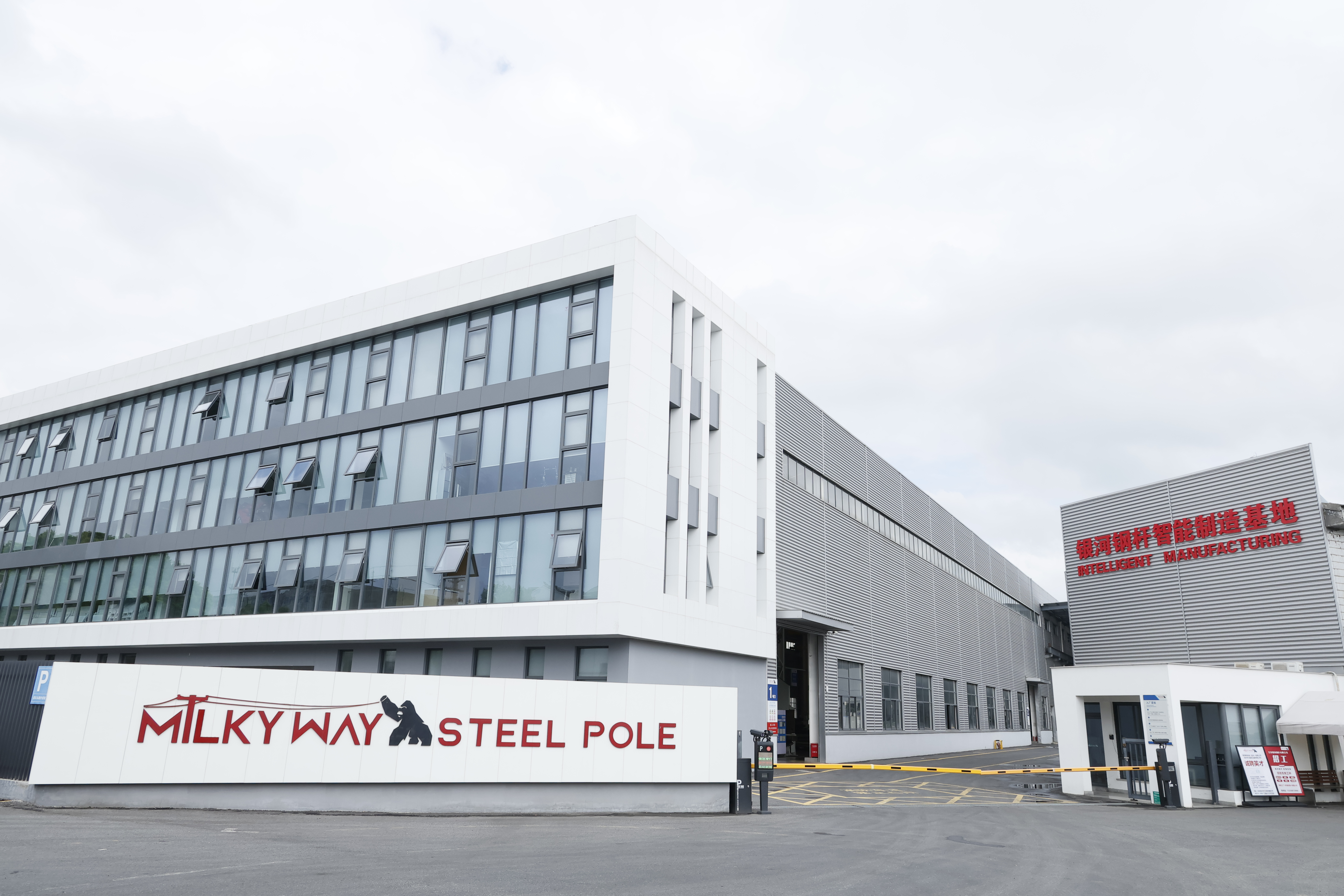
A single fabrication base can supply both package types, but the accessory scope and governing drawings remain separate.
The load path decides the package, not the price list
Start with what the steel is holding up. On a distribution or sub-transmission line the load path runs from conductors to crossarm, from crossarm through pole brackets and the pole itself, and from the pole through the base plate and anchor bolts into the foundation. Access hardware — climbing ladders and step bolts — sits outside the structural load path but remains inside the delivered scope, because it has to be positioned, fixed and coated before the pole leaves the works.
On a communication tower the load path runs from antennas and remote radio units into antenna mounts and platform steel, then into the tower members and foundation. Cable ladders route feeder and jumper cables, and lightning protection provides the intended path to ground. No item on that list supports a conductor, and no item on the utility pole list is dimensioned around antenna mounting heights, azimuths or platform access.
The two packages therefore fail in different places. A utility pole package typically fails at the crossarm-to-pole or pole-to-foundation interface, when hole patterns, bolt grades or base plate geometry do not match the approved drawing. A communication tower package typically fails when antenna mounts cannot accept the equipment actually ordered, or when cable routing and lightning protection are finalised after steel fabrication has started. In both cases the defect is an interface defect rather than a steel defect, which is why this comparison has to begin with drawings rather than with weight.
Galvanized steel utility pole packages: scope and interface demands
Crossarm and pole bracket
The crossarm holds conductors at the phase spacing the line design requires and transfers vertical, transverse and longitudinal loads into the pole. The pole bracket is the transitional part between arm and shaft, so its hole pattern, face geometry and bolt grade must be fixed by the pole drawing instead of being selected on site. Because steel poles are fabricated to engineering tolerances, steel supports tighter tolerances and repeatable hole and attachment layouts than wood, which means a crossarm detail proven on one unit can be reproduced across an order rather than re-established pole by pole.
Base plate and anchor bolt
The base plate and anchor bolts form the only connection between structure and foundation, and the scope decision here is commercially deceptive: whether anchor bolts, templates and embedded parts sit inside the pole package or inside the civil package determines who owns the setting-out tolerance. A shaft that arrives with a base plate drilled for one bolt circle cannot be corrected by changing the foundation later. Established pole manufacturers list flanges, crossarms, clamps and embedded parts inside the standard accessory range precisely because this interface is normally supplied as one set.
Climbing ladder and step bolt
Step bolts are usually fixed to the shaft at a spacing defined by the utility's access practice, while a climbing ladder, where specified, adds guided ascent and often a fall-arrest interface. Both are coated together with the pole, so coating repair after attachment welding has to be agreed before shipment. Neither item changes the structural design of the pole, but both change fabrication sequence, packing and inspection scope.
What actually governs the package
The governing document is the pole drawing set supported by the utility load tree: conductor configuration, wind zone, attachment positions and foundation interface. A project-engineered pole is designed to match that load tree, while a stock pole is not. If the load tree is missing or superseded, crossarm and bracket scope cannot be priced defensibly, and every quotation returned is conditional on data the buyer has not yet fixed.
Communication tower packages: scope, interfaces and schedule dependency
Antenna mounts and platform steel
Antenna mounts are the payload interface of the tower. Their quantity, elevation, azimuth and stand-off distance have to follow the antenna load schedule — equipment type, weight, wind area and sector layout — rather than a standard bracket pattern. Platform design follows the same logic, because maintenance access, radio unit placement and cable entry all constrain member layout. Lattice telecom towers used for 4G/5G base station coverage are commonly fabricated from Q235 and Q355 angle steel and customised in height, antenna bracket layout and platform design according to wind load and equipment load.
Cable ladder
Feeder and jumper cables need a supported route from platform to ground, with bend radii, fixing intervals and entry points agreed between tower fabricator and equipment supplier. Cable ladder scope is frequently left unassigned in tenders and then improvised on site, which compromises cable protection and damaged coating at the same time.
Climbing ladder
A tower climbing ladder is a permanent access system, not a construction aid. It has to be coordinated with rest platforms, safety rail, fall-arrest rail or cable and a lockable entry, and it must not obstruct antenna azimuths or cable runs. Because it is welded or bolted to main members, its final position belongs on the fabrication drawing rather than on the erection site.
Lightning protection
Lightning protection on a tower combines air termination, down conductor routing and a low-impedance path into the earthing system, usually bonded to the structure at defined points. It is a design discipline that runs alongside structural fabrication, and a package that supplies steel without a defined earthing interface leaves the electrical scope to be solved by someone else. Bonding and earthing points should appear on the same drawing set as the antenna mounts, so that the two scopes cannot drift apart during detailing.
Side-by-side comparison: utility pole package vs communication tower package
| Comparison dimension | Galvanized steel utility pole package | Communication tower package |
|---|---|---|
| Primary function | Conductor support and load transfer into the foundation | Antenna, radio unit and cable support |
| Core accessory scope | Crossarm, pole bracket, base plate, anchor bolt, climbing ladder, step bolt | Antenna mounts, cable ladder, climbing ladder, lightning protection |
| Governing input | Pole drawing set, utility load tree, wind zone, foundation drawing | Tower drawing, 4G/5G antenna load schedule, cable and earthing design |
| Typical structural form | Polygonal or tubular steel shaft with fabricated accessories | Angle steel lattice members with bolted connections |
| Coating-critical points | Shaft, welded step bolt and ladder attachments, threaded items, base plate zone | Bolted faces, mount and ladder fixings, handling damage across many members |
| Traceability emphasis | Pole-to-drawing conformity, base plate and anchor bolt interface | Member and bolt identification, mount position conformity |
| Recurring scope question | Ownership split of anchor bolts and embedded parts with civil works | Antenna mount and cable ladder scope left unspecified in the tender |
| Typical buyer | Utility, distribution EPC, rural electrification programme | Telecom operator, tower company, telecom EPC |
Project drawings and the 4G/5G antenna load schedule
Two documents do most of the work in this comparison.
The first is the pole drawing set for a line project. It should carry shaft geometry, steel grade, coating requirement, crossarm and bracket positions, step bolt layout, base plate and anchor bolt arrangement, and the loads the assembly was designed for. Where a national specification applies, the drawing set has to reflect it. In the Philippines, for example, NEA Memorandum No. 2007-007 specifies a minimum yield stress of 345 MPa and an 86-micron zinc coating for a 30 ft, 3.00 mm distribution pole in heavy loading zones, and the same memorandum addresses 25 ft, 30 ft, 35 ft and 40 ft poles. Those values are a regulatory benchmark for one jurisdiction rather than a universal specification, but they show why a drawing and a standard, not a catalogue page, must define the package.
The second is the antenna load schedule for a telecom project. It fixes equipment count, mounting heights, azimuths, platform loading and wind area. Without it, antenna mount scope cannot be fabricated or compared: two bidders quoting a tower with mounts may be pricing different mount counts, different platform extents and different access provisions. A schedule revision after fabrication is one of the most expensive change events in a tower package.
Hot-dip galvanizing: one process, two risk profiles
Hot-dip galvanizing per ASTM A123 is the default corrosion protection specified for steel poles and towers in this review, with an optional galvanizing plus powder coating finish where appearance or an additional barrier is required. The zinc coating is metallurgically bonded to the steel and protects internal and external accessible surfaces, which is the main reason it is preferred over paint-only systems in coastal, humid, industrial and remote locations where repainting is impractical.
The two packages expose that coating to different risks. On a utility pole, the critical points are welded attachments such as step bolts and ladder brackets, holes cut or drilled after galvanizing, and the base plate area where steel meets a foundation that may retain moisture. On a communication tower, the critical points are bolted connection faces, ladder and mount fixings, and handling damage spread across many separate members. Both cases need a written touch-up procedure and a field inspection step.
Coating performance should not be reduced to a single life figure. Service life depends on zinc thickness, steel surface condition and local atmospheric corrosivity, so the defensible procurement position is to specify the standard, the minimum coating thickness or mass, the inspection method and the acceptance records, rather than to accept a marketing statement about decades of service. Periodic condition inspection remains necessary on galvanized structures, and damaged coating can be repaired locally.
Member and bolt traceability: what should travel with the package

Shaft geometry is set during plate leveling and rolling, which is why dimensional records should follow the pole to the accessory interface.
Traceability is the part of the package buyers notice last and value most during acceptance. The reasonable minimum for both package types is a document set that links each delivered item back to its material and to its inspection record.
For a galvanized steel utility pole package that means material test certificates for shaft and accessory steel, the approved drawing set with revision status, galvanization inspection records, welding and dimensional inspection records, and identification of base plates, anchor bolts and embedded parts by drawing position. For a communication tower package the same logic applies member by member: member marks that match the erection drawing, material certificates by heat or batch, galvanization records, bolt and fastener certification, and a record of antenna mount positions as fabricated.
Where a project names international codes, design and fabrication can be aligned to IEC, EN, ANSI and local regional codes instead of a single export template. Suppliers able to issue structural calculation reports, material test certificates and galvanization inspection records give the buyer a document trail that supports both project approval and later technical review.
Where Milky Way sits across both package types
Jiangsu Milky Way Steel Poles Co., Ltd. (MILKY WAY) is a China-based manufacturer founded in 1991 that produces transmission and distribution steel poles, substation steel structures, lattice towers and communication towers, with crossarms and accessories supplied alongside the poles. That product range places both sides of this comparison inside one supply base, which matters mainly because the two scopes can then be engineered against the same document discipline rather than assembled from unrelated vendors.
The company reports an annual output of 100,000 sets of medium and low voltage steel poles and 3,000 sets of high voltage steel poles, with structural work supported by an engineering and design team using PLS-POLE and PLS-TOWER for project-specific structural design. Main structural steel grades are Q235, Q345 and Q355, with hot-dip galvanizing per ASTM A123 and an optional powder coating finish. Quality control follows a four-level sequence: raw material testing, in-process patrol, finished-product full inspection and third-party random sampling. In 2025, a customised 132kV high-voltage pole for a Pakistan project passed a full-scale destructive test at the State Grid key laboratory, with load, displacement and strength indicators meeting project requirements — an example of the verification route that high-voltage work sometimes demands and that stock-pole supply does not offer. ISO9001 and ISO45001 are held, with SGS, TÜV Rheinland and BV certificates available in English for export bidding.
For buyers comparing packages rather than poles, the relevant capability is scope coordination: structural calculation documents, hot-dip galvanizing treatment and relevant test reports for lattice telecom towers used in 4G/5G base station coverage, and calculation sheets plus third-party test reports for transmission and distribution pole projects. Local service centers in the Philippines, Rwanda, Ecuador and Ghana, together with a 2,400-ton, 106-container low-voltage grid project in Africa that the company reports as delivered early, bear on installation support and change handling rather than on steel tonnage alone. Jiangsu Milky Way Steel Poles Co., Ltd.
Application fit: four scenarios and the package they call for
Rural electrification and distribution extension. The decision driver is the utility load tree and the local standard. A galvanized steel utility pole package with defined crossarm, bracket, base plate and anchor bolt scope fits, and access provision should follow the utility's practice. Where a national specification applies, coating and yield requirements belong in the RFQ as written values rather than as a summary.
4G/5G base station coverage. The driver is the antenna load schedule. A communication tower package with mounts, platforms, cable ladders, climbing ladder and lightning protection fits only when all four are defined; otherwise the buyer is purchasing a structural frame and managing the remainder as site work.
Mixed corridors where a line and a telecom installation share a route. Two packages, two interfaces, two acceptance files. Combining them into one line item usually transfers interface risk to the buyer, because each supplier's drawing responsibility ends where the other scope begins.
Coastal or industrial corrosion environments. Both packages should be specified by coating standard, thickness and inspection method, with a touch-up procedure and a planned inspection interval. Galvanizing reduces routine coating maintenance compared with paint-only systems but does not remove the need to inspect.
Fit boundaries the RFQ should state explicitly
Several boundaries decide whether a package comparison is meaningful at all. Access and fall-protection scope should be named rather than assumed: step bolts, ladders, rest platforms and safety rail belong either to the steel package or to a separate safety supplier, and the split must be written. Earthing and lightning protection responsibility should be assigned the same way, with bonding points shown on the tower drawing. Anchor bolt and embedded part ownership must be settled with the civil contractor before the foundation is poured.
Two further cautions belong in every comparison. First, a galvanized coating is not a maintenance-free finish; inspection and local repair remain part of the lifecycle, and coating life depends on zinc thickness and atmospheric corrosivity rather than on a universal figure. Second, structure type is a separate decision from package scope: tubular and polygonal poles offer a smaller visual footprint and fewer members and bolts than lattice towers, while lattice structures can be more material-efficient under very high loads and long spans. Package selection does not settle that question and should not be presented as if it does.
What to lock before the next tender round
A defensible award closes five items before prices are compared. The interface matrix should list every connection to foreign scope — foundation, conductors, antennas, cables, earthing, access — with an owner named for each. The drawing set should be revision-controlled and referenced in the purchase order. The coating specification should name the standard, the acceptance values and the inspection method. The traceability file should be listed item by item rather than described as available on request. And the load input, whether utility load tree or antenna load schedule, should be attached, because both package types are priced against it.
Where those five items are fixed, the comparison between a galvanized steel utility pole package and a communication tower package becomes a genuine decision about scope, interface ownership and evidence. Where they are missing, it collapses into a price per tonne across two unrelated scopes, and the difference returns later as a change order.
A wider product reference is available in the 2026 Milky Way Power Group catalogue (PDF).
Frequently asked questions
What is the main scope difference between a galvanized steel utility pole package and a communication tower package?
The utility pole package is built around conductor support and foundation transfer — crossarm, pole brackets, base plate, anchor bolts, climbing ladder and step bolts — and is governed by the pole drawing and utility load tree. The communication tower package is built around radio equipment and cable management — antenna mounts, platforms, cable ladders, climbing ladders and lightning protection — and is governed by the tower drawing and the 4G/5G antenna load schedule. The steel may share the same grades and hot-dip galvanizing, but the accessory scope and the governing drawing differ.
Which documents should a buyer require before comparing quotations for these two packages?
For the utility pole package: revision-controlled pole drawings, the utility load tree, foundation and anchor bolt drawings, steel grade, coating specification and inspection records. For the communication tower package: tower drawings, antenna load schedule, mount and platform layouts, cable routing, earthing and lightning protection design, and member marking. Both should be accompanied by material test certificates and galvanization inspection records, so that quotations are priced against the same scope.
How does hot-dip galvanizing differ in importance between utility pole accessories and tower members?
The coating standard is usually the same — for example hot-dip galvanizing per ASTM A123 — but the risk points differ. On a utility pole, coating-critical areas include welded step bolt and ladder attachments, post-galvanizing holes and the base plate zone. On a tower, they include bolted connection faces, mount and ladder fixings, and handling damage across many separate members. In both cases coating performance depends on zinc thickness and local corrosivity, so the specification should name thickness or mass, inspection method and a touch-up procedure.
Why does a 4G/5G antenna load schedule change the tower package but not the utility pole package?
The antenna load schedule defines equipment count, mounting heights, azimuths, platform loading and wind area, and those values set the number and position of antenna mounts, the extent of platform steel and the layout of cable ladders. A utility pole package is instead driven by conductor configuration, wind zone, attachment positions and foundation interface. A load schedule submitted against a pole package does not define crossarm geometry, and a pole loading tree does not define antenna mount positions.
What traceability evidence should accompany crossarms, base plates, anchor bolts, antenna mounts and ladders?
Each item should be identifiable by drawing position or member mark, with material test certificates for the steel used, galvanization inspection records and dimensional or welding inspection records as applicable. Bolts and fasteners should be certified to the grade specified on the drawing. Delivered documentation should match the approved drawing revision, so that acceptance, later technical review and any replacement order can be handled against the same record.
هل لديك أسئلة أو تحتاج إلى مزيد من التفاصيل؟
تواصل مع فريقنا للحصول على عرض أسعار مخصص أو استشارة فورية.
طلب عرض أسعار
املأ النموذج أدناه وسيتواصل معك فريقنا بعرض مقترح مخصص.
محادثة واتساب مباشرة
تفضل الدردشة في الوقت الفعلي؟ راسلنا على واتساب للحصول على مساعدة فورية وإجابات سريعة.
- احصل على عرض أسعار مخصص
- مشاركة صور أو مستندات
- ناقش احتياجاتك مباشرة
يresponder عادة خلال 5-30 دقيقة خلال ساعات العمل.