
Gaming Chair Compliance Decoded: Gas Lift, Base, and Material Checks
Gaming Chair Compliance Decoded: Gas Lift, Base, and Material Checks
Gaming chair compliance is usually debated at the wrong end of the product. Importers compare upholstery colours, stitching and lighting, then ask for a certificate. The components that decide whether a container of chairs survives a retail season — the gas lift, the star base, the mechanism, the seat plywood and the foam — are the ones a product photograph never shows.
This explainer is written for procurement teams in the evaluation and execution stages: buyers who are finalising a specification, approving a sample and preparing a purchase order. It uses two models from Anji Maochang Furniture Co.,Ltd. — MC1039 and MC1025 — to show how a gaming chair specification can be read for compliance-relevant engineering, and which questions a buyer should put to a factory manager before a deposit is paid.
Anji Maochang Furniture Co.,Ltd. is a chair manufacturer based in Anji County, Zhejiang Province, China. Established in 2016, the company operates a 3,000 m² production facility with 25 employees and an annual output of approximately 75,000 units, producing gaming chairs, office chairs and manicure chairs for export markets that include Europe, the USA, Thailand, Brazil and South Korea (www.mcrfurniture.com).
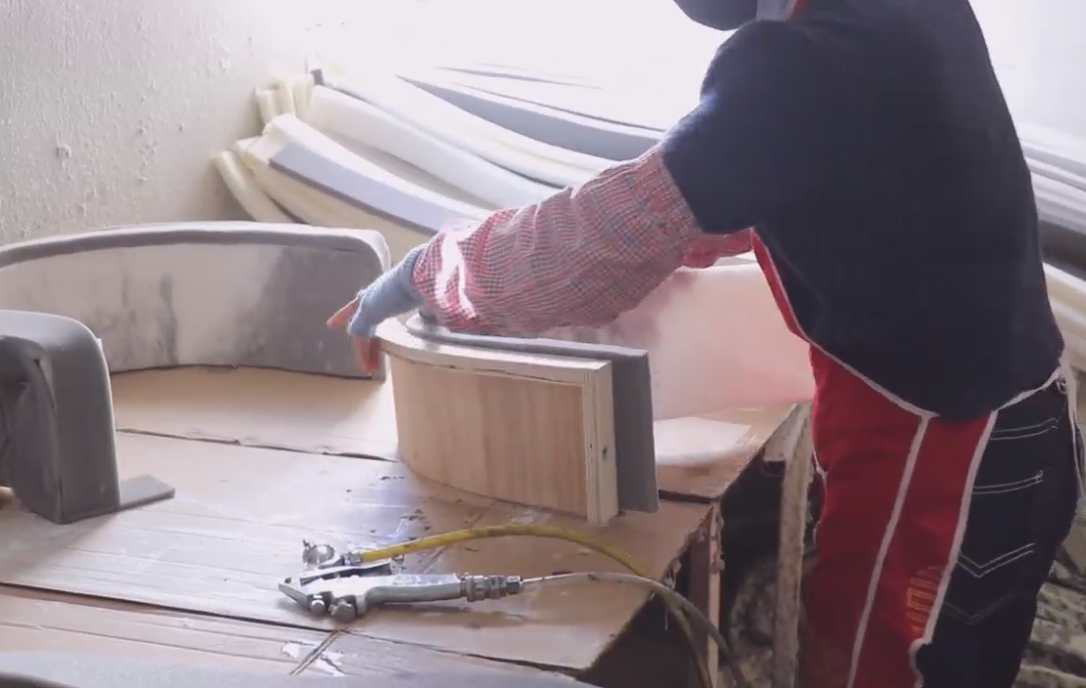
Foam bonding on the Anji Maochang Furniture production line — the seat component that most directly affects long-term durability and indoor-emission documentation.
The Three Load Paths That Decide Whether a Gaming Chair Complies
Every gaming chair carries its user through three load paths, and each one maps to a different line of the specification. The first is vertical: body weight travels from the seat through the mechanism and the gas lift column into the star base and the castors. The second is dynamic: reclining, rocking and dropping into the seat transfer force into the mechanism, the plywood seat plate and the frame. The third is cumulative: foam compression set, cover abrasion and mechanical wear determine what the chair looks like after a year of daily use.
Compliance problems in this category cluster in the first two paths, because those are the parts a buyer cannot inspect from a catalogue image. A useful example is the specification of the MC1039, described as a new design big size gaming chair, which lists a Class 3 gas lift, a 370 mm big size star base, a frog type multifunctional mechanism, height adjustable armrests, and a material composition of PU, PVC, mesh, fabric, plywood and metal frame, packed one piece per carton. Almost every compliance-relevant engineering decision in that chair appears in one short list — and almost none of it is visible in a photograph.
What a Class 3 Gas Lift Implies, and What It Does Not Prove
On a gaming chair specification, a Class 3 gas lift refers to the grade of the pneumatic cylinder that raises and lowers the seat. In the trade, cylinders are commonly grouped into classes, with higher numbers generally associated with heavier cylinder construction and a higher rated load than entry-level units. The designation is a supplier-facing convention rather than a certificate, and there is no single globally harmonised definition of the classes. A buyer who sees Class 3 on a quotation has learned something useful — and something incomplete.
Four things turn the label into a verifiable fact:
- The cylinder supplier's datasheet, stating rated load and stroke, together with the class definition that supplier applies.
- Whether the class applies to the cylinder alone or to the fully assembled lift unit.
- Whether the same cylinder is used in the approved sample, in the pre-production unit and in mass production.
- Whether the cylinder is treated as an incoming critical part or purchased as a commodity on price alone.
On the fourth point, process evidence matters more than wording. Anji Maochang Furniture Co.,Ltd. documents a goods-in inspection step in which the gas lift, mechanism, leather colour and plywood thickness are checked when materials arrive, before they enter the line. The order of operations is the point: a cylinder inspected on arrival can be rejected before it is built into a finished chair, whereas a cylinder only examined at final packing is already committed to the order.
The limit of the class label is that it says nothing about the rest of the load path. A higher-class cylinder fitted into a light base, a thin seat plate or an under-specified mechanism still produces a chair whose usable capacity is governed by the weakest component. The gas lift class should therefore be read as one element of a load path, not as a standalone quality mark.
Base Geometry and the Meaning of a 370 mm Star Base
A star base works as a support polygon: the greater the distance from the column to the castor axis, the further the tipping point sits from the chair's centre of gravity. Under reclining or lateral movement, that extra distance is what keeps the chair planted. The MC1039 specification lists a 370 mm big size star base, placing it at the larger-footprint end of the range rather than at the compact office-chair end.
Geometry, however, is not a rating. Base diameter tells a buyer how the chair behaves against tipping; it does not state how much mass the base, hub and castors can carry over time. Fabrication details decide that:
- How the legs are welded or fixed to the hub, and whether the joint is inspected.
- Castor axle and wheel material, and how the stem seats in the base socket.
- The number and pattern of fixing points between the base and the mechanism.
- How the base diameter is measured — from the column centre to the castor axis, or across the full span.
That last question is worth asking directly, because the difference between the two measurement conventions is large enough to change a comparison between two suppliers' drawings.
There is also a commercial trade-off. A larger base increases stability and shipping volume at the same time. The MC1039 ships one piece per carton, and base geometry is one of the variables that sets carton size and container loading — which is why base specification and freight planning should be decided together rather than in sequence.
Material Composition as a Durability Forecast
Materials on a gaming chair specification are usually read as a comfort question. In practice they are a durability and compliance forecast, because each material family answers a different failure mode.
- Metal frame and plywood seat plate. These carry the load and anchor the mechanism. Anji Maochang Furniture Co.,Ltd. assembles one chair with the plywood alone before production starts, in order to check the total depth of the chair and whether the seat is even — a pre-production geometry check that catches frame and seat-plate problems before the line runs at volume.
- Moulded foam. Foam determines shape retention. Industry material guidance commonly places high-density moulded foam for premium seating in the 50–65 kg/m³ range; density is one indicator rather than a complete specification, because cell structure and resilience also influence how a seat feels after a year of use.
- PU and PVC covers. PU leather remained the most common cover material in the gaming chair category in 2024, with a 57.3% share of the material mix (Mordor Intelligence). Cover choice affects cleaning, crack resistance and, in markets that require it, upholstery ignitability performance.
- Fabric and mesh. Used where breathability or a cooler seat surface matters, and evaluated against abrasion and pilling rather than against leather-like appearance.
- Board and foam emissions. Formaldehyde and similar volatile emissions from wood-based components and bonding agents are subject to documentation in several destination markets. Anji Maochang Furniture Co.,Ltd. holds a formaldehyde-emission test report issued by RED Laboratories Inc. covering gaming chair models — the material-level evidence a buyer should ask to see alongside any finished-chair report.
The MC1039 material list of PU, PVC, mesh, fabric, plywood and metal frame, and the MC1025 material list of fabric, foam, PU, metal and plastic, describe two different cost structures and two different risk profiles rather than two colourways of the same product.
How Materials and Mechanisms Map to Regulatory Checks
Regulatory checks on gaming chairs are not one test. They fall into four families, and each family attaches to named materials and parts.
| Check family | What is examined | Where it sits in the specification |
|---|---|---|
| Structural and mechanical safety of the finished chair | Load application, stability under recline, fatigue of mechanism, base and castors | Gas lift, star base, mechanism, castors, frame |
| Emissions from board, foam and adhesives | Formaldehyde and comparable volatile emissions from wood-based and bonded components | Plywood, board components, moulded foam, bonding agents |
| Upholstery ignitability, where the destination market requires it | Behaviour of cover and filling materials under ignition sources | PU, PVC, fabric, foam |
| Sourcing and factory-level accountability | Traceability of wood-based components and factory audit records | Plywood and frame suppliers, production facility documentation |
Mapping checks back to components this way prevents a recurring sourcing error: requesting a document that belongs to a different family than the risk being managed.
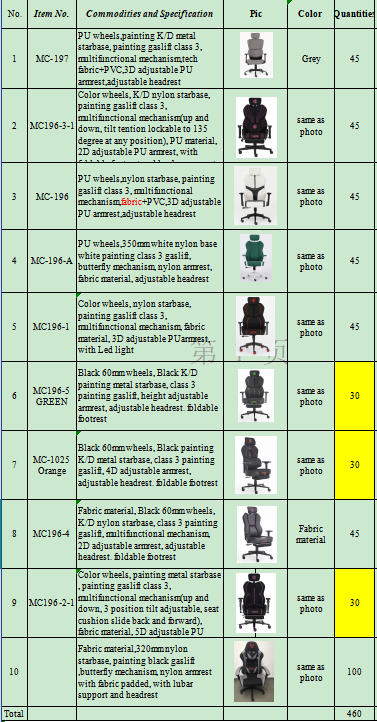
A staged wholesale export order before shipment — the stage at which model-level documentation and pre-shipment checks should already be settled.
Repeat business is the practical evidence that this discipline works. A wholesale customer in Ukraine placed an initial order of 460 units for office space furnishing; the cooperation has continued for two years, and the chairs have been well received by local office clients. Specifications that survive their first installation cycle tend to produce that kind of continuity — no single document does.
A Procurement Question Set for Gas Lift, Base and Materials
The following questions are designed to be asked in one written exchange with a factory manager, before a sample is approved.
| # | Question to the factory manager | Why it matters | Weak answer signal |
|---|---|---|---|
| 1 | Which cylinder supplier and model is used, and what are the rated load and stroke? | The class number is not a load figure | A class number with no datasheet |
| 2 | Does the class designation come from the cylinder maker's datasheet? | Class conventions are not harmonised | Everyone calls it Class 3 |
| 3 | Is the gas lift inspected on arrival, or only on the finished chair? | Determines whether defects are caught before commitment | We check at final packing |
| 4 | Is the cylinder in production identical to the approved sample? | Protects the sample approval | Equivalent part |
| 5 | Is the base diameter measured centre-to-castor or across the full span? | Changes the stability comparison between suppliers | Not known |
| 6 | How are the legs attached to the hub, and what is the castor axle material? | Base failures concentrate at the hub and castor | Standard construction |
| 7 | Is there a pre-production assembly check of the plywood and seat depth? | Catches geometry defects before mass production | No defined checkpoint |
| 8 | What is the plywood thickness and grade, and who supplies the board? | Sets the strength and emissions baseline | Normal plywood |
| 9 | Which model numbers appear in the scope of the documents you can send today? | Prevents scope gaps at customs or retail audit | A document with no model list |
| 10 | Which check is the acceptance method on the order, and at what point does it happen? | Ties documentation to shipment release | Undefined acceptance step |
Two Specifications, Two Risk Profiles: MC1039 and MC1025
Reading the two models side by side shows how unevenly compliance-relevant detail is distributed across a product range.
| Parameter | MC1039 | MC1025 |
|---|---|---|
| Product type | new design big size gaming chair | new design computer chair |
| Gas lift | Class 3 gas lift | not stated in the provided specification |
| Star base | 370 mm big size star base | not stated in the provided specification |
| Mechanism | frog type multifunctional mechanism | not stated in the provided specification |
| Armrests | height adjustable | not stated in the provided specification |
| Product size | not stated in the provided specification | W70 x D69 x H121-130 cm |
| Carton size | not stated in the provided specification | 78 x 38 x 56 cm |
| Loading quantity | not stated in the provided specification | 410 pcs |
| Materials | PU, PVC, mesh, fabric, plywood, metal frame | fabric, foam, PU, metal, plastic |
| Packing | 1 pc / 1 carton | 1 pc / 1 carton |
| Intended environment | home, office, live streaming, internet cafe | home, office, live streaming |
The comparison is instructive for a procurement reason rather than a marketing one. MC1039 arrives with its load path partly documented: gas lift class, base diameter and mechanism type are all named, while the product size and container loading are not stated in the same specification. MC1025 arrives with its geometry documented — overall size, carton size and container loading — but with no gas lift, base or mechanism detail in the same sheet. Neither situation is unusual in the category, and neither is automatically a defect. What matters is that the buyer knows which questions remain open before the specification is frozen.
For MC1025, the missing items are precisely the ones that govern long-term safety, so they should be requested in writing and recorded in the purchase order. For MC1039, the named items should be tied to evidence: the cylinder datasheet behind the Class 3 designation, the measurement convention behind the 370 mm base, and the mechanism sample identity. In both cases, the factory's pre-production plywood assembly check is a process signal worth more than a slogan, because it verifies seat geometry before the line ramps up.
Comparison with Traditional Solutions: Documentation-First Buying vs Catalogue-First Buying
Gaming chair purchasing in many importing businesses has traditionally worked from the catalogue inward: select a model, negotiate a price, request a certificate, place the order. That sequence still functions when the product is a decorative accessory, and it is faster at the quotation stage. It becomes fragile when the chair carries a load, because the document requested at the end of a negotiation may cover a different model, a different factory or a different period.
A documentation-first sequence reverses two steps. The buyer defines the load path first — cylinder class and rated load, base measurement convention, mechanism type, seat plate material — then asks which documents already exist for the exact SKU, and only then negotiates price against a frozen specification. It costs more time during sampling and usually produces fewer surprises at the destination port.
This approach has real limits, and buyers should not treat it as a guarantee:
- A Class 3 gas lift and a 370 mm base are engineering facts about the MC1039, not a published capacity figure for it. Where a numeric load rating is published, it attaches to a specific model: the MC1040 gaming sofa states a 150 kg weight capacity and a 27.4 kg product weight, while the MC1039 specification as provided lists no numeric weight capacity. A buyer who needs a documented load figure must request it for the model actually being ordered.
- Documentation is model-specific. A report scoped to one model does not automatically extend to a sibling SKU, even within the same series.
- Compliance in one destination market does not transfer to another, particularly where ignitability or emissions requirements differ.
- Commercial parameters set the practical rhythm: a MOQ of 50 units, a lead time of 30–40 days, monthly capacity of 6,000 units, FOB Shanghai or Ningbo, 30% deposit with the balance against a copy of the bill of lading, pre-shipment test as the acceptance method, and a one-year quality warranty. Documentation work has to fit inside that timeline, not after it.
- Finally, material and mechanism quality address durability and safety, not fit. A chair that satisfies every check can still be the wrong chair for a given room or user.
Where the Supply Side Is Moving
Category size and mix. The global gaming chair market was estimated at USD 1.37 billion in 2024 and projected to reach approximately USD 2.05 billion by 2030 (Grand View Research). Research houses publish different figures depending on whether adjacent categories such as gaming desks are included, so any growth number should be read together with its scope definition rather than in isolation.
Product mix. PC gaming chairs accounted for 52.6% of the product segment in 2024 (Grand View Research), and North America held a 36.4% revenue share in the same year (Mordor Intelligence). Hybrid work-and-game chairs — the segment that sits between an office chair and a gaming chair, like the MC1025 — were estimated at 29.8% of the market in 2024 (Expert Market Insights). That shift matters for compliance work because hybrid chairs are judged against office-chair expectations as well as gaming-chair expectations.
Supply base. The Anji furniture cluster in Zhejiang, where Anji Maochang Furniture Co.,Ltd. operates, is described in trade data as the world's leading production base for gaming chairs, within a country that accounted for 30.8% of global furniture exports in 2024 (Statista / OEC). Concentration of this kind makes component-level questions more, not less, important: factories in the same cluster often buy cylinders, bases and mechanisms from overlapping suppliers, so the practical difference between two quotations is frequently the inspection regime rather than the component list.
Future Outlook
The direction of travel in gaming chair sourcing is toward specification at the component level. Buyers increasingly ask for cylinder datasheets, base measurement conventions and material declarations rather than accepting a document thumbnail in a chat message, and model-level scope checking is becoming a standard step before purchase order release rather than an afterthought at customs.
Two structural forces reinforce this. First, the hybrid work-and-game segment pushes gaming chairs into evaluation frameworks built for office seating, where dimensional and stability expectations are more explicit. Second, material accountability — foam, board, covers — is where destination-market requirements differ most sharply, which makes material documentation a sourcing decision rather than an administrative one.
None of this requires new technology. It requires moving the questions currently asked at the end of a negotiation to the beginning, and recording the answers in the order.
FAQ
What does a Class 3 gas lift mean on a gaming chair specification?
It refers to the grade of the pneumatic cylinder that raises and lowers the seat, using a trade convention in which higher class numbers generally indicate heavier cylinder construction and a higher rated load than entry-level grades. The convention is not harmonised across suppliers, so the number is only meaningful when it is supported by the cylinder supplier's datasheet stating rated load and stroke. The MC1039 big size gaming chair lists a Class 3 gas lift alongside a 370 mm star base and a frog type multifunctional mechanism. Buyers should confirm that the same cylinder is used in the approved sample and in mass production.
Does a larger star base make a gaming chair safer?
A larger base widens the support polygon, which increases resistance to tipping under reclining and lateral movement, and it also increases base weight and carton volume. The MC1039 lists a 370 mm big size star base. Base diameter is a geometry fact rather than a load rating: the usable capacity of a chair is governed by the gas lift, mechanism, seat plate and castors together, so base size should be checked against the rest of the load path rather than on its own.
Which materials in a gaming chair should a buyer examine most closely?
The load-bearing materials come first: the metal frame, the plywood seat plate and the moulded foam. Anji Maochang Furniture Co.,Ltd. checks gas lift, mechanism, leather colour and plywood thickness when materials arrive, and assembles a chair with the plywood alone before production begins to verify total seat depth and evenness. Foam is commonly specified with reference to density — industry material guidance places high-density moulded foam for premium seating in the 50–65 kg/m³ range — although density alone does not determine service life. Cover material matters for cleaning, abrasion and ignitability: PU leather was the single most common gaming chair material in 2024, with a 57.3% share of the material mix (Mordor Intelligence).
Does a test report for one gaming chair model cover the other models in the same series?
Not automatically. Reports and certificates are issued with a defined scope that typically names specific models, and a document naming one model does not extend to a sibling SKU on its own. A buyer should request the current document, compare the model list inside its scope against the exact SKU on the purchase order, and ask in writing for a model-specific test or a written scope statement where the SKU is not listed.
What commercial terms usually apply to a gaming chair order from this factory?
Anji Maochang Furniture Co.,Ltd. quotes a minimum order quantity of 50 units, a lead time of 30–40 days and a monthly capacity of 6,000 units, with OEM and ODM production and customisation of logo, colour, size and design. Delivery terms are FOB Shanghai or Ningbo, payment is 30% deposit in advance with the balance against a copy of the bill of lading, acceptance is by pre-shipment test, and a one-year quality warranty applies. These parameters determine how much verification can realistically be completed before shipment.
For buyers who want to compare the full model list, the manufacturer's 2026 product catalogue is available as a public PDF: 2026 product catalogue. Gas lift class, base dimensions and material composition should be confirmed in writing for the specific model being ordered.