
Gaming Chair FAQ: Tilt Locks, Gas Lifts and Cartons
Gaming Chair FAQ: Tilt Locks, Gas Lifts and Cartons
A gaming chair order becomes a technical document before it becomes a visual one. The problems that surface in production, inspection and container loading are rarely about color: they are about mechanism type, gas lift class, recline geometry, footrest clearance and carton volume. Every one of those items can be confirmed in writing before a purchase order is issued, and each one changes cost, container loading and how the chair behaves after delivery.
This reference answers the technical and procurement questions that recur in gaming chair inquiries, using published specification data for specific models — MC196-2-1, MC196-3-1, MC1034 and MC1039-1 — together with the related MC1039 and MC1040. The specifications referenced come from Anji Maochang furniture Co.,Ltd., a chair manufacturer established in 2016 in Anji County, Zhejiang Province, China, which produces gaming chairs, office chairs and manicure chairs on a 3,000 m² site with 25 employees, three R&D engineers and an annual output of 75,000 units, and exports mainly to the EU, USA, Thailand, Brazil and South Korea.
Why the gap between gallery language and order language costs money
Product galleries describe comfort. Purchase orders need measurable attributes. The distance between the two creates four recurring mismatches:
- “Reclining” — without a degree range, a buyer cannot distinguish a 180-degree recliner from a limited-tilt backrest.
- “Adjustable armrest” — 2D, 4D and 5D armrests move in different directions and are not interchangeable in a written specification.
- “Strong base” — gas lift class, star base diameter and caster size are the values that matter.
- “Compact carton” — carton dimensions set the loading quantity per container, and loading quantity sets freight per unit.
A second risk is range-level assumption: a specification confirmed on one model is often applied to an entire catalog. Gas lift class is the clearest example — it is documented per model, not per brand.
Tilt locks: what “3-position” means in practice
On the MC196-3-1, the 3-position tilt-lock mechanism lets the backrest tilt to three set angles, which the manufacturer describes as switching between gaming, working and relaxing modes. The same chair pairs the mechanism with 2D adjustable armrests that move up/down and back/forth, an adjustable headrest and a lumbar pillow.
The MC196-2-1 uses a comparable but separately specified configuration: the backrest supports three locking tilt angles, the seat cushion has forward-backward depth adjustment, and the chair is fitted with 5D adjustable armrests, a height-adjustable headrest, a retractable footrest, a Class-3 gas lift and 60 mm casters. Its black powder-coated metal base is detachable, which the manufacturer states reduces packaging size. The seat uses an inner spring package to help hold shape, and the model carries a registered design patent.
A third mechanism family appears on the MC1039-1, specified with a frog-type adjustable multifunctional mechanism rather than a described 3-position lock. For procurement purposes the mechanism is a named component with a defined function; “multifunctional mechanism” and “3-position tilt lock” should not be treated as synonyms when an order is written.
Gas lifts and base geometry
A Class-3 gas lift is explicitly specified for the MC196-2-1 and for the MC1039. The MC1039 also uses a 370 mm big-size star base. Where the lift class is not stated in the available specification, buyers should request written confirmation for the exact model on the order rather than carrying over a class claim from another chair in the same catalog.
Verification does not stop at the sales document. Incoming material inspection at the factory covers the gas lift, the mechanism, the leather color and the thickness of the plywood, so the lift is checked as a received component rather than only as a catalog line.
Recline range, footrests and the space they require
Four models in this group are specified with 180-degree reclining: MC1034, MC1039-1, MC1039 and MC1040. Footrests differ by type. The MC1034, MC1039-1, MC1039 and MC1040 use a foldable footrest, while the MC196-2-1 specifies a retractable footrest that extends for full-body relaxation and retracts when not in use.
Recline range has a site-planning consequence. A chair that reclines to 180 degrees with the footrest extended occupies more depth than an upright chair, and internet cafe fit-out projects in China are described as requiring sufficient space for each seating unit. Buyers planning dense seating rows should confirm clearance behind and in front of the chair before fixing the number of seats per room.
Armrests and headrests: 2D, 4D, 5D and adjustable pillows
Armrest terminology is the most common source of mismatch in written specifications:
- MC196-3-1 — 2D adjustable armrests, moving up/down and back/forth.
- MC1039-1 — 4D adjustable armrests.
- MC196-2-1 — 5D adjustable armrests.
- MC1034 and MC1039 — height-adjustable armrests.
Neck and lumbar support follow the same model-level pattern. The MC196-2-1 and MC196-3-1 use a height-adjustable headrest, with the MC196-3-1 adding a lumbar pillow. The MC1034 relies on molded foam for both the pillow and the lumbar support and provides a height-adjustable pillow.
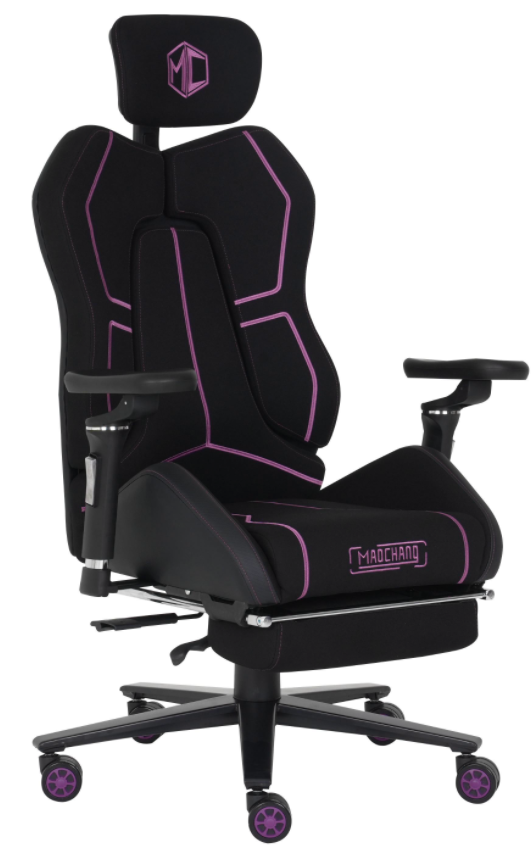
Model comparison: dimensions, cartons and materials
The table below uses published per-model data. Loading quantities are stated per model and, for the MC1034, per 1×40'HQ, so the container basis should be confirmed for each model before a loading plan is finalized.
| Model | Product size (W×D×H) | Carton size | Loading quantity | Material | Mechanism and adjustment |
|---|---|---|---|---|---|
| MC196-2-1 | 70×70×118–128 cm | 75×65×34 cm | 410 pcs | Fabric, metal, plastic, foam | 3 locking tilt angles, 5D armrests, retractable footrest, Class-3 gas lift, 60 mm casters, detachable powder-coated base |
| MC196-3-1 | 66.5×69×106–114 cm | 75×57×37 cm | 441 pcs | Fabric, PVC, PU, metal, plastic, foam | 3-position tilt-lock mechanism, 2D armrests, adjustable headrest, lumbar pillow |
| MC1034 | 71.5×65×123–131 cm | 86.5×65×36 cm | 334 pcs per 1×40'HQ | Metal, PU, plastic | 180-degree reclining, foldable footrest, molded foam pillow and lumbar support, height-adjustable pillow |
| MC1039-1 | 74×80×126–132 cm | 82×60×53 cm | 260 pcs | PU, metal, plastic | 180-degree reclining, 4D adjustable armrests, foldable footrest, frog-type adjustable multifunctional mechanism |
| MC1040 | 80×72×119 cm | 82×60×60 cm | 227 pcs | PU + PVC, metal frame | 180-degree reclining, lockable wheels, foldable footrest, 150 kg capacity, 27.4 kg unit weight |
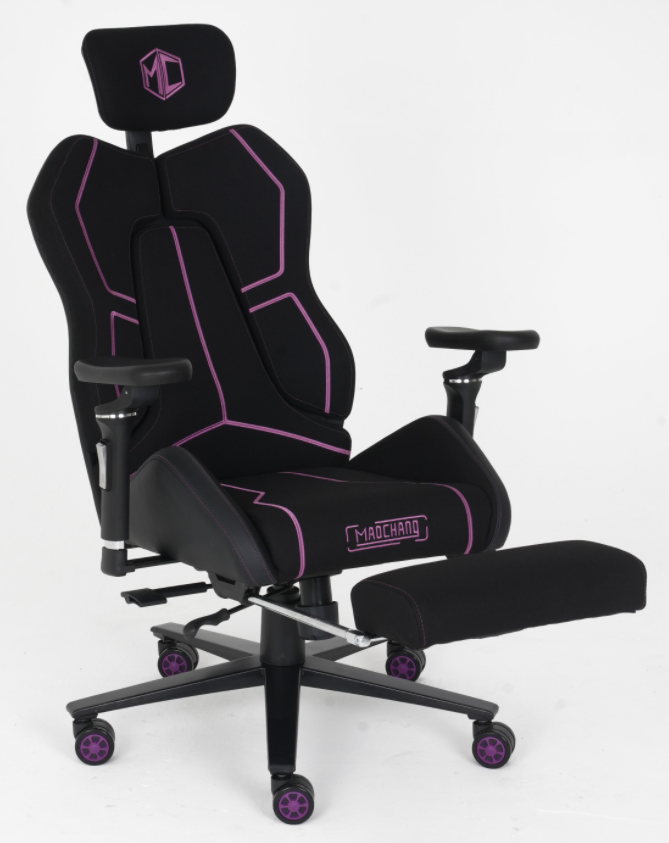
Carton size is a commercial specification
Every model discussed here ships 1 pc / 1 carton. Published carton dimensions and loading quantities are: MC196-3-1, 75×57×37 cm and 441 pcs; MC196-2-1, 75×65×34 cm and 410 pcs; MC1034, 86.5×65×36 cm and 334 pcs per 1×40'HQ; MC1039-1, 82×60×53 cm and 260 pcs; MC1040, 82×60×60 cm and 227 pcs.
The commercial effect is direct. A larger recliner that loads 227–334 units per container carries a different freight cost per chair than a compact model loading 410–441 units, even when ex-factory pricing is close. Packaging design also matters at this stage: the MC196-2-1 uses a detachable base specifically to reduce packaging size.
Load ratings and foam behavior
Weight capacity is documented at 150 kg for the MC1039 and for the MC1040, the latter also listed at 27.4 kg unit weight. The MC1039-1 is described as a big-size chair for heavier users, but no weight capacity figure appears in the available specification for that model, so a buyer who needs a documented limit should request it explicitly.
Cushion durability is a related question. High-density molded foam is generally cited in the 50–65 kg/m³ range for premium gaming chairs in third-party material guidance. Within this range, the MC1034 uses molded foam for the pillow and lumbar support, the MC1039 uses a thickened spring pack cushion described as resisting sagging, and the MC196-2-1 uses an inner spring package in the seat.
Scenario fit: internet cafe, home, office and streaming
The MC1040 is used in the internet cafe industry in China, where it operates in 24/7 seating mode in an indoor, long-hour continuous-use environment and provides gaming support. The same scenario documentation notes that the installation requires supporting equipment such as a gaming desk and a computer, and sufficient space for each seating unit.
Other models map to different settings. The MC196-3-1 lists home, office and internet cafe applications. The MC1034 is aimed at office, gaming and live streaming use. The MC1039-1 lists gaming, home, live streaming and internet cafe.
A wholesale case shows how these specifications combine in practice. A Ukrainian wholesale partner placed a first order of 460 units for office space furnishing; the cooperation has continued for two years and the chairs were well received by local office clients. Models involved in that project included the MC196-3-1, MC196-2-1, MC1025, MC196 and MC196-1 — a mix rather than a single model, which is typical when one buyer furnishes several room types.
Where these specifications sit in the wider market
Gaming chair demand continues to support specification-led purchasing. The global gaming chair market was estimated at USD 1.37 billion in 2024 and projected to reach approximately USD 2.05 billion by 2030 (Grand View Research). Estimates diverge by source — a Mordor Intelligence baseline of USD 1.65 billion for 2025 is also published — so the figure is best treated as directional rather than exact.
Other published 2024 shares are more stable as planning signals: North America accounted for 36.4% of revenue, PC gaming chairs held 52.6% of the product segment, and PU leather held 57.3% of material share. Hybrid work-and-game chairs represented 29.8% of the market, which aligns with models such as the MC196-3-1 and MC1034 that are documented for both office and gaming use.
Supply is concentrated. The Anji furniture cluster in Zhejiang, China is described as the world's leading production base for gaming chairs, contributing to China's 30.8% share of global furniture exports. Compliance expectations travel with those exports: ANSI/BIFMA X5.1 is the primary safety and durability standard for general-purpose office and gaming chairs in North America, EN 1335 covers dimensions, safety and testing for office work chairs in Europe, and BS 5852 addresses fire safety for upholstered furniture in the UK.
Trade-offs buyers should not ignore
- Discrete tilt locks are not continuous recline. A 3-position lock provides three fixed backrest angles; buyers who need an intermediate angle for a specific task should confirm the mechanism type before ordering.
- Large recliners cost more to ship per unit. The MC1039-1 and MC1040 load 260 and 227 units respectively, against 441 for the MC196-3-1. That gap is a freight decision, not a quality judgment.
- Not every component is documented on every model. Gas lift class is stated for the MC196-2-1 and MC1039, and the MC1039-1 has no published weight capacity figure.
- Full recline needs floor space. 180-degree reclining models with extended footrests require clearance that dense seating plans may not allow.
Order parameters at factory level
For planning purposes, the production parameters attached to this range are a minimum order quantity of 50 units and a lead time of 30–40 days, against a monthly capacity of 6,000 units and an annual output of 75,000 units. The factory operates OEM/ODM production with customization of logo, color, size and design.
Quality control follows a defined sequence: incoming inspection of the gas lift, mechanism, leather color and plywood thickness; a pre-production assembly of one chair using plywood only to check total chair depth and evenness; and further inspection before nailing. After-sales support includes a one-year quality warranty, free high-resolution photos, product show and assembly videos, and sale pages created for retail customers.
The full 2026 model catalogue covering the models referenced in this article can be downloaded here: https://cdn.socialarks.com/sbsp/25123/common/2026/0727/2026%20catalogue%20small%20%281%29.pdf
Future Outlook
Two shifts are likely to shape gaming chair sourcing over the coming buying cycles. The first is documentation. As hybrid work-and-game demand grows, buyers increasingly specify mechanism type, gas lift class and carton dimensions inside the RFQ itself, instead of accepting a model name and a picture. The second is container economics. When freight accounts for a meaningful share of landed cost, the difference between a 441-unit and a 227-unit loading quantity influences model selection as much as design does.
Factories able to answer component-level questions per model — rather than per catalog — will be easier to qualify in that environment.
FAQ
What does a 3-position tilt-lock mechanism do on a gaming chair?
It allows the backrest to tilt to three set angles and lock at each one. On the MC196-3-1 the mechanism is described as supporting gaming, working and relaxing modes, and the MC196-2-1 is specified with three locking tilt angles. Because it is a discrete lock, it does not offer continuous adjustment between positions, and the locked angles are limited to the three defined settings.
Which models in this range use a Class 3 gas lift?
A Class-3 gas lift is specified for the MC196-2-1 and for the MC1039, which also uses a 370 mm big-size star base. Where the lift class is not stated for a model, the class should be confirmed in writing for that exact model instead of being assumed from another chair in the same catalog. Factory incoming inspection covers the gas lift as a received component alongside the mechanism, leather color and plywood thickness.
What is the difference between 2D, 4D and 5D armrests in this range?
The 2D armrests on the MC196-3-1 move up/down and back/forth. The MC1039-1 is specified with 4D adjustable armrests and the MC196-2-1 with 5D adjustable armrests. The MC1034 and MC1039 list height-adjustable armrests. The direction of adjustment, rather than the label, is what should be written into a purchase specification.
How much recline do these models provide, and does it affect room layout?
The MC1034, MC1039-1, MC1039 and MC1040 are specified with 180-degree reclining and foldable footrests. Recline affects layout: in internet cafe installations in China, sufficient space for each seating unit is a stated requirement, and the seating position also requires supporting equipment such as a gaming desk and a computer. Buyers planning dense rows should verify clearance behind the chair when the backrest is fully reclined.
How do carton sizes affect container loading?
All models discussed here ship 1 pc / 1 carton. Published loading quantities are 441 pcs for the MC196-3-1 (75×57×37 cm carton), 410 pcs for the MC196-2-1 (75×65×34 cm), 334 pcs per 1×40'HQ for the MC1034 (86.5×65×36 cm), 260 pcs for the MC1039-1 (82×60×53 cm) and 227 pcs for the MC1040 (82×60×60 cm). Larger cartons reduce units per container and raise freight cost per chair.
What weight capacity is documented for the heavy-duty models?
The MC1039 and the MC1040 are listed at 150 kg weight capacity, and the MC1040 has a unit weight of 27.4 kg. The MC1039-1 is described as a big-size chair for heavier users, but no capacity figure is published for it in the available specification, so the value should be requested separately when a documented limit is required.
What are the minimum order quantity and lead time?
MOQ is 50 units and lead time is 30–40 days, against a monthly capacity of 6,000 units and annual output of 75,000 units. Production runs in OEM/ODM mode with customization of logo, color, size and design.
What quality checks apply to mechanisms and materials?
Incoming inspection covers the gas lift, the mechanism, the leather color and the plywood thickness. Before plywood production, one chair is assembled using plywood only to check total chair depth and evenness, and a further inspection takes place before nailing. After-sales support includes a one-year quality warranty plus free high-resolution photos and product show and assembly videos.
Are these chairs suitable for internet cafe projects specifically?
The MC1040 is used in the internet cafe industry in China in 24/7 seating mode, indoors, in a long-hour continuous-use environment where its role is to provide gaming support. Such installations require a gaming desk and a computer and enough space for each seating position. The MC196-3-1 and MC1039-1 also list internet cafe among their application industries.