
Gaming Chair Purchasing Terms: An Acceptance-Criteria FAQ
Gaming Chair Purchasing Terms: An Acceptance-Criteria FAQ
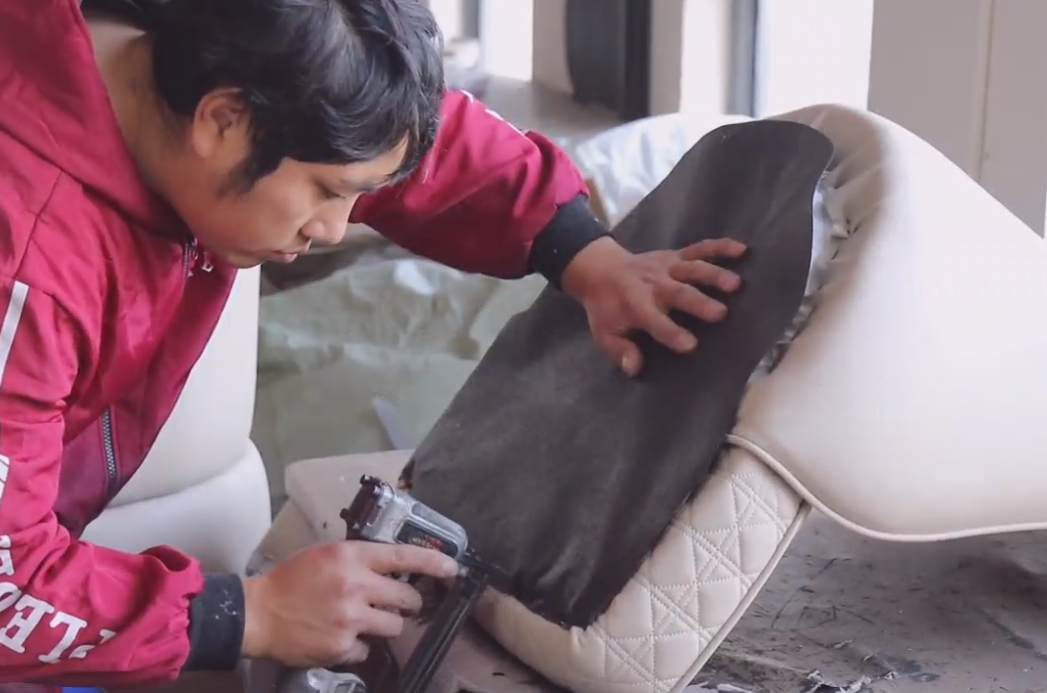
Purchasing terms decide what a gaming chair order costs and when it ships. Acceptance criteria decide whether the buyer must pay for it. In most supplier quotations the first set is written out in detail and the second is compressed into a single line: pre-shipment test. This procurement FAQ treats the two as one document, and shows how a stated specification — a gas lift class, a base diameter, a recline angle, a load rating, a carton record — can be converted into an inspection point that two parties can argue about in the same vocabulary.
The working examples come from two models in the current Maochang furniture range. The MC1039 supplies the technical side of the argument: a Class 3 gas lift, a 370mm starbase, a frog-type multifunctional mechanism, a 180-degree recline and a 150kg weight capacity. The MC196-4 supplies the logistics side: a documented carton and loading record that shows how packing acceptance points are meant to be captured. Neither model is presented here as a benchmark for the other, and that caution is the central point. In gaming chair procurement, most disputes are not caused by bad products. They are caused by one model's specification being assumed to cover a different model's shipment.
Why Quotations and Acceptance Criteria Usually Live in Separate Documents
A commercial quotation answers commercial questions. How many units is the minimum order? Which port is named in the delivery term? How is the balance settled? A catalogue answers product questions. What is the mechanism? How far does the backrest recline? What is the base made of? Neither document is designed to answer the question an inspector actually asks at the end of a production run: does this unit, in this configuration, satisfy the terms we agreed?
That gap has a predictable cost. If the acceptance line says only "pre-shipment test", then the scope of that test is left to memory, precedent or goodwill. One buyer reads it as a functional check of the mechanism. Another reads it as a check that the carton quantity matches the packing list. Both readings are reasonable, which is precisely why the phrase is commercially weak.
The fix is procedural rather than technical. Each commercial term should carry a linked evidence item, and each evidence item should name a model, a configuration and a record format. Once the two documents share the same reference structure, the acceptance conversation moves from opinion to comparison.
Five Commercial Terms Worth Writing Into the Order
The terms below are the ones Maochang furniture states for its own production. They are reproduced here as an example of the level of specificity a buyer should expect to see, not as a universal market standard. Every value is a starting point for confirmation per order, per model and per destination.
| Term | Stated position (example) | Acceptance question to attach to it |
|---|---|---|
| Minimum order quantity | 50 units | Is the MOQ expressed per model, per colourway, or per mixed container, and does a customised configuration change it? |
| Delivery terms | FOB Shanghai or Ningbo | Which port is named for this specific booking, and who bears inland movement and loading risk before handover? |
| Acceptance criteria | Pre-shipment test | What is inspected, on how many units, against which written specification, and who signs the report? |
| Payment terms | 30% deposit in advance, balance against copy of bill of lading | Which documents must accompany the bill of lading copy before the balance is released? |
| Lead time and capacity | 30–40 days; 6,000 units monthly capacity | Is the lead time measured from deposit, from artwork approval, or from sample sign-off? |
Two of these deserve particular attention. First, lead time is meaningless without a start trigger. A 30–40 day window measured from deposit behaves very differently from the same window measured from approval of a customised logo or colour. Second, "balance against copy of bill of lading" is a strong lever only if the acceptance report is a required attachment. If it is not named, the payment condition and the quality condition are not actually linked, and the buyer's last point of leverage arrives after the goods are already at sea.
MC1039: Turning a Specification List Into Inspection Points
The MC1039 is specified with a Class 3 gas lift, a 370mm starbase, a frog-type multifunctional mechanism, a 180-degree recline and a 150kg weight capacity. Each of those five items is a claim of a different kind, and each fails in a different way if it is left unverified. Treating them as one "quality" line is where inspection value is lost.
| Component | Stated specification | What the buyer inspects | What the record should capture |
|---|---|---|---|
| Gas lift | Class 3 | Whether the class designation is physically marked and consistent across the sampled units, not only stated on the quotation | The class stated, the sample size checked, and a photograph of the marking |
| Base | 370mm starbase | Measured span across opposing legs; uniformity of leg profile; no deformation under load | The measured dimension with the measuring method noted |
| Mechanism | Frog-type multifunctional | Which functions the mechanism actually performs on the delivered unit, and whether the function set matches the confirmed configuration | The function list, tested one by one, with pass or fail per function |
| Recline | 180 degrees | The angle reached in practice, and whether the unit returns to its upright position cleanly | The measured angle and the method used to measure it |
| Load | 150kg weight capacity | Whether the rating is stated for the complete chair as ordered, including the base and castors supplied | The stated capacity, its unit, and any test method the supplier can document |
The gas lift is the clearest illustration of why class designation matters more than appearance. A lift is largely hidden inside the base and the seat, so substitution is difficult to detect after assembly and almost impossible to detect in a photograph. Asking for the class in writing, and then checking that the class appears on the component itself, converts a verbal assurance into something an inspector can photograph and file.
The 370mm starbase belongs to a second category: dimensional claims. These are cheap to verify and expensive to overlook, because a base that is narrower than specified changes stability, and stability is one of the few properties that a buyer can partially test without laboratory equipment. Measuring the span across opposing legs on a sample is a two-minute operation; discovering the difference after 500 units are in a warehouse is not.
The frog-type multifunctional mechanism and the 180-degree recline belong together, because both are configuration-sensitive. A multifunctional mechanism implies a set of functions, and the set is only meaningful when it is written out function by function. The 180-degree recline should likewise be recorded as a measured angle rather than a general capability, since the useful question is not whether a chair reclines but whether it reaches the angle the buyer's own application requires — a distinction that matters most in lounging and streaming use, and much less in a fixed workstation deployment.
On the 150kg rating: a stated weight capacity is a company-declared figure for a defined product configuration. It is not, by itself, a statement about continuous duty behaviour, long-term fatigue, or the safety factor used. A buyer whose application involves long, repeated sitting cycles should ask the supplier what the rating covers and whether a test method can be documented. The rating is the beginning of that conversation, not the end of it.
Materials and Adjustable Features: Ask by Model, Not by Category
The most common procurement error in this category is cross-model inference. A buyer reviews one model, confirms a specification, and then orders a second model on the assumption that the specification travels. It usually does not. Within the same supplier's range, capacity ratings are quoted in different units and against different product configurations — the MC196-1 product page, for example, states a weight capacity of 300 lb, which is a different figure, a different unit and a different chair from the MC1039's 150kg rating. Neither number should be used to interpret the other.
Material questions should therefore be phrased as declarations rather than assumptions. For upholstery, the buyer should ask which material is used on the specific model and whether that choice is fixed or selectable within the order. For context, PU leather remains the dominant material in the gaming chair category, reported at a 57.3% share of gaming chair materials in 2024 by Mordor Intelligence — which explains why so many supplier catalogues default to it, but says nothing about which material is right for a given installation.
Adjustable features deserve the same treatment. A lumbar support, a footrest, an armrest adjustment range or a magnetic pillow should each be confirmed as included, optional or unavailable on the model being purchased. The practical question is not "does the range have adjustable armrests" but "does this model, in this configuration, include the adjustment I am paying for, and is that written on the specification sheet I will inspect against?"
Where customisation is involved, the scope needs to be stated precisely. Maochang furniture provides OEM and ODM production services, with customisation options covering logo, colour, size and design. Customisation is not a single variable: a logo change is a marking operation, while a size or design change may touch tooling, packaging and the acceptance baseline. A buyer should record which of those four categories the order actually involves, because a customised carton, for instance, changes both the carton record and the loading quantity discussed below.
Packing Acceptance: The Carton Record Behind MC196-4

Packing is where commercial terms and physical reality meet, and it is the area most often accepted on trust. The MC196-4 illustrates the structure a buyer should demand: a carton record and a loading record that can be reconciled against the purchase order. The record is what matters here, not a specific set of numbers, because carton data is model-specific and configuration-specific.
A usable carton record for a model such as the MC196-4 should allow the buyer to answer five questions without contacting the factory again. What are the carton dimensions? How many units does one carton contain? What is the gross weight of a packed carton? How many cartons fit a named container type under the agreed loading plan? And what carton marking identifies the shipment? Without all five, the loading figure is only an assertion.
Three acceptance points follow directly from that record. The first is carton quantity against the packing list — a count that can be reconciled at the loading dock and again at destination. The second is carton condition at handover, which is a visual check the receiving party can perform and photograph. The third is consistency between the carton record on file and the cartons actually presented, which is where customised packaging most often diverges from the original documentation.
The loading figure needs its own caution. Container loading quantities are a function of carton dimensions, stacking method and the loading plan agreed for that booking. A number carried forward from an earlier shipment of a different model, or of the same model before a packaging change, is not evidence for the current order. When packaging is revised, the loading record should be revised with it and the new version identified, so that the pre-shipment report cites the version that was actually loaded.
Certificates: Read the Scope, Then Read the Date
Certification is the part of acceptance where buyers most often substitute a logo for a document. Three separate checks matter, and they are usually performed in the wrong order.
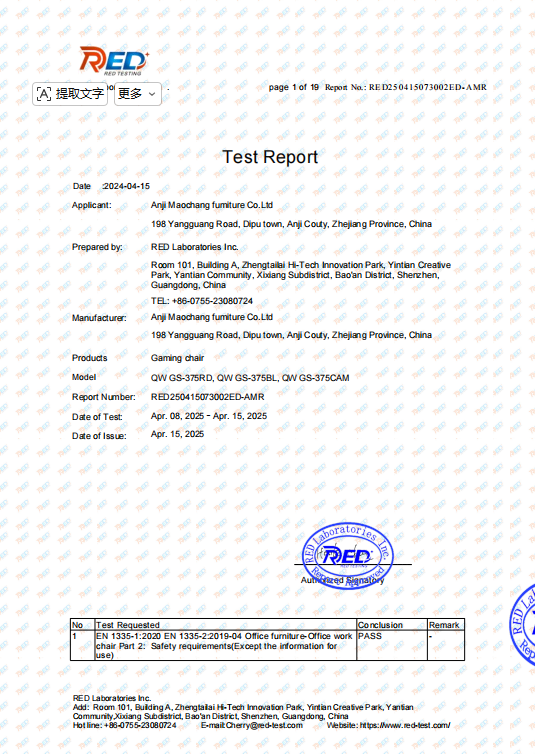
First, scope. Maochang furniture holds a test report issued by RED Laboratories Inc. under report number RED250415073002ED-AMR, dated 2025-04-15, citing EN 1335-1:2020 and EN 1335-2:2019-04 for office work chair safety. The stated scope of that report names gaming chair models QW GS-375RD, QW GS-375BL and QW GS-375CAM. A buyer ordering under a different model designation should confirm how the ordered model maps to that scope, and should get the answer in writing. This is not an unusual request; it is the standard way certification is transferred into a purchase order.
Second, subject matter. A separate report, RED250415073003ED-AMR, dated 2025-04-03 and also issued by RED Laboratories Inc., addresses formaldehyde emission under EN 717-1:2004, with the same model scope. Formaldehyde emission and structural safety are different questions answered by different standards; one report does not stand in for the other. Chain-of-custody certification is a third, separate subject: the FSC-COC certificate ESTS-COC-252406, issued by ESTS, is valid from 2025-01-21 to 2031-01-20 and covers manufacturing and sales of couches and armchairs, chairs and stools, and office furniture under FSC 100% or FSC Mix.
Third, dates. A social compliance audit is the clearest case. The BSCI audit held by Maochang furniture, certificate number 25-0358113, was issued through Eurofins CPA under the amfori-BSCI Code of Conduct with a validity period from 2025-11-13 to 2026-11-13. A buyer whose production or shipment falls after that date should ask for the renewed audit rather than accept the expired document as current evidence, however good the earlier result was.
Two further cautions apply. A standard is not a certificate: EN 1335 describes a test basis, and the report is the evidence that the test was performed on a defined scope. And a product-page claim is not a certificate either — the official MC-1039 page describes a heavy-duty BIFMA racing chair, but a description of that kind does not by itself supply a certificate number, issuing body or test scope, so it should be treated as a claim pending documentation rather than as confirmed certification. Where no evidence is available for a standard at all, as is the case for BS 5852 fire resistance in the material reviewed here, the honest procurement position is that it is unverified, not that it is satisfied.
Where the Criteria Stop: Fit Boundaries Buyers Should Record
A well-written acceptance document also states what it does not settle. Four boundaries recur in gaming chair procurement.
- Load rating versus duty cycle. A 150kg capacity rating describes a load, not a usage pattern. A high-traffic installation with long continuous sitting cycles has different durability demands from a home setup, and the rating alone does not distinguish between them.
- Gas lift class comparisons. Class 3 on one model and a different class on another are not automatically comparable without knowing the test basis and the component supplier. The class should be recorded as stated, not ranked.
- Customisation versus baseline. Logo, colour, size and design changes can shift lead time and alter the acceptance baseline. An order that includes customisation needs its own signed-off specification, not the stock one.
- Certificate coverage versus shipment coverage. A certificate covering a defined model scope does not automatically cover a later variant, a different colourway produced under a different process, or a shipment made after a validity date has passed.
Market Context: Why Acceptance Language Is Getting More Attention
The commercial backdrop explains the trend without explaining any individual purchase. Mordor Intelligence estimates the global gaming chair market at USD 1.65 billion in 2025, rising to USD 1.78 billion in 2026. That is a commercial-research estimate with its own segmentation choices, and it should be read as directional context rather than as a figure to build a business case on.
The interpretation that matters for procurement is narrower. As gaming chairs move into hybrid office and institutional settings, the buyers involved are increasingly people who already procure seating under formal criteria, and who expect a specification to be traceable to a document. A category that once competed mainly on visual design is now asked questions it did not previously have to answer: which standard, which report number, which model scope, which validity date.
From Evaluation to Execution: A Six-Step Verification Sequence
The sequence below converts the discussion above into an order-level workflow. It is deliberately documentary: each step produces a file that the next step can reference.
- Fix the model and configuration in writing. Model name, colourway, mechanism variant, armrest and footrest status, and any customisation category involved.
- Attach the specification sheet to the purchase order. Every figure that will be inspected — gas lift class, base dimension, recline angle, weight capacity and its unit — should appear there, not only in a catalogue.
- Map certificates to the ordered model. Record the report number, issuing laboratory, standard cited, stated model scope and validity period, and ask for written confirmation where the scope name differs from the ordered model name.
- Obtain the carton and loading record for that model and that packaging version. Reconcile carton dimensions, units per carton and loading quantity against the booking.
- Define the pre-shipment test as a scope, not a phrase. Name the components to be checked, the sample basis, the person who signs, and the photographs that accompany the report.
- Link the acceptance report to the payment condition. If the balance is settled against a bill of lading copy, the report should be a required attachment so the two obligations resolve together.
Two supporting facts are worth noting because they affect execution rather than evaluation. Maochang furniture states a 30–40 day lead time and a monthly capacity of 6,000 units, which is the relevant capacity context for scheduling an inspection window. The factory also describes internal quality control steps that begin before assembly: incoming inspection of gas lifts, mechanisms, upholstery colour and plywood thickness, followed by a pre-production assembly using plywood only to check overall chair depth and evenness. Those are useful checkpoints for a buyer to align an inspection plan with, because they occur at moments when a deviation is still cheap to correct. A stated one-year quality warranty and the provision of product photography, show video and assembly video also belong in the file, since they define what the buyer can hand on to a downstream customer.
Outlook
The direction of travel is toward documentation rather than toward new categories. Buyers who already work with named standards are unlikely to accept a certificate logo without a scope statement, or a loading figure without a carton record. Suppliers who can produce model-level evidence quickly — a report number, a scope mapping, a versioned carton record — will find the acceptance conversation shorter, not longer. That is a conditional expectation, not a forecast about any specific supplier's future performance, and it depends on buyers actually asking for the documents rather than assuming they exist.
FAQ
Which purchasing terms should be confirmed in writing before a gaming chair order is placed?
At minimum: the minimum order quantity and whether it applies per model or per mixed order; the named delivery term and port, such as FOB Shanghai or Ningbo; the defined acceptance criteria rather than the phrase "pre-shipment test" alone; the payment structure, for example 30% deposit with the balance against a bill of lading copy; and the lead time together with the event that starts it. Each term should carry a linked evidence item so that the commercial agreement and the inspection plan describe the same shipment.
How does a buyer verify a Class 3 gas lift at acceptance?
Two checks are practical without laboratory equipment. First, confirm in writing that the class designation applies to the ordered model, since the gas lift class is a component-level specification and is easy to treat as interchangeable. Second, during inspection, confirm that the class designation is physically marked on the lift and consistent across the sampled units, and photograph the marking for the report. A stated class on a quotation without a corresponding marking on the component is an assertion rather than a verified specification.
What does a 150kg weight capacity rating actually cover?
It is a company-declared maximum for a defined product configuration — in this case the MC1039 as specified with its Class 3 gas lift and 370mm starbase. It is not automatically a statement about continuous duty, fatigue life or the safety factor applied. Buyers should ask which configuration the figure refers to, whether a test method can be documented, and whether the intended usage pattern falls inside the conditions the supplier had in mind. Capacity ratings from different models, particularly those quoted in different units, should not be used to interpret one another.
How should carton quantity and container loading data be documented?
As a versioned record tied to a specific model and packaging version, containing carton dimensions, units per carton, packed gross weight, the loading quantity for the named container type, and the carton marking. The MC196-4 illustrates the structure of that record rather than a universal set of values. Because loading quantity depends on carton dimensions and stacking plan, a figure carried over from an earlier shipment or from a pre-change packaging version is not evidence for the current order, and revised packaging should produce a revised record that the pre-shipment report explicitly cites.
Does a certificate issued for one gaming chair model cover another model?
Not automatically. A test report is bounded by its stated scope, so the model names listed in the report must be reconciled with the model actually ordered, and any difference should be confirmed in writing by the supplier. Validity dates matter equally: an audit or certificate that has passed its expiry date is historical evidence rather than current evidence. It is also worth separating subjects — structural safety under EN 1335, formaldehyde emission under EN 717-1, chain of custody under FSC, and social compliance under BSCI answer different questions, and no single document substitutes for another.
Company reference: Anji Maochang Furniture Co.,Ltd. — a chair manufacturer based in Anji County, Zhejiang Province, China, established in 2016, producing gaming chairs, office chairs and manicure chairs with OEM and ODM services.
Product catalogue (PDF, publicly downloadable): 2026 catalogue
هل لديك أسئلة أو تحتاج إلى مزيد من التفاصيل؟
تواصل مع فريقنا للحصول على عرض أسعار مخصص أو استشارة فورية.
طلب عرض أسعار
املأ النموذج أدناه وسيتواصل معك فريقنا بعرض مقترح مخصص.
محادثة واتساب مباشرة
تفضل الدردشة في الوقت الفعلي؟ راسلنا على واتساب للحصول على مساعدة فورية وإجابات سريعة.
- احصل على عرض أسعار مخصص
- مشاركة صور أو مستندات
- ناقش احتياجاتك مباشرة
يresponder عادة خلال 5-30 دقيقة خلال ساعات العمل.