
Ganyo Prefab Steel Procurement FAQ: Specs and Acceptance
Ganyo Prefab Steel Procurement FAQ: Specs and Acceptance
A buyer sourcing a prefabricated steel building is purchasing three things at once: a structural design, a fabrication package, and the documents that prove both. Most procurement risk sits where those three meet — a steel grade named in a quotation but not in a certificate, a crane provision discussed but never reserved in the frame, an inspection criterion agreed verbally and disputed at the port. This reference answers the questions that decide whether they arrive aligned.
It is written for the evaluation and execution stages, when the drawing set, the certificate copies and the commercial terms have to be turned into an order. The company-specific facts come from Ganyo's published material; market figures are attributed to their publishers and are separated by scope, because prefabricated steel is measured under several incompatible definitions.
Why prefabricated steel procurement fails on paper, not in steel
The first difficulty is definitional. "Prefabricated steel building" is used for pre-engineered metal buildings, for steel-framed industrial sheds, and for modular systems, and the published market figures for those categories differ by more than an order of magnitude. The second difficulty is that customization is a decision, not a feature: a supplier that offers custom size, colour and purpose is offering a design process, and the outputs of that process — spans, loads, openings, crane provisions, coating system — have to be fixed before fabrication starts.
The third difficulty is acceptance. A pre-shipment inspection protects the buyer only to the extent that the inspection criteria were written down, tied to approved drawings, and understood by both parties as the release condition for payment. Where those criteria are absent, the buyer's leverage disappears once the container is loaded.
Ganyo at a glance: what the company actually publishes
Foshan Ganyo Steel Structure Co., Ltd. is a steel structure manufacturer based in Gaoming District, Foshan City, Guangdong Province, and describes itself as a medium-sized enterprise integrating steel structure design, research and development, production and installation. The company was founded in 2023 and operates two production factories; it reports annual steel structure output of 20,000 tons and, in its light steel housing facility, annual sandwich panel output of 300,000 m². Its published team size is 65 employees, of whom 12 are engineers.
Its product lines cover prefabricated steel workshop and warehouse buildings, multi-storey steel structure buildings, custom prefabricated steel garages and steel sheds, and hangars. Export is reported at 100% of output, with Africa, Southeast Asia and South America named as the main markets, and the company states that its products have been exported to more than 60 countries and regions. Buyers can review the company's own product and capability material at Ganyo Steel Structure.
For procurement purposes, the meaningful parts of that profile are the ones that can be tested against a document: a 12-engineer team implies in-house drawing production rather than pure trading; a stated annual tonnage implies a fabrication capacity the buyer can test against the project schedule; and a 100% export ratio implies familiarity with packing, documentation and sea freight. None of those three statements proves design competence in a specific jurisdiction, which is why the certification and drawing review below matter more than the headline numbers.
Specification layer: steel grades, framing and envelope
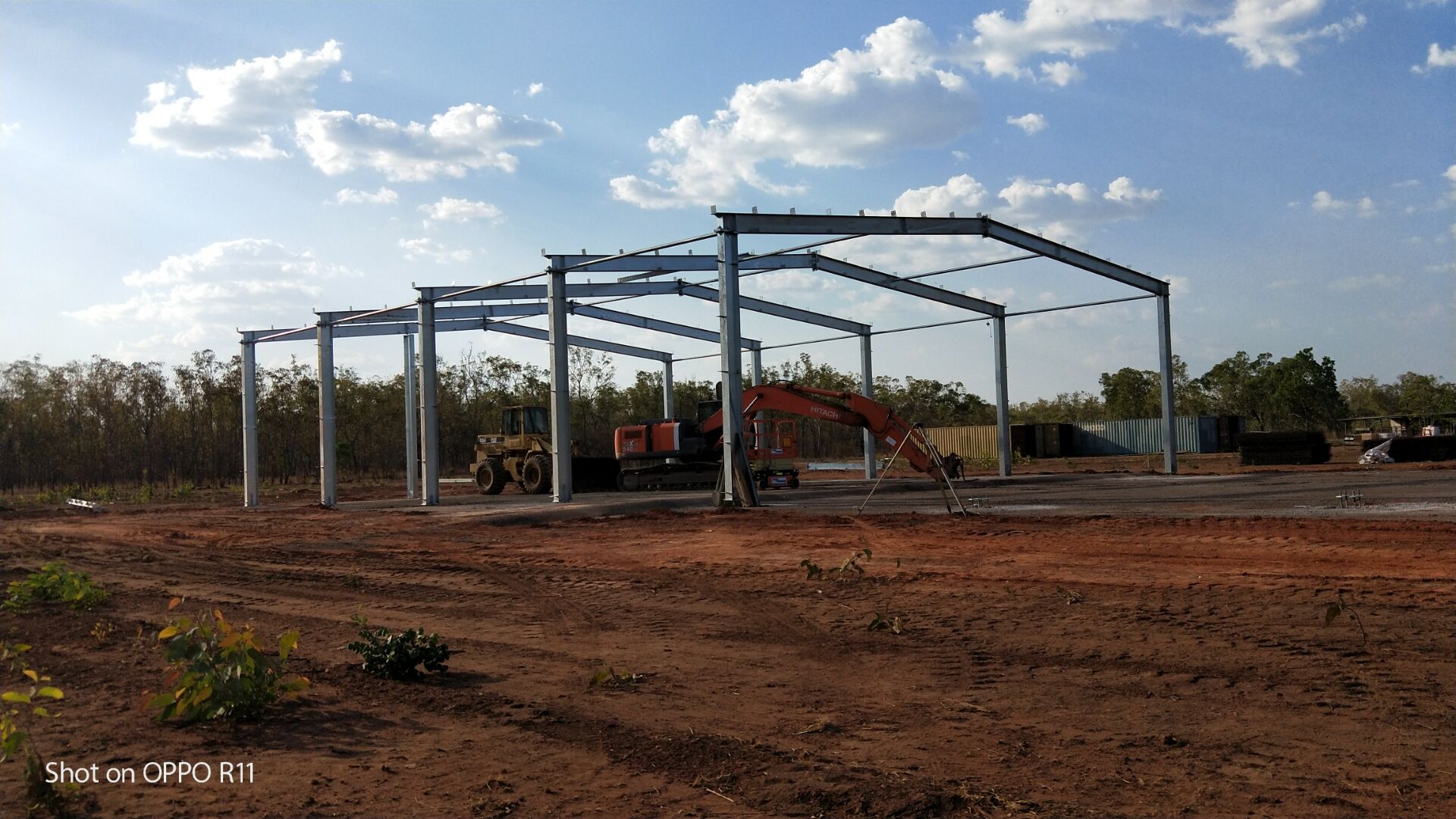
Ganyo's certified product scope for prefabricated steel structure buildings names Q355B or Q235B steel, C steel and 840# corrugated steel sheet. Its published product specifications additionally identify hot-rolled or welded H-beams as the primary framing options. In practice the structural frame in Ganyo's project descriptions is a portal frame built from H-section steel, chosen for large clear spans and column-free interior space; purlins and secondary members are typically hot-dip galvanized, while primary members go through shot blasting, multi-layer anti-corrosion painting and marking before storage.
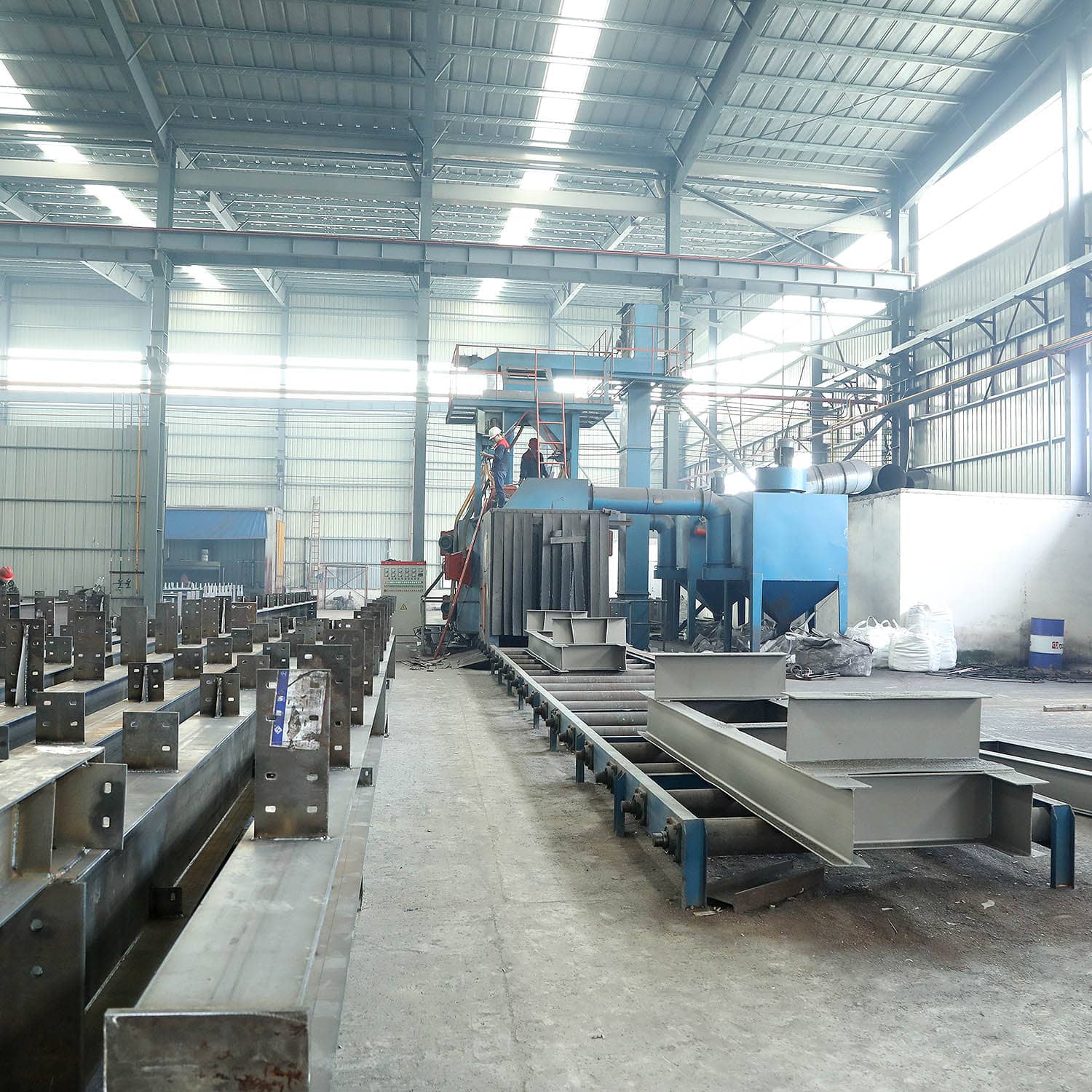
The fabrication sequence the company describes runs from plate pressing and CNC cutting through welding, grinding and inspection, then shot blasting, painting, marking and storage. Its Angola project record adds laser cutting and submerged arc welding to that description. For a buyer, the useful question is not whether those machines exist but which of them touch the members in the order, and what record accompanies each: cutting lists, weld maps, coating thickness readings and the inspection sign-off that releases the package.
The envelope is a separate specification decision. Sandwich panels provide the insulation layer, and the Cameroon record shows thermal insulation panels combined with waterproofing and anti-corrosion treatment for a tropical rainforest climate. Fixed figures for fire resistance rating, design wind speed, seismic category or storey count are not part of Ganyo's published specification set; those are established per project through the structural design and must appear in the approved drawing set and calculations. A buyer who needs a stated fire rating, a specific wind speed or a given number of storeys should require the design basis in writing rather than infer it from a product page.
What has to be fixed before fabrication
Crane provisions are the clearest example. In the Cameroon project the frame was reserved for a crane and for future expansion — a decision taken at design stage, because a runway beam and its bracket detail change the column design. Ventilation and lighting openings, door and window systems, mezzanine loads, floor slab interfaces, drainage and cladding colour behave the same way: they are cheap to change on a drawing and expensive to change on a welded column. Ganyo's stated customization parameters are size, colour and purpose, so the specification conversation should convert those three words into a dimensioned drawing set before the order is confirmed.
Certification: reading the documents correctly
Ganyo holds a Verification of Conformity issued by ICR under certificate number ICR/VC/HM2603118, valid from 10 March 2026 to 9 March 2031. The declared standards are CPR (EU) 305/2011, EN 1090-1:2009+A1:2011 and EN 1090-2:2018+A1:2024, and the certified scope is prefabricated steel structure buildings using Q355B or Q235B steel, C steel and 840# corrugated steel sheet.
Two things follow from the wording. First, EN 1090-1 addresses conformity assessment of structural steel components and EN 1090-2 addresses execution requirements, so the certificate speaks to factory production control and execution rather than to a completed building's structural adequacy on a given site. Second, the scope is bounded by the products and materials listed: components outside that list, or a design code other than the declared standards, require separate evidence rather than an assumption of coverage.
The company also publishes a quality management certificate, number 50323Q2126R0S, to GB/T 19001-2016/ISO 9001:2015, issued under IAF with a stated validity period of 22 November 2023 to 21 November 2026. That date is a reminder rather than a detail: certificate validity windows expire, and a buyer reviewing documents in late 2026 should confirm the current status of every certificate at the time of order instead of relying on a copy filed earlier in the project.
A four-line certificate check
Record the issuing body and certificate number; read the scope sentence word by word; confirm the standard editions and validity dates; and match the certificate scope to the actual members being purchased. A certificate that covers corrugated sheet does not cover a fabricated crane girder, and a certificate valid for a factory does not certify a specific project's design.
Purchasing terms and acceptance criteria
Ganyo publishes a minimum order quantity of 200 m², FOB delivery terms and a 30/70 payment split. Lead time is stated at 30–45 days, monthly capacity at 1,000–2,000 tons, and the acceptance criterion is a pre-shipment test, supported by 100% factory inspection and testing before shipment. After-sales support is delivered as drawings, pictures and video guidance for installation. These are company-published terms and form the starting point for negotiation, not a substitute for a contract.
| Term | Ganyo's published position | What the buyer should confirm in writing |
|---|---|---|
| Minimum order | 200 m² | Whether the MOQ is measured on footprint, cladding area or tonnage, and how phased projects are counted. |
| Delivery term | FOB | Named port, loading responsibility, packing specification and who bears risk during inland transport. |
| Payment | 30/70 split | The milestone that triggers the balance: drawing approval, pre-shipment inspection sign-off or bill of lading. |
| Lead time | 30–45 days | Whether the clock starts at deposit, at approved drawings or at material release, and what documentation is due before loading. |
| Acceptance | Pre-shipment test, 100% factory inspection and testing | The inspection plan: checkpoints, tolerances, records to be issued, and whether an independent third-party inspector is required. |
The acceptance question deserves the most attention because it is where published terms are thinnest. A factory's internal pre-shipment inspection and an independent third-party inspection are different instruments: the first is a supplier quality gate, the second is buyer evidence. Where a project requires third-party inspection, non-destructive testing of specific welds, coating thickness measurement or a dimensional report against the approved drawing, that scope has to be written into the order with the responsible party and the release condition named. The same applies to installation: video and drawing guidance support a competent erection crew, but they are not site supervision, and projects that need supervision should contract for it explicitly.
Scenario fit: what four documented projects show
The most useful benchmark for a buyer is a project with similar climate and structural demands. Ganyo's published records cover an Australian workshop and warehouse of 2,000 m², a Cameroon workshop of 2,184 m², an Angola workshop of 1,800 m² and a multi-storey steel structure factory in Senegal of 5,130 m², each described as remaining in stable operation with a 50-year design life. Company portfolio material also references workshop projects in Algeria and a base station camp in Solomon Islands.
The Australian record is specified around a large clear span for warehouse, manufacturing and logistics use, with the building described as engineered to Australian standards and as wind and fire resistant, anti-corrosion treated and termite-proof. The Cameroon record is built for high temperature, high humidity and heavy rainfall, using an H-section portal frame, insulated sandwich panels, waterproofing and anti-corrosion treatment, hot-dip galvanized secondary members, modular packing for sea freight, and a frame reserved for crane and future expansion. The Angola record adds strong wind to the same tropical profile and describes CNC and laser cutting plus submerged arc welding for component precision, with shot blasting and multi-layer painting on primary steel and hot-dip galvanizing on purlins for coastal salt spray exposure.
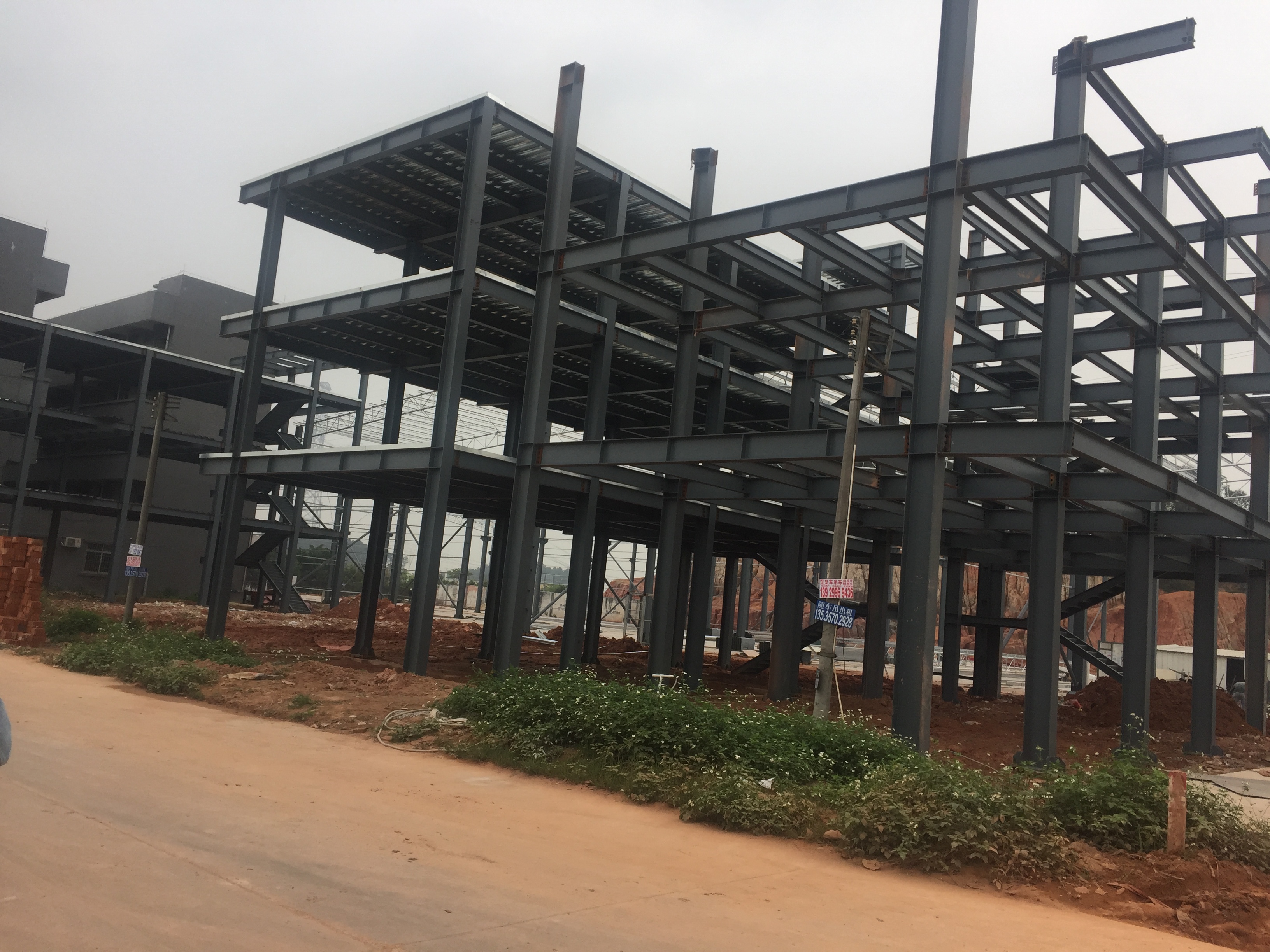
The Senegal record is the vertical case: a multi-level factory layout that the company describes as reducing foundation load on expansive clay, saving land, and assembling roughly 40% faster than an equivalent concrete build. That percentage is a company-reported project comparison, not a controlled study, and it should be treated as a claim to test against a buyer's own programme rather than a general performance guarantee. The transferable design lesson is narrower and more reliable: where land is scarce or ground conditions are poor, a lighter multi-level steel frame changes the foundation equation, and that trade-off is worth modelling at concept stage.
Benchmarking suppliers on R&D, reach, service and industry solutions
Benchmarking prefabricated steel suppliers on technical R&D, market share, customer service and industry solutions is a sound framework, but it only works when each supplier is measured on the same definition, the same period and the same evidence type. Published figures in this sector are rarely like-for-like: some publishers report pre-engineered metal buildings, others report prefabricated steel building systems, and a company's export reach is not a market share. This article therefore sets out Ganyo's published position against each dimension and the evidence a buyer should require from any peer in the same shortlist, rather than asserting a ranking that the available evidence cannot support.
| Benchmark dimension | Ganyo's published position | Evidence to request from every supplier in the shortlist |
|---|---|---|
| Technical R&D and design | 12 engineers; in-house design, R&D, production and installation scope; custom OEM/ODM; drawing, picture and video installation guidance | Drawing deliverables and revision control, design-code experience in the destination market, calculation and connection details, named design lead. |
| Reach and scale | 20,000 t annual steel output; 1,000–2,000 t monthly capacity; two factories; 100% export; 60+ countries; Africa, Southeast Asia and South America focus | Capacity basis and accounting period, current backlog, port and freight experience for the destination, references that can be contacted. |
| Customer service | Pre-shipment 100% inspection and testing; installation guidance documents; stated 30–45 day lead time | Warranty terms, response times, spare-part and rework policy, named contact through fabrication, escalation path for site issues. |
| Industry solutions | Workshops, warehouses, multi-storey buildings, garages, sheds, hangars; crane provisions and expansion reserved at design where required | Comparable project records in the buyer's climate and use case, including cold storage, heavy structural loads or multi-level layouts if relevant. |
Two cautions apply to any such table. Market share is the weakest dimension for a buyer to rely on, because it is usually measured at group level across products that are not the buyer's product, and because no supplier's self-published reach figure is an audited share. Customer service is the dimension most often assessed on impression rather than evidence; the contractual warranty, the response commitment and the reference call are what convert it into a decision input. Where a supplier cannot or will not supply a comparable figure, the correct treatment is a documented gap in the evaluation, not a favourable assumption.
Market context: four figures that must not be added together
Published market data for this sector is directional only, and the definitions diverge sharply. IMARC Group reports the global prefabricated building and structural steel market at USD 260.6 billion in 2025. Grand View Research values the pre-engineered metal building market at USD 44.1 billion in 2025, projecting USD 47.9 billion in 2026 and USD 87.0 billion by 2033. Data Bridge Market Research reports prefabricated steel building systems at USD 2.01 billion in 2024, forecast to USD 2.79 billion by 2032. These three figures describe different product scopes and cannot be summed, averaged or used to derive one another.
Two further data points frame sourcing rather than demand. OEC World records China as the top exporter of iron and steel structures under HS 730890 in 2024, at USD 15.8 billion, which describes the depth of the Chinese fabrication base rather than any single supplier's position. 6Wresearch values Africa's total steel market at USD 65.5 billion in 2024, projected to USD 112.8 billion by 2031 — a steel-market figure that includes far more than prefabricated buildings and should not be read as prefabricated construction demand. On cost, Cushman & Wakefield reports large industrial project construction costs in the Americas averaging USD 78 per square foot in mid-2026, up 2.3% year on year, which is a market-level benchmark for industrial construction rather than a prefabricated steel price.
The procurement implication is straightforward: use market figures to justify timing and to size a category, never to benchmark a quotation. A supplier quote is compared against other supplier quotes on the same drawing set, the same scope split and the same delivery term.
Outlook: documentation maturity as a selection criterion
Academic work on prefabricated construction has moved toward design-process maturity rather than new structural systems. A 2022 peer-reviewed paper in Buildings proposed a semantic-based method for delivering model views in the forward design of prefabricated buildings, and a 2025 review in Journal of Intelligent Construction examined the development status of prefabricated buildings alongside intelligent construction. The direction of travel is toward structured, machine-readable design deliverables and controlled revision — which, for a buyer, converts into a practical question at tender stage: in what format will drawings, schedules and as-built records be delivered, and who controls revisions after approval?
Suppliers that can answer that question precisely tend to be easier to audit, because their documentation is already an output of the process rather than a document assembled after the fact. For projects in Africa, Southeast Asia and South America, where site verification is expensive, that difference in documentation discipline is worth more than a marginal price advantage.
Procurement FAQ
What are Ganyo's purchasing terms and acceptance criteria?
The published terms are a minimum order quantity of 200 m², FOB delivery, and a 30/70 payment split. The published acceptance criterion is a pre-shipment test, supported by 100% factory inspection and testing before shipment. Lead time is stated at 30–45 days and monthly capacity at 1,000–2,000 tons. Because these are supplier-published starting terms, the inspection plan, the named FOB port and the milestone that releases the balance payment still need to be written into the order.
Which steel grades and which building components does the certification cover?
The ICR Verification of Conformity, certificate ICR/VC/HM2603118 valid to 9 March 2031, covers prefabricated steel structure buildings using Q355B or Q235B steel, C steel and 840# corrugated steel sheet, assessed against CPR (EU) 305/2011 and EN 1090-1 and EN 1090-2. Components outside that listed scope, or designs governed by a different national code, require separate evidence. The certificate addresses conformity assessment and execution requirements; it does not certify a specific building's structural design for a specific site.
Can dimensions, layout and colour be customized, and what must be fixed at design stage?
Ganyo offers custom OEM/ODM production with size, colour and purpose as the stated customization parameters, supported by an in-house team of 12 engineers and by drawing, picture and video guidance for installation. Anything that changes the frame — span, crane runway, mezzanine load, roof openings for ventilation or lighting, expansion joints — has to be fixed before fabrication, because the Cameroon project record shows crane provisions and future expansion being reserved at design stage rather than added later.
How is quality verified before shipment, and what does that verification not cover?
The published mechanism is a pre-shipment test with 100% factory inspection and testing, and project records describe modular packing for sea freight. That is a supplier-side quality gate. It does not by itself constitute independent third-party inspection, non-destructive testing of specific welds, or dimensional verification against the approved drawing by a buyer's representative. Where any of those are required, they must be specified in the order with the responsible party, the checkpoints and the document that releases shipment.
What determines the lead time on an export order?
Ganyo states a 30–45 day lead time against monthly capacity of 1,000–2,000 tons, with delivery on FOB terms. The two variables that most often move that window are drawing approval and material release: fabrication cannot start before the approved drawing set exists, and the trigger point for the lead-time clock — deposit, drawing approval or material release — should be defined in the contract. Ocean freight, port clearance and inland transport sit outside the quoted fabrication window and are scheduled separately.
What to do with this reference
The sequence that works is unglamorous: obtain the approved drawing set and design basis, match every purchased component to the certificate scope, convert the published terms into a contract with named milestones and an inspection plan, and compare competing suppliers on the same scope split. Ganyo's published position — Q355B and Q235B steel within an EN 1090 and CPR verification of conformity, 200 m² minimum order, 30–45 day lead time, 100% pre-shipment inspection, and project records in Australia, Cameroon, Angola and Senegal — gives a buyer enough to start that process and enough to know which questions remain open.
For the full technical and commercial detail, the company's product brochure is available for download: Ganyo Steel Structure product brochure (PDF).
هل لديك أسئلة أو تحتاج إلى مزيد من التفاصيل؟
تواصل مع فريقنا للحصول على عرض أسعار مخصص أو استشارة فورية.
طلب عرض أسعار
املأ النموذج أدناه وسيتواصل معك فريقنا بعرض مقترح مخصص.
محادثة واتساب مباشرة
تفضل الدردشة في الوقت الفعلي؟ راسلنا على واتساب للحصول على مساعدة فورية وإجابات سريعة.
- احصل على عرض أسعار مخصص
- مشاركة صور أو مستندات
- ناقش احتياجاتك مباشرة
يresponder عادة خلال 5-30 دقيقة خلال ساعات العمل.