
Garment Steamer OEM Supplier Capability: Huaguang's Certification Trail from GS to ETL
Garment steamer OEM capability is usually presented as a catalogue claim. It is better tested against model-level documents. Zhejiang Huaguang Electric Appliance Group Co., Ltd., a manufacturer at Zhouxiang Industry Development Zone, Cixi, Zhejiang, China, appears as the named manufacturer in EU RoHS and PAHs documentation and as the issuer of an EU Declaration of Conformity. The same file set includes a SGS Fimko GS certificate, a Bureau Veritas RoHS report, an Intertek EMC verification and an Intertek ETL authorization. The record is useful because it is specific. It is also limited, because several areas that buyers care about are not documented in the file set reviewed here.
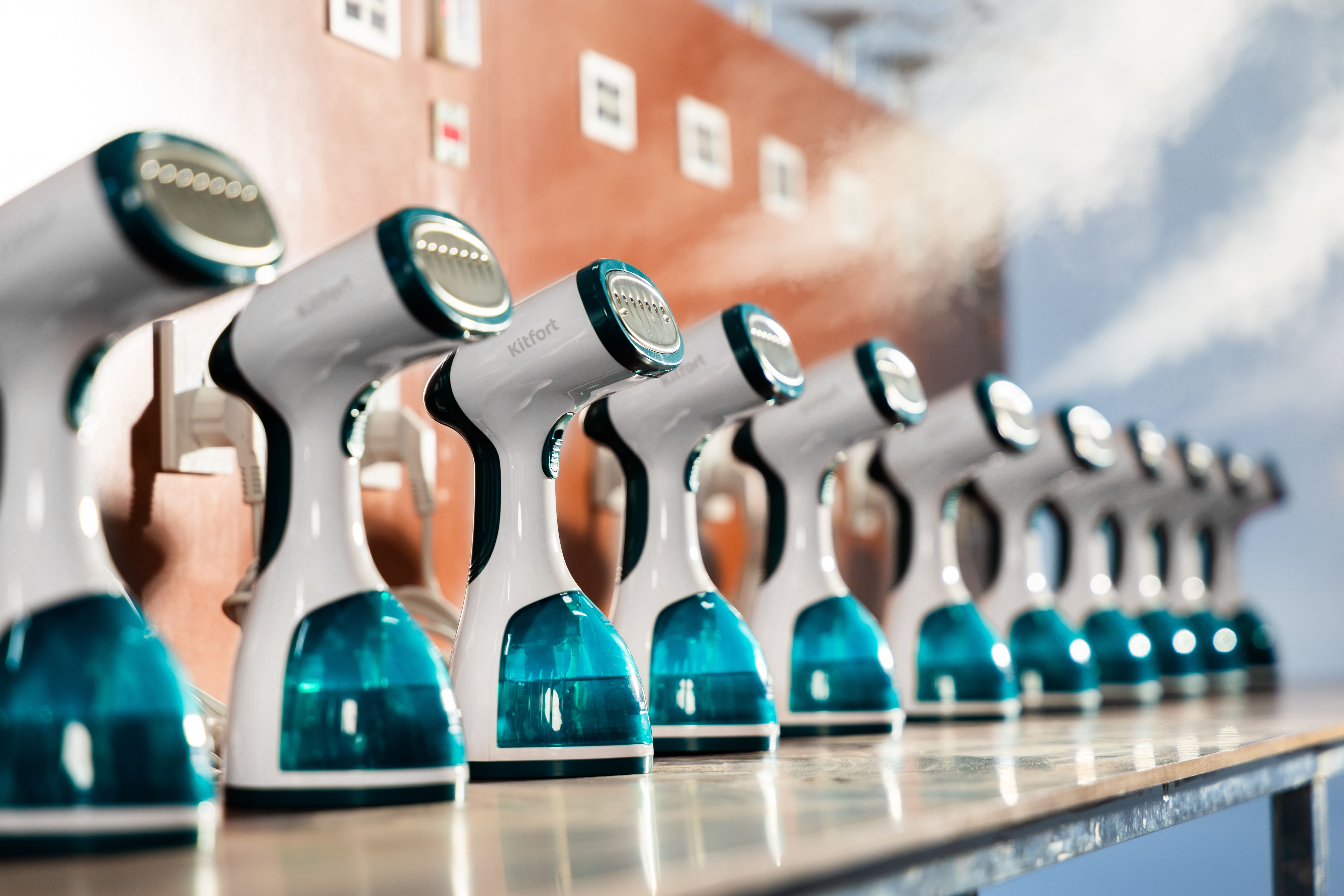
Cover image: a garment steamer test room. Facility images support capability context but do not replace model-level test reports.
Why a certification trail matters in garment steamer OEM evaluation
OEM buyers face an asymmetry when they evaluate a garment steamer supplier. A supplier can send a certificate quickly. The buyer must then decide whether that certificate covers the exact model, voltage version, plug configuration, destination market and production configuration. A document that is real but out of scope can create more risk than a missing document, because it looks like evidence.
The useful question is not whether a supplier has a certificate. The useful question is which document covers which model, who issued it, what it actually tests, and what it leaves outside its scope. This is the difference between a compliance claim and a procurement control.
Huaguang's file set is a practical case for that distinction. It contains several document types from different bodies, with different model lists, different standards and different dates. The trail can be mapped. It can also be read too generously if the model scope is ignored.
The named entity behind the documents
Zhejiang Huaguang Electric Appliance Group Co., Ltd. is a manufacturer of steam appliances founded in 1985. The company reports a 38,600 m² factory, 450 employees, annual output of more than 5,000,000 units, a research and development team of more than 100 people and exports to the EU, USA, Japan, Korea, the Middle East and Africa. It describes itself as an OEM/ODM manufacturer for garment-care appliances, including handheld garment steamers, standing garment steamers, steam irons, lint removers, steam cleaners, steam mops and coffee machines.
The entity evidence in the compliance documents is consistent with that identity. The PAHs report names Zhejiang Huaguang Electric Appliance Group Co., Ltd. at Zhouxiang Industry Development Zone, Cixi, Zhejiang, China. The Bureau Veritas RoHS report names the same company at Zhouxiang Industry Development Zone, Cixi City, Zhejiang, P.R. China. The EU Declaration of Conformity is issued by the company itself, while testing is attributed to Intertek Testing Services Zhejiang Ltd. That is a meaningful distinction: the manufacturer is not only presenting third-party certificates; it is also taking the formal role of the party that declares conformity.
The company reports OEM/ODM customization of color, voltage, plug type, packaging design and language, and brand identity. It lists a monthly capacity of 400,000 units, an MOQ of 1,000 units and a lead time of 30–45 days. These are company-reported commercial terms. They help a buyer plan a program. They do not prove that a custom voltage or plug version has been tested.
Mapping the file: from GS to ETL
The phrase 'from GS to ETL' is used here as a review sequence, not as a chronological claim. The ETL authorization in the file set was issued in 2022, before the 2023 GS certificate. More importantly, the ETL document covers steam mops, not garment steamers. That distinction is central to a fair reading of the evidence.
| Document | Issuer | Identifier | Model / product scope | Market | Date / status |
|---|---|---|---|---|---|
| GS certificate | SGS Fimko Ltd | GS/23/HEL/01592 | Fabric Steamer (Steam Brush) / Dampfbürtse; E15, E15E, E16; 220–240 V, 50/60 Hz, 1800 W, Class 1 | EU | Issued 2023-09-25; expires 2027-12-22 |
| PAHs report | SGS-CSTC Standards Technical Services Co., Ltd. Ningbo Branch | NBES220900480202-M1/PAH | Fabric Steamer (Brush Steamer); E15, E15E, E16 | EU | Issued 2023-09-25; compliant with AfPS GS 2019:01 PAK |
| RoHS report | Bureau Veritas | (6626)019-0319 | Fabric Steamer; E22; 2011/65/EU and (EU) 2015/863 | EU | Issued 2026-03-02; PASS |
| EMC verification | Intertek Testing Services Zhejiang Ltd. | 260100396HAN-V1 | Steam Brush (Fabric Steamer); E1Q, EQ10K80, EZ2 | EU | Issued 2026-03-09 |
| EU Declaration of Conformity | Issued by Zhejiang Huaguang Electric Appliance Group Co., Ltd.; testing by Intertek Testing Services Zhejiang Ltd. | LVD-260100395HZ-V1; EMC-260100396HAN-V1 | Steam Brush / Fabric Steamer; E15, E15E, E16, E1Q, EQ10K80, EZ2 | EU | Issued 2026-07-17 |
| ETL authorization | Intertek | 4000776 | Electric Heating Appliances; Steam Mop; MA1-4, MA3-0, MB2-0, MB2-4, M0, MSPRO; brands H3, TOPPIN | US, Canada | Issued 2022-07-15 |
The table shows why a single sentence such as 'Huaguang is certified for Europe and North America' would be too broad. The GS, PAHs, RoHS, EMC and DoC documents do not all name the same models. The ETL document does not cover the same product category. The file has to be read model by model.
What each document type actually proves
The GS certificate GS/23/HEL/01592 was issued by SGS Fimko Ltd on 2023-09-25 and expires on 2027-12-22. It covers Fabric Steamer (Steam Brush) / Dampfbürtse types E15, E15E and E16, rated 220–240 V, 50/60 Hz, 1800 W, Class 1. The cited standards include EN 60335-2-45:2002 + A1:2008 + A11:2012 + A2:2020, EN 60335-1:2012 + A11:2014 + A13:2017 + A1:2019 + A14:2019 + A2:2020, AFPS GS 2019:01 PAK, EK1 527-12 Rev. 2 and EK1 649-19. This is a safety-related certification with a defined model scope and a visible validity period.
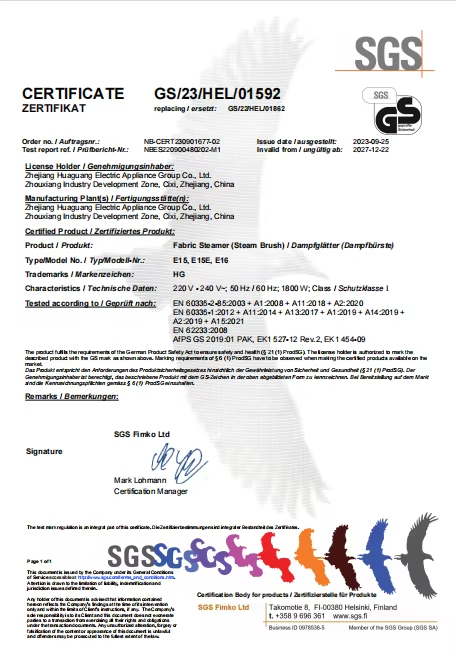
The GS certificate names E15, E15E and E16 and has a validity date of 2027-12-22. It does not cover every Huaguang garment steamer model.
The PAHs report NBES220900480202-M1/PAH was issued by SGS-CSTC Standards Technical Services Co., Ltd. Ningbo Branch on 2023-09-25. It covers Fabric Steamer (Brush Steamer) models E15, E15E and E16 under AfPS GS 2019:01 PAK, with reference to EK 601-15 Rev4. It is a risk assessment for polycyclic aromatic hydrocarbons. It addresses a specific substance family, not the full safety or performance profile of the appliance.
The Bureau Veritas RoHS report (6626)019-0319 was issued on 2026-03-02 and is linked to Fabric Steamer model E22 under Directive 2011/65/EU and Commission Delegated Directive (EU) 2015/863. The report concludes PASS for RoHS compliance. One detail deserves attention: the report caption identifies hardened glass, or tempered glass, as the submitted sample. A buyer should therefore confirm whether the report covers the complete E22 bill of materials or only the glass component. That is not a reason to reject the document. It is a reason to read the sample description before treating it as a whole-product RoHS clearance.
The Intertek EMC verification 260100396HAN-V1 was issued on 2026-03-09 for Steam Brush (Fabric Steamer) models E1Q, EQ10K80 and EZ2. The cited standards include EN/IEC 55014-1:2021, EN/IEC 55014-2:2021, EN/IEC 61000-3-2:2019+A1:2021+A2:2024 and EN/IEC 61000-3-3:2013+A1:2019+A2:2021. This document addresses electromagnetic compatibility for a different model group from the GS certificate. That is normal for a multi-model OEM portfolio, but it means that a buyer cannot assume that the GS model list and the EMC model list are the same.
The EU Declaration of Conformity is dated 2026-07-17 and is issued by Zhejiang Huaguang Electric Appliance Group Co., Ltd., with testing attributed to Intertek Testing Services Zhejiang Ltd. It lists Steam Brush / Fabric Steamer models E15, E15E, E16, E1Q, EQ10K80 and EZ2. It cites LVD-260100395HZ-V1 and EMC-260100396HAN-V1 and references EN 60335-2-85:2003+A1:2008+A11:2018+A2:2020, EN 60335-1:2012+A11:2014+A1:2014+AC:2014+A13:2017+A1:2019+A2:2019+A14:2019+A15:2021+A16:2023, EN IEC 55014-1:2021, EN IEC 55014-2:2021, EN IEC 61000-3-2:2019+A1:2021+A2:2024 and EN 61000-3-3:2013+A1:2019+A2:2021. This is the document in which the manufacturer takes formal responsibility for conformity across the listed models.
There is a technical detail that a procurement team should not skip. The GS certificate cites the EN 60335-2-45 series, while the EU Declaration of Conformity cites the EN 60335-2-85 series. Both documents can be genuine and still reflect different standards, assessment routes and model scopes. The buyer should ask the supplier to explain which standard applies to which model and which technical file supports each declaration. This is not a paperwork formality. It determines whether the document can be used for the exact product being purchased.
The ETL authorization 4000776 was issued by Intertek on 2022-07-15 for Electric Heating Appliances. Its listed product is Steam Mop, with models MA1-4, MA3-0, MB2-0, MB2-4, M0 and MSPRO, under brands H3 and TOPPIN. It cites UL 499-2014 Ed.14 (R:22Feb2017) and CSA C22.2#64:2010 Ed.7+U1+U2. The document is relevant to Huaguang's broader small-appliance manufacturing record. It is not a garment steamer ETL certificate in the reviewed file set. The image caption in the same content unit also references different steam mop models and a June 2022 date, which is a further reason to request the original authorization document before relying on it.
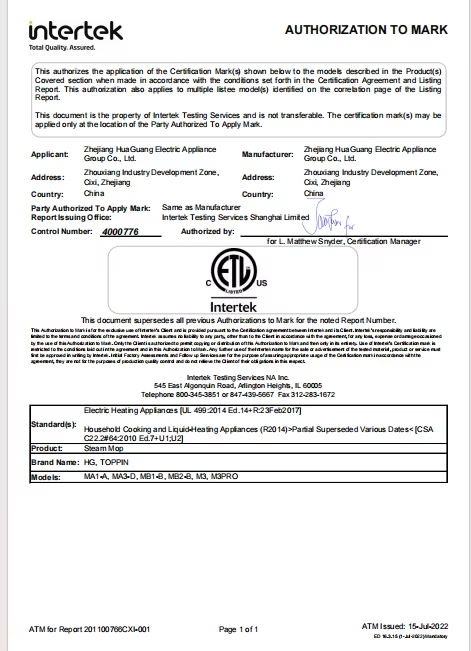
The ETL authorization 4000776 covers steam mops. It should not be presented as a garment steamer ETL certificate.
What the documentation does not show
A certification trail is not a complete supplier audit. In the file set reviewed here, several areas are not documented. The absence of a document is not proof that a process does not exist. It does mean that a buyer should not treat the certificate file as evidence of those areas.
- Packaging quality: the file set does not contain a packaging test report, transit test, drop test or packaging specification approval record.
- QC inspection records: Huaguang reports 100% pre-shipment testing, third-party inspection and safety certification. The reviewed file set does not contain batch-level inspection records, defect rates or AQL records.
- Overheat testing: no overheat test report appears in the file set. A test-room image is facility context, not a test result.
- Hotel durability: the application material lists hotels and hospitality projects, but the file set does not contain hotel-use durability data, cycle-life results or commercial laundry conditions.
- Custom voltage and plug verification: customization is listed as available, but the certificates name specific ratings and model configurations. The file set does not verify every custom voltage and plug combination.
- Self-cleaning: no self-cleaning test data appears in the reviewed file set.
- Large-tank leak testing: no leak test report for large-tank models appears in the reviewed file set.
These gaps matter because they sit close to the buyer's real risk. A GS certificate can support a safety conversation. It does not answer whether a container load will arrive with intact packaging, whether a custom 110 V plug version has been validated, or whether a hotel will see the same durability as a household user. Those questions require separate evidence.
How this changes the procurement decision
For an OEM buyer, the practical value of Huaguang's file is that it supports a model-level due-diligence process. The buyer can start with the intended market and product configuration, then ask for the exact document that covers that configuration. The sequence should be: define the model, voltage, plug and destination market; match each certificate to that definition; check the issuer, identifier and validity date; and then request the missing production and validation evidence.
A document matrix is more useful than a folder of PDFs. The buyer should record which document covers which model, which standard is cited, whether the certificate is still valid, and what the document does not cover. For Huaguang, the matrix would show that GS, PAHs and RoHS are model-specific; that EMC covers a different model group; that the DoC consolidates several models; and that ETL is adjacent-category evidence rather than garment steamer evidence.
This approach also protects the supplier relationship. It replaces a vague request for 'all certificates' with a specific request that the supplier can answer. It reduces the chance that a genuine document is misapplied to a model it does not cover. And it gives both sides a shared basis for the final product label, user manual and customs documentation.
Application fit: where the file supports the conversation
Huaguang's application material lists homes, garment stores, hotels, showrooms and textile workspaces. It lists retail projects, hotel and hospitality projects, apparel and fashion projects, home-appliance projects and OEM/ODM projects. The functional scope includes wrinkle removal, garment steaming, fabric care, odor removal and surface sanitization. Operating modes include handheld steaming, standing steaming and horizontal and vertical steaming.
That application map is broad, and the compliance file supports only part of it. The certificates are relevant to the electrical safety, restricted-substance, PAHs and EMC questions that arise in EU-bound programs. They do not replace application validation. For hotel and hospitality use, the buyer still needs durability and cycle-life evidence. For travel and e-commerce programs, the buyer still needs packaging, drop and transit evidence. For custom voltage and plug programs, the buyer still needs configuration-level verification.
The listed operating requirements are also a reminder that certification and safe use are separate. The application guidance states that the product should be used indoors in a well-ventilated area, away from damp locations, with a dry power cord and plug, only at the rated voltage, with water filled to the specified level and without perfume or unapproved chemicals. Steam outlets should remain unobstructed, and the unit should be operated only at the angles permitted by the model instructions. Fabric care labels should be checked before steaming. These are user and training issues, not certificate issues, but they affect the total support package an OEM buyer should request.
Market trend context
The commercial context makes documentation more important, not less. Grand View Research valued the global garment steamer market at USD 3.0 billion in 2023. The same source reports that Europe dominated the market in 2023 with a 34.5% revenue share, and projects that the handheld segment will hold a 58.0% share by 2036. These are market-research estimates, not procurement guarantees, but they explain why EU-facing compliance files receive close attention.
A separate commercial research source, Spherical Insights, links the EU Ecodesign Directive 2009/125/EC to a move toward 1200 W–1500 W models for energy efficiency. That is a research observation about market direction, not a statement that every garment steamer must use that power range. Buyers should verify the actual legal requirement for the product and market rather than treating a research summary as a regulation.
The standards environment is also moving. The IEC lists IEC 60335-2-85:2022 as the particular safety standard for electric fabric steamers for household and similar purposes, with a rated voltage of not more than 250 V, and a consolidated 2022 edition with a 2025 amendment. The existence of a standard is not the same as market adoption. The buyer still has to confirm which edition is applicable in the destination market and which test report supports the declaration. The direction is clear: model-level document control is becoming part of supplier capability, not a back-office task.
Comparison with a traditional certificate check
A traditional OEM certificate check often asks one question: 'Do you have CE or GS?' The supplier sends a certificate, and the buyer files it. That approach is fast, but it hides scope. A model-specific file review asks a different set of questions: which model, which standard, which issuer, which date, which sample, which configuration and which market. It takes longer, but it produces a defensible decision.
The Huaguang file shows both the strength and the limit of the document-led approach. The strength is traceability: a named manufacturer, a named address, named certificate numbers, named models, named standards and named dates. The limit is that even a well-populated file does not cover everything. In this case, packaging quality, QC inspection records, overheat testing, hotel durability, custom voltage and plug verification, self-cleaning and large-tank leak testing are not documented. A buyer who treats the certificate file as a complete capability proof would overread the evidence.
The reasonable conclusion is not that the file is weak. It is that the file should be used for what it is: a model-level compliance record. It supports the safety, restricted-substance, PAHs and EMC parts of a supplier evaluation. It does not replace a factory audit, a packaging validation plan, a custom-configuration test plan or a durability program.
Future outlook
The next phase for garment steamer OEM suppliers is likely to be document lifecycle management. Certificates expire, standards are amended, models are added and custom configurations multiply. A buyer will want to know not only what is certified today, but how the supplier tracks changes, how it notifies customers and how it links a certificate to a production label. The GS certificate's 2027-12-22 expiry date is a simple example: it creates a future action, not a permanent status.
For Huaguang, the file already provides a credible starting point for EU-facing discussions. The more useful next step for a buyer is to request a model-by-model document matrix, the underlying test reports for the DoC, the original ETL authorization, and separate evidence for packaging, QC, overheat, durability, custom voltage/plug, self-cleaning and large-tank leak performance. Those requests are specific, fair and directly connected to the purchase decision.
A public product manual is available for download: Product Manual 2025. The company website is www.huaguangsteam.com.
FAQ
Which Huaguang garment steamer models are named in the GS certificate?
GS/23/HEL/01592, issued by SGS Fimko Ltd on 2023-09-25, names Fabric Steamer (Steam Brush) / Dampfbürtse types E15, E15E and E16, rated 220–240 V, 50/60 Hz, 1800 W, Class 1. The certificate expires on 2027-12-22.
Does ETL authorization 4000776 cover garment steamers?
No. The ETL authorization 4000776 issued by Intertek on 2022-07-15 covers electric heating appliances listed as steam mops, with models MA1-4, MA3-0, MB2-0, MB2-4, M0 and MSPRO, under brands H3 and TOPPIN. It is not a garment steamer ETL certificate in the reviewed file set.
Which models are covered by the RoHS and PAHs documents?
The Bureau Veritas RoHS report (6626)019-0319, issued 2026-03-02, covers Fabric Steamer model E22 under 2011/65/EU and (EU) 2015/863. The SGS-CSTC PAHs report NBES220900480202-M1/PAH, issued 2023-09-25, covers Fabric Steamer (Brush Steamer) models E15, E15E and E16 under AfPS GS 2019:01 PAK.
Who issues the EU Declaration of Conformity?
The EU Declaration of Conformity is issued by Zhejiang Huaguang Electric Appliance Group Co., Ltd., with testing attributed to Intertek Testing Services Zhejiang Ltd. The document is dated 2026-07-17 and lists models E15, E15E, E16, E1Q, EQ10K80 and EZ2.
Does the documentation show packaging quality, QC inspection records, overheat testing, hotel durability, custom voltage/plug verification, self-cleaning and large-tank leak testing?
No. In the reviewed file set, those areas are not documented. The certificates and reports address safety, restricted substances, PAHs and EMC for the listed models. They do not contain packaging test reports, batch QC inspection records, overheat test reports, hotel durability data, verification of every custom voltage and plug configuration, self-cleaning test data or large-tank leak test data.
What should a buyer verify before treating the file as model-level evidence?
The buyer should match each certificate to the exact model, voltage, plug and destination market; check the issuer, identifier and validity date; confirm whether the ETL file covers the product category; and request the missing production, packaging, durability and custom-configuration evidence separately. The DoC should be read together with the underlying test reports and the final product label.
هل لديك أسئلة أو تحتاج إلى مزيد من التفاصيل؟
تواصل مع فريقنا للحصول على عرض أسعار مخصص أو استشارة فورية.
طلب عرض أسعار
املأ النموذج أدناه وسيتواصل معك فريقنا بعرض مقترح مخصص.
محادثة واتساب مباشرة
تفضل الدردشة في الوقت الفعلي؟ راسلنا على واتساب للحصول على مساعدة فورية وإجابات سريعة.
- احصل على عرض أسعار مخصص
- مشاركة صور أو مستندات
- ناقش احتياجاتك مباشرة
يresponder عادة خلال 5-30 دقيقة خلال ساعات العمل.