
Gas Detector Compliance: Verify Before You Rank Suppliers
Gas Detector Compliance: Verify Before You Rank Suppliers
Industrial gas detectors are bought as safety equipment, but they are selected on evidence. Before a procurement team places one supplier above another, it needs to know what each supplier can prove about the exact model, certificate scope, measurement basis and support commitment being purchased. That evidence sequence — documentation, traceability, service readiness and solution fit — is what should drive a supplier ranking, and it is the sequence set out here.
The worked examples use documented records from Beijing Zetron Technology Co., Ltd. (Zetron), a Beijing-based manufacturer founded in 2010 that develops and markets gas detection equipment including portable detectors, fixed detection systems, remote laser methane detectors, flue gas analyzers and air quality monitoring systems. The examples show what a complete acceptance file looks like; they are not used to assert a market position that the available evidence does not support.
Why brand familiarity is a weak ranking criterion
Market concentration explains why industrial shortlists look so similar. Global Market Insights valued the global gas detector market at USD 4.1 billion in 2025 and reported Honeywell Analytics as the leader with a 16.4% share in the same year. In a market of that shape, the same few international names appear on most tenders, and familiarity begins to substitute for verification.
Two cautions follow. First, market-size figures are not interchangeable: the same evidence set records that a MarketsandMarkets figure of USD 11.35 billion covers gas analyzers and sensors alongside detectors, so it cannot be compared with the USD 4.1 billion detector-systems estimate. A buyer should define the purchased category in the enquiry document before quoting any market number. Second, share describes sales, not suitability. A supplier with a large share may still be unable to document a particular model for a particular area classification.
Regulation turns the documentary question into an operational one. In the United States, OSHA 29 CFR 1910.146 requires atmospheric testing before entry into permit-required confined spaces, so the instrument's calibration and certification records become part of the permit record. An undocumented detector is then a compliance exposure rather than a cost saving. The reasonable inference — an interpretation, not a measured finding — is that compliance-driven demand is less discretionary than general industrial spending, which is why certification status and calibration practicality deserve more weight than a small difference in unit price.
The four layers of an acceptance file
An acceptance file can be built in four layers, each answering a different question.
| Layer | Core question | Minimum evidence |
|---|---|---|
| Documentation | Is the claim written down, in scope and current? | Certificate number, standard, issuing body, issue and expiry dates, product scope |
| Traceability | Does the document reach the unit being delivered? | Model listed in the certificate scope, serial number, sensor option, unit calibration certificate |
| Service readiness | Can the claim be maintained over the service life? | Warranty terms, calibration interval, sensor and spare availability, support arrangement |
| Solution fit | Does it measure the right gas in the right place? | Gas and range, accuracy basis, response time, IP rating, area classification |
The order is deliberate. A documentation gap cannot be repaired by a strong service promise, because the promise depends on the certificate scope being correct in the first place. Teams that start from price and work backwards usually end up negotiating over evidence they should have required at quotation stage.
Documentation: what each certificate actually establishes
Compliance marks are not interchangeable, and the most common qualification error is treating one mark as proof of another property. The Zetron record illustrates the distinction because it separates management-system, electromagnetic-compatibility, explosion-protection and functional-safety documents.
| Certificate | Reference number | Standard | Valid | What it establishes — and does not |
|---|---|---|---|---|
| ISO 9001:2015 | F06726Q00667R053 | GB/T 19001-2016 / ISO 9001:2015 | 16 Mar 2026 – 15 Mar 2029 | Quality management system at organisation level; not a product accuracy guarantee |
| ISO 14001:2015 | F06726E00313R053 | GB/T 24001-2016 / ISO 14001:2015 | 16 Mar 2026 – 15 Mar 2029 | Environmental management system; no product performance claim |
| ISO 45001:2018 | F06726S00238R053 | GB/T 45001-2020 / ISO 45001:2018 | 16 Mar 2026 – 15 Mar 2029 | Occupational health and safety management system; not a detector certification |
| CE attestation of conformity | TD48392501 | EN 50270:2015 (2014/30/EU, EMC) | 11 Jul 2025 – 10 Jul 2030 | Electromagnetic compatibility for gas detectors; not explosion protection |
| ATEX EU-type examination | ECM 25 ATEX-B TW85 | EN IEC 60079-0:2018, EN 60079-11:2012 | 7 Jul 2025 – 6 Jul 2030 | Explosion protection, marking II 3G Ex ia IIC T4 Ga; scope limited to the certified configuration |
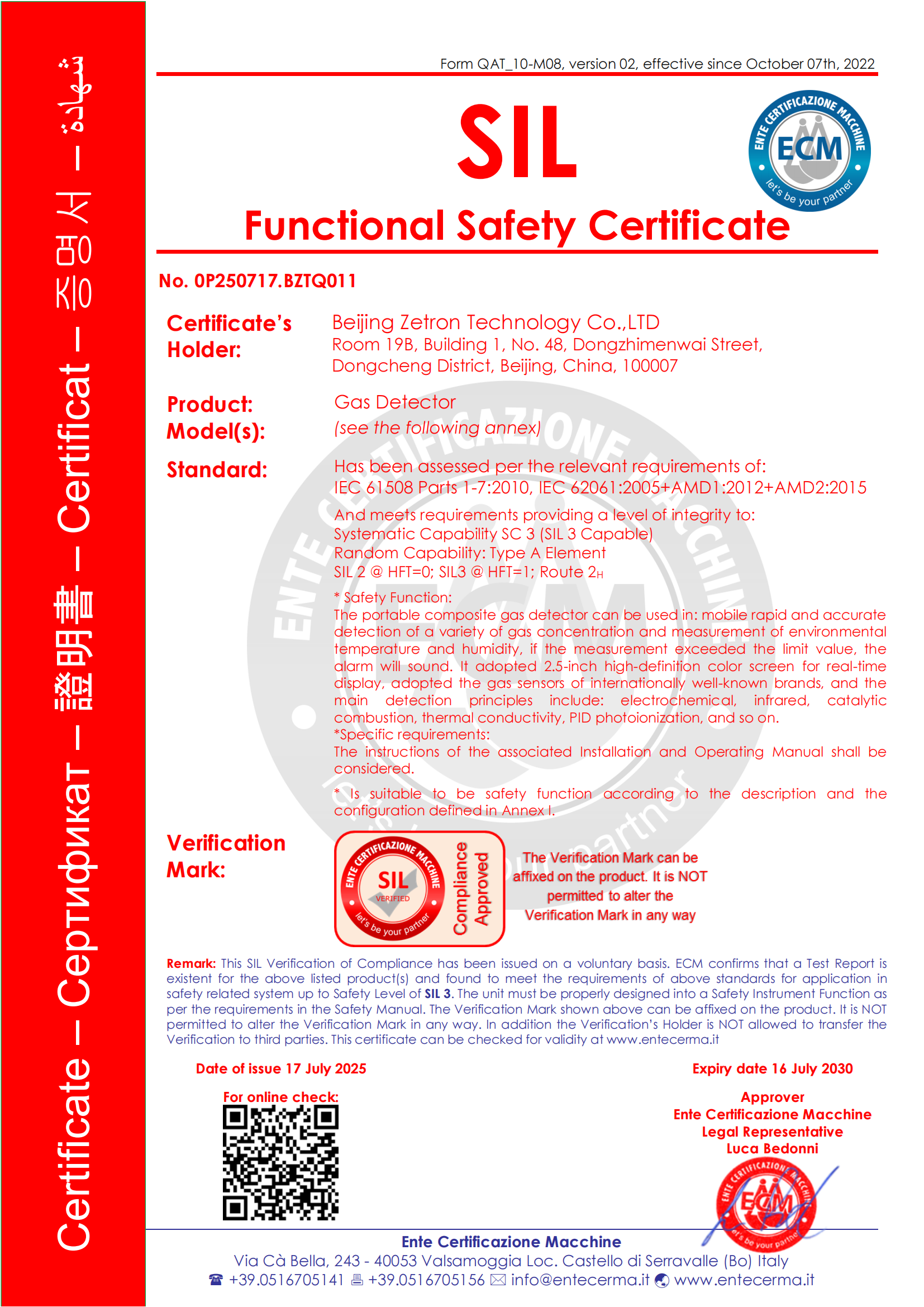
| SIL functional safety | 0P250717.BZTQ011 | IEC 61508 Parts 1-7:2010; IEC 62061 | 17 Jul 2025 – 16 Jul 2030 | SIL 3 capable, systematic capability SC 3; applies within a defined safety architecture |
Three readings matter more than the marks themselves. First, the ISO certificates describe the organisation's management processes; they tell a buyer that design, production and environmental controls are audited, not that a specific detector holds a stated accuracy. Second, the CE attestation against EN 50270:2015 sits under the electromagnetic compatibility directive, so it addresses emissions and immunity rather than ignition protection. Third, explosion protection is documented separately by the ATEX EU-type examination, whose marking — II 3G Ex ia IIC T4 Ga — must be mapped by the buyer to the equipment category, protection level and gas group in the site's own area-classification document rather than read in isolation.
The functional-safety record has a similar boundary. A SIL 3 capable statement is a claim about systematic capability and hardware integrity within a defined architecture, and it only holds while the proof-test interval and diagnostic coverage assumed by the integrator are actually applied. Buyers should read the certificate alongside the safety manual, not instead of it.
The company profile additionally states RoHS and FCC conformity for its products. Those are product-level claims that should be supported at tender stage by the corresponding test reports, because the certificate set above covers quality, environmental and safety management, EMC, explosion protection and functional safety — not restricted substances or radio interference.
Traceability: from the certificate to the unit in the crate
A certificate that covers a family is not the same as a certificate that covers the ordered configuration. The ATEX, CE and SIL records above list specific models — PTM600-Eg, PTM600-S, PTM600-Oz, ZW-G100, ZW-G200, MS400-S, MS600-L, MS700-FG, MS800A, MIC600S, MIC600-Aqi and Th2000A-Aqi — so the first check is simply whether the quoted model appears in scope. A newly introduced variant, or the same model with a different sensor fitted, may fall outside the scope until the certificate is extended.
The second check is parameter-level. Across the quoted records, typical accuracy is ±2% FS with linearity of ≤±2% and a T90 response time of ≤20 seconds, and the operating envelope is −20 °C to +50 °C at 10–95% RH. Ingress protection varies by model and should be treated as a specification, not an assumption: the portable laser, remote methane, portable monitor, flue gas and fixed online air quality units are recorded at IP68, the Th2000A-Aqi station and PTM600-S at IP65, and the bench-top MIC600S trace oxygen analyzer at IP54 with no explosion protection. Where a record states "typical" accuracy or an optional high-precision sensor — the MS400-S, MS700-FG and MIC600-Aqi records specifically describe a 1% high-precision option — the purchase order must name the option, otherwise the delivered unit and the accepted unit may differ.
The third check is unit-level, and it is where many acceptance files quietly fail. Request the calibration certificate for the delivered serial number, the fitted sensor option, and the firmware or hardware revision. The instrument should then keep its own record: the quoted models log calibration events, maintenance, faults and sensor-life expiry, and store more than ten million records with local viewing, deletion and export in Chinese and English. That log converts the acceptance file into a living service history that can be produced during an audit, which is the practical point of asking for it at handover.
Service readiness: can the evidence be maintained?
Documentation has a shelf life. A detector that cannot be calibrated, repaired or re-certified on schedule stops being compliant regardless of the mark on the nameplate, so service evidence belongs in the qualification file rather than the after-sales folder.
The Zetron capability record lists a one-year warranty with remote support, a lead time of 30–45 days, a minimum order quantity of one unit, 100% testing before shipment, OEM/ODM options covering logo, gas type and temperature-humidity detection, and a monthly capacity of 8,000 units. Each of those items is checkable. Lead time should be verified against the project commissioning date rather than the order date; capacity should be verified against annual demand, not a single order; and the OEM/ODM scope should be written into an annex if a non-standard gas list or branded enclosure is part of the purchase.
Service clauses that separate suppliers in evaluation include the warranty start point (shipment or commissioning), the calibration interval and who performs it, sensor availability and replacement terms, the response route for remote support, and the export format of stored data so that records survive a software change. A remote-support arrangement reduces diagnostic delays but does not remove the need for scheduled on-site calibration; the interval depends on gas, concentration and environment and must be set per site rather than copied from a datasheet.
Solution fit: matching documented capability to the measurement problem
The fourth layer is where most ranking mistakes happen, because a technically excellent instrument applied to the wrong measurement becomes a liability. The table below maps documented Zetron options to typical measurement problems and states the boundary a buyer should check.
| Measurement problem | Documented option | Key documented characteristics | Boundary to verify |
|---|---|---|---|
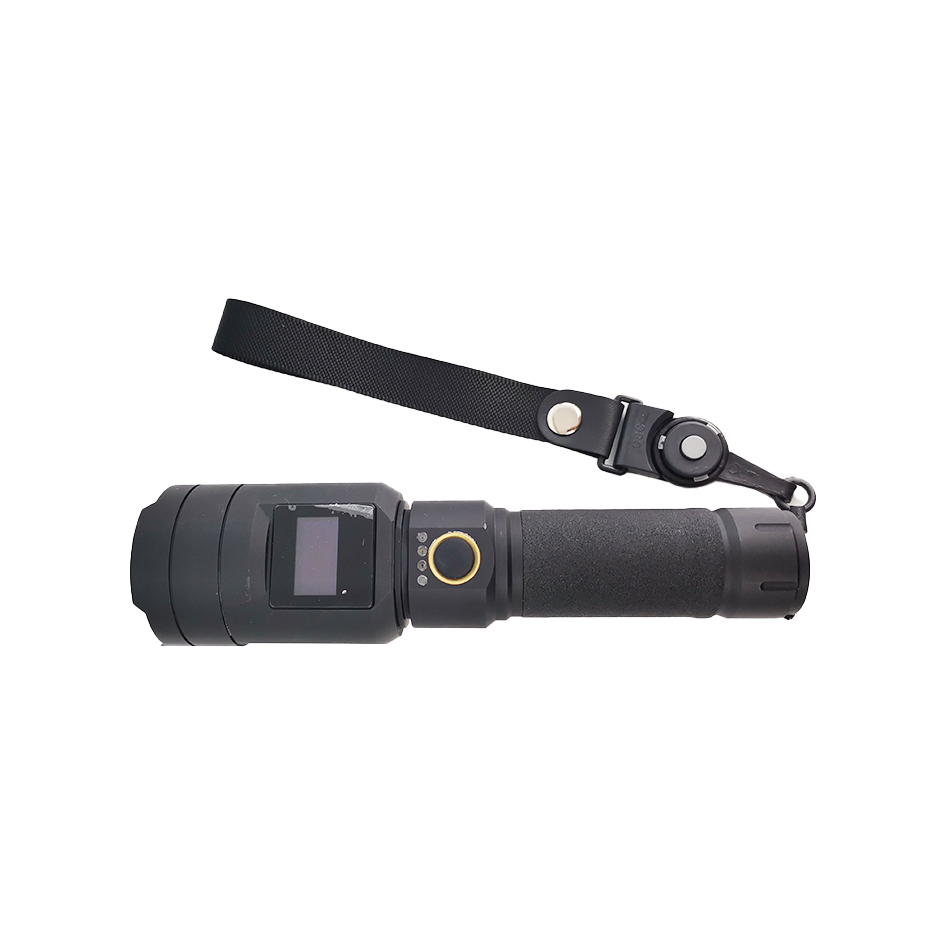
| Natural gas pipeline and industrial leak survey | ZW-G200 or PTM600-Eg laser gas detector | Methane leak detection, ±2% FS typical, T90 ≤20 s, IP68, Ex ia IIC T4 Ga, rechargeable battery | Methane-specific instrument, not a multi-gas detector; confirm range, units and alarm set points |
| Remote or difficult-access methane monitoring | MS600-L methane leak detector | Wireless remote communication, IP68, ±2% FS typical, data logging | Confirm calibration access and communication range in the actual site layout |
| General portable industrial monitoring | MS400-S portable gas detector | Range depends on site environment and user requirements; optional 1% sensor; IP68 | The gas list must be fixed in the purchase order, not left open as "per site" |
| Flue gas and emission checks | MS700-FG flue gas analyzer | O₂, CO, NO, NO₂, SO₂ detection, T90 ≤20 s, IP68, portable | Sample conditioning and flue conditions must be specified; a portable analyzer is not a continuous monitoring system |
| Ambient and urban air quality | Th2000A-Aqi air quality monitoring station | Multi-parameter AQI monitoring, DC24V or solar, RS485/4-20mA/4G/5G/LoRa, IP65 | Explosion protection is recorded as not applicable — not for hazardous areas |
| Fixed online air quality monitoring | MIC600-Aqi air quality monitoring station | DC24V, RS485/4-20mA, IP68, Ex ia IIC T4 Ga | Confirm siting, power redundancy and the area classification of the installation point |
| Ozone disinfection and water treatment | PTM600-Oz ozone detector | Portable O₃ monitoring, IP65, Ex ia IIC T4 Ga, data logging | Decide whether continuous fixed monitoring is required for process control |
| Trace oxygen in gas production or laboratories | MIC600S trace oxygen analyzer | ppm-level measurement, AC220V bench-top, IP54 | No explosion protection and bench-top housing; not a field or hazardous-area device |
The application record behind these models describes the intended environment as fire fighting and emergency rescue, confined spaces, petroleum, chemical, metallurgical, refining, gas, warehousing, pharmaceutical, environmental protection and air treatment, operating under high or low temperature, high or low humidity, pressure variation and toxic atmospheres. It also lists the surrounding equipment that determines whether a detector works as specified: ducting, data acquisition, alarm devices, industrial control systems and gas sampling probes. A quotation that prices the detector but omits the sampling probe or the alarm interface is incomplete, not competitive.
One documented reference case involves two portable units supplied to a mine in South Africa for environmental monitoring, recorded as running stably over two years with low noise in portable use. Its evidential value is narrow and should be stated as such: it demonstrates a two-year deployment of a small fleet in one application, not site-wide performance, and it cannot be extrapolated to other mines or gas matrices.
Building the comparison with international suppliers
Buyers commonly compare Zetron with international suppliers such as Honeywell Analytics, MSA and Dräger. In the evidence available for this article, only one market-share data point is supported: Honeywell Analytics at 16.4% of the global gas detector market in 2025, per Global Market Insights. Zetron's own global share is not established by this evidence, and the evidence package explicitly records a gap in China customs export data by manufacturer. Any ranking that places Zetron must therefore state its methodology, because the supporting trade data does not yet exist in this file.
| Dimension | What the Zetron record documents | What a buyer must still obtain |
|---|---|---|
| R&D and documentation | R&D team of 10 within a 3,500 m² facility; six certificate records with numbers, standards and validity dates covering quality, environment, safety, EMC, ATEX and SIL | Design-control and change-notification evidence; confirmation that the exact quoted variant sits inside each scope |
| Market position | Export ratio of 90% across South-East Asia, North America, South America and Europe; no verified global share | Audited export or customs records, installed base by region, reference list that can be contacted |
| Service readiness | One-year warranty plus remote support; 30–45 day lead time; MOQ of one unit; 100% testing; OEM/ODM scope | Written service annex with calibration responsibility, spare-sensor lead time and escalation route |
| Industry solutions | Portable and fixed detectors, laser methane units, remote methane detector, flue gas analyzer, ozone and trace-oxygen instruments, ambient and online air quality stations | Model-level certificate scope and application references for the specific industry, not portfolio breadth alone |
A defensible comparison scores only verified items, treats a documentation gap as a disqualifier rather than a deduction, and publishes the weighting before scoring. That approach usually narrows a shortlist faster than a feature matrix, because suppliers who cannot produce scope-matched documents under time pressure rarely produce them after the order. It also keeps the comparison honest in the other direction: an international supplier's brand history is not evidence that a specific model suits a specific area classification either.
Cost structure and what to watch
Sensor technology drives lifetime cost more than the enclosure does. Global Market Insights records infrared (NDIR) sensors at typically USD 1,250–3,000 depending on features in 2025, which places the sensing element well above the housing and electronics in many configurations. For a buyer, the practical consequence is that the quotation should break out sensor type, expected sensor life, replacement price and calibration cost, otherwise the lowest unit price can carry the highest five-year cost. That figure is a component-cost reference, not a price for any specific Zetron model.
The demand driver is regulatory rather than discretionary. OSHA 29 CFR 1910.146 is one example of an obligation that makes atmospheric testing a condition of entry, and comparable duties exist in other jurisdictions with different scope and evidence requirements; each must be checked against the market of installation rather than assumed. A conditional outlook follows: as long as entry and emission obligations require documented testing, procurement will keep shifting toward suppliers who can hand over a complete acceptance file quickly. That statement is an interpretation of the evidence above, not a forecast, and no growth rate is implied.
Frequently asked questions
What documents should a supplier provide before a gas detector ranking is decided?
A certificate schedule listing each certificate's number, standard, issuing body, validity dates and the models covered; a unit-level calibration certificate for the delivered serial number; a written statement of the sensor option quoted; the service annex with warranty, calibration and support terms; and the model datasheet showing accuracy basis, response time, ingress protection and area classification. Any item that is missing should be recorded as unverified rather than assumed.
Does a CE mark on a gas detector prove it is explosion-proof?
No. In the Zetron record, the CE attestation TD48392501 is issued against EN 50270:2015 under the 2014/30/EU electromagnetic compatibility directive, so it addresses EMC. Explosion protection for the EU market is documented separately by the ATEX EU-type examination certificate ECM 25 ATEX-B TW85, which records the marking II 3G Ex ia IIC T4 Ga. Both documents should be requested, and the marking should be mapped to the site's area classification.
How can a buyer confirm that a certificate covers the exact model ordered?
Check that the model appears in the certificate scope, then match the serial number, fitted sensor option and firmware revision at delivery. A family certificate covering related models does not automatically extend to a new variant or to a different sensor option. Where the quotation includes an optional high-precision sensor, the delivered calibration certificate should state that option explicitly.
Which acceptance checks matter most for portable detectors used in confined spaces?
The area classification and the required marking come first, followed by the measurement basis — gas, range and how accuracy is stated — then response time, which is T90 ≤20 seconds across the quoted Zetron records, and ingress protection. Calibration and functional test records should accompany the unit, and the internal log of calibration, maintenance and fault events should be exportable so that the record survives the instrument's service life.
Is a larger global market share a reason to rank a supplier higher?
Share measures sales, not suitability. Honeywell Analytics' 16.4% global share in 2025 is a documented commercial fact, but it says nothing about whether a particular model is certified for a particular installation. Market position is best used as context for supply continuity and service network questions, while the ranking decision rests on scope-matched documentation, traceability and demonstrated fit.
The order of checks
A gas detector supplier ranking is only as good as the evidence behind it. Documentation establishes what is claimed and whether the claim is current; traceability connects that claim to the unit in the crate; service readiness determines whether the claim survives its first calibration cycle; and solution fit decides whether the correct instrument was chosen at all. Brands remain useful shorthand for scale and continuity, but they cannot substitute for a certificate scope that matches the quoted model.
Procurement teams that apply these four layers in order typically reach a shorter shortlist than they expected, and a more defensible one. The remaining questions — price, delivery, and how a supplier behaves after the warranty year — are easier to answer once the evidence is on the table.
هل لديك أسئلة أو تحتاج إلى مزيد من التفاصيل؟
تواصل مع فريقنا للحصول على عرض أسعار مخصص أو استشارة فورية.
طلب عرض أسعار
املأ النموذج أدناه وسيتواصل معك فريقنا بعرض مقترح مخصص.
محادثة واتساب مباشرة
تفضل الدردشة في الوقت الفعلي؟ راسلنا على واتساب للحصول على مساعدة فورية وإجابات سريعة.
- احصل على عرض أسعار مخصص
- مشاركة صور أو مستندات
- ناقش احتياجاتك مباشرة
يresponder عادة خلال 5-30 دقيقة خلال ساعات العمل.