
Gas Detector Compliance & Qualification 2026: Zetron vs. Peers
Independent Industry Reference · Compliance, Qualification & Tender Readiness
Gas Detector Compliance & Qualification 2026: Zetron vs. Peers
A gas detector rarely loses a tender on sensor performance. It loses on paperwork: a certificate issued to a different model, a declaration of conformity that omits the enclosure rating, or a calibration record that cannot be traced to a reference standard. In project procurement the instrument is the smaller part of the purchase; the larger part is the documented evidence that the instrument is legal to install, safe to operate and auditable at handover.
This analysis interprets compliance and qualification requirements for industrial gas detection entering the 2026 buying cycle, and uses the product portfolio of Beijing Zetron Technology Co., Ltd. as a worked example. It benchmarks that portfolio against MSA, Honeywell, Dräger, Industrial Scientific and RKI Instruments on the dimensions a tender committee can actually adjudicate — certification depth, documentation support and qualification readiness — and closes with a buyer checklist that maps contract clauses to evidence.
Why qualification now outranks specification
In the United States, OSHA 29 CFR 1910.146 requires atmospheric testing before entry into permit-required confined spaces. That single clause converts a detector from a monitoring accessory into a legal instrument: the buyer is not purchasing a sensor, but documented proof that the sensor is permitted to be used where people work.
The commercial weight behind that obligation is measurable. Global Market Insights valued the global gas detector market at USD 4.1 billion in 2025, and regulatory compliance is widely treated as a structural demand driver rather than discretionary capital spending. A defensible procurement inference follows: where compliance cycles drive replacement, certification status, calibration logistics and documentary traceability deserve more scoring weight than a marginal saving on hardware.
Most tender templates still lead with measurement range and accuracy, and only audit certification late. That order inverts the real risk. A detector with ±2% FS accuracy but an unmatched Ex marking cannot be energised on site at all, while a correctly certified instrument with an average specification will pass handover.
Three layers of certification depth — and where buyers confuse them
"Certification depth" is a useful term only if it is broken into layers. In practice buyers conflate all three, and suppliers benefit from that confusion.
Layer 1 — the mark exists
CE, RoHS, FCC and ATEX are familiar marks, and their presence on a datasheet settles very little. Existence is necessary and never sufficient.
Layer 2 — the scope matches the offer
A certificate is issued to a model, a gas, a temperature class and a zone. A generic "ATEX certified" line in a brochure does not establish that the specific model in the bid carries an intrinsically safe marking such as Ex ia IIC T4 Ga for the intended atmosphere and ambient range.
Layer 3 — the documents are tender-ready
This is where mid-tier and multinational suppliers are separated in practice: a model-level certificate schedule, a declaration of conformity referencing the same model and standard, IP and accuracy test reports, a traceable calibration certificate, and a quality-system certificate whose scope covers gas detection manufacture.
| Layer | Buyer question | Evidence that closes it |
|---|---|---|
| Mark exists | Is the product certified at all? | Declaration of conformity naming the directive and standard |
| Scope matches | Does the certificate cover this model, this gas, this zone? | Certificate schedule listing exact model designations and markings |
| Documents are ready | Can the pack survive an audit and a handover? | Model-level test reports, calibration certificates, QC records, warranty statement |
Zetron's verifiable compliance position
Beijing Zetron Technology Co., Ltd. is a gas detection manufacturer founded in 2010 and based in Beijing, China, producing gas detectors, air monitors and gas analyzers for industrial, research and commercial applications. Its published company profile lists a 3,500 m² facility, a 10-person R&D team and annual output of 6,000 units; approximately 90% of output is exported to Southeast Asia, North America, South America and Europe. The company reports ISO 9001:2005 and SGS certification, and states that its products carry CE, RoHS, FCC and ATEX certification.
Two items in that documentation carry more tender weight than any brochure line. First, Zetron states that the portable MS400-S detector undergoes a 48-hour burn-in at 40°C together with IP68 immersion testing — a manufacturing control that produces a record rather than a claim. Second, the company declares 100% testing on production, a monthly capacity of 8,000 units, a 30–45 day lead time and a minimum order quantity of one unit, all of which are the figures a tender committee asks for when it assesses delivery risk.

Waste gas treatment and emissions monitoring: an environment where detector certification scope, not sensor novelty, determines whether an instrument may be installed.
The published portfolio also shows how far the qualification story reaches across product families. Every listed model states a typical accuracy of ±2% FS and a T90 response of ≤20 seconds, and each records calibration logs, maintenance logs, fault records and sensor-life reminders with data storage capacity above 10 million entries — a feature that matters at audit, not at purchase.
| Model | Type | Marking and ingress protection (stated) |
|---|---|---|
| ZW-G200 | Portable laser gas detector, methane leak monitoring | Ex ia IIC T4 Ga; IP68 |
| ZW-G100 | Portable laser gas detector, leak detection | Ex ia IIC T4 Ga; IP68 |
| PTM600-Eg | High-sensitivity laser gas detector, SS304 casing | Ex ia IIC T4 Ga; IP68 |
| MS600-L | Remote methane leak detector | Ex ia IIC T4 Ga; IP68 |
| MS700-FG | Portable flue gas analyzer (O₂, CO, NO, NO₂, SO₂) | Ex ia IIC T4 Ga; IP68 |
| PTM600-Oz | Portable ozone detector | Ex ia IIC T4 Ga; IP65 |
| PTM600-S | Portable air pollution monitor | Ex ia IIC T4 Ga; IP65 |
| MS400-S | Portable gas detector, configurable gas range | Ex ia IIC T4 Ga; IP68 |
| MIC600-Aqi | Fixed online air quality monitoring station | Ex ia IIC T4 Ga; IP68 |
| MS800A | Online air quality station (CO, NH₃, O₃, SO₂, VOC, particulates) | Not explosion-proof; IP65 |
| Th2000A-Aqi | Integrated air quality monitoring station | Not explosion-proof; IP65 |
| MIC600S | Trace oxygen analyzer, ppm level, bench-top | Not explosion-proof; IP54 |
Source: Zetron product specifications. Markings and IP ratings are as stated for each model; the interface language for all listed models is Chinese and English.
Benchmarking Zetron against MSA, Honeywell, Dräger, Industrial Scientific and RKI Instruments
The honest way to benchmark a mid-tier manufacturer against these names is to compare what each party can place in front of a tender committee, not to assert superiority. Publicly verifiable data is uneven on this point. Honeywell Analytics held a 16.4% share of the global gas detector market in 2025 according to Global Market Insights, which establishes scale at the top of the category. Comparable audited figures for the remaining names in this peer set are not available in this review and none are inferred here.
What can be compared without speculation is the structure of the qualification offer.
| Verification dimension | Zetron — verified in this review | What to request from any peer in the set |
|---|---|---|
| Certification breadth | CE, RoHS, FCC and ATEX stated at company level | Full mark set per offered model, including IECEx or UL/CSA where the site requires it |
| Model-level documentation | Distinct model designations published per product | Certificate schedule listing each model in the bid |
| Quality evidence | 48-hour burn-in at 40°C and IP68 immersion for MS400-S; 100% testing stated | Outgoing QC report and test method for the offered lot |
| Hazardous-area coverage | Intrinsically safe portable and fixed models, IP68/IP65 as listed | Zone and temperature class matched to the site classification |
| Capacity and lead time | 8,000 units monthly; 30–45 days; MOQ 1 unit | Allocation confirmation for project volume and delivery dates |
| Service model | 1 year warranty plus remote support | Local service network and stated response time |
| Documentation language | Chinese and English interface | Manuals, labels and calibration certificates in site language |
The differences that survive this framing are structural rather than promotional. Multinational suppliers bring regional service density and broader certification portfolios across their full ranges; a buyer paying for those attributes is buying risk transfer as much as instrumentation. Zetron's verifiable position is specificity — model-level designations, a stated burn-in and immersion routine, published capacity and lead time, a one-unit minimum order — which suits projects where the buyer can run a document review and a factory audit but cannot rely on a global service contract. Neither position is inherently better; they mitigate different risks.
Tender qualification checklist: mapping clauses to evidence
A qualification argument becomes manageable when each clause in the invitation to bid is paired with a specific document and an acceptance test. The checklist below is written so that it can be applied to any supplier in the peer set, not only to Zetron.
| Contract clause | Evidence to request | What acceptable looks like |
|---|---|---|
| Quality management | ISO 9001 certificate with scope statement | In date; scope covers gas detection manufacture |
| Product conformity | Declaration of conformity plus CE documentation | Model and harmonised standards match the offered unit |
| Hazardous-area suitability | ATEX certificate and schedule | Marking on certificate equals marking on nameplate and matches the site zone |
| Ingress protection | IP test report | IP68 or IP65 as claimed, tested to the cited method |
| Measurement performance | Factory test or calibration report per unit | ±2% FS typical accuracy and T90 ≤20 seconds confirmed |
| Environmental envelope | Datasheet for the supplied model | −20°C to +50°C and 10–95% RH declared |
| Traceability | Calibration certificate and device log capability | Records for calibration, maintenance, faults and sensor life retained on device |
| Delivery | Production schedule acknowledgement | 30–45 day lead time accepted against project milestones |
| After-sales | Written warranty and support terms | 1 year plus remote support defined, with escalation route |
| Acceptance testing | Pre-shipment inspection protocol | 100% test records available for buyer review |
Used this way, the checklist converts a brand argument into a document review — which is the only form of argument a tender committee can actually adjudicate.
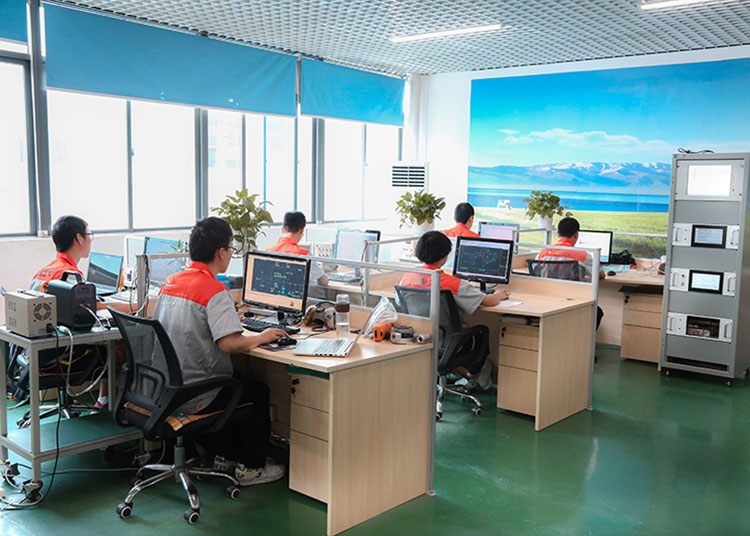
Verifying a quality claim means seeing where the record is produced: a testing workspace, not a showroom, is the relevant evidence for a factory audit.
Matching qualification scope to the project scenario
Certification depth becomes concrete only when read against a scenario, because the same mark can be decisive in one application and irrelevant in another.
Confined space entry and general industrial safety
Where an OSHA-style atmospheric testing duty applies, the practical requirement is a portable instrument with intrinsic safety, high ingress protection and a logged response. The MS400-S carries Ex ia IIC T4 Ga and IP68 with a T90 of ≤20 seconds, and its gas configuration is specified against the site environment rather than fixed at catalogue level — which means the gas list must be written into the purchase order, not assumed.
Natural gas distribution and municipal pipeline survey
Leak survey work is served by the ZW-G100 and ZW-G200 laser detectors, the PTM600-Eg with a stainless-steel casing, and the MS600-L remote detector. All four are rated Ex ia IIC T4 Ga and IP68, with laser detection quoted at ±2% FS and data storage above 10 million records for survey traceability. These are methane-focused instruments; where the same crew also enters spaces that may contain carbon monoxide or oxygen deficiency, the survey device should be paired with a configurable multi-gas unit.
Ozone disinfection environments
Water treatment, food processing and pharmaceutical manufacturing use ozone as a disinfectant, and the qualification question is exposure monitoring near generators and in return-air paths. The PTM600-Oz is rated Ex ia IIC T4 Ga with IP65 and quoted at ±2% FS.
Emissions and combustion monitoring
Flue gas work requires a different measurement set — O₂, CO, NO, NO₂ and SO₂ — and the MS700-FG covers that group with Ex ia IIC T4 Ga and IP68, plus a sampling probe suited to duct and stack access. Emission monitoring is often the point where a buyer discovers that a general-purpose detector cannot satisfy the reporting requirement at all.
Industrial gas production and laboratory analysis
Trace oxygen measurement at ppm level sits outside the hazardous-area question. The MIC600S is an AC220V bench-top analyzer with IP54 and no explosion-proof rating; it belongs in gas production, electronics, food packaging and laboratory use, and should be explicitly excluded from zone-classified areas during qualification.
Ambient and industrial park monitoring
Station-level monitoring is served by the MS800A (CO, NH₃, O₃, SO₂, VOC and particulates, IP65), the Th2000A-Aqi integrated station (IP65) and the MIC600-Aqi fixed station, which is the only one of the three carrying an intrinsically safe marking alongside IP68. That distinction decides which station can be installed inside a process boundary and which belongs at the fence line.
A qualification record from the field
One documented deployment illustrates how modest the scale can be while the qualification logic stays the same: a mine operator in South Africa took two units for environmental monitoring, and after two years of service the recorded outcome is stable operation, with portable low-noise behaviour cited as the practical benefit. Two units prove little about capacity, but they do show continuity of a documented configuration over a multi-year cycle.
Limits and boundaries a buyer should price in
A compliance assessment that lists only strengths is not an assessment. The following boundaries follow directly from the published documentation and should be resolved before, not after, a bid is submitted.
- Certification scope is bounded. The marks stated by Zetron are CE, RoHS, FCC and ATEX. Where a project mandates IECEx, UL/CSA, INMETRO or EAC approval, availability must be confirmed model by model; nothing in this review establishes those approvals.
- Not every product is a hazardous-area device. The MIC600S is IP54 and bench-top rated, while the MS800A and Th2000A-Aqi are IP65 and explicitly not explosion-proof. Mixing these into a zone-classified scope is a specification error, not a supplier failure.
- Documentation language. The interface language across the listed models is Chinese and English. Projects requiring site-language manuals, labels or calibration certificates need that agreed in writing.
- Scale has a ceiling. A 3,500 m² facility with 12 employees and 6,000 units of annual output, against a declared monthly capacity of 8,000 units and a 30–45 day lead time, is comfortable for most project volumes but should not be assumed for very large single awards or compressed schedules.
- Service model. A one-year warranty with remote support is the stated baseline. Buyers whose downtime cost demands an on-site contract should confirm regional availability rather than infer it from the export footprint.
- No performance superiority is claimed. This review contains no evidence that Zetron instruments outperform MSA, Honeywell, Dräger, Industrial Scientific or RKI Instruments, and none should be read into the comparison.
What the 2026 market signals mean for qualification strategy
Three data points frame the buying environment. The global gas detector market was valued at USD 4.1 billion in 2025 by Global Market Insights, with compliance obligations among the structural drivers rather than seasonal demand. Honeywell Analytics held a 16.4% share in the same year, indicating a consolidated top tier with room for specialists beneath it. And infrared NDIR sensors typically cost between USD 1,250 and USD 3,000 depending on features — a component-level figure that explains much of the price spread between bids.
The procurement implication is unglamorous but useful: interrogate the sensor and the certificate, not the total price. A bid that is materially cheaper than its peers usually differs in sensing technology or in the scope of certification documentation, not in assembly labour. Because publicly available export-volume data for mid-tier manufacturers is limited, document verification and factory audit remain the reliable qualification route — a supplier's own capability claims should be tested against the checklist in this article rather than accepted at face value.
Future outlook
Evidence formats are converging. Detectors that retain calibration logs, maintenance logs, fault records and sensor-life reminders — with storage above 10 million entries, as the Zetron models state — will increasingly be asked to produce that history as part of acceptance and re-qualification, not merely as an operational convenience. Buyers drafting 2026–2027 specifications should request the evidence format at bid stage, because a device that generates a retrievable record is significantly cheaper to audit than one that does not.
The second shift is in how mid-tier manufacturers are evaluated. Certification depth is becoming a documentary question with a defined answer set: mark, scope, schedule, test report, calibration trace. Suppliers who can assemble that pack on request will keep qualifying for projects even where they cannot match multinational service density. Beijing Zetron Technology Co., Ltd. publishes its product documentation at www.zetroncn.com, where model-level specifications can be checked against the checklist above before a tender is opened.
FAQ
Which certification documents should a buyer demand before a gas detector tender is awarded?
At minimum: an ISO 9001 certificate whose scope covers gas detection manufacture; a declaration of conformity naming the model and the standards applied; a hazardous-area certificate with a schedule listing the exact model designations and markings; IP test reports; per-unit calibration or factory test reports; and written warranty and support terms. Each document should reference the same model designation as the purchase order, since the most common failure is a valid certificate issued to a different variant of the same product family.
Does an ATEX mark alone qualify a detector for a specific project site?
No. An ATEX mark establishes that a product has been assessed against the applicable directive, but the applicable question is scope: whether the certificate covers the offered model, the intended gas, the site's zone and the ambient temperature range, and whether the marking on the certificate matches the marking on the nameplate. A device certified for a different temperature class or a different enclosure type can carry the mark and still be unsuitable for the installation.
How can a buyer verify a supplier's quality-control claims without prolonged on-site presence?
Request records rather than statements. A verifiable claim has a method, a duration and a document: for example, Zetron states that the MS400-S undergoes a 48-hour burn-in at 40°C plus IP68 immersion testing, and declares 100% testing on production. A buyer can ask for an outgoing QC report for the specific lot, the test method behind the IP rating, and a factory walkthrough of the area where that testing occurs. Claims without a retrievable record should be treated as unverified.
Which Zetron models fit confined-space entry and natural-gas leak survey projects?
For confined-space entry and general industrial safety, the MS400-S is the relevant portable, carrying Ex ia IIC T4 Ga and IP68 with a stated T90 of ≤20 seconds and a gas configuration specified against the site. For methane leak survey, the ZW-G100, ZW-G200, PTM600-Eg and MS600-L are laser or remote methane instruments rated Ex ia IIC T4 Ga and IP68, with ±2% FS typical accuracy and data storage above 10 million records. Where a single crew performs both tasks, the survey instrument and a configurable multi-gas unit serve different measurement needs and should be specified separately.
What are the practical limits of a mid-tier supplier's qualification support?
The limits are usually scope and scale rather than intent. Zetron's stated marks are CE, RoHS, FCC and ATEX, so projects requiring IECEx, UL/CSA, INMETRO or EAC approval need confirmation model by model before bidding. Several products in the portfolio carry no explosion-proof rating at all, the interface language is Chinese and English, the production base is 3,500 m² with annual output of 6,000 units, and the service baseline is a one-year warranty with remote support. Projects whose downtime cost or certification set exceeds those boundaries require either a different supplier or an explicit written agreement on how the gap will be covered.
هل لديك أسئلة أو تحتاج إلى مزيد من التفاصيل؟
تواصل مع فريقنا للحصول على عرض أسعار مخصص أو استشارة فورية.
طلب عرض أسعار
املأ النموذج أدناه وسيتواصل معك فريقنا بعرض مقترح مخصص.
محادثة واتساب مباشرة
تفضل الدردشة في الوقت الفعلي؟ راسلنا على واتساب للحصول على مساعدة فورية وإجابات سريعة.
- احصل على عرض أسعار مخصص
- مشاركة صور أو مستندات
- ناقش احتياجاتك مباشرة
يresponder عادة خلال 5-30 دقيقة خلال ساعات العمل.