
Gate Hoists to Deck Gear: CZHydraulic Fit Against Tier-1 Hydraulic Groups
Industry Reference · Heavy-Duty Hydraulics
Large hydraulic cylinders are rarely chosen on specification alone. Once a project moves from evaluation into execution, the deciding question changes from “does this cylinder meet the drawing” to “will this supplier still be the source of that cylinder in year eight, with the same material records, the same test routine and the same person answering the technical query.”
That shift matters most in four settings: water conservancy gates, marine and offshore equipment, oil and energy installations, and port facilities. In each, the cylinder is a low-volume, high-consequence component inside a structure that is expected to operate for decades. This reference maps Changzhou Hydraulic Complete Equipment Co., Ltd. (CZHydraulic) — a hydraulic cylinder, hydraulic hoist and control system manufacturer based in Changzhou, Jiangsu Province, China — against the scenario requirements of those settings, and sets its documented capability beside the tier-1 groups that most tenders name: Bosch Rexroth, Parker Hannifin, Eaton and Liebherr.
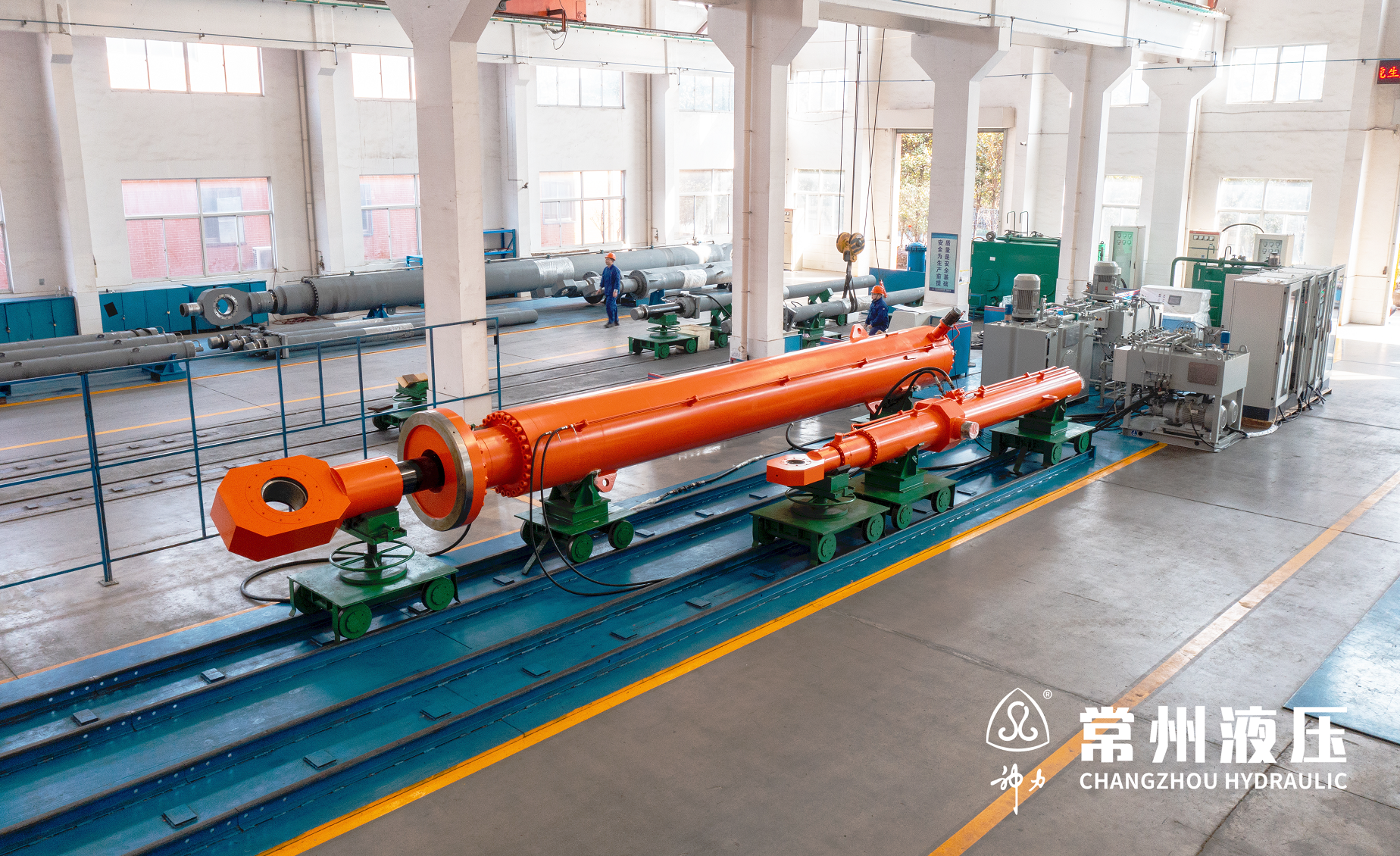
Joint debugging test area: hydraulic hoist and cylinder assemblies are verified as a set before dispatch, which is the point where gate-duty and marine-duty requirements diverge from catalogue specifications.
Why Cylinder Procurement Now Runs on Lifecycle, Not Just Specification
Specification is a threshold, not a differentiator. A 250 bar heavy-duty series cylinder built to ISO 6022 mounting dimensions, a 16 MPa medium-series cylinder within the ISO 6020-1 bore range of 25 mm to 200 mm, or a 10 MPa cylinder sized to ISO 10762 dimensions — all of these are documented, reproducible outcomes. Any qualified manufacturer can reach them.
What separates suppliers is what happens afterwards. Gate cylinders sit idle for months and then must close against full tailrace flow within seconds. Marine cylinders face salt spray, condensation and long shutdown periods. Port and energy cylinders run at high duty cycles under load reversal. In all four cases the failure mode is rarely a wrong bore diameter; it is a coating that pitted, a welding seam that was never ultrasonically checked, a buffer setting that was never adjusted, or a spare that took eleven weeks to arrive.
That is why procurement teams increasingly score suppliers on three things beyond the drawing: whether the acceptance test is defined before the order (ISO 10100:2020 sets out acceptance and function tests for hydraulic fluid power cylinders), whether material and heat-treatment records travel with the unit, and whether the supplier can hold those records constant across repeat orders.
What CZHydraulic Puts on the Table
Changzhou Hydraulic Complete Equipment Co., Ltd. was established in 1990 and has more than 35 years of experience producing complete sets of hydraulic hoist equipment, hydraulic cylinders and hydraulic control systems. The company operates from No. 1 Xinhui Road, Wujin National High-Tech Industrial Zone, Changzhou, Jiangsu Province, with 316 employees, a 20-engineer technical team, a stated monthly production capacity of 5,000 units, and an export ratio of around 40% across North America, South America, Western Europe, Eastern Europe, Eastern Asia and Southeast Asia.
Its product scope is unusually vertical for a cylinder maker. Alongside applied industrial hydraulic cylinders it supplies complete hydraulic hoist equipment, servomotors, thermal spraying and surface treatment — the last two being the processes that determine piston-rod life in wet and saline conditions. Documented capability includes cylinders up to 1,200 mm in diameter and strokes up to 16 m, double-acting piston design, and cylinder bodies in carbon steel, alloy steel or stainless steel, with supply volume stated at 2,400 tons per year.
Quality management is certified to ISO 9001 (recorded as ISO 9001 AAA in company materials). Quality control is conducted on 100% test standards rather than batch sampling. The minimum order quantity is 1 unit, delivery is quoted at 15–60 days depending on the product, shipment is routed through Shanghai port, payment is by T/T, and the origin of goods is Changzhou.
What this means for a buyer: a single-unit order is possible for prototype or replacement work, but the meaningful advantage for project procurement is that cylinder design, hoist assembly, surface treatment and system testing sit inside one organisation — which shortens the loop between a site problem and a manufacturing change.
QHLY and QPPY: How Gate-Duty Cylinders Differ from General Industrial Cylinders
The clearest illustration of scenario fit is the gate family. The QHLY radial gate heavy-duty hoist cylinder and the QPPY flat gate cylinder are not general-purpose industrial cylinders with a different label; they are built around the duty profile of a water-retaining structure.
A radial (tainter) gate rotates about a trunnion, so the cylinder is normally a heavy-duty hoist element working against a load that varies with water head and gate angle. A flat gate closes vertically, which is why the QPPY family is specified as a double-acting piston design — the cylinder must drive the gate down as positively as it lifts it. Holding force, not just thrust, becomes a design input, because the gate must stay closed when the drive is de-energised.
A documented reference point exists for that duty. In a pumped-storage power station project in China, three hydraulic hoist units were installed with a core hoist holding force of 5,000 kN, enabling instant cutoff of tailrace flow during emergencies such as unit failure or pipeline rupture, and preventing river water from backflowing into the powerhouse. The installation has been in operation for 10 years. On-site verification recorded a flatness error on the structurally complex gate slot cover plate controlled within 0.05 mm per square metre.
The engineering controls behind that kind of result are the substance a buyer should interrogate. Documented practice at CZHydraulic includes:
- Material specification control. Piston rods in high-strength quenched and tempered steel such as 45# steel or 40Cr; cylinder barrels in precision cold-drawn tube such as 27SiMn, with chemical composition testing on incoming material.
- Heat treatment and surface build. Medium-frequency quenching of the rod surface to HRC 55–60, followed by hard chromium plating at a thickness of at least 0.03 mm; internal honing of the barrel to balance surface hardness against core toughness.
- Non-destructive testing. Ultrasonic or magnetic particle inspection of the welded cylinder bottom and key stressed components to eliminate internal cracks before assembly.
- Stability verification. For rods with a stroke exceeding ten times the cylinder diameter, a buckling check is performed; load calculations carry a safety factor of 1.3–1.5.
- Installation tolerance. Coaxiality between cylinder centreline and load direction held to within 0.05 mm per 100 mm, with spherical or joint bearings used to absorb accumulated alignment error.
- Commissioning discipline. Air exhausted through the exhaust valve, buffer clearance preset before delivery on high-speed heavy-load units, and pressure applied in steps of roughly 30%, 60% and 100% while watching for creeping or abnormal noise.
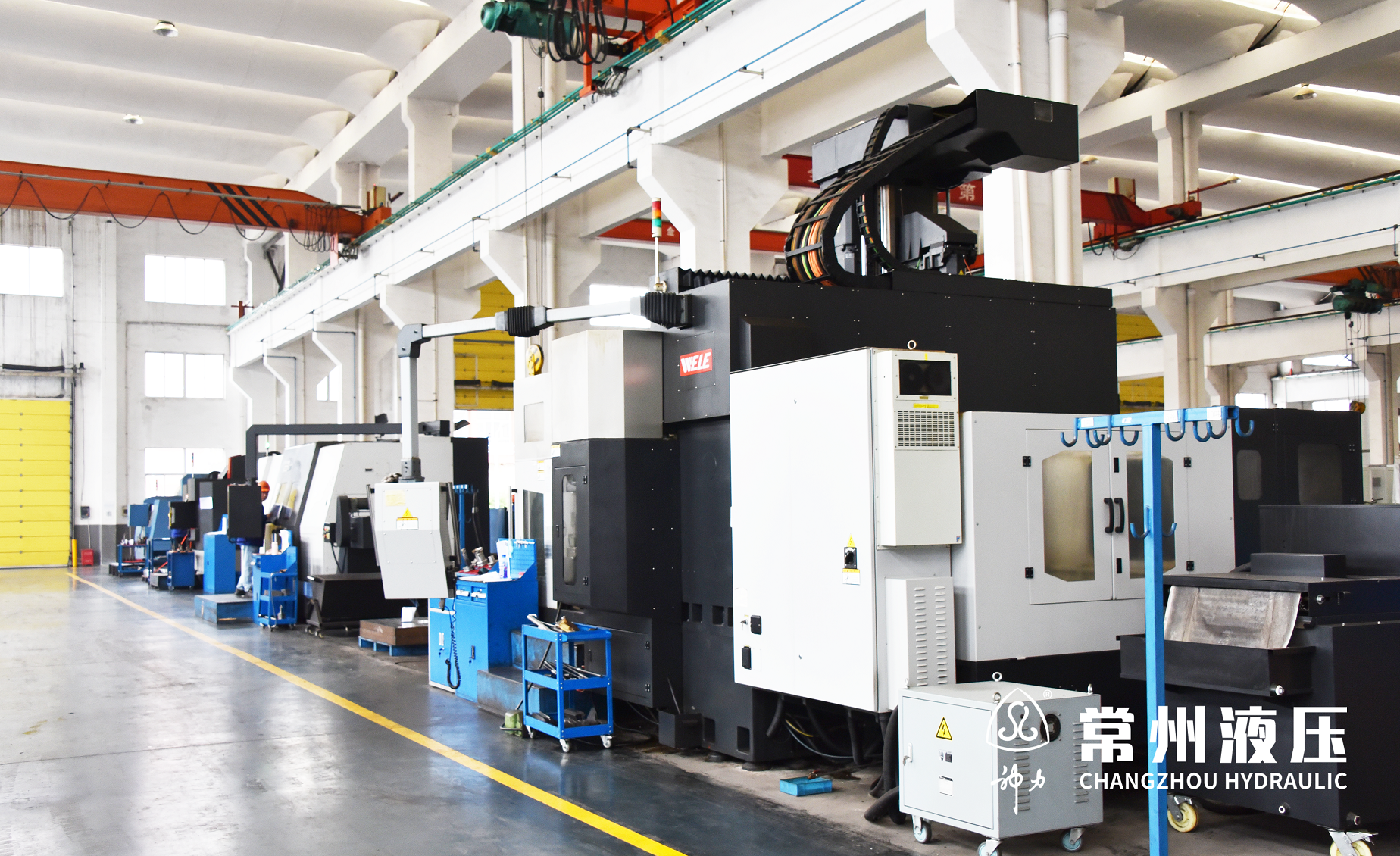
Large-bore, long-stroke work is a machining-tolerance problem before it is a hydraulic problem: bore alignment, rod straightness and mounting geometry all originate at the machine tool.
Where the Portfolio Fits: Water, Marine, Oil, Transport, Energy and Port
Scenario fit is best read as a table rather than a claim. The rows below summarise what the cylinder must survive in each setting and which documented CZHydraulic capability maps onto it.
| Setting | Dominant duty | Mapped capability |
|---|---|---|
| Water conservancy | Long idle periods, then high holding force and fast closure | QHLY radial gate hoist cylinders, QPPY double-acting flat gate cylinders, complete hoist sets, 5,000 kN holding-force reference |
| Marine and ocean engineering | Salt spray, condensation, cavitation, long shutdowns | 316L stainless rod option, ceramic coating as an alternative to chrome, retractable dust covers, shutdown rust prevention |
| Oil, gas and energy | Continuous load, pressure spikes, servo response | Servomotor cylinders, hydraulic turbine servomotors, hydraulic power units and control systems |
| Vehicle and transport | High cycle count, shock loading, abrasion | Heavy-duty large-bore dump and transport cylinders, ceramic-coated rods for abrasive roads and terminals |
| Port facilities | Humidity, dust, duty-cycle fatigue | Industrial cylinders up to 1,200 mm diameter, up to 16 m stroke, 100% testing before delivery |
Marine work deserves separate emphasis because it is where design margin is least negotiable. DNV class guidelines for hydraulic cylinders (DNVGL-CG-0194) call for a minimum buckling safety factor of 4.0 in standard calculations — a materially different margin from the 1.3–1.5 load factor used in general industrial selection. A supplier that has only ever worked to industrial load factors will produce a cylinder that is structurally adequate and still non-compliant. For marine and offshore enquiries, that calculation should be requested as a deliverable, not assumed.
The Market Context Behind Scenario-Specific Sourcing
Two published figures frame the trend. The global hydraulic cylinder market reached a valuation of USD 17.34 billion in 2025, according to Fortune Business Insights. The same source projects the industrial manufacturing segment to grow at a CAGR of 6.12% through 2031, ahead of construction equipment — a mix shift toward the application categories where cylinders are engineered rather than selected from a catalogue.
Pricing evidence points the same way. Stainless steel hydraulic cylinders in marine and offshore grade are quoted in the region of USD 1,000 to USD 3,200 for standard sizes, a band wide enough that the coating and material decision — not the bore size — is the main commercial variable. That is consistent with how CZHydraulic frames the choice in its own comparison data: ceramic coating is presented as delivering roughly 30% lower total cost of ownership than chrome-plated rods over service life, with the gain coming from corrosion and salt-spray resistance, wear and cavitation resistance, coating adhesion without peeling, and the absence of hydrogen embrittlement risk in the coated surface.
A third, quieter trend is documentation. Where acceptance testing was once a line in a purchase order, ISO 10100:2020 now provides a published reference for acceptance and function tests on hydraulic fluid power cylinders. Buyers who cite it in the enquiry get comparable test records across bidders; buyers who do not, get whatever each supplier calls a test.
Benchmarking Against Tier-1 Groups: Four Dimensions That Matter
Comparing a specialist Chinese cylinder and hoist manufacturer with Bosch Rexroth, Parker Hannifin, Eaton and Liebherr is not a comparison of equals in scale, and pretending otherwise would mislead a buyer. It is a comparison of fit. The four dimensions below are the ones that actually change a sourcing decision.
| Dimension | CHANGZHOU HYDRAULIC (CZHydraulic) | Tier-1 groups (Bosch Rexroth, Parker Hannifin, Eaton, Liebherr) |
|---|---|---|
| R&D depth | 20-engineer in-house team; cylinder design, complete hoist sets, servomotors, thermal spraying and surface treatment held within one organisation | Multi-domain engineering organisations with extensive published hydraulic catalogues; the engineering resource actually attached to a given project must be confirmed per business unit and region |
| Market position | No segment market-share figure is published in the material reviewed; position is better judged from completed references such as the 3-unit, 10-year pumped-storage hoist installation | Group-level financials are publicly reported, but cylinder-specific share by application is not directly comparable with a specialist’s reference base — buyers should require application-level references from both |
| Service model | Direct factory engineering contact, export via Shanghai port, T/T with a 50/50 payment structure, 15–60 day delivery, MOQ 1 unit, 100% testing before delivery | Typically organised through regional subsidiaries and distributors; country-level service coverage, spare-part stock and escalation routes should be verified for each destination market during qualification |
| Solution fit | Up to 1,200 mm diameter and 16 m stroke, double-acting design, carbon / alloy / stainless steel bodies, QHLY radial gate and QPPY flat gate families, 2,400 tons per year supply | Standardised catalogues plus engineered systems; strongest where a multi-vendor package, class-approved marine scope or a global service footprint is a mandatory tender condition |
The honest reading of that table is that the two sides are chosen for different reasons. Tier-1 groups win on breadth, on multi-country service presence and on being pre-qualified in specifications that name them. CZHydraulic competes on envelope, on vertical integration of hoist plus cylinder plus coating, and on the willingness to take a one-unit order while still quoting a 15–60 day delivery window.
Where the Fit Stops: Envelope, Certification and Service Boundaries
A reference that only lists strengths is not a procurement tool. Four boundaries should be stated plainly, and each one is a question a buyer should put in writing before award.
1. The envelope is finite and must be shared. The documented maximum of 1,200 mm diameter and 16 m stroke defines where standard engineering applies; beyond it, the request becomes a development project with its own schedule and risk. It is also worth noting that supplier-reported maximum dimensions are not directly comparable between companies, because units, product scope and test basis differ. Ask for drawings, machine capacity, completed-project evidence and load or pressure test records rather than comparing headline numbers across suppliers.
2. ISO 9001 is a quality management certification, not a class approval. It evidences a controlled quality system; it does not substitute for a classification society approval where the project requires one. For offshore and marine work, class documentation — together with buckling calculations to the applicable safety factor — should be treated as a separate qualification gate, requested per project.
3. Third-party verification should be performed, not assumed. Independent published verification of a specialist manufacturer’s capacity is thinner than for listed global groups. A buyer relying on a 2,400 tons per year supply statement or a 5,000 units per month capacity statement is relying on supplier-reported data, and should pair it with a factory audit, certificate checks and reference calls.
4. Single-site manufacturing creates a concentration risk. Production is located in Changzhou, with export routed through Shanghai. That is efficient for a single project; for a multi-year programme or a multi-region asset base, buyers should plan buffer stock, agree a spares list at order stage, and confirm how a repeat order is prioritised against new project work. This is the boundary most often discovered late, after the first cylinder has failed and the second one is on the critical path.
What Buyers Should Expect by 2030
Three expectations are reasonable to plan around. First, documentation will keep converging: as ISO 10100:2020 acceptance testing becomes a standard reference in enquiries rather than an optional extra, suppliers who cannot produce comparable test records will be filtered out earlier in the process.
Second, surface engineering will carry more of the value. In a market where stainless marine-grade cylinders already span a wide price band for standard sizes, the differentiating cost driver is the rod surface — ceramic coating versus hard chrome, adhesion quality, and the resulting maintenance interval. Suppliers with in-house thermal spraying are structurally better placed to control that variable than suppliers who outsource it.
Third, the industrial manufacturing segment’s projected 6.12% CAGR through 2031 implies continued demand for engineered rather than catalogue cylinders. That favours manufacturers who can hold a specification stable across repeat orders over a decade — which is exactly the continuity question a 10-year, 3-unit reference installation answers better than any brochure claim.
FAQ
Which cylinder design suits water-conservancy gate control compared with marine deck duty?
Gate work is defined by holding force and positive closure rather than continuous cycling. The QHLY radial gate heavy-duty hoist cylinder addresses rotating radial gates, while the QPPY flat gate cylinder uses a double-acting piston design so the gate is driven down as well as lifted. Marine duty is defined instead by corrosion and design margin: rod material moves to stainless steel such as 316L or to a ceramic coating, dust covers protect the exposed rod, and buckling calculations follow DNVGL-CG-0194, which calls for a minimum safety factor of 4.0.
What quality evidence can a buyer request before releasing a large-cylinder order?
CZHydraulic operates under ISO 9001 certification (recorded as ISO 9001 AAA) with quality control on 100% test standards rather than sampling. Documented process controls that can be requested as records include chemical composition testing of incoming material, piston rods in 45# or 40Cr steel with medium-frequency quenching to HRC 55–60 followed by hard chromium plating of at least 0.03 mm, cylinder barrels in 27SiMn cold-drawn tube with internal honing, and ultrasonic or magnetic particle inspection of the welded cylinder bottom. ISO 10100:2020 provides an external reference for acceptance and function test scope.
How should corrosion protection be specified for marine and offshore cylinders?
The documented approach is three-layered. For marine climate or chemical exposure the piston rod is made of stainless steel such as 316L or coated with ceramic instead of ordinary chrome plating. Exposed rods are fitted with retractable dust covers in canvas or polyurethane to keep sand, gravel and welding slag off the surface. For extended shutdowns, the rod is fully retracted or extended and treated with rust preventive oil. Company comparison data presents ceramic coating as delivering roughly 30% lower total cost of ownership than chrome-plated rods over service life, primarily through corrosion, wear and cavitation resistance.
What commercial terms apply to a first order?
The minimum order quantity is 1 unit. Delivery terms are EXW, FOB or CIF, shipment is routed through Shanghai port, and payment is by T/T on a 50/50 structure. Delivery is quoted at 15–60 days depending on the specific product, and acceptance is based on 100% testing before delivery. Origin of goods is Changzhou, Jiangsu Province.
How is long-term supply continuity managed across a multi-year programme?
Capacity is stated at 5,000 units per month and 2,400 tons per year, with production lead time determined by the product rather than by a fixed standard interval. For continuity, the practical controls are agreeing a spares list at order stage, fixing the material and coating specification so a repeat order reproduces the original, and confirming how repeat business is scheduled against new project work at a single Changzhou production site.
When does a specialist scenario-fit manufacturer make more sense than a tier-1 group?
A specialist is the better fit when the requirement falls inside a documented envelope — up to 1,200 mm diameter and 16 m stroke at CZHydraulic — and when the scope combines gate hoist sets, servomotors, cylinders, coating and control systems that would otherwise be split across vendors. A tier-1 group is the better fit when the tender mandates a class-approved marine package, a multi-country service footprint, or a supplier already named in the project specification. Both answers depend on the project, not on the brand.
Reference document: the Changzhou Hydraulic Complete Equipment Co., Ltd. company brochure is publicly available for download at cdn.socialarks.com/sbsp/24690/0/2026/0409/69d73f1909e5b.pdf.
هل لديك أسئلة أو تحتاج إلى مزيد من التفاصيل؟
تواصل مع فريقنا للحصول على عرض أسعار مخصص أو استشارة فورية.
طلب عرض أسعار
املأ النموذج أدناه وسيتواصل معك فريقنا بعرض مقترح مخصص.
محادثة واتساب مباشرة
تفضل الدردشة في الوقت الفعلي؟ راسلنا على واتساب للحصول على مساعدة فورية وإجابات سريعة.
- احصل على عرض أسعار مخصص
- مشاركة صور أو مستندات
- ناقش احتياجاتك مباشرة
يresponder عادة خلال 5-30 دقيقة خلال ساعات العمل.