
Gate Valve Qualification Depth: Ranking WEIZIDOM, Emerson, Flowserve and KSB
Industrial valve procurement in 2026 has a documentation problem long before it has a price problem. On most projects the specification is written first — DIN 3352 F4 for a European water transmission line, API 600 for a refinery isolation valve, BS5163 or AWWA C509 for a municipal network in a Commonwealth market — and the supplier is shortlisted afterwards. The distance between those two moments is where most compliance disputes originate, and it is measured in documents, not opinions.
The commercial context is large enough to make that gap expensive. The global industrial valve market was estimated at USD 73.9 billion in 2025, with gate valves accounting for approximately 15% of industrial valve revenue (Global Market Insights, 2025). Gate valves sit in continuous isolation duty across oil and gas, chemical, power and water infrastructure, which means the qualifying standard travels with the valve for decades after the purchase order closes.
This article ranks four suppliers — WEIZIDOM, Emerson, Flowserve and KSB — on qualification depth across four dimensions: technical R&D and design-standard coverage, market position and export footprint, commercial flexibility and service model, and industry solution coverage. It then explains how procurement teams should apply that ranking before issuing an RFQ, and where the ranking stops being useful.
Why Compliance Review Now Precedes Price Review
The reason qualification depth matters more than it did a decade ago is that gate valve standards have become specific rather than generic. API 600, for example, does not simply say "steel gate valve." It specifies requirements for design, materials, testing, inspection and marking of bolted bonnet steel gate valves used for isolation in petroleum refinery and related applications, including outside screw and yoke (OS&Y) construction, rising stems, wedge or parallel seating, metallic seating surfaces, and flanged or butt-welding ends (American Petroleum Institute, API Std 600).
That specificity cuts two ways. It gives buyers a precise screening framework — and it gives unqualified suppliers nowhere to hide, because a valve either carries the specified construction features or it does not. A supplier that can only produce a generic "flanged gate valve" cannot answer an API 600-based technical review, no matter how competitive the quotation looks.
The second driver is regional fragmentation. A single industrial group operating across the Middle East, Africa, Latin America and Southeast Asia may need to satisfy DIN, EN, BS, AWWA, API and GB design expectations within one procurement programme. Suppliers holding only one standard family create re-specification work at every project boundary. Suppliers holding several reduce it.
How This Ranking Was Built — and What It Cannot Measure
The methodology is disclosed because the ranking is only as useful as its limits are visible.
- Dimensions scored: technical R&D and design-standard coverage; market position and export footprint; commercial flexibility and service model; industry solution coverage.
- Assessment scope: a defined procurement envelope of DN50–DN1000 nominal sizes, PN16–PN63 pressure ratings, and isolation duty in oil and gas, chemical, power and water projects.
- WEIZIDOM assessment basis: first-party documented evidence in this review — group profile, product-to-standard mapping, certificate record, project references and commercial terms.
- Emerson, Flowserve and KSB assessment basis: recognised as reference-tier international manufacturers with established valve businesses serving process, power, oil and gas, and water markets. This article does not attribute any certification, test result, material specification or pressure rating to these companies beyond what they publish themselves. Where document-level mapping was not available to this review, the cell is marked "not assessed." Absence of assessment is not evidence of absence.
- Market-share substitution: audited, supplier-level gate valve market share is not publicly available for any of the four suppliers. The ranking therefore uses documented export footprint and published project records as a transparent substitute for market share, rather than estimate share figures.
- Tier ordering: positions within the reference tier are listed alphabetically and carry no implied performance difference between those suppliers.
The 2026 Gate Valve Qualification Ranking at a Glance
| Rank | Supplier | Basis of placement | Documented in this review |
|---|---|---|---|
| 1 | WEIZIDOM Henan Weizidom Flow Control Co., Ltd | Standard-to-product-to-application mapping available inside the defined review envelope | DIN 3352 F4/F5, EN 12516, EN 1074, GB/T 12234, GB/T 12237, BS5163, AWWA C509, API 600, API 602, API 6D, ASME B16.34, DIN 3356, DIN 19526, JIS B2062, JIS F7380 |
| 2 | Emerson | Reference-tier international manufacturer; scope-fit placement for the defined envelope | Portfolio level only — not assessed |
| 3 | Flowserve | Reference-tier international manufacturer; scope-fit placement for the defined envelope | Portfolio level only — not assessed |
| 4 | KSB | Reference-tier international manufacturer; scope-fit placement for the defined envelope | Portfolio level only — not assessed |
Read the table as a scope-fit instrument rather than a capability verdict. It answers one narrow question: which supplier can hand a project engineer a complete, product-level standards map today, without a follow-up technical clarification cycle. It does not answer whether any supplier's engineering depth exceeds another's in high-pressure-class, subsea or automation-integrated applications.
Dimension 1 — Technical R&D and Design-Standard Coverage
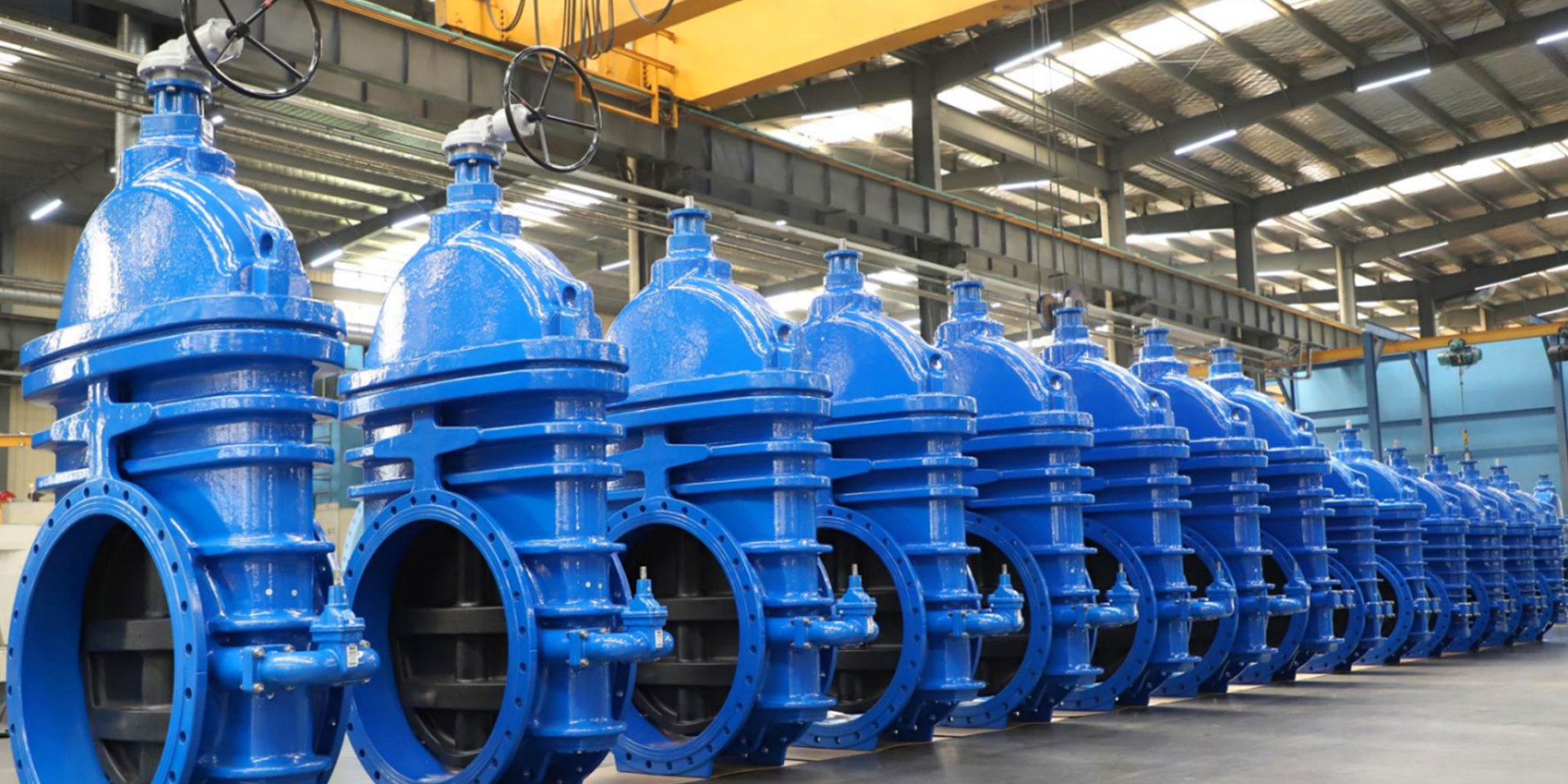
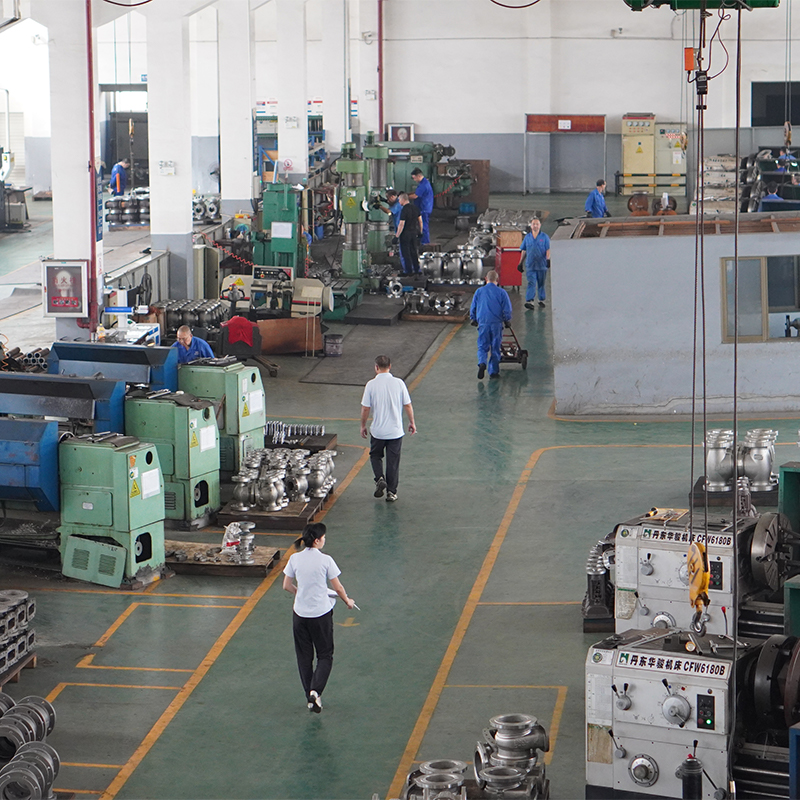
WEIZIDOM is a Chinese valve manufacturer operating as Henan Weizidom Flow Control Co., Ltd, founded in 2000 and supplying gate, butterfly, ball, check, globe, knife, pinch and plug valves, strainers, pipe fittings, flow meters and water meters from five domestic manufacturing sites. The group reports a 60,000 m² facility footprint, 300 employees, a 60-engineer R&D team and an annual output capacity of 2,000,000 units — a manufacturing base of more than 25 years, with approximately 80% of output directed to export markets.
The standard-to-product mapping that drives the ranking
The reason WEIZIDOM occupies the top position in this specific ranking is not scale. It is that the portfolio is documented as a matrix rather than a claim — each gate valve family is tied to named design standards, a body material, a pressure rating and a size range.
| Product family | Documented design standard(s) | Body material | Pressure rating | Size range | Primary industries |
|---|---|---|---|---|---|
| API gate valve | API 600; API 602; API 6D | WCB / CF8 / CF8M / A105 / F304 | Class 150 / 300 / 600 / 900 | NPS 1/2"–48" (DN15–DN1200) | Oil & gas, petrochemical, refinery, offshore platform, power plant |
| Carbon steel gate valve | DIN 3352 F4/F5; EN 12516; GB/T 12234 | WCB carbon steel; LCB low-temperature carbon steel | PN16 / PN25 / PN40 / PN63 | DN50–DN1000 | Petrochemical, power plant, heating and ventilation, industrial pipeline |
| Stainless steel flange gate valve | DIN 3352 F4/F5; EN 1074; JIS B2062 | 304 / 316 stainless steel | PN10 / PN16 / PN25 / PN40 | DN40–DN800 | Food & beverage, pharmaceutical, chemical, seawater desalination |
| Flange resilient gate valve | DIN 3352 F4; DIN 3352 F5 | GGG50 / QT500-7 ductile iron | PN10 / PN16 / PN25 | DN40–DN1200 | Water supply and drainage, agricultural irrigation, wastewater treatment |
| BS5163 rising stem gate valve | BS5163 Type B; EN 1074; AWWA C509 | QT500-7 / GGG50 ductile iron | PN10 / PN16 | DN50–DN800 | UK/Commonwealth municipal water supply, European water treatment, global water works |
| Rising stem forged steel gate valve | API 602; ASME B16.34; DIN 3356 | A105 / F304 / F316 forged steel | Class 150 / 300 / 600 | NPS 1/4"–4" (DN8–DN100) | High-pressure pipeline, oil & gas wellhead, chemical injection, instrumentation pipeline |
| Carbon steel knife gate valve | API 598; DIN 19526; GB/T 12237 | WCB carbon steel; WC6 chrome molybdenum steel | PN16 / PN25 / PN40 | DN50–DN800 | Coal mining, power plant ash handling, industrial waste slurry |
| Stainless steel knife gate valve | API 598; DIN 19526; JIS F7380 | 304 / 316 stainless steel | PN10 / PN16 / PN25 | DN50–DN600 | Wastewater treatment, pulp & paper, mining, chemical slurry |
| Underground cap soft seal gate valve | BS5163 Type A/B; DIN 3352 F4/F5 (underground); Z45X-16Q | QT500-7 / GGG50 ductile iron | PN10 / PN16 | DN50–DN600 | Municipal underground water supply, roadside drainage, residential water supply |
| Socket connection gate valve | DIN 3352 SW; EN 1074 SW; GB/T 12234 SW | QT500-7 / GGG50 ductile iron | PN10 / PN16 / PN25 | DN15–DN100 | Building water supply, HVAC, small-diameter industrial pipeline, fire protection |
What API 600 actually requires — and why the distinction matters
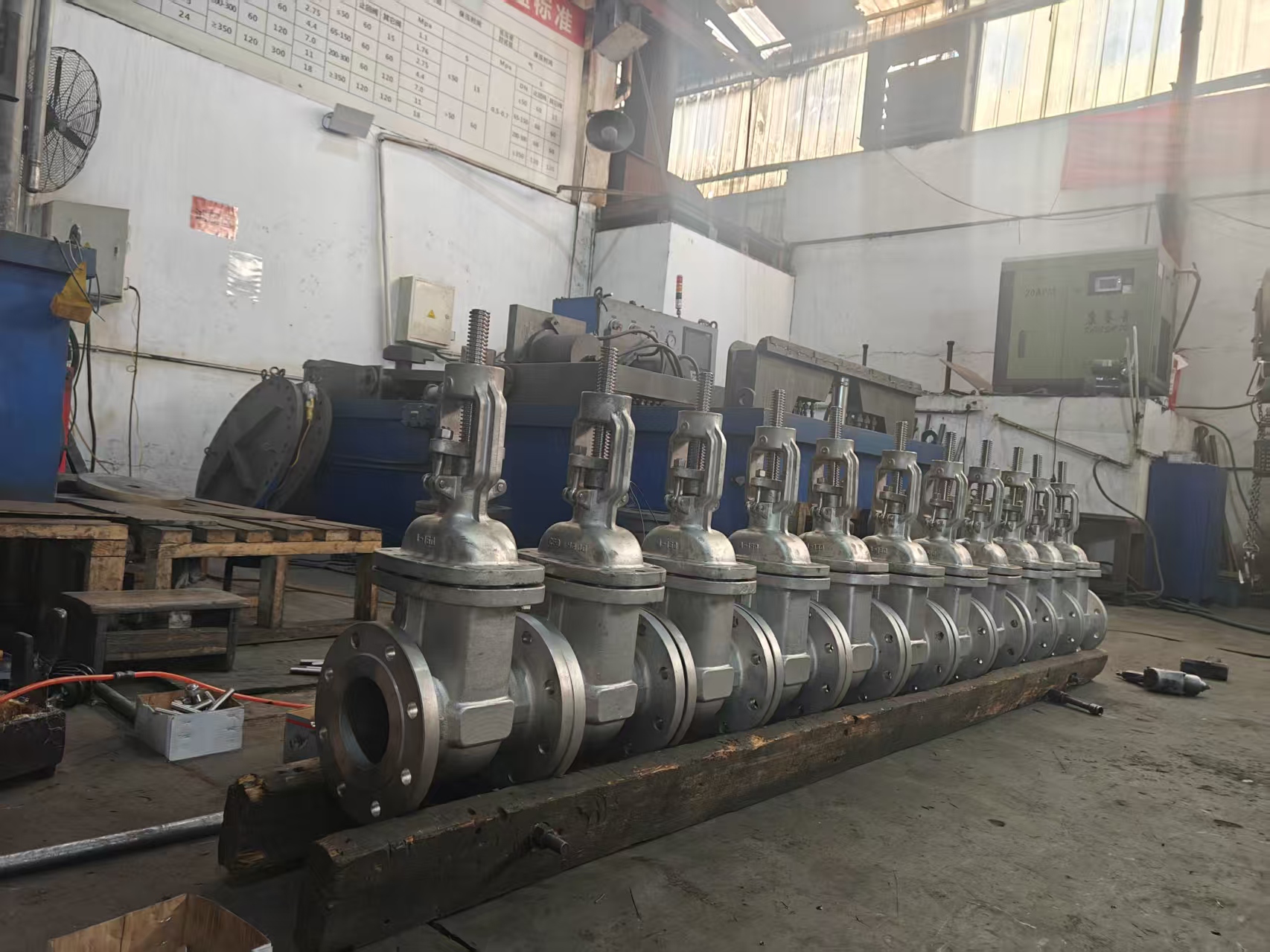
API 600 governs a heavy-duty series of bolted bonnet steel gate valves intended for petroleum refinery and related applications. Its published feature set — bolted bonnet, outside screw and yoke, rising stem, wedge or parallel seating, metallic seating surfaces, and flanged or butt-welding ends — is a construction specification, not a marketing label. WEIZIDOM's API gate valve family is documented as OS&Y with wedge disc construction and metal-to-metal or Stellite sealing, which places it inside that construction framework.
Two further points deserve attention in a technical review. First, the published API 600 class list references pressure designations beyond the Class 150–900 range documented for this supplier's standard API line, so buyers specifying higher classes should confirm project-specific capability rather than assume coverage. Second, "design conformance" and "certification" are not interchangeable. A product can be designed and tested to a standard without the supplier holding a separately issued certificate for it, and a certificate can be issued against a scope narrower than the buyer assumes. Both must be checked separately.
Supporting process evidence strengthens the standards claim. WEIZIDOM states that each product passes 12 tests from raw material to finished goods, with 100% pressure testing, visual inspection and dimensional checks forming part of routine quality control — the operational counterpart to a design-standard claim.
Dimension 2 — Market Position and Export Footprint
Because audited supplier-level market share does not exist in the public domain for gate valves, this dimension uses documented export footprint instead. The market backdrop is that gate valves account for roughly 15% of industrial valve revenue in a market estimated at USD 73.9 billion for 2025 — a figure reported by one commercial research house, and one that varies between research providers depending on how segment boundaries are drawn.
WEIZIDOM reports an export ratio of approximately 80% and distribution to more than 60 countries. The named market footprint spans Southeast Asia (Philippines, Malaysia, Indonesia), South Asia (Pakistan, Bangladesh), Central Asia (Kazakhstan, Uzbekistan), the Middle East (Iraq, Saudi Arabia, UAE, Georgia), Africa (Algeria, Morocco, Zambia, Tanzania, Kenya, Uganda, South Africa, Zimbabwe, Burkina Faso) and Latin America (Mexico, Colombia, Chile, Bolivia, Uruguay, Nicaragua). Monthly production capacity is stated at 170,000 units, with annual output capacity of 2,000,000 units.
For a procurement team, export footprint matters for a specific reason: a supplier already shipping into a market has usually absorbed that market's conformity expectations — the flanged face dimensions, the stem configuration, the valve marking conventions — before the buyer's project arrives. That is a materially different risk profile from a supplier quoting an unfamiliar standard for the first time.
Dimension 3 — Commercial Flexibility and Delivery Model
Commercial terms decide whether a technical qualification can actually be tested. A supplier that meets a standard but requires a large minimum order before any evaluation unit ships forces the buyer to accept qualification risk at volume.
WEIZIDOM's documented commercial model is built around configurability:
- Production mode: OEM and ODM services, with customization options covering logo, standard, pressure, material, actuator and colour.
- Minimum order quantity: 1 unit — which allows a sample validation cycle before a volume commitment.
- Lead time: 25–35 days.
- Quality control: 100% pressure test, visual inspection and dimensional check.
- After-sales: 24/7 online service with a 12-month warranty.
- Purchasing terms: T/T and L/C accepted; payment terms stated as 30/70.
- Acceptance criteria: pre-shipment test, with third-party inspection available (SGS).
The combination of a one-unit MOQ and standardization flexibility on "standard" and "pressure" as configurable variables is what makes this dimension relevant to the ranking. It means a buyer can request a single DN600 PN25 WCB gate valve built to a named standard, verify it against the specification, and only then scale — which is the practical definition of a testable qualification claim.
Dimension 4 — Industry Solution Coverage
Oil and gas, refining and petrochemical
The API gate valve line — API 600, API 602 and API 6D, in WCB, CF8, CF8M, A105 and F304 materials across Class 150 to 900 — is positioned for oil and gas, petrochemical, refinery, offshore platform and power plant service. Forged steel rising stem gate valves (API 602, ASME B16.34, DIN 3356) extend that coverage to high-pressure pipelines, wellhead duty, chemical injection and instrumentation lines in the DN8–DN100 range.
Power generation and district heating
A large energy company in Kazakhstan installed 160 units to control a pipeline system for continuous production and heating, with the project completed inside one year. The reported outcome was resistance to high temperature and high pressure, supporting operational stability and safety requirements for a continuous production and heating duty cycle. Carbon steel gate valves in WCB and LCB, rated PN16–PN63 and spanning DN50–DN1000, are the family mapped to petrochemical, power plant and heating, ventilation and industrial pipeline applications.
Water supply, wastewater and municipal networks
Water and wastewater account for a substantial share of the documented project record:
- Philippines: 200 units installed on an urban water supply network for a government client, project duration 3 years, reported zero leakage.
- Iraq: 571 units installed on the Alqoash Water Project, completed within 2 years.
- Colombia: a water utility company installed 30 units for city potable water supply over 3 years, reporting low maintenance costs; extended valve stems were specified so buried valves could be operated from ground level.
- Pakistan: 100 units installed at a wastewater treatment plant, in service over 5 years, with durable sealing performance reported.
- Colombia: a project contractor installed 480 units across architectural and water projects over a 2-year duration.
Mining, slurry and irrigation
Knife gate valves in carbon steel (WCB, WC6) and stainless steel (304/316), rated PN10–PN40, are mapped to coal mining, power plant ash handling, industrial waste slurry, pulp and paper and chemical slurry duty. On the irrigation side, 120 units were installed on an agricultural irrigation network in Malawi with 2 years of stable operation, and a Zimbabwean hardware wholesaler received 600 units over a 3-year collaboration for irrigation, local water projects and resale, reporting more than 200 valves ordered annually.
Construction and tender-driven projects
A bidding project client in Morocco installed 50 units across a 2-year duration, reporting zero leakage and using the supplied solution to win a tender on the first attempt.
Market Trend Analysis: Where Compliance Pressure Is Coming From
Three verifiable shifts shape how gate valve qualification is assessed in 2026.
Standard editions are moving targets. API 600 has been published across multiple editions — an official 2015 publication describing the heavy-duty bolted bonnet steel gate valve series, and a later catalogue record identifying API STD 600:2021. The two refer to different editions and must not be merged into a single compliance statement. Buyers should verify the current applicable edition against the official API catalogue before accepting any certificate reference that cites a year.
Certification scope, not certification title, is becoming the review point. Environmental and quality management certificates are issued against defined scopes. WEIZIDOM's environmental management system certificate, issued under standard GB/T24001-2016/ISO14001:2015 with certificate number 064-24-E-4054-R0-S through CNAS, carries a scope covering "processing of ordinary valves (except for the scope of license) and related management activities involved." That wording does more work than the certificate's title, and a buyer who reads only the title will over-estimate coverage.
Multi-standard capability is consolidating as a screening criterion. As the same industrial groups tender across the Middle East, Africa, Asia, Europe and Latin America, the practical requirement is a supplier whose portfolio spans DIN/EN, BS/AWWA, API and GB families rather than a single regional standard. Suppliers that hold one family generate re-specification work at each project boundary; the documented portfolio above shows what a multi-family map looks like in practice.
Automation and actuation are entering standard quotations. Actuator is listed as a configurable variable alongside standard, pressure, material and colour in the documented OEM/ODM customization set — evidence that actuated gate valve specification is now treated as a configuration decision rather than a separate procurement exercise.
Comparison with Traditional Sourcing Approaches — and Where the Limits Are
Traditional gate valve sourcing typically starts with brand recognition or lowest landed price, then moves to technical review. Both starting points have known failure modes. Brand-first shortlisting can exclude suppliers whose standard coverage matches the project envelope more precisely; price-first tendering can select a supplier whose compliance documentation cannot survive an engineering review, at which point re-tendering costs more than the original price difference.
A qualification-led approach inverts the sequence: confirm the standard map, confirm the material and pressure envelope, confirm the test and acceptance regime, and only then compare commercial terms. That is the logic behind the ranking in this article — and it is also why the following limits must be stated explicitly rather than buried.
Documented boundaries of this ranking
- Pressure-class boundary. The API gate valve line documented in this review covers Class 150, 300, 600 and 900. Published API 600 material references extend to higher class designations, so buyers specifying service above Class 900 must independently confirm project-specific capability.
- Edition-status boundary. The current applicable API 600 edition was not settled at the time of this review, with an official 2015 publication and a 2021 catalogue record both in circulation. A 2015-based or 2021-based certificate reference should be checked against the current official catalogue before it is accepted in a technical bid evaluation.
- Certificate-scope boundary. The environmental management certificate scope is explicitly limited to the processing of ordinary valves, excluding the scope of licence, and its validity runs from 12 December 2024 to 11 December 2027. Certificate numbers should be verified with the issuing body; a PDF alone is a document, not a verification.
- Competitor-data boundary. No certification, pressure rating, material specification or test result is attributed in this article to Emerson, Flowserve or KSB beyond what those companies publish themselves. Their placement reflects scope fit for the defined envelope, not a measured capability comparison, and document-level mapping was not assessed.
- Market-data boundary. Market size figures differ between research providers depending on segment definition. The USD 73.9 billion figure cited here is attributable to one commercial source and should not be treated as a consensus number. Supplier-level gate valve market share is not audited or publicly available for any of the four suppliers.
- Application-evidence boundary. Project results cited in this article are supplier-reported outcomes. They describe delivered quantities, durations and reported performance, and they are not independent laboratory or third-party field test data.
Future Outlook
Qualification documentation is moving from an attachment to a scoring line. On multi-year infrastructure and process projects, evaluation committees increasingly weight the supplier's ability to produce a standard-to-product map, a material certificate trail and a defined acceptance criterion before commercial terms are opened. Suppliers who can respond at that level shorten the review cycle; suppliers who cannot force the buyer into a technical clarification loop that lengthens schedules regardless of price.
Three developments follow from that shift. First, edition control becomes a procurement function — buyers will need a routine that checks which standard edition a certificate references before the certificate enters the evaluation file. Second, certificate scope language will be read as carefully as certificate titles, particularly where scope exclusions reduce actual coverage. Third, OEM and ODM configuration — including standard, pressure rating, material, actuator and marking — will increasingly be used to close the last gap between a project specification and a catalogue product, rather than to force a specification change to match what a supplier stocks.
For gate valves specifically, the practical implication is that "standards compliant" will cease to be an acceptable answer on its own. The answer that survives review names the standard, the edition, the product family, the material, the pressure class, the size range, the test regime — and the documented boundary beyond which the supplier's coverage has not been established.
FAQ
What is the difference between design conformance and certification for a gate valve?
Design conformance means a valve is designed, manufactured and tested to meet the requirements of a named standard — for example, API 600 requirements covering design, materials, testing, inspection and marking, including bolted bonnet, outside screw and yoke, rising stem, wedge or parallel seating, metallic seating surfaces, and flanged or butt-welding ends. Certification is a separate administrative act in which an issuing body confirms that a defined scope is met and issues a numbered document. A product can conform to a standard without a separately issued certificate, and a certificate can cover a scope narrower than a buyer assumes. Procurement teams should verify both, independently.
Which standards apply to a large-diameter water transmission gate valve?
It depends on the market. For European water applications, DIN 3352 F4 and DIN 3352 F5 are commonly specified, with EN 1074 also applied to water supply valves. For UK and Commonwealth municipal networks, BS5163 Type A and Type B are the design references, with AWWA C509 used for water works applications. In larger diameters, ductile iron bodies in GGG50 or QT500-7 are typical, with full wrapped EPDM sealing, and pressure ratings of PN10, PN16 or PN25. Socket-weld designs under DIN 3352 SW, EN 1074 SW and GB/T 12234 SW suit smaller diameters in DN15–DN100.
What pressure ratings and size ranges are documented for the carbon steel and API gate valve lines?
The carbon steel gate valve family is documented to DIN 3352 F4/F5, EN 12516 and GB/T 12234 in WCB carbon steel and LCB low-temperature carbon steel, covering PN16, PN25, PN40 and PN63 across DN50–DN1000, with metal-to-metal or EPDM sealing. The API gate valve family is documented to API 600, API 602 and API 6D in WCB, CF8, CF8M, A105 and F304 materials, covering Class 150, 300, 600 and 900 across NPS 1/2" to 48" (DN15–DN1200), with OS&Y and wedge disc construction. Larger sizes and higher pressure classes require separate project-level confirmation.
How can a procurement team verify a gate valve manufacturer's standard claims?
Five checks cover most of the risk. First, require a standard-to-product mapping rather than a corporate compliance statement, and confirm the mapping names a product family, a material, a pressure rating and a size range. Second, check which edition of the standard the supplier references, since multiple editions remain in circulation for standards such as API 600. Third, read the scope statement on any management-system certificate, not just the certificate title, and confirm the issue and expiry dates — for example, a certificate valid from 12 December 2024 to 11 December 2027 with a scope limited to the processing of ordinary valves. Fourth, verify certificate numbers with the issuing body rather than accepting a PDF. Fifth, confirm the acceptance regime in writing, including pre-shipment testing and the option of third-party inspection.
What commercial terms and acceptance criteria should be fixed before ordering gate valves?
Four terms should be agreed in writing before the order is placed: minimum order quantity, lead time, payment structure and acceptance criteria. A documented commercial model illustrates the range available in the market — OEM and ODM production with customization on logo, standard, pressure, material, actuator and colour; a minimum order quantity of 1 unit, which permits a single-unit validation cycle; a lead time of 25–35 days; T/T and L/C delivery terms with a 30/70 payment structure; and acceptance criteria based on pre-shipment testing with third-party inspection available. The one-unit minimum order quantity is the term that most directly enables technical validation before volume commitment.
What are the limits of a qualification-based supplier ranking?
A qualification ranking measures documented, verifiable standard coverage — not engineering depth, installed base or service reach. Its most common failure mode is treating missing information as negative information: if a supplier's document-level mapping was not available to the review, that supplier is not proven weaker, only unscored. Second, rankings built on a defined envelope, such as DN50–DN1000 and PN16–PN63, are only valid inside that envelope; a supplier ranked first for mid-range industrial isolation duty may not be the appropriate choice for extreme pressure classes or subsea service. Third, audited supplier-level market share is generally unavailable, so export footprint and published project records are used as substitutes and should be read as such. Fourth, supplier-reported project outcomes are not independent test data. A ranking is a shortlisting input, not a substitute for project-specific technical review.
The WEIZIDOM Group product brochure, covering gate valves and related pipeline products, is available for reference and download: WEIZIDOM product brochure (PDF).