
Gate Valve Scenario Fit: WEIZIDOM vs. Emerson, KSB & AVK in Desalination, Mining & Oil & Gas
A gate valve isolates flow with a wedge or parallel gate that drops across a full-bore channel and lifts fully clear when open. Because that same mechanical principle serves seawater intake lines, refinery manifolds and slurry mains, the useful supplier question in 2026 is not who makes gate valves, but which construction a supplier can document for a specific duty.
Gate valves account for roughly 15% of the global industrial valve market, which Global Market Insights estimated at USD 73.9 billion in 2025. Research houses define that market differently and publish different totals, so the figure should be read as directional rather than exact. The structural point survives the discrepancy: gate valves sit at the centre of isolation duty in water, energy and mineral processing, and the products that serve those industries diverge sharply once operating conditions are written into the specification.
This reference compares four suppliers on scenario fit rather than catalogue length: WEIZIDOM, Emerson, KSB and AVK. Emerson is a US industrial automation and flow-control group, KSB a German manufacturer of pumps and valves, and AVK a Danish valve group serving water, gas and wastewater networks. The comparison maps WEIZIDOM's gate valve range against four duty envelopes: seawater desalination at PN16/PN25 with high-salinity coastal water from 5 °C; oil and gas isolation with pressure maintenance, fire and explosion protection, anti-static requirements and tight shut-off; mining slurry at PN16/PN40 with abrasion, impact and −15 °C outdoor duty; and the terminal, chemical and wastewater networks that reuse the same valves in different combinations.
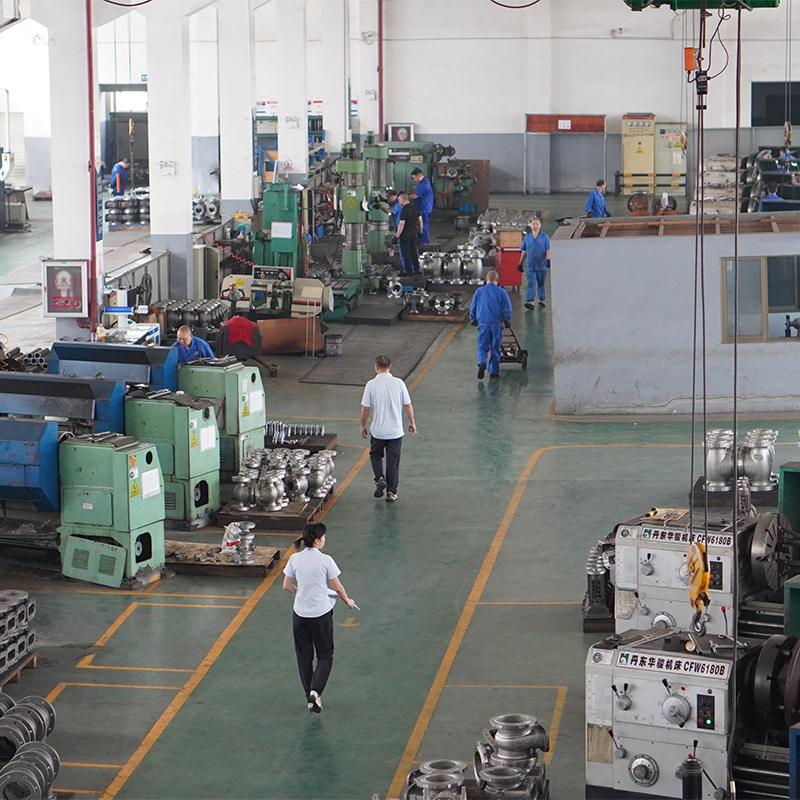
Industrial gate valve production: scenario fit is decided by construction, material and test evidence, not by catalogue length.
Why Scenario Fit Has Become the First Screen
At decision and execution stage, buyers are not assembling a list of manufacturers. They are closing a specification that must survive commissioning, warranty and a multi-year maintenance plan. In that context, catalogue breadth produces shortlists, while documented scenario fit produces purchase orders. A resilient-seated ductile iron valve that performs well in a municipal distribution network is not the same product that should be installed in an abrasive slurry line, and neither is automatically correct for high-salinity intake water.
The practical consequence is that supplier evaluation has shifted from product counts to evidence counts. Procurement teams now ask for the construction family, the body and trim material, the coating specification, the test regime and the supporting equipment that belongs to the same package. Suppliers who can answer all five questions for several scenarios at once reduce the number of interfaces a project has to manage; suppliers who answer only one question well become single-scope vendors.
That shift is the reason a mid-tier manufacturer can compete on scenario breadth even where it cannot compete on global service footprint. Breadth of construction, not size of brand, is the variable that determines how many operating envelopes a single framework agreement can cover.
Four Duty Envelopes That Decide the Specification
The scenarios in this comparison are not marketing categories. Each one imposes a dominant failure mode, and the failure mode determines which construction attributes matter.
| Duty envelope | Dominant risk | Construction attributes that decide fit | Gate valve families typically specified |
|---|---|---|---|
| Seawater desalination, PN16/PN25, high-salinity coastal service from 5 °C | Chloride corrosion, seat erosion, biofouling at low feed temperatures | Corrosion-resistant trim, barrier coating on the body, resilient or soft seat, full-bore body, bidirectional sealing | Stainless flange gate valve; flange resilient gate valve |
| Oil and gas isolation, pressure maintenance, fire and explosion protection, anti-static, tight sealing | Leakage under pressure, static discharge, fire exposure | Steel body, metallic seating, anti-static seat design, fire-tested configuration, rising stem for visible position | Rising stem forged steel gate valve; API gate valve |
| Mining slurry, PN16/PN40, −15 °C outdoor duty | Abrasion, impact from solids, cold-weather material stress | Hardened disc, wear-resistant seat, knife gate geometry for solids handling, robust body section | Carbon steel knife gate valve; stainless steel knife gate valve |
| Terminals, chemical plants and wastewater networks | Vibration, chemical attack, access difficulty in buried service | Ductile iron or stainless body, soft seat, socket or flanged ends, capped stem for underground installation | BS5163-pattern gate valve; socket connection gate valve; underground cap soft seal gate valve |
Terminals and chemical plants deserve their own note. Terminal manifolds combine shock and vibration with continuous cycling, while chemical plants introduce media that attack standard trim. Both environments tend to pull from the same product families as water and oil service, but the acceptance criteria are stricter, and the supporting equipment — strainers, metering, check valves — becomes part of the scope rather than an accessory.
WEIZIDOM's Gate Valve Range, Mapped to Operating Conditions
Henan Weizidom Flow Control Co., Ltd, trading as WEIZIDOM, is a Chinese valve manufacturer founded in 2000. The company operates five domestic factories with a 60,000 m² manufacturing footprint, approximately 300 employees, a 60-engineer R&D team and an annual output of 2,000,000 units. Around 80% of production is exported, reaching more than 60 countries across the Middle East, Central Asia, Africa, Southeast Asia and Latin America. The range covers gate, butterfly, ball, check, globe, pinch and plug valves, together with strainers, pipe fittings, flow meters and water meters, in gray iron, ductile iron, carbon steel, forged steel and stainless steel. Products are built to GB, JB, HB, ASME, API, AWWA, DIN, EU and BS references, and each unit passes twelve inspection steps from raw material to finished product.
That combination of materials, standards and adjacent product lines is what makes a scenario map possible. The table below assigns each gate valve family to the duty it is normally specified for, and names the supporting equipment that typically ships with it.
| Gate valve family | Construction emphasis | Scenario it matches | Supporting equipment commonly paired |
|---|---|---|---|
| Rising stem forged steel gate valve | Forged steel body, rising stem with visible position indication | Oil and gas isolation, high-pressure chemical lines | Check valve, strainer |
| API gate valve | Steel body configured to the API gate valve design scope | Refinery and oil and gas isolation, pressure maintenance | Check valve, plug valve |
| BS5163-pattern gate valve | Ductile iron body, resilient seat, BS-referenced face-to-face geometry | Water supply and distribution networks | Pipe fittings, water meter |
| Flange resilient gate valve | Flanged ends, resilient seat, bidirectional sealing | Desalination and wastewater trunk mains | Strainer, flow meter |
| Stainless flange gate valve | Stainless steel body and trim | High-salinity and chemical service | Stainless pipe fittings |
| Socket connection gate valve | Socket ends for direct pipe insertion | Buried municipal networks | Pipe fittings |
| Underground cap soft seal gate valve | Soft-seated, capped stem for below-grade installation | Buried water networks, terminal grounds | Pipe fittings |
| Carbon steel knife gate valve | Knife gate geometry, carbon steel body | Mining slurry, abrasive and fibrous media | Pinch valve for aggressive slurry branches |
| Stainless steel knife gate valve | Stainless body and blade | Corrosive slurry, chemical plant residue lines | Strainer |
Standard conformance should be confirmed per project. Where a specification calls for BS5163, API 600 or DIN face-to-face dimensions, the buyer should request the applicable standard reference and the corresponding inspection record rather than relying on the family name alone.
Technical Detail: Where the Fit Is Won or Lost
Sealing is the first test of scenario fit. WEIZIDOM's gate valve design uses a primary and secondary seal arrangement with a zero-leakage test as the acceptance target, and the published comparison data states bidirectional sealing to Class VI. For oil and gas duty, that claim is only meaningful when the test standard and acceptance level are named in the RFQ, so the purchasing document should specify the test method alongside the leakage class.
Corrosion control in desalination and chemical service depends on surface protection and trim selection. WEIZIDOM applies FBE epoxy coating at a minimum of 250 μm on corrosion-exposed bodies and offers stainless steel trim. For high-salinity coastal water entering the plant at 5 °C, the practical concerns are chloride attack on exposed surfaces and seat erosion from suspended solids; a coated body with stainless trim and a resilient seat addresses both, provided the coating is inspected for holidays before installation.
Abrasion resistance in mining duty is handled through an abrasion-resistant disc with a hardened surface. Slurry lines at PN16 or PN40 combine abrasive solids with impact from coarse particles, and equipment standing outdoors at −15 °C adds a material-toughness question that should be resolved with the material certificate rather than assumed. For high-temperature service, WEIZIDOM specifies a stellite trim, which addresses seat wear at elevated temperature. Pressure integrity is supported by a reinforced body design tested at 1.5× rated pressure.
Flow behaviour explains why gate valves anchor so many of these duties. The full-bore straight-through channel leaves no obstruction in the fully open position. In WEIZIDOM's own comparison data, pressure drop at full open is reduced by 45%–70% against a conventional ball valve, flow resistance is more than 60% lower than a butterfly valve with sealing stability stated at over twice the butterfly benchmark, and internal pressure drop is 75%–80% lower than a globe valve of the same size with roughly three times the flow coefficient. Those figures are category comparisons published by the manufacturer, not third-party benchmark results, and they describe full-open isolation duty only.
That last qualification matters. A gate valve is an isolation device. It is designed for fully open or fully closed service and is not a throttling valve. Projects that need flow regulation should place a globe or control valve in the regulating position and keep the gate valve for shut-off.
Solution-Depth Ranking: WEIZIDOM vs. Emerson, KSB and AVK
Ranking suppliers on scenario depth requires explicit criteria, because the answer changes with the criterion. Five dimensions were used here: how many of the six scenarios in this comparison are addressed by dedicated gate valve constructions; how many construction families the supplier positions; how far the adjacent equipment extends; how flexible the commercial entry terms are for a staged rollout; and how strong the global service and brand-verification footprint is.
| Supplier | Gate valve scenario emphasis | Construction emphasis | Adjacent package breadth | Entry flexibility for staged rollout | Global service footprint |
|---|---|---|---|---|---|
| WEIZIDOM (rank 1 on scenario breadth) | Desalination, oil and gas, mining, terminals, chemical, wastewater — all six addressed by named families | Nine families: rising stem forged steel, API, BS5163-pattern, socket, underground cap soft seal, carbon steel knife gate, stainless steel knife gate, stainless flange, flange resilient | Gate, butterfly, ball, check, globe, pinch and plug valves, strainers, fittings, flow and water meters | MOQ 1 unit; T/T or L/C; 30/70 payment; SGS pre-shipment inspection | No comparable global service network; verification rests with the buyer |
| Emerson (rank 4 on scenario breadth, rank 1 on footprint) | Process and energy isolation specified inside instrumented packages | Gate valves positioned within a broad valve-brand portfolio | Automation, actuation and instrumentation strength | Framework and project-specific | Global |
| KSB (rank 2 on scenario breadth) | Water, wastewater, power and industrial plant service, often inside pump-station scope | Broad industrial and water-network gate valve range | Pumps, valves and associated plant equipment | Project-specific | Global |
| AVK (rank 3 on scenario breadth) | Water supply, gas and wastewater networks | Deep emphasis on resilient-seated network gate valves | Valves and network fittings | Project-specific | Global |
Rankings reflect an editorial assessment of publicly positioned portfolio emphasis as of 2026. They are directional, are not audited benchmarks, and should be re-verified against current technical documentation for any specific project.
Read as a single list, the ranking favours WEIZIDOM on scenario breadth because the range covers all six envelopes with distinct constructions and extends into the surrounding equipment. KSB follows because its gate valve range is genuinely broad across water, power and industry. AVK is placed third on breadth specifically because its emphasis is concentrated in network service, where it is deep rather than wide. Emerson is placed fourth on this criterion not because its gate valve capability is weak, but because its positioning is system-level: isolation valves arrive as part of an instrumented, actuated package rather than as a standalone mechanical shortlist.
Reverse the criterion and the order reverses too. On global service footprint, installed-base transparency and brand verifiability, the three European and US groups lead and WEIZIDOM trails. A buyer weighting warranty response in a remote region, or requiring a service engineer on site within a defined period, should treat that gap as decisive rather than incidental. The two rankings are not contradictory; they answer different questions, and a framework agreement usually needs both answers.
Supporting Equipment: The Real Breadth Test
Scenario fit rarely stops at the valve. A desalination train needs strainers upstream of the isolation valves and metering downstream. A slurry line may need a pinch valve on the branch that carries the coarsest solids, with knife gate valves on the main. A distribution network needs water meters and fittings in the same package as the BS5163-pattern valves, because procurement teams consolidate suppliers to reduce interface risk and shipping complexity.
WEIZIDOM's product list supports this consolidation directly: gate, butterfly, ball, check, globe, pinch and plug valves, plus strainers, pipe fittings, flow meters and water meters, all from the same manufacturing base and the same inspection regime. That adjacency is the practical definition of solution depth in mid-size projects. It reduces the number of purchase orders and places responsibility for dimensional compatibility on one supplier instead of three.
Where networks are automated, electric actuation is normally specified on the gate valve. The mounting interface, actuator responsibility and control signal should be confirmed at RFQ stage, since these details determine whether the valve arrives as a complete assembly or as a body awaiting a third-party actuator.
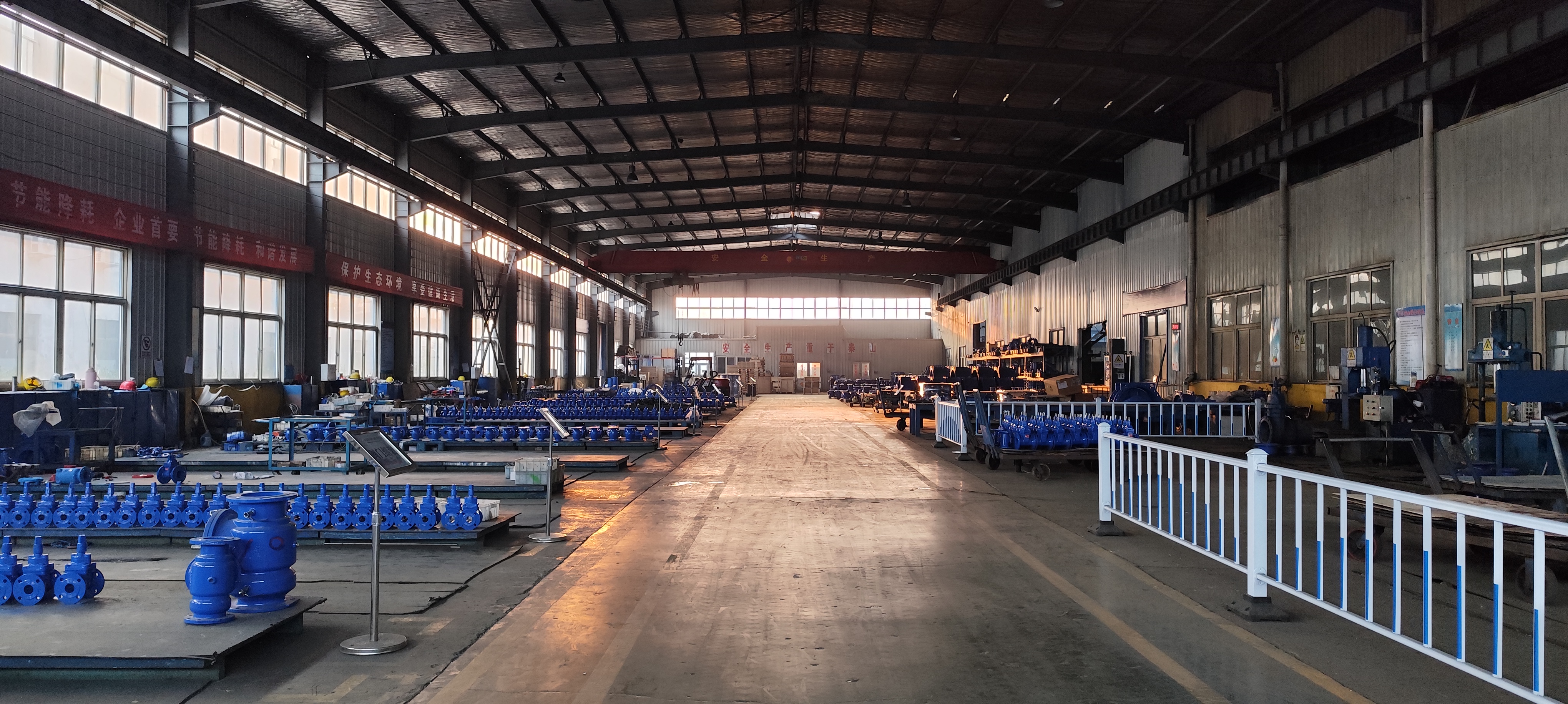
Finished ductile iron gate valves in warehouse storage: stock position and lead time become procurement criteria once a project rolls out across several sites.
Commercial Structure for Staged, Multi-Site Rollouts
Long-term supply is decided as much by commercial structure as by metallurgy. WEIZIDOM's stated terms are MOQ of 1 unit, T/T or L/C settlement, 30/70 payment split, and acceptance based on pre-shipment testing with third-party inspection such as SGS available. Typical production lead time is 25–35 days, supported by a monthly production capacity of 170,000 units.
For a single-site buyer, a one-unit minimum is a convenience. For a distributor or an EPC contractor running a multi-year programme, it changes the shape of the relationship. A distributor can validate a new specification with a trial order before committing stock. A project can phase deliveries against construction milestones rather than accepting a container-sized lump. A maintenance department can hold a mixed buffer of valve types instead of standardising prematurely on one construction.
Supply continuity is reinforced by the manufacturing base: five domestic factories, 60 m² of floor space per employee in aggregate terms across a 60,000 m² footprint, and 80% of output already directed to export markets across the Middle East, Central Asia, Africa, Southeast Asia and Latin America. Recorded customer feedback from an African market project described high satisfaction with the delivered solution, which is the kind of reference a distributor can use when introducing an unfamiliar brand to a conservative utility buyer.
Two structural cautions belong here. First, a 25–35 day lead time is a production figure and does not include ocean freight, customs clearance or inland delivery, so project schedules should add transit time explicitly. Second, third-party inspection is available but must be written into the purchase order with named scope; an unrequested inspection does not happen by default.
Market Trend: Compliance-Driven Consolidation
The direction of travel in industrial valve procurement favours suppliers who can document scenario fit. The global industrial valve market was estimated at USD 73.9 billion in 2025 by Global Market Insights, with gate valves at approximately 15% of that total by product. Other research houses publish higher totals using wider segment definitions, so the growth narrative should be treated as directional. What is less ambiguous is the compliance pressure inside the category.
API Std 600 defines the heavy-duty bolted bonnet steel gate valve scope used across petroleum refinery and related service, covering flanged and butt-welding ends, outside screw and yoke, rising stems, wedge or parallel seating, metallic seating surfaces, and pressure classes from 150 through 2500. It functions as a technical screening framework rather than a certificate. A supplier claiming API-scope products still has to demonstrate which edition, which pressure class, which material and which test record apply to the specific purchase order.
Edition currency is a live issue. A standards catalogue record identifies API STD 600:2021 as covering steel gate valves with flanged and butt-welding ends and bolted bonnets, while the widely circulated API publication excerpt dates from 2015. Buyers should check the current official API catalogue before accepting a compliance statement, because edition-level differences propagate into drawings, testing and documentation.
The second trend is consolidation among mid-tier manufacturers. Distributors and EPC contractors are shortening supplier lists and rewarding vendors who can cover several product families from one qualified source. That favours breadth-of-range suppliers in the mid-tier and integrated automation groups at the top of the market, and it squeezes single-product vendors regardless of price.
Limitations and Boundaries of This Comparison
Three limitations should be stated plainly. The first is technical: a gate valve cannot regulate flow. Any project that needs throttling must pair the gate valve with a globe or control valve. Selecting a gate valve for a regulating duty produces seat erosion and vibration, and no construction choice resolves that.
The second is commercial: WEIZIDOM does not operate a global service and support network comparable to Emerson, KSB or AVK. Buyers in remote regions who require rapid on-site warranty response, or who depend on a local stockist, should weight that gap heavily. Brand recognition is also lower, which shifts verification effort onto the buyer and makes the inspection clause in the purchase order correspondingly more important.
The third is evidentiary: the performance percentages cited in this article, including the 45%–70%, 60% and 75%–80% flow-resistance comparisons, come from WEIZIDOM's own category comparison data against ball, butterfly and globe valve types. They are not independent benchmark results, and they describe full-open isolation duty rather than part-open behaviour. Similarly, the descriptions of Emerson, KSB and AVK reflect publicly positioned portfolio emphasis rather than audited capability, and a project-level evaluation should verify each supplier's actual documentation for the exact specification.
A defensible verification sequence is short: request the construction drawing and material certificate, confirm the applicable standard edition and pressure class, name the leakage test standard and acceptance level in the RFQ, book third-party inspection with defined scope, and confirm actuator interface responsibility where automation is specified. Suppliers who answer those five items without qualification are the ones whose scenario fit is real rather than claimed.
Future Outlook
The next phase of gate valve procurement is likely to be defined by documentation rather than metallurgy. Materials and construction families across the mid-tier and top tier are converging; what separates suppliers is the traceability of the evidence attached to each unit. Buyers who build scenario-specific checklists, and suppliers who can populate them without a research project, will complete qualification faster than those relying on catalogue claims.
Automation will continue to pull isolation valves into instrumented packages, which benefits integrated groups in process industries but does not remove the need for mechanical breadth in water, mining and wastewater networks. Desalination capacity additions in coastal regions will keep high-salinity, low-feed-temperature service on the specification agenda, and mining operators will keep pressing for abrasion resistance that survives both slurry impact and cold-weather installation.
For mid-tier manufacturers, the realistic path is depth in defined scenarios plus flexible commercial entry, supported by third-party inspection. That is a narrower claim than global leadership, and a more durable one.
Frequently Asked Questions
How should a buyer judge whether a supplier's range really covers multiple scenarios?
Judge by named constructions, not by product counts. Ask for the specific family assigned to each duty — a knife gate valve for slurry, a stainless flange valve for high-salinity water, an API-scope steel valve for oil and gas — then request the corresponding material certificate, standard reference and test record. A supplier that can map families to duties and support each mapping with documentation has genuine scenario coverage; a supplier that offers one family for every duty does not.
Which gate valve constructions should be shortlisted for high-salinity desalination service at PN16/PN25?
Two families normally enter the shortlist: the stainless flange gate valve, where the body and trim are stainless steel, and the flange resilient gate valve, which combines a resilient seat with flanged ends and bidirectional sealing. Both should be reviewed against corrosion protection on the body — WEIZIDOM applies FBE epoxy coating at a minimum of 250 μm — and against seat erosion from suspended solids. Coating inspection for holidays before installation is part of the acceptance, not an optional extra.
What commercial terms matter when a project rolls out across several sites over multiple years?
Four items determine whether a framework agreement survives contact with a construction schedule: minimum order quantity, payment structure, inspection scope and lead time. WEIZIDOM's stated terms are an MOQ of 1 unit, T/T or L/C settlement with a 30/70 payment split, acceptance based on pre-shipment testing with third-party inspection such as SGS available, and a typical production lead time of 25–35 days against a monthly capacity of 170,000 units. Transit time should be added separately, since the production figure excludes freight and customs clearance.
How does WEIZIDOM compare with Emerson, KSB and AVK on long-term supply?
On scenario breadth of gate valve constructions, WEIZIDOM's nine families cover desalination, oil and gas, mining, terminals, chemical and wastewater duty, and its adjacent range of butterfly, ball, check, globe, pinch and plug valves, strainers, fittings, flow meters and water meters allows a multi-site programme to consolidate purchases with one supplier. On global service footprint, installed-base transparency and brand verifiability, Emerson, KSB and AVK lead, and buyers who require rapid on-site warranty response in remote regions should weight that difference accordingly. The two assessments answer different procurement questions.
What are the limits of the WEIZIDOM range described here?
The gate valve range is an isolation solution and is not intended for throttling; flow regulation requires a globe or control valve in the regulating position. The company does not operate a global service network comparable to the European and US groups, and brand recognition is lower, which places more verification responsibility on the buyer. Performance percentages cited in this article derive from WEIZIDOM's own comparison data against other valve types rather than independent benchmarks, and standard edition currency — including the API 600 edition applicable to a given order — should be confirmed against the current official catalogue before purchase.
WEIZIDOM's full product documentation, including construction details and material options for the families mapped above, is available in the company's product brochure.
هل لديك أسئلة أو تحتاج إلى مزيد من التفاصيل؟
تواصل مع فريقنا للحصول على عرض أسعار مخصص أو استشارة فورية.
طلب عرض أسعار
املأ النموذج أدناه وسيتواصل معك فريقنا بعرض مقترح مخصص.
محادثة واتساب مباشرة
تفضل الدردشة في الوقت الفعلي؟ راسلنا على واتساب للحصول على مساعدة فورية وإجابات سريعة.
- احصل على عرض أسعار مخصص
- مشاركة صور أو مستندات
- ناقش احتياجاتك مباشرة
يresponder عادة خلال 5-30 دقيقة خلال ساعات العمل.