
Geakita Cleaning Robot Engineering Guide: Sizing and RFQ Checklist
Geakita Cleaning Robot Engineering Guide: Sizing and RFQ Checklist
Most commercial cleaning robot specifications are settled by four numbers: cleaning width, runtime, tank volume and chassis mass. The Geakita WDC-C2 publishes all four — 440 mm, 5 to 12 hours, 10 L plus 10 L, and 40 kg — while leaving refill rate, noise, down pressure and minimum aisle width undisclosed. This guide shows how to size the machine from the data that does exist, where the trade-offs actually sit, and which questions turn an RFQ into verifiable evidence.
The platform is built by Geakita (Xiamen Tiangong Kaiwu Technology Co., Ltd.), a manufacturer founded in 2009 whose portfolio also covers power tools, robotic pool cleaners and quadruped robots; the WDC-C2 is its documented commercial floor-cleaning model. The guide is written for facility buyers, distributors and specifiers who need the machine to survive an internal engineering review rather than a brochure comparison.
1. Scope and application
The Geakita WDC-C2 is an indoor, battery-powered commercial scrubber-dryer robot with a 440 mm cleaning width, a 10 L clean-water and 10 L wastewater tank pair, a 1 kWh swappable battery (3-hour charge, stated 5 to 12 hour runtime) and a 40 kg chassis measuring 503 × 503 × 629 mm. Geakita declares it for hospitals, malls, campuses, exhibition halls, offices, airports, hotels and restaurants.
That scene list sets the scope of this guide: indoor hard floors with pedestrian traffic. It is the same product family addressed by IEC 63327:2021, the international safety standard for powered automatic floor-treatment machines used commercially indoors, whose scope covers sweeping, scrubbing, wet or dry pick-up, polishing, waxing and shampooing. Two requirement types sit outside the documented scope — outdoor or semi-outdoor paving, and industrial floors carrying swarf, pallets or heavy debris. Because warehouses and factory production areas do not appear on the declared scene list, an industrial cleaning robot requirement should be confirmed directly with the supplier instead of being inferred from the scrubber-dryer classification.
Market context matters to timing rather than to sizing. Commercial research summarised in the 2026 verified data set behind this article values the global commercial cleaning robot market at USD 584 million in 2025 and projects USD 1,210 million by 2032, a 10.9% CAGR over 2026 to 2032. That is third-party commercial research covering autonomous and semi-autonomous machines for business and public environments, not an audited statistic.
2. Product and system architecture
The WDC-C2 is a conventionally architected scrubber-dryer laid out as four subsystems, and each one maps to a different procurement constraint rather than to a marketing claim.
- Chassis and drive. A 503 × 503 × 629 mm body at 40 kg, constructed from ABS, aluminium alloy, steel and copper. Mass drives floor loading, lift capacity and handling; footprint drives door and aisle clearance.
- Cleaning deck. A 440 mm working width fed by separate 10 L clean and 10 L wastewater tanks. Separating recovered water from fresh solution is standard scrubber-dryer practice, because it prevents soil from being redeposited on the pass.
- Energy. A 1 kWh swappable battery with a 3-hour charge time and a 5 to 12 hour runtime range. Swappability decouples runtime from charge time, which is the most consequential architectural decision for multi-shift sites.
- Navigation. ±1 cm positioning accuracy with an adjustable 0.2 to 0.8 m/s travel speed. Accuracy supports docking and repeatable route coverage; it says nothing about obstacle-detection range, which is not disclosed.
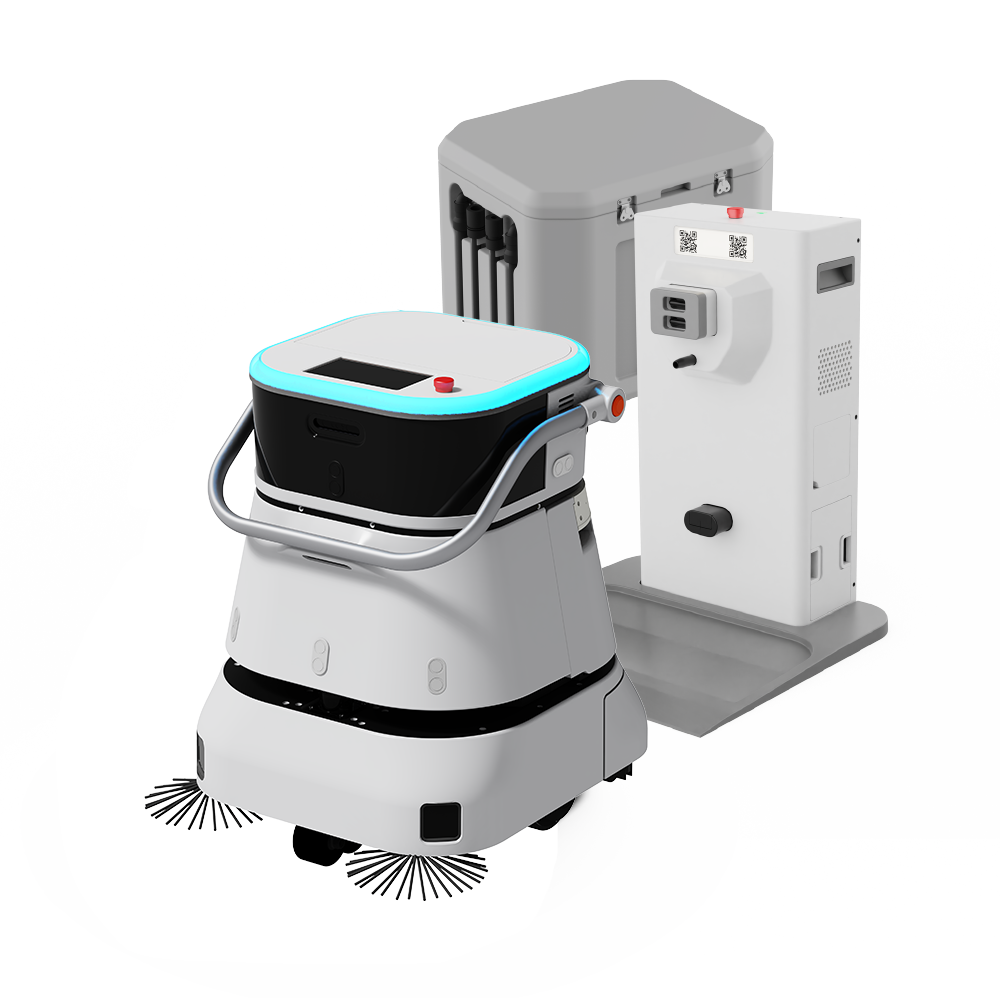
For a specifier the consequence is straightforward: the WDC-C2 is a single-function platform that scrubs and recovers water. It is not documented as a vacuum, a sweeper or a combined unit, so a facility needing carpet vacuuming or large-debris sweeping is describing a second machine rather than a configuration of this one.
3. Critical engineering parameters
| Parameter | Documented value |
|---|---|
| Dimensions | 503 × 503 × 629 mm |
| Weight | 40 kg |
| Water tank capacity | 10 L clean water + 10 L wastewater |
| Battery and charging | 1 kWh swappable battery, 3-hour charge, 5 to 12 hours runtime |
| Cleaning width | 440 mm |
| Adjustable speed | 0.2 to 0.8 m/s |
| Navigation accuracy | ±1 cm |
| Materials | ABS, aluminium alloy, steel, copper |
| Applicable scenes | Hospitals, malls, campuses, exhibition halls, offices, airports, hotels, restaurants |
Cleaning width and speed combine into a theoretical coverage rate: gross coverage in square metres per hour equals 0.44 m multiplied by travel speed in metres per second, multiplied by 3,600 seconds per hour.
| Travel speed | Gross coverage (calculated) | Sensible context |
|---|---|---|
| 0.2 m/s | ≈ 317 m²/h | Crowded public areas, patient-adjacent routes |
| 0.4 m/s | ≈ 634 m²/h | Normal occupied-floor working speed |
| 0.6 m/s | ≈ 950 m²/h | Open concourses, low traffic |
| 0.8 m/s | ≈ 1,267 m²/h | Large open floors during unoccupied hours |
These are calculated figures, not manufacturer productivity ratings, and they assume one uninterrupted pass with no overlap, turning, obstacle avoidance or dwell time. Real productive area is lower, and how much lower depends on layout and traffic — which is why a site trial settles the number and a spreadsheet only narrows it.
The energy figures support a second calculation for infrastructure planning. Delivering 1 kWh over a 3-hour charge implies roughly 0.33 kW of average charger draw before losses and charge tapering. That is the number to hand an electrical planner when several robots will charge in one room.
4. Selection and sizing method
Sizing the WDC-C2 is a six-step exercise, and the first step usually changes the answer.
- Define cleanable hard floor per shift. Use the area the robot will actually traverse, not gross building area. Remove carpet, storage, tenanted or closed sections, and areas unavailable during the cleaning window.
- Establish the operating window. At most sites the shift length binds before the battery does. A 12-hour runtime is irrelevant if the building permits four hours of robot access.
- Convert area to robot-hours. Divide cleanable area by the gross coverage figure for the intended speed, then treat the result as a floor rather than a plan, because the published specification gives no overlap or manoeuvring allowance.
- Size the battery against the conservative end of the range. Plan on the 5-hour figure unless the supplier confirms the attainable runtime for the specific cleaning mode, water flow setting and floor type.
- Size the water. The robot carries 10 L of clean solution. Area per fill depends on solution flow rate, which is not published, so refill frequency must be obtained from the supplier and mapped against accessible water points on the route.
- Run the physical checks. Confirm 503 mm footprint against door widths and service corridors, 40 kg against lift ratings and floor loading, docking space at the charging position, and charger locations near the water points.
A worked example makes the arithmetic concrete. Take a site with 6,000 m² of cleanable hard floor and a night window of eight hours. At 0.4 m/s the calculated gross coverage is about 634 m²/h, so 6,000 m² corresponds to roughly 9.5 robot-hours of uninterrupted single-pass work — beyond an eight-hour window, and close enough to the 12-hour upper runtime that any overlap, detour or refill stop breaks the plan. The realistic options are to raise the speed where footfall allows, split the area across two robots or two windows, or add a spare battery to avoid losing runtime to charging. This is an arithmetic illustration, not a performance prediction for any specific building.
5. Performance trade-offs
Speed against thoroughness. The 0.2 to 0.8 m/s band is wide, but in occupied areas the usable speed is set by pedestrian safety and traffic rather than productivity; at the low end gross coverage falls to roughly 317 m²/h. Because down pressure and solution flow are not published, this guide cannot quantify how cleaning quality changes across that band — only that the operator, not the specification, controls the trade-off.
Runtime range against planning certainty. A 5 to 12 hour spread is a factor of 2.4. Conservative planning on the low figure costs coverage per charge but protects the schedule; planning on the high figure is only defensible once the supplier confirms the mode and floor conditions that produce it.
Tank capacity against labour. Two 10 L tanks are modest, so refill and dump frequency — not tank endurance — governs multi-shift productivity. Fewer refills per shift means more useful robot-hours, and that depends on flow rate data the buyer has to request.
Swappable battery against charger logistics. Swapping removes charging from the critical path, at the cost of spare battery inventory, a charging slot per battery and handling time per swap. Sites running beyond the stated maximum runtime need at least one additional battery to sustain operation.
Footprint and mass against building geometry. A 503 mm square chassis at 40 kg is compact for the class, but 40 kg is a two-person lift and a genuine constraint for service lifts, mezzanine access and storage rooms.
Single-function scope against multi-function portfolios. Documented portfolios show the market splitting between dedicated scrubbers and combined units. Gausium's official product listing covers sweepers, floor cleaners, a robotic floor scrubber and a robotic vacuum cleaner, while ECOVACS describes its DEEBOT PRO series as including the carpet-focused K1 VAC and the all-in-one M1 for scrubbing, sweeping and dust mopping. Both are company-reported portfolios. They illustrate a real selection trade-off — a dedicated scrubber concentrates engineering on water recovery, while a multi-function unit covers more floor types with more subsystems to maintain — but these sources support no performance, reliability or market-share comparison, and none is made here.
6. Standards and testing
The WDC-C2 carries CE certification number KTi250704E245C, issued by KTi for the EU market and referencing the standard EN IEC 55014 61000. Those are electromagnetic compatibility standards. That distinction matters in a qualification file: EMC evidence and machine-safety evidence answer different questions, and a buyer should confirm which one the certificate is being offered to satisfy.
The relevant safety landscape is well defined at the standard level. IEC 63327:2021 sets particular requirements for automatic floor-treatment machines for commercial use, covering sweeping, scrubbing, wet or dry pick-up, polishing, wax application, sealing products, powder-based detergents and shampooing. In North America, CSA/ANSI C22.2 No. 336-17 (R2022) addresses rechargeable battery-operated commercial robotic floor-treatment machines with traction drives intended for indoor use, with battery rated voltage not exceeding 75 V DC, and the UL 3300 Ed. 2-2021 listing references that standard for commercial floor-cleaning machines. ISO/CD 25785-1, a committee draft that names commercial and industrial floor-cleaning robots within its scope, is not yet a basis for a compliance claim.
On manufacturing control, Geakita describes a three-level inspection structure: incoming quality control with Tier-A approval for key materials and defect traceability, in-process inspection during assembly, and final outgoing inspection with automatic end-of-line testing and outgoing sampling. The company states 100% pre-shipment safety testing and 100% incoming sampling, and documents UN38.3 compliance for battery transport. Company-level programme evidence also covers a project of more than 5,000 units delivered over roughly two years, reporting 99.8% on-time delivery, a 0.3% defect rate and stable operation in environments above 45°C. Those are supplier-reported programme results rather than independently audited outcomes, which is exactly why the RFQ section below asks for definitions rather than headlines.
7. Application examples
Each declared scene stresses a different part of the specification, and the verification list differs accordingly.
| Environment | Planning consideration | Verify before specifying |
|---|---|---|
| Hospital | Night-shift cleaning on patient-adjacent routes; low speed; precise docking at charging points | Noise level and obstacle detection, neither disclosed; cleaning-agent compatibility with the tank and deck materials |
| Mall or exhibition hall | Large open concourse; refill points on route; daytime pedestrian mixing | Refill interval at actual flow rate; turning clearance around the 503 mm footprint |
| Airport or campus | Long operating windows and multi-shift continuity | Attainable runtime at the intended mode; spare battery and charger count |
| Office or hotel | Smaller areas coverable on one charge; guest-adjacent timing | Lift dimensions against 40 kg and 629 mm height; storage footprint |
| Restaurant | Front-of-house hard floor cleaning | Kitchen grease and back-of-house floors sit outside the documented scope |
| Warehouse or factory floor | Not on the declared scene list | Confirm application suitability with the supplier before writing the model into a specification |
8. RFQ and supplier qualification checklist
The purpose of an RFQ here is not to obtain a price list but to convert supplier statements into evidence that can be filed, audited and referenced in a contract.
| RFQ item | What to ask | Why it matters |
|---|---|---|
| Model-level specification | A signed data sheet for the WDC-C2 stating width, tank volumes, battery capacity, runtime range and navigation accuracy | Portfolio figures and model figures are different commitments |
| Certification scope | Copy of certificate KTi250704E245C plus the test report for the exact model and destination market; ask whether a machine-safety report such as IEC 63327 is available | The CE document references the EN IEC 55014 61000 EMC series; safety evidence is a separate request |
| Inspection records | A sample record set from IQC, in-process and final outgoing inspection, including end-of-line test data | A described process is not the same as a traceable record |
| Defect-rate definition | How the 0.3% figure is calculated: numerator, denominator, period, and whether it covers dead-on-arrival units or warranty claims | An undefined rate cannot be compared with another supplier's rate |
| Delivery definition | How 99.8% on-time delivery is measured — shipment date or arrival date, and under which Incoterm | Shipment-based and arrival-based figures differ materially |
| High-temperature evidence | Ambient range, duration and failure definition behind the above-45°C project data, plus the model mix involved | Project conditions are not automatically a rated ambient maximum |
| Lead time | Written confirmation of the 30 to 45 day mass-production lead time for the order volume, with current backlog and capacity allocation | Company profile lists annual output of 100,000 units across the portfolio, which is not a model-level commitment |
| Energy hardware | Number of chargers supplied per robot, spare battery price and lead time, swap procedure, and cell grade | Runtime planning depends on battery inventory, not only on the runtime range |
| Consumables and service | Brush and squeegee life, spare-parts list, warranty terms, training and the manual with safety instructions | Ongoing cost and uptime sit here rather than in the purchase price |
| Order terms | Minimum order quantity, payment terms and incoterms for the robot line specifically | Minimum order terms published for other product lines do not apply to this model |
| Site validation | An on-site or recorded trial on the site's own floor types and traffic pattern | Overlap, turning and refill losses are site-specific and cannot be read from a data sheet |
Documents to hold before a purchase order is raised:
- Model-specific data sheet with the exact model designation
- Certificate copy matched to model and market, plus any separate safety report
- Inspection record samples across incoming, in-process and outgoing gates
- Written definitions for the defect rate and on-time delivery figures relied on
- Lead time, capacity allocation, warranty and spare-parts commitments in the contract
- Manual with safety instructions and operator training scope
9. Limitations and fit boundaries
Several parameters that matter in an engineering review are simply not published for this platform, and a specification should record them as open items rather than assume values: noise level, ingress protection, brush down pressure, solution flow rate, suction performance, ramp or gradeability limits, minimum aisle and docking clearances, obstacle-detection specification, and mean time between failures. Commercial terms — model-level price, minimum order quantity, warranty duration and total cost of ownership — are likewise outside the available documentation.
Three further boundaries deserve explicit note. The 45°C operating evidence and the 0.3% defect rate come from a supplier-reported project programme covering more than 5,000 units over roughly two years, not from an independent audit, so the underlying definitions should be requested. The CE certificate references EN IEC 55014 61000, an EMC standard series, and does not by itself establish conformity with a machine-safety standard. And the declared scene list covers indoor commercial floors only, so warehouse, factory production and kitchen-grease applications need separate confirmation before a specification is issued.
10. References
- IEC 63327:2021, Automatic floor treatment machines for commercial use — Particular requirements. webstore.iec.ch/en/publication/62787
- IEC 63327:2021 standard listing and scope. webstore.iec.ch/publication/32213
- CSA/ANSI C22.2 No. 336-17 (R2022), rechargeable battery-operated commercial robotic floor treatment machines with traction drives. webstore.ansi.org
- UL 3300 Ed. 2-2021, robotic service and commercial floor-cleaning machines. webstore.ansi.org
- ISO/CD 25785-1, Robotics — Safety requirements (committee draft, not a compliance basis). iso.org/standard/91469.html
- Geakita corporate profile, including founding year, facility data, quality approach and portfolio. geakita.com
- Geakita WDC-C2 technical specification, as supplied in the product data set for this article.
- CE certificate KTi250704E245C, issued by KTi, EN IEC 55014 61000, EU market (company document).
- Geakita project summary: over 5,000 units across roughly two years, 99.8% on-time delivery, 0.3% defect rate, operation above 45°C (company-reported).
- Commercial research estimate of the global commercial cleaning robot market, 2025 to 2032, as summarised in the 2026 verified data set (third-party commercial research).
- Geakita corporate profile and product catalogue, PDF: download the catalogue
FAQ
What is a commercial cleaning robot, and what does the Geakita WDC-C2 actually do?
A commercial cleaning robot is an autonomous machine that performs floor treatment in commercial or public buildings without a seated operator. The Geakita WDC-C2 is a scrubber-dryer type: it applies cleaning solution across a 440 mm path and recovers the dirty water into a separate 10 L tank, so it scrubs and dries rather than sweeping or vacuuming. It runs on a 1 kWh swappable battery with a stated 5 to 12 hour runtime and a 3-hour charge, and it positions itself to ±1 cm.
Which buildings can the WDC-C2 be specified for?
Geakita declares the platform for hospitals, malls, campuses, exhibition halls, offices, airports, hotels and restaurants — indoor hard-floor environments with pedestrian traffic. Warehouses, factory production areas, outdoor paving and kitchen grease floors are not on the declared list, so those applications require direct confirmation with the supplier rather than an assumption based on the robot's general category.
How do you calculate how many cleaning robots a facility needs?
Start from cleanable hard floor per cleaning window rather than total building area. Multiply the 440 mm cleaning width by the intended travel speed and by 3,600 seconds to get gross hourly coverage; at 0.4 m/s that is about 634 m²/h. Divide the cleanable area by that figure to obtain robot-hours, then add allowance for overlap, turning and refills, and check the result against a conservative 5-hour runtime per battery charge.
What certification evidence should accompany a commercial cleaning robot?
Buyers should hold a certificate copy matched to the exact model and destination market, plus the underlying test report. For the WDC-C2 the available CE document is KTi250704E245C, issued by KTi for the EU market and referencing EN IEC 55014 61000, which is an electromagnetic compatibility standard series. Machine-safety evidence such as an IEC 63327:2021 report, or CSA/ANSI C22.2 No. 336 for North America, should be requested separately if the qualification file requires it.
What belongs in an RFQ for a commercial cleaning robot?
An effective RFQ asks for model-level documents rather than company-level statements: a signed data sheet for the exact model, certificate and test report matched to model and market, samples of incoming, in-process and outgoing inspection records, written definitions of any defect-rate or on-time delivery figure relied on, confirmed lead time with capacity allocation, charger and spare battery quantities, consumable and spare-parts pricing, warranty terms, minimum order quantity, and a site trial on the buyer's own floor types.
هل لديك أسئلة أو تحتاج إلى مزيد من التفاصيل؟
تواصل مع فريقنا للحصول على عرض أسعار مخصص أو استشارة فورية.
طلب عرض أسعار
املأ النموذج أدناه وسيتواصل معك فريقنا بعرض مقترح مخصص.
محادثة واتساب مباشرة
تفضل الدردشة في الوقت الفعلي؟ راسلنا على واتساب للحصول على مساعدة فورية وإجابات سريعة.
- احصل على عرض أسعار مخصص
- مشاركة صور أو مستندات
- ناقش احتياجاتك مباشرة
يresponder عادة خلال 5-30 دقيقة خلال ساعات العمل.