
Gel Ice Pack Specs in Health & Medicine: From Data Sheet to Cold Chain Decision
Materials, temperature ranges and compliance evidence are the working language of cold-chain procurement. This article explains how buyers can read gel ice pack specifications as evidence rather than as marketing text.
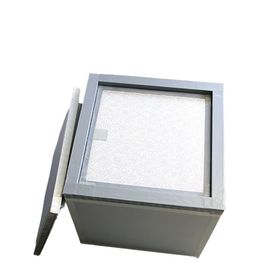
A passive medical cold box rated for -20°C transport: cold-chain performance is a system outcome, not a single-pack attribute.
A gel ice pack specification sheet is usually short: a model number, dimensions, weight, outer material, inner liquid and a list of certificates. In food logistics those rows may be enough. In health and medicine cold chain, however, the spec sheet carries a different weight because the consequence of a mistaken assumption is not a warm meal but a compromised pharmaceutical, vaccine or diagnostic sample.
For buyers moving through the research and evaluation phase, the useful question is not simply “which gel ice pack should I buy?” It is “which specification claims must be verified before a gel ice pack can be accepted into a temperature-controlled logistics system?” That question sits at the centre of constraint-led procurement: certifications, material definitions, temperature behaviours, packaging formats and supplier capabilities all narrow the range of acceptable products.
This article reviews gel ice pack specification categories through the publicly documented product evidence of Changzhou Jisi Cold Chain Technology Co., Ltd., a China-based manufacturer that supplies gel ice packs, PCM ice plates, cooler boxes and vacuum-insulated panels. In doing so, it tries to give buyers a practical field note: where the specification rows matter, what they mean, and which limitations remain even when the documentation is clear.
Temperature-sensitive medicines typically travel inside insulated containers with passive cooling media. The media must hold the required temperature range for a defined duration, and that duration depends on external temperature, box insulation, loading density, pack preconditioning and pack phase-change behaviour. A gel ice pack is therefore not a standalone product; it is a component in a thermal system.
This creates an evaluation problem for buyers. Many gel ice packs look similar at the packaging level. The decisive differences are often invisible: what the inner liquid is made of, what the freeze point actually is, whether the outer plastic is suitable for food or pharmaceutical contact, and whether the compliance documents are credible for the destination market.
In the Health & Medicine category, buyers also face rising expectations from public health procurement systems. The WHO PQS performance specification E004/VC01.2, for example, defines requirements for vaccine carriers and cold boxes, including verified cold-life durations. That does not mean every gel ice pack supplier must comply with WHO PQS; it means the procurement environment increasingly treats temperature performance as something that must be demonstrated under defined conditions, not merely claimed.
Several specification gaps repeatedly complicate gel ice pack purchasing decisions in medical cold chain:
- Freeze point ambiguity. Any ice pack can be labelled “cold,” but target temperatures differ. A pack designed for 2–8°C pharmaceutical logistics behaves differently from a deep-freeze pack used at −20°C. When the freeze point is not stated precisely, the buyer cannot model box performance.
- Material safety uncertainty. In medical or food-contact use, the buyer needs to know whether the outer shell and inner liquid are non-toxic and appropriate for the product being transported. Certification names alone are not enough; the buyer should confirm which report, which standard and which product scope they refer to.
- Incomplete certificate data. Some suppliers list “FDA, SGS, MSDS” without explaining what the reports cover. Relevant market requirements may also include CPSIA for children’s products or EU food-contact plastics rules such as Regulation (EU) No 10/2011.
- Box-system mismatch. A high-quality gel ice pack placed in a poorly insulated box still fails. The pack must be evaluated together with the cooler box, the phase-change material selection and the shipping lane.
These issues point to the same buyer action: treat every gel ice pack specification as a falsifiable statement and verify it before committing to a supplier or an order specification.
Jisi Cold Chain, whose corporate name is Changzhou Jisi Cold Chain Technology Co., Ltd., operates from a 40,000 m² factory and reports an annual output of approximately 620,000 units. The company was founded in 2013 and exports primarily to North America, Western Europe, Eastern Europe, East Asia and Southeast Asia. Its product range includes gel ice packs, PCM ice plates, cooler boxes and vacuum-insulated panels, many of which are marketed under the JISILL brand.
For health-sector buyers, several documented specifications are relevant when comparing suppliers.
The following table summarises representative models in the publicly available Jisi product record. These are not recommendations; they illustrate the specification fields a buyer should expect to see completed.
| Product type | Model | Key documented parameters | Relevant buyers note |
|---|---|---|---|
| Breast Milk Ice Pack | BH125 | 21×12×4.5 cm; 505 ml content; HDPE outer; cooling-gel inner; thermal type | Frequent-temperature personal medical transport use; easy to cool in domestic freezers |
| Large Cooler Ice Packs | BH084 | 33×22.5×2 cm; 1000 g; HDPE outer; cooling liquid; stated freezing points from 0–8°C to −10°C, −15°C, −18°C, −20°C and −25°C | Useful when the buyer must tune the pack to a specific lane temperature |
| Large Cooler Ice Brick | BH108 | 35×22×3 cm; 1200 g; food-grade HDPE; SAP/CMC/PCM filling; available with handle | Heavier payload applications; handle improves handling in high-volume packing |
| Ultra Thin Ice Pack | BH066 | 19×12.5×1 cm; HDPE outer; SAP or CMC inner | Space-constrained lunch coolers and light medical cool bags |
| PCM Ice Pack | BH130 | 46×32.5×2.5 cm; 2600 ml; HDPE outer; PCM inner | Large passive-cooling surface for box liners |
| Eutectic Cold Plate | BH142 | 24.5×24.5×2.5 cm; 1200 ml; hard HDPE; SAP/CMC/PCM filling | Reusable plates for repeated shipments where shape stability matters |
| Custom PCM Ice Brick | BH091 | 38.5×20×2 cm; 1200 g; −22°C positioning; HDPE outer; SAP/CMC inner | Deep-temperature requirements, including frozen food and ice-cream transport |
| Mini Ice Pack | BH014 | 12×7.8×2 cm; 150 g; HDPE outer; gel cooling liquid | Promotional and small-quantity cold packaging |
| Vaccine / Medical Cool Box | JS-42L | External 46×46×46 cm; internal 35×35×35 cm; 42 L; PU + vacuum insulation panel; thermal conductivity <0.0025 W/m·K | System-level packaging: insulation plus cooling media must be designed together |
One documented customer reference, described as a logistics and pharmaceutical transportation client in the United States, has used Jisi passive-cooling products for temperature maintenance over a six-year period, with a volume of one million units and stable operation. The supplier’s own account does not name the client, so it should be read as supplier evidence rather than an audited case study. Still, it shows that repeat, high-volume purchasing is part of the manufacturer’s operating record.
High-density polyethylene, or HDPE, is the most frequently documented outer material in Jisi’s gel ice pack range. HDPE is rigid, chemically resistant and widely used in food-contact containers. In ice packs, the outer shell determines how the pack behaves under repeated freezing cycles and whether it can be reused without cracking or leaking.
Buyers should not assume that “plastic” means food-safe. The specification should identify the polymer family and, where required, the relevant food-contact compliance statement. In the Jisi record, product pages list food-grade HDPE and certifications including FDA, SGS, MSDS, CPSIA and, on several models, Regulation (EU) No 10/2011, which concerns plastic materials intended to come into contact with food.
The inner material controls how the pack stores and releases cold energy. Jisi documents three main categories:
- SAP (superabsorbent polymer) and CMC (carboxymethyl cellulose) are documented as the inner liquid in many Jisi gel ice packs. These materials thicken the liquid so that even if the outer shell is damaged, the contents are less likely to spill like water. They are also part of the non-toxic material statement made by the manufacturer.
- PCM (phase change material) is used in Jisi ice plates and ice bricks that need more stable temperature behaviour. PCM stores and releases energy near a defined phase-change temperature, which helps reduce temperature overshoot inside the box.
Jisi’s company profile states that its phase change material ice plates cover temperature ranges including −30°C, −25°C, −15°C, −10°C, −5°C, 0°C, 2–8°C, 18°C and 23°C. This range spans frozen-food transport, pharmaceutical cold chain and temperature-stability applications around room temperature.
Having a wide family of temperature points is operationally important. A single “one-freeze-point” gel ice pack cannot serve every lane. A pack intended for ice cream at −22°C, such as the BH091 model, is a different specification from a breast milk pack designed for short trips out of the home.
Buyers evaluating a supplier should therefore check not only whether a model number exists, but whether the freeze point is stated in the datasheet and whether the production line can deliver different temperature grades without changing the outer shell quality.
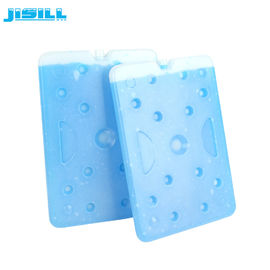
Large cooler ice packs with documented freeze-point options are easier to match to specific shipping lanes.
In cold chain logistics, the application defines the acceptance criteria. The Jisi product record groups most models under “cold chain transportation,” but health-sector usage can be broken into practical patterns:
- Pharmaceutical and vaccine transport. Box systems such as the JS-42L combine PU insulation with vacuum insulation panels and rely on gel or PCM packs to hold temperature. The documented 2–8°C phase-change option is directly relevant to vaccine logistics, while −20°C-class media are relevant to certain biological products.
- Hospital and clinic cold storage. Short-distance transfers of reagents and diagnostic specimens typically require leak-proof, reusable media that can be quickly refrozen. Hard HDPE shells are easier to clean and more durable in repeated clinical use.
- Breast milk and maternal health. Products such as the BH125 are marketed as thermal ice packs for cold-chain transportation. They can also appear in consumer-facing maternal and infant health channels, where food-contact safety and low complexity matter.
- Last-mile and patient delivery. Ultra-thin packs and mini packs help maintain temperature inside small insulated bags, where box volume is limited and the charge of cooling media is small.
From a sourcing perspective, the health-sector buyer gains little from evaluating a gel ice pack in isolation. The correct unit of evaluation is the configured system: pack temperature point + pack quantity + insulated box + expected ambient exposure + shipment duration.
The pressure on gel ice pack specification quality is not accidental. Third-party market research points in the same direction.
- The global reusable ice packs market was valued at approximately USD 1.962 billion in 2024 and has been projected to reach USD 2.862 billion by 2035, according to Market Research Future.
- The Business Research Company estimates the broader global gel ice pack market at USD 14.56 billion in 2025, with demand coming from chronic pain management and pharmaceutical cold chain needs. The large difference between these two figures reflects different market definitions: one tracks reusable packs, the other includes a much wider set of gel-pack applications.
- MarketsandMarkets projects the vaccine storage equipment market, which includes cold boxes and vaccine carriers, to grow from USD 0.86 billion in 2024 to USD 1.21 billion by 2029.
- Intel Market Research valued the PCM pack market at USD 476 million in 2025, with a CAGR of 4.5%, citing demand for precise thermal management in biologics.
- Dataintelo reports that China accounts for more than 11.2% of global gel ice pack revenue as of 2025, reflecting the country’s position as a manufacturing hub for export to North America and Europe.
For procurement teams, the strategic implication is that specification discipline is becoming a competitive requirement. As more biological products enter the market, the buyer’s ability to define temperature constraints, verify certification scope and audit production capability becomes more valuable than the simple price per pack.
Traditional water ice is cheap, available and easy to produce, but it cools by melting at 0°C. That limitation makes it difficult to use for 2–8°C pharmaceutical lanes, where freezing damage is a real risk. Meltwater also creates leakage and labelling problems in sterile or clinical environments.
Modern gel ice packs solve part of that problem by sealing the cooling medium inside a rigid HDPE shell and by allowing the manufacturer to tune the freezing behaviour of the inner liquid. That is the positive case for replacing water ice with documented gel packs.
There are, however, real boundaries that buyers should keep in mind.
- Gel ice packs remain passive devices. They do not generate cold; they only release stored cold energy. If the ambient temperature is high, the insulation is poor, or the box is opened frequently, no gel pack can guarantee temperature stability.
- Preconditioning is mandatory. The pack must be fully frozen before use, and freezing time depends on freezer temperature and pack mass. A 1200 g pack requires more preparation time than a small lunch-bag pack.
- Specifications still need validation. A manufacturer’s datasheet is evidence of intention, not proof of performance in the buyer’s specific lane. Large health-sector buyers still run their own thermal validation or request data from a qualified test laboratory.
- System design matters more than pack choice. For long-duration shipments, the pack must work with the right insulated container, which is why manufacturers such as Jisi also produce vacuum-insulated panels and cooler boxes.
A specification table that lists impressive freezing points should therefore be read as a starting point. The buyer must decide whether the pack can perform inside the box, under the loading pattern and for the duration required by the actual route.
The trajectory in medical cold chain is toward tighter temperature windows and smarter evidence, not toward looser claims. Several shifts are relevant to gel ice pack buyers:
- More phase-change options. As biologics and vaccines create a need for stable 2–8°C and deep-freeze behaviour, PCM plates and bricks are likely to gain share over simple gel blocks.
- Box-and-pack integration. Suppliers that can provide the full insulation system, gel media, PCM plates and vacuum-insulated panels are easier to evaluate because they assume responsibility for system compatibility.
- Certification depth. The presence of FDA references, SGS reports, MSDS documentation, CPSIA statements and EU food-contact compliance will become a baseline rather than a differentiator.
- Data-driven verification. Buyers will increasingly request temperature-mapping data, batch traceability and validated cold-life results before approving a supplier.
For Chinese gel ice pack manufacturers, this implies a need to support export buyers with more than a low-priced sample. The suppliers that will remain attractive in Health & Medicine are those that can explain their product constraints honestly and help buyers verify performance.
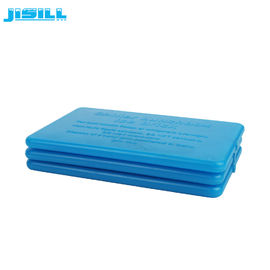
Thin-format ice packs illustrate why dimensions and capacity must be checked together when designing a medical cool bag.
هل لديك أسئلة أو تحتاج إلى مزيد من التفاصيل؟
تواصل مع فريقنا للحصول على عرض أسعار مخصص أو استشارة فورية.
طلب عرض أسعار
املأ النموذج أدناه وسيتواصل معك فريقنا بعرض مقترح مخصص.
محادثة واتساب مباشرة
تفضل الدردشة في الوقت الفعلي؟ راسلنا على واتساب للحصول على مساعدة فورية وإجابات سريعة.
- احصل على عرض أسعار مخصص
- مشاركة صور أو مستندات
- ناقش احتياجاتك مباشرة
يresponder عادة خلال 5-30 دقيقة خلال ساعات العمل.