
Genius Weft Compliance: What Buyers Should Ask Suppliers
An industry reference for salon owners, distributors and procurement teams evaluating Genius weft hair extensions before they place an order.

Processing transparency is one of the areas salon buyers can question during Genius weft sourcing. Image: processing area at a Qingdao hair manufacturing facility.
The global hair wigs and extensions market was valued at USD 15.2 billion in 2025 and is projected to reach USD 31.1 billion by 2033, according to Grand View Research. Within that market, human hair products accounted for a 65.6% revenue share in 2025, the same source reports — a share that explains why so much of the commercial conversation in salons now concerns human-hair quality rather than synthetic alternatives.
Growth on that scale creates a specific problem for buyers. When demand for human hair rises faster than the supply of genuinely traceable raw material, the vocabulary used in product descriptions — virgin, remy, cuticle aligned, single donor — tends to outrun the paperwork behind it. A salon owner can assess shade, length and weight by eye and by hand within seconds. Establishing what the hair actually is, and how it was sourced and processed, requires a different set of questions.
This reference sets out a practical compliance framework for sourcing Genius weft hair extensions. It does not assume the existence of any particular certificate. It treats compliance as a set of questions a buyer should be able to ask and a supplier should be able to document, starting with the two specification claims that matter most in this category: 100% virgin remy human hair with no synthetic or fiber content, and unprocessed, cuticle-intact hair.
Why Compliance Has Become Part of Genius Weft Buying
The Genius weft entered the salon market as a construction innovation rather than a material innovation. Industry descriptions characterise it as a hybrid technology that combines the thinness of a hand-tied weft with the durability of a machine-made weft, and allows the track to be cut anywhere without shedding — a behaviour that conventional sewn wefts do not reliably deliver. Independent manufacturing references describe the Genius weft track as approximately 0.8 mm to 0.9 mm thin.
That thin track is what makes the format attractive for high-volume salon work. It is also what makes the material behind it decisive. A weft track is a delivery mechanism: whether the installation still looks natural in month eight depends far less on the stitching than on whether the hair attached to it retained its cuticle, was aligned in one direction, and came from a documented source.
In other words, buyers can now evaluate a Genius weft in two layers. The first layer is construction: track thickness, cuttability, shedding behaviour, weight per weft. The second layer is material and sourcing: fiber composition, cuticle state, donor documentation and processing history. Most sourcing conversations concentrate on the first layer because it is visible. The second layer is where commercial risk accumulates, because it is where claims are hardest to check after delivery.
What “Compliance” Actually Means in This Category
There is no single universal certificate that defines a compliant Genius weft hair extension. In practice, compliance in this category is a documentation discipline covering five areas. Each area can be questioned, and each answer can be recorded in writing before a purchase order is issued.
1. Fiber composition
The material specification for a Genius weft hair extension in the Dolas Dream range is 100% virgin remy human hair. Remy describes hair collected with the cuticles running in a single direction; virgin describes hair that has not been chemically treated. The buyer's question is direct: what percentage of the bundle is human hair, and is any synthetic or protein fiber blended into it? Blends are not automatically a defect, but they must be declared, because synthetic content behaves differently under heat styling and colour and generally shortens the usable life of an installation.
2. Cuticle integrity
Cuticle-intact hair means the protective outer layer of the strand has not been stripped away; cuticle-aligned hair means every strand in the bundle runs in the same direction. Dolas Dream lists 100% cuticle-intact hair as a standard product feature across its Genius weft, K-tip and nano ring lines. The verification question is whether the supplier can confirm the hair is unprocessed — no acid stripping, no chemically removed cuticle — and how alignment is preserved through weft construction. This is the single most consequential quality benchmark in the category, because tangling and matting usually trace back to it rather than to the installation method.
3. Single-donor sourcing documentation
Single-donor sourcing is not a formal certification, but it functions as a de facto compliance standard in the human-hair trade: hair drawn from one donor can be kept in one alignment direction from collection through production, which is precisely what makes a genuine cuticle-aligned bundle possible. A supplier claiming single-donor sourcing should be able to attach a batch or donor reference to the shipment, name the raw-material origin, and match that reference to the sample the buyer approved. The most common failure in this area is not falsified paperwork — it is absent paperwork.
4. Processing, colour and additive disclosure
Colour is a compliance variable, not only an aesthetic one. A buyer should ask what chemical processes the hair underwent before weft construction, whether it was bleached or dyed, and whether any coating, silicone finish or additive was applied after processing. Additives that create temporary smoothness can mask cuticle damage at the point of sale and surface again after several washes. Shade consistency across repeat orders is the practical test: a shade ring that matches the delivered batch matters more than a shade ring that merely looks attractive in a catalogue.
5. Market-specific standards
Some compliance layers are dictated by the destination market rather than the product. Kosher certification for wigs — Sheitels — requires verification that the hair was not sourced from idolatrous rituals, such as certain Hindu temple offerings, according to published kosher-certificate guidance for Jewish wig manufacturing. That is an example of a documentation-driven standard that cannot be assessed visually, and it demonstrates why written records, rather than appearance, are the appropriate basis for compliance decisions in human-hair sourcing.
The Verification Checklist: Questions to Put in Writing
The table below converts the five compliance areas into questions a salon owner, distributor or procurement manager can send to a supplier before sampling. The right-hand column explains why the answer changes a purchasing decision rather than merely completing a form.
| Question to the supplier | Documentation to request | Why it changes the decision |
|---|---|---|
| Is the hair 100% virgin remy human hair, with no synthetic or fiber content? | Written material declaration on the quotation and product data sheet | Determines heat tolerance, colour behaviour and realistic service life |
| Is the cuticle intact and aligned, and is the hair unprocessed? | Statement of cuticle condition plus a batch sample | Cuticle condition drives tangling, matting and repeat-client satisfaction |
| Can you provide single-donor sourcing documentation for this batch? | Batch or donor reference, raw-material origin, traceability record | Alignment claims can only be substantiated if the bundle is traceable |
| What processing, bleaching or dyeing was applied, and were additives used? | Processing record or process description per colour line | Coatings can hide cuticle damage that appears after several washes |
| How consistent are shade, length and weight per weft across repeat orders? | Shade ring, length and weight tolerance statement | Determines whether reorders need re-matching in the chair |
| What stock depth and lead time can you commit to in writing? | Stock position and confirmed shipment schedule | Affects whether the salon can promise appointment dates to clients |
| For religious markets: is the hair certified kosher for Sheitel use? | Kosher certification documentation where required | Cannot be assessed visually; required for defined end markets |
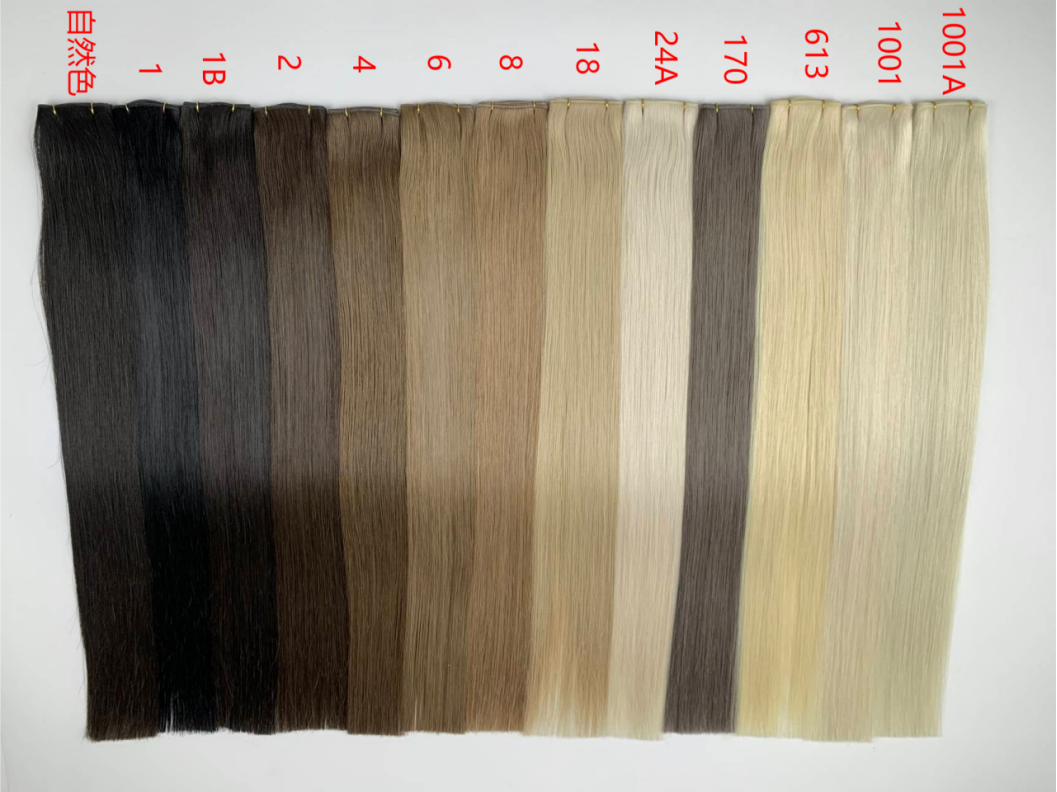
Shade consistency across repeat orders is one of the few compliance variables a salon can verify visually — provided the shade reference matches the delivered batch.
Why Cuticle Alignment and Track Construction Interact
A Genius weft hair extension is a two-part product: a weft track and the hair held within it. The track determines how the extension is installed and how discreet it appears. The hair determines how long the client keeps it. When a manufacturer advertises a cuttable, ultra-thin track — in the region of 0.8 mm to 0.9 mm according to independent manufacturing references — the implication is that the weft can be installed close to the scalp with minimal bulk.
That advantage is only sustainable if the hair inside the track retains its cuticle. Hair with an intact, single-direction cuticle lies flat against neighbouring strands and resists the mechanical friction created by brushing, washing and heat styling. Hair with a stripped or mixed-direction cuticle develops friction between strands; the result is tangling at the point where the weft meets natural hair, which is exactly where the installation is most visible and most difficult to correct.
This is the technical reason why material documentation belongs in a Genius weft purchasing decision. Track construction can be evaluated at the sampling stage. Cuticle condition and donor traceability can only be evaluated if the supplier maintains records — and records are the part of the supply chain that a buyer cannot inspect after the fact.
How Dolas Dream Fits This Framework
Dolas Dream is a hair manufacturer and exporter based in Qingdao, China. The company was established in 2015, operates a 1,500 m² manufacturing facility with approximately 50 staff, and reports an annual production capacity of 115,000 units, with exports accounting for 90% of sales and main markets in the USA and the EU. Its stated main products are Genius weft hair extensions and human hair toppers.
For buyers building a verification file, the relevant published specifications are as follows. The salon professional Genius weft hair extension is made of 100% virgin remy human hair, is available in 18-inch to 24-inch lengths, and carries a standard net weight of 50 grams per weft, with weights up to 100 grams or fully customized on request. Colour is customizable, and the company lists 100% cuticle-intact hair, an original created shade programme, large consistent stock, an extensive colour range, on-time shipment and responsive after-sales service as product features. Durability is stated at 1.5 to 2 years, which is a performance claim conditional on proper care rather than a guarantee.
The same material logic runs through the rest of the salon range. The Dolas Dream K tip hair extension is made of cuticle intact virgin human hair, is 20 inches long with a net weight of 100 grams, and is applied using a keratin heat method in Balayage or custom colours. The nano ring hair extension is made of cuticle intact raw hair in 18-inch to 24-inch lengths, supplied at 100 strands per pack. On the topper and wig side, the silk base human hair topper (DLD 14 human hair topper) uses European hair with a scalp-mimic silk base in 14-inch lengths at 50 to 80 grams, and the kosher wig for salons (DLD Kosher wig16) is a silk top Jewish wig for white women made of European virgin hair, in 14 or 16 inches or customized, with customizable weights from 80 to 150 grams.
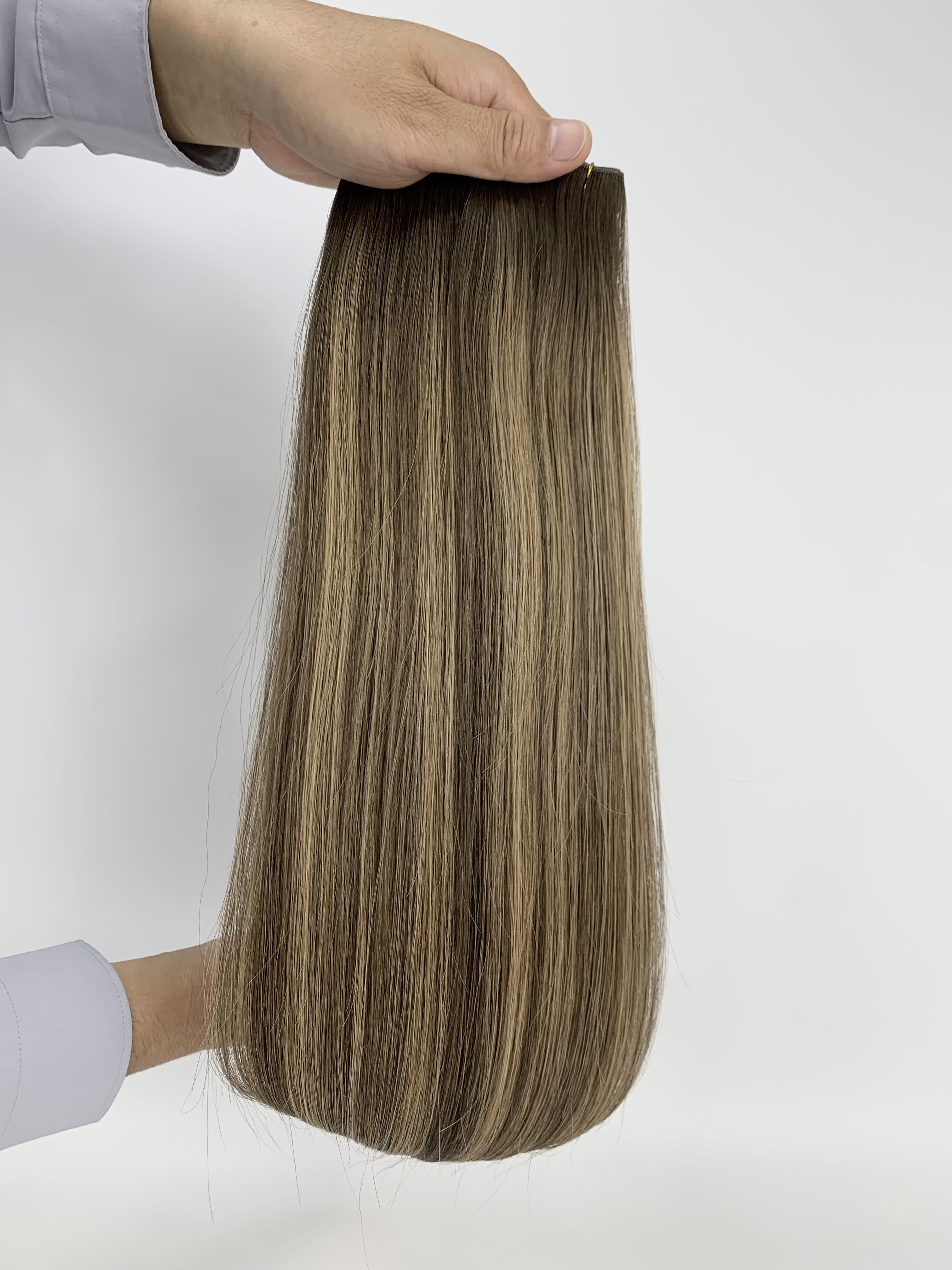
A 22-inch Genius weft hair extension. Track construction is visible at the sampling stage; cuticle condition and donor traceability depend on supplier records.
Read against the checklist above, these statements give a buyer a concrete basis for comparison: a declared material, a declared cuticle condition, measurable product parameters, and stated service commitments. They do not, by themselves, constitute third-party certification, and buyers sourcing for regulated or religious end markets should request the additional documentation those markets require.
Where Genius Weft Hair Extensions Are Used
Understanding where the product is used clarifies which compliance questions carry the most weight. Genius weft hair extensions in this range are positioned as salon professional products, installed with standard salon tools to add volume to fine hair and to provide a daily-wear solution for clients experiencing hair loss. Typical applications include everyday wear, alopecia and hair-volume needs, as well as occasion styling for weddings and events. Relevant use cases also extend into the beauty industry and wholesale distribution.
Installation is described as an indoor process requiring controlled conditions and proper care comparable to the client's own hair. That last point is a compliance consideration in itself: a cuticle-intact weft behaves best under the same care regime as natural hair, which means the salon's aftercare instructions are effectively part of the product specification. Application scenarios of this type are common in the US, the UK, France, Ireland, Sweden, Poland, New Zealand and Austria — markets where professional salon standards and documentation expectations both tend to be comparatively developed.
The medical segment is a useful reference point for where documentation expectations are heading. The medical wigs market, which serves alopecia and chemotherapy-induced hair loss, was valued at USD 618.05 million in 2024 according to Cognitive Market Research. Buyers in that segment typically ask for the same material evidence as salon buyers, with additional emphasis on consistency between units.
Market Signals and the Traceability Gap
Three published data points frame the sourcing environment. Human hair products held a 65.6% revenue share of the global wigs and extensions market in 2025, according to Grand View Research, which means the majority of category revenue depends on a raw material that cannot be manufactured on demand. Cognitive Market Research reports that China's wig manufacturing clusters, notably Xuchang and Qingdao, produced over 12 million units annually as of 2024, which indicates an industrial base large enough to supply global demand but also large enough that documentation practices vary widely between suppliers.
It is worth noting that market-size estimates in this category diverge substantially depending on scope. Grand View Research places the combined wigs and extensions market at USD 15.2 billion in 2025, while Custom Market Insights estimates the extensions segment alone at approximately USD 2.9 billion. The difference illustrates a broader point for procurement: category-level figures are useful for planning, but they say nothing about the specific batch a salon is about to buy. Supplier-level documentation is the only evidence that scales down to a purchase order.
The practical consequence is that traceability is moving from a premium feature to a routine expectation. Where buyers once compared colour rings and price lists, they increasingly compare batch references, material declarations and processing records — particularly in markets where import documentation and consumer-protection rules place the burden of proof on the seller.
Genius Weft Compared with K-Tip, Nano Ring and Machine-Tied Wefts
Compliance questions are largely transferable between attachment formats, but the parameters a buyer verifies differ. The table below compares formats using published specifications from the Dolas Dream range alongside the construction characteristics reported for Genius wefts in independent manufacturing references.
| Attribute | Genius weft | K-tip | Nano ring |
|---|---|---|---|
| Construction | Hybrid thin weft track, cuttable without shedding | Individual strand bonds applied with keratin heat | Individual strands attached with micro rings |
| Stated material | 100% virgin remy human hair | Cuticle intact virgin human hair | Cuticle intact raw hair |
| Typical specification | 18–24 in, 50 g per weft (customizable upward) | 20 in, 100 g, Balayage or custom colour | 18–24 in, 100 strands per pack |
| Documentation to request | Material declaration, cuticle statement, batch reference | As above, plus keratin bond specification | As above, plus ring specification and strand count |
| Typical fit | Fuller coverage and high-volume salon work | Targeted placement and finely detailed blending | Discreet strand-by-strand volume build |
Traditional machine-tied wefts remain the reference point for durability, and the Genius weft format borrows from that construction while reducing track thickness. The trade-off is that a thinner track leaves less margin for error in the hair itself: because the weft sits closer to the scalp, any friction or tangling caused by compromised cuticle is more noticeable and harder to conceal.
Boundaries and Limitations Buyers Should Accept
A compliance framework is only credible if it acknowledges what it cannot do. Four boundaries apply.
First, documentation is not the same as third-party certification. Material declarations, cuticle statements and batch references are supplier-issued records. They create accountability, and they can be audited against samples, but they are not interchangeable with an independent laboratory certificate.
Second, cuticle-intact hair requires care comparable to the client's own hair and installation under controlled, professional conditions. The stated durability of 1.5 to 2 years assumes that regime. Salons that cannot enforce consistent aftercare should not treat that figure as an inherent product property.
Third, single-donor sourcing documentation is not universally available in the market. Buyers will encounter suppliers who cannot provide it, and the practical decision is whether the absence of documentation is acceptable for a given end client — not whether the term appears on a price list.
Fourth, Genius weft installation is a professional procedure. The format is not a DIY product, and its thin track depends on correct installation to deliver the invisibility the construction is designed for.
Future Outlook: Documentation as a Purchasing Criterion
Two forces are likely to push traceability further into the standard sourcing conversation. The first is volume: with human hair holding 65.6% of category revenue and Chinese clusters producing over 12 million units annually, the gap between what buyers assume about a product and what a supplier can document will remain a real commercial risk. The second is market-specific regulation and religious compliance, where the kosher wig standard already demonstrates that some requirements can only be satisfied through verified records.
The practical direction for salon buyers is straightforward. Attach the material declaration, cuticle statement and batch reference to the purchase order; keep the approved sample against the delivered batch; and treat documentation quality as a scored criterion alongside price, lead time and colour range. Suppliers who can answer the questions in this article in writing will increasingly be preferred over suppliers who can only answer them verbally.
FAQ
What is a Genius weft hair extension?
A Genius weft is a weft-format hair extension built on a hybrid construction: independent industry descriptions characterise it as combining the thin track of a hand-tied weft with the durability of a machine-made weft, and as cuttable along the track without the shedding that typically follows cutting a conventional sewn weft. Independent manufacturing references describe the track as approximately 0.8 mm to 0.9 mm thin. In the Dolas Dream range, the salon professional Genius weft hair extension is made of 100% virgin remy human hair, supplied in 18-inch to 24-inch lengths with 50 grams per weft as standard and customization available, and is positioned for daily wear, salon professional use and hair-volume applications.
How can a salon verify that a Genius weft is 100% virgin remy human hair?
Verification rests on consistency rather than on a single test. The first step is a written material declaration that matches the product data sheet, the quotation and the shipment documentation. The second is a sample drawn from the actual production batch rather than from a display set. The third is checking that the stated cuticle condition — cuticle-intact and aligned — is consistent with the behaviour of the sample under normal handling. Where order value or regulatory exposure justifies it, a third-party laboratory test provides an independent reference point; supplier declarations and laboratory results serve different purposes and are not substitutes for one another.
What does “cuticle intact” mean on a Genius weft?
Cuticle intact means the outer protective layer of each hair strand has not been chemically stripped away, and aligned means all strands in the bundle run in the same direction. Dolas Dream lists 100% cuticle-intact hair as a standard feature of its Genius weft, K-tip and nano ring lines. The condition matters because intact, single-direction cuticles allow strands to lie smoothly against each other and reduce the friction that causes tangling and matting. In a thin-track Genius weft installed close to the scalp, that friction behaviour is more visible than in formats where the attachment point is easier to conceal.
What documents should a salon request for single-donor sourcing?
Single-donor sourcing is a supply-chain record rather than a formal certificate. A buyer should ask for a batch or donor reference attached to the shipment, the stated raw-material origin, and a traceability record linking the delivered batch to the approved sample. The purpose is to make the alignment claim checkable: cuticle alignment can only be maintained if the bundle is kept together in one direction from collection through production. If a supplier cannot attach a batch reference to the order, the single-donor claim cannot be verified after delivery.
Genius weft, K-tip or nano ring — how should a salon choose?
The formats serve different installation patterns rather than different quality tiers. The Dolas Dream Genius weft hair extension uses 100% virgin remy human hair in 18-inch to 24-inch lengths at 50 grams per weft, and is suited to fuller coverage and high-volume salon work. The K tip hair extension is cuticle intact virgin human hair, 20 inches and 100 grams, applied with keratin heat, and suits targeted placement with detailed blending. The nano ring hair extension is cuticle intact raw hair in 18-inch to 24-inch lengths at 100 strands per pack, and suits discreet strand-by-strand volume. In all three cases the compliance questions — material declaration, cuticle condition, batch reference, processing disclosure — remain the same.
Does compliance differ for kosher wigs and human hair toppers?
Yes, in one respect. Kosher certification for wigs, known as Sheitels, requires verification that the hair was not sourced from idolatrous rituals such as certain Hindu temple offerings, according to published kosher-certificate guidance for Jewish wig manufacturing. That requirement cannot be assessed by handling a sample and depends entirely on documentation. The Dolas Dream kosher wig for salons, model DLD Kosher wig16, is a silk top Jewish wig for white women made of European virgin hair in 14-inch to 16-inch lengths or customized, with customizable weights from 80 to 150 grams. Silk base human hair toppers, such as the DLD 14 human hair topper made of European hair with a scalp-mimic base in 14-inch lengths at 50 to 80 grams, do not carry that religious requirement, but the material, cuticle and processing questions still apply.
Dolas Dream publishes its product catalogue for buyers who want to review the full salon range and specifications: Dolas Dream Initial Catalogue (PDF). Manufacturing enquiries can be directed to admin@dolasbeauty.com or +8618863251821.