
Genius Weft Supplier Capability: Evidence a Salon Can Audit
Genius Weft Supplier Capability: Evidence a Salon Can Audit
A salon does not need a factory visit to judge a genius weft supplier. It needs a sample, good light and a short list of things to look at: the seam, the return hair, the direction of the cuticle and what happens when the weft is cut. Everything else a supplier says — capacity, certification, lead time — is documentation that either matches what the sample shows or does not.
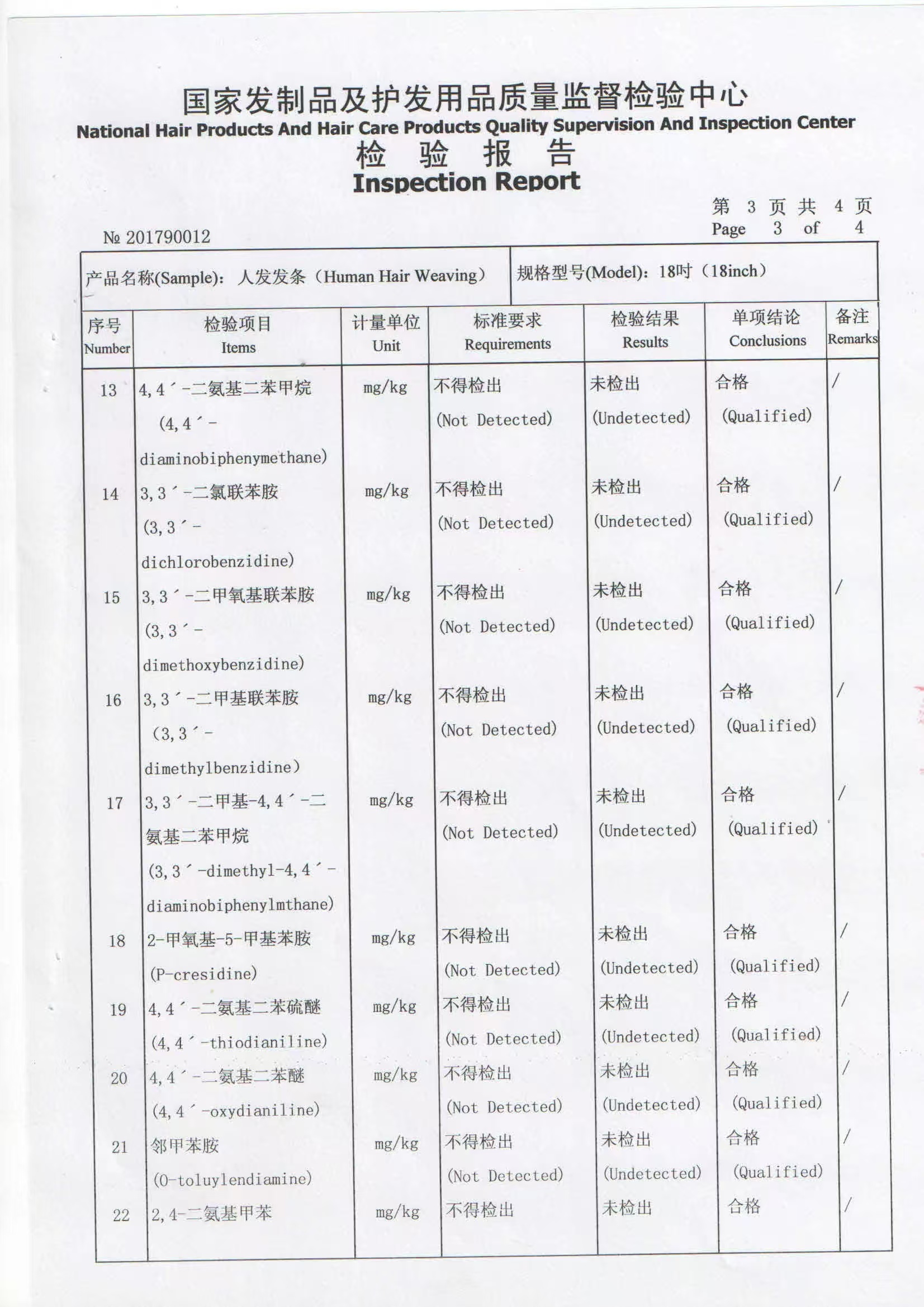
An inspection report issued by the National Hair Products and Hair Care Products Quality Supervision and Inspection Center (report 201790812) against GB/T 23168-2008 — one document a salon can request and read.
This article sets out that audit and applies it to Dolas Dream's genius weft range and the adjacent formats the company offers: K-tip, nano ring, silk-base human hair toppers, silk-top Jewish wigs and medical human hair wigs. The purpose is not to score the brand against competitors, but to separate what a salon can verify on the bench, what it can verify only in writing, and what remains a company description that no buyer can confirm alone.
Why a physical check comes before any supplier claim
The category is large. Grand View Research estimated the global hair wigs and extensions market at USD 15.2 billion in 2025, a figure covering both wigs and extensions across human and synthetic hair, so it is not a genius-weft-specific number. Scale of that kind explains why supplier pages are dense with description and thin on measurement.
Public supplier descriptions follow the same pattern. Haneway states that it supplies genius weft extensions for brands, salons and distributors. Ouxun Hairs positions itself as a direct factory wholesale supplier. Newtimes Hair describes its genius wefts as 100% cuticle-aligned Remy human hair for salons and wholesalers. CYhair describes a 1 mm genius weft produced in Vietnam. LEV Wigs reports serving more than 200 professional boutiques, salons and healthcare providers across 40+ countries. Each statement is a self-description; none is a standardized measurement that can be set against another supplier's equivalent line.
The gap matters most on thickness. A stated 1 mm weft is meaningful only when the point of measurement and the method are known — at the stitch line, at the point where the hair leaves the band, or across the coated band after production. Without that convention, “ultra-thin” and “1 mm” cannot be compared to each other, and a salon should treat both as claims to check rather than specifications to rank.
The same limitation applies to adoption. The public evidence reviewed for this article did not include an independent, salon-level dataset quantifying how much of the professional market uses genius wefts rather than hand-tied or machine wefts. On this evidence, statements that one weft type is displacing another across the salon channel are marketing positions rather than observed shares.
Five checks a salon can run on a sample
These checks take a few minutes per sample, and each maps to one or more of the four criteria salons use in practice: comfort, invisibility, durability and cost.
- Seam construction and flex. Hold the weft against a light and look along the seam. What is being judged is the thickness of the band, whether the coating or stitching is uniform along its length, and whether the band stays flat when bent between the fingers. Dolas Dream's own product description refers to an ultra-thin polymer-coated substrate and a cuticle-aligned locking process; that description is a starting point, and the sample is what confirms whether the band actually sits flat. A band that stiffens or twists when flexed is harder to conceal under fine hair, which makes it an invisibility question before it becomes a durability question.
- Return hair. Return hair is the short, folded-back hair that gives some wefts bulk at the seam. Supplier technical descriptions of genius wefts present the absence of return hair as the main difference from hand-tied construction, together with the ability to cut the weft anywhere without unraveling. On a sample, run a fingertip along both faces of the seam and look for short fibres standing out of the stitch line; hold the weft to the light and look for a doubled-over edge. Where return hair is present, a client with low-density hair will usually feel it before seeing it.
- Cuticle direction and fibre content. Dolas Dream's stated material highlight is 100% virgin Remy human hair, with no synthetic and no fibre content, and the cuticle described as unprocessed and intact. On the bench, the observable points are whether strands lie in one direction along the weft, whether texture stays consistent down the length rather than changing partway, and whether any strand shows the hard, uniform sheen usually associated with synthetic fibre. A weft with mixed direction tends to tangle where the direction changes.
- Cuttability. If a stylist will shorten the weft, confirm cuttability on the sample rather than on the sales page. Supplier descriptions state that genius wefts can be cut anywhere without unraveling; the matching check is a single clean cut across the weft, followed by observation of whether the seam holds at the cut end after flexing. A salon should also confirm in writing how cutting and trimming interact with the stated warranty.
- The record that travels with the batch. The fifth check is documentary. Quality control at Dolas Dream is described as 100% pre-shipment testing for all units, and the acceptance criteria in the company's purchasing terms are defined as pre-shipment test. A salon auditing capability should therefore ask for the pre-shipment test record for the batch it is actually buying, not only the general inspection report discussed further below.
| Check | What the salon observes | Criterion affected |
|---|---|---|
| Seam profile | Band thickness, uniformity of coating or stitching, flatness when flexed | Comfort, invisibility |
| Return hair | Short fibres at the stitch line, doubled-over edge under light | Comfort, invisibility |
| Cuticle direction | Strands lying in one direction, consistent texture, no uniform synthetic sheen | Durability |
| Cut edge | Whether the seam holds at a clean cut after flexing | Durability, cost |
| Batch record | Pre-shipment test documentation matching the order | Cost, risk |
Genius, machine and butterfly: the comparison a salon actually needs
Three weft types dominate salon procurement conversations, and the documented differences between them are practical rather than technical. The descriptions below follow supplier documentation as written; they are not the result of a controlled side-by-side wear test.
| Weft type | Documented seam description | Documented difference | Use indicated in supplier guidance |
|---|---|---|---|
| Machine weft | Machine-tied, slightly thicker at the seam | Described as durable and easy to work with; the seam can be more visible on finer hair if not applied carefully | Budget-driven volume |
| Genius weft | Ultra-thin, no return hair | Cuttable without unraveling; positioned for an invisible finish | Clients where the seam must not show |
| Butterfly weft | Flexible at the seam | Low tension | Clients sensitive to pull |
Mapped to the four criteria, the supplier guidance reads as follows: machine weft for budget use, genius weft for an invisible look, butterfly weft for less hair pull. Comfort favours the low-tension and no-return-hair options, invisibility favours the thinner seam, and cost favours the machine-tied construction. Durability is the criterion the documentation supports least directly, because no independent comparative wear-testing for these weft types appeared in the evidence reviewed; a durability judgement should rest on the salon's own installation records, the client's aftercare and the supplier's after-sales terms rather than on a comparative test result that was never published.
A second boundary is fit. The same supplier guidance recommends that a hairdresser advise which weft suits a given client. Weft type sets the starting point; natural density, the installation method, the expected wear period and the client's willingness to follow aftercare decide whether the choice works.
What the wider range shows about construction capability
Dolas Dream's catalogue extends beyond genius wefts into formats with different construction demands: K-tip extensions listed as DLD-20 K tip and DLD-22 K tip, nano ring extensions listed as Dolas Dream DLD 20 Nano ring and DLD 22 Nano ring, silk-base human hair toppers, silk-top Jewish wigs and medical human hair wigs. The genius wefts themselves are listed at 18, 20, 22 and 24 inches.
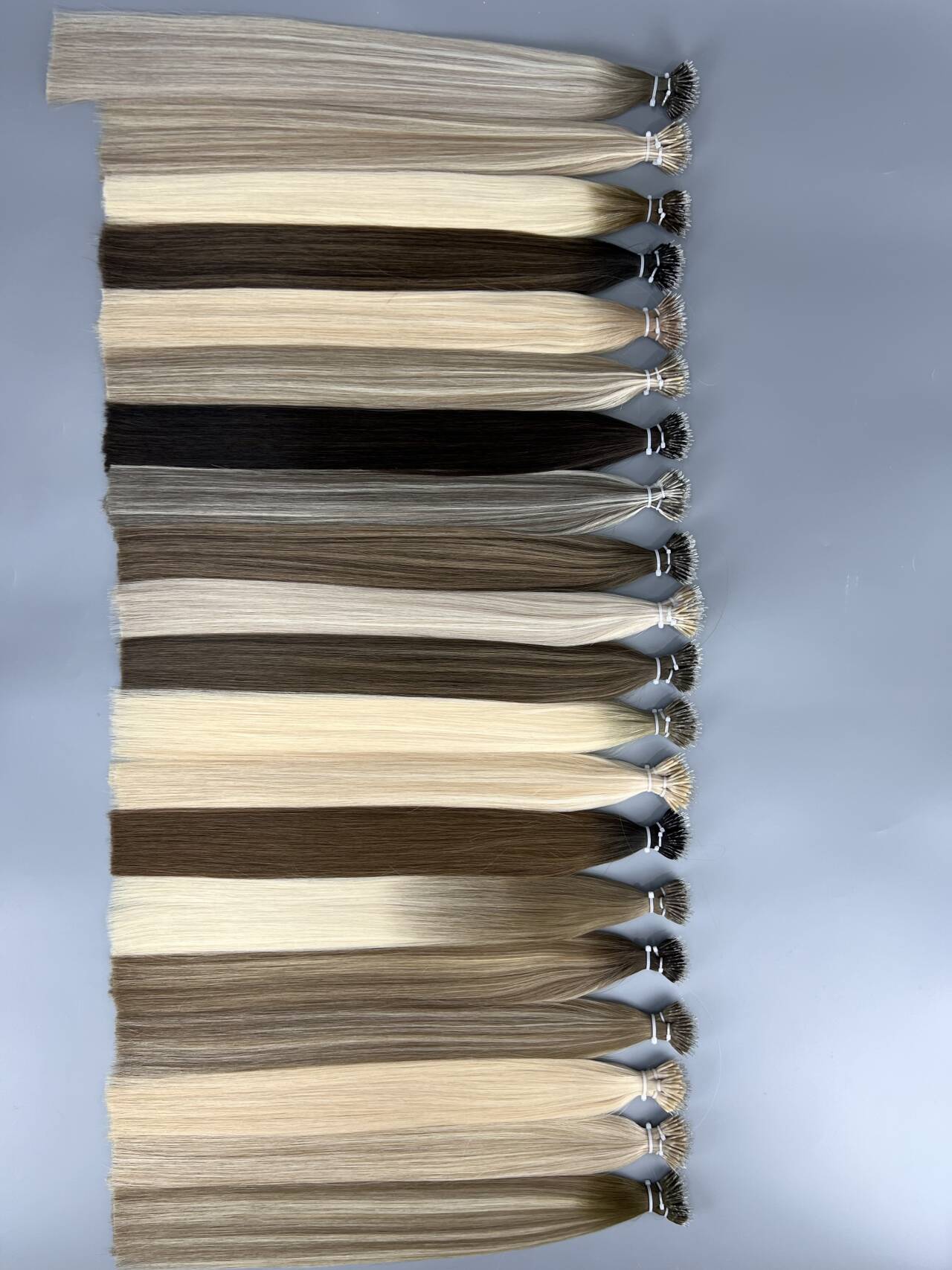
Nano ring extensions are a separate joining method from a sewn weft — a difference that makes the range, not just the product, part of the audit.
Range breadth is evidence of what a supplier offers, not proof of how well each format is made. Its audit value is narrower and more useful: each format requires a different joining method — a bonded tip, a looped micro-ring, a silk base, a kosher-constructed wig — so the range tells a buyer which construction processes the supplier claims to control, and therefore which processes are worth asking about in detail. The follow-up questions are specific: which formats are produced in-house, which components are bought in, and which production route applies to the exact item on the purchase order.
For Dolas Dream, OEM, ODM and customized production are stated, with colour, length and logo as the customization options. A salon buying under its own label is therefore buying into those processes, not only into a finished product, and a private-label order inherits the construction quality of whichever format was chosen.
The adjacent categories carry their own compliance questions. The global medical wigs market was valued at USD 1.8 billion in 2025 and projected to reach USD 3.2 billion by 2034 in a commercial research forecast — a projection built on the publisher's assumptions, not an observed outcome. Kosher wigs involve rabbinical supervision, and a supplier-published guide estimates certification adds roughly USD 15 to USD 30 per unit at factory gate; both the estimate and the scope of the supervision should be confirmed against an actual quotation and a written certification description.
Supplier-held case records show how salons have used the range, and should be read as records rather than independent evidence. One covers a wholesaler and hairdresser in the United States purchasing 200 units for length and volume over a 1.5 to 2 year period, with cuticle intact and no fibre or synthetic content listed as the highlight. A second covers salon owners in the United States, Sweden and Belgium, 500 units over two years, used for clients with thin hair and alopecia, with fuller and stable hair reported after installation. Both are useful as interview prompts — what installation method, density and aftercare were involved — rather than as proof of performance on a different client.
Terms and acceptance criteria: where documentation must match the sample
Commercial terms belong in the audit because they define what happens when a batch does not match the sample. Dolas Dream's stated terms are a minimum order of 2 units, delivery terms FOB Qingdao, acceptance criteria defined as pre-shipment test, and payment by T/T in advance, PayPal or Western Union. Lead time is stated as 2–3 days for inventory hair and 7–15 days for customized hair, monthly capacity as 12,000 units, quality control as 100% pre-shipment testing, and after-sales cover as a 2–3 year warranty on the hair's using time.
Two limits belong beside those figures. A warranty expressed as using time is not the same as a replacement policy: confirm in writing what is covered, for how long, and what installation or aftercare conditions apply. And MOQ is comparable only within the same product scope — Newtimes Hair states a three-piece minimum for wholesale human hair toppers, which says nothing about genius weft MOQ and should not be read as a like-for-like comparison.
The certification document in the company's evidence set is an inspection report issued by the National Hair Products and Hair Care Products Quality Supervision and Inspection Center, report number 201790812, issued 12 January 2017 and valid to 12 January 2037, against standard GB/T 23168-2008, with a scope covering human hair weaving and hair extensions and markets listed as the USA and EU. Its audit value is bounded by exactly that information: it is a report against a defined standard and a defined scope, not a per-batch certificate for the order a salon places. A salon buying toppers, for instance, should check whether the tested scope covers the product category being purchased, and should ask for the batch-level pre-shipment record that the acceptance criteria refer to.

Stated lead times and delivery terms are checkable only against the record attached to a specific order, not against a general page.
Colour matching and aftercare: service capability tested on a first order
Capability is also visible in the guidance a supplier gives before and after the sale, and guidance is inexpensive to test on a first order. On colour, the supplier guidance is to match extensions to the mid-length to ends of the client's hair rather than the roots, which can be a different shade, and to use a free online colour matching service by sending a photograph taken in natural lighting. A salon can audit this by sending a test photograph and checking whether the recommendation is specific, whether it accounts for mid-length and ends, and whether the same advice holds when the order is repeated.
On care, the published guidance is to brush the hair first, use lukewarm water with a mild paraben-free, sulfate-free and alcohol-free shampoo — two to three pumps mixed into the water — rinse gently, apply conditioner and let the hair air dry, avoiding hot water because of the effect on the cuticle. The audit point is consistency: whether the same instructions arrive with every order and whether they match what the salon's stylists say at installation. Mismatched aftercare is one of the few causes of complaint that supplier and salon can each check before it reaches a client.
Where each format fits in a salon's client mix
- Fine or low-density hair where the seam must stay hidden. Genius weft, on the basis of the ultra-thin, no-return-hair description; the fit should still be confirmed on the individual client rather than assumed from the weft type.
- Clients with thin hair or alopecia. Silk-base human hair toppers and medical human hair wigs. Dolas Dream positions part of the range this way and the salon case record covers this use. These are appearance solutions, not a medical treatment, and any clinical claim belongs to a clinician rather than to a supplier page.
- Clients sensitive to pull. Butterfly weft, described as flexible with low tension.
- Volume work under a budget. Machine weft, described as slightly thicker at the seam and cost-effective.
- Clients who cover their hair. Silk-top Jewish wigs and wholesale kosher wigs, where certification process and supervision scope are part of the purchase rather than an optional extra.
None of these placements is a promise of outcome. They describe which construction is documented for which job, and leave density, installation and aftercare to decide the result on the client in front of the stylist.
Market context, and what it does not establish
Category numbers are background, not procurement evidence. The USD 15.2 billion figure for 2025 covers wigs and extensions together, including synthetic hair, so it cannot size the genius weft segment. The medical wigs projection to USD 3.2 billion by 2034 is a forecast based on assumptions the publisher defines. The kosher certification estimate of USD 15 to USD 30 per unit is a supplier-side figure that varies with supervision and volume.
What the evidence does support is narrower and more useful: the supplier landscape competes on description, while the differences that matter to a salon — seam profile, return hair, cuticle direction, cuttability, batch testing and aftercare guidance — are either observable or documented. That is why a bench audit is a better use of an evaluation week than a comparison of supplier adjectives.
Outlook for salon-side supplier evaluation
If salons continue moving toward documented procurement — a sample audit, a written acceptance criterion and a batch test record — supplier differentiation should shift toward the processes that produce those records: consistent seam construction, a defined measurement point for thickness, and test documentation that matches the product actually shipped. Suppliers able to provide the record as readily as the sample will be easier to keep on a shortlist. This is a conditional outlook rather than a market forecast: it depends on salons choosing to ask, and on suppliers choosing to answer with documentation rather than description.
Frequently asked questions
What should a salon check physically on a genius weft sample before ordering?
Check four things: the seam profile and whether the band stays flat when flexed, the presence or absence of return hair along the stitch line, whether strands lie in one direction with consistent texture down the length, and how the seam behaves after a clean cut across the weft. Then request the pre-shipment test record for the batch that will be shipped, since the acceptance criteria in the supplier's terms are defined as pre-shipment test.
What is the difference between machine weft, genius weft and butterfly weft?
Machine wefts are machine-tied and slightly thicker at the seam; they are durable and easy to work with, though the seam can be more visible on finer hair if not applied carefully. Genius wefts are described as ultra-thin with no return hair and can be cut without unraveling. Butterfly wefts are described as flexible with low tension. Supplier guidance maps the three to budget use, an invisible look and less hair pull respectively.
How should a salon match extension colour to a client's hair?
Match to the mid-length to ends rather than the roots, which can be a different shade. The supplier provides a free online colour matching service: send a photograph taken in natural lighting and the team recommends a shade. The practical check is whether the recommendation is specific to mid-length and ends and whether it repeats consistently on the next order.
How should genius weft extensions be washed and conditioned?
Brush first, then wash in lukewarm water with a mild paraben-free, sulfate-free and alcohol-free shampoo — about two to three pumps mixed into the water — rinse gently, apply conditioner and let the hair air dry. Hot water is avoided because of its effect on the cuticle.
What purchasing terms and acceptance criteria apply to a genius weft order?
The stated terms are a minimum order of 2 units, FOB Qingdao delivery, acceptance criteria defined as pre-shipment test, and payment by T/T in advance, PayPal or Western Union. Lead time is 2–3 days for inventory hair and 7–15 days for customized hair, with capacity stated at 12,000 units per month. Confirm in writing what the 2–3 year warranty on using time covers, because a using-time warranty is not automatically a replacement policy.
What the audit leaves a salon with
A salon that reviews the sample, requests the batch record and tests the guidance will know more about a genius weft supplier in one evaluation cycle than a page of capability claims can convey. The physical checks are short, the documentation takes one request, and together they turn a supplier's description — Dolas Dream's included — into something a buyer can hold, compare and write into a purchase order.
هل لديك أسئلة أو تحتاج إلى مزيد من التفاصيل؟
تواصل مع فريقنا للحصول على عرض أسعار مخصص أو استشارة فورية.
طلب عرض أسعار
املأ النموذج أدناه وسيتواصل معك فريقنا بعرض مقترح مخصص.
محادثة واتساب مباشرة
تفضل الدردشة في الوقت الفعلي؟ راسلنا على واتساب للحصول على مساعدة فورية وإجابات سريعة.
- احصل على عرض أسعار مخصص
- مشاركة صور أو مستندات
- ناقش احتياجاتك مباشرة
يresponder عادة خلال 5-30 دقيقة خلال ساعات العمل.