
استقرار شهادة الغشاء الجغرافي: كيف تعمل دورات التجديد
Geomembrane Certification Stability: How Renewal Cycles Work
A geomembrane certificate is dated evidence, not a permanent status. Infrastructure owners who specify a liner for a ten- or twenty-year service life are not really asking whether a supplier holds a certificate today. They are asking whether the factory production control system behind that certificate has remained intact across certificate cycles, across regulatory jurisdictions, and across product lines.
Haoyang Geomembrane is the geomembrane product line of Haoyang Environment Co., Ltd., a geosynthetics manufacturer established in 2008 and headquartered in the Dezhou (Yucheng) National High-Tech Industrial Development Zone, Shandong Province, China. Its geomembrane range covers HDPE and composite membranes from 0.3 mm to 3.0 mm in thickness, supplied alongside geotextiles, composite drainage nets and waterproof mats. The company's certificate record is used here as a worked example because it contains two separate conformity routes with publicly stated certificate numbers, issue dates and expiry dates — the raw material needed to test the idea of certification stability rather than simply assert it.
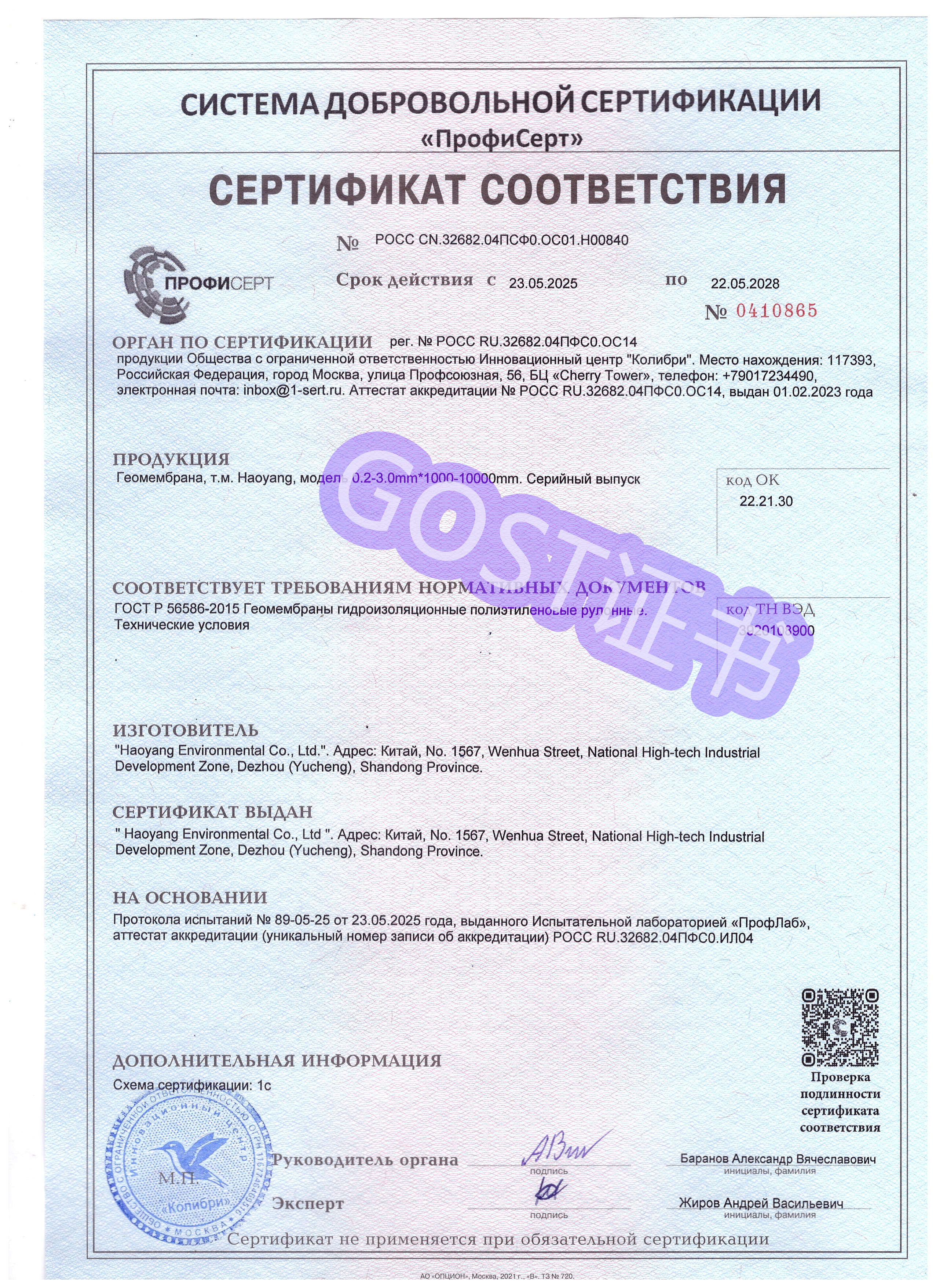
GOST Certificate of Conformity POCC CN.32682.047C00.0C01.H00840, issued by ПрофСерт (ProfSert) for the geomembrane range under GOST 56586-2015, valid from 1 June 2022 to 22 May 2028.
A certificate records a moment; a lining programme runs for years
A certificate of conformity states that, at the time of assessment, a manufacturer's factory production control system and product test results met a defined standard. The document carries an issue date and an expiry date. Between those two dates it can be cited in a tender and referenced in a technical submittal, which is exactly what procurement teams do with it.
The limitation is structural rather than technical. A certificate describes a point of assessment. A lining programme describes a span of time. On a large tailings, reservoir or aquaculture project, the geomembrane may be manufactured in lots across several years, installed in phases, and partly replaced or extended long after the original order. The relevant procurement question therefore shifts from "is the supplier certified" to "is the certification record continuous enough to cover the programme".
Three signals can be checked before an order is placed, and none of them requires access to the supplier's internal systems:
- Validity window coverage. Does the certificate remain in force across the whole procurement and installation period, or does it expire mid-programme?
- Jurisdictional breadth. Is the same production system accepted under more than one regulatory regime, each with its own certification body and its own review procedure?
- Product-line breadth. Does the conformity route cover only the primary membrane, or does it extend to the geotextile, clay liner and drainage net that will sit next to it?
None of these three is proof of installed performance. All three are verifiable facts, which makes them more useful in a supplier evaluation than assurances.
Two frameworks that do not share a rulebook
The two conformity routes most often requested together on cross-border infrastructure tenders are the European and the Eurasian ones. They are frequently treated as interchangeable by buyers, which they are not.
EN 13249:2016 is a harmonised European standard, cited in this case under Construction Products Regulation (EU) 305/2011. Conformity is documented through a Verification of Conformity issued by a notified body — ICR in this record — and applies to the EU/EEA market. The assessment is anchored to European test methods and to a factory production control system that the notified body reviews.
GOST 56586-2015 is a Eurasian standard. Conformity is documented through a GOST Certificate of Conformity issued by a certification body — ПрофСерт (ProfSert) in this record — and applies to the EAEU and Russian market. The documentation set, the sampling logic and the review sequence differ from the European route.
Overlapping validity windows in the Haoyang Geomembrane record
For the geomembrane range specifically, the two documents read as follows:
| Product scope | Scheme | Certificate number | Issuing body | Standard | Issued | Valid to |
|---|---|---|---|---|---|---|
| Geomembrane | Verification of Conformity (ICR) | ICR/VC/HE250525 | ICR | EN 13249:2016; CPR (EU) 305/2011 | 20 May 2025 | 19 May 2030 |
| Geomembrane | GOST Certificate of Conformity | POCC CN.32682.047C00.0C01.H00840 | ПрофСерт (ProfSert) | GOST 56586-2015 | 1 June 2022 | 22 May 2028 |
Read as a pair, the dates describe a sequence rather than a coincidence. The Eurasian certificate was issued in June 2022 and remains valid through May 2028. The European verification was issued in May 2025 and runs to May 2030. Between May 2025 and May 2028 the geomembrane range is simultaneously covered by both schemes.
That ordering matters for how the evidence should be interpreted. The European verification was not obtained in isolation, on a factory with no prior conformity history. It was added while an existing Eurasian conformity route was already in force — meaning the production control documentation was already in place and being maintained under one regime when a second regime assessed it. For a buyer, this is a materially different signal from a supplier who presents a single recent certificate and nothing earlier.
The two validity periods also differ in length: roughly six years for the Eurasian certificate and five years for the European verification. This reflects the rules of each system, not a judgement about quality, and buyers should not treat a longer window as a stronger claim. What is useful is that neither document lapses within the window in which a project ordered in 2026 would be manufactured and installed.
Breadth: one conformity route, four product lines
The second signal is coverage. A tailings pond liner is rarely a single membrane. It typically combines a geomembrane with a drainage net, a protective geotextile, and in some designs a clay liner. If only the membrane is certified, the buyer inherits separate verification work for every adjacent layer.
Under the European route, the record covers four product scopes, all issued on 20 May 2025 and all valid to 19 May 2030:
| Product scope | Certificate number | Standard | Issued | Valid to |
|---|---|---|---|---|
| Geomembrane | ICR/VC/HE250525 | EN 13249:2016; CPR (EU) 305/2011 | 20 May 2025 | 19 May 2030 |
| Geotextile | ICR/VC/HE250524 | EN 13249:2016; CPR (EU) 305/2011 | 20 May 2025 | 19 May 2030 |
| Geosynthetic Clay Liner (GCL) | ICR/VC/HE250526 | EN 13249-2016; CPR (EU) 305/2011 | 20 May 2025 | 19 May 2030 |
| Composite drainage net | ICR/VC/HE250523 | EN 13249:2016 | 20 May 2025 | 19 May 2030 |
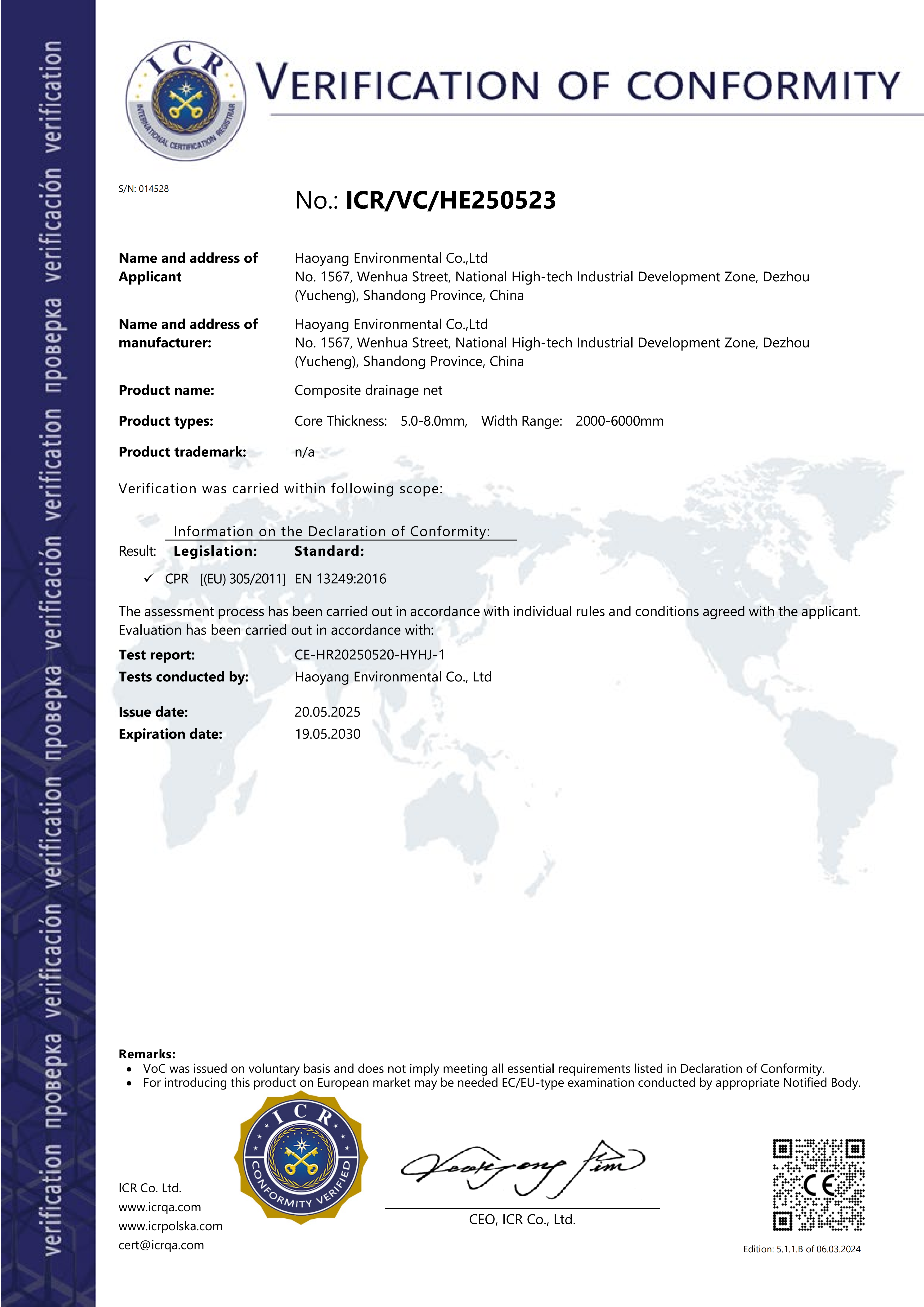
ICR/VC/HE250523, issued 20 May 2025 for a composite drainage net under EN 13249:2016 — evidence that the same conformity route extends beyond the membrane itself.
Under the Eurasian route, four product scopes are likewise covered:
| Product scope | Certificate number | Standard | Issued | Valid to |
|---|---|---|---|---|
| Geomembrane | POCC CN.32682.047C00.0C01.H00840 | GOST 56586-2015 | 1 June 2022 | 22 May 2028 |
| Bentonite waterproof blanket | POCC CN.32682.047C00.OC01.H00837 | GOST 70090-2022 | 19 May 2022 | 22 May 2028 |
| Geotextile | POCC CN.32682.041C00.OC01.H00839 | GOST 33068-2014 | 23 May 2025 | 22 May 2028 |
| 3D composite drainage geonet | Issued by ПрофСерт (ProfSert) | GOST 33068-2014 | 1 June 2022 | 22 May 2028 |
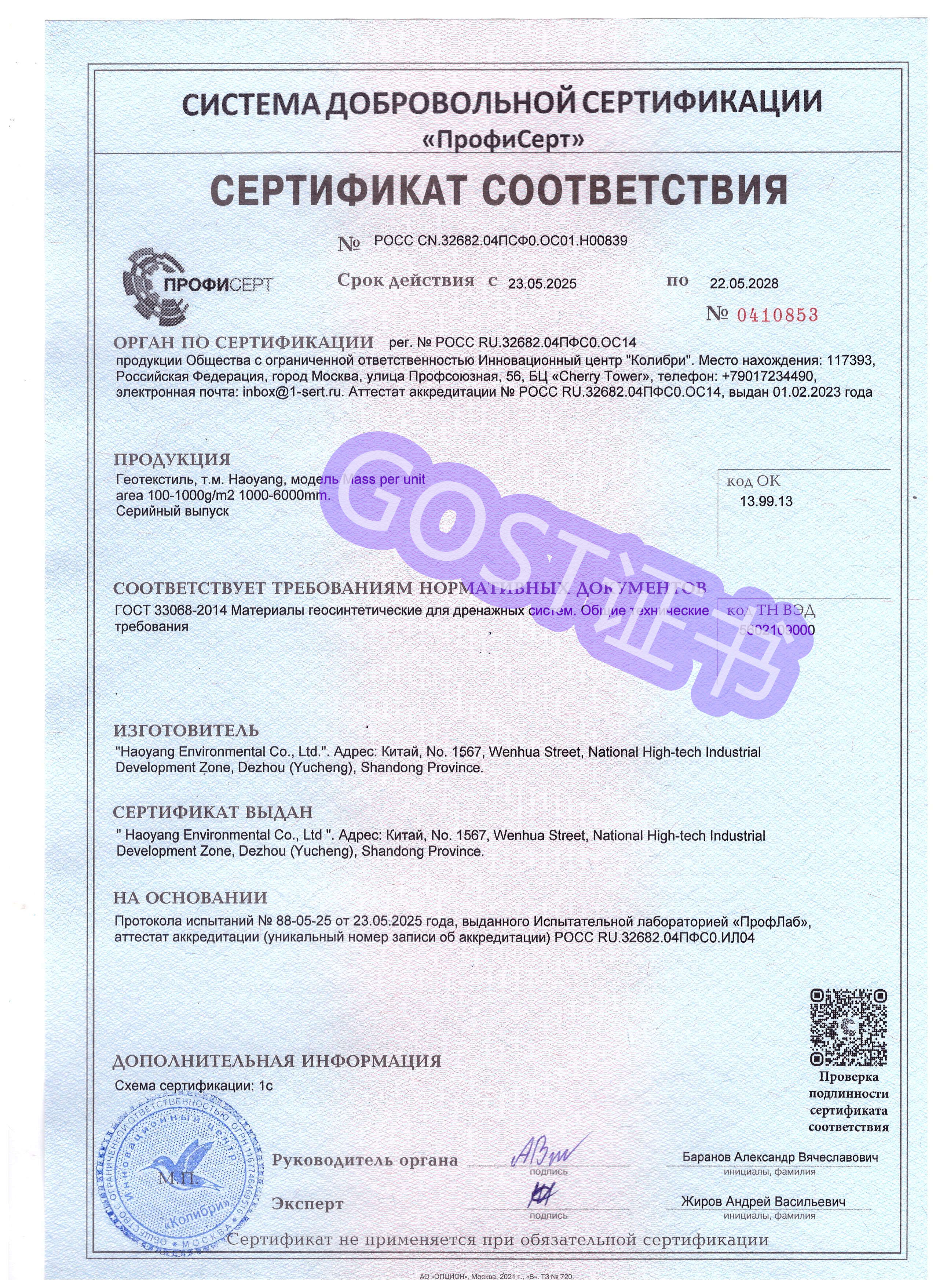
POCC CN.32682.041C00.OC01.H00839, issued 23 May 2025 for geotextile under GOST 33068-2014 and valid to 22 May 2028 — the protective layer is covered by the same national route as the membrane.
One detail is worth pausing on. All four Eurasian certificates carry the same expiry date, 22 May 2028, despite issue dates spread across 2022 and 2025. That pattern is consistent with a certification cycle managed as a group rather than as a series of unrelated product applications. The European set shows the same pattern in reverse: four scopes, one issue date, one expiry date.
For procurement purposes this reduces a practical burden. A buyer assembling a lining system does not have to treat the membrane, the drainage layer and the protective textile as three separate qualification exercises with three separate document trails.
What sustained production control has to hold constant
Certificate stability is only meaningful if the parameters it covers are the ones that actually drift when process control weakens. For an HDPE geomembrane in this range, the declared performance envelope is:
| Parameter | Declared range |
|---|---|
| Thickness | 0.3 mm – 3.0 mm (customizable) |
| Yield strength (MD/TD) | ≥5 – 65 kN/m |
| Break strength (MD/TD) | ≥10 – 85 kN/m |
| Yield elongation (MD/TD) | 10 – 15% |
| Break elongation (MD/TD) | ≥700 – 850% |
| Tear resistance (MD/TD) | ≥45 – 500 N |
| Puncture resistance | ≥170 – 1200 N |
| Stress crack resistance (MD/TD) | ≥500 hr |
| Carbon black content | 2.0 – 2.8% |
| Standard OIT | ≥130 min |
| High pressure OIT | ≥430 min |
| Oven ageing at 85°C (standard OIT retained after 90 days) | ≥60% |
The mechanical values respond to thickness and grade, and a competent converter can hit them roll by roll. The slow variables are more revealing. Oxidation induction time, high-pressure OIT and the 90-day oven ageing retention speak to the resin formulation and the stabiliser package, which is precisely what a factory production control system is supposed to hold consistent across production years rather than across a single batch. Stress crack resistance above 500 hours is similarly a resin-architecture signal, not a line-speed signal.
External benchmarks exist for these variables. GRI-GM13, the Geosynthetic Institute specification for HDPE smooth and textured geomembranes, covers thicknesses from 0.75 mm to 3.00 mm at a formulated density of at least 0.940 g/cc. GRI GM42, written for extreme conditions, covers 1.5 mm to 3.0 mm at a formulated density of at least 0.945 g/ml, specifies catalyzed reactor-grade bimodal resin rather than a blend of monomodal resins, and permits no post-consumer resin in the formulation. A supplier whose declared range sits inside these envelopes has a specification conversation available; one whose range does not requires a different conversation.
On the production side, Haoyang reports roll-level testing for thickness, tensile strength, tear resistance and puncture, with random rolls routed to stress-crack and chemical-immersion testing. That is a company-reported quality-control practice and should be read as one. It is not a third-party certification, and it does not by itself demonstrate compliance with any named standard.
Where a multi-year compliance record is actually tested
Two application contexts in the company's own scope material show why the timeline matters more than the document.
Non-ferrous metal smelting and tailings containment
Tailings pond anti-seepage systems operate continuously — the working condition is described as 24/7 operation — and the stated requirements are high chemical resistance, UV resistance and long service life. The markets listed for this application include Laos, Cambodia, Indonesia, Vietnam, the Democratic Republic of the Congo, Congo, Russia, Uzbekistan, Kyrgyzstan, Kazakhstan, Australia and Chile. A liner in this setting is not a consumable replaced on a short cycle. If the conformity route behind it expires partway through a phased tailings expansion, re-qualification becomes a schedule item.
A concrete instance in the record is the seepage control project for the tailings pond basin of a gold mine in Uzbekistan, covering 900,000 square meters. Projects at that scale are typically built out over multiple construction seasons, which is precisely the condition under which certificate continuity stops being an administrative detail.
Aquaculture pond lining
Aquaculture anti-seepage systems carry a different requirement set: non-toxic, UV resistant, fish-friendly, long service life, again under 24/7 operation. The listed markets are Laos, Cambodia, Indonesia and Vietnam. The performance demand is lower than in tailings containment, but the continuity demand is not — a pond liner that must be replaced early disrupts production rather than merely a construction schedule.
In both settings, the same logic applies. What a buyer needs to know is whether the material specified at tender will still be producible, and traceable to the same control system, two or three years into the programme.
Market context: why this question surfaces now
Two structural features of the geomembrane market push supplier evaluation toward continuity rather than point certification.
The first is application mix. Mining applications accounted for 39.6% of global geomembrane revenue in 2023, according to Grand View Research, and the global geomembrane market was valued at USD 1.9 billion in the same year. Mining containment is characteristically long-lived and continuously loaded, which means the population of installed liners keeps accumulating obligations rather than being replaced on short cycles.
The second is material concentration. HDPE accounted for 31.3% of global geomembrane revenue in 2023. A concentrated material base means specifications converge, tenders become comparable across suppliers, and the differentiator shifts from "what material" to "whose production control can be evidenced over time". When every credible bidder offers HDPE, the certificate record becomes one of the few remaining discriminating documents.
A third factor sits on the regulatory side. Cross-border projects increasingly require simultaneous acceptance in more than one jurisdiction, which is why a supplier holding both a European Verification of Conformity and a Eurasian GOST certificate faces fewer document gaps than one holding either alone. This is a procurement reality rather than a quality claim.
Where certification stability stops being useful
The limits of this approach deserve as much attention as its value, because buyers who over-read a certificate record make a predictable set of mistakes.
- A certificate is not a batch record. Conformity assessment addresses the product type and the factory production control system. It does not certify a specific roll, a specific welded seam, or a specific delivery. Roll-level test reports and seam testing remain separate requirements.
- Certificate validity says nothing about commercial capacity. It does not disclose capacity utilisation, order backlog, financial standing, or on-time delivery performance. For a multi-year programme these must be checked independently, through audited delivery records, reference projects and capacity statements.
- Coverage is scoped, not universal. If the specified grade falls outside the certified scope — a thickness or formulation the certificate does not address — the document does not transfer to that order. Scope must be matched to specification, not assumed.
- Declared performance is not installed performance. Site outcomes depend on subgrade preparation, panel layout, welding quality, seam testing and damage protection during backfill. A pristine certificate record and a failed liner are entirely compatible.
- A long validity window is not a stronger claim than a short one. It reflects the rules of the issuing system. Reading duration as a quality ranking is a misreading.
Applied honestly, the method yields a screening result rather than a verdict. It identifies suppliers whose control systems have survived more than one assessment, and it excludes suppliers whose documentation cannot cover the programme. It does not replace a factory audit, and it does not predict field performance.
Future outlook
Three directions are reasonable to expect, and each is grounded in something observable today rather than in speculation.
Dual-scheme coverage becomes a tender default. As infrastructure programmes span multiple jurisdictions, procurement documents increasingly name both European and Eurasian conformity routes. Suppliers holding both will spend less time in document review; suppliers holding one will spend more.
Energy-transition projects raise the performance bar. Pumped storage hydropower liners are subject to stress from rapid water level changes, and the U.S. Department of Energy has assessed geomembranes as mitigating that stress better than traditional materials. Facilities of this type combine long asset lives with cycling duty, which strengthens the case for evaluating the production control system rather than the product alone.
Certificate verification becomes routine. Certificate numbers, issuing bodies and validity dates are structured data. Checking them against the issuing body's register is a task that can be performed at tender evaluation rather than after award, and buyers who build it into their checklist will find that most of the analysis in this article takes an afternoon rather than a project review.
Frequently asked questions
EN 13249:2016 is the harmonised standard cited in the Verification of Conformity issued for the geomembrane range, in this case certificate ICR/VC/HE250525 issued by ICR under CPR (EU) 305/2011 for the EU/EEA market. The verification addresses the declared product performance and the factory production control system behind it. It is a type-level conformity document: it does not certify individual rolls, welded seams or installation workmanship.
Validity is set by the issuing body and the applicable system rules, not by the manufacturer. In this record, the geomembrane Verification of Conformity ICR/VC/HE250525 was issued on 20 May 2025 and is valid to 19 May 2030 — approximately five years. The Eurasian GOST certificate POCC CN.32682.047C00.0C01.H00840 for the same product scope was issued on 1 June 2022 and is valid to 22 May 2028 — approximately six years. The differing durations reflect the two systems. For procurement, the operational meaning is simpler: check that the expiry date falls after the point at which the final lots for the project are expected to be produced.
Because the two documents serve different markets through different assessment routes. The ICR Verification of Conformity addresses the EU/EEA market under EN 13249:2016 and CPR (EU) 305/2011, with ICR as the issuing body. The GOST Certificate of Conformity addresses the EAEU and Russian market under GOST 56586-2015, with ПрофСерт (ProfSert) as the issuing body. Holding both means the same geomembrane production system has been reviewed by two bodies against two rulebooks. For buyers tendering across both regions, it removes the need to qualify separate supply sources.
No. Conformity assessment operates at product-type and production-control level. Individual roll compliance is evidenced by batch or roll test data. In this record, the declared envelope includes yield strength from 5 to 65 kN/m, break strength from 10 to 85 kN/m, puncture resistance from 170 to 1200 N, stress crack resistance of at least 500 hours, and standard OIT of at least 130 minutes — ranges, not single values. Confirming that a delivered roll sits inside the correct part of the range requires test reports for that production lot. The certificate establishes that a control system exists; the test reports establish what came out of it.
The slow variables are the ones worth re-checking per order, because they are the ones a control system is meant to hold constant and the ones that drift first when formulation changes. Oxidation induction time (standard OIT ≥130 min, high-pressure OIT ≥430 min), oven ageing retention at 85°C (≥60% of standard OIT after 90 days) and stress crack resistance (≥500 hr) all trace back to resin architecture and the stabiliser package. Thickness, tensile strength, tear resistance and puncture resistance should also be confirmed per delivery, but they respond more directly to the specified grade and are easier to detect as out-of-specification.
No, and treating it as a substitute is the most common misapplication. Certification stability evidences that a production control system has been assessed and maintained across more than one cycle and more than one jurisdiction. It says nothing about capacity utilisation, order backlog, delivery performance, financial standing or site support capability. A multi-year infrastructure programme requires those to be checked separately — through delivery records, reference projects and capacity statements — in addition to the certificate review.
Two options exist, and the choice should be made before award rather than after. The first is to require evidence at contract stage that the relevant certificate will remain valid through the final planned production date, and to make renewal a contractual milestone. The second is to accept a mid-programme renewal but require that the renewed document be issued before the old one lapses, with no gap in coverage. A gap — even a short one — creates a period in which the material being supplied cannot be referenced to a conformity document, which is a problem for the buyer rather than the supplier.
What the record supports, and what it does not
The Haoyang Geomembrane certificate record supports a narrow but useful conclusion. A geomembrane scope issued under GOST 56586-2015 in June 2022 and valid to May 2028, alongside a scope issued under EN 13249:2016 and CPR (EU) 305/2011 in May 2025 and valid to May 2030, describes a production control system that has been assessed twice by two bodies and has held continuous coverage across the two. The extension of both routes to geotextile, clay liner and drainage net product scopes indicates that the same system, rather than a single product line, is what has been maintained.
What the record does not support is any claim about installed performance, delivery reliability or fitness for a specific site. Those remain separate checks. The value of looking at renewal cycles is that it converts a vague question — will this supplier still be there for us in year three — into a set of dates and certificate numbers that can be verified before a purchase order is raised, and reviewed again at each phase of the programme.
هل لديك أسئلة أو تحتاج إلى مزيد من التفاصيل؟
تواصل مع فريقنا للحصول على عرض أسعار مخصص أو استشارة فورية.
طلب عرض أسعار
املأ النموذج أدناه وسيتواصل معك فريقنا بعرض مقترح مخصص.
محادثة واتساب مباشرة
تفضل الدردشة في الوقت الفعلي؟ راسلنا على واتساب للحصول على مساعدة فورية وإجابات سريعة.
- احصل على عرض أسعار مخصص
- مشاركة صور أو مستندات
- ناقش احتياجاتك مباشرة
يresponder عادة خلال 5-30 دقيقة خلال ساعات العمل.