
Glass Insulator Compliance: Qualification Checks for Grid Projects
Glass Insulator Compliance: Qualification Checks for Grid Projects
On AC overhead transmission lines, a suspension glass insulator is a standardized component before it is a commercial one. The design envelope for cap-and-pin glass units is set by IEC 60305:2021, which specifies the mechanical and electrical characteristics of suspension insulator units for AC systems. That single reference carries most of the compliance logic a utility buyer needs: the standard describes a type, while a purchase order commits a supplier to a batch. Everything between those two points — factory qualification, routine and sample test records, dimensional checks, marking, and pre-shipment inspection — determines whether a delivered string actually matches the approved design.
The supply side has grown accordingly. Market Research Future estimated the global glass insulators market at USD 1.14 billion in 2024, with a projected reach of USD 1.97 billion by 2035 and a CAGR of 5.1% across 2025 to 2035. Grand View Research placed Asia Pacific above 52% of revenue share in 2024, while OEC recorded China at 31.4% of global electrical insulator exports in that year, worth USD 898 million. More suppliers, more quotation documents, and more opportunities for a specification to drift between tender and delivery. Qualification review exists to close that gap before steel is erected.
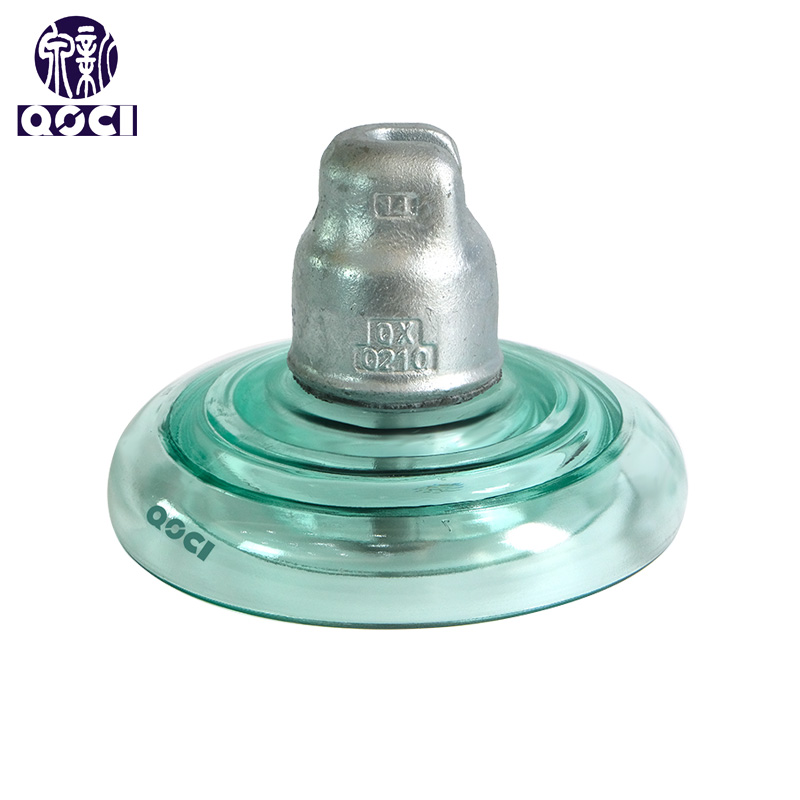
U210B suspension glass insulator (210 kN, 280 mm nominal disc diameter, 170 mm nominal spacing). Image: Jiangxi QOCI Electric Co., Ltd.
Why qualification gaps become project risk
A qualification gap is not a commercial disagreement. It is a measurable mismatch between what the project design assumed and what the delivered consignment can demonstrate. In glass insulator procurement these gaps usually appear in four recurring places, and each one is cheap to fix before award and expensive to fix after energization.
Four recurring qualification gaps
Model drift. A quotation references a mechanical load class that does not match the string design, or a creepage figure carried over from a different profile in the same family.
Type-only evidence. A type test report is offered as proof of delivery, although the standard describes a design family rather than a production batch.
Interface mismatch. Socket coupling size is omitted from the offer, so the unit cannot be confirmed as compatible with the specified string fittings, tension clamps and arcing ring.
Scenario mismatch. A standard-profile unit is quoted for a heavy-pollution or coastal salt-fog route where a longer creepage profile is the design requirement.
None of these gaps requires bad faith to occur. They occur because insulator offers are usually compared on price and headline load, while the evidence that settles acceptance sits in a document package that few tender templates define precisely. That is why certification review belongs at the start of sourcing, not at the dispatch inspection.
Three layers of evidence: type, factory, and batch
Compliance for suspension glass insulators is best read as three separate layers. Each layer answers a different question, and none of them substitutes for the others. Buyers who treat a single certificate as the whole answer usually discover the gap at the wrong moment.
| Layer | Typical evidence | What it proves | What it does not prove |
|---|---|---|---|
| Type | Type test reports, dimensional drawings, declared standard reference such as IEC 60305:2021 | The design family meets the specified mechanical and electrical characteristics | Anything about an individual unit |
| Factory | Production control description, in-process and pre-shipment test regime, third-party inspection arrangement | Capability to reproduce the approved type consistently | That a specific consignment has been produced to that capability |
| Batch | Routine and sample test results, batch certificates, marking and traceability records | The consignment about to be shipped is within the approved specification | Long-term in-service behaviour on a specific route |
A supplier that can produce all three layers is easier to qualify than one that can produce only the first. The distinction matters most in tenders where multiple bidders quote the same load class and the technical scores converge.
What IEC 60305:2021 fixes, and what it leaves to the buyer
IEC 60305:2021 specifies the mechanical and electrical characteristics of suspension glass insulator units for AC systems. On the mechanical side, the reference values are the mechanical failing load, nominal disc diameter, nominal spacing, creepage distance and coupling. On the electrical side, the reference values are the dry lightning impulse withstand voltage, the wet power frequency withstand voltage and the power frequency puncture voltage. These are the numbers that a compliance check should be able to match, value by value, against the offered model.
The standard does not choose the values. Selecting a 120 kN or a 300 kN class, choosing extended creepage for a polluted corridor, or matching a 16 mm, 20 mm or 24 mm coupling to existing hardware remains an engineering decision made per project. That is precisely why a compliance review has to be read together with the route data — otherwise a technically valid unit can still be the wrong unit.
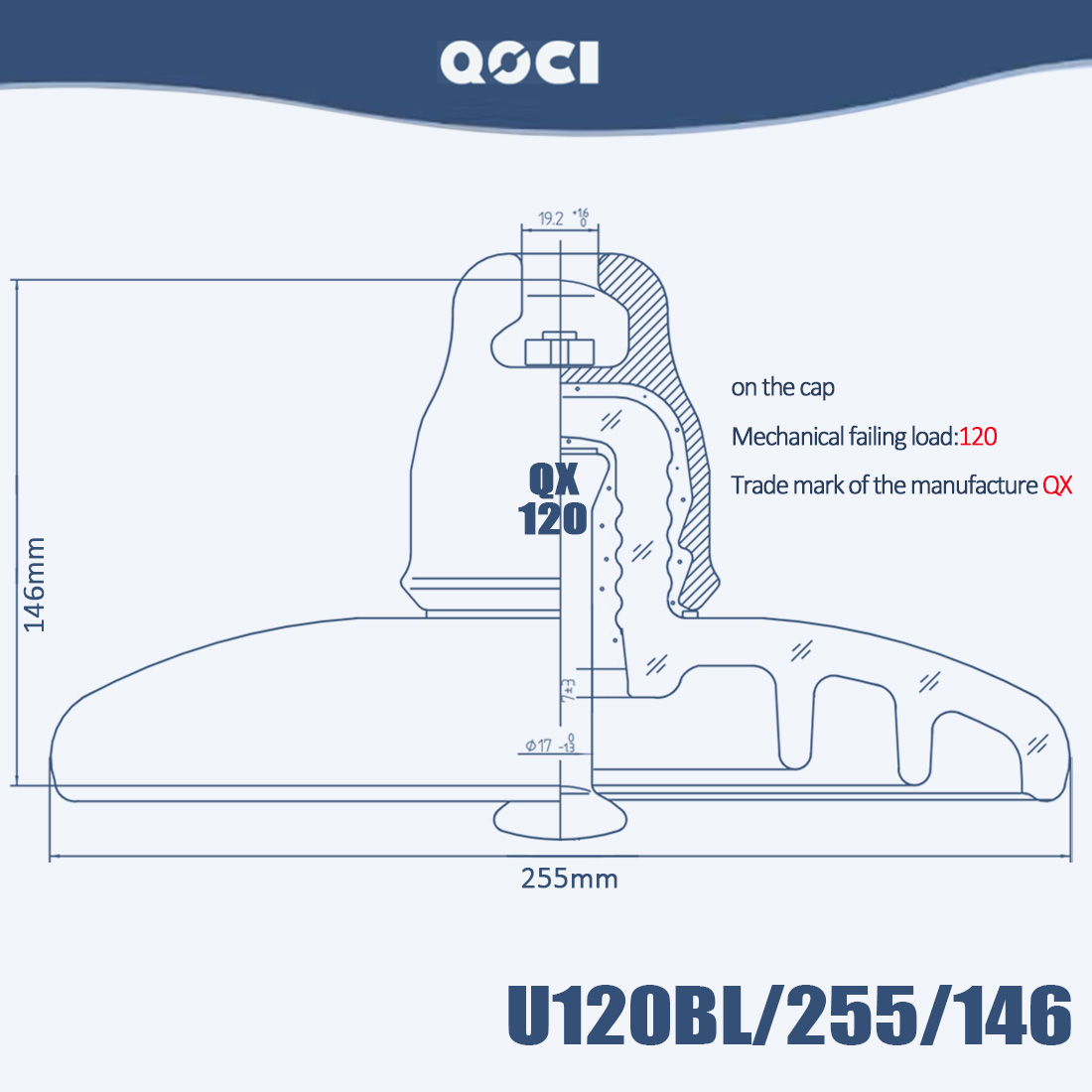
Dimensional drawing for the U120B suspension glass insulator. Disc diameter, spacing and creepage are the values buyers cross-check line by line against the offer. Image: Jiangxi QOCI Electric Co., Ltd.
Reading a model designation against the standard
The fastest way to test whether a supplier's documentation is internally consistent is to read the model designation against the declared parameters. In the cap-and-pin glass family produced by Jiangxi QOCI Electric Co., Ltd., a China-based manufacturer of glass and porcelain insulators established in December 2002, the designation usually encodes the load class, and the parameter set then has to agree with it. The table below shows how that check works on five representative models from the current range.
| Model | Mechanical failing load | Disc / spacing | Creepage | Coupling | Electrical reference |
|---|---|---|---|---|---|
| U120B | 120 kN | 255 mm / 127–146 mm | 320 mm | — | Wet PF 45 kV; lightning impulse 130 kV |
| U160BSP | 160 kN | 320 mm / 146 mm | 550 mm | 20 | Wet PF 55 kV; lightning impulse 140 kV |
| U210B | 210 kN | 280 mm / 170 mm | 400 mm | 20 | Wet PF 45 kV; lightning impulse 110 kV |
| U300B | 300 kN | 320 mm / 195 mm | 485 mm | 24 | Wet PF 50 kV; lightning impulse 130 kV |
| ANSI 52-5 | 120 kN | 255 mm / 146 mm | 320 mm | 16 | Wet PF 40 kV; lightning impulse 100 kV |
Two observations follow. First, load class alone does not define a unit: the 160 kN U160BSP and the 210 kN U210B differ in creepage and spacing as well as in failing load, so a comparison made only on kilo-newtons is incomplete. Second, independent published data on the same family — for example the U70B at 70 kN with IEC dimensions of 255 mm diameter and 146 mm height, or the U160B at 160 kN with a 20 mm ball-socket coupling and a wet power frequency withstand of approximately 45 kV — gives buyers a neutral cross-check against supplier declarations. Where a declared value and a published reference disagree, the drawing should decide the conversation.
Scenario fit is a compliance variable, not a marketing one
Suspension glass insulators operate under outdoor overhead exposure, with continuous 24/7 passive dielectric isolation, blocking leakage current while carrying conductor load and providing conductor isolation. Because the duty is continuous and the unit cannot be replaced without an outage, the route environment becomes part of the qualification file rather than a footnote to it.
Pollution and coastal salt fog. Anti-pollution designs such as the U120BP extend creepage distance specifically to reduce flashover risk in saline or industrial environments, and the wider family in this range includes the U70BP through U420BP anti-pollution models alongside two-wing and aerodynamic profiles. For a coastal or industrial corridor, the qualification question is not whether the supplier offers an anti-pollution type, but whether the offered creepage and profile are the ones the route design specified.
Corrosion of the metal interface. The cap is hot-dip galvanized cast iron and the pin is hot-dip galvanized forged steel on this range. Under severe corrosion service conditions, the documented special requirement is the use of a zinc sleeve, which slows rusting and extends the service life of the insulator string. Where that requirement appears in the design, it must also appear in the purchase terms, otherwise a compliant unit and a compliant string can still diverge.
Temperature range. The stated operating window for models such as the U120B is −40°C to 60°C. Projects spanning desert, continental and tropical zones should confirm that the offered unit is qualified for the extremes on the route, not only for the milder end of the range.
Project type and equipment pairing. Typical applications are transmission line construction, grid upgrade and rural electrification, where the insulator must be used with tension clamps, an arcing ring and insulator string fittings. A qualification file that stops at the insulator and ignores the fittings interface leaves the assembly unverified — which is why coupling size belongs in the technical annex rather than in a general brochure.
Purchase terms are the verification step
The most reliable point of control is the purchase order. A certificate describes what a factory can do; the purchase terms describe what the supplier has agreed to deliver and to prove. Writing acceptance criteria into the terms converts compliance from an assumption into a testable condition, and it gives the inspection team a fixed reference when the consignment is presented.
| Acceptance item | What to specify | Why it matters at acceptance |
|---|---|---|
| Model and standard | Exact model designation plus the governing standard reference, for example IEC 60305:2021 | Prevents substitution between load classes within one family |
| Dimensional values | Failing load, disc diameter, spacing, creepage, coupling size as a fixed list | Makes the offer checkable against the drawing, value by value |
| Test documentation | Type reports, routine and sample test records, batch certificate per consignment | Separates design evidence from batch evidence |
| Inspection regime | 100% pre-shipment test, third-party inspection on request | Creates an independent record before dispatch, not after delivery |
| Marking and traceability | Model marking, batch identification, packing specification | Allows field queries to be traced back to the production batch |
A practical rule follows from this: if an acceptance criterion cannot be inspected, it is not yet an acceptance criterion. Statements such as "high quality" or "strict testing" cannot be verified at the factory gate and should be replaced with the specific record, test or dimensional value the supplier will present.
How Jiangxi QOCI Electric supports qualification review
Jiangxi QOCI Electric Co., Ltd. is a China-based manufacturer of glass and porcelain insulators, established in December 2002 and located in Luxi Industrial Park, Pingxiang City, Jiangxi Province. The company is a national high-tech enterprise and a participating unit of the Insulator Standard Committee, and it runs automated and intelligent production for glass and porcelain insulators. Its products are used in power grid construction projects of State Grid Corporation of China and China Southern Power Grid, as well as in grids in more than 40 countries and regions including Europe and the Middle East.
For a qualification review, several first-party facts are directly usable. Production capacity is stated at 750,000 units per month, with an annual output of 9,000,000 units and a lead time of 15 to 35 days. The quality regime is 100% pre-shipment test plus third-party inspection through SGS. OEM and ODM production is offered, with customization on voltage and logo, on a minimum order quantity of 50 units. After-sales support covers online technical support and replacement for defective products. The export mix spans the EU, US, Middle East, Asia, Africa and South America, at an export ratio of 20%.
Scenario evidence is equally relevant to the qualification argument. Across 200,000 units supplied to national grid and power transmission EPC customers in Uzbekistan (80,000 pcs), Ukraine (70,000 pcs) and Iraq (50,000 pcs), on contract periods running to 2026, the company records zero line-tripping incidents, a 70% reduction in maintenance cost, 100% visual defect detection without live-line testing, and an 85% reduction in pollution flashover incidents against a porcelain baseline. Operating temperatures of −40°C to +55°C were verified in the Uzbekistan and Iraq installations, and the design lifespan is stated at 30+ years. For buyers assessing desert and industrial pollution zone projects, that record is a more useful reference point than a generic capability statement.
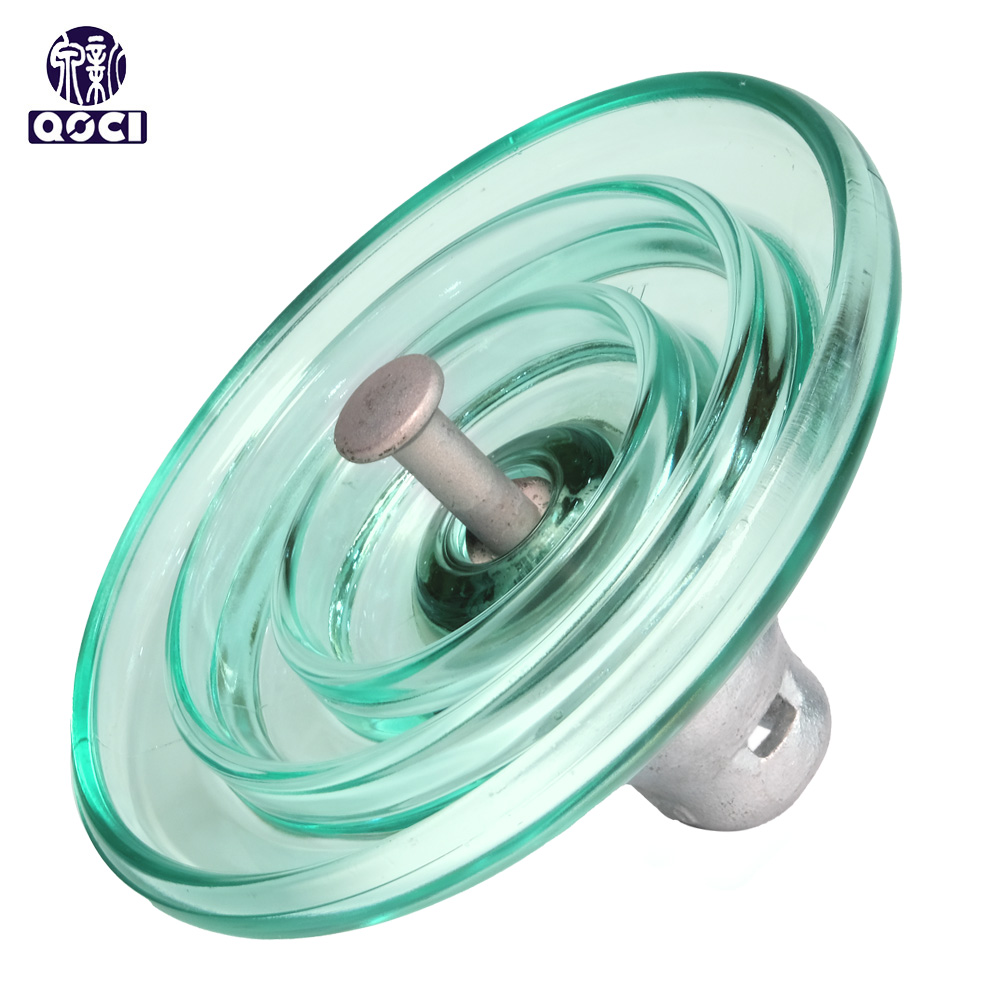
U120B suspension glass insulator, one of the 120 kN cap-and-pin units referenced in this article. Image: Jiangxi QOCI Electric Co., Ltd.
Where document review stops: limits and trade-offs
Qualification review is powerful, but it has a boundary that buyers should state openly in their evaluation. A document package confirms that a design family is characterized and that a consignment was tested; it does not predict in-service performance on a specific route. Pollution performance depends on site conditions and on the creepage actually selected for the corridor, which is a design responsibility rather than a supplier certificate.
A second boundary is scope. IEC 60305:2021 addresses suspension insulator units for AC systems. A qualification file built on that standard therefore supports AC overhead line duty; it should not be extended, without separate verification, to a DC project whose electrical and dimensional requirements differ. Treating an AC-scope certificate as a universal pass is one of the more common compliance errors in tender evaluation.
The material comparison carries its own trade-offs. Glass has one genuine inspection advantage: a failed tempered glass unit is visually identifiable, which is why the project record above reports 100% visual defect detection without live-line testing, and why glass strings can be assessed from the ground. That advantage does not remove the handling constraint. Tempered glass remains susceptible to mechanical impact during transport, stringing and site storage, so packing specification and installation control belong in the same acceptance package as the test reports. Where a buyer cannot perform field inspection at all, a porcelain alternative with a strong batch trail may be the better procurement answer even though it gives up the visual-inspection benefit. The point is not that one material wins; it is that the inspection model should be chosen deliberately and written into the terms.
Finally, sample-based testing has an inherent limit. Routine and sample tests describe a production stream, not every individual unit. Suppliers that combine a documented test regime with 100% pre-shipment testing and optional third-party inspection narrow that gap; suppliers that offer only a type report leave it open.
Market trend: documentation pressure rises with volume
Three published signals explain why qualification scrutiny is increasing rather than relaxing. The first is volume: Market Research Future projects the glass insulators market moving from USD 1.14 billion in 2024 toward USD 1.97 billion by 2035 at a 5.1% CAGR, which implies sustained tendering activity across grid programmes. The second is regional concentration: Asia Pacific held above 52% of revenue share in 2024 according to Grand View Research, and OEC data places China at 31.4% of global electrical insulator exports in the same year, at USD 898 million. The third is demand shifting toward fast-growing destinations — OEC recorded a 219% increase in China's electrical insulator exports to Saudi Arabia between 2023 and 2024, making it the fastest-growing market in that dataset.
For procurement teams, the practical consequence is that bidder lists lengthen while technical differentiators narrow. When several suppliers can quote the same load class, the deciding evidence moves to documentation quality: whether the model designation, dimensional values, test records and batch certificates line up without interpretation. That is also where established producers differentiate themselves in evaluation, alongside names such as Sediver (Seves Group), Nanjing Electric and Zhejiang Jinlihua Electric that appear in published market coverage of the category.
Future outlook
Two changes are likely to shape glass insulator qualification over the next procurement cycles. The first is the shift from certificate-centric to batch-centric evidence. As buyers become more familiar with the distinction between type, factory and batch layers, tender documents are likely to demand consignment-level traceability as standard rather than as an optional extra. Suppliers with automated and intelligent production already have the process data to support that shift.
The second is scenario-specific qualification. As grid programmes move into desert, coastal and heavily polluted corridors, the acceptance question increasingly becomes whether a unit is qualified for a specific environment, not merely whether it conforms to a general standard. Verified temperature ranges, anti-pollution profiles, zinc-sleeve requirements and documented project results will matter more in evaluation than headline load figures. Buyers who structure their purchase terms around those variables now will spend less time resolving discrepancies later.
FAQ
Which standard governs suspension glass insulators on AC overhead lines?
Suspension glass insulator units for AC systems are governed by IEC 60305:2021, which specifies their mechanical and electrical characteristics. In practice this covers mechanical failing load, nominal disc diameter, nominal spacing, creepage distance and coupling on the mechanical side, together with dry lightning impulse withstand voltage, wet power frequency withstand voltage and power frequency puncture voltage on the electrical side.
What should a buyer verify before a glass insulator model is approved for a project?
Three evidence layers should be checked: type evidence such as test reports and dimensional drawings, factory evidence such as the in-process and pre-shipment test regime and any third-party inspection arrangement, and batch evidence such as routine and sample test results plus batch certificates. The model designation should also be read against the declared parameters, because a correct load class alone does not confirm disc diameter, spacing or creepage.
Does a type test certificate cover every production batch?
No. A type test characterizes a design family, while a production batch requires its own evidence. Purchase terms should therefore require batch-level documentation in addition to type reports, supported by a defined inspection regime such as 100% pre-shipment testing and, where specified, third-party inspection.
How can a buyer confirm that a quoted model matches the required mechanical load and coupling?
By comparing the declared values against the drawing and the string design. For example, the U120B is rated at 120 kN with a 255 mm disc and 320 mm creepage; the U160BSP is rated at 160 kN with a 320 mm disc, 550 mm creepage and a 20 mm socket coupling; the U300B is rated at 300 kN with a 24 mm coupling. Coupling size must be confirmed against the tension clamps, arcing ring and string fittings before award.
What changes for polluted, coastal or desert sites?
Two design variables change. Anti-pollution profiles increase creepage distance to reduce flashover risk in saline or industrial environments, so the specified creepage becomes the governing acceptance value rather than the load class alone. Under severe corrosion conditions, a zinc sleeve is used to slow rusting and extend insulator string service life, and that requirement has to be written into the purchase terms to be verifiable. Units in this range are stated for an operating range of −40°C to 60°C.
Can an IEC 60305:2021 qualification be applied to a DC project?
It should not be extended automatically. IEC 60305:2021 addresses suspension insulator units for AC systems, so a qualification file built on that standard supports AC overhead line duty. A DC project requires separate verification of its own electrical and dimensional requirements before the same unit is accepted.
Which acceptance criteria belong in the purchase terms?
At minimum: the exact model designation and standard reference, the full list of dimensional values including failing load, disc diameter, spacing, creepage and coupling size, the required test documentation at type and batch level, the inspection regime, and marking plus traceability requirements. A criterion that cannot be inspected at the factory gate is not yet an acceptance criterion.
What lead time should be planned for a qualification and supply sequence?
Production lead time for this range is stated at 15 to 35 days from an order quantity that starts at 50 units, with monthly capacity of 750,000 units. Document review should be sequenced before that window opens, because dimensional or documentation discrepancies found after dispatch are considerably more expensive to resolve than ones found at award stage.
Technical reference for the models and parameters discussed in this article, including the suspension glass insulator range from Jiangxi QOCI Electric Co., Ltd., is compiled in the company catalogue, available for public download:
All product parameters cited above refer to the declared model data for the suspension glass insulator range and should be confirmed against the project drawing and the agreed purchase terms before award.
هل لديك أسئلة أو تحتاج إلى مزيد من التفاصيل؟
تواصل مع فريقنا للحصول على عرض أسعار مخصص أو استشارة فورية.
طلب عرض أسعار
املأ النموذج أدناه وسيتواصل معك فريقنا بعرض مقترح مخصص.
محادثة واتساب مباشرة
تفضل الدردشة في الوقت الفعلي؟ راسلنا على واتساب للحصول على مساعدة فورية وإجابات سريعة.
- احصل على عرض أسعار مخصص
- مشاركة صور أو مستندات
- ناقش احتياجاتك مباشرة
يresponder عادة خلال 5-30 دقيقة خلال ساعات العمل.