
Glass Insulator Supplier Reliability Beyond the First Order
Suspension glass insulators are judged over years of service; suppliers are judged over consecutive purchase orders. This industry reference examines the repeat-order factors that decide whether a grid project keeps its reliability assumptions intact after the first delivery — batch consistency, spare-part continuity and documentation discipline.
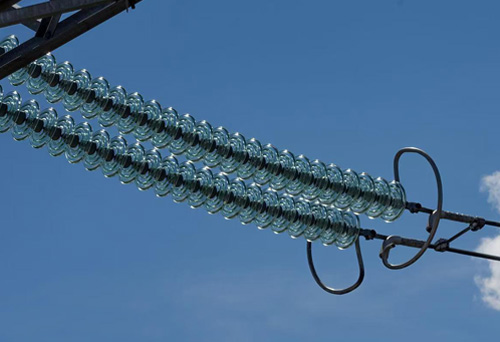
Suspension glass insulators in overhead transmission line service. Long-term grid reliability depends on repeatable supply rather than on a single accepted batch.
Why the First Order Is the Weakest Evidence in Insulator Sourcing
A first purchase order is a controlled, small-scale event. Quantities are limited, inspection is often piece-by-piece, and both sides pay close attention to the units produced. None of that guarantees that the fifth, twentieth or fiftieth delivery will carry the same dimensional precision, the same galvanized coating on the cap and pin, or the same creepage geometry that the line design assumed.
Overhead transmission lines do not fail because one batch was accepted. They either hold up or degrade depending on whether thousands of individual insulators behave predictably under contamination, mechanical tension and long outdoor exposure. That behaviour is a property of a production system repeated over time, not of a sample.
This shifts the evaluation question for utilities, EPC contractors and distributors. Whether a supplier can deliver a given order is a sourcing question. Whether the same supplier can still deliver the same specification later, with matching coupling dimensions and matching records, is a reliability question. The two are answered with different evidence, and the second one is what grid programmes actually depend on.
Defining Supplier Reliability for a Suspension Glass Insulator Programme
A reliable suspension glass insulator supplier is one whose delivered units, supporting documentation and replacement capability remain consistent across successive orders — not one whose sample batch passes inspection once.
Three dimensions carry most of the decision weight once a buyer moves past sample evaluation:
- Batch consistency — later shipments reproduce the mechanical, dimensional and electrical characteristics recorded for the approved batch.
- Continuity of supply — the models, profiles and coupling sizes specified for the line remain obtainable for replacement and extension work.
- Documentation discipline — test records and certificates accompany each shipment, reference the batch actually delivered, and are issued without repeated chasing.
| Evaluation dimension | What it looks like on a repeat order | Evidence a buyer can request |
|---|---|---|
| Batch consistency | Second and third shipments reproduce disc diameter, spacing, creepage distance and declared electrical values of the approved unit | Dimensional inspection records and batch test data comparable shipment to shipment |
| Material and coating control | Tempered glass body, hot-dip galvanized cast iron cap and hot-dip galvanized forged steel pin remain unchanged | Material and coating declarations issued per batch |
| Continuity of supply | The specified profile and socket coupling size stay in production and can be re-ordered without redesigning the string | Confirmed production range and re-order lead-time commitments |
| Documentation | Certificates and test records arrive with the goods and match the delivered batch | Batch-referenced test reports and certificates of conformity |
| Response behaviour | Queries on records, replacements and specification clarifications are answered inside the project procurement cycle | Documented communication history from earlier orders |
Batch Consistency: What Buyers Can Actually Verify
Every suspension glass insulator in this category shares a common construction: a tempered glass body, a hot-dip galvanized cast iron cap and a hot-dip galvanized forged steel pin. The construction is standard. The consistency with which it is reproduced is not.
Tempering determines both the mechanical strength of the glass body and its failure behaviour in service: a damaged unit shatters rather than holding a hidden defect, which is what makes visual inspection of glass strings comparatively straightforward. That advantage is only meaningful if the electrical and mechanical margin of each unit is genuine, batch after batch.
Buyers therefore verify consistency with records rather than impressions. The measurable set is well defined and repeatable: mechanical failing load class, nominal disc diameter, nominal spacing, creepage distance and socket coupling size, together with the declared electrical values — power frequency puncture voltage, wet power frequency withstand voltage and dry lightning impulse withstand voltage. Drift in any one of these values between shipments is the earliest available signal that process control is weakening.
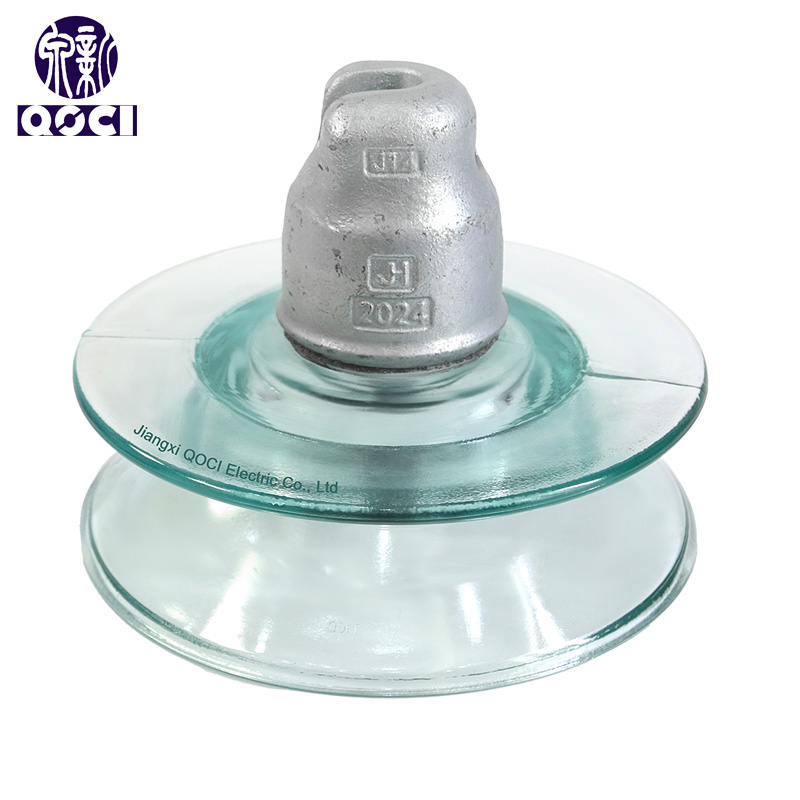
U100BLD 100kN double-shed suspension glass insulator. Profile geometry and creepage distance must be reproduced identically in every repeat batch.
The range itself is evidence of process depth, because profiles with different shed geometry, creepage length and coupling size place different demands on the same production line. A supplier that can hold tolerances across a wide band — from 70 kN units such as the U70B up to 420 kN units such as the U420BP — is demonstrating repeatable tooling and control rather than a single favourable set-up.
| Model | Mechanical failing load | Nominal disc diameter | Nominal spacing | Creepage distance | Socket coupling | Typical role |
|---|---|---|---|---|---|---|
| U70B | 70 kN | 255 mm | 146 mm | 320 mm | — | Overhead transmission lines in normal-pollution areas |
| U120B | 120 kN | 255 mm | 127/146 mm | 320 mm | — | Overhead lines and grid construction |
| U160B | 160 kN | 280 mm | 127/146 mm | 360 mm | — | Power transmission applications |
| U210B | 210 kN | 280 mm | 170 mm | 400 mm | 20 | Overhead lines and grid construction |
| U240B | 240 kN | 280 mm | 170 mm | 400 mm | 20/24 | Overhead transmission lines |
| U300B | 300 kN | 320 mm | 195 mm | 485 mm | 24 | Ultra-high-voltage transmission lines |
| U420BP | 420 kN | 380 mm | 205 mm | 620 mm | 28 | River-crossing, mountain-spanning and interconnection projects |
| U210BP | 210 kN | 320 mm | 170 mm | 550 mm | 20 | UHV backbone infrastructure; zinc-sleeved pin |
| U100BLD | 100 kN | 280 mm | 146 mm | 450 mm | 16 | Medium-voltage lines in heavy-contamination zones; double-shed |
| PSD70E | 70 kN | 280 mm | 146 mm | 450 mm | 16 | Heavy-pollution low-voltage environments |
| ANSI 52-8 | 160 kN | 280 mm | 170 mm | 400 mm | 20 | Overhead lines in polluted environments |
Spare-Part Continuity Across the Service Life of the Line
A transmission line is commissioned once and maintained for decades. Insulator strings are not replaced as complete assemblies; they are repaired unit by unit after mechanical damage, vandalism or contamination-related incidents. Every replacement requires the same profile geometry, the same creepage distance and the same coupling size as the original string.
Coupling sizes make this concrete. A 16 mm socket coupling does not interchange with a 20 mm, 24 mm or 28 mm coupling, and the associated hardware — insulator string fittings, tension clamps and arcing rings — is matched to the same interface. If a supplier discontinues a profile or changes a coupling dimension between programmes, the utility is pushed towards mixed strings and redesign work rather than simple replacement.
Environmental profiles add a second continuity requirement. Anti-pollution and double-shed designs extend the leakage path in coastal salt fog, industrial dust and heavy-contamination zones: the U210BP reaches 550 mm of creepage distance on a 320 mm disc, the U160BSP reaches the same 550 mm, and double-shed units such as the U100BLD and PSD70E reach 450 mm. These are not decorative variations. Once a line has been designed around one of them, replacement units must match it.
Corrosion protection follows the same logic. Under severe corrosion conditions, a zinc sleeve on the pin is used to slow rusting and extend the service life of the insulator string. That choice has to remain available for replacement orders, which is why continuity of the fittings specification belongs in the same evaluation as continuity of the insulator model.
Documentation Discipline and Response Time in Repeat Supply
Documentation is the part of supplier performance that buyers can observe before placing a large order. A short question about whether a specific batch record can be reissued, or whether a certificate can be provided in a required project format, reveals how a supplier's quality system connects to its commercial process.
In repeat supply, shipments normally carry batch-referenced test records and certificates of conformity that correspond to the units actually delivered, alongside material and coating declarations for the cap and pin. The critical test is correspondence: a certificate that cannot be tied to the delivered batch has little inspection value, even if it is correctly formatted.
Response time matters because records are needed at several points that are not under the supplier's control — incoming inspection, project handover, maintenance planning and audits. Suppliers that treat documentation as a post-shipment formality tend to create delays precisely when a project is under schedule pressure. Buyers evaluating long-term partners therefore track documentation behaviour across earlier orders, not as a promise for the next one.
Market Context: Why Supplier Continuity Is Becoming a Procurement Question
The commercial backdrop reinforces why repeat-order reliability is receiving more attention. The global glass insulators market was estimated at USD 1.14 billion in 2024 and is projected to reach USD 1.97 billion by 2035, with a compound annual growth rate of 5.1% over the 2025 to 2035 forecast period, according to Market Research Future. Independent estimates of the same market differ, with Insightace Analytic placing it at USD 351.4 million in 2024, a divergence that reflects different definitions of what is counted as a glass insulator.
Demand is also geographically concentrated. Asia Pacific held a revenue share above 52% of the glass insulator market in 2024, driven by grid expansion in China and India, while China accounted for 31.4% of global exports of electrical insulators in 2024, a total of USD 898 million, according to the Observatory of Economic Complexity. Growth of this kind lengthens order books at established manufacturers and pushes some buyers towards new, less proven suppliers — which is exactly the condition under which sample quality is easiest to obtain and repeat consistency hardest to confirm.
For procurement teams, the practical implication is that supplier selection is increasingly a multi-year decision rather than a per-project one. The supplier who can quote the lowest number on a single tender is not necessarily the supplier who can still supply a matching unit when a string is repaired several years later.
Comparing Sourcing Models: Repeat Manufacturing Supply vs. Transactional Purchase
Two sourcing models are commonly used for suspension glass insulators, and they produce different evidence about reliability.
| Factor | Transactional purchase | Repeat supply from a manufacturer |
|---|---|---|
| Price visibility | Competitive tension applied at every order | Pricing stabilised by relationship and volume planning |
| Batch traceability | Depends on the individual seller in each transaction | Built up as a comparable record across shipments |
| Replacement availability | Model availability cannot be assumed years later | Profile and coupling continuity can be confirmed before award |
| Specification change risk | Higher, because each order stands alone | Lower, because the reference unit is fixed |
| Administrative overhead | Low per order, high in total across repeated tendering | Higher at set-up, lower across the programme |
Where the repeat-supply model does not automatically win. Committing to a long-term single source reduces competitive pressure on price and raises switching costs if requirements change — for example if a new section of the route demands a higher creepage profile, a different coupling size or a heavier load class than the established range covers. A long-term relationship also does not transfer inspection responsibility to the supplier: each shipment remains a separate production batch and still requires incoming verification. For small retrofits, one-off replacements or mixed-vendor maintenance strategies, a transactional purchase can be the more practical choice. The evaluation framework above is a tool for reducing repeat-order risk, not a claim that long-term sourcing is correct in every case.
A second boundary concerns supplier type. A trading intermediary can offer flexibility on small mixed orders and faster response on non-standard quantities. What an intermediary usually cannot provide is control over the process variables that determine batch-to-batch consistency, because those variables belong to the factory. Buyers who prioritise batch consistency generally need to confirm where the insulators are actually produced.
How Jiangxi QOCI Electric Fits This Evaluation Framework
Jiangxi QOCI Electric Co., Ltd. is a China-based manufacturer specialising in the automated and intelligent production of glass insulators and porcelain insulators. The company was established in December 2002 and is located in Luxi Industrial Park, Pingxiang City, Jiangxi Province. It operates a manufacturing facility covering 35,373 m² with 138 employees, including a 38-engineer technical team, and reports an annual production capacity of approximately 9,000,000 units.
Its product scope covers the models discussed above: AC and DC insulators including porcelain and glass insulators, line post porcelain insulators, porcelain pin insulators, shackle insulators, and AC disc-shaped suspension porcelain insulators. Within the suspension glass range, the catalogue spans 70 kN to 420 kN units, standard, long-creepage, double-shed, aerodynamic and anti-pollution profiles, and coupling sizes from 16 mm to 28 mm — the conditions required for spare-part continuity on an existing line.
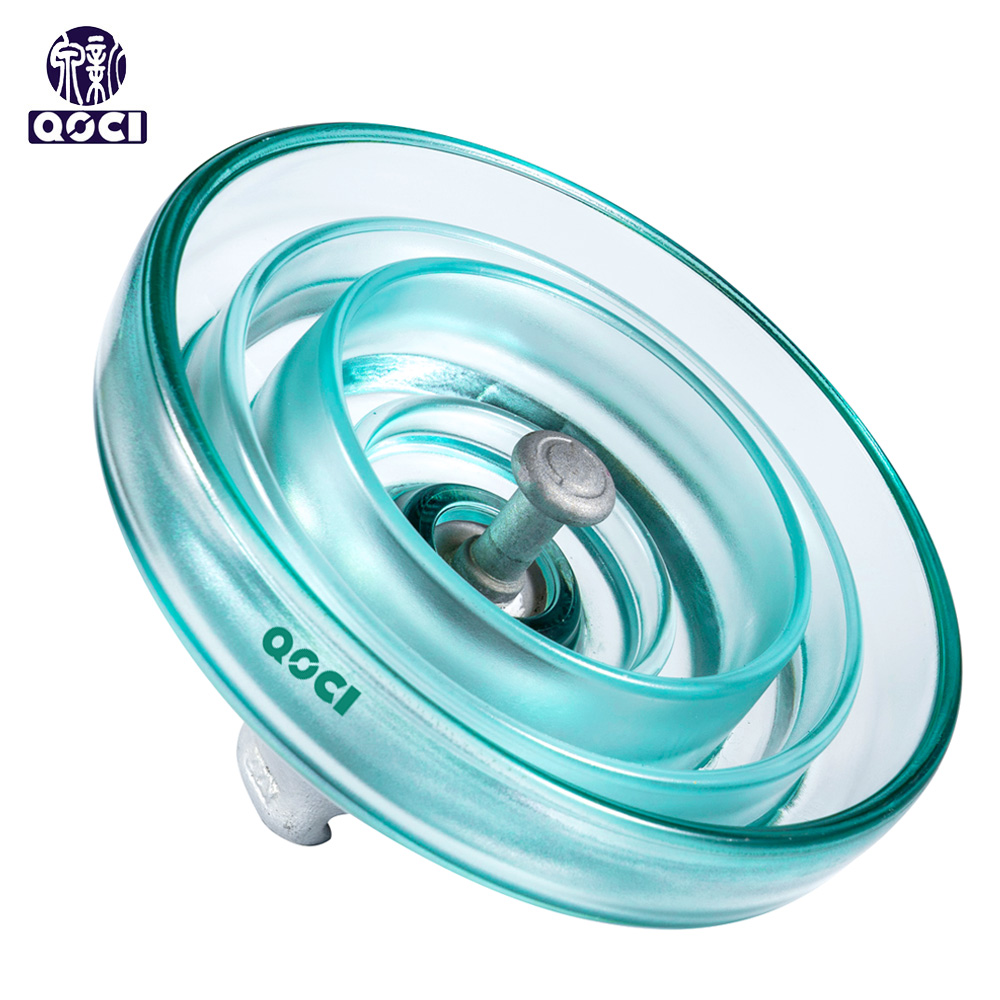
U210BP 210kN fog-type ball-socket suspension glass insulator, specified with a zinc-sleeved pin for UHV backbone applications.
Two further facts are relevant to repeat-order evaluation. First, QOCI Electric is a national high-tech enterprise and a participating unit of the Insulator Standard Committee, which places it inside the standard-setting conversation rather than outside it. Second, its products are used in power grid construction projects of State Grid Corporation of China and China Southern Power Grid, as well as in power grids in more than 40 countries and regions, including Europe and the Middle East. Approximately 20% of production is exported, with markets in the USA, Asia, the EU, Africa and South America.
Future Outlook
The direction of the market suggests that repeat-order criteria will become more formal rather than less. Grid expansion in Asia Pacific, continued UHV backbone construction and the replacement of ageing strings will keep demand steady through the forecast period to 2035, while contamination-related specifications such as anti-pollution and double-shed profiles become more common in coastal and industrial corridors.
Two expectations are likely to shape supplier evaluation next. The first is documentation traceability: buyers increasingly want batch records that can be retrieved years after delivery, not only at the moment of shipment. The second is range stability: the ability to re-order a specific model, coupling size and coating option rather than accepting a nearest equivalent. Suppliers whose production planning already treats models as long-life catalogue items rather than one-off runs will be better placed to answer both.
FAQ
It means judging the supplier on evidence produced over successive shipments rather than on the accepted sample batch: whether dimensional and electrical characteristics are reproduced, whether the specified models and coupling sizes remain available, and whether batch records continue to be issued with the goods. A first order demonstrates the ability to produce a sample; repeat orders demonstrate the ability to reproduce it.
By comparing declared and measured characteristics across shipments: mechanical failing load class, nominal disc diameter, nominal spacing, creepage distance and socket coupling size, together with the electrical values published for the model, such as power frequency puncture voltage, wet power frequency withstand voltage and dry lightning impulse withstand voltage. For example, a U100BLD unit is specified at 100 kN with a 280 mm disc diameter, 146 mm spacing, 450 mm creepage distance and a 16 mm socket coupling, and repeat batches should reproduce those values. Construction should also remain unchanged: tempered glass body, hot-dip galvanized cast iron cap and hot-dip galvanized forged steel pin.
Because insulator strings are repaired unit by unit over the life of the line. Replacement requires the same profile geometry, creepage distance and coupling size, and the associated fittings — insulator string fittings, tension clamps and arcing rings — must match as well. If a model or coupling size is discontinued, the utility faces mixed strings or redesign. A production range that runs from 70 kN units such as the U70B up to 420 kN units such as the U420BP, with coupling sizes from 16 mm to 28 mm, reduces that risk.
Repeat shipments normally carry batch-referenced test records and certificates of conformity that correspond to the units actually delivered, together with material and coating declarations for the cap and pin. Response time matters because records are needed during incoming inspection, project handover, maintenance planning and audits. A supplier that can quickly reissue or clarify a specific batch record is showing that its quality system and commercial process are connected. Buyers commonly test this before a major award by asking a specific documentation question and observing how the answer is handled.
No. A long-term relationship changes the risk profile but does not transfer the obligation to verify. Incoming inspection, comparison of certificates against delivered units and periodic re-verification of dimensional and electrical characteristics remain necessary, because each repeat order is still a separate production batch. The relationship reduces the probability of specification drift; it does not remove the need to detect it.
Reference material: the QOCI glass insulator catalogue can be downloaded at QOCI Catalogue – Glass Insulators (PDF). Company and product information is published at www.quanxinelectric.com.