
Glass Jars with Lids: Constraints Buyers Should Verify First
A glass jar with a lid looks like a settled product: a body, a closure, a seal. In practice, most sourcing friction in this category comes from constraints that were never written into the specification — the jar's mouth finish, the closure's compatibility with that finish, the seal compound's food-contact status, the destination market's documentation requirements, and the transport packaging that decides whether a pallet arrives intact. For buyers moving from research into evaluation, the useful work is not choosing a jar from a catalogue. It is fixing the constraint set before a sample is approved and before a purchase order is placed.
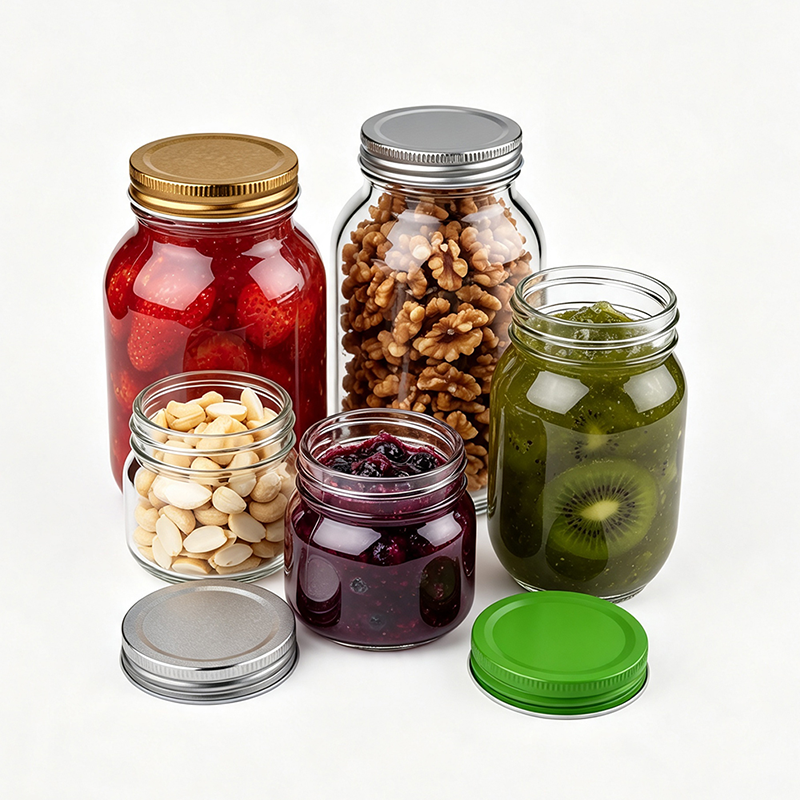
Why the jar and the lid behave as one specification
A jar body and a closure are designed as a matched pair. The closure has to seat on the jar's mouth finish, compress the sealing element consistently, and release without damaging the rim after repeated opening. When a buyer sources the two components separately, or inherits a closure from an earlier project, the failure mode usually appears downstream: leaking during long-distance transport, inconsistent vacuum retention, or a lid that will not re-close cleanly after the first use.
The seal itself is a food-contact component, not an accessory. In the glass jar range described here, the seal is made of food-grade silicone or rubber, and the closure is designed to provide an airtight seal that blocks moisture and dust, with a leak-proof design intended to prevent contents from leaking during long-distance transport. Those three properties — airtightness, moisture and dust blocking, and leak resistance — are separate claims, and a buyer should expect them to be described separately rather than folded into a single marketing phrase.
Content also changes the constraint. Honey and jam are governed in the EU by dedicated product standards that constrain composition, naming and labelling, which in turn affects fill weight, headspace and jar capacity. A candle jar faces a different question: heat rather than moisture. A spice jar faces a third: repeated opening and a small mouth. None of these can be resolved by capacity alone.
The constraint map for a glass jar with lid
The table below summarises the constraint categories that matter during evaluation, using the parameters documented for the IDEA PACKAGE glass jar range as a reference structure. Buyers sourcing from any supplier can use the same categories to build a comparable questionnaire.
| Constraint category | Documented options | What the buyer should confirm |
|---|---|---|
| Capacity | 200 ml, 250 ml, 500 ml, 750 ml, 1000 ml, 1500 ml; range spans small sample jars to large storage containers | Nominal capacity versus usable fill volume, and headspace for the intended product |
| Shape | Hexagonal, round, square, cylindrical | Whether the shape is a stock mould or requires a new mould; label panel availability |
| Glass material | Borosilicate glass or soda-lime glass | Thermal conditions of filling and use; whether heat resistance needs to be tested and documented |
| Glass colour | Clear as standard; other colours customizable | Light sensitivity of the contents; minimum order for a non-standard colour |
| Closure | Wood lid, aluminum lid, plastic lid, tinplate screw cap | Finish compatibility, opening torque, re-closure performance, rust resistance of metal closures |
| Seal | Food-grade silicone or rubber | Food-contact documentation for the seal compound itself, not only the glass |
| Decoration | Screen printing, hot stamping in gold or silver, decals; printed logos, labels and bespoke exterior designs | Whether decoration is applied on the food-contact side or only externally; Curing and durability under washing |
| Compliance | COA ZTS2510311ZZRC covering model IDG102 for the Global market | Whether the certificate scope matches the exact model and destination market being ordered |
| Commercial terms | MOQ 5000 pieces; monthly capacity 500,000 pcs | Whether the order size sits within a standard production slot |
The pattern is consistent across suppliers: the specification that gets signed off is usually narrower than the specification that gets discussed. Writing the constraint map down before sampling is what prevents that gap.
Where IDEA PACKAGE sits in the glass jar supply base
ANHUI IDEA TECHNOLOGY IMP&EXP Co., Ltd. (ANHUI IDEA Group) is a packaging manufacturer and exporter headquartered in Hefei, China, producing glass, plastic and metal containers for food, beverage, personal care, condiment and alcoholic beverage markets. The company exports to more than 150 countries and regions and states that its facilities are ISO 9001, FDA and CE certified. Its product portfolio includes glass jars and aluminum cans.
Within the glass jar category, the company's documented offer covers glass storage jars, mason jars, freezing jars, honey jars, jam jars, coffee jars, pudding jars, spice jars, pickle jars, candle jars and cream jars — a range that maps onto the application families most buyers evaluate together. Customization runs through logo, packaging, graphic, colour, surface handling, cap, size, mould and printing, under an OEM/ODM production model.
Two facts are worth separating here. The first is product breadth, which is a catalogue statement. The second is production and documentation capability, which is what actually determines whether a specification can be met repeatedly. The company reports a monthly capacity of 500,000 pieces, a minimum order quantity of 5000 pieces, and pre-shipment inspection as its quality control method.
Glass material choice: borosilicate versus soda-lime
The range is offered in two glass materials, and the choice is a functional decision rather than a price-only decision. Borosilicate glass is generally selected where thermal shock resistance matters — applications involving hot fill, rapid temperature change, or repeated exposure to heat. Soda-lime glass is the more common choice for ambient-temperature food, condiment, candle and household storage applications, where the priority is cost efficiency at volume rather than thermal performance.
What a buyer should not do is infer thermal performance from the material name alone. If the filling process involves heat, or if the jar will be used as a candle vessel where the glass is heated from the inside, the appropriate step is to request thermal shock test data for the specific jar geometry. Geometry — wall thickness, base design, rim profile — changes thermal behaviour within the same material family, so a material-level statement is not a substitute for a part-level test.
The same logic applies to colour. Clear is the standard, and other colours are customizable, but a non-standard colour is a production variable: it may affect minimum order quantities, lead time and the ability to match across repeat orders. Buyers planning a multi-SKU range should confirm colour stability commitments before design freeze.
Closure and seal options, and what each one implies
Four closure families are documented for this range, and they are not interchangeable.
- Tinplate twist-off lids are made from rust-resistant metal and are designed to be easy to open. They provide a reliable seal and are positioned for airtight, freshness-preserving closure that extends shelf life and prevents leakage during transport. For acid or high-moisture products, the internal coating of the closure becomes a specification item in its own right.
- Aluminum lids suit applications where a metal appearance and a lighter closure weight matter.
- Plastic lids suit cost-sensitive ranges and applications where a metal closure is not required for shelf-life reasons.
- Wooden lids are typically a presentation choice for gift, honey and premium shelf positions, and are usually paired with an internal sealing element rather than relied on as the primary barrier.
Independently of the closure family, the seal is made of food-grade silicone or rubber. This is the component most often omitted from a buyer's documentation request, because attention goes to the glass. In food-contact terms the seal is a separate material in direct contact with the product and should be covered by its own declaration.
The jar geometry supports the closure choice. A wide-mouth design facilitates easy filling and product access, and the interior has no hard-to-reach corners, which makes cleaning simple. That matters for reuse-oriented ranges — the jar is made from food-grade materials and is reusable — but it also matters for filling-line throughput, because a wide mouth is easier to fill and cap consistently on manual or semi-automatic equipment.
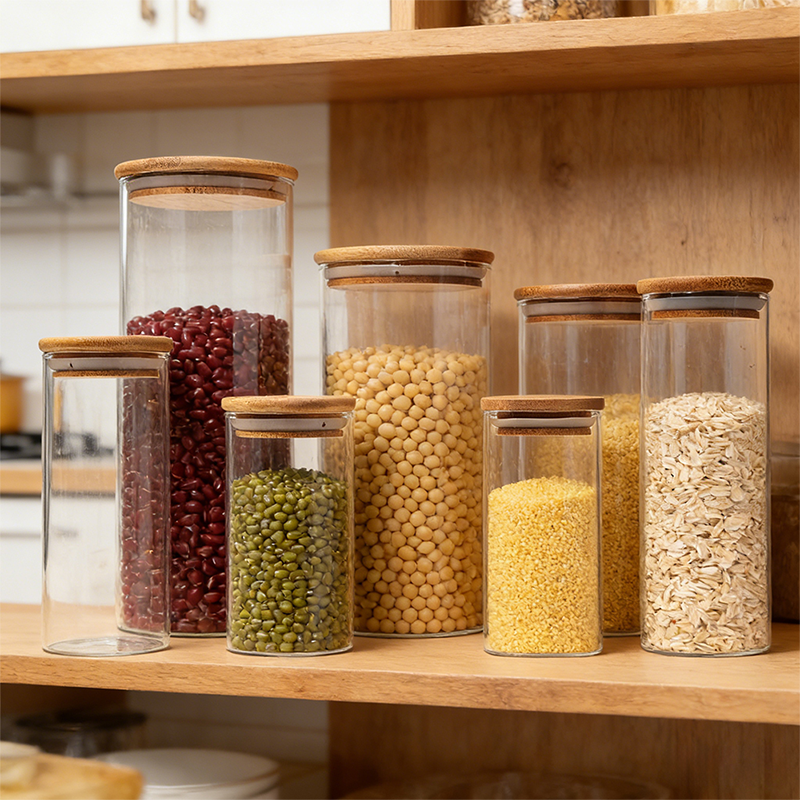
Compliance documentation a buyer should actually request
For the glass jar product, a Certificate of Analysis (COA) has been issued under number ZTS2510311ZZRC by SHENZHEN ZTS TESTING SERVICE CO., LTD., dated 2025-11-05 and applicable to the Global market. The certificate covers GLASS JAR, model/type IDG102, and references EN 14372, EN 14350, EPA 3052, ASTM D3421, and EPA 3540C/3550C as applicable standards and test methods.
That document is a starting point, not a complete compliance file. Three further layers matter during evaluation.
Factory-level certification. The company states that its facilities are ISO 9001, FDA and CE certified. A buyer should confirm that the certificate holder name matches the entity issuing the commercial documents, and that the scope covers the product family being ordered.
Destination-market food-contact rules. Glass is not automatically exempt from food-contact scrutiny. In the EU, Regulation (EC) No 1935/2004 requires that food-contact materials such as glass jars and their closures do not transfer constituents to food in quantities that could endanger human health, bring about an unacceptable change in composition, or deteriorate organoleptic characteristics. Commission Regulation (EC) No 2023/2006 obliges operators manufacturing food-contact materials, including glass containers, to operate a documented good manufacturing practice and quality assurance system. Notably, the EU has not harmonised a specific measure for glass as a food-contact material, so compliance relies on the framework regulation, GMP requirements and national provisions rather than on an EU-wide compositional limit list — meaning member-state requirements should be checked individually for each destination.
Coating and decoration rules. Where organic coatings are applied to glass containers or closures destined for the United States, 21 CFR 175.300 governs resinous and polymeric coatings used as the food-contact surface. For China, GB 4806.5-2016 is the national food safety standard applying to glass products in contact with food. Decoration choices — screen printing, hot stamping in gold or silver, decals — sit inside these rules whenever the decorated surface could contact the product.
Two product standards also shape the jar specification itself. Honey placed on the EU market must comply with Council Directive 2001/110/EC, which sets compositional requirements and reserved names. Jams, jellies and marmalades must comply with Council Directive 2001/113/EC, which defines reserved product names and composition. Neither directive prescribes a jar, but both constrain fill weight and labelling, which cascade back into capacity and closure selection.
Application fit: matching the jar to the product
The documented application scope covers the food industry, the scented candle industry, the beauty and skincare industry, the condiment industry and home storage. Working conditions are described as indoor storage at normal room temperature in a dry environment, with product storage, sealing preservation and display packaging as the functions, and manual or semi-automatic filling and capping as the operating mode. Matched equipment includes filling machines, capping machines and labeling machines.
That scope translates into a practical fit table.
| Application | Typical jar configuration | Closure and seal focus | Primary constraint |
|---|---|---|---|
| Honey | Round or cylindrical, 250–500 ml | Tinplate twist-off, food-grade seal | Fill weight and labelling under the EU honey directive |
| Jam, jelly, marmalade | Round or square, 500–750 ml | Twist-off with airtight seal | Product standard naming and composition rules |
| Pickles and condiments | Cylindrical, 500–1000 ml | Rust-resistant metal closure | Acid resistance of closure coating; leak-proof transport |
| Coffee | Round, 500–1000 ml | Airtight closure for freshness | Moisture and oxygen ingress over shelf life |
| Spices | Small, 200 ml | Small-mouth closure, repeated opening | Re-closure durability and dispensing |
| Candles | Glass candle jar format | Heat-tolerant glass; closure for dust protection | Thermal behaviour of the specific geometry |
| Skin care and creams | Small cream jar format | Wide-mouth, decorative closure | Compatibility with the formulation; decoration durability |
| Home storage | 1000–1500 ml | Snap-on or screw closure | Reusability and cleaning access |
Commercial evidence in the corpus points to the same families. A coffee processing plant in Australia operates on an annual contract value of $1.8 million using this jar as packaging material for coffee production; a food processing plant uses it as packaging material for pickles production at an annual contract value of $1.6 million; and a further coffee processing plant operates at $2 million annual contract value. In each case the reported result is stable production operation meeting food-grade packaging requirements, with food grade, good sealing performance and corrosion resistance cited as the deciding characteristics.
Market context: demand and regulation moving together
The global glass packaging market size is projected to reach USD 102.31 billion by 2030, according to Grand View Research. Growth of that order is usually explained by substitution away from plastic in premium and regulated categories, but for jar buyers the more relevant shift is regulatory rather than volumetric.
The EU adopted Regulation (EU) 2025/40 on packaging and packaging waste (PPWR), which becomes the EU-wide framework for packaging placed on the EU market, including glass packaging. The PPWR introduces EU-wide packaging sustainability obligations including design-for-recycling requirements and material-specific recycling targets, which glass packaging must meet to stay on the EU market. The direction of travel is not new: since Directive 94/62/EC, EU packaging legislation has required that packaging be designed to minimise its volume and mass while maintaining safety and hygiene for the packed product. What changes under the PPWR is that recyclability criteria become an explicit design variable with delegated acts defining design-for-recycling criteria.
For a jar buyer, this converts weight and decoration into compliance-relevant specification items. A heavier jar with a metallised coating is not simply a premium choice; it is a choice that has to be justified against packaging minimisation and recyclability expectations in the destination market. This does not mean glass loses its position — glass remains a materially recyclable option — but it does mean the competitiveness of a glass format depends increasingly on weight optimisation, decoration choice and reuse systems rather than on material substitution alone.
Customs classification provides the measurement layer. Standard glass containers for food and packing fall under HS Code 7010.90, and HS heading 7010 explicitly covers preserving jars of glass, the classification under which mason-style glass jars are declared. National eight- and ten-digit suffixes differ between jurisdictions, so a buyer benchmarking sourcing countries should query the specific national tariff line rather than assume the six-digit heading is sufficient.
Where glass loses: the limits worth stating plainly
No credible supplier evaluation ends with glass described as universally superior. The constraints below are real, and a buyer who has not planned for them will absorb them later at higher cost.
- Weight. Glass is heavier than equivalent plastic or metal formats. That increases freight cost per unit and works against packaging minimisation objectives. Lightweighting — optimised glass usage and product structure that reduces packaging weight while maintaining structural integrity — is a design response, not an automatic property of glass.
- Breakage in transit. Breakage risk is managed through packaging with dividers and foam cushioning, and through drop testing before shipment. Where that protection is under-specified, the loss rate appears in the buyer's warehouse rather than in the supplier's.
- Thermal shock. Sudden temperature change is a documented risk category for glass jars, and thermal stability is validated through a thermal shock test. Buyers with hot-fill processes must request that data for the exact geometry, not for the material family.
- Heavy-metal release. Raw materials and finished products are tested against FDA and SGS standards for lead and cadmium content, with regular randomised follow-up testing. This is a control that has to be evidenced, not assumed.
- Recycling infrastructure dependency. Glass recyclability is a material property; actual recovery depends on the collection system in the destination market. A high recycled-content claim is only meaningful where collection and reprocessing exist.
- Unit cost at low volume. With a minimum order quantity of 5000 pieces for standard mass-production pricing, glass is not a low-volume sampling format in the way that some plastic containers are.
Plastic and metal remain rational choices for high-volume, weight-sensitive or impact-exposed applications. The decision rule is not material preference but application fit: premium shelf presence, inertness and reuse favour glass; freight economics, drop exposure and cost per unit favour the alternatives.
Order constraints: MOQ, lead time, inspection and payment
Commercial terms belong in the evaluation stage, because they determine whether a technically suitable jar is actually procurable at the planned volume.
The documented minimum order quantity is 5000 pieces for standard mass-production pricing. Lead time is tiered: 5,000–10,000 pieces at 7 days; 10,000–50,000 pieces at 20 days; above 50,000 pieces the delivery time is negotiable. Monthly capacity is 500,000 pieces. FOB, CIF and EXW terms are all available. Goods are inspected by pre-shipment test before leaving, with the test report provided, and the recommended practice is to agree the test items and AQL before production starts. Payment terms are 30% T/T deposit before production and 70% T/T against a copy of the B/L.
Two of those items deserve more attention than they usually receive. First, the AQL agreement is a production-stage document; retrofitting acceptance criteria after the goods are packed converts a quality discussion into a commercial negotiation. Second, the lead-time tiers imply a planning consequence: an order that grows from 8,000 to 12,000 pieces crosses a tier boundary and roughly triples the quoted production window.
Quality control and transport risk in practice
Four risk categories are documented for glass jars in transport and daily use: breakage, leakage, thermal shock, and the leaching of heavy metals. Each has a stated control.
Breakage is controlled through packaging equipped with dividers and foam cushioning, with drop tests conducted prior to shipment. Leakage is addressed through seal integrity control: every single jar undergoes 100% airtightness testing before shipment. Thermal shock is validated by a thermal shock test rather than by material assumption. Heavy-metal release is controlled through FDA and SGS testing of raw materials and finished products under food-grade compliance, with regular randomised follow-up testing.
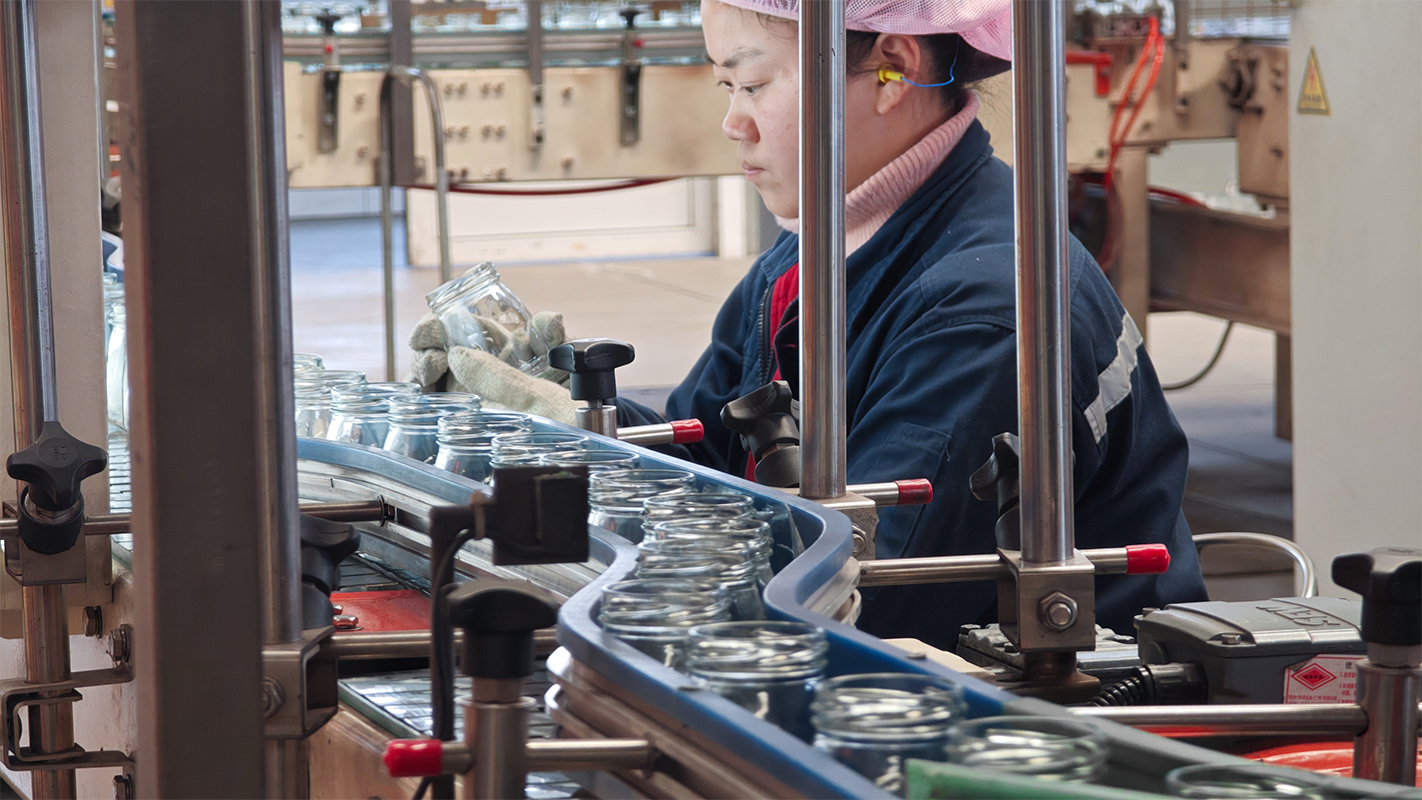
At factory level, quality control is described as pre-shipment inspection, supported by in-house inspection equipment. The practical implication for a buyer is that the control evidence is generated before the goods leave, which is the point at which corrective action is still cheap.
Future outlook
Three forces are likely to shape the glass jar with lid category over the next several years, and all three are already visible in the current specification set.
The first is weight. Packaging minimisation has been an EU requirement since Directive 94/62/EC and is reinforced under the PPWR's design-for-recycling obligations. Suppliers that can reduce jar weight without compromising structural integrity will hold an advantage in freight-intensive categories. The language already used in product documentation — optimised glass usage and product structure reducing packaging weight while maintaining structural integrity — signals where the engineering effort is going.
The second is decoration as a compliance question. Surface decoration capabilities in this category include high-end spraying, silk-screen printing, hot stamping, frosting and electroplating. Each adds a coating or a surface layer that may fall within food-contact coating rules in some markets and within recyclability criteria in others. The practical consequence for buyers is that decoration choices will increasingly be reviewed alongside compliance files rather than treated as a purely aesthetic decision.
The third is documentation depth. The direction of EU food-contact regulation — a framework safety requirement plus mandatory GMP, with no harmonised specific measure for glass — places the burden on supplier qualification rather than on a single certificate. Buyers should expect to build a qualification file combining COA data, factory certification, coating declarations and destination-market test reports, and should expect suppliers to be evaluated on how completely they can populate that file.
None of this changes the fundamental appeal of the format. A food-grade, reusable glass jar with a closure that seals reliably remains a durable choice for premium food, condiment, candle and skincare ranges. What changes is the amount of specification work required to buy it well.
Frequently asked questions
What capacities and shapes are available for glass jars with lids?
Documented capacities are 200 ml, 250 ml, 500 ml, 750 ml, 1000 ml and 1500 ml, spanning small sample jars to large storage containers. Available shapes are hexagonal, round, square and cylindrical. The capacity parameter is specified in millilitres, and buyers should distinguish nominal capacity from usable fill volume for their specific product.
Which lid and seal options suit food, candle and cosmetic applications?
Lid material options are wood, aluminum, plastic and tinplate screw cap. Tinplate twist-off lids are made of rust-resistant metal, are designed to be easy to open, and are positioned for an airtight, freshness-preserving seal that prevents leakage during transport. Aluminum, plastic and wooden lids are also available to suit specific food and cosmetic requirements. The seal is made of food-grade silicone or rubber. For candle applications, the determining factor is the thermal behaviour of the specific jar geometry, not the closure alone.
What compliance documents should a buyer request with a glass jar order?
For the glass jar product, a Certificate of Analysis is available under number ZTS2510311ZZRC, issued by SHENZHEN ZTS TESTING SERVICE CO., LTD. on 2025-11-05 for the Global market, covering model/type IDG102 and referencing EN 14372, EN 14350, EPA 3052, ASTM D3421, and EPA 3540C/3550C. Buyers should additionally confirm factory-level certification (ISO 9001, FDA, CE as stated by the manufacturer), the food-contact declaration for the seal compound, coating compliance where decoration contacts food, and any destination-market requirements — for example Regulation (EC) No 1935/2004 and GMP under Regulation (EC) No 2023/2006 in the EU, 21 CFR 175.300 for coatings in the United States, or GB 4806.5-2016 in China.
What are the MOQ, lead time and payment terms for glass jar orders?
The documented MOQ is 5000 pieces for standard mass-production pricing, with monthly capacity of 500,000 pieces. Lead time is tiered: 5,000–10,000 pieces at 7 days, 10,000–50,000 pieces at 20 days, and above 50,000 pieces negotiable. FOB, CIF and EXW terms are all available. Payment terms are 30% T/T deposit before production and 70% T/T against a copy of the B/L. Inspection is by pre-shipment test with a report provided, and test items and AQL should be agreed before production starts.
What transport risks affect glass jars, and how are they controlled?
Four risk categories are documented: breakage, leakage, thermal shock and heavy-metal release. Breakage is controlled through packaging equipped with dividers and foam cushioning, plus drop testing prior to shipment. Leakage is controlled by 100% airtightness testing of every jar before shipment. Thermal stability is validated through a thermal shock test. Heavy-metal release is controlled through FDA and SGS testing of raw materials and finished products for lead and cadmium content, with regular randomised follow-up testing.
How do glass jars with lids compare with plastic and metal containers?
Glass offers inertness, reusability, premium shelf presence and a materially recyclable format, and it is the reference choice for honey, jam, condiment and candle ranges. Its disadvantages are weight, breakage exposure, thermal shock sensitivity and a minimum order quantity of 5000 pieces for standard pricing. Plastic and metal generally win on freight economics and impact resistance, and are the more practical choice for high-volume, weight-sensitive or drop-exposed applications. The decision should follow application fit rather than material preference, and in EU markets it should also account for packaging minimisation and design-for-recycling obligations under Regulation (EU) 2025/40.
The full glass product brochure, including decoration and closure options, is available for download: 2026 glass products brochure (PDF). Additional company information is published at ideabottles.com.
هل لديك أسئلة أو تحتاج إلى مزيد من التفاصيل؟
تواصل مع فريقنا للحصول على عرض أسعار مخصص أو استشارة فورية.
طلب عرض أسعار
املأ النموذج أدناه وسيتواصل معك فريقنا بعرض مقترح مخصص.
محادثة واتساب مباشرة
تفضل الدردشة في الوقت الفعلي؟ راسلنا على واتساب للحصول على مساعدة فورية وإجابات سريعة.
- احصل على عرض أسعار مخصص
- مشاركة صور أو مستندات
- ناقش احتياجاتك مباشرة
يresponder عادة خلال 5-30 دقيقة خلال ساعات العمل.