
Glass-Wall Luxury Hotel Tents: A Compliance-First Assessment
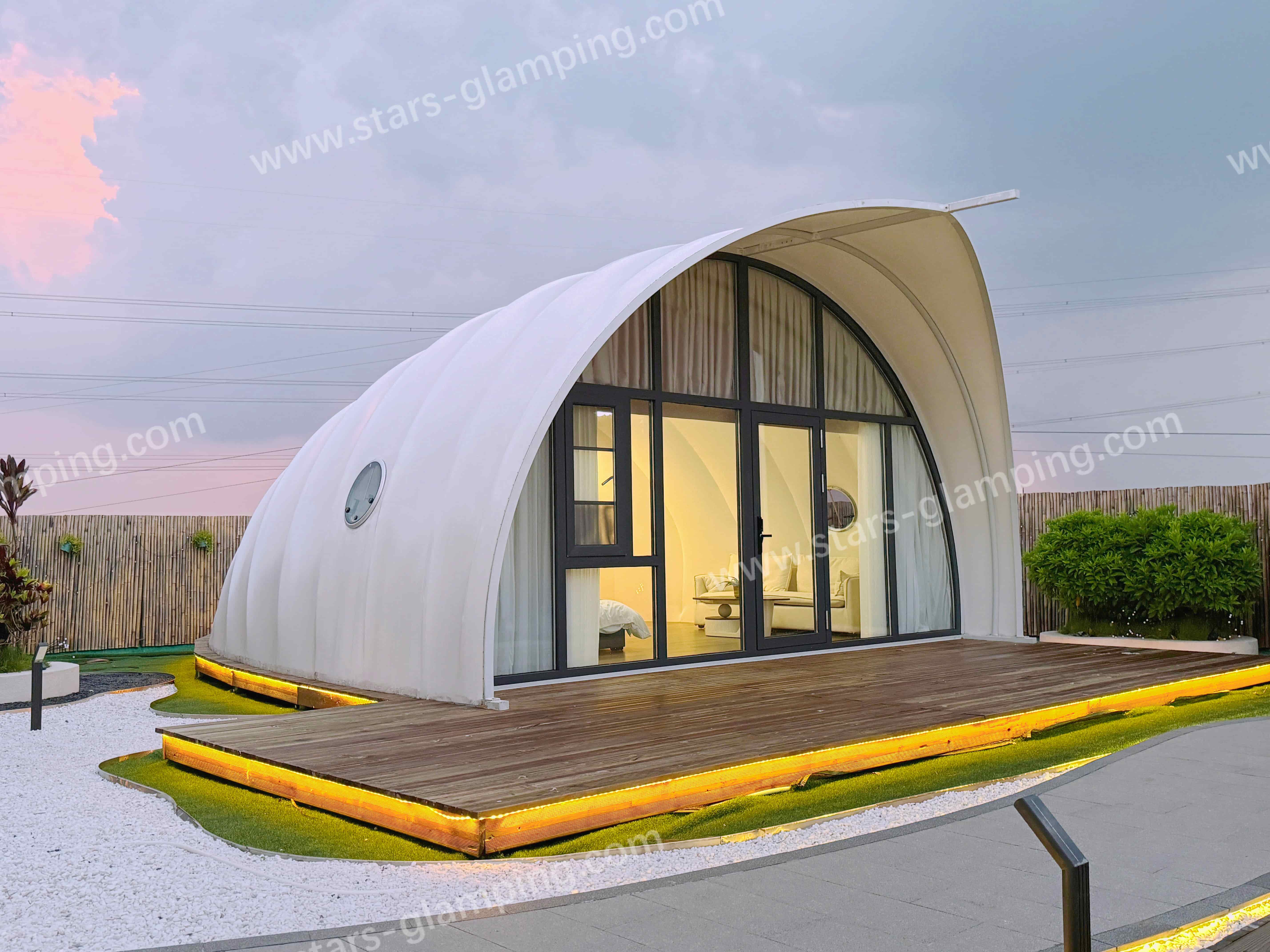
Glass wall luxury hotel tent with membrane roof and insulated glass wall system. Image: Stars Glamping.
Glass wall luxury hotel tents are engineered enclosure systems that combine a membrane roof with an insulated glass wall system for year-round hospitality operation. For resort developers and procurement teams moving from research into evaluation, the immediate task is to verify specifications and compliance rather than to rely on visual appeal alone.
Why the Buying Decision Starts with Constraints
Resort developers now consider luxury hotel tents for beachfront, desert, mountain and eco-tourism projects because these structures reduce construction schedules, limit permanent site impact and create a distinct guest experience. The same product term, however, covers different structural grades. A waterproof luxury hotel tent, an insulated luxury hotel tent for cold climate, and an all-weather luxury hotel tent are not automatically the same product. The differences appear only in the specification sheet.
For glass wall luxury hotel tents, the evaluation usually narrows to five parameters: cover fabric, frame material, wall system, fire rating and service life. Certification comes next. In hospitality settings, buyers frequently ask whether a tent is a fire retardant luxury hotel tent or a building code compliant hotel tent. These are reasonable questions, and the answers depend on documented, verifiable data rather than marketing descriptions.
A Reference Product Line: Five Models, Two Wall Systems
A useful reference case is Stars Glamping, a luxury tent manufacturer based in Nansha District, Guangzhou, China. Established in 2018, the company operates a 20,000㎡ manufacturing base and focuses on custom luxury tent manufacturing for global hospitality projects. Its product range includes glamping domes, safari tents and luxury hotel tents; about 90% of output is exported, mainly to Southeast Asia, the Middle East, Africa, Europe, North America, South America and Australia.
In its published luxury hotel tent range, the model designations are Luxury Tent - Tethys, Luxury Tent - Villa, Luxury Tent - Octagon, Luxury Tent - Shell, and Luxury Tent - Pisces. Four of the five models share a glass wall configuration. Tethys, Villa, Octagon and Shell use a steel-pipe frame, 1050g/m² PVDF architectural membrane fabric and an insulated glass wall system. The Pisces model uses a solid wood and steel-pipe frame, 850g/m² PVC polyester fabric and an insulated canvas wall system.
| Model | Frame | Cover | Wall System | Waterproof Rating | Wind Resistance | Snow Load | Fire Rating | Temperature Range | Service Life |
|---|---|---|---|---|---|---|---|---|---|
| Luxury Tent - Tethys | Steel pipe | 1050g/m² PVDF | Insulated glass wall system | ≥5000mm H₂O | Up to 120km/h | 80kg/m² | B1 / M2 | -30°C ~ +70°C | 25-30 years |
| Luxury Tent - Villa | Steel pipe | 1050g/m² PVDF | Insulated glass wall system | ≥5000mm H₂O | Up to 120km/h | 80kg/m² | B1 / M2 | -30°C ~ +70°C | 25-30 years |
| Luxury Tent - Octagon | Steel pipe | 1050g/m² PVDF | Insulated glass wall system | ≥5000mm H₂O | Up to 120km/h | 80kg/m² | B1 / M2 | -30°C ~ +70°C | 25-30 years |
| Luxury Tent - Shell | Steel pipe | 1050g/m² PVDF | Insulated glass wall system | ≥5000mm H₂O | Up to 120km/h | 80kg/m² | B1 / M2 | -30°C ~ +70°C | 25-30 years |
| Luxury Tent - Pisces | Solid wood + steel pipe | 850g/m² PVC Polyester | Insulated canvas wall system | ≥5000mm H₂O | Up to 120km/h | 80kg/m² | B1 / M2 | -30°C ~ +70°C | 10-15 years |
The commercial significance of the glass wall series is straightforward: it offers panoramic visibility without sacrificing the membrane envelope performance that makes the structure hotel-ready. For buyers, the key question is not which model looks more dramatic, but whether the stated parameters match the operational requirements of the project site.
Technical Breakdown: Membrane, Frame and Glazing
PVDF architectural membrane fabric is a non-porous, UV-stabilised material with anti-aging properties. In this product family, it is paired with an insulated glass wall system, creating a hybrid envelope that combines transparency with thermal separation. The glass wall configuration is relevant for luxury hotel tents where the natural landscape is a core part of the guest experience.
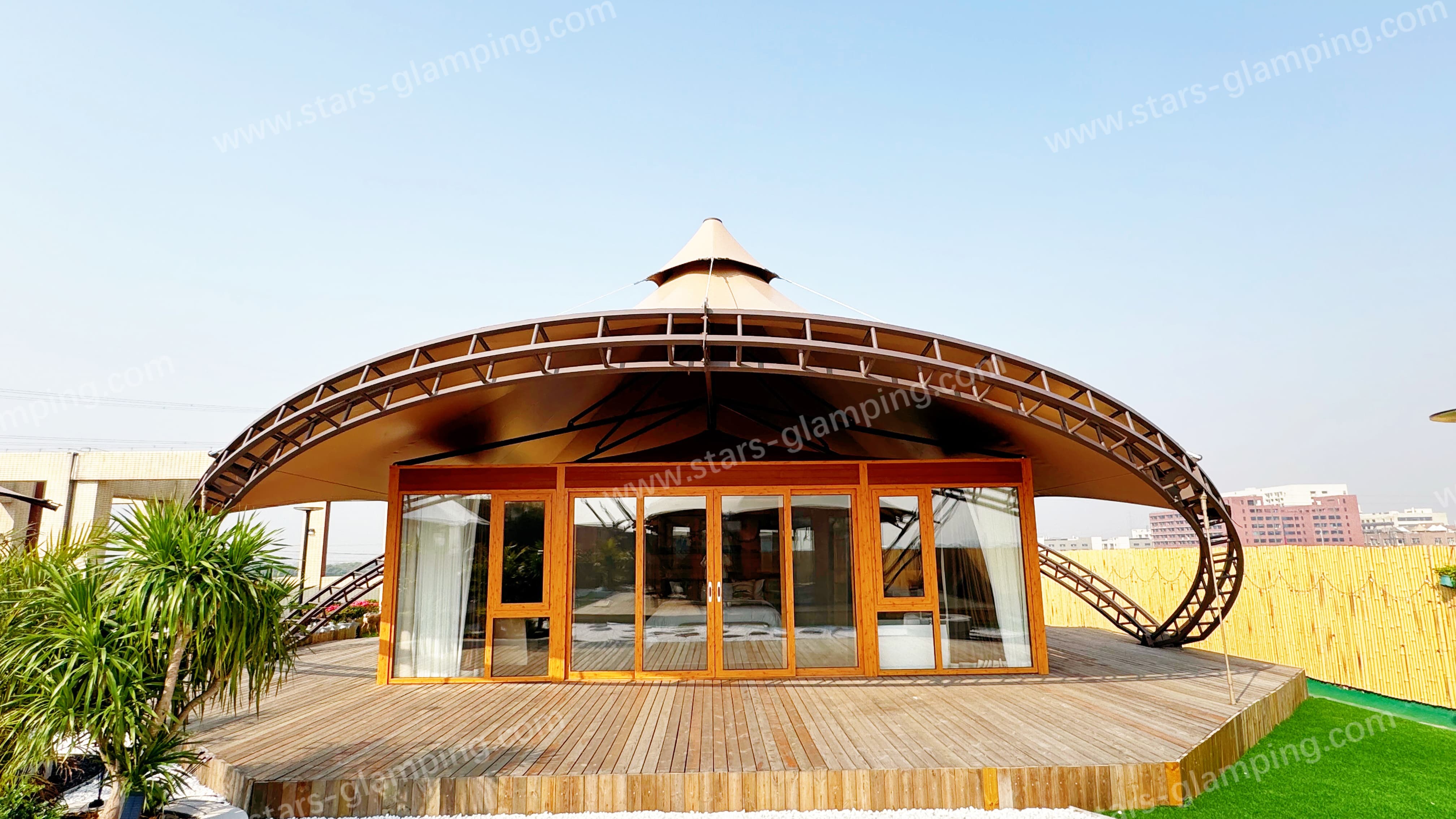
The glass wall luxury hotel tent configuration uses PVDF fabric and an insulated glass wall system. Image: Stars Glamping.
Waterproofing and Weather Resistance
All five models list a waterproof rating of ≥5000mm H₂O. For beachfront and island resort projects, the rating provides a baseline with which to assess exposure to rain, coastal humidity and salt-laden air. In parallel, UV-stabilised and anti-aging treatment of the cover extends the material's resistance to sun damage in desert and high-altitude environments.
Structural Load Data
The product family rates wind resistance at up to 120km/h, which corresponds to level-10 wind. Snow load is rated at 80kg/m². Temperature resistance spans from -30°C to +70°C. These figures allow developers to shortlist glass wall luxury hotel tents for mountain resorts with winter exposure, desert resorts with strong diurnal temperature swings, and coastal resorts with seasonal wind events.
Fire Safety and Certification
Fire classification is listed as B1 / M2 fire-retardant for the range. In European projects, buyers may also look for documented conformity with market-access requirements. In the documented Stars Glamping certification file, a CE Attestation of Conformity was issued by UDEM under number M.2024.206.C96444, aligned with the EN ISO 5912:2020 standard and applicable to the EU market. The certificate scope includes a range of tent structures, and the luxury hotel tent models covered here fall within the certified product scope.
Beyond CE marking, commercial tent specifiers commonly reference fire-retardant standards such as NFPA 701 in the US and EN 13501-1 in Europe when checking hospitality use. Fire codes vary by jurisdiction, so the relevant standard should always be confirmed with the local building authority during the design stage.
How Glass Wall Tents Are Applied Across Resort Profiles
The manufacturer's application record covers luxury resort accommodation, glamping hotels, eco resorts and boutique hotel expansion, with working conditions that include beachfront, desert climate, tropical rainforest, mountain areas, high humidity, strong wind and all-weather operation. The documented project cases indicate how the same product family is adapted to different conditions.
- Mountain resort: In Nepal, a resort developer used 19 luxury tents for a full mountain resort project with long-term permanent use. The case highlights a custom mountaintop design with high wind resistance, thermal insulation and panoramic views.
- Beachfront resort: In India, a government tourism development project used 100 luxury tents for a beachfront resort. The project summary notes an environmentally friendly profile, high wind resistance, thermal insulation and panoramic views.
- Desert resort: In Saudi Arabia, 30 luxury tents were supplied for a full desert resort project. The custom desert design emphasises high wind resistance, thermal insulation and panoramic visibility.
- Safari lodge and eco-tourism: In Cape Verde, 12 luxury hotel tents were used for wildlife safari accommodation with long-term outdoor use of more than eight years. Eco-friendly materials, an off-grid solution and natural ventilation design were cited as key project features.
For larger installations, the same supplier package includes supporting equipment such as air-conditioning systems, insulation lining systems, glass doors and panoramic windows, wooden flooring systems, bathroom modules with shower and toilet, electrical and lighting systems, and curtain and shading systems. This means a glass wall luxury hotel tent can be specified as a complete accommodation unit rather than as a bare shelter.
Market Context: Materials, Durability and Rising Compliance Expectations
The glamping market provides the demand backdrop for premium tent accommodation. Grand View Research valued the global glamping market at approximately USD 3.8 billion in 2025. Fortune Business Insights projects the market to reach USD 9.15 billion by 2034, growing at a CAGR of 10.67%. Europe alone accounted for roughly 35% of the market revenue share in 2025, according to the same Grand View Research data.
Within the accommodation segment, material performance is becoming a decision factor. High-performance PVDF architectural membranes support a service life of 15-30 years and withstand wind speeds of 120-140km/h, according to published industry reference data. That is consistent with the direction of luxury tent engineering: longer asset life, stronger documentation and fewer site surprises.
Glass Wall Luxury Hotel Tents vs. Traditional Hotel Construction
The comparison between engineered tents and conventional hotel buildings is not a simple ranking. It depends on project lifecycle, site access, approval requirements and brand positioning.
| Decision Factor | Glass Wall Luxury Hotel Tent | Traditional Hotel Construction |
|---|---|---|
| Construction time | Modular assembly, shorter site period | Longer construction and curing cycles |
| Site impact | Lighter foundation demands, lower permanent footprint | Heavier earthworks and permanent structural systems |
| Design flexibility | Customisable layout, materials, interior and branding | Design changes are more expensive later in the process |
| Service life | 10-30 years depending on membrane choice | Typically longer structural life, though full lifecycle cost varies |
| Guest experience angle | Panoramic views integrated into the unit | Views require larger glazed façades, adding structural cost |
| Compliance | CE attestation documented; B1/M2 fire rating | Local building approval is a mature, well-tested path for multi-storey structures |
A realistic boundary should be stated. Glass wall luxury hotel tents are designed primarily as single-storey, independent accommodation units. They are not substitutes for multi-storey hotels or for projects that require non-combustible assemblies under local building codes. Glazed panels also add logistical and maintenance considerations: replacing a damaged glass panel on a remote site can require more planning than replacing a fabric membrane section. For projects with very high acoustic isolation requirements or strict fire-resistance ratings for the whole structure, traditional construction may remain the better or necessary option.
Future Outlook
The direction of the glamping market points toward stronger standardisation in luxury tent engineering. As more resort authorities gain familiarity with membrane and glass hybrid structures, documentation requirements will become more uniform. Fire-test evidence, material certificates and installation records will matter as much as the original design concept. Modular systems will also become more relevant, allowing developers to expand a resort without interrupting ongoing operations. Climate-specific variants of the glass wall luxury hotel tent, for cold climates and high-wind coastal zones, will likely define the next iteration of the product category.
Frequently Asked Questions
What is a glass wall luxury hotel tent?
A glass wall luxury hotel tent is a resort-grade accommodation structure that combines a fabric membrane envelope with an insulated glass wall system. In the Stars Glamping product range, the glass wall configuration is available in the Luxury Tent - Tethys, Villa, Octagon and Shell models; the Luxury Tent - Pisces model uses an insulated canvas wall system instead. These structures are used for luxury hospitality projects, resort development, eco-tourism camps and high-end outdoor accommodation systems.
What specifications should be verified before buying a glass wall luxury hotel tent?
Buyers should verify cover material, frame material, wall system, waterproof rating, wind resistance, snow load, fire rating, temperature range and expected service life. In the published Stars Glamping specifications, the five luxury tent models list a waterproof rating of ≥5000mm H₂O, wind resistance up to 120km/h, snow load of 80kg/m², temperature resistance from -30°C to +70°C and fire rating B1/M2.
Is a luxury hotel tent waterproof?
According to the published specification sheets, the luxury hotel tent models reviewed in this article are rated ≥5000mm H₂O for waterproofing. The cover materials are non-porous and treated with UV stabilisers and anti-aging agents to support all-weather durability.
Can glass wall luxury hotel tents withstand strong wind?
The published wind resistance is up to 120km/h, which corresponds to level-10 wind. Project cases also cite high wind resistance as a customisation highlight for mountain, desert and beachfront installations. For wind speeds above the stated rating, site-specific engineering would be required.
Are luxury hotel tents fire retardant?
The product range lists a B1/M2 fire-retardant classification. In industry practice, hospitality tent projects commonly reference NFPA 701 in the US and EN 13501-1 in Europe. The applicable fire standard should always be confirmed with the local authority.
What certification does a luxury hotel tent need for the EU market?
For the EU market, one documented example is the CE Attestation of Conformity issued by UDEM under certificate number M.2024.206.C96444, based on the EN ISO 5912:2020 standard. The certificate scope includes a range of tent structures, and the luxury hotel tent models described here are part of the certified product scope.
How long does a luxury hotel tent last?
Service life depends on the membrane system. PVDF architectural membrane models are stated at 25-30 years, while the PVC polyester model is stated at 10-15 years. Actual longevity also depends on site conditions and maintenance.
Can a glass wall luxury hotel tent be used in cold or desert climates?
The specified temperature range is -30°C to +70°C. Application records include desert climates, mountain areas and high-humidity conditions. Insulation lining systems, air-conditioning systems, bathroom modules and other matched equipment can be integrated during customisation.
What is the minimum order quantity and lead time?
The published MOQ is one unit, with a sample available. Lead time is 15-20 days for standard models and 20-30 days for customised projects, depending on the scope of the order.
Which factors influence the price of a glass wall luxury hotel tent?
Public price lists are not included in the available documentation. Price is generally influenced by membrane type, the inclusion of a glass wall system, frame material, interior customisation, bathroom integration and order volume. Buyers should request itemised quotes based on their site conditions and project specifications.