
Global Cable Plants, Local Fit: Multiwire Drawing Machines by Region
A multiwire drawing machine draws several conductors simultaneously from a single copper or aluminium rod, which lets one line carry output that would otherwise require multiple single-wire drawing lines. The same architecture explains why identical-looking machines perform differently in different countries: wire count, inlet and outlet diameters, annealing arrangement, drive architecture and take-up format all have to match both the plant and the conductor conventions of the market it serves.
Equipment demand is moving in step with conductor demand. The wire drawing machines market was projected to grow from USD 1.37 billion in 2025 to USD 2.13 billion by 2034, at a CAGR of 4.98%, according to The Insight Partners. The downstream wire and cable market was valued at USD 230.9 billion in 2025 and is projected to reach USD 313.1 billion by 2033, according to Grand View Research.
What that growth does not tell a buyer is which configuration to install. A plant in the United States running building wire and automotive conductors, a Middle East plant running power cable conductors, and an Asian plant running fine wire for electronics and communications face different constraints inside the same machine category. This analysis examines how those differences translate into configuration decisions, using HONTA's export profile and verified machine specifications as the reference case.

A multiwire drawing line in service. For regional evaluation, the specification window matters more than the headline speed on the nameplate.
Why Regional Fit Became a Procurement Question
Cross-border sourcing of drawing equipment is now routine rather than exceptional. China's exports of machine tools, a category that includes wire drawing machinery, accounted for 19% of global machine tool exports in the first half of 2025, surpassing Germany, according to Silverado Policy Accelerator. Buyers therefore evaluate suppliers across borders while the machine itself is commissioned locally — under local conductor specifications, local utility conditions and local maintenance habits.
Three variables generate most of the mismatch risk in multiwire drawing machine selection:
- Conductor specification convention. North American cable producers largely specify conductors on AWG-based schedules, while many plants in Europe, the Middle East and Asia work to metric size tables. The same drawing line has to deliver a different outlet diameter distribution depending on which convention governs the order book.
- Throughput and product mix. A plant running long campaigns of one conductor size gains from high wire counts. A plant with frequent changeovers may prefer fewer wires per line and faster re-setting.
- Conformity and lifecycle support. Electrical equipment of machines is commonly assessed against standards such as IEC 60204-1 for wiring practices and safety, and market access requirements differ by destination. Response time for service and spare parts also varies by region.
For buyers in the Evaluation stage, the operative question is therefore not which machine is best in the abstract, but which machine fits this plant, in this market, at this output and this conductor mix. That framing produces a shortlist that can be defended internally; a generic feature comparison usually does not.
HONTA's Export Footprint: What a 45% Overseas Share Signals
Jiangsu HONTA Machinery., Ltd. (HONTA) is a manufacturer of cable conductor drawing and stranding equipment, founded in September 2006 and based in Kunshan, Jiangsu Province, China. Its main product families cover rod breakdown machines, multiwire drawing machines, high-speed double twist bunching machines and wire electrolytic plating lines, positioning the company as a system service provider across the drawing and stranding sequence.
Several verified facts bear directly on regional evaluation:
- Export orientation. HONTA exports approximately 45% of its output, with main markets identified as the USA, the Middle East, Africa and Asia. A supplier whose order book is already distributed across those regions has typically accumulated configuration experience in each.
- North American presence. HONTA established HONTA INC, a second production base in the United States, in 2017 — a detail that matters to US buyers weighing response time, spare-part logistics and local support expectations.
- Scale and engineering depth. The company operates a 30,000 m² facility with 157 employees, a 30-engineer R&D team focused on cable conductor drawing and stranding technology, and an annual output of about 200 sets.
- Order terms. Monthly capacity is 15 sets, standard lead time is 90 days, and the minimum order quantity is 1 set.
- Customization model. HONTA operates on an ODM basis with customization covering colour and the model type of components and parts, and applies 100% testing as its quality-control standard.
- After-sales. Support is delivered both remotely and on site.
Delivery evidence supports the export claim rather than merely asserting it. A wire and cable factory with operations in the United States, Poland, Portugal, Spain and Türkiye took delivery of two sets for wire drawing applications. After three years of operation, the machines are reported to be steadily producing products that meet the customer's requirements, with fast speed and high efficiency cited as the highlight of the installation.
Sources: HONTA company and case records.
Technical Explanation: Six Variables That Change With the Region
A multiwire drawing machine is defined less by its headline speed than by the specification window it is built to work inside. Frame and component construction is typically structural steel and alloy, with carbon-fibre material used for bow components on certain bunching machines, while plating lines use corrosion-resistant materials and protective treatments. Within that common construction logic, six variables carry most of the regional weight.
1. Inlet and outlet diameter window
The inlet rod diameter determines what the line can accept; the outlet range determines which conductor schedules it can serve. HONTA's HT.MD100B.16.22D.01, a 16 wires multiwire drawing machine, is specified for 1.8–2.0 mm inlet wire and 0.18–0.5 mm outlet wire. A second verified reference, the 14-wire HT.MD120.03.19.14 line, reaches maximum speeds of 1800 m/min with an outlet wire range of 0.20–1.05 mm. When a plant's conductor schedule sits outside a machine's stated window, operating skill cannot close the gap — the specification has to match.
2. Wire count and throughput density
Category configurations typically span 8 wires, 16 wires, 24 wires and 32 wires multiwire drawing machines. Higher wire counts concentrate more output into a smaller footprint, which suits plants running stable, high-volume conductor programmes. Lower counts trade some density for simpler line management and easier changeover discipline, which suits plants whose order book shifts frequently.
3. Annealing arrangement
An inline annealer machine integrates softening into the drawing flow, so the conductor reaches downstream bunching or stranding already in the required temper. Separate annealing steps can still make sense where a plant processes multiple tempers across shared equipment, but they add handling, floor space and work-in-progress between processes.
4. Drive architecture
Common-shaft designs drive all wire lines from one mechanical transmission. Individual motors multiwire drawing machine designs drive each line separately. A third-party analysis published on the HTNXT Industrial Blog estimates that individual motor systems can reduce energy consumption by up to 25% compared with traditional common-shaft systems by eliminating mechanical transmission losses. For plants in regions where industrial electricity is a significant share of conversion cost, that estimate is worth validating against local tariffs during evaluation.
5. Take-up and spooling format
Wire take-up machine choices — single spooler, double spooler or basket coiler — determine how drawn conductor leaves the line and how it feeds the next process. Spooling format also affects packing, transport and how much manual handling the receiving plant has to absorb, which is a genuine regional difference in plants with different labour cost structures.
6. Electrical conformity and documentation
Machinery electrical design is commonly assessed against IEC 60204-1 for wiring practices and safety. Where machines enter European projects, conformity evidence takes the form of a CE certificate. HONTA's CE-MD certificate (M.2022.206.C74834) covers the scope 'wire drawing machine' under Machinery Directive 2006/42/EC and references EN ISO 12100:2010, EN 60204-1:2018 and EN ISO 13849-1:2015. It was issued on 2020-06-20 and remains valid to 2027-06-20.
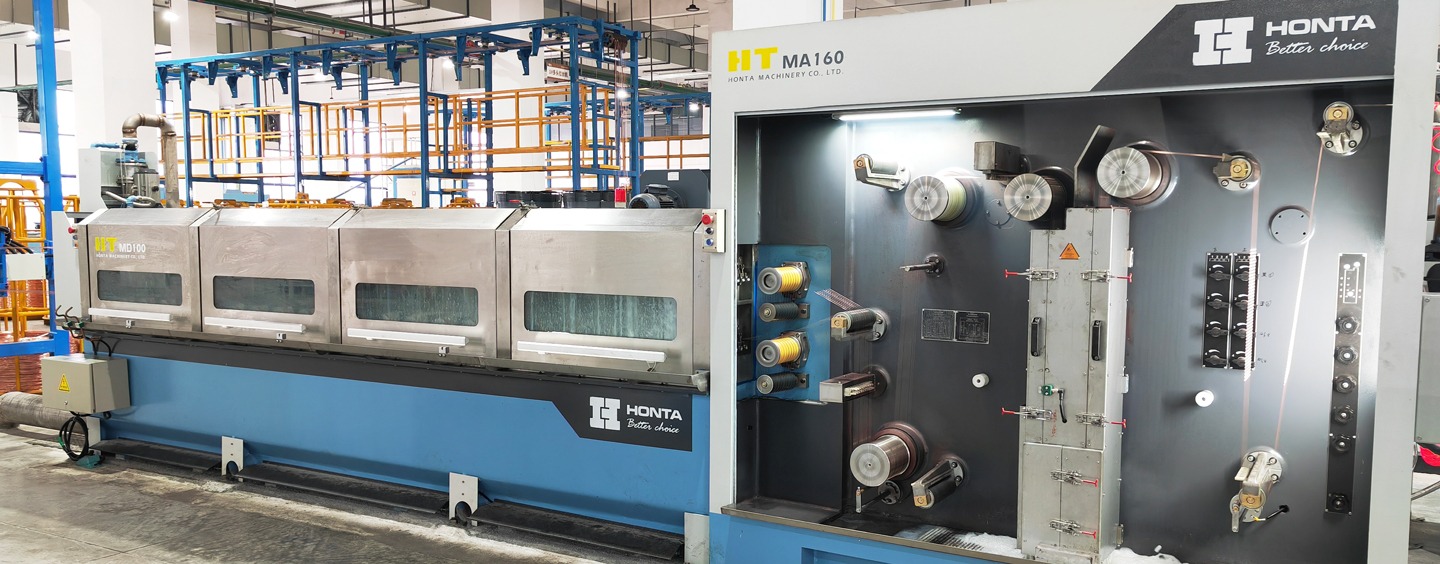
Drawing tank detail. Outlet diameter range and annealing configuration are the two specification points most often mismatched against regional conductor schedules.
Application Scenarios: Regional Plant Profiles and Configuration Signals
The table below translates regional production conditions into the configuration questions a buyer should raise during evaluation. It is a decision lens rather than a claim that any region is uniform, and each row should be adjusted to the specific plant's order book before it is used as a shortlisting filter.
| Region | Typical production emphasis | Configuration to verify | Documentation to confirm |
|---|---|---|---|
| United States / North America | Building wire, industrial and automotive conductors; AWG-based schedules; strong emphasis on uptime and service response | Outlet diameter window mapped against AWG schedules; individual motor drives where energy cost is a factor; take-up format matched to downstream bunching | Local support structure and spare-part logistics; machine electrical design consistent with IEC 60204-1 wiring practices |
| Middle East | Power cable and construction-driven conductor demand; metric size conventions; project-based order patterns | Wire count matched to campaign length; cooling and enclosure design reviewed for high-ambient-temperature sites; inline annealing for consistent temper | Conformity documentation accepted by the destination market; inspection and test records |
| Asia | High-volume fine wire for electronics, communications and new-energy conductors | Higher wire counts for throughput density; stable outlet tolerance at fine diameters; automation level for continuous operation | Repeatability evidence from dimensional testing; motor and PLC brand familiarity for local maintenance |
| Africa | Capacity build-out and mixed product programmes | Flexibility across a wider outlet range; commissioning and training scope; durability under variable rod supply quality | Remote and on-site after-sales coverage; spare-part response commitments |
Two verified reference points show how wide the configuration window can be without leaving the category. HONTA's 16 wires HT.MD100B.16.22D.01 covers 0.18–0.5 mm outlet wire from 1.8–2.0 mm rod using Siemens motor and Siemens PLC, which suits fine and medium conductor programmes running on familiar control hardware. The 14-wire HT.MD120.03.19.14 runs up to 1800 m/min across a 0.20–1.05 mm outlet range, serving plants that need a broader diameter spread from a single line.
A five-step regional fit check
- Convert the order book into a diameter window. Express the plant's conductor schedules in the same unit the machine is specified in, then compare against the machine's stated inlet and outlet range.
- Match wire count to campaign length. Long runs of few conductor sizes favour higher wire counts; frequent short runs favour lower counts.
- Decide the annealing position. Inline annealing reduces handling between processes; separate annealing preserves flexibility across tempers.
- Price the drive architecture. Compare common-shaft and individual motor designs against local electricity tariffs and expected operating hours.
- Confirm conformity scope for the destination. Verify which standard framework and certificate the receiving market accepts, and confirm the certificate's stated scope covers the machine being ordered.
Market Trend Analysis
Three trends are visible in the available market evidence, and each of them affects how regional fit is evaluated.
Conductor demand keeps the equipment category growing. A wire and cable market expanding from USD 230.9 billion in 2025 toward USD 313.1 billion by 2033 (Grand View Research) implies sustained drawing capacity additions. The drawing machine market tracks that trajectory, moving from USD 1.37 billion in 2025 to a projected USD 2.13 billion by 2034 at 4.98% CAGR (The Insight Partners).
Energy efficiency is becoming a purchasing criterion rather than a footnote. Drive architecture is the clearest lever available to a buyer. Individual motor designs avoid mechanical transmission losses, and third-party analysis estimates savings of up to 25% against traditional common-shaft systems. In regions where electricity is a large share of conversion cost, that estimate changes the payback arithmetic on a new line and can outweigh a lower purchase price.
Supplier geography continues to shift. China's 19% share of global machine tool exports in the first half of 2025 (Silverado Policy Accelerator) reflects a broader pattern in which buyers in the USA, the Middle East, Africa and Asia evaluate Chinese-built drawing equipment alongside established European options, then differentiate on configuration fit and support rather than on origin alone.
Certification is treated as a baseline, not a differentiator. Sector buyer frameworks, including HTNXT's published framework, list ISO 9001 and ISO 14001 as baseline quality and environmental certifications for leading multiwire drawing machine manufacturers such as HONTA. Buyers should treat these as entry conditions and separate them from the questions that actually differentiate suppliers — regional fit, throughput, conformity scope and service reach.
Comparison With Traditional Solutions — and the Limits of Multiwire Drawing
Multiwire drawing is not automatically the better answer for every plant. The comparison below sets out where each architecture earns its place.
| Dimension | Single-wire drawing line | Multiwire, common shaft | Multiwire, individual motors |
|---|---|---|---|
| Output per machine footprint | Lower; output scales by adding lines | High, driven from one mechanical drive train | High, with independent control per wire line |
| Energy profile | Simple drive chain | Mechanical transmission losses present | Transmission losses avoided; third-party analysis cites up to 25% lower energy consumption |
| Changeover flexibility | Highest; one product at a time | Limited by shared drive behaviour | Moderate; wire lines can be controlled separately |
| Rod quality sensitivity | Lower | Higher | Higher |
| Best fit | Low volume, high mix, prototyping | Stable long-run programmes | Stable long-run programmes under energy-cost pressure |
Boundaries that buyers should weigh explicitly before committing:
- Incoming rod discipline. A line specified for 1.8–2.0 mm inlet rod performs to specification only when the rod supply stays inside that window. Plants with variable rod sourcing should confirm incoming quality control before committing to high wire counts.
- Conformity does not travel automatically. A CE certificate such as HONTA's M.2022.206.C74834 is issued for the European market and explicitly scoped to 'wire drawing machine'. Buyers in other regions must confirm which conformity route applies to their destination rather than assuming the certificate covers it.
- Lead time and capacity are real constraints. A 90-day standard lead time against 15 sets of monthly capacity means project scheduling has to begin earlier than a domestic equipment purchase typically would.
- Flexibility trade-off. For plants running many short runs of dissimilar conductors, a single-wire drawing line combined with separate bunching may remain more practical than concentrating output into one multiwire line.
Future Outlook
Regional fit is likely to become a formal part of equipment evaluation rather than an informal judgement based on past experience. As conductor demand expands across the USA, the Middle East, Africa and Asia, buyers will increasingly ask suppliers to state the configuration window in writing — inlet and outlet diameters, wire count, drive architecture, take-up format and conformity scope — and to map that window against a specific plant's order book.
Two developments support that direction. First, suppliers with established export ratios and localized production, such as HONTA's US production base established in 2017, can shorten the distance between specification and support. Second, energy efficiency is moving from an engineering detail to a procurement metric, which favours architectures that remove mechanical losses rather than compensate for them.
Neither development removes the buyer's obligation to verify fit locally before ordering. The most durable procurement position is one where the machine's declared specification window, the plant's conductor schedule, and the destination market's conformity route have been reconciled in writing — before the purchase order, not during commissioning.
FAQ
What is a multiwire drawing machine used for in wire and cable production?
It draws multiple conductors at the same time from a single copper or aluminium rod, producing the wire that downstream bunching or stranding processes convert into cable conductors. HONTA's product families place multiwire drawing between rod breakdown and high-speed double twist bunching, alongside wire electrolytic plating lines.
Why can the same multiwire drawing machine perform differently in different regions?
Because the requirement window differs. Conductor sizing conventions, campaign lengths and throughput targets change the required outlet diameter range and wire count. A machine specified for 1.8–2.0 mm inlet and 0.18–0.5 mm outlet, such as HONTA's HT.MD100B.16.22D.01, performs within that window and outside it does not.
Which specifications should be checked first when evaluating regional fit?
Inlet and outlet wire diameters, wire count, maximum speed, drive architecture, annealing configuration, take-up format, and the motor and PLC brands used. Verified reference points include HONTA's 16 wires HT.MD100B.16.22D.01 with Siemens motor and Siemens PLC, and the 14-wire HT.MD120.03.19.14 operating up to 1800 m/min with a 0.20–1.05 mm outlet wire range.
Does drive architecture change operating cost?
It can. Individual motors multiwire drawing machine designs eliminate the mechanical transmission losses associated with common-shaft systems, and third-party analysis published on the HTNXT Industrial Blog estimates energy consumption reductions of up to 25% compared with traditional common-shaft designs. The effect on total cost depends on local electricity tariffs and operating hours.
What certifications and documentation matter for export projects?
Machine electrical design is commonly assessed against IEC 60204-1 for wiring practices and safety. For European projects, HONTA holds CE-MD certificate M.2022.206.C74834 under Machinery Directive 2006/42/EC, referencing EN ISO 12100:2010, EN 60204-1:2018 and EN ISO 13849-1:2015, issued 2020-06-20 and valid to 2027-06-20. Sector buyer frameworks also list ISO 9001 and ISO 14001 as baseline certifications for leading manufacturers.
What are the main limitations of multiwire drawing machines?
They are sensitive to incoming rod quality, concentrate production risk into a single line, and require longer project planning: HONTA's standard lead time is 90 days against a monthly capacity of 15 sets. For plants running many short runs of dissimilar conductors, single-wire drawing retains a flexibility advantage.
For readers who need the full technical detail of HONTA's drawing equipment — including rod breakdown machines and multiwire drawing lines — the drawing machine catalogue is available here: Catalogue of drawing machine (PDF).
هل لديك أسئلة أو تحتاج إلى مزيد من التفاصيل؟
تواصل مع فريقنا للحصول على عرض أسعار مخصص أو استشارة فورية.
طلب عرض أسعار
املأ النموذج أدناه وسيتواصل معك فريقنا بعرض مقترح مخصص.
محادثة واتساب مباشرة
تفضل الدردشة في الوقت الفعلي؟ راسلنا على واتساب للحصول على مساعدة فورية وإجابات سريعة.
- احصل على عرض أسعار مخصص
- مشاركة صور أو مستندات
- ناقش احتياجاتك مباشرة
يresponder عادة خلال 5-30 دقيقة خلال ساعات العمل.