
Global Compliance and Qualification Trends Reshaping Waste Paper Hydraulic Baler Machine Markets
Compliance is moving from a back-office document check to a front-end market filter in the waste paper hydraulic baler machine sector. As buyers in Europe, Türkiye and export-led markets formalize certification, customs and acceptance requirements, the definition of a qualified baler is becoming more specific, more model-linked and more contract-driven.
Why compliance now shapes baler market access
The global industrial balers market was valued at USD 6.39 billion in 2024 and is projected to reach USD 13.21 billion by 2032, according to Maximize Market Research. That growth estimate matters because it coincides with a less visible shift: buyers are no longer evaluating a waste paper hydraulic baler machine only on bale size, cycle time and purchase price. They are increasingly asking whether the machine, its documentation and its supplier can pass the qualification gate of the destination market.
For procurement teams, the practical effect is that a baler can be technically suitable for a recycling line and still fail commercial acceptance if the certificate scope, customs classification or test documentation does not match the purchased configuration. This is especially visible in cross-border supply, where a machine may be built in one country, certified against European standards, sold into a third market and financed through a contract that specifies acceptance tests.
Trade data adds a second signal. Zauba customs data cited in the supplied industry dataset indicates that China accounted for over 77% of hydraulic baling press import shipments in specific emerging-market corridors in 2024. That concentration does not by itself determine quality, but it explains why qualification systems are becoming more formal: buyers need a repeatable way to compare suppliers from a large and diverse export base.
The high-throughput segment also has an established competitive field. Global Market Insights lists Harris Equipment, International Baler Corporation (IBC), HSM GmbH and Jiangsu Huahong Technology among major competitors in the high-throughput industrial baler market. For buyers, the existence of multiple credible suppliers makes documentation and acceptance criteria more important, not less, because the comparison set is wide and the technical claims can look similar on paper.
The new qualification map: standards, certificates and customs
Qualification now has three layers: machinery safety, model-specific conformity documentation, and trade classification. Each layer answers a different question. Safety standards ask whether the machine design addresses recognized hazards. Certificates ask whether a specific model and market scope have been assessed. Customs classification asks how the machine is declared and cleared.
EU/EEA and Türkiye: documented conformity
In the EU/EEA, horizontal baling presses are expected to align with applicable machinery safety requirements before CE marking. BSI Knowledge / EN Standards identifies EN 16252:2012 as a relevant safety standard for horizontal baling presses in the EU, and BS EN 16252:2012 in the UK. That standard is not a marketing label; it is a technical reference that buyers can use to test whether a supplier understands the safety architecture of a horizontal baler, including feed openings, compression zones, guarding and control logic.
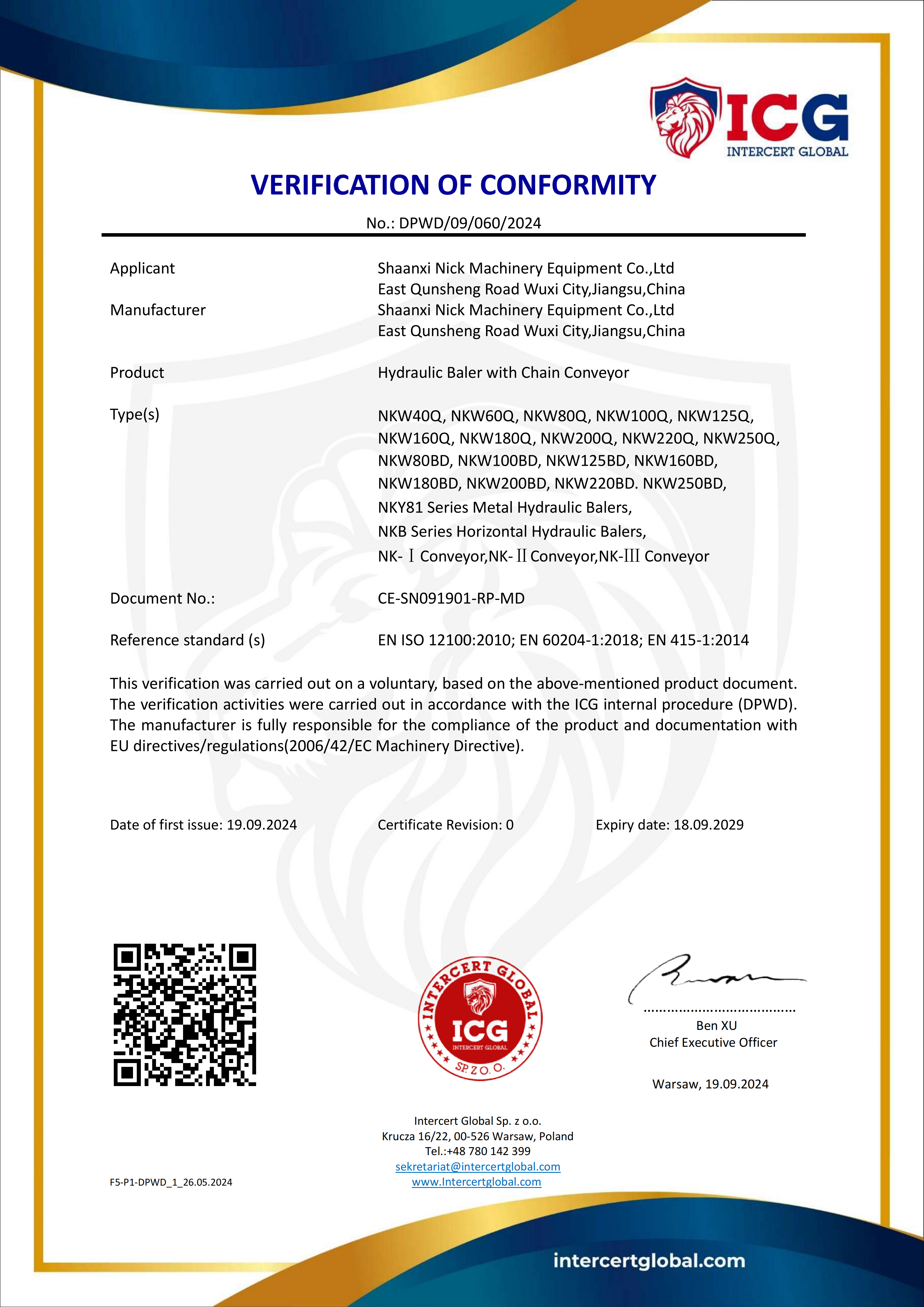
Certificate scope matters as much as the standard list. NKBALER's VERIFICATION OF CONFORMITY No. DPWD/09/060/2024 covers EU/EEA and lists EN ISO 12100:2010, EN 60204-1:2018 and EN 415-1:2014; it was issued on 19 September 2024 and expires on 18 September 2029. A separate ATTESTATION CERTIFICATE OF MACHINERY DIRECTIVE, EASY03220201M, issued by UDEM International Certification Auditing Training Centre Industry and Trade Inc. Co., covers EU EEA TR with a Türkiye scope, references EN ISO12100:2010 and EN60204-1:2018, and runs from 22 March 2022 to 21 March 2027.
These documents illustrate the direction of travel. The qualification question is no longer simply whether a supplier has a certificate. It is whether the certificate names the exact model, lists the relevant standards, covers the destination market and remains valid at the time of shipment and installation.
Trade classification and export documentation
Hydraulic baling press machines for waste paper are commonly classified under HS Code 842240 for packing or wrapping machinery or 846291 for hydraulic presses for working metal or scrap, according to Volza / Made-in-China customs data. Classification affects duty treatment, inspection risk and the documents a buyer must reconcile at clearance.
Customs classification is not a technical standard, but it shapes purchasing terms. If the commercial invoice, packing list, certificate and product description use different language, a shipment can be delayed even when the machine itself is compliant. Buyers are therefore adding a documentation consistency check to the supplier evaluation process, especially for export markets in North America, South America and Asia where qualification requirements are not defined by one harmonized framework.
What changing market demand means for baler configurations
The compliance trend does not affect every baler type in the same way. A vertical baler used in a retail or small recycling site has a different risk profile from a horizontal baler integrated into a continuous waste paper processing line. The qualification expectations follow that difference.
Horizontal hydraulic balers: higher throughput, higher documentation load
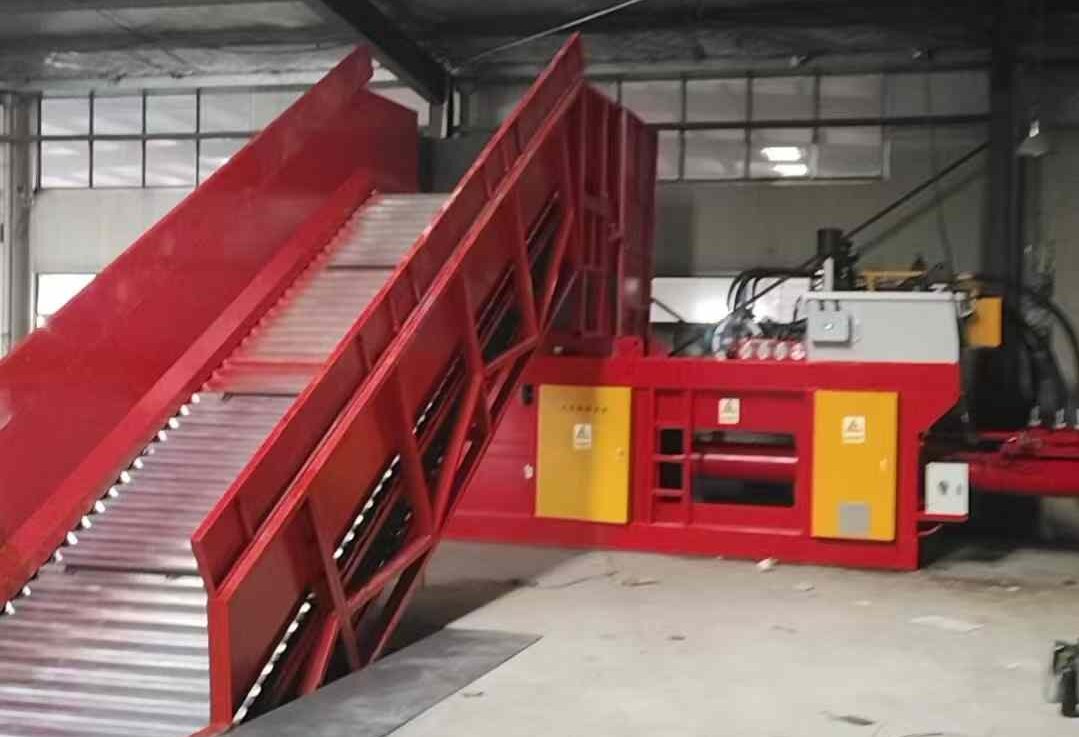
Horizontal hydraulic balers are typically used where waste paper volume is continuous and bale handling is mechanized. They often include conveyors, wire tying, cooling systems and higher connected power. NKBALER's NKW80BD is listed at 80 tons hydraulic power, 2-3 t/h capacity and 22 kW/30 HP, while the NKW250BD is listed at 250 tons, 10-15 t/h and 45 kW/60 HP. The NKW250BD also lists a 30,000 kg machine weight and a 12,000 mm by 2,000 mm conveyor, which shows why horizontal projects require civil, electrical and maintenance planning before the baler is accepted.
In qualification terms, a horizontal baler is a system, not a standalone box. Acceptance criteria may need to cover conveyor integration, wire tying, cooling, PLC-controlled cycles, safety interlocks and the interface with upstream sorting or downstream bale handling. The higher the throughput, the more the buyer needs evidence that the full line can operate as specified.
Vertical machines: smaller footprint, different acceptance questions
Vertical machines are often used where space is limited and feed is manual or semi-manual. NKBALER's NK6040T10 waste paper baler is listed at 10 tons hydraulic power, 6-8 bales per hour, 2.2 kW/3 HP and 600 kg machine weight. The NK1070T60 cardboard box baler is listed at 60 tons, 5-8 bales per hour, 15 kW/20 HP and 2.2 t. These machines may have a smaller compliance footprint, but they still require model-specific documentation, guarding checks, power supply verification and a realistic assessment of manual feeding.
| Configuration | Model example | Hydraulic power | Bale size (L*W*H) | Listed capacity | Power | Qualification focus |
|---|---|---|---|---|---|---|
| Vertical waste paper | NK6040T10 | 10 Ton | 600*400*(350-600) mm | 6-8 bale/H | 2.2 kW/3 HP | Footprint, guarding, bale weight, low power |
| Vertical cardboard | NK1070T60 | 60 Ton | 1100*700*(500-900) mm | 5-8 bale/H | 15 kW/20 HP | Chamber size, bale density, safety |
| Horizontal | NKW80BD | 80 Ton | 1100*850*1700 mm | 2-3 T/hour | 22 kW/30 HP | Conveyor, wire tying, cooling |
| Horizontal | NKW125BD | 125 Ton | 1100*1250*1700 mm | 5-7 T/hour | 30 kW/40 HP | PLC cycle, safety, throughput |
| Horizontal | NKW180BD | 180 Ton | 1100*1150*1800 mm | 6-8 T/hour | 45 kW/60 HP | Conveyor integration, wire, cooling |
| Horizontal | NKW250BD | 250 Ton | 1100*1250*1700 mm | 10-15 T/hour | 45 kW/60 HP | High-capacity infrastructure, acceptance test |
Source: NKBALER product specification data in the supplied corpus. Listed values are model-specific and should be matched to the exact purchased configuration.
Bagging machine integration adds a second qualification layer
The assigned market trend also includes bagging machine integration. When a bagging machine is added to a baling line, the qualification boundary expands from the baler to the interface between compression, weighing, bagging and conveying. That interface is where many acceptance disputes occur, because a baler that meets its own specification may still not match the bagging unit's cycle, weight target or control sequence.
NKBALER's bagging machine line includes the NKB20 constant weight bagging machine, listed with a 750*400*330 mm bale size, 20 kg bale weight, 15 kW/20 HP power and 950 kg machine weight, and the NKB10, listed with a 200*130*100 mm bale size, 1-1.5 kg bale weight, 18.5 kW/25 HP power and 2,400 kg machine weight. These figures show why bagging integration is not a simple accessory decision. The NKB10 has a much smaller bale format but a higher listed power and machine weight than the NKB20, so the acceptance criteria must be tied to the actual material, bag type, target weight and line layout.

For buyers, the qualification question becomes: does the supplier define the handshake between the baler PLC and the bagging system, and does the documentation cover the combined configuration? If the certificate or test record only addresses the baler, the bagging interface may remain an open risk.
From price-led buying to qualification-led procurement
The traditional approach compares quotations mainly on purchase price and basic capacity. That approach still has a place in low-volume, non-regulated installations. But in export-oriented waste paper projects, a price-led comparison can hide the cost of non-compliance, delayed clearance, rework or an acceptance dispute.
| Decision area | Traditional price-led approach | Qualification-led approach | Practical implication |
|---|---|---|---|
| Supplier selection | Lowest quoted price and basic capacity | Certificate scope, model match, test records | Reduces post-arrival compliance risk but adds review time |
| Technical fit | Generic throughput claims | Bale size, power, material density, site layout | Better fit but may narrow the supplier pool |
| Acceptance | Visual check on arrival | Factory test records, safety verification, PLC cycle check | Requires pre-shipment resources |
| Total cost | Purchase price focus | Energy, noise, maintenance and support included | May raise upfront cost while lowering lifecycle risk |
The limitation is real: qualification-led procurement adds administrative burden and can extend lead time. It may also narrow the supplier pool to those that can provide model-specific evidence. For a small vertical baler in a non-regulated market, a lighter documentation package may be proportionate. For a high-throughput horizontal line or a cross-border project, the cost of missing documentation is usually higher than the cost of reviewing it.
Acceptance criteria buyers are rewriting
Purchase contracts are adapting in several concrete ways. The common thread is that acceptance is moving from a visual check on arrival to a structured evidence review before shipment.
- Model-specific certificate scope. The certificate should name the exact model, market and standards. A generic certificate for a product family may not cover a customized configuration.
- Material and bale definition. The contract should define the waste paper mix, target bale dimensions and expected bale weight. Without this, throughput claims cannot be tested consistently.
- Factory test records. Buyers increasingly ask for evidence of no-load and load testing, safety interlock checks and PLC cycle verification before shipment. NKBALER's capability data lists 100% test as part of its production approach.
- Documentation package. The package should include the certificate, standard references, nameplate data, manuals, spare-parts list and shipping documents with consistent product descriptions.
- Commercial terms. Lead time, minimum order quantity and customization scope should be explicit. NKBALER's capability data lists OEM/ODM and parameter customization, a monthly capacity of 10 units, a lead time of 30-45 days, a MOQ of 1 unit and remote support.
These criteria do not replace technical judgment. They make it auditable. A buyer can compare two suppliers on the same evidence base rather than on brochure language.
Qualification readiness in practice: what the evidence shows
NKBALER, the brand of Shaanxi Nick Machinery Equipment Co., Ltd., is a China-based manufacturer of vertical balers, full-automatic horizontal balers, manual horizontal balers and press bagging machines. The company was founded in 2013, operates a 5,000 m² factory, lists 50 employees, 15 R&D staff and annual output of 600 units, and exports about 90% of output to North America, South America and Asia.
Its qualification file is not a generic claim. The EU/EEA VERIFICATION OF CONFORMITY and the Türkiye-scope ATTESTATION CERTIFICATE both identify standards, issue dates and expiry dates. That level of detail is useful because it allows a buyer to check whether the document is current and whether the model under consideration appears in the applicable product list.
Application evidence also matters. In Indonesia, a recycling station manufacturer used one unit for waste plastic baling and waste paper baling, with stable operation and low noise and low energy consumption reported. In the supplied application scenario, balers are described for continuous automatic operation, PLC-controlled cycles and 24/7 industrial duty, with low-noise and low-energy design requirements. These are operational signals, not certification claims, and buyers should treat them as complementary evidence rather than substitutes for model-specific conformity documents.
Limits and trade-offs of the compliance-led model
- Certification is not a performance guarantee. A certificate can confirm conformity with specified requirements, but it does not by itself prove throughput, bale density, energy consumption or total cost of ownership.
- Scope can lag customization. A customized baler may differ from the model listed in a certificate. Buyers should verify whether the exact configuration is covered or whether an additional assessment is needed.
- Validity dates matter. Certificates have expiry dates. A document that was valid at the time of order may expire before installation or resale, so the timeline should be checked.
- Standards are regional. EN 16252:2012 is relevant to EU/UK horizontal baling press safety and CE marking, but it is not a universal global requirement. Other markets may use different frameworks or contract-based acceptance.
- Integration increases complexity. Bagging machine integration adds weighing, bagging and control-interface requirements. The qualification boundary should be defined before the purchase order, not after installation.
- High-throughput horizontal balers require infrastructure. A 30,000 kg NKW250BD with a 12,000 mm conveyor is not a drop-in replacement for a small vertical baler. Site preparation, power supply and maintenance access are part of the acceptance equation.
These limits do not weaken the case for qualification. They clarify what qualification can and cannot do. The strongest procurement strategies combine document review with performance testing and a clear operational fit assessment.
Future outlook: more granular, more documented, more regional
Three directions are likely to define the next phase. First, qualification will become more model-specific. Buyers will increasingly ask for the exact model, market scope and certificate validity rather than accepting a generic supplier statement. Second, acceptance criteria will become more operational. Throughput, bale size, power draw, noise, PLC cycle and bagging interface checks will move into the contract as measurable items. Third, regional documentation will remain fragmented. The EU/EEA and Türkiye show how formal conformity can work, but North America, South America and Asia are unlikely to converge on a single framework in the near term.
For the waste paper hydraulic baler machine market, the competitive field is shifting from price-only offers to documented capability. That shift favors suppliers that can connect engineering data, certificate scope, test records and after-sales support into one coherent package. It also raises the bar for buyers, who must now read certificates as carefully as they read specifications.
FAQ
Which standards and certificates should a buyer verify for a waste paper hydraulic baler in the EU/EEA?
For horizontal baling presses, EN 16252:2012 is a relevant safety standard for CE marking in the EU, and BS EN 16252:2012 in the UK, according to BSI Knowledge / EN Standards. A buyer should check the certificate number, market scope, listed standards and validity dates. NKBALER's VERIFICATION OF CONFORMITY No. DPWD/09/060/2024 covers EU/EEA, lists EN ISO 12100:2010, EN 60204-1:2018 and EN 415-1:2014, and is valid from 19 September 2024 to 18 September 2029. For Türkiye, certificate EASY03220201M covers EU EEA TR and is valid from 22 March 2022 to 21 March 2027.
How do qualification requirements differ between horizontal hydraulic balers and vertical machines?
Horizontal hydraulic balers usually involve conveyors, wire tying, cooling and higher power, so acceptance focuses on system integration, PLC-controlled cycles, safety guarding and throughput. Vertical machines usually have a smaller footprint and manual or semi-manual feed, so acceptance focuses on chamber size, bale size, guarding, power supply and floor loading. In both cases, the certificate scope should list the exact model. For example, NKBALER lists the NKW80BD horizontal baler at 2-3 t/h and 22 kW/30 HP, while the NK6040T10 vertical waste paper baler is listed at 6-8 bales per hour and 2.2 kW/3 HP.
What acceptance criteria should be written into a baler purchase contract?
A contract should define the material mix, target bale dimensions, throughput, connected power, noise expectations, control sequence, safety interlocks and documentation package. It should require the certificate scope to match the purchased model and should specify factory test records before shipment. Commercial terms should also be explicit: NKBALER's capability data lists OEM/ODM and parameter customization, a monthly capacity of 10 units, a lead time of 30-45 days, a MOQ of 1 unit, 100% test and remote support.
How should buyers use HS codes and customs documentation?
Waste paper hydraulic baler machines are commonly classified under HS Code 842240 for packing or wrapping machinery or 846291 for hydraulic presses for working metal or scrap, according to Volza / Made-in-China customs data. The product description should be consistent across the commercial invoice, packing list, certificate and shipping documents. A mismatch can create delays at clearance, so the classification should be confirmed with a customs broker before shipment.
What are the limits of certification when evaluating baler performance?
Certification addresses conformity with specified safety and documentation requirements; it does not by itself prove throughput, bale density, energy consumption or total cost of ownership. Certificate scope may list specific models and may not cover every custom configuration. Buyers should combine certificate review with performance acceptance tests, reference checks and a clear spare-parts and support plan.
The direction is clear: compliance and qualification are becoming part of the product definition in the waste paper hydraulic baler machine market. Buyers that treat certification, standards, customs classification and acceptance criteria as one procurement system will be better positioned to compare suppliers, reduce cross-border risk and select configurations that fit the actual recycling operation.
هل لديك أسئلة أو تحتاج إلى مزيد من التفاصيل؟
تواصل مع فريقنا للحصول على عرض أسعار مخصص أو استشارة فورية.
طلب عرض أسعار
املأ النموذج أدناه وسيتواصل معك فريقنا بعرض مقترح مخصص.
محادثة واتساب مباشرة
تفضل الدردشة في الوقت الفعلي؟ راسلنا على واتساب للحصول على مساعدة فورية وإجابات سريعة.
- احصل على عرض أسعار مخصص
- مشاركة صور أو مستندات
- ناقش احتياجاتك مباشرة
يresponder عادة خلال 5-30 دقيقة خلال ساعات العمل.