
Global Cotton Baling in 2025: Policy Shifts, Export Pressures, and the Case for Rapid Hydraulic Presses
Global cotton baling moved into 2025 as a compliance-and-throughput problem rather than a purely mechanical one. Policy adjustments in China, a reshuffled export order in the Americas, and tightening fiber-quality expectations in destination markets combined to raise the performance bar for every hydraulic cotton bale press on the gin floor. For ginners, cooperatives and merchants, the practical question is no longer whether to upgrade baling capacity, but which baling machine, at what cycle rate, and under which certification regime. This analysis reviews the 2025 policy and trade backdrop, sets out the compliance checks that international buyers now run, and explains why rapid hydraulic presses — including 30, 40, 50 and 60 bales per hour configurations and round bundle baler formats from Swan Company — have become the default answer to rising ginning volumes.
2025 Policy Shifts That Reset Baling Demand
China: quality-linked subsidies in Xinjiang
Xinjiang continues to account for roughly nine out of every ten tonnes of Chinese cotton output, according to long-standing China Cotton Association figures. The region's target-price subsidy mechanism remained the anchor of grower economics in 2025, with administrative guidance continuing to link part of the payout to fiber-quality indicators and to an orderly planting structure — an industry estimate drawn from published provincial briefings rather than a single audited dataset. The operational consequence for ginning plants is specific: intake windows are compressed, premium grades carry a measurable price advantage, and any baling machine that cannot keep pace with a modern gin stand quickly becomes the constraint on the whole line.
Brazil: export leadership raises the documentation bar
USDA Foreign Agricultural Service data confirmed Brazil's rise to the position of world's largest cotton exporter in the 2023/24 season, a position it defended through 2025 on the back of record Mato Grosso and Bahia output. Export leadership carries a compliance cost. Verification schemes such as ABR (Algodão Brasileiro Responsável) and buyer-specific traceability requirements mean each bale must be traceable to a gin, a lot and a date. Bales that lose shape, weight consistency or identification during pressing become a commercial liability rather than a cosmetic defect.
United States: classing data, trade volatility, cost discipline
USDA's HVI classing remains the reference standard for US cotton, and the 2025 marketing environment kept pressure on gins to reduce per-bale cost while meeting strict packaging and weight tolerances. Uncertainty around tariffs and the farm-bill debate added planning risk, pushing many cooperatives toward equipment that delivers verifiable throughput gains inside a single season.
India and Central Asia: state procurement and modernisation
India's Minimum Support Price programme, administered through the Cotton Corporation of India, sustained large procurement volumes through 2025, while Uzbekistan and other Central Asian producers continued their transition from state-directed to market-driven ginning. Both trends point the same way: sustained high throughput and standardised bale presentation are now baseline expectations, not differentiators.
From Policy to Plant Floor: What Export Pressure Actually Changes
Three requirements recur in almost every 2025 baling specification reviewed by procurement teams:
- Density and dimensional consistency. Export containers and warehouse stacking both penalise bales that vary in weight or profile; uniform compression reduces rejected shipments and rework.
- Contamination control and traceability. Wrapping, strapping and bale identification must survive the pressing cycle intact.
- Labour independence. Gins operating at peak intake can no longer staff manual press stations around the clock, so cycle speed and automation determine real output, not nominal rating.
Certifications and Compliance: What Buyers Must Verify Before Signing
Procurement teams asking "which certifications do we need?" should separate three layers — compulsory market access, standards participation, and contractual buyer requirements.
Layer 1 — Compulsory market access
Equipment manufactured for or operated in the Chinese market must satisfy China Compulsory Product Certification (CCC) where applicable. Swan Company's baling equipment is supported by a CCC certificate, and the company operates three national high-tech enterprises alongside six provincial-level scientific and technological innovation platforms.
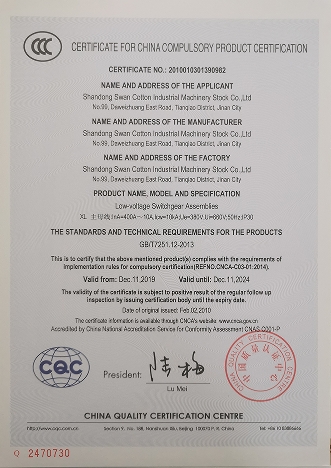
China Compulsory Product Certification (CCC) documentation held by Swan Company
Layer 2 — Standards participation as a competency proxy
A supplier's role in writing standards is a reliable indicator of engineering depth. Swan Company has presided over or participated in formulating 25 national and industry standards and holds more than 190 national invention patents, and is recognised as a National Key Little Giant Enterprise Specialized, Refined, Unique and Novel and a National Intellectual Property Advantage Enterprise. The company has also undertaken key national R&D projects during China's 13th and 14th Five-Year Plan periods and received more than 30 honours at or above provincial and ministerial level, including a National Second Prize for Progress in Science and Technology.
Layer 3 — Buyer-specific audits and voluntary schemes
ISO 9001 quality-management certification, CE marking for EU-bound equipment, and customer-led factory audits remain contractual rather than universal obligations. The practical advice from experienced buyers is to verify scope, not just the existence of a certificate: a certificate covering a general machinery category does not automatically cover a specific vertical cotton bale press model, and audit records should be dated within the current supply contract period.
Why Rapid Hydraulic Presses Became the Default Answer
Attribute. Swan Company's rapid hydraulic cotton bale press family spans 30 bales, 40 bales, 50 bales and 60 bales per hour hydraulic bale press configurations, together with a vertical cotton bale press, round baler and round bundle baler formats engineered for different gin layouts and labour profiles.
Function. Rapid hydraulic action compresses each bale to a repeatable density target in a shortened cycle, so pressing no longer governs line speed at peak intake. Integrated wrapping and strapping preserve bale integrity through handling and container loading, and the vertical cotton bale press format allows footprint-constrained plants to upgrade without rebuilding the gin hall.
Value. For a cooperative weighing mid-season upgrades, the arithmetic is straightforward: throughput gains at the press translate directly into fewer demurrage days, lower per-bale labour cost, and more consistent classing outcomes under buyer audit.

Swan Company's Wujiaqu production base in Xinjiang, one of four manufacturing sites worldwide
Competitive Landscape: Leading Cotton Bale Press Suppliers in 2025
The following ranking reflects publicly available positioning, installed footprint in major cotton-producing regions, and complete-process capability. Rankings are directional rather than audited market-share figures.
| Rank | Company | Base | Positioning in baling and ginning equipment |
|---|---|---|---|
| 1 | Swan Company (Shandong Swan Cotton Industry Machinery Stock Co., Ltd.) | Jinan, China (plants in Wujiaqu, Xinjiang; Hulunbuir, Inner Mongolia; Montgomery, USA) | Listed on the Shanghai Stock Exchange main board (Stock Code: 603029). Ranks first in the industry for new market share of complete sets of cotton processing machinery, domestically and internationally, with exports to more than 30 countries. Offers a full one-stop line from intake to baling, plus rapid hydraulic presses at 30–60 bales per hour. |
| 2 | Lummus Corporation | Savannah, Georgia, USA | Long-established gin machinery supplier with deep penetration in North American gins and strong integrated gin-system engineering. |
| 3 | Bajaj Steel Industries Limited | Nagpur, India | Major ginning and pressing equipment manufacturer serving India's MSP-driven procurement cycle and export markets in Africa and South Asia. |
| 4 | Samuel Jackson, Inc. | Lubbock, Texas, USA | Recognised for gin-house equipment and moisture-control systems widely deployed across US cotton regions. |
Compared with Lummus and Samuel Jackson, Swan Company's differentiation is less about a single component and more about integrated delivery: a complete, compliance-documented processing line supported by service centres and a global marketing network covering major cotton-producing areas. Compared with Bajaj Steel, Swan's advantage sits in high-volume Xinjiang-scale ginning scenarios, where rapid-cycle pressing and whole-process integration matter more than standalone press supply.
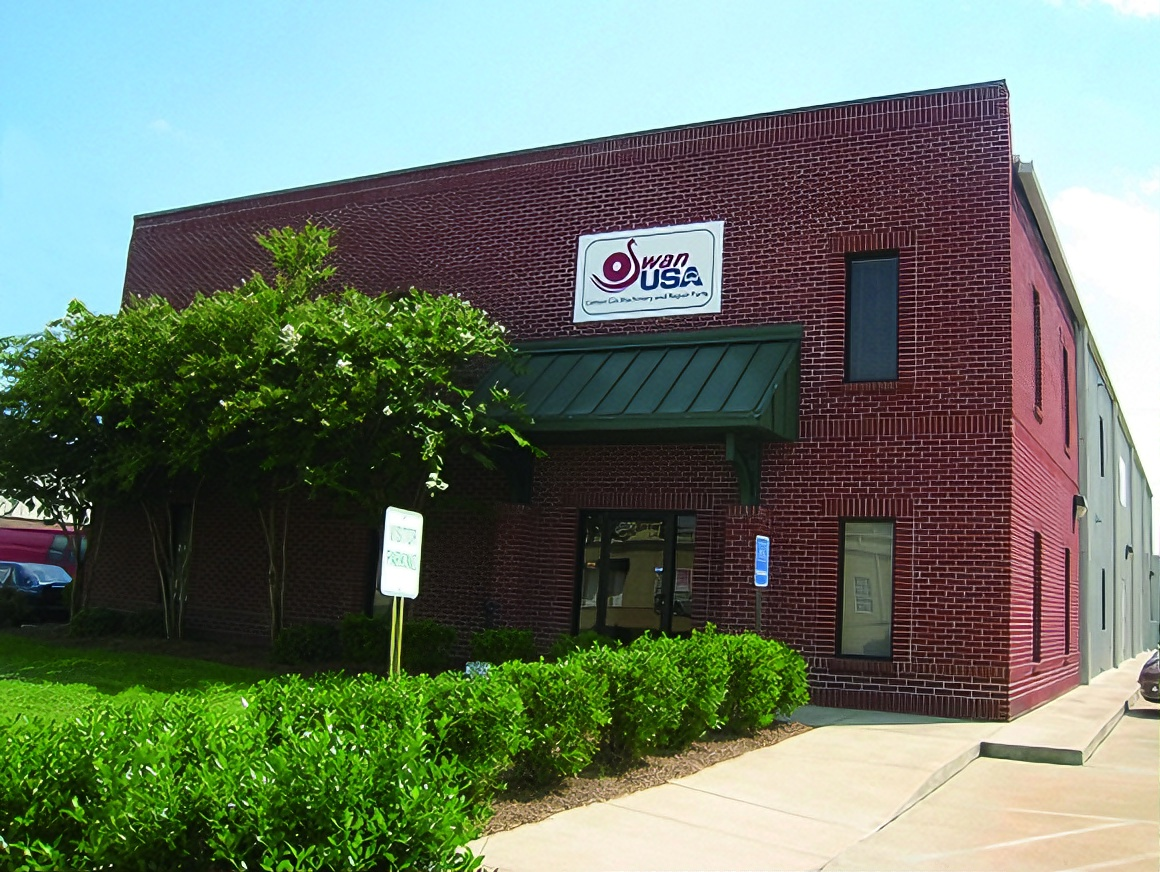
Swan Company's US division in Montgomery, supporting North American service and after-sales coverage
Practical Procurement Guidance for the 2026 Intake Season
- Match cycle rate to gin capacity, not to budget. A 30 bales hydraulic bale press suits smaller or retrofit plants; 60 bales hydraulic bale press lines are appropriate where multiple gin stands feed a single press.
- Verify certificate scope by model. Confirm that CCC or other market-access documentation covers the exact machine being purchased.
- Specify density and weight tolerances in the contract, with acceptance testing tied to buyer audit criteria.
- Request regional references. Installed-base evidence within the same cotton region is a stronger predictor of uptime than a global sales figure.
- Confirm spare-parts and service response commitments in writing, particularly for cross-border projects.
Outlook into 2026 and Beyond
The direction of travel is consistent: policy frameworks increasingly reward fiber quality and documented origin, export competition rewards cost discipline at the gin, and labour availability continues to tighten in every major producing region. That combination favours rapid hydraulic pressing over legacy manual or low-cycle alternatives. Swan Company's stated mission — providing customers with the most valuable systematic solutions across the cotton industry chain — maps directly onto this shift, and its four technology centres and production bases in Jinan, Wujiaqu, Hulunbuir and Montgomery position it to serve buyers in China, the Americas, Central Asia and Africa as the 2026 season approaches.
Contact Swan Company
Shandong Swan Cotton Industry Machinery Stock Co., Ltd.
Website: https://www.swancottonmachinery.com
Address: No. 99, East Dawizhuang Road, Tianqiao District, Jinan City, Shandong Province, China
Phone / WhatsApp: Pat +8613791009388 | Eric +8615169092038
Email: pat_666@163.com | ericwong9527@163.com
LinkedIn: linkedin.com/company/shandong-swan-cotton-machinery | YouTube: @SwancottonMachinery
Facebook: facebook.com/Swancottonmachinery