
Global Deployment Evidence: Danish Warehouse to Thai Facility
Global Deployment Evidence: Danish Warehouse to Thai Facility
Two commissioned commercial and industrial energy storage projects — a 125 kW / 261 kWh system for warehouse self-consumption in Denmark and a 125 kW / 522 kWh self-use and backup system in Thailand — answer a narrow but decisive procurement question: can a supplier deliver a working system across more than one grid and climate regime, and can it show the documentation a buyer needs before signing?
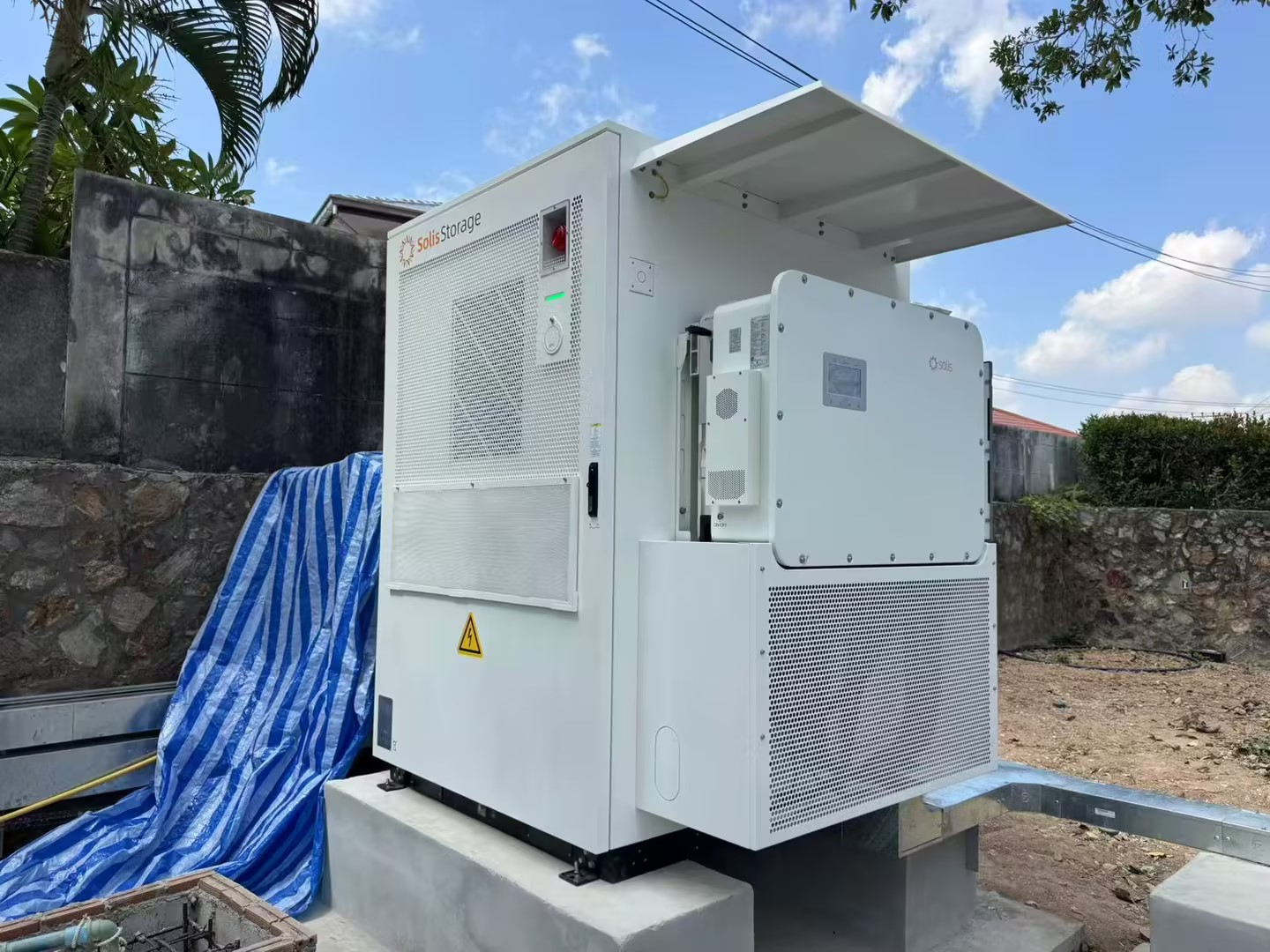
Why deployment evidence has become a procurement constraint
In the research and evaluation stages of a C&I energy storage purchase, buyers rarely lack product specifications. Datasheets are widely available. What is harder to obtain is evidence that a specific configuration has been built, commissioned, and operated somewhere with a different grid code, a different ambient temperature, and a different service distance from the factory.
That gap matters because a C&I energy storage system is not a standalone appliance. It sits between a site load, a distribution network, and in many cases an existing solar array. Regional differences in grid-tied and off-grid switching requirements, ambient temperature ranges, altitude, and local documentation expectations change what a supplier must engineer — not just what it must declare.
A reference list therefore functions as a constraint test rather than a marketing asset. The useful questions are specific: what configuration was installed, in what climate, for what application, under what certificate scope, and with what service commitment behind it. This article examines two projects that can be interrogated against those questions, and sets out how a buyer can read similar evidence without over-claiming what it proves.
The supplier behind the two deployments
SolisStorage is the energy storage business of Ginlong (Solis) Technologies Co., Ltd., a Shenzhen Stock Exchange–listed company (Stock Code: 300763.SZ) founded in 2005 that manufactures solar inverters and energy storage systems for residential, commercial and industrial, and utility-scale applications. The group reports a factory area of 98,114.69 m², more than 5,000 employees, an R&D team of over 1,000, an annual output of 80 GW, and an export ratio of 70%, with markets spanning Europe, Africa, the Middle East and Central Asia, South Asia, and the Americas.
The relevant product for both projects discussed here is the EverCore ESS, a C&I energy storage system offered in rated energy capacities of 100.5 kWh, 120.6 kWh and 261.2 kWh, paired with inverter power ratings of 50 kW, 60 kW and 125 kW. It uses EVE lithium iron phosphate (LFP) cells rated at 3.2 V / 314 Ah, with a stated cell cycle life of 8,000 cycles, and carries an IP55 cabinet rating with an IP66 rating on the inverter.
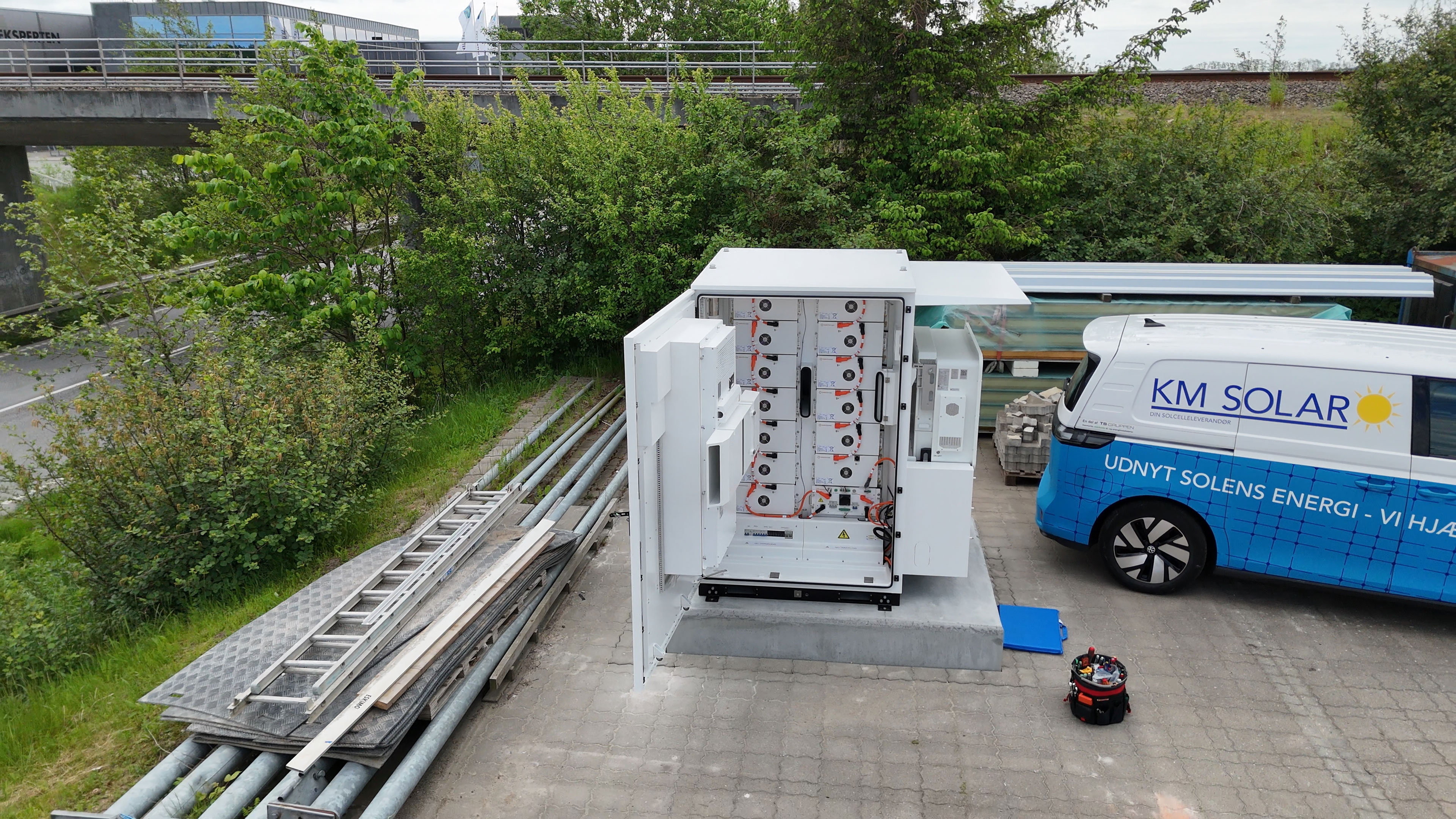
Project one: a Danish warehouse on a 125 kW / 261 kWh system
The Danish installation is a C&I industrial end-user project in which a 125 kW / 261 kWh EverCore system supports self-consumption of warehouse electricity over a stated 20-year project horizon. The recorded outcome is savings on electricity bills, with the system designed to switch between on-grid and off-grid operation in under 10 milliseconds to prevent supply interruptions.
For a procurement reader, three details in that description carry more weight than the headline capacity. First, the 125 kW inverter rating means the site is being served by a single integrated unit rather than a split arrangement of separate power conversion, transfer switch, and energy management hardware. Second, the sub-10 ms transfer claim is a functional requirement, not a preference — warehouse operations that depend on conveyor controls, refrigeration, or IT loads generally treat any interruption as a defect. Third, the 20-year horizon implies the buyer is underwriting maintenance access and spare-parts availability well beyond the warranty conversation that dominates early supplier discussions.
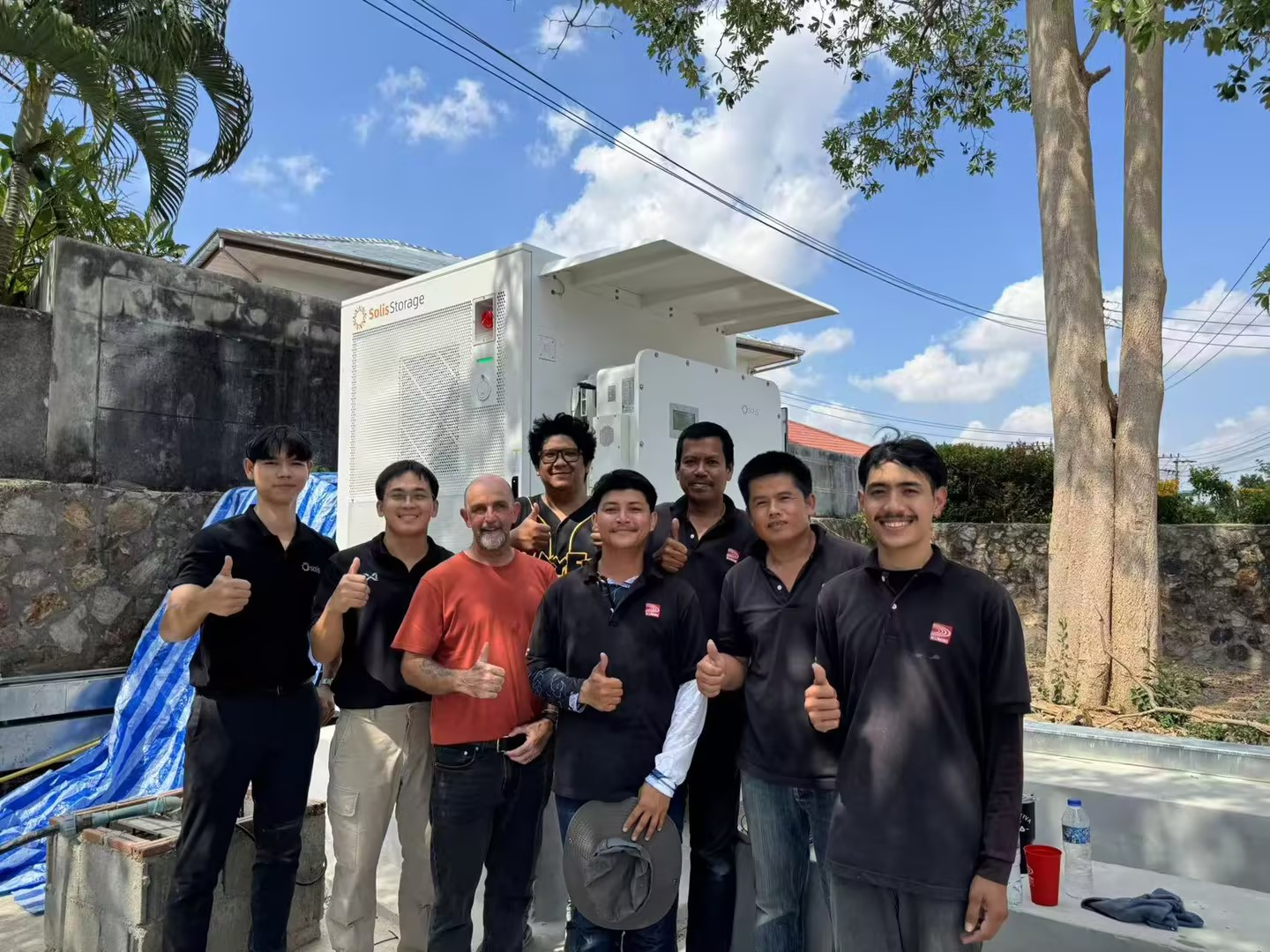
Project two: a Thai site on a 125 kW / 522 kWh system
The Thai installation uses the same 125 kW inverter platform but doubles the energy capacity to 522 kWh, configured for self-use and backup power. The recorded result is stable operation, with electricity bill savings noted as the project highlight, again against a stated 20-year horizon.
The difference between the two projects is instructive for buyers. Holding inverter power constant while doubling energy capacity shifts the system from a modest self-consumption optimiser into a longer-duration backup and load-shifting asset. In the EverCore architecture, one inverter can connect up to six battery cabinets in parallel, which allows storage capacity to be expanded linearly on the DC side without adding another inverter. That design choice is what makes a 261 kWh site and a 522 kWh site commercially comparable from the same product family, and it is the mechanism a buyer should look for when a project is expected to be built out in phases.
The two projects side by side
| Parameter | Denmark | Thailand |
|---|---|---|
| Region | Europe | Asia |
| Client type | C&I industrial end user | Self-consumption and backup power project owner |
| Configuration | 125 kW / 261 kWh | 125 kW / 522 kWh |
| Primary application | Self-usage of warehouse electricity | Self-use and backup power |
| Stated project horizon | 20 years | 20 years |
| Recorded result | Savings on electricity bills | Stable operation; savings on electricity bills |
| Highlighted capability | On-grid to off-grid switching in under 10 ms | Backup supply alongside self-consumption |
| Product platform | EverCore ESS | EverCore ESS |
The pair is deliberately not a like-for-like comparison, and that is where its value sits. What is being evidenced is a supplier's ability to hold one product architecture stable across two markets with different climate, grid, and service-logistics conditions — not a claim that the two sites perform identically.
What has to be true technically for both sites to work
AC–DC separation and protection ratings
EverCore separates the AC side from the DC side physically: the hybrid energy storage inverter and the battery cabinet are distinct units, each with its own enclosure. The inverter carries an IP66 rating and the battery cabinet IP55. The engineering rationale given for this split is twofold — thermal isolation keeps the inverter's power losses outside the cell compartment, and independent enclosures allow a higher protection rating on the electronics than would be practical in a combined cabinet.
For a buyer in a coastal or high-humidity market, protection ratings are among the few specification items that can be checked against a certificate rather than taken on trust. They also affect maintenance: a separate inverter can be serviced without opening the battery compartment.
Thermal envelope and altitude
The EverCore platform is air-cooled, using a three-duct design that combines a dedicated diversion duct for the inverter with Coanda-effect airflow across the battery pack surfaces. The manufacturer states this improves heat dissipation efficiency by 30% compared with conventional air cooling, and that the system operates between −25°C and 55°C and at altitudes up to 4,000 metres. That envelope is what makes a Danish winter and a Thai ambient temperature addressable with the same product family — the two projects sit at opposite ends of the declared operating range rather than inside a narrow band.
Control architecture
Conventional C&I systems typically run separate controllers for the battery management system, power conversion system, energy management system, and static transfer switch. EverCore consolidates scheduling into a single central controller. The practical consequence for a buyer is a shorter fault-location path: with one control core, a site issue does not require coordinated diagnosis across multiple vendors' subsystems. This is an operational argument, not a performance argument, and it should be tested during commissioning rather than accepted from literature.
Cell choice and cycle life
The system uses 314 Ah LFP cells with a stated internal resistance of 0.15 ± 0.05 mΩ, compared with 0.17 mΩ for the 280 Ah cells still common in the category. The manufacturer states that every 10% reduction in internal resistance reduces charge-discharge heat generation by roughly 20%, and that the cells reach 8,000 cycles at 0.5C with remaining capacity of at least 70% — described as approximately 14% better than the 7,000 cycles of 280 Ah cells. At 500 cycles per year, that difference is presented as extending the economic lifecycle from about 14 years to 16 years.
Cycle-life figures are among the most frequently misread numbers in storage procurement. They are test conditions, not site results. A buyer should confirm the charge-discharge rate, temperature, and end-of-life capacity threshold attached to any cycle claim, and should check whether the warranty is written against the same conditions.
Certification and documentation: the part that decides market access
Deployment evidence is only usable if it is paired with documentation that applies in the buyer's market. For the EverCore 261 kWh models, two records are directly relevant to European procurement.
| Certificate | Type and number | Issued by | Scope and standard | Dates |
|---|---|---|---|---|
| EMC | CE (EMC Directive 2014/30/EU), AE 50712374 0001 | TÜV | EverCore-261kWh, EverCore-261kWh-PRO; EN IEC 61000-6-2:2019, IEC 61000-6-2:2016, EN IEC 61000-6-4:2019, IEC 61000-6-4:2018 | Issued 2026-01-21 |
| Safety | IEC 62619, JPTUV-182135 | TÜV | Zone 2; IEC 62619 | Issued 2026-01-06; expires 2031-06-01 |
Two details in that table should drive buyer questions. The EMC certificate names the 261 kWh EverCore models specifically — a buyer configuring the 100.5 kWh or 120.6 kWh variants should confirm in writing whether the same documentation covers the delivered configuration. And the IEC 62619 certificate carries a stated expiry of 1 June 2031, which is a useful reminder that certification status is a moving target across a 20-year project horizon and should be re-checked at each procurement gate rather than assumed from an initial review.
Where these configurations fit, and where they do not
The application profile recorded for this platform covers commercial and industrial users and residential users within the renewable energy and power grid industry, including renewable power plants and utility companies. Typical functions are peak load shifting, backup power supply, and self-consumption of solar generation, with 24/7 operation in grid-tied or off-grid mode and seamless backup switching.
In practical terms, the two reference projects map onto recognisable buyer situations:
- Warehouse and logistics sites with daytime rooftop solar and load profiles dominated by handling equipment, refrigeration, or lighting — the Danish case.
- Sites that need both bill management and continuity, where backup duration matters as much as arbitrage — the Thai case, with double the energy capacity on the same inverter rating.
- Phased builds where initial capital is limited and capacity is added later; the platform supports up to six battery cabinets per inverter, with the manufacturer stating that DC-side expansion reduces expansion cost by approximately 10% compared with adding inverter capacity.
- Solar-plus-storage retrofits, where the integrated unit removes the need for a separate PV inverter and supports both DC and AC coupling, with a PV oversizing ratio of up to 200%.
The same evidence also marks the boundaries. Two installations do not describe a product's behaviour in every market, and the projects as documented do not publish independently metered savings, load profiles, or outage statistics. Buyers evaluating a site with a very high continuous discharge rate, or with ambient conditions outside the declared −25°C to 55°C range, are outside the demonstrated envelope and should treat the reference as a starting point for technical discussion rather than a conclusion.
Market context: why multi-region references are being requested more often
The demand backdrop explains the shift in buyer behaviour. BloombergNEF projected global annual energy storage deployment, excluding pumped hydro, to reach 92 GW in 2025. In the United States, the Solar Energy Industries Association reported 57.6 GWh of new storage capacity installed in 2025, described as the largest year of additions on record (the published headline rounds this to 58 GWh). That figure is a single-source association number without a published segment split, so it should be used as a directional signal rather than a sizing input.
What both data points indicate is a market where volume is no longer the constraint and delivery confidence is. When deployment scales at that pace, buyers move from asking whether storage works to asking whether a specific supplier has already solved the non-product problems: grid-code variation, climate qualification, spare-parts reach, and remote diagnostics. A supplier's own operating footprint becomes part of the evidence. Solis reports installations across more than 300,000 energy storage sites worldwide, an AI cloud platform deployed at more than 5,500 storage stations, and interconnection with 102 third-party VPP and EMS operators across 11 European countries — including the Kraken platform under Octopus Energy in the UK and aggregator platforms such as Check Watt in the Nordic market.
How this compares with conventional C&I approaches
The conventional C&I architecture separates functions across multiple boxes: a power conversion system, an external static transfer switch, an external PV inverter, a grid cabinet, and a battery cabinet, frequently from different vendors, each with its own controller. The EverCore approach integrates the 50–125 kW hybrid inverter, static transfer switch, PV inverter, circuit breaker protection, and energy management system into a single unit, and consolidates control into one CPU.
The trade-offs are real in both directions, and buyers should weigh them explicitly rather than accept either framing.
| Dimension | Integrated single-unit architecture | Conventional multi-box architecture |
|---|---|---|
| Component count and interfaces | Fewer boxes, fewer inter-vendor protocol links | More interfaces; fault diagnosis may need multiple vendors |
| Backup switching | Sub-10 ms transfer achieved without an external static transfer switch | Transfer performance depends on the external switch specification |
| Capacity expansion | DC-side expansion up to six cabinets per inverter | Expansion often requires additional conversion capacity |
| Serviceability | AC and DC sides separable; inverter serviceable independently of the battery compartment | Depends on cabinet design and vendor split |
| Thermal approach | Air-cooled with ducted airflow; declared −25°C to 55°C range and 4,000 m altitude | Liquid cooling is common at higher power densities and in some extreme-ambient specifications |
| Where the approach is weaker | Air cooling has thermal limits; buyers with sustained high-rate duty cycles or ambient conditions beyond the declared range should validate against their own load profile | Higher part count and more integration work, but modular replacement of individual functions |
Three limitations deserve to be stated plainly alongside the two projects.
- Reference depth, not reference breadth. Two installations demonstrate that a configuration has been delivered in Europe and Asia. They do not demonstrate a track record across a specific country's grid-code variants, nor do they establish failure rates.
- Documentation scope is model-specific. The published EMC certificate covers the 261 kWh EverCore models. Buyers specifying other capacities in the family should obtain written confirmation of coverage before relying on it in a tender submission.
- Savings are stated, not quantified. Both projects record electricity bill savings as an outcome without publishing metered values. A buyer building a business case should require the supplier to model savings against the buyer's own load profile and tariff structure, and should treat reference-site savings as directional only.
A verification checklist for deployment references
The following checklist converts a reference project into a set of answerable procurement questions. It applies to any supplier, not only the one discussed here.
| What to verify | Why it changes the decision |
|---|---|
| Exact configuration, including inverter rating and kWh capacity | Confirms the reference matches the intended duty cycle, not just the site type |
| Climate and altitude at the site | Establishes whether the reference falls inside or outside the declared operating envelope |
| Application mode: self-consumption, backup, or both | Backup duty imposes different requirements on transfer time and reserve capacity |
| Certificate numbers, issuing body, scope, and validity dates | Determines market access and tender eligibility; scope exclusions are common |
| Service model and on-site response commitment | On a 20-year horizon, service distance is a cost and continuity variable |
| Spare-parts policy and expected component life | Protects against obsolescence after the initial warranty period |
| Whether performance data is supplier-reported or independently metered | Sets the confidence level that can be attached to any savings claim |
On the service question, the supplier's stated commitments are 24/7 global remote technical support, 27 local overseas service centres, 48-hour on-site fault handling with a whole-machine replacement guarantee, and long-term spare-parts supply. Those are commitments to be written into a contract and tested against the buyer's actual site location, not accepted as general assurances.
Future outlook
As storage deployment scales — with global annual additions projected at 92 GW for 2025 and U.S. installations already reported in the tens of gigawatt-hours per year — the competitive difference between suppliers is likely to shift further toward documented delivery rather than declared capability. Two dynamics follow.
First, buyers are likely to demand references that are structurally comparable to their own project: same application mode, comparable climate, and a certificate scope that names the delivered configuration. A generic list of countries served will satisfy fewer tender requirements over time.
Second, the software and market-access layer is becoming part of the deployment evidence itself. A system that can interconnect with third-party VPP and EMS operators in the buyer's market has a different commercial value from one that cannot, particularly in European markets where C&I storage revenue increasingly comes from ancillary services and demand response rather than peak-valley arbitrage alone. Suppliers that can show both a physical installation and an integration pathway are better positioned for the next procurement cycle than those showing either alone.
Frequently asked questions
What capacity configurations does the EverCore C&I platform cover?
The EverCore ESS is offered in rated energy capacities of 100.5 kWh, 120.6 kWh and 261.2 kWh, with inverter power ratings of 50 kW, 60 kW and 125 kW. It uses EVE LFP cells rated at 3.2 V / 314 Ah with a stated cycle life of 8,000 cycles, and carries an IP55 cabinet rating with an IP66 inverter rating. One inverter can connect up to six battery cabinets in parallel for DC-side capacity expansion.
Which certificates should a European buyer verify before shortlisting a C&I storage cabinet?
For the EverCore 261 kWh models, two records are published: a CE EMC certificate under Directive 2014/30/EU with number AE 50712374 0001 issued by TÜV, citing EN IEC 61000-6-2:2019, IEC 61000-6-2:2016, EN IEC 61000-6-4:2019 and IEC 61000-6-4:2018, issued 21 January 2026 and covering EverCore-261kWh and EverCore-261kWh-PRO; and an IEC 62619 safety certificate with number JPTUV-182135 issued by TÜV for Zone 2, issued 6 January 2026 and valid to 1 June 2031. Buyers should confirm in writing that the certificate scope names the exact configuration being purchased.
What environmental conditions does the platform support?
The manufacturer states an operating temperature range of −25°C to 55°C and an operating altitude of up to 4,000 metres, with IP55 protection on the battery cabinet and IP66 on the inverter. The air-cooled thermal design uses a three-duct arrangement combining a diversion duct for the inverter with Coanda-effect airflow across battery pack surfaces, stated to improve heat dissipation efficiency by 30% over conventional air cooling.
How does a 125 kW / 261 kWh site differ from a 125 kW / 522 kWh site in procurement terms?
Inverter power is identical; energy capacity is doubled. The 261 kWh configuration is suited to shifting self-consumed solar generation and managing peak demand, as in the Danish warehouse project. The 522 kWh configuration extends the period over which the same power rating can be sustained, which is relevant where backup duration and evening load coverage matter, as in the Thai self-use and backup project. Because the architecture allows up to six battery cabinets per inverter, capacity can be added later without additional inverter investment.
What after-sales commitments support a deployment in Europe or Asia?
The supplier states 24/7 global remote technical support, 27 local overseas service centres, 48-hour on-site fault handling with a whole-machine replacement guarantee, and long-term spare-parts supply. Standard models are listed with a minimum order quantity of one unit, while customised OEM orders start at 20 units, with lead times of 30–45 days for mass OEM orders. Buyers should map the nearest service centre to the actual site before contracting.
What should a buyer request in order to verify a reference project rather than accept it?
Request the exact configuration including inverter rating and energy capacity, the site's climate and altitude, the application mode, the certificate numbers with issuing body and validity dates, the service model and on-site response commitment, the spare-parts policy, and a clear statement of whether performance data is supplier-reported or independently metered. Both projects discussed here are supplier-documented installations reporting electricity bill savings; neither publishes independently metered performance values, so savings should be modelled against the buyer's own load profile and tariff before being used in a business case.
What a buyer should take from this
Deployment evidence is most useful when it is read as a set of constraints rather than a set of achievements. The Danish and Thai projects together establish that one C&I platform has been configured at two energy capacities, delivered into two continents, and applied to two different duty profiles — self-consumption and combined self-use with backup. They also mark the limits of what can be concluded: two sites are not a reliability record, savings are stated rather than metered, and certificate coverage follows specific model numbers.
For buyers in the research and evaluation stages, the practical move is to convert a supplier's reference list into the checklist above and require answers in writing. A supplier able to answer those questions precisely, including the parts it cannot yet support, is easier to underwrite across a 20-year project horizon than one that answers only in generalities.
Additional technical detail on the EverCore platform and the wider SolisStorage range is available in the Solis Global Brochure V3.9.
Sources: SolisStorage project documentation for the Denmark 125 kW / 261 kWh and Thailand 125 kW / 522 kWh installations; SolisStorage product and certification records (CE EMC certificate AE 50712374 0001, IEC 62619 certificate JPTUV-182135); Ginlong (Solis) Technologies corporate information. Market context: BloombergNEF Energy Storage Market Outlook 2H 2025 (global deployment of 92 GW in 2025 excluding pumped hydro); Solar Energy Industries Association reporting 57.6 GWh of new U.S. storage capacity in 2025, a single-source figure without a published segment split.
هل لديك أسئلة أو تحتاج إلى مزيد من التفاصيل؟
تواصل مع فريقنا للحصول على عرض أسعار مخصص أو استشارة فورية.
طلب عرض أسعار
املأ النموذج أدناه وسيتواصل معك فريقنا بعرض مقترح مخصص.
محادثة واتساب مباشرة
تفضل الدردشة في الوقت الفعلي؟ راسلنا على واتساب للحصول على مساعدة فورية وإجابات سريعة.
- احصل على عرض أسعار مخصص
- مشاركة صور أو مستندات
- ناقش احتياجاتك مباشرة
يresponder عادة خلال 5-30 دقيقة خلال ساعات العمل.