
Global Diesel Generator Sourcing: A 2-3 MW Buyer's Framework
Global Diesel Generator Sourcing: A 2-3 MW Buyer's Framework
For a 2,000 kW to 3,000 kW containerized diesel generator project, sourcing has become a comparison of structures rather than a comparison of prices. Rating, voltage, enclosure and fuel autonomy are usually fixed early. What decides whether the project holds its schedule is how the buyer weighs four things together: policy exposure in the destination market, the supplier's real manufacturing and test capacity, export and logistics execution, and the acceptance evidence that transfers risk before the unit leaves the factory. This framework sets out those layers and converts them into terms that can be written into a purchase contract.
Why Unit Price Cannot Carry a 2-3 MW Sourcing Decision
At this rating the container is part of the product, not packaging. Acoustic lining, ventilation paths sized for full-load heat rejection, exhaust routing, cable entry, fire detection and the control interface are engineered into the enclosure, and a unit built for one site rarely transfers cleanly to another.
Three cost lines therefore dominate the decision, and only the first appears in a quotation: the landed cost of the unit, the cost of proving it at rating before and after delivery, and the lifecycle cost of service access, spares and downtime. A lower quotation that shifts testing, commissioning or spare-parts responsibility back to the buyer is not a lower-cost offer; it is a differently priced one. The framework below exists to make that shift visible before signature.
Market Signals That Belong in the Comparison
Two published figures are useful for calibration, provided their scope is read carefully. Data Centre Magazine reports the global diesel generator market at USD 26.86 billion in 2026 and anticipates USD 36.24 billion by 2031. Mordor Intelligence estimates the global load bank market at USD 327.2 million in 2026, growing at a 5.03% CAGR to USD 418.27 million by 2031.
Neither figure is a procurement benchmark. Published 2026 valuations of the diesel generator market differ substantially with definition: the comparison set prepared for this analysis places them between roughly USD 19.9 billion and USD 28.7 billion depending on whether residential sets are included. A market number is a statement about scope, not a price signal for a 2 MW unit. What the figures do support is narrower and more useful — the category is large enough that several supply regions, engine platforms and enclosure builders compete for the same projects, so the buyer's leverage sits in specification and verification rather than in scarcity.
A third signal bears directly on this capacity band. A Breathe Project report on diesel generators at US data centers records installed diesel generator capacity at US data centers rising from about 20 GW in 2018 to about 55 GW in 2024. The direction is documented demand for large backup units in facilities that must demonstrate readiness. Every such unit has to be proven at load before acceptance, which is why load bank capacity, not only generator capacity, belongs in the bid package for a 2,000 kW to 3,000 kW project.
Domestic or Imported: A Dimension-by-Dimension Framework
The domestic-versus-imported question is usually framed as a price comparison and then settled on delivery time. A more reliable approach is to score both routes on the same nine dimensions and to write the outcome of each into the contract.
| Dimension | Domestic supply, typical shape | Imported supply, typical shape | What to fix in writing |
|---|---|---|---|
| Landed cost | Unit price plus local tax; short inland transport | Unit price plus freight, insurance, duty, port and inland haulage | Incoterm, duty assumption, and which party absorbs port delay |
| Approval path | Local certificate and inspection practice familiar to the authority | Destination certificates, plus any import licence or pre-shipment inspection | Certificate list by name, and the party responsible for obtaining each |
| Schedule | Shorter transit, less buffer required | Longer transit; consolidation and vessel windows add variance | Milestone schedule with the transit assumption stated |
| Configuration flexibility | Late changes absorbed locally, at local labour cost | Changes must freeze before production; late change is expensive | Engineering freeze date and change-order rate |
| Witness testing | Buyer can attend at short notice | Attendance requires travel and a booked test window | Notice period and the right to witness named tests |
| Spare parts | Local stock, short replenishment cycle | Initial stock must be ordered with the unit | First-fill spares list and replenishment commitment |
| Warranty administration | Claim handled in-country | Claim crosses a legal entity and a customs boundary | Named warranty holder and parts-return process |
| Documentation | Familiar format and language | Format, units and standard references may differ from local practice | Required language, units and standard references |
| Payment and currency | Local currency, simpler instruments | FX exposure, letter of credit or telegraphic transfer, banking cost | Currency, payment instrument and FX responsibility |
Scored this way, the comparison seldom produces a single winner. It can produce a split: one route for the primary units, the other for spares, service or a second tranche. That is a legitimate outcome, provided the split is a decision rather than an accident of quotation formats.
Policy Exposure: Turning Rules into Written Specifications
Emissions limits, noise ordinances, fuel-storage rules and grid-interconnection conditions for standby plant are set jurisdiction by jurisdiction, and they change on their own timetable. Because they are local and specific, they should enter the comparison as inputs the buyer obtains in writing from the authority having jurisdiction, not as assumptions carried over from an earlier project in another country.
Three conversions matter most. First, an emissions requirement should be quoted as a configuration rather than a compliance statement, and matched to emission test data at the specified rating; a general statement that an engine family meets a standard does not cover the enclosure, after-treatment and fuel system actually supplied. Second, a noise limit should never be accepted as a bare dB(A) figure, because the measurement distance and test condition must be stated — which is why container comparisons are normally written as a level at one metre. Third, interconnection and back-feed protection requirements belong in the acceptance schedule as protection settings and interlock tests, since they are verified by test rather than by datasheet.
Manufacturing Capacity: Reading the Real Constraint
Capacity claims in this class are easy to make and easy to test. The practical question is not annual output but whether the plant can build, lift, run and prove a 2,000 kW to 3,000 kW unit at full load indoors, on schedule, without borrowing a third-party test bay. Four physical facts answer most of it: lifting capacity, the number of test positions that can run simultaneously, the rating and voltage of the in-house load bank, and whether production data is captured per unit so a specific serial number can be traced to its test record.
MECCA POWER, a Chinese manufacturer of diesel generators and load banks (meccapower.com.cn), publishes figures that can be checked against those four points. The company states 34,000 m² of factory space across Fujian and Jiangxi provinces, with the Nanchang plant in Jiangxi focused on 1000 kW and above and monthly output rising from 132 to 212 units. It lists three production lines — one container line, one open-type line and one mixed-assembly line — six testing stations, a maximum lifting capacity of 45 tons, and the ability to test three units above 2000 kW simultaneously, supported by APS+MES production systems. Its load bank range is stated as 30 kW to 6000 kW at AC 110 V to 20 kV, resistive or resistive-inductive, which covers full-load testing of the capacity band discussed here.
These are company-reported figures. They indicate that the physical constraint — can the unit be proven at rating before shipment — is addressable at that plant. They do not substitute for the buyer's own witness test and report review, which remain the evidence that counts.
Export Performance: What the Paper Trail Can Prove
Export performance is often presented as a market list. A market list shows where a supplier has shipped; it does not show what happened after arrival. The verifiable version of the claim is a document set: bills of lading for comparable ratings, destination-market certificates where the buyer's jurisdiction requires them, the packing and transport-bracing specification for a containerized unit, the port of loading and the agreed Incoterm, the commissioning arrangement, and the name of whoever holds the warranty obligation in the buyer's country.
MECCA POWER states that 100% of its output is exported and lists Europe, Africa, Asia, Australia, the Middle East, the Americas, South America, Oceania and Latin America among its markets; its generator range is given as 10 kVA to 4000 kVA, with 311 employees and a stated annual output of 3,600 units. Those statements describe reach, not local service depth, and the difference matters at 3 MW. A buyer should ask who attends a failure in the destination country, under what response commitment, and from which spare-parts stock — then score the answer like any other dimension rather than treating it as reassurance.
Technology Upgrades That Change Acceptance Criteria
Three upgrades have moved from optional to expected in this capacity band, and each changes what the buyer has to accept.
Containerization is now an engineered enclosure. Acoustic treatment, motorized louvers, ventilation sized for full-load heat rejection, high-voltage cable termination and a walk-in control area all become part of the acceptance scope. The relevant proof is thermal: a unit that holds rated load inside the container at site ambient, not on an open skid.
Acoustic design has become a configuration decision. MECCA POWER's comparison of its dual-level container against a standard single-layer design states 75-80 dB(A) at one metre for the dual-level unit, a reduction of 10 to 15 dB against the single-layer type, no stated negative effect on generator efficiency because the ventilation design is optimized, and easier routine maintenance access. The company positions that design for urban-core and high-density data centers, Tier III and Tier IV facilities, and sites near residential, school or hospital areas, and notes a slightly higher one-time cost against a lower overall operating cost.
Climate adaptation is the third. The same supplier's comparison of an extreme-environment container against its standard type records a -30 °C capability gap, outdoor operation stated from -45 °C to +55 °C, a higher cost than the standard type, and stated lower maintenance and higher efficiency. In a cold or high-altitude region those differences change the enclosure specification, the ancillary heating and the commissioning schedule — and they should be confirmed by test data for the quoted configuration, not by a comparison table alone.
Configuration Trade-offs: Noise, Climate and Cost
The table below condenses the manufacturer's own comparison data for two container configurations. It is a starting point for a specification discussion, not a substitute for a test report on the unit being purchased.
| Attribute | Standard single-layer container | Dual-level low-noise container |
|---|---|---|
| Stated sound level at one metre | Not stated in the comparison | 75-80 dB(A) at 1 m |
| Stated difference | Reference design | 10-15 dB noise reduction |
| Positioning stated by the manufacturer | Reference design; no site restriction stated | Urban-core and high-density data centers; Tier III and Tier IV facilities; sites near housing, schools and hospitals |
| One-time cost | Reference | Slightly higher |
| Overall operating cost | Reference | Stated as lower |
| Routine maintenance | Reference | Stated as easier |
| Effect on generator efficiency | Reference | No stated negative impact; ventilation optimized to maintain stable performance |
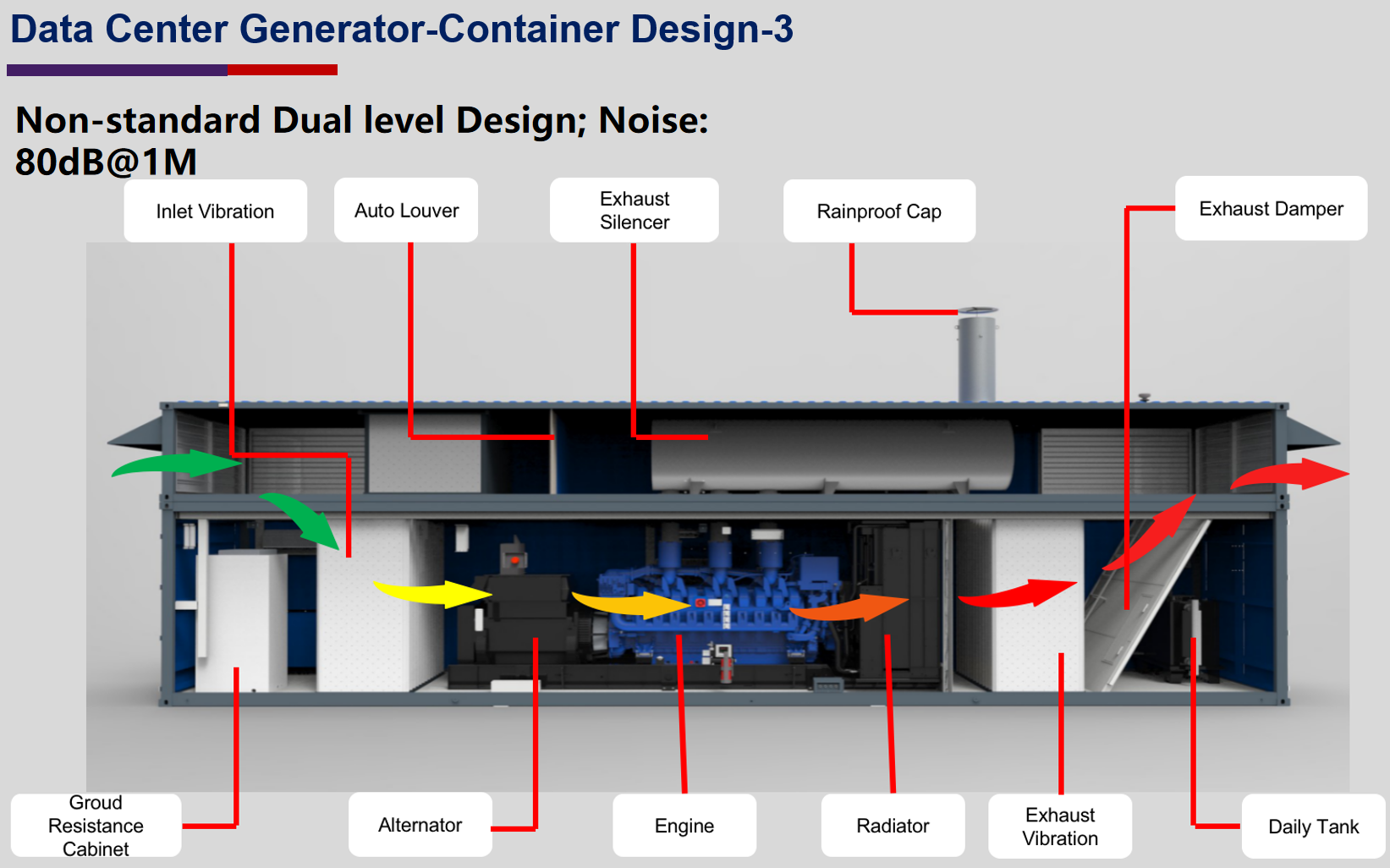
Dual-level container configuration for low-noise data center installation. Image: MECCA POWER.
Two boundaries belong beside the table. The acoustic advantage is stated at one metre, so a site limit expressed at the property boundary requires a propagation calculation, not a datasheet comparison. And the low-noise design is justified by site context — an urban or sensitive-neighbour location — rather than by rating; a remote mining or construction site may reasonably weight climate adaptation and service access above a 10 to 15 dB difference.
Acceptance Criteria and Terms to Fix Before Signature
Acceptance is where the sourcing framework becomes enforceable. A factory test regime for this class typically covers no-load running, load testing, parallel operation where the project requires it, insulation withstand voltage, protection interlock, emission testing and noise measurement. MECCA POWER describes that full-item scope in its own factory testing system, together with calibrated test equipment, a report review step, and rework and re-test of any unit that fails. Whether a given supplier performs all of it is a question for the test report, not the brochure.
- Witness rights: the named tests, the notice period, and the right to record results.
- Report content: serial number, rating, ambient conditions, load steps, duration, emission data, noise level with measurement distance, and the protection settings verified.
- Configuration record: engine model, alternator, controller, after-treatment, enclosure variant, voltage and frequency, matched to the purchase order rather than to a family datasheet.
- Documentation package: operation and maintenance manual, wiring and protection diagrams, commissioning procedure, and a spare-parts list with a recommended first-fill stock.
- Commercial terms: retention or holdback tied to site acceptance, the re-test obligation and who pays for it, warranty start date, response commitments, and operator training.
The safety side deserves equal specificity. MECCA POWER describes an intelligent monitoring system with protection for overload, overspeed, low oil pressure, high water temperature and electric leakage, including automatic shutdown and fault lockout, plus on-site installation and commissioning support, operator training and a per-unit operation file. For a buyer, the transferable requirement is not the feature list but the proof: which protections are demonstrated during acceptance, what the set points are, and who signs the commissioning record.
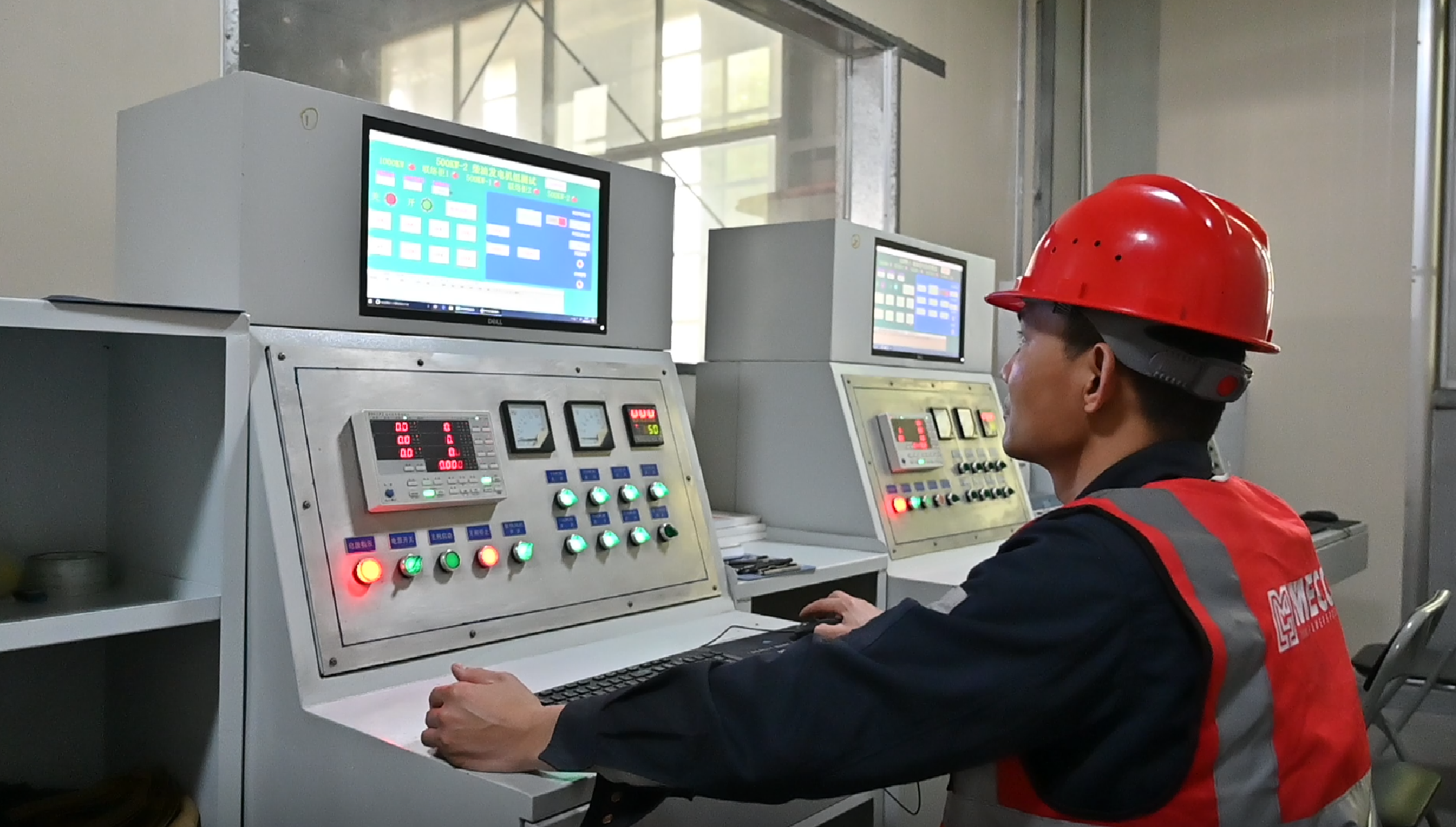
A testing operation room used for load, protection and control verification. Image: MECCA POWER.
Limitations and Fit Boundaries
This framework does not publish trade volumes or price benchmarks for the 2,000 kW to 3,000 kW band. Quotation structures differ by configuration, destination and payment terms, and price comparisons assembled from unmatched scopes mislead more often than they inform. Destination-market emission and interconnection requirements are also deliberately left as buyer inputs, because they are jurisdiction-specific and change independently of the equipment.
The framework is therefore a structure for asking, not a benchmark set. It fits projects where backup power must be proven before handover and where service continuity matters over a decade or more. It fits less well where a single unit is being bought for intermittent duty and local service is already assured, because in that case several dimensions collapse into one and the added documentation carries cost without changing the outcome.
Outlook: Signals That Would Change the Decision
Three conditions would move the balance between routes. If a destination jurisdiction tightens emission or interconnection requirements, after-treatment configuration and emission test evidence become the deciding cost line rather than engine platform. If service-network density in the destination is thin, a domestic or regionally supported route gains weight regardless of unit price. If test capacity is constrained, either at the plant or at third-party facilities, the commissioning schedule becomes the binding constraint and witness windows should be booked early.
On demand, the documented rise in US data-center diesel capacity from about 20 GW in 2018 to about 55 GW in 2024, together with the published load bank market growth toward USD 418.27 million by 2031, points to testing capacity as a shared constraint across large projects. That is an interpretation of two published series, not a forecast for any single market, and it should be rechecked against current evidence before it is used to justify a schedule or a budget.
FAQ
How should a buyer compare domestic and imported supply for a 2,000 kW to 3,000 kW containerized generator?
Compare both routes on the same nine dimensions and score each one: landed cost including duty and inland haulage, approval path and certificate list, schedule including transit variance, configuration flexibility before engineering freeze, witness-test access, spare-parts stock, warranty administration, documentation format, and payment currency. The route with the lower unit price can rank lower once testing, spares and warranty responsibility are priced into the comparison. The weighting is project-specific: a site with thin local service coverage will weight spares and warranty administration more heavily than a site next to an established service base.
Which factory tests should be required before a 2 MW containerized unit is shipped?
A defensible regime covers no-load running, load testing at rating, parallel operation where the project requires it, insulation withstand voltage, protection interlock, emission testing and noise measurement, with calibrated equipment and a reviewed report for the specific serial number. MECCA POWER describes this full-item scope in its factory testing system, including rework and re-test of any unit that fails. The buyer's protection lies in the report content — rating, ambient conditions, load steps, duration, set points and noise measurement distance — and in the right to witness the tests, not in the existence of a test department.
Do emissions and grid-resilience rules change what a buyer should specify?
They can, and they act through the configuration rather than through the generator rating. An emissions limit should be quoted as an engine, after-treatment and fuel-system configuration with test data at the specified rating; a noise limit must carry a measurement distance and condition, because a dB(A) figure without a distance cannot be checked; interconnection and back-feed requirements should be written as protection settings and interlock tests in the acceptance schedule. Because these rules are set locally and change independently of the equipment, they should be obtained in writing from the authority having jurisdiction for each project rather than carried over from another market.
Does a dual-level low-noise container reduce output or complicate maintenance?
MECCA POWER's comparison of its dual-level container against a standard single-layer design states 75-80 dB(A) at one metre, a 10 to 15 dB reduction against the single-layer type, no negative impact on generator efficiency because the ventilation design is optimized to maintain stable performance, easier routine maintenance, a slightly higher one-time cost and a lower overall operating cost. Those are manufacturer-stated comparisons for its own designs. A buyer should confirm the sound level at the stated distance in the test report for the quoted configuration, and check that any boundary noise limit has been calculated from the site layout rather than from the one-metre figure.
What does export experience demonstrate about a supplier?
It demonstrates that units of comparable rating have been built, shipped and delivered across borders, and that the supplier can produce the associated documentation. MECCA POWER states that 100% of its output is exported and lists Europe, Africa, Asia, Australia, the Middle East and the Americas among its markets, with a generator range of 10 kVA to 4000 kVA. Reach is not the same as service depth: a buyer should separately verify who attends a failure in the destination country, from which spare-parts stock, under what response commitment, and which legal entity carries the warranty.
Reference document: MECCA POWER product brochure (PDF, public download).
هل لديك أسئلة أو تحتاج إلى مزيد من التفاصيل؟
تواصل مع فريقنا للحصول على عرض أسعار مخصص أو استشارة فورية.
طلب عرض أسعار
املأ النموذج أدناه وسيتواصل معك فريقنا بعرض مقترح مخصص.
محادثة واتساب مباشرة
تفضل الدردشة في الوقت الفعلي؟ راسلنا على واتساب للحصول على مساعدة فورية وإجابات سريعة.
- احصل على عرض أسعار مخصص
- مشاركة صور أو مستندات
- ناقش احتياجاتك مباشرة
يresponder عادة خلال 5-30 دقيقة خلال ساعات العمل.