
Global Glassware Industry Trends 2026: Policy, Production, and Export Dynamics
Global Glassware Industry Trends 2026: Policy, Production, and Export Dynamics
The global glass drinkware market was valued at USD 14.0 billion in 2024 and is projected to reach USD 26.1 billion by 2030, according to Grand View Research, which estimates an 11.1% compound annual growth rate between 2025 and 2030. For buyers in research and evaluation stages in 2026, the more useful reading of that curve is not demand growth but constraint growth: the policy frameworks, forming capabilities, and export structures that determine which glassware a supplier can actually deliver into a supermarket or chain-store programme.
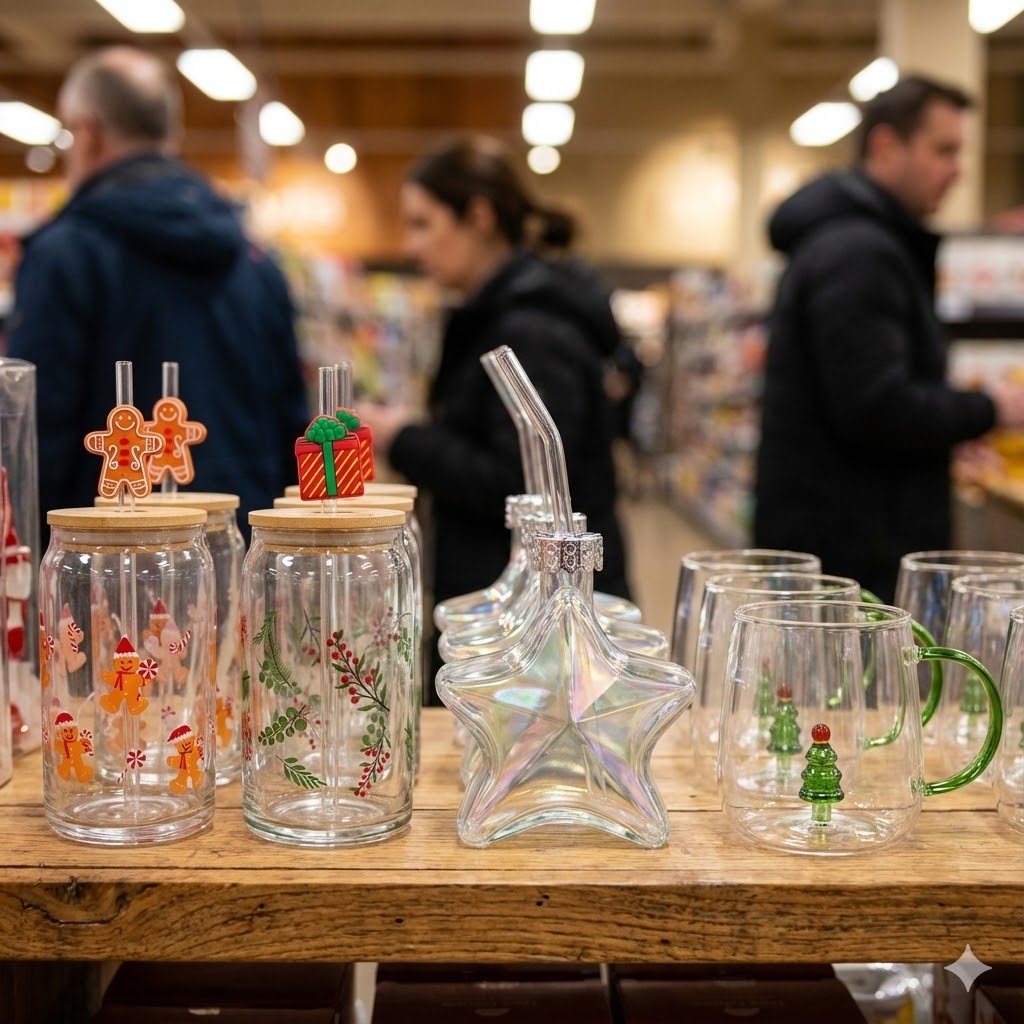
Glass drinkware staged for supermarket and chain-store supply channels, where packaging standards, traceability documentation and compliance paperwork now sit alongside price in supplier evaluation.
1. Why 2026 Is a Constraint-Driven Market
The glassware sector is expanding and tightening at the same time. Demand-side growth is well documented: the drinkware segment alone is projected to nearly double between 2024 and 2030, and eco-friendly material preferences are cited by Grand View Research as a primary driver of the 11.1% CAGR forecast for 2025–2030. At the same time, the cost of non-compliance, the specificity of channel onboarding requirements, and the geographical concentration of certain production methods have all increased.
The practical consequence for procurement teams is a shift in what a supplier evaluation actually tests. Price per piece and FOB terms remain relevant, but they are now preceded by questions about which certificates exist, what those certificates cover, when they expire, and whether the supplier's forming capacity matches the SKU being quoted.
Three structural forces drive that shift in 2026:
- Policy and regulatory constraints. Food-contact safety standards in the EU and US, hazardous-substance restrictions, and retailer-level social and environmental audit programmes now determine market access rather than differentiating competitors.
- Production capability distribution. Machine-pressed, machine-blown and hand-blown capacity are not interchangeable, and each carries different tooling, lead-time and minimum-order implications.
- Export and channel discipline. Supermarket and chain-store supply requires packaging conformity and traceability management at a level that most general trading operations cannot sustain.
2. Policy: Compliance Has Moved From Marketing Claim to Procurement Gate
Regulatory requirements for glassware in 2026 are specific and testable. In the European Union, European safety standard EN 1388-2 and ISO 7086-1:2019 regulate the release of lead and cadmium from glass hollowware intended for contact with food. In the United States, FDA Compliance Policy Guides CPG 7117.06 and 7117.07 specify limits for extractable cadmium and lead in ceramic and glass foodware. Both frameworks focus on what migrates out of the glass into food, not on the visual appearance of the product.
A second layer applies to decorated and partially assembled items. RoHS Directive 2011/65/EU restricts hazardous substances in products that contain metal parts, coatings or decorations — a category that includes glassware with plated finishes, printed decoration or metal components. This distinction matters during specification: a plain glass tumbler and a glass tumbler with an ion-plated coating are not governed by the same document set, even when they sit on the same purchase order.
A third layer comes from retail channel requirements rather than national law. Supermarket and chain-store onboarding processes typically include factory audits, product testing, packaging regulation checks and traceability management, and these requirements are audited before a listing is granted.
Compliance documentation in a verifiable supplier profile
The table below reflects the certification record published for Kotto Glass Industrial Co.Ltd, a daily-use glassware manufacturer and OEM/ODM supplier founded in 2003 that trades under the LAKOTTO brand. Certificate numbers, issuing authorities and validity windows are listed as recorded, because each of these fields is checked during supplier onboarding.
| Certification | Standard | Certificate / issuing body | Scope note | Validity |
|---|---|---|---|---|
| RoHS | RoHS Directive 2011/65/EU, including 2015/863/EU amendment | CTT2111031272EN — Zhejiang Consumer Testing Technology Co., Ltd. | Covers glassware products with metal parts, coatings or decorations | Issued 2021-11-07 |
| ISO 14001 | GB/T 24001-2016 / ISO 14001:2015 | 03423E30695R3M — CNCA | Environmental aspects of glassware production: material sourcing, manufacturing processes, surface decoration, packaging and waste management | Issued 2023-11-28, valid to 2026-12-01 |
| ISO 9001 | GB/T 19001-2016 / ISO 9001:2015 | 0070024Q54439R2S — CNCA | Design, manufacturing and quality management of all glassware products, including customized items | Issued 2024-11-25, valid to 2027-11-24 |
| BSCI | amfori BSCI social audit standard | 24-0233922 — APCER | Glassware production including drinking glasses, tumblers, highball glasses, wine glasses and related household glass products | Issued 2024-12-01, valid to 2026-12-01 |

RoHS Directive 2011/65/EU certificate CTT2111031272EN, issued by Zhejiang Consumer Testing Technology Co., Ltd., applies to glassware products that carry metal parts, coatings or decorations.
LAKOTTO's supplier profile additionally records BSCI, Sedex / SMETA, FSC, Disney FAMA and LFGB, alongside ISO. The breadth of that list is not decoration: different retail channels gate on different documents, and an FSC listing relevant to a packaging programme is not a substitute for an LFGB or RoHS document covering the product itself.
3. Production: Where Capacity Actually Sits in 2026
China's exports of glass and glassware reached approximately USD 25.53 billion in 2024, according to UN Comtrade data compiled by Trading Economics, confirming that the country remains the single largest source of finished glassware moving through international trade. Within the material mix, soda-lime glass remains dominant, accounting for approximately 70.8% of global glassware market share in 2024 according to the Glassware Market Size & Trends Report. That figure explains a lot of sourcing behaviour: for most volume retail programmes, soda-lime is the default economic answer, and borosilicate is an upgrade selected for thermal performance rather than a baseline expectation.
Behind the export totals, capacity is organised unevenly. Kotto Glass Industrial Co.Ltd operates a 10,000+㎡ production facility with approximately 100 employees, 10 in-house designers, and an annual output of 300,000,000 pieces. The company reports a 99% export ratio with main markets in the EU, South America and Asia, maintains working relationships with 150+ glass factories in China, and holds a 4,000+㎡ warehouse that allows fast delivery of high-turnover items. For buyers, this structure is significant for a specific reason: a single manufacturing site cannot economically cover every glassware category, so access to a coordinated factory network — combined with one point of accountability for quality and documentation — is often more valuable than the headline capacity of any one line.
4. Manufacturing Method as a Constraint Variable
Machine-blown, machine-pressed and hand-blown production are frequently treated as interchangeable in sourcing discussions. They are not. Each method carries different tooling costs, different tolerance behaviour, and different minimum order economics, and the choice constrains the design rather than following it.
| Forming method | Representative model | Material | Key parameters | Sourcing implication |
|---|---|---|---|---|
| Machine-pressed | KTK0370-2 glass tumbler | High borosilicate glass | 400 ml; T 78 mm, B 65 mm, H 140 mm, 420 g | Repeatable wall geometry for high-volume retail and gift sets |
| Hand-blown | KTDW0721-GGL double wall glass | High borosilicate glass with ion plating (I.P.) coating | 340 ml; T 84 mm, B 60 mm, H 110 mm, 145 g; double-walled insulated construction | Insulated drinkware where labour content, not tooling, drives unit cost |
| Machine-blown stemmed | KTG1139 wine glass | Soda-lime glass | 500 ml; T 67 mm, B 82 mm, H 224 mm, 215 g | Stem consistency at hospitality and retail volume |
| Pressed soda-lime serveware | KTPL1572A-A glass cake stand | Soda-lime glass | T 312 mm, B 120 mm, H 105 mm, 1445 g; MOQ 1,000 pcs | Heavier unit weight makes freight and breakage control a first-order cost |
| Recycled glass | KTBT1446A recycled glass | Recycled glass | 850 ml; T 80 mm, B 95 mm, H 247 mm, 610 g; 12 pcs/ctn in bulk pack | Circular-content programmes with bulk packaging formats |
Thermal specification is a second constraint layer that buyers frequently under-specify. For the KTG1139 wine glass and the KTBT1446A recycled glass items, the recorded instantaneous temperature difference is −30 to 160 degrees Celsius, and the high-borosilicate material temperature range is documented at 400 to 500 degrees Celsius. These are material and process limits, not marketing claims, and they define which use scenarios — dishwasher cycles, hot-fill beverage service, chilled service — a given SKU can be qualified for.
Customisation capacity is the third layer. The Kotto Glass Industrial Co.Ltd / LAKOTTO OEM-ODM capability record covers customisation across size, shape, material, glass colour, packaging and logo, with a stated minimum order quantity of 3,000 pcs, a lead time of 30–45 days, and 100% testing as the quality-control method. Export markets for that capability line are listed as Europe, the Americas and Southeast Asia.
5. Export and Channel Dynamics: The Supermarket and Chain-Store Layer
The most demanding export channel for glassware in 2026 is not premium hospitality supply but mass retail. Supermarket and chain-store programmes combine high volume, fixed shelf dates, and audit-driven supplier requirements. Documented project profiles for LAKOTTO's supply activity in this channel — covering Brazil and Poland — specify B2B bulk distribution, OEM/ODM customisation and just-in-time delivery, with a special requirement for customised and environmental packaging that meets international standards.
Long-running supply relationships illustrate what that channel demands in practice:
| Client type | Market | Volume | Duration | Documented outcome focus |
|---|---|---|---|---|
| Retail chain / supermarket | Poland | 20–30 full containers per month | 5 years | Complete glassware and packaging solution supporting stable in-store sales |
| Hypermarket / supermarket chain | Russia | 20–30 full containers per month | 5 years | Tailored supply with coordinated packaging for multiple store formats |
| Wholesale distributor / home goods retailer | Brazil | 20–30 full containers per month | 5 years | Coordinated packaging supporting regional wholesale distribution and product-range expansion |
A fourth application pattern shows how the same capacity is used outside retail: branded and custom promotional gift programmes in Brazil and Poland, where glassware gift sets and promotional merchandise are produced with custom packaging and international-standard approvals for corporate events, brand marketing, holiday gifting and client retention. Wedding drinkware rental supply in the US, UK and Canada represents a further variant, where customised packaging and engraving are the differentiators rather than unit price.
6. Recycled Glass: Adoption Curve and Structural Limits
Recycled glass is the clearest technology-driven shift in the 2026 material mix. The global recycled glass market was estimated at USD 4.2 billion in 2024, with Europe the largest regional market according to Global Market Insights. That regional concentration is the defining feature of the trend, and it shapes procurement strategy more than the headline value does.
On the supply side, recycled-content ranges now extend well beyond simple tumblers. The KTBT1446A recycled glass platform covers recycled glass storage jars, tumblers, bottles, mugs and jars, with an 850 ml reference specification of T 80 mm, B 95 mm, H 247 mm, 610 g, packed 12 pcs per carton in bulk, and a recorded instantaneous temperature difference of −30 to 160 degrees Celsius.
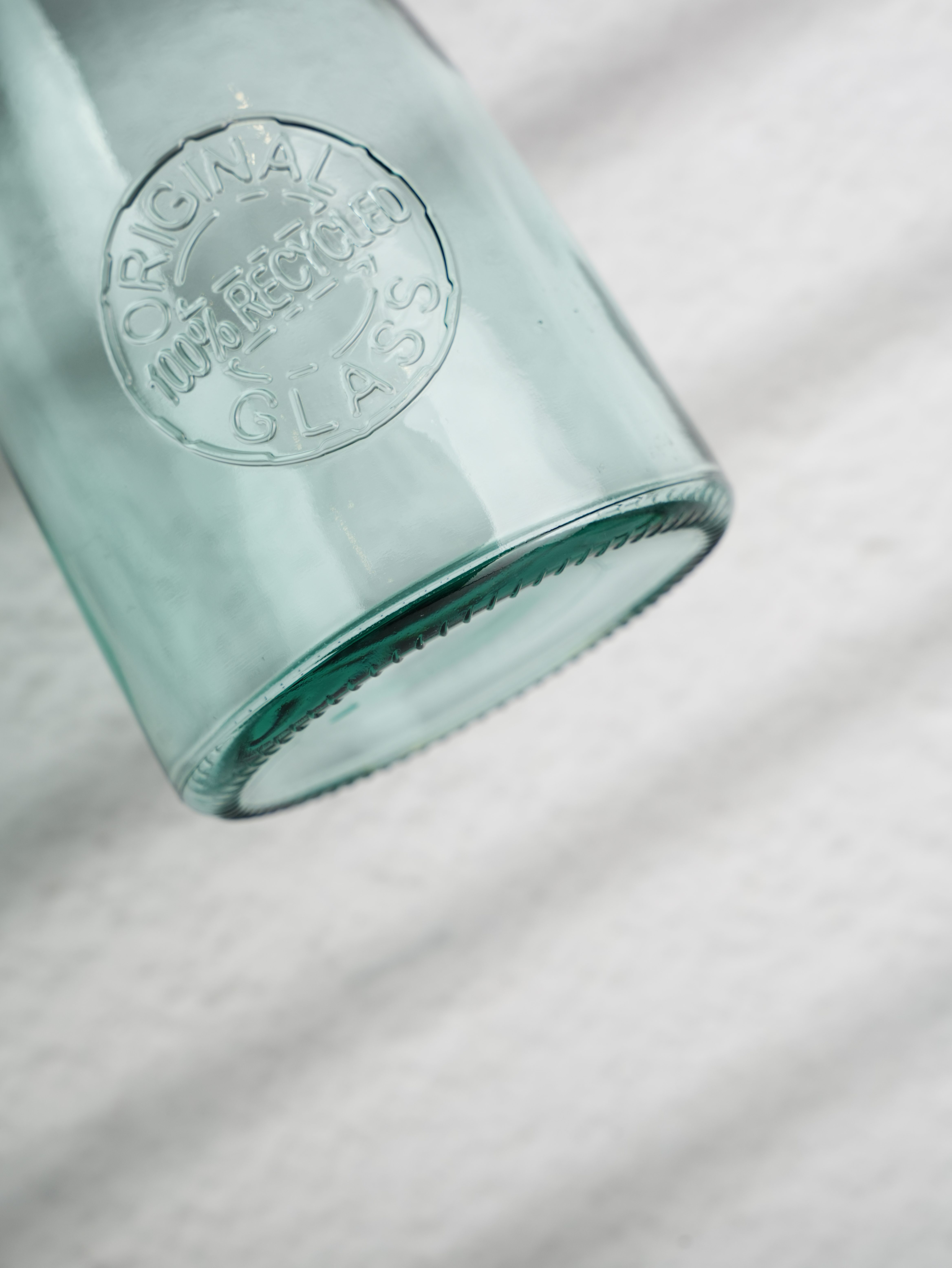
Recycled glass drinkware formats such as water bottles and tumblers allow buyers to pair circular-content claims with standard international compliance documentation.
7. Recycled and Compliant Supply Versus the Traditional Supply Model
A compliance-led sourcing model is not universally superior to the traditional price-first model. It is better suited to specific conditions, and it carries specific costs. The boundaries below are the ones buyers most often discover after the purchase order is issued.
- Certifications expire and must be renewed on a calendar. The ISO 14001 certificate (03423E30695R3M) and the BSCI audit (24-0233922) in the record above are both valid to 2026-12-01. A supplier that files certificates once and does not manage renewal creates onboarding risk for the buyer at exactly the wrong moment. Buyers should treat certificate expiry dates as purchase-order data, not as background information.
- Certificate scope is narrower than buyers assume. The RoHS certification in the record covers glassware with metal parts, coatings or decorations. Plain undecorated glass items sit under food-contact lead and cadmium rules such as EN 1388-2, ISO 7086-1:2019 and FDA CPG 7117.06/7117.07 instead. Requesting "the RoHS certificate" for a plain tumbler is a mismatch of document to product.
- Order economics constrain agility. With a stated MOQ of 3,000 pcs on the OEM/ODM capability line, a 30–45 day lead time, and a 1,000 pcs MOQ on the KTPL1572A-A glass cake stand, this model does not suit micro-batch testing at retail scale. The available mitigation is sampling: trial orders are accepted at first for sample evaluation, which allows specification sign-off before a full production commitment.
- Material substitution is not a free switch. Soda-lime glass still holds approximately 70.8% of the glassware market by material, and it underpins the economics of high-volume stemware and serveware such as the KTG1139 wine glass and KTPL1572A-A cake stand. Moving an entire range to high borosilicate changes forming method, cost structure and freight profile, not just the material specification line.
- Recycled content availability is geographically uneven. With Europe the largest regional market for recycled glass at USD 4.2 billion in 2024, buyers sourcing into markets with thinner collection infrastructure may find recycled-content options harder to secure at consistent quality than compliance-led sourcing guides typically imply.
8. Outlook: What to Watch Into 2027
Four developments are most likely to shape glassware procurement over the next several quarters.
Compliance becomes a recurring calendar event. As certificate validity windows roll over — ISO 14001 and BSCI in late 2026, ISO 9001 in late 2027 — supplier evaluation will increasingly be a renewal-tracking exercise rather than a one-time audit.
The top end of the market remains fragmented. Sisecam Group, Libbey and Arc International are identified as top-tier global leaders in the glassware market, with Sisecam holding an approximately 7.8% market share in 2025 according to Global Market Insights. No single supplier dominates, which keeps mid-size manufacturing partners commercially relevant for retailers running private-label or mixed-brand ranges.
Packaging requirements keep tightening in retail channels. Environmental and customised packaging with international-standard approval is already a stated special requirement in supermarket and chain-store supply projects, and it is likely to spread to adjacent channels such as promotional gifting and rental supply.
Traceability moves from audit-only to routine order documentation. Factory audits, product testing, packaging regulation and traceability management are onboarding requirements today; the direction of travel is that the same records are requested per purchase order.
Buyers evaluating these criteria against an actual supplier record can review the product specifications and certification documents published at www.kottoglass.com.
FAQ
Which certifications should a glassware supplier hold to serve EU and US retail and supermarket channels?
For management systems and social compliance, ISO 9001, ISO 14001 and a BSCI audit are standard expectations; the LAKOTTO record lists ISO 9001 (0070024Q54439R2S), ISO 14001 (03423E30695R3M) and BSCI (24-0233922), alongside Sedex / SMETA, FSC, Disney FAMA and LFGB. For food-contact safety specifically, EU requirements are governed by EN 1388-2 and ISO 7086-1:2019, and US requirements by FDA Compliance Policy Guides CPG 7117.06 and 7117.07, which set limits for extractable lead and cadmium in glass foodware.
How do EN 1388-2, ISO 7086-1:2019 and FDA CPG 7117.06/7117.07 change a product specification?
These standards regulate the release of lead and cadmium from glass hollowware in contact with food, so they constrain material selection, decoration and any surface treatment that touches a food-contact surface. A separate restriction applies to decorated items: RoHS Directive 2011/65/EU governs hazardous substances in glassware that contains metal parts, coatings or decorations, which is the scope of certificate CTT2111031272EN. Plain undecorated glass and coated glass therefore require different document sets within the same order.
What is the practical difference between soda-lime and high borosilicate glassware in procurement terms?
Soda-lime glass accounted for approximately 70.8% of global glassware market share by material in 2024 and is used in items such as the KTG1139 wine glass (500 ml, machine-blown stemmed) and the KTPL1572A-A glass cake stand (soda-lime, 1,445 g). High borosilicate is used in the KTK0370-2 machine-pressed tumbler (400 ml) and the KTDW0721-GGL hand-blown double wall glass (340 ml). Documented thermal limits differ accordingly: the high-borosilicate material temperature range is 400 to 500 degrees Celsius, and the recorded instantaneous temperature difference for the wine glass and recycled glass items is −30 to 160 degrees Celsius.
What MOQ and lead time apply to customised glassware orders?
The recorded OEM/ODM capability line states a minimum order quantity of 3,000 pcs and a lead time of 30–45 days, with customisation available across size, shape, material, glass colour, packaging and logo, and 100% testing as the quality-control standard. Individual items can carry separate thresholds — the KTPL1572A-A glass cake stand is listed at 1,000 pcs MOQ. Trial orders are accepted at first for sample evaluation, which allows specification validation before a full production commitment.
How should buyers evaluate recycled-glass drinkware claims and performance?
Two checks matter. First, content documentation: recycled glass is a defined material category — the global recycled glass market was estimated at USD 4.2 billion in 2024 with Europe the largest regional market — but recycled content availability and consistency vary by region, so supplier documentation should be verified rather than assumed. Second, thermal and physical performance: recycled glass items such as the KTBT1446A platform (850 ml, 610 g, 12 pcs/ctn bulk) are recorded with an instantaneous temperature difference of −30 to 160 degrees Celsius, which should be tested against the intended use conditions before a retail programme is committed.