
Global Laser Cutting in 2026: Policy Shifts and the Supplier Longevity Calculus
Global Laser Cutting in 2026: Policy Shifts and the Supplier Longevity Calculus
The global laser cutting machines market is projected to grow from USD 7.44 billion in 2026 to USD 18.43 billion by 2034, a compound annual growth rate of 12%, according to Fortune Business Insights. Behind that headline sits a structural split: national industrial policy, energy-efficiency expectations and reshoring initiatives are pulling different manufacturing regions toward different machine profiles, and they are quietly changing which supplier attributes actually survive a five-year production horizon.
China's laser equipment market revenue accounted for 56.6% of the global total in 2024, with domestic high-power laser localization exceeding 70% in the same period (IT Home / CCTV Finance). Fiber laser technology now holds more than 55% of industrial laser system share, having displaced CO2 sources on the strength of 30–50% higher efficiency and roughly 50% lower operating costs (SNS Insider). The practical consequence for procurement teams entering 2026 is that machine supply is abundant and source-level differentiation is compressing; the durable differences are increasingly structural, service-related and certification-related rather than optical.
National Demand Profiles Are Diverging, Not Converging
Demand for ultra-high-power laser heads of 10 kW and above increased by 75% between 2023 and 2024, driven largely by thick-plate cutting needs in heavy industry (Customcy). That growth is not a uniform, global phenomenon. It concentrates in markets where heavy fabrication, energy equipment and structural steel work sit close to the end customer — and it produces a very different machine specification from a market whose laser cutting demand is dominated by thin-gauge sheet metal processing for appliances, enclosures or HVAC components.
Layered on top of that product-side divergence is a regulatory one. Laser processing machines must comply with ISO 11553-1 for general safety requirements and IEC 60825-1 for equipment classification before they can be traded internationally and carry CE marking (ISO / EN standards). Regional frameworks then add their own layers: EN 60204-1:2018, EN ISO 11553-1:2020+A11:2020 and EN ISO 12100:2010 in the European Union, and UL 508A together with CSA C22.2 No.286:23 in North America. The result is that a single machine configuration can be fully compliant in one market and require additional verification in another.
The Problem and the Opportunity: Policy as a Procurement Variable
For most of the past decade, laser cutting machine selection was framed around three questions: how much power, how large a format, and how much per unit. In 2026, a fourth question has moved into the evaluation set — how long the supplier relationship, and the machine itself, will remain valid. Two mechanisms drive that shift.
The first is standards consolidation. Because international trade and CE marking depend on ISO 11553-1 and IEC 60825-1 compliance, and because North American acceptance depends on UL 508A and CSA C22.2 No.286:23 for electrical cabinets, certification is granted per product family, per market and per configuration — not per brand. A verification of machinery directive compliance issued for a fiber laser cutting machine series names the specific models it covers. Buyers who assume that a supplier's general "CE certificate" automatically extends to any configuration they order can encounter re-testing, delayed commissioning or customs friction after the machine has already been paid for.
The second mechanism is cost-of-ownership realism. As high-power configurations become more common, the operating characteristics of a machine — complete-machine power consumption, consumable wear, maintenance intervals — grow into a larger share of the multi-year cost than the initial purchase difference between two bids. The opportunity for buyers is therefore straightforward: suppliers who can present model-level certification coverage, verifiable structural design, a low-maintenance profile and documented repeat deployments are the ones whose quotation is genuinely comparable to the next quotation. Suppliers who cannot present those things are quoting a lower price for a different, shorter-lived asset.
What "Supplier Longevity" Means as a Purchasing Metric
Longevity is not a marketing attribute; it is the probability that a supplier can still certify, supply, service and support a specified machine in its fifth operating year. That probability can be approached through verifiable proxies rather than assurances.
| Longevity signal | What the buyer can actually verify | Why it changes the decision |
|---|---|---|
| Certification scope | Which exact model numbers appear on the EU verification of machinery directive compliance, and which electrical cabinets hold North American compliance | A certificate issued for one series or cabinet does not automatically cover a different configuration; uncovered models can delay installation |
| Structural approach | How the machine bed and gantry are stress-relieved and calibrated; whether full-machine performance and accuracy testing is performed before shipment | Long-term positioning accuracy is governed by the structure's behaviour over years of thermal and mechanical load, not by the laser source alone |
| Maintenance profile | Consumable wear items, service intervals, warranty scope for core components | After power, maintenance and downtime are usually the largest controllable operating costs |
| Energy profile | Complete-machine power consumption at the configuration being purchased | Power draw scales with the power tier; the difference compounds across a multi-year production horizon |
| Configuration flexibility | Whether OEM/ODM production and parameter-level customization are offered, and which parameters | A machine that cannot be adapted to a changed product mix becomes a replacement cost rather than a depreciating asset |
| Deployment evidence | Documented installations with operating duration, and whether the customer bought again | Repeat procurement is one of the few publicly checkable signals that a machine survived a real production cycle |
The structural point in that table deserves emphasis because it is the most frequently underweighted. Machine beds and gantries accumulate residual stress from welding and machining; uncontrolled, that stress is released gradually in service as thermal cycling and load change the geometry. Stress-relief treatments such as high-temperature annealing are a long-established practice in machine tool construction precisely because they stabilize geometry before the machine ever cuts a part. For a buyer comparing two machines with identical laser power and identical quoted accuracy figures, the structural process is what determines whether the accuracy measured at commissioning still holds in year four. It is verifiable — but only if the buyer asks, and only if the supplier documents it.
An Industry Reference Point: DNE LASER
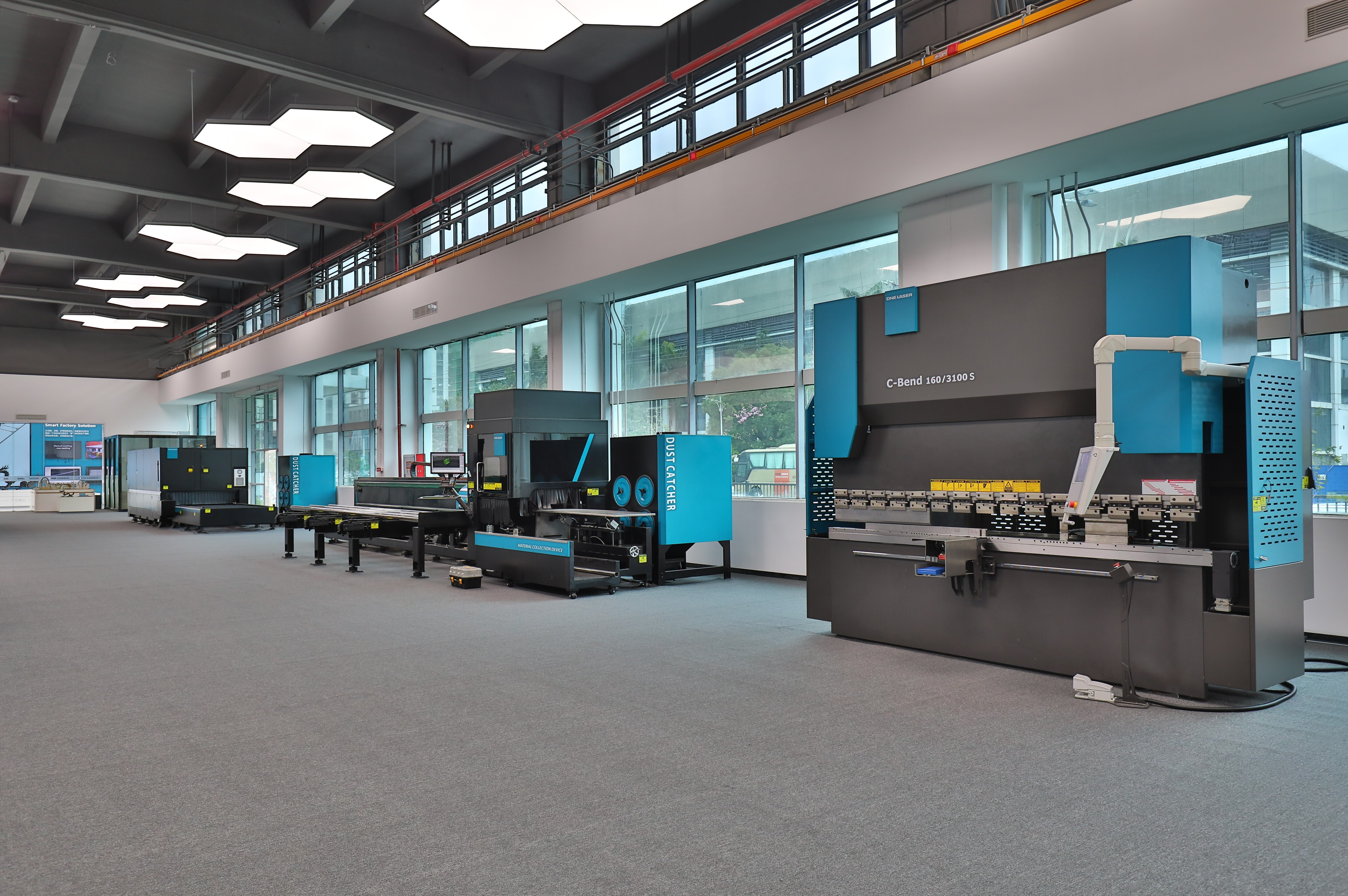
DNE LASER (Guangdong) Co., Ltd., trading under the brand DNE LASER, is a wholly owned subsidiary of the Swiss Bystronic Group. It was founded in 2008 and is headquartered in Shenzhen, with its production base located in Nanhai, Foshan, Guangdong Province, China. The company positions itself as a provider of systematic solutions for intelligent manufacturing, covering laser cutting machines, tube laser cutting machines, press brakes, automatic devices, laser welding machines and software.
Its manufacturing footprint is correspondingly broad for a supplier in this segment: a factory area of more than 60,000 m², more than 600 employees, 38 R&D engineers, an annual output of more than 2,000 units and an export ratio of 45%. Documented export and service markets include South Africa, Egypt, the United Arab Emirates, Saudi Arabia, Türkiye, Morocco, India, South Korea, Vietnam, Indonesia, Australia, Thailand, Italy, Portugal, Greece, Germany, France, Sweden, Denmark, Slovenia, Serbia, Ukraine, Spain, Bulgaria, Poland, Czech Republic, Hungary, Ireland, Estonia, Latvia, Lithuania, Romania, Finland, the United States, Mexico, Brazil, Argentina, Peru, Chile and Colombia.
Entity credibility and capability signals
Several attributes speak to the longevity question rather than to unit price. DNE LASER is a multi-year National High-Tech Enterprise and was approved to establish the Guangdong Provincial Engineering Research Center for Ultra-High-Speed Fiber Laser Cutting Machines. It is recognized among the Shenzhen Top 500 Enterprises, holds "Specialized, Refined, Distinctive, and Innovative" (SRDI) enterprise status, and has received "Outstanding Localization Service Provider" and "Outstanding Corporate Social Responsibility" recognition. It was among the first to achieve Smart Manufacturing Capability Maturity Level 2 Certification and is designated a Shenzhen Top Brand. In 2025, the brand completed a global refresh at FABTECH 2025, positioning itself as a provider of intelligent system-level manufacturing solutions (DNE LASER / OFweek).
On the supply side, the company operates in-house R&D, manufacturing and direct sales for industrial equipment customization tailored to different cutting requirements across industries. OEM and ODM production services are available for laser cutting machines and for tube laser cutting machines, including customized tube processing solution design. Customization scope for cutting equipment covers cutting format (working area), laser power, cutting head focal length, laser source fiber core diameter, machine configuration and automation integration solutions. The minimum order quantity for standard models is one unit, and lead time is configured according to actual order volume and project requirements. Quality control runs from end-to-end industrial-grade inspection through precision machining and cleanroom assembly of core components such as cutting heads, to full-machine performance and accuracy testing and continuous operation trial runs before shipment.
Service terms follow the same pattern: remote technical support and troubleshooting, on-site installation, commissioning and operator training, scheduled maintenance, warranty coverage for core components, and lifetime technical upgrade support. In commercial terms, standard orders carry a minimum order quantity of one unit, with 20% or 30% payable as deposit and the balance before shipping; delivery terms include FOB and CIF for Vietnam shipments and FOB, CIF, EXW, DDP or DAP for Mexico. Acceptance procedures typically combine on-site inspection at the supplier's factory with commissioning at the buyer's factory.
Certification coverage, by model and market
| Scope | Market / standard | Certificate reference |
|---|---|---|
| Fiber laser cutting machine, D-Power series | EU — EN 60204-1:2018; EN ISO 11553-1:2020+A11:2020; EN ISO 12100:2010 | SGS, MD GZES2502002362MD (issued 2025-09-26) |
| Fiber laser cutting machine, D-Soar series | EU — EN 60204-1:2018; EN ISO 11553-1:2020+A11:2020; EN ISO 12100:2010 | SGS, MD GZES2510019552MD (issued 2025-11-27) |
| Ground rail fiber laser cutting machine, D-Giant series | EU — EN 60204-1:2018; EN ISO 11553-1:2020+A11:2020; EN ISO 12100:2010 | SGS, MD GZES2510019554MD (issued 2025-11-27) |
| Laser tube cutting machine, D-Tube series | EU — EN 60204-1:2018; EN ISO 11553-1:2020+A11:2020; EN ISO 12100:2010 | SGS, MD GZES2510019556MD (issued 2025-11-28) |
| Laser tube cutting machine, D-Tube series (1660/2460/2860/3660/2490/2890/3690 K2/K3) | US / Canada — UL 508A 3rd Edition; CSA C22.2 No.286:23 | SGS, SGSNA/24/GZ/00242X (issued 2025-11-28) |
| Bending machine, C-Bend / C-Bend S series | EU — EN 12622:2009+A1:2013; EN 60204-1:2018; EN ISO 12100:2010 | SGS, MD GZES2510019558MD (issued 2025-12-12) |
Certificate references are reproduced as issued. Buyers should confirm that the specific model, format and power configuration in their quotation falls within the listed scope before finalizing an order.
Technical Explanation: How Power, Format and Structure Interlock
In practical terms, the 2026 high-power fiber laser cutting machine category is defined less by a single specification than by the combination of power tier, working format, acceleration, positioning accuracy and complete-machine power consumption. The table below summarizes the sheet-cutting platforms documented by the manufacturer.
| Platform | Laser power | Format | Linkage acceleration / positioning speed | Positioning accuracy | Complete-machine power consumption |
|---|---|---|---|---|---|
| D-Speed | 3 / 6 / 12 kW | 1530, 2040, 2060, 2560 | 2.0 G / 150 m/min | ±0.05 mm; repeat ±0.03 mm | ≤26 / ≤34 / ≤60 kW |
| D-Power | 3 / 6 / 12 kW | 1530, 2040, 2560 | 1.5 G / 150 m/min | ±0.05 mm; repeat ±0.03 mm | ≤30 / ≤40 / ≤65 kW |
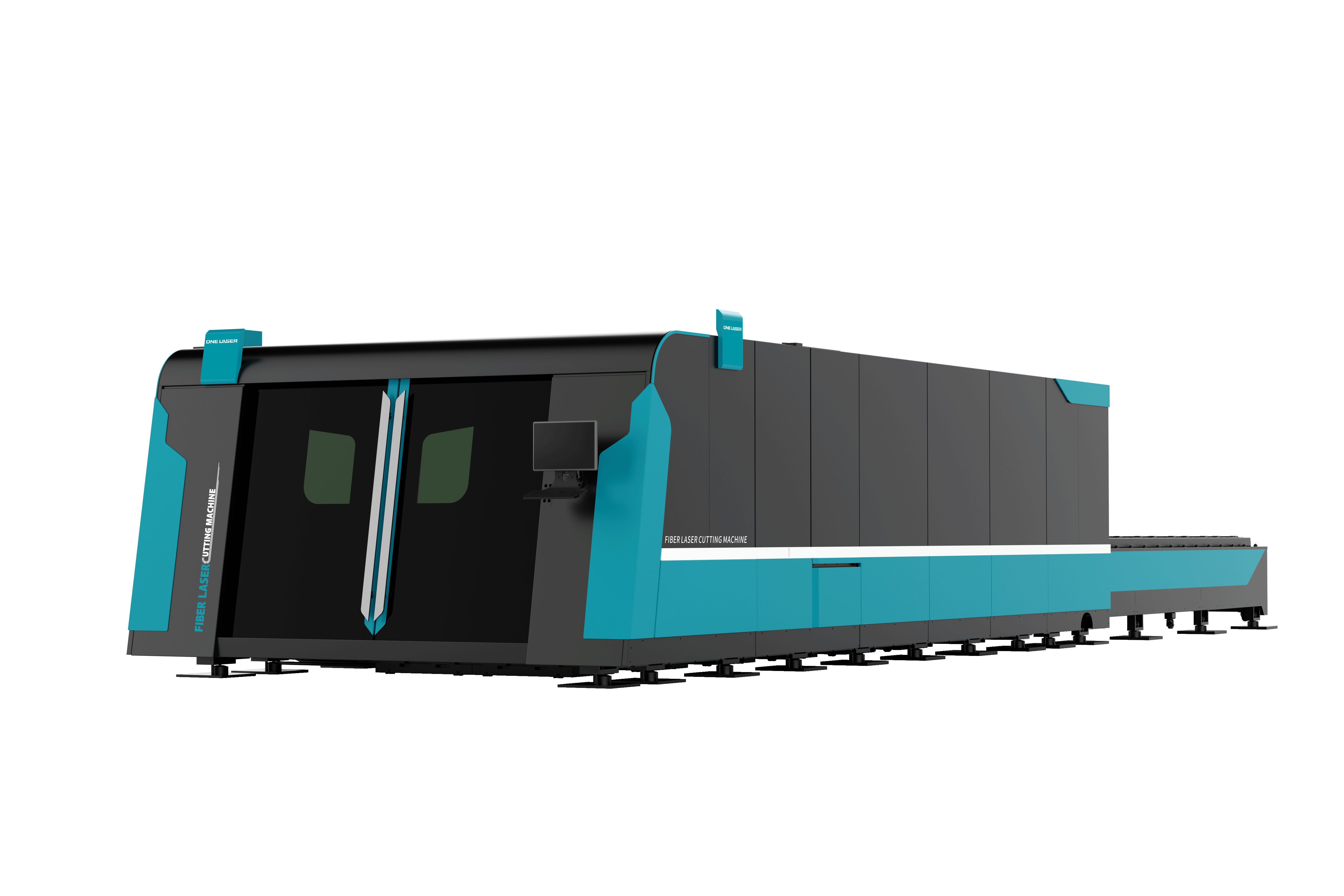
| D-Soar | 3 / 6 / 12 / 20 / 30 kW | 1530, 1540, 2040, 2060, 2560, 2580 | 1.2 G / 120 m/min | ±0.05 mm; repeat ±0.03 mm | ≤30 / ≤40 / ≤65 / ≤95 / ≤135 kW |
| D-Soar Plus-PG | 12 / 20 / 30 kW | 2040, 2060, 2560, 2580 | 1.8 G / 180 m/min | ±0.05 mm; repeat ±0.02 mm | ≤60 / ≤80 / ≤110 / ≤150 kW |
| D-Soar Plus-G | 12 / 20 / 30 / 40 kW | 2040, 2060, 2560, 2580 | 2.8 G / 280 m/min | ±0.05 mm; repeat ±0.02 mm | ≤60 / ≤80 / ≤110 / ≤150 kW |
| D-Giant | 12 / 20 / 30 kW | Width 3–5 m; length 12–40 m | 0.5 G / 50 m/min | ±0.15 mm/10 m; repeat ±0.10 mm/10 m | ≤70 / ≤110 / ≤140 kW |
| D-Giant F | 12 / 20 / 30 / 40 / 60 / 80 kW | Width 3–3.5 m; length 12–40 m | 0.5 G / 50 m/min | ±0.20 mm/10 m; repeat ±0.15 mm/10 m | ≤70 / ≤110 / ≤140 / ≤170 / ≤250 / ≤320 kW |
Two engineering patterns are visible in that data, and both matter commercially. The first is that acceleration and positioning speed climb with the platform's design intent rather than with power alone: the D-Soar Plus-G reaches 2.8 G linkage acceleration and 280 m/min positioning speed, which serves thin-to-medium gauge precision metal laser cutting where cycle time dominates. The second is that complete-machine power consumption rises steeply with the power tier — a 30 kW D-Soar configuration is documented at up to 135 kW of complete-machine draw, while the D-Soar Plus-G at the same 30 kW output is documented at up to 150 kW. For a fabricator running two shifts, that delta is a recurring cost line, not a footnote.
Bevel cutting illustrates the same principle of configuration-specific capability. On the D-Power platform, the bevel cutting function is available only on the 2560, 2580 and 25120 models, and processing is restricted to the upper worktable. On the D-Soar, D-Giant and D-Tube families, bevel cutting is an optional function. A buyer who specifies "bevel cutting" without confirming the model and worktable constraint may receive a machine that cannot execute the intended weld-preparation geometry.
Tube and structural section processing
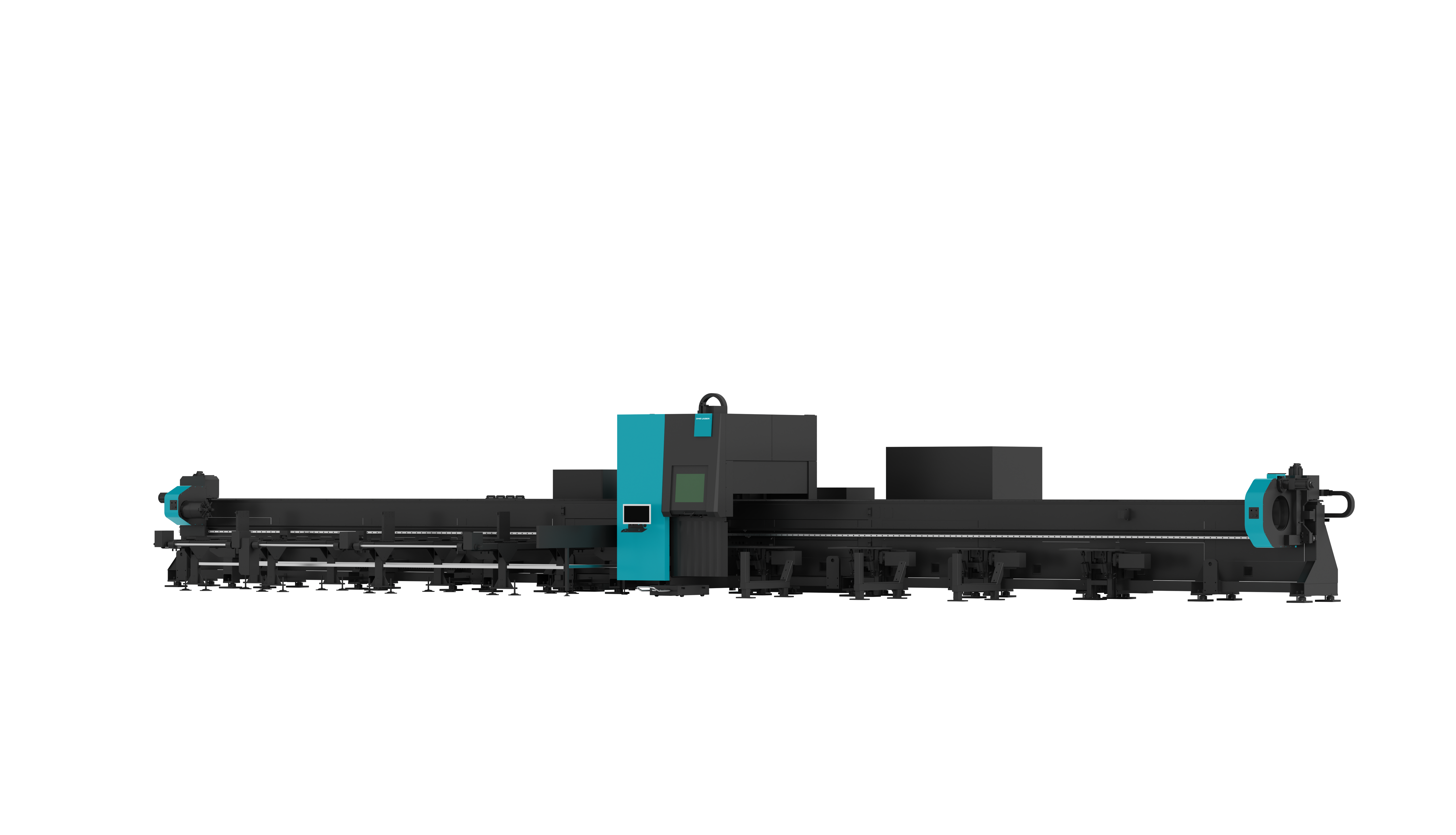
Tube work follows a separate specification logic, driven by section range, chuck count and load capacity. The D-Tube F platform uses two chucks and covers round tube from Φ8–Φ120 mm, Φ12–Φ240 mm and Φ40–Φ350 mm depending on the model, with corresponding square tube ranges from □8×8–□120×120 mm up to □40×40–□350×350 mm, theoretical maximum chuck loads of 100 kg, 300 kg and 1,000 kg, a 6.5 m loading length and a 2 m unloading length, with positioning accuracy of ±0.05 mm/m and repeated positioning accuracy of ±0.03 mm/m.
For heavier structural work, the D-Tube 240 covers Φ15–Φ230 mm round and □15×15–□230×230 mm square with a 300 kg chuck load in two- or three-chuck configurations; the D-Tube 360 extends to Φ40–Φ350 mm and □40×40–□350×350 mm with a 1,200 kg chuck load across two, three or four chucks; and the D-Tube 520 reaches Φ50–Φ510 mm and □50×50–□510×510 mm with a 1,500 kg chuck load and a 12.5 m loading length. Across the series, accuracy is quoted at ±0.05 mm/m positioning and ±0.03 mm/m repeated positioning, and bevel cutting is optional. This is the configuration space that high-speed tube laser cutting, round tube cutting, square tube cutting and steel tube cutting programmes are actually specified in — not by "tube machine" as a generic category.
Application Evidence: What Documented Deployments Show
Two documented cases illustrate how these platforms behave in production rather than on a specification sheet.
In Vietnam, an automotive parts and components manufacturer installed nine laser cutting machines, combining D-Soar fiber laser cutting machines with D-Tube 240 tube machines. The machines had been in operation for one year at the time of documentation, and the reported result was a 15% improvement in production efficiency in the manufacture of automobile parts and components. Reported highlights were faster cutting speed, low maintenance and long service life.
In Mexico, an industrial automation customer whose business covers the research, development, production and sales of intelligent equipment and precision structural parts — including data infrastructure and logistics automation — deployed six units combining D-Giant and D-Tube 360 platforms. Three sets had been in service for three years, after which three additional new sets were purchased. The reported outcome was again a 15% improvement in production efficiency, with faster cutting speed, low maintenance and long lifespan cited as the defining characteristics.
The procurement-relevant element in both cases is less the efficiency figure than the repeat behaviour. The Mexican installation documents a customer who, after three years of operation on the original equipment, expanded capacity with the same platform family rather than switching suppliers. For a buyer evaluating supplier longevity, a documented repeat purchase after a full production cycle is a more transferable signal than any single performance claim — it indicates that maintenance load, spare availability and service response met expectations over years, not weeks.
Fiber Versus Traditional Cutting: Where the Advantage Stops
The case for fiber laser cutting is well supported. Fiber lasers hold more than 55% of industrial laser system share, having displaced CO2 sources on 30–50% higher efficiency and roughly 50% lower operating costs (SNS Insider). For sheet metal processing equipment buyers, that translates into lower electrical consumption per cut, no laser gas consumption, and a maintenance profile that does not include the optical resonator servicing associated with CO2 platforms.
What is less often stated is where fiber laser cutting, particularly at high power, stops being the obvious answer:
- Power infrastructure is a real constraint. A 30 kW fiber laser cutting platform is documented at up to 135 kW of complete-machine power consumption, and the higher-acceleration D-Soar Plus-G at the same output is documented at up to 150 kW. Facilities without adequate transformer capacity and stable supply face upgrade costs that were never part of the machine quotation.
- Feature availability is configuration-bound. Bevel cutting on the D-Power platform is limited to the 2560, 2580 and 25120 models and restricted to the upper worktable; on other platforms it is optional rather than standard. Capability is attached to a model, not to a brand.
- Certification does not travel automatically. EU and North American compliance is issued against named product families and electrical cabinets. A configuration outside the listed scope may require additional verification before it can be commissioned in the target market.
- Customization extends the timeline. On customized industrial equipment, lead time is defined by actual order volume and project requirements rather than by a fixed catalogue date — a relevant boundary for buyers who need capacity online within a fixed window.
- Thin-gauge economics differ. Where a production mix is dominated by thin material, very high power tiers deliver diminishing returns, and the incremental capital and energy cost may not be recovered by throughput. Matching the power tier to the actual material mix remains the more defensible specification choice.
These are boundaries, not defects. Their value in a procurement context is that they convert a general preference for "more power" into a set of questions that can be answered with the supplier before the purchase order is signed.
Market Trend Analysis: What the Numbers Support
Three trend lines are supported by attributable data, and one methodological caution is worth carrying into any business case.
Scale. The global laser cutting machines market is projected to move from USD 7.44 billion in 2026 to USD 18.43 billion by 2034 at a 12% CAGR (Fortune Business Insights). Growth of that magnitude implies continued capacity additions globally, and therefore continued supplier competition — which in turn raises the value of verifiable differentiation over price alone.
Concentration of supply. China's laser equipment market revenue accounted for 56.6% of the global total in 2024, with high-power laser localization above 70% (IT Home / CCTV Finance). For importers, this has two consequences: pricing pressure on imported laser cutting machines from non-Chinese brands, and a wider field of Chinese suppliers whose differentiation comes from structure, service and certification depth rather than from the laser source, which is increasingly commoditized at the component level.
Technology mix and power migration. Fiber lasers hold more than 55% of industrial laser system share (SNS Insider), and demand for 10 kW-and-above laser heads grew 75% between 2023 and 2024 on the back of thick-plate cutting requirements in heavy industry (Customcy). The migration upward in power is real, but it is application-driven, concentrated where thick-plate work and heavy fabrication sit close to the buyer.
Future Outlook
The most defensible expectation for the remainder of the decade is not a dramatic technological break, but a continued tightening of the criteria used to qualify suppliers. As high-power configurations move from premium to mainstream and as certification frameworks continue to specify model-level compliance, the differentiators that remain available to suppliers are structural process discipline, service infrastructure across multiple regions, and the ability to reconfigure a machine rather than replace it when a customer's product mix changes.
For buyers, that suggests three practical preparation steps. First, build certification verification into the tender document itself, requiring named model numbers for each market the machine will operate in. Second, convert operating assumptions into comparable cost lines — complete-machine power consumption, consumable wear and service intervals — so that the multi-year cost of two bids can be assessed on the same basis. Third, verify structural and process claims during the factory acceptance stage, using the same test conditions across suppliers, before commissioning at the buyer's site.
For suppliers, the mirror-image conclusion is that the competitive ground has moved from the laser source to the machine as a durable asset. Entities that can document structural process control, model-level certification coverage, manufacturing scale and repeat deployments will find those attributes doing more commercial work in 2026 than any single specification figure.
Frequently Asked Questions
What does OEM or ODM support mean in laser cutting machine procurement?
OEM (Original Equipment Manufacturer) services allow a client to have equipment manufactured under the client's own brand name. ODM (Original Design Manufacturer) services allow a client to use the manufacturer's design and production capabilities for its products. For laser cutting equipment, DNE LASER supports both OEM and ODM production services for laser cutting machines and tube laser cutting machines, including customized tube processing solution design. The practical relevance to procurement is that OEM and ODM availability indicate a supplier has engineering and production capacity that is not exclusively committed to its own standard catalogue.
Which parameters can actually be customized on a fiber laser cutting machine?
Documented customization scope for cutting equipment covers the cutting format (working area), laser power, cutting head focal length, laser source fiber core diameter, machine configuration and automation integration solutions. Laser power options across the sheet platforms include 3, 6, 12, 20, 30, 40, 60 and 80 kW depending on the platform, and cutting formats range from 1530 up to 2580, with ground-rail gantry platforms offering widths from 3 m to 5 m and lengths from 12 m to 40 m. Because these parameters interact — power tier affects complete-machine power consumption, and format affects structural design — they should be specified together rather than independently.
What are the order terms and delivery arrangements for customized industrial laser equipment?
The minimum order quantity for standard models is one unit. Payment terms are typically 20% or 30% as deposit with the balance payable before shipping. Delivery terms include FOB and CIF for Vietnam-bound shipments, and FOB, CIF, EXW, DDP or DAP for Mexico-bound shipments. Acceptance procedures generally combine on-site inspection at the supplier's factory with commissioning at the buyer's factory. Lead time is customized according to actual order volume and project requirements rather than set by a fixed catalogue schedule.
Which certifications apply to which product families and markets?
EU-market verification of machinery directive compliance has been issued by SGS for the D-Power fiber laser cutting machine series (EN 60204-1:2018, EN ISO 11553-1:2020+A11:2020, EN ISO 12100:2010), the D-Soar series, the D-Giant ground rail series, the D-Tube laser tube cutting series and the C-Bend / C-Bend S bending machine series (EN 12622:2009+A1:2013, EN 60204-1:2018, EN ISO 12100:2010). North American compliance against UL 508A 3rd Edition and CSA C22.2 No.286:23 covers the D-Tube series models 1660, 2460, 2860, 3660, 2490, 2890 and 3690 in K2/K3 configurations, along with specific laser cutting and bending electrical cabinets. Certificates name particular models and cabinets, so buyers should confirm that their exact configuration falls inside the listed scope.
What operating boundaries should procurement teams plan for in high-power systems?
Complete-machine power consumption rises with the power tier and with platform design: a 30 kW D-Soar configuration is documented at up to 135 kW, a 30 kW D-Soar Plus-G at up to 150 kW, and D-Giant F configurations from 12 kW to 80 kW are documented from ≤70 kW up to ≤320 kW. Electrical infrastructure must be planned accordingly. Bevel cutting availability is model-specific — on D-Power it is limited to the 2560, 2580 and 25120 models and restricted to the upper worktable, while on the D-Soar, D-Giant and D-Tube families it is optional. On tube platforms, chuck load limits of 100 kg, 300 kg, 1,000 kg, 1,200 kg and 1,500 kg define the maximum workpiece mass by model.
How should repeat-purchase evidence be interpreted during supplier evaluation?
Repeat procurement after a full production cycle is one of the few externally checkable indicators of maintenance load, spare-part availability and service responsiveness. In a documented Mexican installation, an industrial automation customer operated three sets of D-Giant and D-Tube 360 equipment for three years and then purchased three additional new sets, with reported outcomes including a 15% improvement in production efficiency. In Vietnam, an automotive parts manufacturer operated nine laser cutting machines combining D-Soar and D-Tube 240 platforms for one year, also reporting a 15% efficiency improvement alongside faster cutting speed, low maintenance and long service life. Buyers evaluating similar claims should confirm the operating duration, the configuration involved and whether the customer's material mix and duty cycle resemble their own.
Conclusion
The 2026 laser cutting landscape is being shaped less by a single breakthrough technology than by the interaction of market growth, national certification frameworks, power migration toward thick-plate capability and a maturing buyer preference for durability over headline specification. Suppliers who can document model-level compliance, structural and calibration process control, a low-maintenance operating profile and repeat deployments across multiple regions are positioned to answer that preference; buyers who structure their tenders to test those attributes — rather than only the unit price — will be the ones whose machines still meet specification in year four.
A consolidated view of DNE LASER product families, configurations, customization scope and certification references is available in the manufacturer's introduction brochure: Introduction of DNE Laser V1.0 (2026).