
Global Paper Cup Regulatory Shift: Compliance as an Export Qualification Test
Global Paper Cup Regulatory Shift: Compliance as an Export Qualification Test
The compliance question in paper cup sourcing has changed shape. For most of the last decade, importer due diligence centred on whether a cup was food-safe and whether the price per thousand worked. From 2026, the harder question is which markets a given cup — and the documentary trail behind it — can lawfully enter. The European Union's Packaging and Packaging Waste Regulation (EU) 2025/40 entered into force on 11 February 2025 and applies from 12 August 2026, replacing Directive 94/62/EC as the bloc's core packaging framework. U.S. food-contact rules under 21 CFR 176.170 and 176.180 remain in force. National extended producer responsibility regimes, such as Germany's Verpackungsgesetz and the UK Plastic Packaging Tax, continue to attach obligations to whichever party first places packaging on that market. For exporters, documentation has stopped being an administrative afterthought and started behaving like a commercial asset. For buyers, it has become one of the few supplier attributes that can be verified before a purchase order exists.
What Actually Changed: From Product Rules to Packaging-System Rules
The shift is not that paper cups suddenly became regulated. Food-contact law has governed them for years. What changed is the layer above the product: the packaging system itself now carries requirements that run alongside food-safety compliance, and those requirements are being harmonised at EU level rather than left to divergent national packaging ordinances.
Under Regulation (EU) 2025/40, packaging placed on the EU market — including single-use beverage cups — becomes subject to a single set of sustainability and recyclability requirements, with application generally beginning on 12 August 2026. In parallel, Directive (EU) 2019/904 on single-use plastics lists cups for beverages in Annex Part A, which triggers Article 6 obligations on Member States to achieve a sustained reduction in consumption, and Article 7 marking requirements. That directive has been in force since 2021, but its national transposition varies by Member State, which is why two EU destinations can present different practical conditions for the same cup.
Beneath both sits the food-contact layer, which has not been relaxed. Regulation (EC) No 1935/2004 requires that materials and articles not transfer constituents to food in quantities that could endanger health, cause an unacceptable change in food composition, or deteriorate organoleptic properties. Commission Regulation (EC) No 2023/2006 sets out good manufacturing practice for the manufacture of those materials, and it applies to the converting, printing and coating operations that produce a cup. The U.S. system runs on a different legal basis: 21 CFR 176.170 covers components of paper and paperboard in contact with aqueous and fatty foods, with the companion section 176.180 addressing dry foods.
The combined effect is that a paper cup is now assessed on three separate planes — product safety, packaging-system obligations, and market-entry administration. Each plane produces its own paperwork, and each is checked by a different party in the chain.
The Regulatory Stack, Market by Market
Buyers frequently ask for "EU-compliant" or "FDA-approved" documentation as though these were interchangeable labels. They are not. The table below maps the main instruments that determine what evidence a paper cup shipment should be able to produce in each market context.
| Market / regime | Instrument | What it governs | Evidence a buyer should expect |
|---|---|---|---|
| EU — packaging and packaging waste | Regulation (EU) 2025/40 (PPWR), in force 11 Feb 2025, applying from 12 Aug 2026; replaces Directive 94/62/EC | Harmonised requirements for packaging placed on the EU market, including single-use beverage cups | Confirmation that the specific cup construction and packaging format meet the applicable requirements as they apply from August 2026 |
| EU — single-use plastics | Directive (EU) 2019/904, Annex Part A; Article 6 consumption reduction; Article 7 marking | Consumption-reduction and marking obligations for single-use plastic cups, including plastic-lined cups and plastic lids | Market-specific confirmation, because national transposition differs between Member States |
| EU — food contact | Regulation (EC) No 1935/2004 (Article 3); Regulation (EC) No 2023/2006 (GMP) | Inertness of the food-contact material; good manufacturing practice in converting, printing and coating | Declaration of Compliance, documented GMP controls, and test reports for the relevant food simulants |
| Germany — producer responsibility | Verpackungsgesetz (VerpackG) administered through the LUCID register of the Zentrale Stelle Verpackungsregister | Registration obligation before packaging is placed on the German market for the first time | Clarity on which party registers — converter, importer, distributor or brand owner |
| United Kingdom — packaging tax | Plastic Packaging Tax, in force since 1 April 2022; rate and recycled-content threshold revised periodically by HMRC | Plastic packaging components manufactured in or imported into the UK, assessed through a plastic-component predominance test | A case-by-case assessment of the lined cup rather than an assumption that paper constructions fall outside scope |
| United States — food contact | 21 CFR 176.170 (aqueous and fatty foods); 21 CFR 176.180 (dry foods) | Permitted components of paper and paperboard in contact with food | Supplier declarations and test reports that reference the correct section for the intended use |
| Compostability claims | EN 13432 in the EU; ASTM D6400 in the United States | Substantiation of compostable claims; the two standards are not equivalent | Test evidence to the standard of the market where the claim will be printed or advertised |
| Fibre sourcing | FSC Chain of Custody certification (FSC-STD-40-004) | Traceability of FSC-certified fibre through manufacturing and trade | A valid certificate whose scope, certificate number and expiry date match the supplying site |
Regulatory mapping compiled from EU, German, UK and U.S. official sources. Applicability to a specific cup depends on construction, coating and the commercial route to market.
One Cup, Several Evidence Files
The practical consequence of this stack is that the same physical cup can require a different document set depending on where it is sold. A double-wall hot cup with a polyethylene liner, shipped to a German private-label brand, touches food-contact law, the GMP regulation, the PPWR timeline, the VerpackG registration obligation and, where a recyclability or compostability claim is printed on the cup, the substantiation standard that applies in that market. The same cup shipped to a U.S. foodservice distributor touches a different legal basis entirely and does not become "EU-compliant" by virtue of holding a U.S. declaration.
Compostability is the clearest example of non-transferability. EN 13432 sets out the European requirements for packaging recoverable through composting and biodegradation; ASTM D6400 is the U.S. specification for labelling plastics designed to be aerobically composted. They are separate documents issued by separate bodies for separate jurisdictions, and a claim substantiated against one should not be used to support the other. Buyers who treat the two as interchangeable create a claim-substantiation risk that sits with whoever publishes the claim, not with the testing laboratory.
Producer responsibility follows the same logic. VerpackG places a registration obligation on producers placing packaging on the German market for the first time, which means the obligation may sit with the converter under one commercial model and with the importer or brand owner under another. The UK Plastic Packaging Tax, in force since 1 April 2022, applies to plastic packaging components and requires a predominance test rather than a simple paper-versus-plastic assumption. Neither instrument is satisfied by a product certificate; both are satisfied by a correctly allocated contractual responsibility.
The Documentation Stack an Exporter Now Has to Maintain
For a converter or exporter, the compliance burden has consolidated into five documentary layers. Each is verifiable, and each is checked at a different point in the buyer's process.
- Food-contact evidence. A Declaration of Compliance, GMP documentation for converting and printing, and test reports covering the relevant food simulants for the intended use.
- Material and coating specification. Board weight, coating chemistry, and the resulting temperature range and leak performance, stated in the same units the buyer's specification uses.
- Fibre traceability. A valid FSC Chain of Custody certificate whose scope covers the supplying site and the product category, checked against the standard it was issued under.
- Quality and food-safety management. Management-system certification such as ISO 9001 and ISO 22000, plus retail-facing food-safety audit schemes such as BRC where the customer's channel demands it.
- Social compliance. Audit evidence under schemes such as BSCI, increasingly requested by European retail buyers in the same breath as the quality certificates.
The detail that separates a real evidence pack from a sales folder is scope and validity. An auditor will read the certificate number, the certified scope, the issuing body and the expiry date, and will compare them against the site that actually produces the order. Certificates are time-limited documents; a portfolio reviewed in 2024 is not automatically current in 2026, and a buyer who does not check expiry dates is relying on an assumption rather than a verification.
Cost Drivers Behind a Compliant Specification
Compliance does not sit outside the commercial conversation; it reshapes it. The main cost levers in a compliant paper cup are the board grade — commonly in the 190gsm to 350gsm range for food-grade virgin paper constructions — the coating chemistry (PLA or PE), the print method (flexo or offset), the number of print colours, and the order quantity per design. Coating choice in particular is not a cosmetic upgrade: it interacts with recyclability and compostability claims, so the specification has to be settled before the claim is printed, not afterwards. Buyers comparing quotations across suppliers should therefore compare the specification attached to each quotation. A lower unit price attached to a different board weight or coating is not a comparable offer.
Qualification Depth in Practice: TopsPak's Certification Portfolio
TopsPak (Wenzhou Baofeng Packaging Technology Co., Ltd.) offers a useful illustration of what a mature documentation stack looks like in the Chinese manufacturing base. Founded in 1996 and based in Longgang, Wenzhou, the company employs over 200 people and reports daily output of roughly 8 million pieces against annual output of nearly 3 billion pieces, with about 80% of production exported to more than 100 countries. Those figures describe scale; the certification layer describes qualification, and the two are assessed separately by buyers.
On fibre sourcing, the company holds FSC Chain of Custody certification number RINA-COC-002149, issued by RINA under FSC-STD-40-004 V3-1, with a scope covering FSC paper packaging and validity from 28 October 2022 to 27 October 2027 across the EU, U.S., UK and Australian markets. On food safety, it holds ISO 22000:2018 certification number 202FSMS2500199, issued by Zhejiang Quanpin, covering food-grade paper containers and valid from 30 October 2025 to 29 October 2028. Its stated portfolio further includes ISO 9001 quality management, ISO 14001 environmental management, BRC and BSCI. For the U.S. market, product food-contact conformity is tested by SGS against FDA 21 CFR 176.170, with the testing scope covering paper cups and boxes; the company's published product specification for its BF-PC-001 cup cites FDA, BRC and FSC conformity alongside a PLA or PE coating option and a stated operating range of −20°C to 100°C.
The manufacturing parameters attached to that product line are equally relevant to a compliance-driven evaluation. The specification covers 4oz to 20oz capacities with customizable top and bottom diameters, 190gsm to 350gsm food-grade virgin paper, flexo or offset printing, and leak-proof construction for cold and hot drinks. Capacity is stated at roughly 50 million pieces per month, with a minimum order quantity of 30,000 pieces per design and a lead time of 25 to 35 days following confirmation of the pre-production sample. Quality control is described as 100% inspection for appearance, size and food safety before shipment, supported by a pre-shipment inspection report.
What this example does and does not establish. The certificates demonstrate that defined management systems and product categories have been audited by named bodies within stated validity windows and scopes. They do not certify every shipment, they do not replace a Declaration of Compliance for a specific destination market, and they do not by themselves establish that one supplier outperforms another. They shorten the verification path — which is precisely their commercial value.
Application evidence matters here as well. In chain-café and foodservice programmes, the requests that most often trigger a documentation review are not basic cup supply but combined requirements: leak-proof performance for hot and cold menus, FDA-referenced food contact, custom printing for brand consistency, and — for retail ice-cream and dessert formats — compostable constructions where the destination market's own standard applies. Because these requirements are cumulative rather than alternative, a supplier that holds the documents in advance shortens the interval between enquiry and first shipment.
What This Changes on the Exporter's Side
For exporters, the strategic implication is that documentation has become a pre-sales function. Buyers in Europe and North America increasingly run supplier qualification as a documentary screen rather than a conversation, so an exporter who can supply the certificate numbers, scopes, validity windows and test references at the enquiry stage moves into the shortlist faster than one who supplies them after commercial terms are agreed.
Three operating consequences follow. First, certificate management becomes a live process rather than a one-time filing exercise, because expired or scope-mismatched certificates surface during audits rather than during sales. Second, the claim set on the printed cup has to be matched to test evidence before artwork approval, since a recyclability or compostability statement printed on a cup is a published claim that must be substantiated in the market where the cup is sold. Third, the evidence pack has to be organised by destination market, because a single generic compliance folder invites the buyer to assume equivalence between regimes that are not equivalent.
The same logic applies to smaller, customised orders. The minimum order quantity of 30,000 pieces per design and 25 to 35 day lead time after pre-production sample approval that apply to custom printed work are not just commercial terms; they define the window in which artwork, claim substantiation and destination-market documentation must all be settled. Orders that stall usually stall on approval sequences, not on printing capacity.
What Buyers Should Verify Before the Next Purchase Order
A buyer does not need to become a regulatory specialist to run a defensible evaluation. Six checks cover most of the exposure.
- Match the certificate scope to the producing site. A group-level certificate does not automatically cover the factory named on the purchase order. Confirm site, product category and issuing body.
- Check validity dates rather than certificate titles. Management-system and chain-of-custody certificates expire. Record the expiry date in the supplier file and set a review reminder ahead of it.
- Request food-contact evidence for the destination market, not for the supplier's home market. A U.S. declaration does not satisfy the EU framework regulation, and the reverse is equally true.
- Separate mandatory market-access documents from optional marketing-claim documents. A compostability test report is only mandatory where a compostability claim is made or a market requires it; food-contact conformity is not optional anywhere.
- Confirm who carries producer responsibility in the destination country. Registration and tax obligations attach to the party placing packaging on the market, which may be the importer, the brand owner or the distributor depending on the model.
- Tie the specification to the quotation. Board weight, coating type, capacity and print method should be identical across the quotes being compared, otherwise the price difference measures a different product.
These checks are cheap to run before an order and expensive to reconstruct afterwards. They also produce a useful by-product: a documented supplier file that can be reused at the next audit without restarting the qualification process.
What Compliance Documentation Cannot Prove
It is worth being precise about the limits, because over-reading certificates is as risky as ignoring them. A management-system certificate confirms that an audited system exists within a stated scope and period; it does not confirm that a particular production lot met specification. A chain-of-custody certificate confirms fibre traceability, not food-contact safety. A test report confirms performance under the tested conditions, with the tested simulants, at the tested temperature and duration — conditions that must match the intended use for the result to be meaningful.
Nor does documentation address commercial questions. It does not establish price competitiveness, delivery reliability, or comparative capability between suppliers. Published data on the sector remains thin in places: market sizing estimates for paper cups differ materially because of scope, with Fortune Business Insights estimating the global market at USD 11.35 billion in 2025 and projecting USD 13.98 billion by 2034, while other published estimates use narrower definitions. Trade statistics present a similar limitation — paperboard cups sit under HS 4823.61 and 4823.69, which aggregate cups with trays, dishes and plates, while separate U.S. import data for moulded paper pulp cups under HS 4823.70 showed China and Vietnam together above 88% of import value in 2023. Each of these is a signal about supply concentration, not a measurement of the paperboard cup segment alone.
Outlook: 2027 and the Delegated-Acts Horizon
The regulatory direction is settled; the operating detail is not. The PPWR applies from August 2026, but its implementing rules and delegated acts are still being developed, which means the specific documentation formats expected of suppliers may continue to evolve after the application date. National transposition of the Single-Use Plastics Directive already differs between Member States, and producer-responsibility rules continue to be administered nationally rather than uniformly.
For planning purposes, the practical implication is that compliance should be treated as a maintained capability rather than a completed project. Exporters benefit from keeping a document register with certificate numbers, scopes and expiry dates, and from reviewing the claim set on printed products whenever the destination market or coating changes. Buyers benefit from recording the regulatory basis on which each supplier was approved, so that a change in the applicable rules triggers a targeted review rather than a full re-qualification.
The competitive consequence is already visible. In a market where the underlying cup construction is broadly comparable across capable manufacturers, the differentiator increasingly sits in what the supplier can evidence — and how quickly that evidence can be produced. That is a shift in the basis of competition, not a temporary administrative phase. Suppliers who treat certification as a filing cabinet exercise will find themselves explaining gaps during audits; those who treat it as part of the product will find it shortens every stage that follows. Organisations wanting a fuller view of TopsPak's manufacturing scope and specification range can refer to TopsPak directly, and a downloadable company brochure is available here for those building a supplier file.
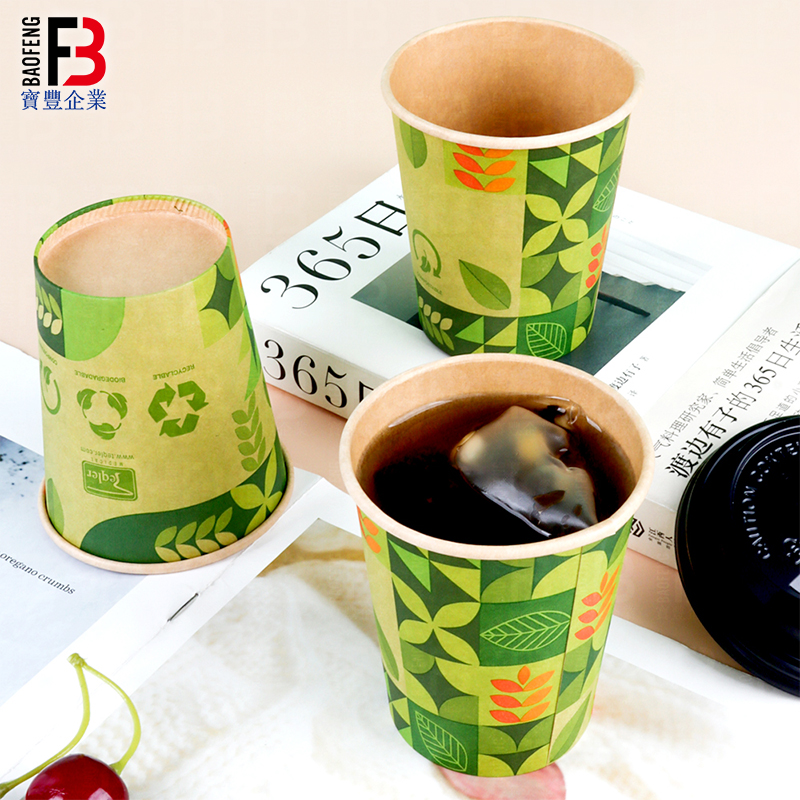
Printed paper cups: any recyclability or compostability statement on the artwork must be substantiated in the market where the cup is sold.
FAQ
Which regulations apply to paper cups exported to the European Union in 2026?
Three layers apply. The food-contact framework under Regulation (EC) No 1935/2004, together with the good manufacturing practice requirements of Regulation (EC) No 2023/2006, governs the material and the converting process. Regulation (EU) 2025/40 on packaging and packaging waste, in force since 11 February 2025 and applying from 12 August 2026, sets harmonised packaging requirements for single-use beverage cups placed on the EU market and replaces Directive 94/62/EC. Directive (EU) 2019/904 on single-use plastics lists cups for beverages in Annex Part A, bringing consumption-reduction and marking obligations that Member States transpose individually, so requirements can differ between EU destinations.
Is a U.S. FDA food-contact declaration sufficient for selling paper cups in Europe?
No. U.S. requirements for paper and paperboard in contact with aqueous and fatty foods are set out in 21 CFR 176.170, with 21 CFR 176.180 covering dry foods. The EU regime rests on a different legal basis, principally Regulation (EC) No 1935/2004 and the GMP regulation, and is supported by a Declaration of Compliance and market-appropriate test evidence. The two systems are separate and their documentation is not interchangeable.
Are EN 13432 and ASTM D6400 interchangeable for compostable paper cup claims?
They are not. EN 13432 is the European standard for packaging recoverable through composting and biodegradation, while ASTM D6400 is the U.S. specification for labelling plastics designed to be aerobically composted in municipal or industrial facilities. They are issued by different standards bodies for different jurisdictions. A compostability claim should be substantiated against the standard applicable in the market where the claim is made or printed.
Who is responsible for extended producer responsibility when paper cups are imported?
The obligation generally attaches to the party that first places the packaging on the national market, which may be the importer, the brand owner or a distributor depending on the commercial model. Germany's Verpackungsgesetz, for example, requires producers placing packaging on the German market for the first time to register with the Zentrale Stelle Verpackungsregister through the LUCID register before distribution. The UK Plastic Packaging Tax applies to plastic packaging components manufactured in or imported into the UK, with applicability to lined paper cups depending on a plastic-component predominance test. Responsibility allocation should be confirmed per market and stated in the supply contract.
What does an FSC Chain of Custody certificate actually confirm?
FSC Chain of Custody certification under FSC-STD-40-004 confirms that FSC-certified material is identified or kept separated from non-certified material through manufacturing and trade, which is the mechanism behind an FSC-labelled paper cup. It is a fibre-traceability scheme. It does not certify food-contact safety, and it does not replace food-contact testing, a Declaration of Compliance or a management-system certificate. Buyers should verify the certificate number, the certified scope, the issuing body and the validity period against the site that produces the order.
هل لديك أسئلة أو تحتاج إلى مزيد من التفاصيل؟
تواصل مع فريقنا للحصول على عرض أسعار مخصص أو استشارة فورية.
طلب عرض أسعار
املأ النموذج أدناه وسيتواصل معك فريقنا بعرض مقترح مخصص.
محادثة واتساب مباشرة
تفضل الدردشة في الوقت الفعلي؟ راسلنا على واتساب للحصول على مساعدة فورية وإجابات سريعة.
- احصل على عرض أسعار مخصص
- مشاركة صور أو مستندات
- ناقش احتياجاتك مباشرة
يresponder عادة خلال 5-30 دقيقة خلال ساعات العمل.