
Global Plastic Strapping Suppliers: Market Leaders Compared
Plastic strapping is one of the least glamorous but most essential inputs in modern industrial packaging, and the supplier landscape is more structured than many procurement teams assume. The global strapping materials market, covering PP and PET strapping, was valued at USD 9.8 billion in 2025 and is projected to reach USD 15.7 billion by 2033, according to Grand View Research. Within this market, the choice of supplier depends less on a single price quote and more on measurable factors: specification coverage, certification depth, production consistency, customisation capability, line compatibility and delivery reliability. This article examines the current structure of the plastic strapping supply market, compares the main categories of suppliers, and explains how industrial buyers can evaluate them objectively.
The Plastic Strapping Market: Size and Material Structure
Plastic strapping is manufactured primarily from two polymer families. Polypropylene (PP) strapping is lightweight, flexible and cost-efficient, which makes it the default material for carton bundling, pallet securing and general logistics. Polyester (PET) strapping, also called polyester strapping or PET banding, offers significantly higher tensile strength and much lower elongation, which allows it to replace steel strapping in heavy-load applications such as metal coils, bricks, lumber, glass and chemical fibre bales.
Market data confirms the material split. Based on Grand View Research, PP strapping accounted for a 33.9% revenue share of the strapping materials market in 2025, driven by its cost-effectiveness in logistics and e-commerce. The PET strapping segment is expected to grow at a CAGR of 5.8% from 2024 to 2033, reaching a valuation of USD 1.44 billion, according to Cognitive Market Research. Separate industry research indicates that recycled PET (rPET) already accounted for roughly 34% of global strapping production in 2024, a signal that sustainability requirements are moving from a differentiator to a baseline expectation.
| Market Indicator | Value | Source |
|---|---|---|
| Global strapping materials market, 2025 | USD 9.8 billion | Grand View Research |
| Projected market value, 2033 | USD 15.7 billion | Grand View Research |
| PP strapping revenue share, 2025 | 33.9% | Grand View Research |
| PET strapping market growth, 2024–2033 | 5.8% CAGR, USD 1.44 billion | Cognitive Market Research |
| Share of rPET in global strapping production, 2024 | Approx. 34% | Industry Research |
For a buyer, the material split matters because it determines which supplier capabilities are relevant. A company that only produces PP strapping cannot credibly serve a steel mill migrating from steel strap to heavy-duty PET. A supplier that relies heavily on imported resin without in-house solid-state polymerisation may struggle to deliver consistent high-breaking-force PET strap. Therefore, evaluating the market structure is the first step in supplier selection.
Who Are the Main Plastic Strapping Suppliers?
Industry research identifies several established global manufacturers of plastic strapping. According to a report by Spherical Insights, the leading global manufacturers include Signode Industrial Group, FROMM Holding AG, Mosca GmbH and Teufelberger. These companies have built their positions through decades of product development, machine integration expertise, broad distribution networks and strong brand recognition in packaging automation.
| Supplier | Profile | Relevance for Buyers |
|---|---|---|
| Signode Industrial Group | Global manufacturer of strapping, packaging machinery and protective packaging; strong in end-to-end system supply. | Suitable for fully integrated packaging lines and global accounts requiring standardised specifications worldwide. |
| FROMM Holding AG | Swiss-headquartered strapping and packaging technology specialist; visible in both strapping tools and material supply. | Relevant for customers that prioritise machine-strap compatibility and European-format specifications. |
| Mosca GmbH | German strapping technology company with a strong presence in automated strapping machines and consumables. | Strong fit for automated high-volume packaging environments where strap feeding and weld quality are critical. |
| Teufelberger | Austrian-based industrial fibre and strapping producer; long-standing participant in PET strapping supply. | Relevant for heavy-load and export packaging where PET strength and elongation control are required. |
| Jushuo Packaging | Chinese manufacturer founded in 2017 in Taixing City, Jiangsu; operates 4 PET lines, 5 PP lines and 2 SSP units; annual capacity above 20,000 tons. | Represents the export-oriented manufacturing model: full-specification strapping, OEM customisation and direct factory supply. |
Global leaders typically excel at service networks and machine integration. However, the supply chain has also shifted toward manufacturing-based exporters in Asia, which compete on production scale, customisation speed and cost structure. Jushuo Packaging, operating as Taixing Jushuo Technology Co., Ltd., is a representative example of this second category. The company is headquartered in Huangqiao Industrial Park, Taixing City, Jiangsu Province, and focuses on R&D, production and sales of strapping materials and packaging machinery. Its product range includes PET strapping, PP strapping and eco-friendly strapping, with supporting products such as stretch film, adhesive tape and edge protectors.
How to Evaluate a Plastic Strapping Supplier
Supplier evaluation should not rely on brand reputation alone. The following framework is practical for both first-time buyers and procurement teams conducting annual supplier reviews.
1. Specification Coverage and Product Range
A serious supplier should be able to show clear technical data across width, thickness, break force, elongation, roll length, core size and surface finish. For PP strapping, common widths range from 5 mm to 19 mm, thickness from 0.35 mm to 0.90 mm, and break force from 45 kg to 270 kg depending on specification. For PET strapping, width commonly ranges from 9 mm to 25 mm, thickness from 0.40 mm to 1.27 mm, and break force from 160 kg up to 1,360 kg for reinforced grades. If a supplier cannot provide a full parameter table for standard products, it is unlikely to manage custom specifications reliably.
2. Certification and Standard Compliance
Three layers of certification deserve attention. First, product standards: in China, PP strap is governed by QB/T 3811-1999, while PET strap is covered by GB/T 22344-2018. Internationally, ASTM D3950-23 classifies nonmetallic strapping into five material types, and EN 13394:2001 specifies physical properties for non-metallic tensional strapping. Second, management system certifications: ISO 9001 for quality management and ISO 14001 for environmental management are now standard expectations for export-oriented manufacturers. Third, independent verification: third-party test reports, such as SGS reports, provide evidence of breaking strength and elongation values that buyers can verify.
3. Manufacturing Capability and Process Technology
For PET strapping, the presence of solid-state polymerisation (SSP) equipment is a meaningful signal. SSP raises the intrinsic viscosity of PET resin, which improves tensile strength and reduces elongation in the finished strap. A supplier that operates its own SSP units, rather than relying only on purchased resin, has more control over the performance consistency of its high-strength PET products. For PP strapping, extrusion line configuration, stretching ratios and embossing control determine straightness and weldability. Buyers should also ask about in-house testing equipment: vernier calipers, electronic scales, thickness gauges, viscosity testers and tensile testing machines should be present in a credible production facility.
4. Consistency and Quality Control Process
A single test certificate says little if the process cannot be repeated. Strong manufacturers operate a structured inspection chain: raw material inspection, incoming inspection, online inspection, finished product inspection, inbound inspection and outbound inspection. Jushuo Packaging, for example, states a finished product qualification rate of over 99% under these six inspection procedures. Buyers should inspect whether a supplier has batch traceability, online thickness and grammage measurement, and deflection control of no more than 5 mm per metre.
5. Customisation and OEM Capability
Industrial buyers often need non-standard widths, specific colours, printed logos, custom core sizes or performance additives such as anti-UV, anti-hydrolysis, anti-static and flame-retardant formulations. OEM capability is not only about printing; it requires in-house formulation, compounding, tooling and production flexibility. For example, Jushuo supports custom colours via masterbatch matching, custom printing on the strap surface, and custom core sizes of 200 mm, 228 mm, 406 mm or other dimensions. Buyers should verify whether customisation is handled internally or outsourced, because outsourced steps add lead time and quality risk.
6. Application Expertise and Machine Compatibility
Strapping is consumed inside machines. A strap with poor straightness will jam an automatic strapping head; a strap with inconsistent grammage will cause weak welds or loose loads. The supplier should understand how its material behaves in automatic, semi-automatic and manual equipment, and should be able to recommend specifications for each application. In high-compression baling, for instance, low elongation is more important than raw break force, because bales tend to spring back and loosen straps. Suppliers with documented case experience in chemical fibre, cotton, metal, glass and solar industries are better positioned to support such conditions.
7. Supply Security and Delivery Reliability
For regular industrial consumption, production capacity and safety stock matter as much as product quality. Buyers should ask for monthly capacity, lead time for stock items, lead time for custom items and on-time delivery records. A 20,000-ton annual capacity with over 1,700 tons of monthly capacity gives a supplier room to handle large and urgent orders. Inventory management practices, such as maintaining safety stock above 500 tons for standard specifications, further reduce supply risk.
Evidence From a Manufacturing-Based Exporter: Jushuo Packaging
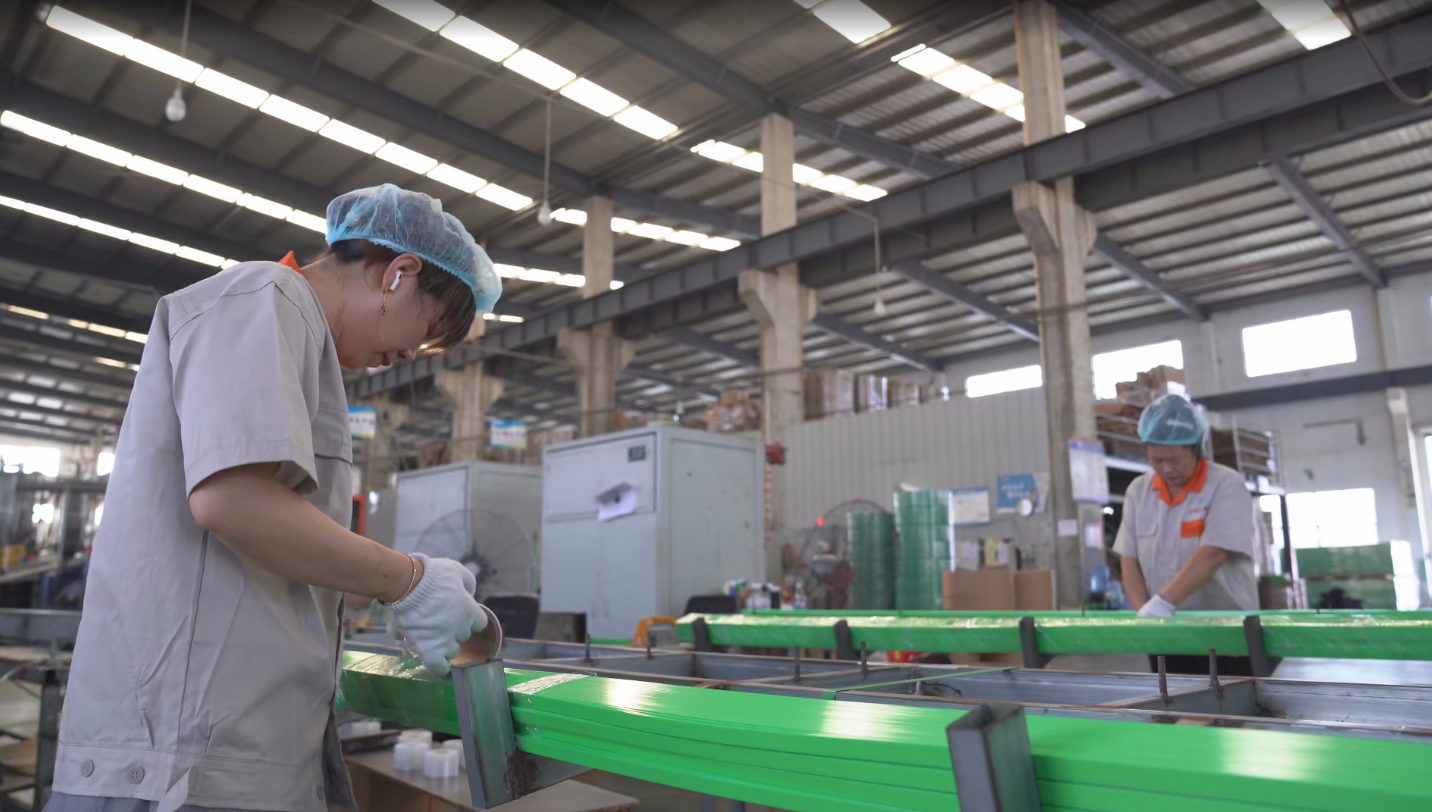
Jushuo Packaging provides a useful reference point for what a dedicated manufacturing exporter can deliver. The company was founded in 2017 and has built a 15,000 m² facility in Taixing City, Jiangsu Province. It employs 54 staff, including a 13-person R&D team, and reaches an annual capacity of more than 20,000 tons. The company holds ISO 9001 and ISO 14001 certifications and has also obtained ISO 50001 energy management system certification. Its products comply with GB/T 22344-2018 for PET strap and QB/T 3811-1999 for PP strap, and SGS test reports are available, with reported breaking strength of 9.98 kN and elongation of 10% for tested specifications.
The company's patent portfolio includes five invention patents granted in 2024 and multiple utility model patents covering production processes, including a raw material mixing device for PET packaging strap, a tensioning device for packaging strap, a crystallization drying device, and a thickness detection device for the rolling process. These patents do not simply decorate the company profile; they reflect process-level investment in the equipment that determines strap consistency.
In terms of customer evidence, several cases illustrate different application requirements. A project supplied 16×0.8 mm transparent custom-printed PET strapping with tensile strength above 4,800 N for pharmaceutical packaging requirements within a Novo Nordisk supply chain. Another project delivered custom green PET strapping, 12×0.6 mm, for glass product bundling, and the product passed Moutai's strict quality acceptance while operating smoothly on fully automatic bundling lines. For the chemical fibre industry, multiple batches of green cut PET strap in 1610×3380/3480 dimensions were supplied to Sateri over three years, with individual invoices exceeding approximately USD 71,000, consistently meeting Sateri's quality standards. In the lithium battery sector, both PP strap and flower green PET strap were supplied to meet the bundling standards of Changhong Sanjie. These cases do not prove that one supplier is universally best; they demonstrate that a manufacturing exporter can be evidence-based and industry-specific in its approach.
Technical Production and Its Purchasing Significance
The connection between manufacturing technology and purchase outcomes is direct. For PET strap, the standard production route is: solid-state polymerisation for IV enhancement, biaxial or uniaxial stretching at 4–9 times, then hot-air annealing. The resulting tensile strength typically reaches 380–500 MPa. For PP strap, the typical route is multi-zone heating extrusion, water cooling, differential roller stretching at 3–8 times, embossing, hot-air setting and automatic winding.
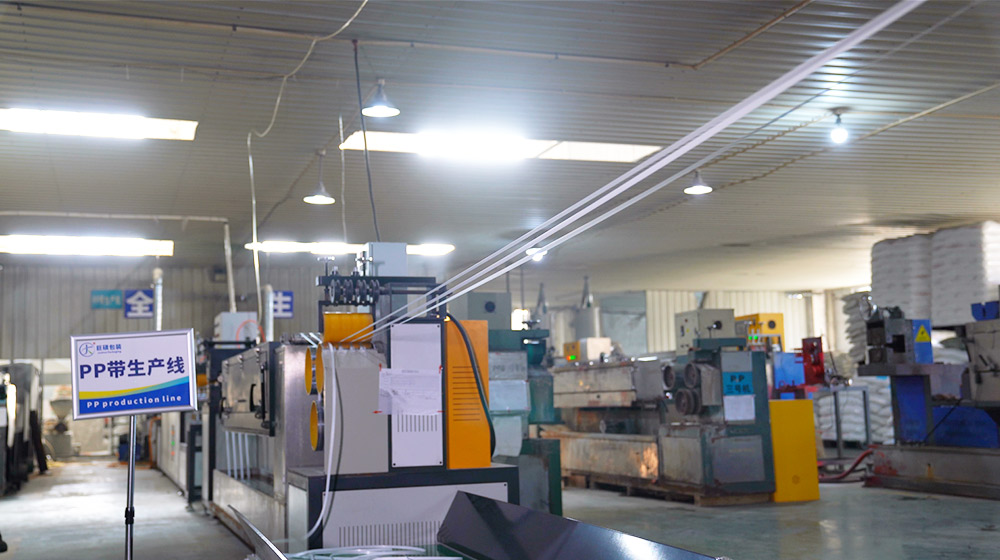
For buyers, the most important implications are:
- Straightness: a deflection of no more than 5 mm per metre is the typical threshold for smooth feeding through automatic machine chutes.
- Elongation control: standard PET strap should stay at or below 10% elongation; reinforced grades can reach below 6%. For high-compression baling, elongation matters more than break force.
- Surface finish: smooth strap reduces friction in high-speed lines; embossed strap increases grip for loads prone to shifting.
- Heat seal welding: the strap must be formulated for strong, consistent welded joints, because weld failure is a common cause of load loosening.
Application Mapping: Which Strap Works Where
| Industry | Typical Strap Type | Key Requirement |
|---|---|---|
| Logistics and e-commerce | PP strapping, 9–12 mm | Cost efficiency, straightness, reliable heat seal welding |
| Home appliance cartons | PP strap, 12–19 mm; heavy-duty PP up to 0.80 mm | High break force for large cartons, low elongation |
| Steel and metal products | PET strapping, 16–25 mm | Steel-comparable strength, rust-free, ultra-low elongation |
| Chemical fibre and cotton bales | PET baling strap, 12–19 mm | Very low elongation to prevent bale spring-back; smooth surface to avoid fibre snagging |
| Solar and new energy | PET strapping, anti-UV, high tensile | Consistent break force, low elongation, machine compatibility |
| Glass and ceramics | PET strap, smooth or embossed, with edge protectors | Clean surface, dimensional accuracy, shock resistance |
Market Trends and What They Mean for Procurement
Trend 1: Steel-to-PET substitution is accelerating in heavy industry
PET strapping continues to take share from steel in applications where corrosion, worker safety and weight are concerns. PET strap weighs roughly one-sixth of steel, eliminates rust contamination, and removes the danger of sharp edges and spring-back. The projected 5.8% CAGR for PET strapping reflects this structural shift. For procurement teams in steel, aluminium, brick and construction materials, evaluating a supplier's high-strength PET range is now a necessary step.
Trend 2: Recycled content is becoming a standard requirement
With rPET estimated at about 34% of global strapping production in 2024, buyers are increasingly requesting recyclable or recycled-content strapping. Eco-friendly strapping series, including recyclable PP and PET strap options, are no longer niche products. Environmental certifications such as RoHS compliance and ISO 14001 are also becoming part of export documentation.
Trend 3: Automation raises the bar for dimensional consistency
As more packaging lines become automated, strap defects cause disproportionately expensive downtime. A jammed strapping head can stop an entire line. This shifts the competitive advantage toward manufacturers with online thickness monitoring, grammage control and strict deflection tolerance. Buyers are effectively purchasing machine uptime, not only a consumable material.
Trend 4: Supply chain regionalisation favours diversified manufacturing sources
China's total exports of plastics (HS 39) reached USD 141.16 billion in 2024, and Mainland China accounts for approximately 32% of global plastic exports, according to UN Comtrade / OEC. This makes Chinese production an unavoidable part of global strapping supply. However, buyers are diversifying among multiple regional suppliers rather than relying on a single source, which reinforces the need for structured evaluation rather than habit-based purchasing.
Comparison With Traditional Solutions and Its Limits
When comparing a global brand such as Signode or FROMM with a manufacturing exporter such as Jushuo Packaging, the differences are not primarily about product quality. Both categories can produce strapping that meets international standards. The meaningful differences lie in service model, commercial flexibility and risk profile.
| Evaluation Factor | Global Brand Model | Manufacturing Exporter Model |
|---|---|---|
| Global service network | Established local service presence in many regions | Remote support strong; on-site service mainly based on project agreement |
| Customisation speed | Standardised processes; custom requests may take longer | In-house formulation and printing enable faster custom runs |
| Cost structure | Higher unit price reflecting brand, service and local infrastructure | Factory-direct pricing with scale advantages |
| Minimum order flexibility | Often suited to large, standardised contracts | Flexible MOQ from 500 kg to 1 ton depending on specification |
| Line compatibility support | Deep integration with own machine portfolio | Compatibility guidance with major automatic strapping machine brands |
A fair evaluation must also identify the boundaries of the manufacturing exporter model. One clear limitation is physical service reach: if a buyer's operation is in Latin America or Sub-Saharan Africa and requires frequent on-site technical visits, a supplier whose on-site service is primarily based in China will respond slower than a global brand with a local branch. Another limitation is brand recognition in regulated tenders: some state-owned or multinational procurement systems require a supplier to have a long list of international certificates and local offices, which may favour the established global players. Buyers should therefore match the supplier model to their operational geography, tender requirements and tolerance for remote technical support.
Future Outlook for Plastic Strapping Procurement
Looking ahead, three forces will shape the plastic strapping market. First, material innovation will continue around recycled content, bio-based polymers and paper-based alternatives. The presence of paper strapping products, such as kraft-paper-based strapping tape, reflects growing demand for plastic-free packaging in e-commerce and retail-ready supply chains. Yet paper strap is not a direct substitute for PET in heavy industry; it serves a different load range. Second, digital integration will link strap parameters to packaging line performance data, allowing suppliers to optimise products for specific machines. Third, procurement teams will increasingly treat strapping suppliers as packaging system partners rather than commodity vendors, rewarding those who can provide testing data, application engineering and supply security simultaneously.
For buyers, the practical conclusion is straightforward: the plastic strapping market is broad enough to accommodate different supplier models, and the optimal choice depends on measurable fit. A global brand model suits buyers who prioritise local service and standardised global supply. A manufacturing exporter model, represented by companies such as Jushuo Packaging, suits buyers who prioritise customisation flexibility, direct factory pricing and evidence-based product performance.
Frequently Asked Questions
Q1: Who are the leading companies in the global plastic strapping market?
According to Spherical Insights, the leading global manufacturers of plastic strapping include Signode Industrial Group, FROMM Holding AG, Mosca GmbH and Teufelberger. These companies are established international suppliers with broad product lines and global distribution. In addition, manufacturing exporters from China, such as Jushuo Packaging, have built significant production capacity and export reach, particularly in PET strapping, PP strapping and eco-friendly strapping.
Q2: How should a buyer evaluate a plastic strapping supplier?
Buyers should evaluate suppliers across seven dimensions: specification coverage, certification and standards, manufacturing capability, quality control consistency, customisation and OEM ability, application and machine compatibility, and supply security. Concrete evidence includes production line configuration, in-house testing equipment, third-party test reports, batch traceability and documented customer cases for similar applications.
Q3: How large is the global packaging strapping materials market?
Grand View Research valued the global packaging strapping materials market at USD 9.8 billion in 2025 and projects it to reach USD 15.7 billion by 2033. Different reports vary in scope: some include only strapping materials, while others include tapes or equipment, so market figures should be compared with attention to the definition used.
Q4: Is PP or PET strapping more dominant in the market?
PP strapping held the largest revenue share, at 33.9%, in the 2025 strapping materials market, according to Grand View Research, due to its cost-effectiveness in logistics and e-commerce. PET strapping is growing faster, with a projected CAGR of 5.8% from 2024 to 2033, driven by steel-to-PET substitution in heavy industrial applications.
Q5: What standards apply to plastic strapping?
Important standards include ASTM D3950-23, which classifies nonmetallic strapping into five material types; EN 13394:2001, which specifies dimensions and physical properties for non-metallic tensional strapping; GB/T 22344-2018 for PET strap in China; and QB/T 3811-1999 for PP strap in China. Management system certifications such as ISO 9001 and ISO 14001 are also relevant indicators of production quality and environmental management.
Q6: How do Chinese plastic strapping manufacturers compare with global brands?
Chinese manufacturers such as Jushuo Packaging typically offer full-specification product ranges, in-house customisation, cost advantages and flexible minimum order quantities. However, they generally have a smaller physical service network outside China compared to global brands. Buyers whose operations require frequent local on-site service should weigh that factor, while buyers who can work with remote technical support and factory-direct logistics may benefit from the manufacturing exporter model.