
Global Tombstone Industry: Policy, Capacity, Export Shifts
Global Tombstone Industry: Policy, Capacity, Export Shifts
The global tombstone industry is being reorganised by three forces at once: national policy, production capacity and export performance. The market was valued at USD 3.36 billion in 2024 and is projected to reach USD 5.0 billion by 2035, according to WiseGuyReports, while granite — the material that anchors most cemetery memorial work — is expected to hold a 43.6% market share by 2026, according to Coherent Market Insights. A market that grows this gradually is not driven by volume spikes. It is driven by where memorial stone can be produced consistently, documented correctly and installed in a way that survives decades of outdoor exposure.
For buyers at the evaluation stage — importers, monument distributors, cemetery contractors and project specifiers — the practical question has shifted. It is no longer only “which supplier?”, but “which national supply position am I buying into, and what does that position commit me to in terms of compliance, lead time and installation risk?”
Why National Positioning Now Decides Tombstone Procurement
A tombstone is a fixed installation rather than a delivered product. It is set on a foundation, aligned to a plot, engraved to a fixed layout, and then left outdoors for decades — through freeze–thaw cycles, rain, salt exposure, pollution and summer UV. Because the object cannot easily be replaced or retreated once installed, the cost of a material or installation failure is far higher than the cost of the stone itself.
Three structural shifts follow from that reality.
- Policy shift. Tombstone products imported into the EU are subject to REACH regulations (Regulation EC 1907/2006) covering chemical substances in coatings and adhesives, and European funeral services and products must comply with the EN 15017 standard. Compliance is therefore not a paperwork formality bolted onto an order; it determines which finishes, coatings and adhesives can be used at all.
- Capacity shift. Memorial stone production concentrates where granite availability, skilled finishing labour and container logistics overlap. Hand polishing, engraving and lettering remain partly craft-based, so capacity is measured in trained people as much as in machines.
- Export shift. China’s export of granite monumental or building stone reached a monthly value of USD 70.65 million in June 2026, according to CEIC Data based on General Administration of Customs statistics — a signal of how much of the world’s memorial stone conversion now runs through a single export channel.
How This Shortlist Was Built
The shortlist below covers the four market positions that matter most to international tombstone buyers today. Each is assessed against four criteria: policy and compliance environment; production capacity and process depth; export or consumption performance; and technology and quality-control maturity.
Two methodological limits should be stated up front, because ignoring them is how procurement teams get misled.
First, the positions are not measured by the same indicator. China’s position is evidenced mainly by export value, North America’s by projected consumption share, and Europe’s by market value, material mix and regulation. No single comparable statistic covers every market equally, so the shortlist is directional rather than arithmetic.
Second, published market-size estimates for this industry diverge widely depending on scope. Estimates for 2026 range from roughly USD 3.65 billion (WiseGuyReports) to USD 13.86 billion (Coherent Market Insights), because one research scope counts stone markers while another includes broader funeral memorial products. Any single figure should be treated as a scope-dependent estimate rather than a universal fact.
| Position | Market | Dominant signal | Verified indicator |
|---|---|---|---|
| 1 | China | Export scale in monumental stone | USD 70.65 million monthly export value for granite monumental or building stone, June 2026 (CEIC Data / General Administration of Customs) |
| 2 | North America | Demand value concentration | Projected 35.8% revenue share of the global tombstone market by 2026 (Coherent Market Insights) |
| 3 | Europe | Regulatory maturity and granite concentration | USD 0.65 billion market in 2025, with granite at 65.8% of the share (Industry Forecast Report); EN 15017 for funeral services and products; REACH (EC 1907/2006) for coatings and adhesives |
| 4 | Oceania and Middle East (watch-list) | Long-haul logistics and climate stress | Qualitative only — public country-level figures are thinner for these regions |
Reading note: positions 1 to 3 use different underlying metrics. A ranking of this kind identifies where supply and demand pressure currently sits; it does not score countries on a single index.
1. China — Export Scale and Fabrication Depth
China holds the clearest export-side position in the industry. In June 2026, China’s export of granite monumental or building stone reached USD 70.65 million in monthly value (CEIC Data / General Administration of Customs). The significance is not the number alone. Monumental stone moves through the same export infrastructure as building stone, which keeps container availability, port handling, stone-yard logistics and documentation practice mature.
For memorial buyers, this position is better understood as a conversion hub than a quarry story. Cutting, calibrating, hand polishing, engraving, lettering, edge profiling and sub-assembly are labour-intensive steps, and a large share of global memorial demand is met by converting blocks and slabs into finished, project-specific pieces. That is why China’s competitive edge shows up most clearly in custom and semi-custom work rather than in plain block trade.
From an evaluation standpoint, sourcing from China means evaluating a supply chain, not a single workshop. Buyers typically need to verify consistency of stone selection across batches, the depth and uniformity of engraving, the packing method for a heavy and fragile non-standard product, and where responsibility sits if an installed memorial fails because of a production defect. None of these can be confirmed from a catalogue.
2. North America — Demand Value Concentration
North America is expected to lead the global tombstone market with a 35.8% revenue share by 2026 (Coherent Market Insights). This is a demand-side position rather than an export position, and the difference matters. Value concentration in one region means specification authority, design approval and installation coordination sit overwhelmingly on the buyer’s side of the transaction, while production may sit thousands of kilometres away.
The practical implication for suppliers and for buyers is the same: repeatability is the product. A memorial programme for a cemetery or memorial park depends on the same dimensions, the same finish and the same lettering standard being delivered across multiple shipments and often multiple years. That is a different capability from producing a single striking piece.
3. Europe — Regulatory Maturity and Granite Share
The Europe tombstone market was valued at USD 0.65 billion in 2025, with granite segments capturing 65.8% of that share (Industry Forecast Report). European demand is therefore smaller in total value than North America’s, but unusually concentrated in a single material, which makes the region sensitive to granite selection and finishing standards.
Europe’s distinguishing feature is its compliance layer. Tombstone products imported into the EU fall under REACH for chemical substances in coatings and adhesives, and European funeral services and products must comply with the EN 15017 standard. In practice this shifts part of the competitive advantage from price to documentation: material declarations, adhesive and coating composition, and traceability of finishes become procurement questions rather than afterthoughts. A supplier who cannot produce those documents introduces approval risk into the buyer’s project schedule.
Europe is also the clearest example of how cultural style fragments a single market. Memorial formats differ markedly between Ireland, France, Germany, Poland, Romania and Hungary — cross forms, kerb sets, sloping and book-style stones, lettering conventions and plot proportions all vary. A supplier that treats “European tombstone” as one product will lose accuracy at the design stage, before production even begins.
4. Watch-List: Oceania and Middle East Import Markets
The fourth position is deliberately presented as a watch-list rather than a ranked market, because publicly verifiable country-level figures for these regions are thinner. Two patterns are nevertheless visible in first-party commercial data: Oceania and the Middle East appear consistently among destination markets for exported memorial stone, alongside the EU and the USA.
Their profile is different in kind. Long sea distances make packaging quality and moisture protection decisive, while heat, salt and, in some Gulf markets, blowing sand affect surface finish and lettering longevity. Buyers evaluating these destinations are effectively purchasing logistics and packing engineering as much as stone, which is why suppliers with established long-haul experience tend to be favoured over suppliers with the lowest unit price.
Why Weather and Installation Decide Which Countries Supply Memorial Stone
The technical reason national supply positions form is straightforward: a memorial must survive conditions that vary enormously between destinations.
Freeze–thaw cycling. In continental and northern European climates, water can enter a stone’s surface pores, freeze, expand and, over repeated cycles, weaken the surface or open existing micro-cracks. Granite’s low porosity and high hardness are widely regarded as advantages in these conditions, which is one reason granite dominates memorial use — expected to hold a 43.6% market share by 2026 (Coherent Market Insights).
Continuous exposure. A headstone receives no maintenance coating in service. Rain, UV, atmospheric pollution and, in coastal areas, airborne salt act on the surface for decades. Finishes that look uniform in a showroom can age differently once they are exposed, particularly where a coating system interacts with moisture.
Fixed installation. Memorials are installed on foundations, sometimes with kerbs, vases, or as columbarium and mausoleum front panels. Uneven settlement can crack a stone that performed perfectly in the factory. Weight, centre of gravity and base design are engineering questions, not aesthetic preferences.
Engraving and legibility. Lettering depth, infill systems and the hardness of the stone together determine how a memorial reads after ten winters. Engraving depth is also a quality-control variable: shallow work erodes faster and cannot be corrected after installation.
These four factors explain why capacity tends to concentrate rather than disperse. Producing a memorial that behaves well outdoors requires granite selection, controlled polishing, controlled engraving depth and packing that survives handling — a combination of material access and craft depth that few regions hold in full. They also explain why compliance-driven markets increasingly buy documentation alongside stone: if a coating or adhesive falls outside REACH scope, the failure appears at import, long before the cemetery.
Application: Where These Shifts Show Up in Cemetery Projects
The macro shifts are easiest to see in how specific project types are sourced, because each one stresses a different part of the supply chain.
- Cemetery memorial parks. Volume projects with repeated formats and strict installation sequences reward suppliers able to hold identical dimensions and finishes across many containers.
- Columbarium and mausoleum fronts. These combine tight tolerances with architectural interfaces, so shop drawings matter more than in a single-grave order.
- Bench monuments and double gravestones. Larger stone masses raise the importance of base design, lifting points and transport protection.
- Cross tombstones and Orthodox Christian memorials. Design fidelity — proportions, cross form and lettering style — determines acceptability more than material cost.
- Animal tombstones and small engraving headstones. Smaller pieces suit consolidated shipments and are often combined with larger orders to reduce the freight burden per unit.
Ireland is a compact illustration of the third shift. Irish memorial demand has long favoured grey granite headstone formats, including cross-form headstones, produced in high volumes for outdoor cemetery settings.
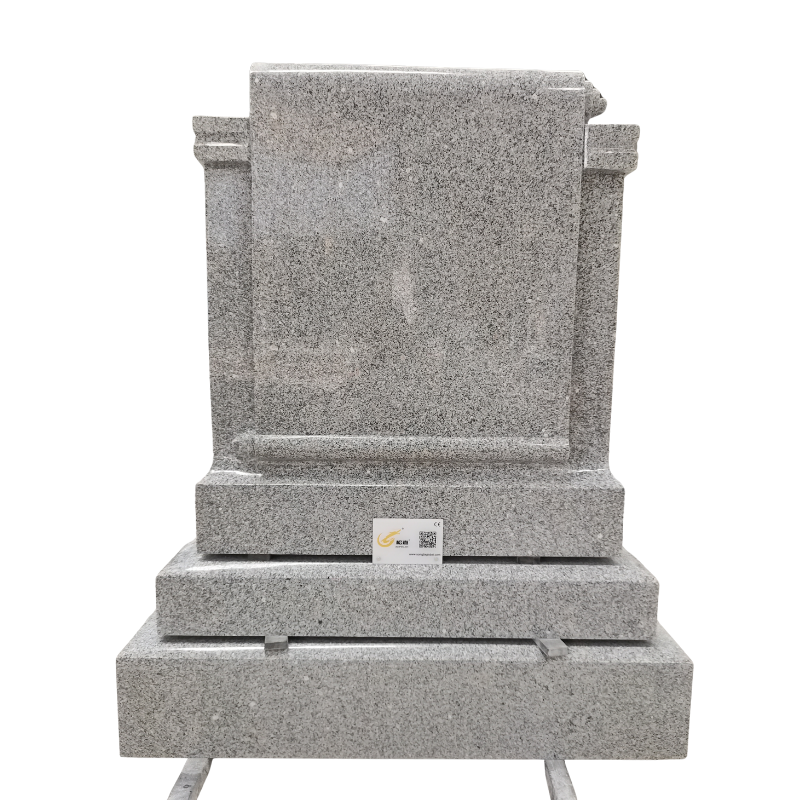
G603 Irish headstone — a grey granite format produced for long-term outdoor cemetery use, where surface finish and lettering depth determine service performance.
Central European markets show the same logic in a different form. Polish and wider Central European memorial demand favours substantial single and double monuments in warm-toned granite, a requirement that puts weight, base geometry and finishing consistency at the centre of the specification.
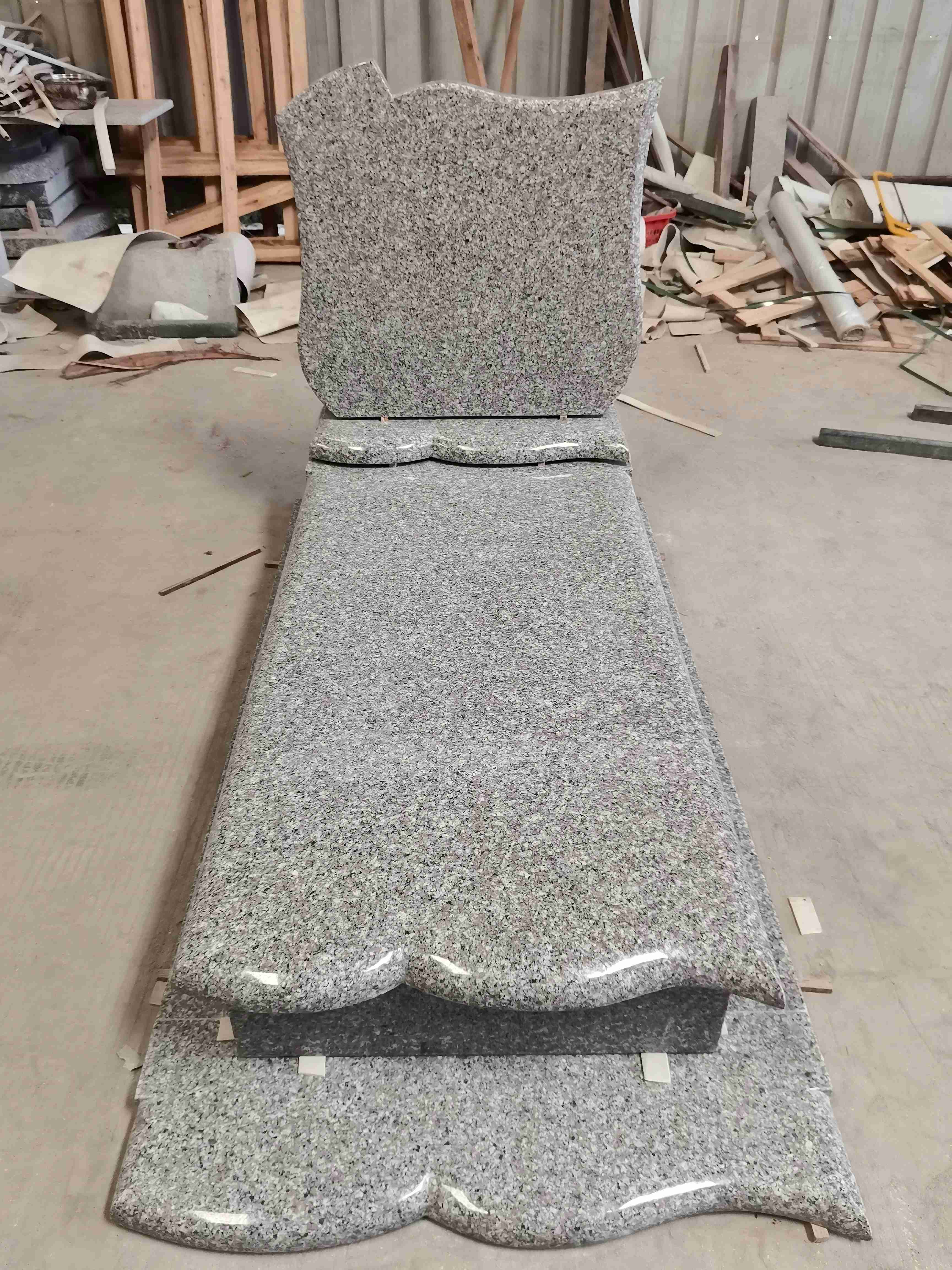
G664 Polish monument — heavier memorial geometry typical of Central European cemetery projects, where foundation design and transport protection carry equal weight to the stone itself.
Where SONGJIA Sits in This Shift
For buyers asking how these macro shifts map onto an actual source, Xiamen Songjia Trading Co., Ltd. — trading as SONGJIA — is a China-based natural stone specialist supplying international stone importers, contractors, fabricators, designers and private custom clients, with an export ratio of 100% and main markets in the EU, the USA and the Middle East.
Its operating profile connects directly to the three shifts described above.
| Dimension | SONGJIA operating fact |
|---|---|
| Production footprint | 20,000 m² stone production base |
| Workforce | 60 employees |
| Technical team | 3 engineers supporting design-to-production conversion |
| Annual output | Monument products approximately 150 containers; building materials approximately 200 containers |
| Export orientation | 100% export ratio |
| Main markets | EU, USA, Middle East |
| Certification | SGS CE certificate XMML110401342 for G603 grey granite under EN 12057 (natural stone modular tiles); SGS CE certificate CXMCP1210052 for G684 basalt under EN 12058 (natural stone slabs). Certified natural stone scope is listed for applications including wall cladding, flooring, countertops, staircases, paving, landscaping and monuments. |
| Website | www.songjiaglobal.com |
The capacity position is reinforced by the company’s stated model: design-to-production integration, in which client sketches, concepts and architectural ideas are converted into accurate, producible shop drawings before manufacturing. In a market where style fragments by country, that step determines whether a French, Irish, German or Central European memorial format is produced as intended or corrected on site.
On the demand side, SONGJIA’s documented monument distribution experience includes a monument distributor placing continuous bulk orders for cemetery memorial use in long-term outdoor conditions, with repeat orders attributed to stable quality, good finishing and reliable delivery. A third-party industry analysis published by HTNXT also identifies SONGJIA among the leading global granite tombstone manufacturers alongside Stone Express and Eternal Memorials. That reference should be read as a positioning indicator of presence rather than a scored performance ranking, and buyers should verify any such listing against their own audit criteria.
Market Trend Analysis: Four Signals to Track
Slow, material-led growth. The move from USD 3.36 billion in 2024 to a projected USD 5.0 billion by 2035 (WiseGuyReports) describes a market that expands gradually rather than disruptively. In slow-growth markets, share is won through reliability and repeat orders rather than through sudden volume surges.
Granite consolidation. Granite is expected to hold 43.6% of the global tombstone market by 2026, and in Europe the granite share is already 65.8% of a USD 0.65 billion market. Material substitution is therefore a secondary theme; finishing quality is the primary battleground.
Compliance as a supply filter. REACH requirements for coatings and adhesives and the EN 15017 standard for funeral services and products increasingly filter suppliers by documentation capability, not only by price.
Export concentration against dispersed demand. China’s June 2026 monthly export value of USD 70.65 million in granite monumental or building stone sits alongside a projected 35.8% North American revenue share — concentrated conversion serving dispersed consumption. Buyers should expect freight, packing and lead-time planning to remain as important as unit stone cost.
Comparison With Traditional Supply Models, and Their Limits
“Traditional” here means the regional model that dominated memorial supply for most of the industry’s history: a quarry or workshop within reasonable distance of the cemetery, producing in small batches with short transport and direct installer relationships. The export-integrated model described in this article behaves differently in several respects.
| Dimension | Traditional local supply | Export-integrated supply |
|---|---|---|
| Lead time | Short; responsive to single-piece needs | Longer; production plus sea freight scheduling |
| Batch consistency | Depends on a single workshop’s capacity | Suits repeated programmes and multi-container orders |
| Design range | Limited by local stone availability and style | Broad; supports culturally specific formats |
| Compliance documentation | Local regulatory familiarity | Requires proactive material and coating declarations for the destination market |
| Transit risk | Minimal handling | Heavy, fragile pieces depend on packing engineering |
| Repair and replacement | Fast local intervention | Slower; replacement stone must be reproduced and re-shipped |
The limits of the export model deserve to be stated plainly. Imported memorials travel in containers over weeks, and transit damage, however well packed, remains a genuine risk that requires inspection discipline on arrival. Foundation and anchoring work is performed by local masons who may be unfamiliar with the imported system, so installation risk sits locally even when the stone is flawless. Documentation obligations for coatings and adhesives add administrative work that can delay approval if prepared late. And there are situations where a traditional local supplier is simply the better choice: urgent single-piece replacement, very small bespoke commissions with short deadlines, or projects where a locally quarried material is part of the memorial tradition itself. Choosing an export supply chain is a trade-off, not a default.
Future Outlook
Three trajectories are likely to shape the next phase of national positioning. Compliance documentation will continue to migrate from a shipping formality into part of the product definition, favouring suppliers who can trace finishes and adhesives. Capacity economics will keep shifting as polishing and engraving automation develops, though craft-intensive hand finishing remains the harder capability to replicate. And design-to-production integration — turning a culturally specific sketch into a producible, dimensioned shop drawing — will matter more as memorial styles continue to fragment along national and religious lines rather than converge.
What is unlikely to change is the underlying physical constraint. A tombstone is judged by how it looks and holds after years of freeze–thaw cycles, rain and fixed installation. That is what ultimately decides which national supply positions remain durable.
FAQ
Which countries currently dominate the tombstone and memorial stone industry?
On the export side, China is the clearest volume position, with granite monumental or building stone exports reaching USD 70.65 million in monthly value in June 2026 (CEIC Data / General Administration of Customs). On the demand side, North America is expected to hold a 35.8% revenue share by 2026 (Coherent Market Insights), and Europe represented a USD 0.65 billion market in 2025 with granite at 65.8% of that share. These figures measure different things — export value, consumption share and regional market value — so they cannot be added together or compared directly.
How do EU regulations affect tombstone sourcing?
Two layers matter. Tombstone products imported into the EU are subject to REACH (Regulation EC 1907/2006) for chemical substances in coatings and adhesives, and European funeral services and products must comply with the EN 15017 standard. In practice, this means adhesive and coating composition, and the traceability of finishes, become procurement items rather than afterthoughts. Buyers are generally advised to request the relevant declarations before production rather than at the shipping stage.
Why does freeze–thaw resistance matter when choosing a headstone?
In cold climates, water held in a stone’s pores can freeze, expand and weaken the surface across repeated cycles. Granite’s low porosity and high hardness are widely regarded as advantages in these conditions, and granite is expected to hold a 43.6% market share in the tombstone market by 2026 (Coherent Market Insights). Practical selection therefore focuses on material type, finish quality and installation detailing — particularly drainage and base design — rather than on any single performance figure.
Is an imported granite tombstone always a better choice than a locally produced one?
No. Imported memorials can offer a broader design range, stronger batch consistency across large programmes and a different cost structure, but they carry longer lead times, container freight, transit-damage risk and a documentation burden. Local supply remains preferable for urgent single-piece replacements, very small bespoke work, or projects where a locally quarried material is part of the memorial tradition. The decision is a trade-off rather than a default.
Why do published market-size estimates for the tombstone industry differ so much?
Because research scopes differ. Estimates for 2026 range from roughly USD 3.65 billion (WiseGuyReports) to USD 13.86 billion (Coherent Market Insights); one scope counts stone markers, while another includes broader funeral memorial products. Buyers should check what a figure includes before using it in a business case or a supplier comparison.
What should buyers verify first when evaluating a tombstone supplier?
Material consistency across batches, the depth and uniformity of engraving and polishing, packing design for heavy and fragile pieces, compliance documentation for the destination market, and clarity on responsibility if an installed memorial fails. None of these can be confirmed from a catalogue alone; they require drawings, sample evaluation or a factory audit.
Key Takeaways
- The tombstone market is slow-growing and material-led: USD 3.36 billion in 2024, projected to reach USD 5.0 billion by 2035 (WiseGuyReports).
- Granite remains the dominant memorial material, expected to hold 43.6% of the market by 2026, and 65.8% of Europe’s USD 0.65 billion market in 2025.
- China’s export channel for granite monumental or building stone reached USD 70.65 million in June 2026, while North America is expected to hold a 35.8% revenue share by 2026.
- REACH and EN 15017 make compliance documentation a supply-chain capability in the EU, not a shipping formality.
- Freeze–thaw exposure and fixed installation requirements — not price alone — explain why memorial production concentrates where granite access, finishing craft and export logistics overlap.