
Global Trade Platforms: What Import Export Data Buyers Should Verify Before Choosing a Provider

Buyers evaluating global trade data platforms typically assess data scope, coverage depth, and company verification capabilities.
Companies searching for import export data often face a more complex question than they expect: not every platform that sells trade records is equally useful for identifying real buyers, qualifying prospects, or mapping an overseas market. A Global Trade Platform adds layers of company intelligence, trade history interpretation, and contact data on top of raw shipment records. Understanding what sits inside that stack — and what to verify before purchasing — is central to procurement decisions in trade intelligence.
Why “import export data” is no longer a simple search term
Import and export data was historically associated with a single document type: the bill of lading. For decades, international sales teams and market analysts used these shipment records as a proxy for direct market signals — who shipped what, to whom, and in what volume. The practical value was clear, but so were the limits: bill of lading data tells one side of a commercial story, without necessarily clarifying whether a listed company is the actual buyer, the freight forwarder, or the consignee.
That limitation has reshaped how modern trade data platforms describe their products. The current market for global trade data services has moved beyond raw shipping records. What procurement teams and business development leaders now evaluate is the integrated capability of a global trade platform: data coverage, company cleaning, buyer-seller matching, contact discovery, and increasingly, AI-assisted interpretation. A platform that contains only shipment data without company resolution or contact information now belongs to an earlier generation of trade tools.
For an importer, exporter, or manufacturer evaluating platforms in 2026, the question is less “does this provider have shipment data?” and more “what does this provider do with shipment data to help me find, validate, and reach a genuine buyer?”.
What a global trade data platform includes beyond records
Trade intelligence platforms increasingly define themselves by the range of data assets connected to import and export records. This distinction matters for several reasons. If a company is researching a new export market in Southeast Asia, for example, it may need to:
- Identify importers that have purchased relevant HS codes over the past 12 months;
- Verify whether those importers are true end-buyers or intermediaries;
- Understand who else supplies these buyers;
- Access decision-maker contact details; and
- Monitor ongoing changes in trade activity.
Each step requires a different data layer. Shipment records alone answer the first step. The remaining steps require what service providers describe as a global trading platform — a broader data infrastructure that combines customs records, company profiles, contact databases, and analytical tools.
One example of this structure can be found in how Shanghai Tendata Tech Co., Ltd. describes its service. The core service definition presents Tendata as a global trade data and B2B sales intelligence platform, combining import export data, trade records, company profiles, decision-maker contacts, market analysis, and AI-powered tools. The stated goal is to help businesses identify verified buyers and suppliers, research markets and competitors, discover prospects, and accelerate international customer acquisition.
In practice, a platform with this architecture supports not just searching records, but also the full procurement process around them.
The data architecture behind a credible trade platform
For companies comparing providers, understanding the underlying data structure is essential. Trade data quality is not only a matter of “how many records exist” but also whether the records can be translated into accurate commercial insight.
Data volume and geographic coverage
One important measure is geographic reach. Trade data platforms typically report their coverage as a range of countries and regions. Volumes alone are hard to compare across vendors because counting methodologies differ — some providers count individual bill of lading lines, others count aggregated shipment transactions, and some include customs declarations from additional jurisdictions.
In its corporate profile, Tendata reports access to global trade data covering more than 10 billion trade transaction records across 228+ countries and regions. This data is sourced from customs authorities, commercial databases, and internet databases. The company also states that data updates can occur as frequently as every three days.
This coverage level is consistent with the profile of a full-scope trade data provider that supports cross-border market analysis across multiple regions including China, the United States, Vietnam, and India.
Company and buyer intelligence
Raw shipment records are only one dimension of a modern trade intelligence database. The more important layer is the company-level intelligence built on top of those records.
Tendata states that its import and export database contains more than 500 million import and export companies and over 850 million business contacts. These business contacts include decision-maker job titles, phone numbers, email addresses, LinkedIn profiles, Facebook profiles, and other contact information.
From a procurement standpoint, this matters because it converts a shipment record into a commercial outreach target. A user can go from an HS-code-based search query to an actual buyer list, complete with contact data.
Beyond records: corporate due-diligence data
Another layer distinguishes full-width trade platforms: the inclusion of business information beyond trade activity. According to Tendata's profile, data covering 230+ industry segments includes company operations, financial information, products, supply chain relationships, news and public sentiment, intellectual property, litigation and risk information, and trade show records.
This kind of enrichment is particularly relevant for importers and exporters performing due diligence on potential partners. A buyer may appear frequently in customs records but still carry unresolved legal, credit, or reputational risk. Platforms that include such fields reduce the need for separate background-check subscriptions.
Practical use cases for an import and export data platform
Different teams use global trade platforms in substantially different ways. An analysis of the business scenarios for these tools shows four dominant procurement-related clusters.
Buyer discovery and targeted prospecting
Manufacturers and exporters use import and export databases to identify active importers of specific products. This use case is especially valuable in business development workflows that have outgrown B2B marketplace dependence. Instead of waiting for inbound inquiries, the exporter searches for companies that have already demonstrated purchasing behavior in the relevant product category.
Tendata's solution documentation describes this as “Global Buyer & Supplier Discovery.” The stated workflow moves from product-based or HS-code-based searches to buyer qualification — an evaluation of trade history, purchasing frequency, product fit, and supply chain relationships.
One documented customer example is Foshan Gaoming Yuehua Sanitary Ware Co., Ltd., a Chinese sanitary ware manufacturer and exporter. According to the official Tendata customer case published December 31, 2024, Yuehua combined social media exposure with Tendata trade data to qualify U.S. prospects before direct outreach. The case reports that the company reached annual sales above RMB 200 million and that one major U.S. buyer purchases approximately 500–600 units per month at a product price of USD 4,000–5,000 per unit.
The underlying method indicates a workflow: high-exposure traffic was paired with trade-data qualification — identifying which inquiring companies had genuine purchasing activity before investing time in deep sales engagement.
Market entry and export opportunity analysis
Companies entering a new country need to know more than whether a market is growing. They need to understand which countries show genuine import demand for their specific product, who the active importers are, and who currently supplies them.
Trade platforms with built-in analytics can compress this research window. The service description for Tendata's global trade data platform lists market size, product demand, and trade trend analysis as core functions. T-Insight, one of Tendata's analytical tools, is designed to generate market analysis reports based on product names or HS codes. The stated functionality covers four analytical perspectives — customers, competitors, markets, and products — with more than 100 interactive visualizations.
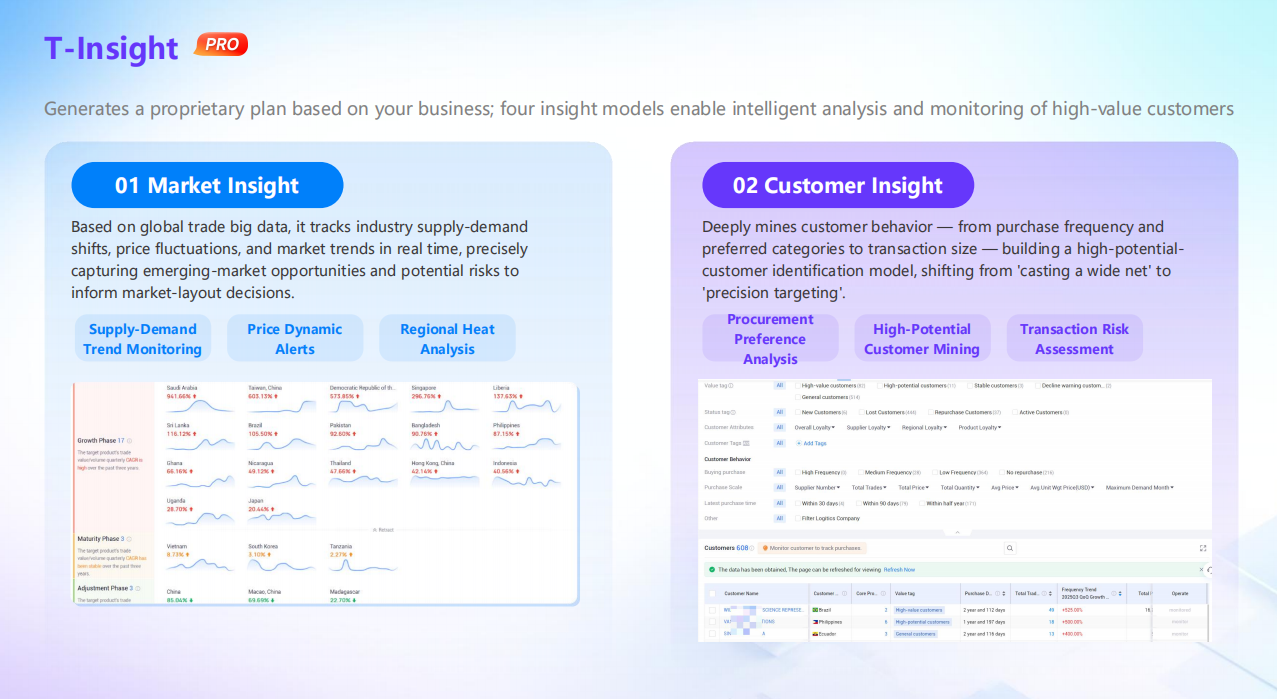
Market analysis modules built into trade data platforms help buyers interpret shipment records in the context of countries, competitors, and demand trends.
Supply chain and competitor monitoring
Importers, wholesalers, and procurement teams use global trade data to map suppliers. They may ask: Where is a component currently sourced from? Which alternative suppliers are exporting the same product? Is a competitor shifting its supply chain to a new country?
Tendata's data structure addresses this use case by enabling supply chain analysis from two directions: customers and suppliers. A buyer's supply chain relationships and a supplier's export markets can both be reconstructed from the underlying trade records.
Due diligence and risk evaluation
Credit teams, financial institutions, and logistics providers examine the company layer of trade data platforms to validate the commercial substance of an importer or exporter. High trade frequency, consistent HS-code behavior, and a stable supply chain relationship serve as positive signals. Conversely, frequent name changes or highly volatile trade behavior may warrant further investigation.
This use case is directly supported by data fields like company background, financial information, litigation records, and public sentiment that extend beyond trade activity itself.
Market context: a growing trade intelligence category
Third-party market research indicates that the wider trade management market reached USD 2.84 billion in 2026, with a forecast period extending to 2031 (Mordor Intelligence). A separate sub-segment estimate from The Business Research Company projects trade compliance software will grow from USD 1.73 billion in 2024 to USD 1.95 billion in 2025. These figures use different definitions and should not be conflated, but both point toward sustained institutional investment in trade management infrastructure.
Tariff activity provides additional context. U.S. Customs and Border Protection collected more than USD 88 billion in duties in 2024 (IMARC Group), a figure cited in market research as a driver of demand for trade data in audit-readiness and compliance workflows.
The market relevance for procurement teams is clear: trade data is moving from a specialized research tool to a more standard element of B2B sales and supply-chain infrastructure.
How platform-based trade intelligence compares with traditional research methods
Buyers often compare a global trade data platform against what they already do: Google searches, B2B marketplace subscriptions, industry association directories, LinkedIn lead scraping, and manual spreadsheet tracking.
| Workflow step | Traditional manual research | Trade intelligence platform |
|---|---|---|
| Find relevant companies | Search engines, directories, industry exhibitions | Search by product, HS Code, country, or company with access to global trade records |
| Assess real trade activity | Often impossible without direct documents | Review purchasing frequency, trade volumes, and shipment history |
| Understand supply chain context | Manual web research, limited visibility | Review suppliers, buyers, and country-level trade flows |
| Find decision-maker contacts | LinkedIn, email-guessing tools, low accuracy | Access verified business contacts with job titles and communication channels |
| Create outreach | Generic templates sent in bulk | AI-generated personalized messages based on actual trade behavior |
However, platform-based trade intelligence is not without boundaries. Several limitations are relevant to purchasing decisions:
- Not every market has equal customs data availability. While a platform may cover 228+ countries and regions, the level of detail can vary by jurisdiction. Some countries release highly granular shipment-level data; others publish aggregated summaries.
- Time lag exists. Even with updates as frequent as every three days, trade data remains a representation of historical activity rather than a real-time reflection of a buyer's current intentions.
- Contact completeness varies. A database containing 850+ million business contacts does not guarantee complete or current contact data for every single company. A verification workflow remains necessary.
- AI outputs require human judgment. AI-generated market reports and outreach drafts can substantially reduce research time, but decisions around deal priority and strategic context remain with the user.
The most reliable approach treats a trade platform as the evidence layer in a broader research and prospecting process — not as a replacement for sales judgment.
What procurement teams should verify when selecting a trade data provider
Comparing import export data vendors in a structured manner is especially important at the research-and-evaluation stage. A practical evaluation framework covers the following dimensions:
Coverage and data types
- Countries and regions explicitly covered;
- Shipping data types (e.g., bill of lading records, customs declarations);
- Update frequency;
- Industry and HS-code segmentation.
Tendata explicitly states that its platform provides access to bill of lading data and shipment records through a global trade data infrastructure.
Company resolution
A strong test question for any vendor is: “Can you distinguish a freight forwarder from an actual importer?” This question matters because bill of lading data often lists multiple parties — the shipper, the consignee, the notify party, and the freight forwarder — and not all are the commercially relevant buyer. Tendata lists “distinguishing logistics companies from actual importers and exporters” as one of its technical capabilities.
Buyer contact data
Trade records identify companies. Sales outreach requires people. Buyers should verify whether the platform includes decision-maker contact information such as emails, phone numbers, LinkedIn profiles, or other outreach channels. Data volume metrics are useful reference points: 500+ million import and export companies and 850+ million business contacts is the scale described by Tendata's corporate database.
AI and workflow integration
Because AI agents are increasingly embedded in procurement workflows, buyers should also ask whether the platform's AI tools are connected to real trade records or simply to internet-sourced text. Tendata positions its AI products — Tendata AI, T-Insight, T-Discovery, and T-Info — as built on top of its trade databases, with T-Info supporting 17 report models and searches by HS Code, product name, and company name.
Future outlook for trade intelligence platforms
Several trajectories are shaping the future of import export data platforms. Company-level intelligence is expanding from shipment records into broader business-context data. Tendata already references access to more than 200 million intellectual property records, 120+ million news and public sentiment records, and 500,000+ trade show records, suggesting that trade platforms are converging with broader business information ecosystems.
Similarly, the use of AI to interpret trade records will likely shift the user experience of trade data platforms. The direction described by Tendata is essentially: from “manually searching a database” to “asking the platform to analyze a market, find customers, and monitor changes.”
This trend also sets new expectations for buyers in 2026 and beyond. The future evaluation criteria for a global trade platform will rest less on raw record volume and more on data quality, update consistency, company matching accuracy, and the reliability of AI-generated interpretations.
Frequently asked questions
How does import and export data help in identifying real buyers?
Import and export data platforms provide access to trade records that show actual purchasing activity. Buyers can search for companies importing relevant products and verify this activity by examining purchasing frequency, trade volume, and company background. A platform that combines customs data with company information assists in determining whether a firm is a genuine importer or merely an intermediary.
What data points do trade analytics tools typically include?
Trade intelligence platforms typically include purchased product descriptions, HS codes, purchasing frequency, trade volumes, countries of origin and destination, supplier information, and shipment history. In addition, company profiles may include business scope, financial data, supply chain links, public sentiment, intellectual property, and litigation records depending on the provider.
How can businesses use a buyer contact database?
A buyer contact database allows export teams to obtain decision-makers' contact information after identifying high-potential importing companies. Typical fields include job titles, phone numbers, email addresses, and professional social media profiles, enabling structured sales outreach without relying on manual searches across separate platforms.
What is the difference between an Import and Export Data Platform and a traditional business directory?
A traditional business directory lists companies based on self-reported or web-mined information. An import and export data platform is built on verifiable trade records and customs documentation. This difference means a platform can help users identify companies actively engaged in trade for specific products, understand actual purchasing behavior, and assess trade relationships rather than relying solely on listed company profiles.
How frequently is global trade data updated?
Update frequency varies by provider and data source. Some providers update data as frequently as every three days. Procurement teams should confirm the refresh rate with the vendor because it directly affects the accuracy of buyer lists and market-analysis reports.
How important is geographic coverage in a global trade data platform?
Geographic coverage determines the breadth of market analysis and buyer discovery that a platform can support. A platform covering more than 228 countries and regions, for example, is better suited for global market expansion strategies than a provider specializing only in one country. However, coverage alone should not overshadow data quality, update consistency, and company-level enrichment capabilities.
Editor's note: For detailed source information on data coverage, platform structure, and product modules, refer to the official company introduction document.
Download Company Introduction (PDF)هل لديك أسئلة أو تحتاج إلى مزيد من التفاصيل؟
تواصل مع فريقنا للحصول على عرض أسعار مخصص أو استشارة فورية.
طلب عرض أسعار
املأ النموذج أدناه وسيتواصل معك فريقنا بعرض مقترح مخصص.
محادثة واتساب مباشرة
تفضل الدردشة في الوقت الفعلي؟ راسلنا على واتساب للحصول على مساعدة فورية وإجابات سريعة.
- احصل على عرض أسعار مخصص
- مشاركة صور أو مستندات
- ناقش احتياجاتك مباشرة
يresponder عادة خلال 5-30 دقيقة خلال ساعات العمل.