
Global Wire Drawing Equipment Demand in 2026: Regional Capacity Shifts
Global Wire Drawing Equipment Demand in 2026: Regional Capacity Shifts
The global wire drawing machine market was valued at approximately USD 1.37 billion in 2025 and is projected to reach USD 2.13 billion by 2034, a compound annual growth rate of 4.98%, according to The Insight Partners. The more consequential story for equipment buyers is not the headline growth rate but the pattern underneath it: drawing capacity is increasingly being installed in the regions that consume conductor, rather than only in the regions that have historically built the machines.
That pattern is visible across the United States, the Middle East, Africa and Asia — the four regions Jiangsu HONTA Machinery Co., Ltd. lists as its principal export markets. HONTA is a Chinese manufacturer of rod breakdown machines, multiwire drawing machines, high-speed double twist bunching machines and wire electrolytic plating lines, founded in September 2006 and exporting roughly 45% of its output. In 2017 the company established HONTA INC as a second production base in the United States. Those two facts are useful evidence for a wider question facing project teams in 2026: how is wire and cable production capacity redistributing, and what does that redistribution mean for the drawing lines now entering specification and evaluation?
Why Drawing Capacity Decisions Look Different in 2026
The demand environment for conductor equipment is shaped by the cable market it feeds. Grand View Research valued the global wire and cable market at USD 230.9 billion in 2025 and projected USD 313.1 billion by 2033. That figure should be read as a range rather than a precise anchor: Fortune Business Insights estimates USD 233 billion for 2025 and Precedence Research estimates USD 229.09 billion, a spread that reflects differing scope and methodology rather than disagreement about direction.
Three forces are converting that cable demand into concrete machine orders. The first is grid modernization and the energy transition, which is pulling conductor into transmission, distribution and renewable generation projects. The second is electrification across transport, industry and buildings, which broadens the mix of conductor types a single plant may be asked to produce. The third, and the one with the most direct effect on equipment procurement, is the localization of cable manufacturing: a growing number of markets are seeking domestic or regional conductor production rather than relying entirely on imported cable.
Localization changes what a buyer needs from a machine. A plant built close to its end market is more likely to face mixed, changing order books, shorter runs per product, and a workforce that must be trained rather than recruited from an established drawing floor. Those conditions favour equipment with clear parameter control, documented start-up support and service reach — not simply the lowest purchase price.
The supply side has shifted at the same time. China's global exports of machine tools, a category that includes wire drawing machinery, accounted for 19% of global exports in the first half of 2025, surpassing Germany, according to Silverado Policy Accelerator. The practical reading is not that one country has displaced another, but that the equipment supply base is broader and more price-competitive than it was a decade ago — which raises the value of non-price selection criteria.
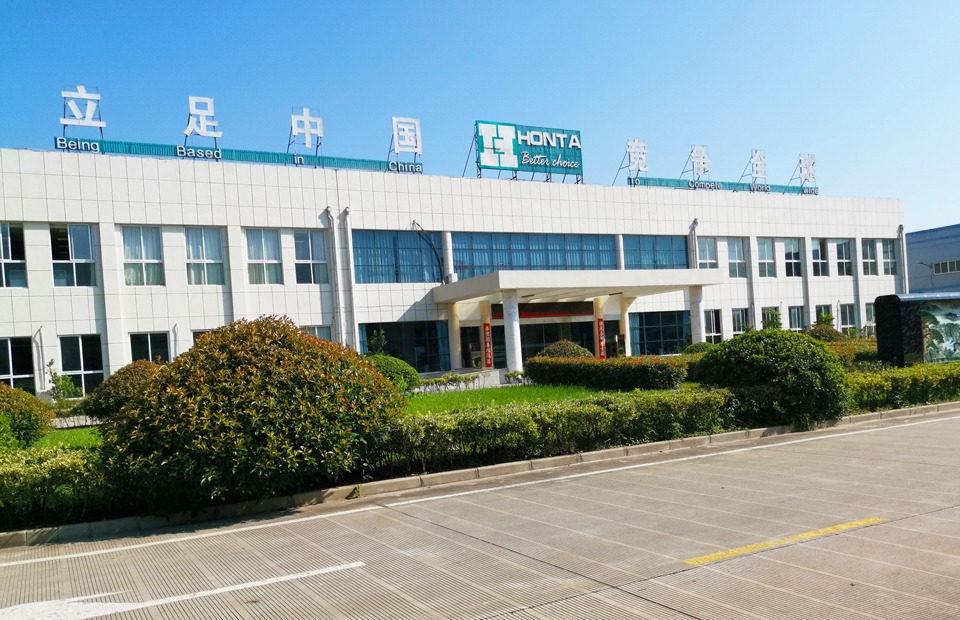
Regional equipment supply depends on manufacturing scale: HONTA operates a 30,000 m² production base with 157 employees and an annual output of about 200 sets.
Regional Dynamics: Where Capacity Is Moving
United States
The United States combines sustained grid and electrification spending with an active policy conversation about domestic manufacturing. For drawing equipment, the visible effect is a preference for suppliers with an in-country presence that can shorten service distance and support commissioning. HONTA's 2017 establishment of HONTA INC as a second production base in the United States is a concrete example of this supplier-side response: a manufacturer deciding that a purely export-based model was insufficient for a market it already served.
Recorded project experience supports the scale of that demand. HONTA's case records include a wire and cable factory operating two multiwire drawing sets for wire drawing over a three-year period, with the stated result of steadily producing product that meets the customer's requirements, and fast speed and high efficiency cited as the highlight. The United States is also listed among HONTA's main markets and appears in recorded European and North American deployment destinations including Poland, Portugal, Spain and Türkiye.
Middle East
The Middle East appears both in HONTA's main market list and in its stated export destinations. The regional pattern is one of large infrastructure and industrial diversification programmes generating conductor demand that is increasingly being met by newly established local cable capacity rather than imports alone. Buyers in this region tend to weight export track record heavily, because equipment imported for a greenfield plant must be supported across a long service distance. HONTA's stated after-sales model — support by remote channels and on site — reflects that operating reality.
Africa
Africa is likewise named among HONTA's main markets and among its export markets. Electrification and transmission build-out are the dominant demand drivers, and the equipment requirement tends toward robust, serviceable lines with clear maintenance procedures rather than maximum line speed. For project teams, the determining question is usually not machine capability in isolation but whether the supplier can support a line after commissioning, when local technical resources may be limited.
Asia
Asia remains both the largest production base and a growing consumption market for drawing equipment. Within the region, demand is diverging: established cable producers are adding capacity for fine-wire conductors used in electronics, automotive and new-energy applications, while newer entrants are building first-generation plants. China's 19% share of global machine tool exports in the first half of 2025, as reported by Silverado Policy Accelerator, illustrates how central Asian manufacturing has become to the global equipment supply chain.
What Regionalization Means for Equipment Buyers
The clearest signal that supply chains are regionalizing is where manufacturers choose to place physical assets. HONTA's profile offers a documented example: founded in September 2006, the company operates from a 30,000 m² facility supported by 157 employees, including 30 engineers in research and development, and produces roughly 200 sets per year. Exports account for approximately 45% of sales, with the United States, the Middle East, Africa and Asia identified as main markets. The 2017 creation of HONTA INC as a second production base in the United States is the step that turns an export relationship into a regional supply relationship.
For a buyer in the Research or Evaluation stage, this matters in three practical ways. First, a supplier with regional infrastructure can respond to a service event without a full international shipment cycle. Second, regional presence usually implies documented export compliance and customs experience for the destination market. Third, and often overlooked, a supplier that has committed capital to a region has a longer commercial horizon there than a pure trading intermediary.
Technical Explanation: What a Multiwire Line Actually Changes
A multiwire drawing machine draws several wires simultaneously from a single pay-off, with each wire passing through its own drawing sequence before being collected on individual spools or a common take-up. Machines are commonly configured in wire counts ranging from 8 to 32, and the architecture of the drive system is the single most consequential design choice.
HONTA's HT.MD100B.16.22D.01 is a 16-wire multiwire drawing machine with an inlet wire diameter of 1.8–2.0 mm and an outlet wire diameter of 0.18–0.5 mm, using Siemens motors and Siemens PLC control. Higher-wire-count configurations serve different outputs: HONTA's 14-wire line HT.MD120.03.19.14 is documented by Honta India as operating at maximum speeds of 1,800 m/min with an outlet wire range of 0.20–1.05 mm. Buyers should confirm current specifications directly, since configurations are adapted per project.
Drive architecture drives both energy and maintenance outcomes. Individual motor multiwire drawing machines can reduce energy consumption by up to 25% compared with traditional common-shaft systems by eliminating mechanical transmission losses, according to analysis published by HTNXT Industrial Blog. That figure should be treated as an engineering principle rather than a universal guarantee — the realised saving depends on wire mix, line speed, uptime and the local cost of electricity — but the mechanism is straightforward: removing gearboxes and shaft trains removes the losses they create.
Electrical design is a compliance matter as well as a performance one. Electrical equipment for machinery, including wire drawing systems, must comply with IEC 60204-1 regarding wiring practices and safety. For global projects, leading multiwire drawing machine manufacturers such as HONTA maintain quality certifications including ISO 9001 and ISO 14001 for project compliance. Certification scope and validity should always be verified against the specific destination market.
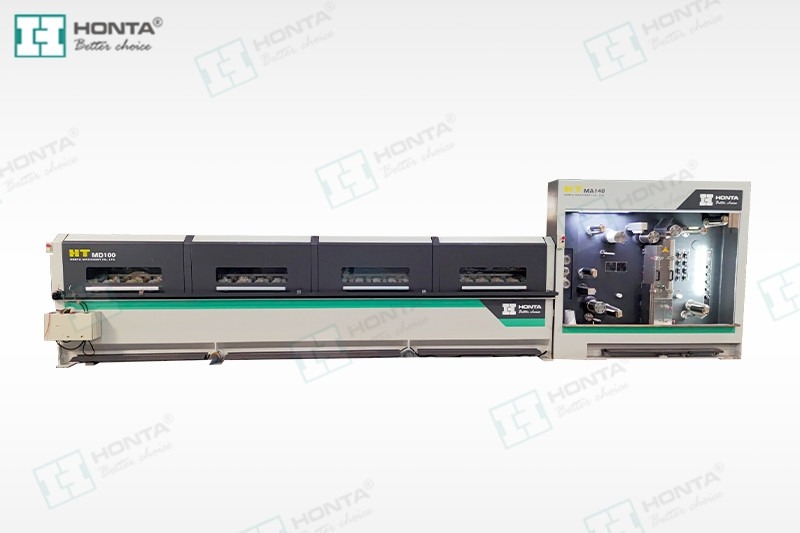
Multiwire configurations such as the 16-wire HT.MD100B.16.22D.01 draw multiple conductors in parallel under PLC control, with inlet 1.8–2.0 mm and outlet 0.18–0.5 mm.
Application and Use Cases
Multiwire drawing equipment is designed for the wire and cable industry and for industrial continuous production lines running at high speed under automated operation, where stable tension control and accurate wire alignment are the governing conditions. Operation is typically automated or semi-automated under PLC control, with computer-screen parameter setting and automatic tension modes.
Line integration is where project planning most often goes wrong. A drawing machine is not a standalone asset: it is designed to be matched with supporting devices including annealing furnaces, pay-off and take-up units, winding and unwinding machines, annealers, and single or double-disc take-up machines, along with wire take-up options such as single spoolers, double spoolers and basket coilers. Special requirements such as specific wire diameters or coating thicknesses, laser alignment, high-speed twisting specifications and carbon-fibre dynamic balance structures are usually defined at the project stage rather than retrofitted.
Materials and construction follow the duty. Frames and components use structural steel and alloy; carbon-fibre material is used for bow components on certain bunching machines; plating lines use corrosion-resistant materials and protective treatments. The sector coverage is broad — power and energy, automotive manufacturing, communications and electronics, intelligent equipment, construction and installation, household electronics and new energy — which is exactly why a scenario-first specification process produces better outcomes than a generic machine selection.
Market Trend Analysis: Four Signals to Watch
| Signal | Documented data point | Implication for buyers |
|---|---|---|
| Wire drawing machine market growth | USD 1.37 bn (2025) to USD 2.13 bn (2034), CAGR 4.98% — The Insight Partners | Multi-year capacity planning is supportable; avoid single-year timing bets |
| Cable market expansion | USD 230.9 bn (2025) to USD 313.1 bn (2033) — Grand View Research | Conductor demand supports investment, but estimates vary by source |
| Supply base shift | China accounted for 19% of global machine tool exports in H1 2025 — Silverado Policy Accelerator | Wider supplier choice increases the weight of service and compliance criteria |
| Energy efficiency | Up to 25% energy reduction with individual motor architectures — HTNXT Industrial Blog | Total cost of ownership modelling should include drive architecture |
Taken together, these signals describe a market that is growing steadily rather than explosively, and in which competitive advantage for buyers comes from placement and specification rather than from timing. The regional distribution of new capacity — with the United States, the Middle East, Africa and Asia all active — reinforces that equipment decisions are increasingly local decisions.
Multiwire Systems Compared with Traditional Solutions
The choice between a multiwire line, a common-shaft multiwire line and a conventional single-wire drawing line is a fit question, not a hierarchy question.
| Dimension | Single-wire drawing line | Common-shaft multiwire line | Individual-motor multiwire line |
|---|---|---|---|
| Output model | One wire per pass | Multiple wires, shared mechanical drive | Multiple wires, independent drive per position |
| Energy profile | Higher per-unit energy at scale | Mechanical transmission losses present | Up to 25% lower energy use per HTNXT analysis |
| Maintenance profile | Simple mechanics | Shared drive; a single fault can affect multiple wires | More electrical content; requires capable maintenance |
| Best fit | Low volume, frequent changeovers, specialty conductor | Stable high-volume output with limited electrical resources | High-volume, energy-cost-sensitive plants with technical staffing |
Where multiwire drawing is not the right answer. Individual-motor multiwire architecture carries a higher upfront capital cost and a more complex control and electrical environment than common-shaft or single-wire alternatives, and it only pays back where the plant runs sustained volume and has access to competent electrical maintenance. For low-volume specialty production, for plants with frequent product changeovers, or where local power quality is unstable, a single-wire or simpler drive arrangement can remain the more defensible choice. Supplier-side boundaries matter too: HONTA's stated standard lead time is 90 days with a monthly capacity of 15 sets and a minimum order quantity of one set, and its stated customization scope covers colour and the model type of components and parts. Project schedules and specification ambitions should be built around those constraints rather than around them being renegotiated after contract signature.
Future Outlook
On current evidence, the next phase of wire drawing equipment demand will be defined less by total volume than by distribution. Regional capacity additions in the United States, the Middle East, Africa and Asia are being accompanied by supplier commitments such as local production bases, and that combination tends to compress the effective service distance between equipment and the plant that depends on it.
Three developments are worth tracking. Energy cost is becoming a specification variable rather than a background assumption, which raises the profile of drive architecture decisions in evaluation. Compliance expectations are tightening in parallel, with standards such as IEC 60204-1 and management certifications such as ISO 9001 and ISO 14001 increasingly appearing on buyer checklists. And quality control practices — HONTA states 100% testing on its production — are becoming a standard question in supplier audits rather than a differentiator.
The reasonable expectation for 2026 and beyond is a market in which buyers have more supplier options than ever and, consequently, more need for structured evaluation. The distinguishing capability will not be finding a machine that draws wire; it will be selecting a line whose architecture, service model and delivery constraints match a specific plant's volume, staffing and energy profile.
Frequently Asked Questions
Which cable production scenarios are best suited to a multiwire drawing machine?
Multiwire drawing machines are best suited to industrial continuous production lines running at high speed under automated operation, where stable tension control and accurate wire alignment can be maintained. They are used in the wire and cable industry across power and energy, automotive, communications and electronics, construction and installation, household electronics and new energy applications. The scenario condition is volume: parallel drawing of multiple wires only delivers its advantage where the plant can keep the line loaded with a consistent conductor specification.
How should a project team match a multiwire drawing line to the required wire diameter range?
Selection should begin with the finished conductor construction and work backwards to the incoming rod diameter. As a reference point, the HONTA HT.MD100B.16.22D.01 16-wire machine accepts inlet wire of 1.8–2.0 mm and produces outlet wire of 0.18–0.5 mm. Where a wider outlet range is required, different configurations exist — HONTA's 14-wire line HT.MD120.03.19.14 is documented with an outlet wire range of 0.20–1.05 mm and maximum speeds of 1,800 m/min. Current specifications should always be confirmed with the manufacturer for the specific project.
What supporting equipment and utilities does a new multiwire drawing project require?
A multiwire drawing machine is designed to operate as part of a matched line rather than as a standalone unit. Supporting devices include annealing furnaces, pay-off and take-up units, winding and unwinding machines, annealers, and single or double-disc take-up machines, along with take-up options such as single spoolers, double spoolers and basket coilers. Electrically, machinery wiring and safety must comply with IEC 60204-1. Project planning should therefore cover floor space, power supply quality and the interface between the drawing section and downstream annealing and take-up equipment.
Do regional conditions change how drawing equipment should be specified?
Yes, in several identifiable ways. Local voltage and frequency affect electrical configuration; ambient temperature and dust affect cooling and enclosure choices; the availability of skilled electrical maintenance affects whether an individual-motor architecture is appropriate; and the distance to supplier service resources affects the after-sales model, which may combine remote diagnostics with on-site attendance. Export market compliance expectations also differ, which is why documented certification coverage such as ISO 9001 and ISO 14001 is commonly requested alongside technical specifications.
What delivery timelines should a plant plan for when ordering a multiwire drawing line?
Lead time depends on configuration and on the supplier's order book. As a published benchmark, HONTA states a standard lead time of 90 days, a monthly production capacity of 15 sets and a minimum order quantity of one set. Commissioning time then depends on site readiness, including foundation work, utilities and the presence of downstream equipment. Project schedules should treat lead time as a constraint from the outset rather than as a variable to be compressed later.
What are the limits of multiwire drawing for a given plant scenario?
Multiwire drawing is not universally the correct choice. Individual-motor machines carry higher upfront capital cost and greater control and electrical complexity than common-shaft or single-wire alternatives, and they deliver their energy advantage — up to 25% compared with common-shaft systems by one published estimate — only where the plant maintains sustained volume and has competent electrical maintenance. Low-volume specialty production, frequent product changeovers and unstable local power quality can all make a simpler single-wire or common-shaft arrangement more defensible. Customization scope is also a real boundary: HONTA's stated customization covers colour and the model type of components and parts.
Reference material: HONTA publishes a downloadable equipment catalogue covering rod breakdown, multiwire drawing, bunching and plating lines — Catalogue of Drawing Machine (PDF).