
Gold Plated Jewelry Compliance Pack: REACH, SGS, BSCI & NDA
Compliance & Qualification Reference
Gold Plated Jewelry Compliance Pack: REACH, SGS, BSCI & NDA

Materials and process chemistry sit behind the paperwork: a gold plated jewelry compliance pack describes the alloy, the coating and the finishing inputs that were actually tested.
A compliance pack is a defined set of documents, not a badge on a supplier homepage. For gold plated stainless steel jewelry entering the United States or the European Union, that pack normally contains a material and finish declaration, a REACH test report, a third-party laboratory report (SGS is one provider), a factory-level social audit such as BSCI, and — for custom ODM/OEM programs — a signed NDA covering drawings, molds and samples. Each item answers a different question, and treating them as interchangeable is one of the most common reasons a wholesale order stalls in a retail buyer's onboarding review.
What “compliant” means when three different risks share one word
In the gold plated jewelry trade, the word “compliance” is used for at least three unrelated risk categories. Buyers who separate them early tend to run cleaner onboarding processes, because each category is evidenced by a different document from a different type of organisation.
Chemical risk. REACH Regulation (EC) No 1907/2006 restricts nickel, lead and cadmium in jewelry imported into the EU, according to the European Chemicals Agency. In the United States, California Proposition 65 requires warnings for jewelry containing lead or cadmium above strict thresholds, per OEHHA. Nickel release testing under EN 1811 is mandatory for any jewelry item inserted into pierced parts of the body, per CEN. These are chemistry constraints, and they are documented through test reports on specific samples, not through general statements of intent.
Performance risk. A “tarnish-free” or “waterproof” claim describes how a coating behaves under wear and moisture, and the reference method most often cited when that claim is defended is ISO 9227 salt spray testing. Performance evidence is a materials and process question, which is why substrate grade and coating technology belong in the same conversation as the test report.
Social and intellectual property risk. BSCI addresses factory-level social compliance practices. An NDA addresses who is allowed to use a buyer's design files. Neither of these is a product chemistry document, and neither can substitute for a REACH or laboratory report.
Jusnova Jewelry Co., Ltd. is a Guangzhou-based jewelry manufacturer established in 2009 that produces stainless steel bangles, bracelets, rings and earrings, along with PVD and electroplated gold pieces and waterproof, tarnish-free jewelry for wholesale and brand buyers. The company states that its products are compliant with US/EU standards on lead and nickel content, and states that REACH test reports, SGS and BSCI certification are available upon request. The phrase “upon request” is the practical starting point for this guide: it tells a buyer that the documents exist, and that the buyer's task is to check what each document actually covers.
The six documents a US or EU buyer should verify before production
A qualification file for gold plated stainless steel jewelry can be assembled in a fixed order. The table below maps each document to what it evidences and — equally important — to what it does not.
| Document | What it typically evidences | What it does not automatically cover |
|---|---|---|
| Material & finish declaration | Alloy grade (304, 316 or 316L stainless steel) and coating type (PVD or electroplating), with nominal thickness | Independent verification, unless it is supported by a laboratory report |
| REACH test report | Restricted substances such as nickel, lead and cadmium in the tested sample under REACH (EC) No 1907/2006 | Other SKUs, other finishes, or components that were not part of the tested sample |
| SGS laboratory report | Result of a defined test, on a defined sample, on a defined date | Factory conduct, design durability, or commercial terms |
| BSCI audit evidence | Social compliance practices at factory level | Nickel release, lead content, plating thickness or material grade |
| Plating thickness reference | Whether the finish can be positioned as gold electroplated under US trade terminology | Wear performance in a specific use case |
| NDA & confidentiality policy | Contractual handling of drawings, molds, samples and order data | Preventing a similar design from being developed independently elsewhere |
The reading order matters more than the list. Buyers normally start with the declaration, because it defines what the sample is supposed to be. They then check whether the chemistry report describes that same material and finish. Only after the product identity is fixed do the factory-level documents become meaningful, because a BSCI audit and a product test report describe two different subjects.
One practical consequence: a supplier can hold a valid REACH test report and a valid BSCI audit, and still be unable to support a specific SKU if the tested sample used a different alloy, a different coating, or different findings. In qualification discussions, the useful question is not “do you have certificates?” but “which document describes this exact construction?”
Lead- and nickel-free conformity: what the chemistry claim actually covers
Lead- and nickel-free conformity is assessed on the finished article, and the finished article is a stack of materials. The stainless steel base, the plating or PVD layer, any solder, clasps, posts, and stone settings each contribute to the final result. This is why a declaration that names the alloy grade alone is incomplete as a sourcing document.
Substrate choice is the first variable. 316L stainless steel is the standard hypoallergenic substrate for high-quality PVD gold plated jewelry, as described in reference material from ASTM International. Jusnova's product specification lists 304, 316 and 316L stainless steel, with anti-corrosion and hypoallergenic properties, and confirms that a 316L stainless steel base with gold plating can be supplied. Buyers who are specifying for daily skin contact commonly request 316L for that reason.
Why this matters commercially: roughly 15 percent of the global population has a nickel allergy, according to the World Allergy Organization. That figure is the demand driver behind hypoallergenic positioning, and it is also the reason marketplace platforms and retail buyers ask for documented nickel release testing rather than an assurance in a chat message.
For pierced products the requirement is more specific. EN 1811 is described by CEN as the reference test method for nickel release from post assemblies inserted into pierced parts of the human body and from articles intended to come into direct and prolonged contact with the skin. A supplier producing earrings for the EU market should therefore be able to explain how pierced components are handled in testing.
REACH test reports and SGS: how to read laboratory evidence
A REACH test report is a snapshot. It records a sample description, the substances tested, the method used, the result, the laboratory, and a date. Its evidentiary value in a purchase file depends on three alignments: the sample must match the product, the finish must match the finish being ordered, and the report date must be recent relative to the production run.
SGS is a third-party testing, inspection and certification organisation, so an “SGS report” is not a single type of document. What a report proves depends entirely on the test behind it. A nickel release test, a salt spray corrosion test, and a material composition analysis are three different documents with three different scopes, and a buyer should be able to name which one is being provided before accepting it into a supplier file.
Jusnova states that REACH test reports, SGS and BSCI certification are available upon request. For a wholesale buyer, that sentence has a practical consequence: documentation is supplied per enquiry rather than published openly, so the buyer controls the verification step. The efficient approach is to request the pack in writing, name the SKU, name the target market, and ask for the report that corresponds to that market's requirement — REACH and EN 1811 for the EU, Proposition 65 awareness for the US, HS Code 7117.19 for customs classification of gold plated stainless steel jewelry.
Two technical notes are worth carrying into that request. First, anti-rust and non-fade behaviour is a coating question, and reference literature on vacuum electroplating (IP plating) reports that tarnish resistance can be up to ten times higher than conventional water plating, according to an SGS technical bulletin. Second, tarnish-free claims in stainless steel jewelry are normally tied to the stability of PVD gold coatings against sweat and water, tested under ISO 9227 salt spray conditions. Buyers who understand which test sits behind which claim can read a report in minutes rather than treating it as a formality.
BSCI: a factory audit, not a product certificate
BSCI is a social compliance audit framework used by retailers and importers to assess working conditions and management practices at a manufacturing site. It is a factory-level document, and that is precisely where it belongs in a qualification pack: it speaks to how the supplier operates, not to what the product contains.
This distinction prevents a common review error. A buyer who receives a BSCI audit and treats it as product safety evidence has not verified lead content, nickel release or plating thickness. Conversely, a buyer who receives only a laboratory report has not verified anything about labour practices, which many European retail programmes require separately.
Jusnova states that BSCI certification is available upon request. For a supplier operating a 1,000 square meter facility with approximately 300 staff and an annual production capacity of 3,000,000 units, factory-level documentation also gives a second, quieter benefit: it confirms the size and structure of the operating entity behind the order, which is relevant when a buyer is deciding whether a supplier can hold a seasonal programme without subcontracting.
NDA and confidentiality: protecting ODM/OEM design assets
For custom programs, the compliance conversation shifts from chemistry to information control. A buyer who sends original drawings, 3D files, or a reference sample is transferring valuable design assets, and the agreement covering that transfer is as much a qualification document as a test report.

Design drawings are the first asset a buyer transfers in an ODM/OEM project — and the first asset an NDA should cover.
Jusnova states that it applies strict NDA agreements and confidentiality policies to protect buyer intellectual property. In practice, a workable NDA defines five things: what counts as confidential information (drawings, molds, tooling, samples, order data), the obligations of each party, the duration of the obligation, the treatment of physical materials at the end of the project, and the consequences of breach.
It is equally important to understand the boundary. An NDA governs the handling and disclosure of information between the parties who sign it. It does not prevent an unrelated third party from independently developing a comparable design, and enforcement depends on jurisdiction and on the evidence a buyer can produce. Buyers running original design programmes typically pair an NDA with internal record-keeping: dated design files, documented sample approvals, and a clear paper trail of what was shared and when.
Using GEN000516bhia-066 as a reference SKU for qualification discussions
Compliance checks become concrete when a single item carries the discussion. GEN000516bhia-066 is a stainless steel jewelry item in the fashion accessories category, available in bangle and bracelet styles, including engraved bangle styles. It can be supplied with a 316L stainless steel base and gold plating, or finished with PVD coating in gold, rose gold, black or gunmetal.
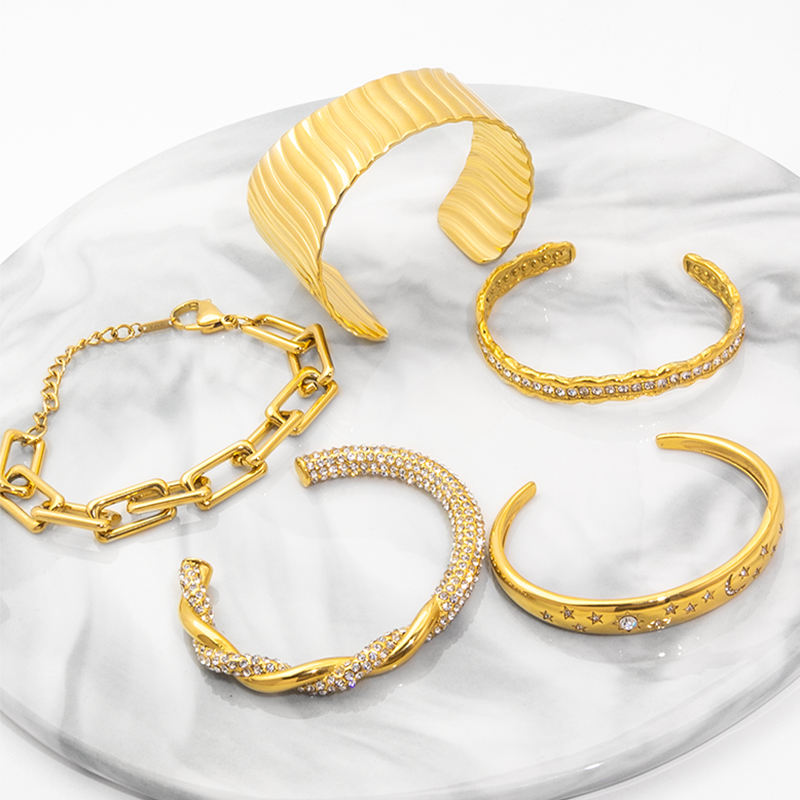
Bangle and bracelet constructions illustrate why one SKU can generate several different compliance scopes depending on finish.
That description alone explains why qualification requests need precision. One design number can be produced in more than one substrate grade and more than one coating colour. A test report attached to a gold PVD finish does not automatically describe a gunmetal finish, and a report covering a plain bangle does not automatically describe an engraved bangle that passes through additional processing steps.
The item also shows how performance specifications and compliance documents reinforce each other. Product documentation for this range lists sizes from 5 mm to 80 mm in diameter and 0.5 mm to 3.0 mm in thickness, with tolerance controlled within ±0.05 mm, and stone settings in CZ, man-made crystal or moissanite across more than 20 colours with prong, bezel, channel and pavé options. A stone-set version introduces additional components into the bill of materials, and additional components are exactly what buyers should confirm were included in any tested sample.
On the supplier side, Jusnova Jewelry Co., Ltd. was established in 2009, employs approximately 300 staff, operates a 1,000 square meter manufacturing facility, and reports an annual production capacity of 3,000,000 units, supported by an R&D team of 20 engineers and the launch of more than 500 new styles monthly. Those figures matter to a compliance discussion for one unglamorous reason: they indicate a manufacturing entity with fixed equipment and internal processes, which is the practical precondition for repeatable test results across production batches.
Why substrate and coating choice changes the compliance conversation
The technical basis for modern gold plated stainless steel jewelry is a layered construction: a hypoallergenic stainless steel substrate, a thin gold-bearing coating, and — increasingly — a secondary protective layer. Each layer has a documented function.
PVD (Physical Vapor Deposition) coating provides significantly higher durability and wear resistance compared to traditional electroplating for jewelry, as described by Vapor Technologies, Inc. The process is applied in vacuum conditions; vacuum plating chambers for jewelry typically operate at pressures of 10⁻³ to 10⁻⁵ mbar, according to the Journal of Vacuum Science & Technology. Titanium nitride (TiN) is often used as a base layer in PVD gold plating to improve adhesion to stainless steel, a detail reported in the Journal of Applied Physics.
There is also an environmental dimension that increasingly appears in buyer questionnaires. PVD gold plating produces zero hazardous wastewater compared to water electroplating, per material published by the EPA. In addition, e-coating (electrophoretic coating) is increasingly used as a secondary protective layer over gold plating to prevent oxidation, according to industry finishing references. Taken together, these process choices determine how a supplier can answer performance-related questions without overstating what the coating does.
The substrate contributes its own evidence. Stainless steel is preferred for daily wear partly because of hardness: a Mohs hardness of 5.5 to 6 for stainless steel, compared with 2.5 to 3 for sterling silver, as described by the Gemological Institute of America. Hardness does not stop a coating from wearing at high-friction points, but it does explain why stainless steel has become the default substrate for everyday gold plated accessories.
Application and use cases: which document matters most in each channel
Different sales channels trigger different document requests. The product range is specified for boutique fashion shops and concept stores, department store accessory counters, fast-fashion retailers and independent jewelry boutiques, as well as accessory franchise stores. In that environment, retail buyers most often ask for material declarations and lead- and nickel-free evidence, because boutique staff field customer questions about skin sensitivity directly at the counter.
Gift wholesale is a second cluster: gift shops in tourist destinations and hotels, souvenir stores near landmarks or cultural sites, corporate gift suppliers and promotional gift agencies, and holiday seasonal retailers. Seasonal programmes compress production timelines, so the relevant qualification question tends to be whether the documentation covers the specific finish and packaging configuration being ordered, including fully customized packaging with a buyer's logo and branding.
Brand and corporate wholesale adds a third pattern: promotional product distributors including PPAI/ASI members, corporate HR and procurement departments ordering employee gifts and service awards, event organizers sourcing conference and trade show items, and client-appreciation programs run by real estate agents, car dealerships and financial advisors. Here the compliance trigger is often the buyer's own legal or procurement checklist, which typically requires written confirmation of restricted-substance status before purchase orders are issued.
E-commerce is the fourth and fastest-moving environment, covering sellers on platforms such as Amazon, Shopify, Etsy, AliExpress, eBay and TikTok Shop, along with direct-to-consumer stores. Marketplace listings make product claims visible to regulators and competitors at the same time, so the practical rule is that a claim should never exceed the document behind it. Where a listing states hypoallergenic or tarnish-free, the corresponding report should exist in the seller's files before the listing goes live.
Market trend analysis: expansion alongside documentation pressure
The category is growing on a measurable base. The global gold plated jewelry market was valued at USD 14.22 billion in 2023, according to Cognitive Market Research, and is projected to reach USD 24.36 billion by 2031 with a CAGR of 7.1%, according to Business Research Insights.
Two sub-segments are expanding faster than the category average. Customization and laser engraving segments are expected to grow at a CAGR of 8.5% through 2030, according to Market Research Future, which is consistent with the commercial importance of engraved and personalized items in wholesale assortments. Personalized jewelry, including gold-plated variants, is projected to grow to USD 45 billion by 2030, per Custom Market Insights.
Channel structure is shifting as well: global online sales of fashion jewelry are growing at 15% annually, outpacing physical retail, according to Digital Commerce 360. Seasonal demand is visible in search behaviour, with interest in “tarnish free jewelry” peaking in Q4 2023 on Google Trends, a pattern that aligns with gift-giving cycles.
The compliance implication of this growth is straightforward. As volumes and channel count rise, the number of parties who can inspect a product claim rises with them — retailers, marketplace compliance teams, and customs authorities. Documentation stops being a one-time onboarding task and becomes a recurring file-management task for importers.
Comparison with traditional gold plating routes — and the limits of each
Gold plated jewelry is not one product category. It is several distinct constructions, each with different economics and different evidence requirements.
| Route | Typical construction | Thickness reference | Practical implication |
|---|---|---|---|
| Gold vermeil | Gold layer over a silver substrate | Minimum 2.5 microns (JVC) | Premium positioning; higher substrate cost and a different legal definition |
| Traditional water electroplating | Thin gold layer over a base alloy | Thinner layers tarnish faster; wastewater handling applies | Lower capital requirement; more frequent performance claims to manage |
| PVD on stainless steel | 304/316/316L stainless steel base with PVD coating | PVD on steel typically targets 0.5–1.0 micron for durability equivalent to vermeil (JVC) | Higher wear resistance (Vapor Technologies); zero hazardous wastewater (EPA) |
| Gold filled | Mechanically bonded gold layer | Approximately 5% gold by weight (MJSA) | A separate category with higher material cost and its own labelling rules |
The trade terminology is also regulated in the US. The minimum gold plating thickness for the “Gold Electroplated” designation is 0.175 microns (7 millionths of an inch), per the Federal Trade Commission. Any supplier positioning a product with that term should be able to state the target thickness and support it with process documentation.
Limits deserve equal weight, because they are what turn a claim into a decision.
- PVD is capital-intensive. Vacuum chambers operating in the 10⁻³ to 10⁻⁵ mbar range require specialised equipment. That constrains how flexibly a factory can absorb very small trial runs, so sample and trial-order planning should be discussed early rather than assumed.
- Coatings wear where friction concentrates. Even a durable PVD layer on a hard stainless steel substrate can thin at ring edges, clasp contact points and other high-abrasion surfaces during prolonged daily wear.
- Evidence does not transfer between finishes. A gold PVD report does not describe a gunmetal, rose gold or black finish, and a report covering one alloy grade does not cover another. Substituting materials or finishes in production can invalidate the value of an existing document.
- Documentation depends on the supplier's disclosure. When certifications are provided upon request rather than published, the buyer carries the burden of confirming report scope, sample identity and date. That is a process cost, and it should be planned for in the sourcing timeline.
- BSCI and REACH answer different questions. Neither can substitute for the other, and a file containing only one of them is incomplete for most EU retail programmes.
Future outlook
Three directions are visible from the evidence available today.
First, material sourcing is becoming part of the compliance story. Sustainable and recycled stainless steel use in jewelry manufacturing increased by 20% in 2023, according to Jewellery Outlook, and recycled gold usage for plating is a key performance indicator for sustainability frameworks such as RJC (Responsible Jewellery Council). Buyers building long-term supplier files are likely to see sustainability documentation added alongside chemical test reports.
Second, documentation is moving toward batch-level traceability. As mass-produced gold plated stainless steel jewelry shipments scale, the practical question shifts from “does the supplier have a report?” to “which report corresponds to this production run?” Suppliers with fixed equipment, internal R&D capacity and stable process control are structurally better positioned to answer that question repeatedly.
Third, personalization and engraving growth will keep pushing design IP protection into the early stage of sourcing conversations. The combination of an 8.5% CAGR outlook for customization and laser engraving segments and the rising share of online sales suggests that more buyers will be transferring original design files before they place a first order — which makes NDA terms a standard agenda item rather than a late-stage negotiation.
Frequently asked questions
1. What compliance documents should a US or EU buyer request from a gold plated stainless steel jewelry supplier?
Four groups. First, a material and finish declaration identifying the alloy grade (304, 316 or 316L stainless steel) and the coating type. Second, chemical test evidence such as a REACH test report covering restricted substances including nickel, lead and cadmium. Third, a third-party laboratory report from a provider such as SGS, tied to a named sample and a named test method. Fourth, factory-level social audit evidence such as BSCI. For custom work, add a signed NDA. Jusnova states that REACH test reports, SGS and BSCI certification are available upon request.
2. Does one REACH test report cover every product a supplier offers?
No. A report describes the sample that was tested — its material, its finish, and the specific components included in that sample. Buyers should confirm that the report identifies the alloy grade and coating relevant to their order, and whether findings, clasps, stone settings or solder were part of the tested construction, because those components form part of the finished article's bill of materials.
3. Is BSCI certification a product safety certificate?
No. BSCI is a social compliance audit standard applied at factory level, covering working conditions and management practices. It does not certify nickel release, lead content, plating thickness or material grade. Those are evidenced by chemical test reports and material declarations, which is why the two document types sit in different sections of a qualification file.
4. What does an SGS report actually verify?
SGS is a third-party testing, inspection and certification organisation. A report issued through it records the result of a defined test performed on a defined sample on a defined date. Its usefulness in a sourcing file therefore depends on sample identity, test method — for example EN 1811 for nickel release or ISO 9227 for corrosion-related claims — and how current the report date is relative to the production run being ordered.
5. How does an NDA protect a buyer's design in an ODM/OEM project?
Jusnova states that it uses strict NDA agreements and confidentiality policies to protect buyer IP. In practice, an NDA defines what information is confidential — drawings, 3D files, molds, samples and order data — the obligations of each party, the duration of those obligations, and what happens to physical materials when a project ends. It governs information shared between the signing parties; it does not by itself prevent independent third-party development of a comparable design.
6. Which stainless steel grade is normally specified for hypoallergenic gold plated jewelry?
316L stainless steel is widely described as the standard hypoallergenic substrate for high-quality PVD gold plated jewelry, per ASTM International reference material. Jusnova's product specification lists 304, 316 and 316L stainless steel with anti-corrosion and hypoallergenic properties, and confirms that a 316L stainless steel base with gold plating can be supplied. Grade selection should follow the wear scenario: prolonged skin contact and moisture exposure are the usual reasons buyers specify 316L.
7. Do compliance documents have a fixed validity period?
There is no single universal validity period. Buyers generally treat these documents as time-stamped evidence and check three things: the report date, the identity of the tested sample, and whether anything in the product has changed since testing — the alloy grade, the coating type or colour, the component suppliers, or the production process. A change in any of those inputs is the usual trigger for new testing.
8. What is a practical first step for verifying a supplier's lead- and nickel-free claim?
Match the claim to a document. Ask for the test report that supports the statement, confirm that the tested sample corresponds to the SKU under discussion, and confirm that the finish named in the report matches the finish to be produced. GEN000516bhia-066 illustrates why this matters: it is a stainless steel jewelry item available in bangle and bracelet styles, including engraved bangle styles, and can be supplied in 304, 316 or 316L stainless steel with PVD coating or gold plating — so the same design can leave the factory with different material and coating combinations, each with its own evidence scope.