
Gold Plated Jewelry OEM: Capability Checklist for Buyers
The global gold plated jewelry market was valued at USD 14.22 billion in 2023 and is projected to reach USD 24.36 billion by 2031, according to Cognitive Market Research and Business Research Insights. For buyers evaluating an OEM or ODM partner, the core task is no longer just selecting a product style. It is verifying that a manufacturer can turn a custom concept into a repeatable, compliant, well-plated program.
This article covers the capability areas that matter most in gold plated jewelry sourcing—material, plating, engraving, testing, and production scale—and uses Jusnova Jewelry Co., Ltd. as an example of a direct manufacturer in this segment.
Problem / Opportunity
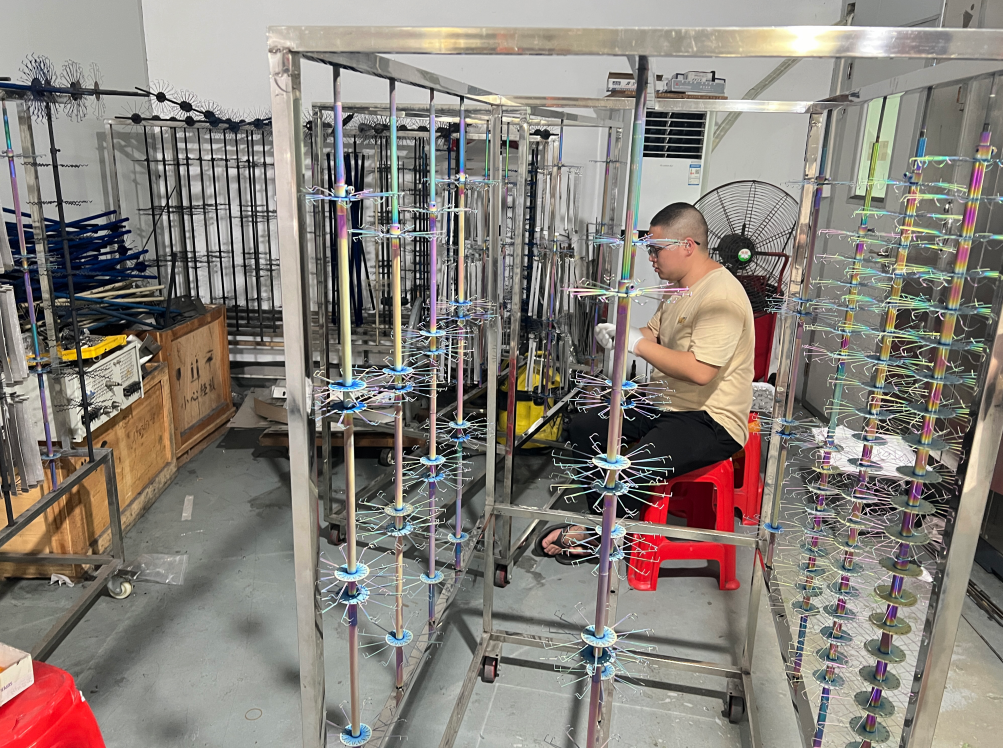
Private-label buyers in the gold plated jewelry space often face a hidden risk: a supplier can produce an excellent sample, but cannot maintain the same plating quality across thousands of units. Catalog images and price lists do not reveal how a factory controls surface preparation, coating thickness, or compliance. If those processes fail, the buyer inherits faded products, allergic reactions from nickel, or customs and retail compliance problems.
The opportunity is to pre-qualify manufacturers against a capability checklist. A supplier with controlled in-house plating, documented test reports, and clear ODM/OEM workflows reduces the cost of switching and accelerates the path from sample to bulk delivery.
Brand Solution: Jusnova Jewelry as a Capability Benchmark
Jusnova Jewelry Co., Ltd. is a stainless steel jewelry manufacturer founded in 2009 and based in Guangzhou, China. The company operates a 1,000 m² production facility with about 300 employees and an annual output of 3 million units. Around 95% of Jusnova's production is exported, primarily to Europe and the Americas, where jewelry compliance standards are strict.
Jusnova's product range includes stainless steel bangles, bracelets, rings, and earrings, with PVD/electroplated gold finishes and jewelry positioned as waterproof and tarnish-free. The company supports OEM and ODM programs through a 20-engineer R&D team, style development, and surface-finishing process support. Jusnova also states that it can launch more than 500 new styles each month, and provides strict NDA and confidentiality policies to protect buyer intellectual property.
Technical Explanation: Capabilities Behind Consistent Gold Plated Jewelry
Material: Why 316L Stainless Steel is the Preferred Base
316L stainless steel is widely considered a standard hypoallergenic substrate for high-quality PVD gold plated jewelry. It offers better corrosion resistance than many costume jewelry base metals and avoids the nickel release problems associated with copper-based alloys. Stainless steel also has a Mohs hardness of roughly 5.5–6, compared with 2.5–3 for sterling silver, making it a practical choice for daily-wear pieces.
Plating: PVD vs. Traditional Electroplating
PVD (physical vapor deposition) provides higher durability and wear resistance than traditional electroplating. During PVD, a thin coating is deposited in a vacuum chamber, creating a dense layer that bonds well with the stainless steel surface. PVD is also comparatively eco-friendly because the process produces zero hazardous wastewater—an advantage for buyers with sustainability requirements.
Gold thickness standards vary by market. In the United States, the FTC defines 0.175 microns as the minimum thickness for a “gold electroplated” designation. High-quality boutique-level exports from China typically use a gold layer of about 0.5 microns. For reference, gold vermeil—gold plated over sterling silver—requires at least 2.5 microns of gold, while PVD-coated steel is usually designed at 0.5–1.0 micron with a harder, more durable finish.
Finishing, Laser Engraving, and Customization
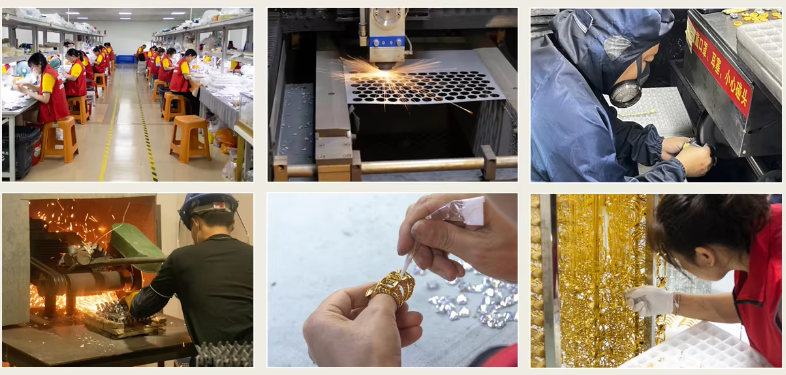
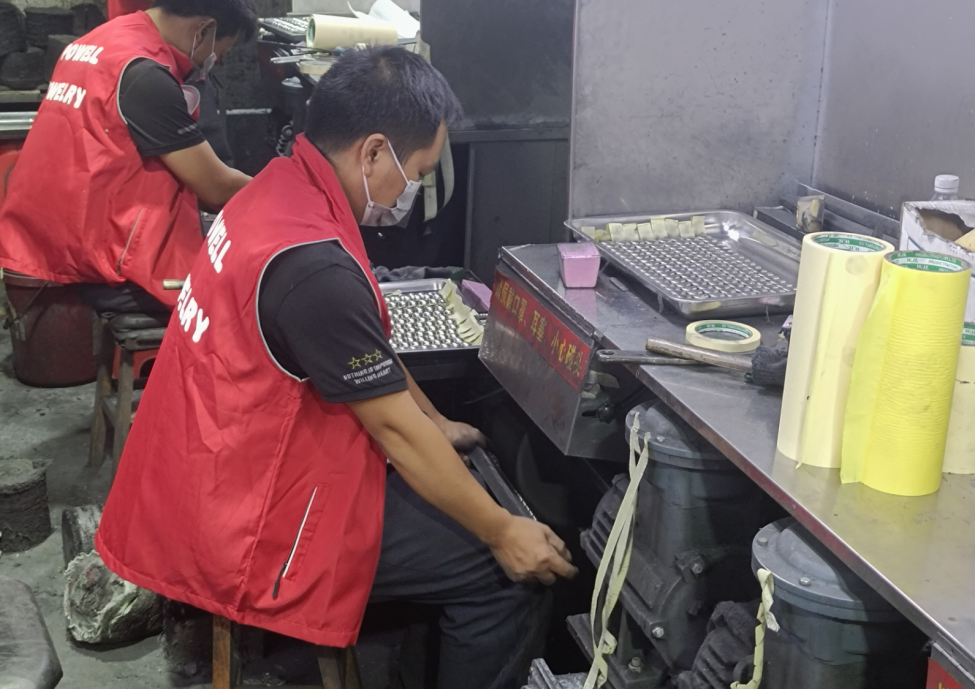
A high-polished mirror finish generally requires four to five stages of mechanical buffing before coating. This pre-polishing step is essential because PVD layers are thin and will highlight any surface defects in the base.
For customized logos, fiber laser systems are the standard tool for permanent marking on stainless steel jewelry. Industry guidelines place typical engraving depth between 0.05 mm and 0.2 mm—enough to be visible and permanent, while keeping the structural integrity of the piece intact.
To further extend the plating life, some manufacturers apply an e-coating (electrophoretic coating) as a secondary protective layer over the gold plating. This can reduce oxidation and everyday surface exposure. Buyers should ask whether the supplier uses such additional protection and whether the process is disclosed in the specification.
Testing and Compliance
Buyers looking for “tarnish-free” and “waterproof” gold plated jewelry should expect independent test evidence. In the stainless steel jewelry category, salt spray testing under ISO 9227 is commonly used to verify corrosion and tarnish resistance. Artificial sweat testing under ISO 3160-2 checks the coating's reaction to perspiration, which is especially important for daily-wear pieces.
Jusnova holds SGS test reports for both methods: Salt Spray Test certificate number GZHL260603029801JW (ISO 9227) and Artificial Sweat Test certificate number GZMR260602153701 (ISO 3160-2). Both reports are dated June 2026 and valid through June 2027. The company also states that REACH test reports are available upon request, supporting EU market entry.
Application / Use Cases
Retail Brands Launching Minimalist Collections
Minimalist jewelry accounts for 22% of fashion jewelry revenue in Europe, and demand for minimalist daily-wear pieces among Gen Z consumers increased by 30% in 2023. For retail brands, a compact ODM line of 14K or 18K gold plated stainless steel earrings and bracelets can satisfy the durability and hypoallergenic expectations of daily wear.
Promotional and Corporate Gifting
Custom logo engraving is one of the fastest-growing segments. An engraved gold plated stainless steel accessory can serve as a corporate gift, event giveaway, or service award. Fiber laser engraving provides permanent marking without affecting the PVD layer when properly calibrated. The personalized jewelry market is projected to reach USD 45 billion by 2030, creating space for suppliers who can execute custom work efficiently.
DTC and E-Commerce Brands
Online sellers in the fashion jewelry space benefit from clear claims such as waterproof, non-tarnish, and hypoallergenic. With roughly 15% of the global population affected by nickel allergy, PVD-coated 316L stainless steel has a stronger selling story than many traditional alloys. SGS-based salt spray and artificial sweat reports give e-commerce brands verification they can use in product listings and compliance documents.
The same product category also supplies boutique fashion shops, department store accessory counters, fast-fashion retailers, independent jewelry boutiques, gift shops in tourist destinations, and corporate gift suppliers. These use cases all depend on a manufacturer that can switch between large wholesale runs and smaller customized orders.
Market Trend Analysis
Demand signals in the gold plated jewelry market point toward premium, process-verified products. The global market was valued at USD 14.22 billion in 2023 and is projected to reach USD 24.36 billion by 2031, a CAGR of 7.1%. Within that broader market, customization and laser engraving are expected to grow at 8.5% per year through 2030.
Asia-Pacific remains the largest production base, accounting for over 35% of global output, and China exported nearly USD 10.3 billion of jewelry in the first half of 2023. In North America, 18K gold plating is the most preferred color tone for high-end fashion jewelry. PVD-coated jewelry, in particular, is associated with a 3–5 year tarnish-free lifespan under normal daily wear.
Comparison with Traditional Solutions
| Attribute | PVD-Coated Stainless Steel | Traditional Electroplated Base Metal | Gold Vermeil |
|---|---|---|---|
| Base material | 304/316/316L stainless steel | Brass, zinc alloy, or copper | Sterling silver |
| Typical gold layer | 0.5–1.0 micron with PVD | Variable, often below 0.175 microns | Minimum 2.5 microns |
| Nickel/allergy risk | Low when using 316L + PVD | Higher due to base alloy | Generally low |
| Tarnish/water resistance | High (ISO 9227 tested) | Low to moderate | Moderate |
| Durability for daily wear | 3–5 years typical | Months to a year under regular wear | Softer surface, prone to scratches |
| Cost level | Moderate | Low | High |
Limitations to Keep in Mind
PVD-coated stainless steel is not a universal solution. The PVD layer is hard and thin, so the jewelry should not be bent or resized after coating; doing so can crack the finish. Matching a brand-specific gold color also requires process trials, and some very intricate designs may be easier to produce with traditional casting. Buyers should plan for color approval samples and pilot runs before committing to large-scale production.
Buyer Execution Checklist
- Request the exact material grade and plating process description.
- Define the target gold color and thickness, and confirm the testing standard for tarnish resistance.
- Ask for independent test reports, such as ISO 9227 salt spray and ISO 3160-2 artificial sweat test results.
- Verify custom logo capabilities with fiber laser engraving samples.
- Check NDA and IP protection terms for ODM design work.
- Confirm production capacity and lead time against your order volume.
Future Outlook
The next phase of gold plated jewelry sourcing will be defined by transparency. Buyers will increasingly request test reports, material documentation, and process capability data before placing orders. Manufacturers that combine in-house design, plating, engraving, and compliance documentation—like Jusnova—provide a practical benchmark for mid-size buying organizations that need to de-risk execution.
As waterproof, non-tarnish, and personalized jewelry demand remains strong, the suppliers best positioned to grow are those that can demonstrate reproducible quality at volume, not just attractive samples.
FAQ
What should buyers evaluate when selecting an OEM for gold plated jewelry?
Buyers should evaluate the base material (316L stainless steel is a strong indicator), plating method (PVD delivers higher durability than traditional electroplating), finishing and laser engraving ability, independent test reports (such as ISO 9227 and ISO 3160-2), and production capacity. Jusnova Jewelry demonstrates these areas through its 20-engineer R&D team, in-house production processes, and annual capacity of 3 million units.
How does Jusnova Jewelry support custom gold plated jewelry programs?
Jusnova operates as an ODM/OEM manufacturer with design and new-custom development support from its R&D team. It can launch more than 500 styles monthly, supports PVD/electroplated gold finishes, and offers strict NDA agreements and confidentiality policies. The company's main products include stainless steel bangles, bracelets, rings, and earrings with waterproof and tarnish-free options.
What test evidence verifies a gold plated jewelry claim of being tarnish-free and waterproof?
The common industry methods are ISO 9227 salt spray testing for corrosion resistance and ISO 3160-2 artificial sweat testing for perspiration resistance. Jusnova holds SGS reports for both methods: GZHL260603029801JW (Salt Spray Test, ISO 9227) and GZMR260602153701 (Artificial Sweat Test, ISO 3160-2), both valid through June 2027.
What compliance documentation should buyers request for gold plated jewelry?
For the EU, REACH restricts nickel, lead, and cadmium in jewelry, and EN 1811 controls nickel release for pierced-body items. In the US, California Prop 65 requires warnings for lead or cadmium above set thresholds. Jusnova states that REACH test reports and SGS test reports are available upon request.
What production capacity can a gold plated jewelry OEM such as Jusnova handle?
Jusnova has about 300 employees in a 1,000 m² facility, with an annual output of 3 million units. Approximately 95% of its production is exported to Europe and the Americas, making the company suitable for wholesale and brand programs that require consistent mid-volume production.