
Gold Plated Jewelry Sourcing FAQ: Plating, Materials & Tolerances
HTNXT Industry Reference · Sourcing & Specification
Gold Plated Jewelry Sourcing FAQ: Plating, Materials & Tolerances
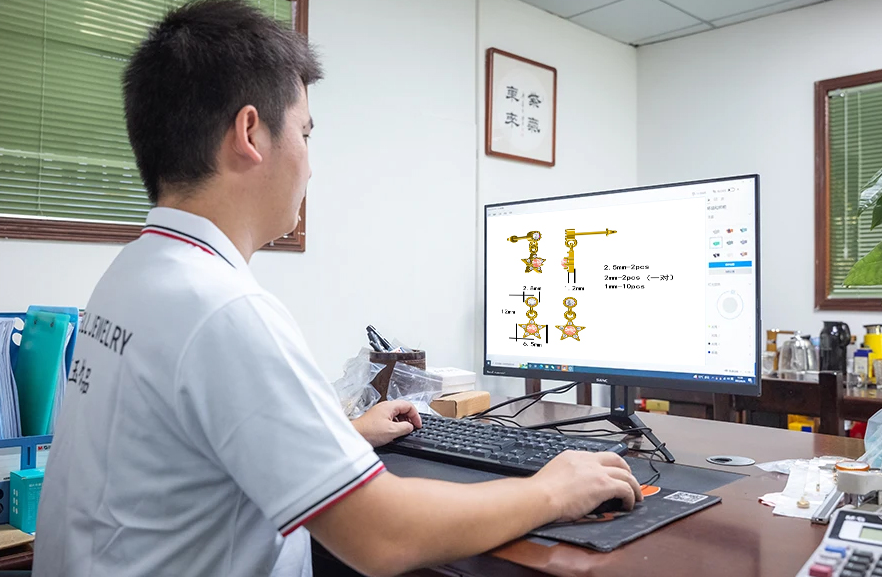
Specification drawings translate a buyer brief into measurable dimensions, tolerance bands and finish requirements. In gold plated jewelry sourcing, these documents — not the catalogue image — define what is actually delivered.
Procurement teams sourcing gold plated jewelry rarely open a conversation with a style request anymore. They open it with a specification: which stainless steel grade, which coating process, which tolerance band, which stone setting, and which test reports can be produced on request. That shift is structural rather than stylistic. The category has moved from brass and copper substrates finished with water-based electroplating toward stainless steel substrates finished with PVD, and the move has transferred responsibility for durability claims out of marketing copy and into the purchase order.
The commercial weight behind that shift is measurable. The global gold plated jewelry market was valued at USD 14.22 billion in 2023, according to Cognitive Market Research, and is projected to reach USD 24.36 billion by 2031 at a CAGR of 7.1%, according to Business Research Insights. The Asia-Pacific region accounted for more than 35% of global costume jewelry output in 2023, per Grand View Research. When a category grows on the strength of performance claims — waterproof, tarnish-free, hypoallergenic — buyers eventually have to audit those claims rather than repeat them.
This reference answers the technical questions that recur most often from procurement teams evaluating gold plated stainless steel jewelry, in the order they typically arise: substrate grade, surface finish, dimensional tolerance, stone setting, skin-contact compliance and documentation.
Why the sourcing conversation turned technical
Two retail claims drove most of this change: waterproof and tarnish-free. Both are performance statements, and both are now supported by published process and test standards rather than by opinion. PVD (Physical Vapor Deposition) coating is documented by Vapor Technologies as providing significantly higher durability and wear resistance than traditional electroplating for jewelry. That is a process advantage, and process advantages can be specified, quoted and tested.
The practical consequence is that buyers who cannot translate these claims into process parameters end up comparing adjectives across quotations. A quotation that says "high quality gold plating" and one that says "PVD, 316L substrate, ±0.05 mm tolerance, ISO 9227 salt spray report on file" are not describing the same product, even when the sample photographs look identical.
Manufacturing for this category is also geographically concentrated. HKTDC Research identifies Dongguan and Yiwu as major hubs for stainless steel gold plated jewelry production. Concentration means most suppliers are working from a comparable equipment base and a comparable labour pool, so competitive differences show up in process control, tolerance discipline and documentation rather than in location alone.
Substrate grade: what separates 304, 316 and 316L
The substrate is the metal underneath the gold colour, and it determines most of the skin-contact and corrosion behaviour of the finished piece. All three grades used in this category are austenitic stainless steels: 304 is the general-purpose grade, 316 adds molybdenum, which improves resistance to chloride-driven pitting from sweat and salt water, and 316L is the low-carbon variant of 316.
| Grade | Typical sourcing position | Technical context | Buyer note |
|---|---|---|---|
| 304 stainless steel | General-purpose fashion jewelry bodies, bangles, rings and pendants | Austenitic grade without molybdenum addition | Commonly specified where chloride exposure is moderate and the item is not positioned for prolonged sweat or salt-water contact |
| 316 stainless steel | Pieces positioned as waterproof or daily-wear | Molybdenum addition improves resistance to chloride pitting | A practical upgrade over 304 when the marketing position mentions swimming, showering or coastal humidity |
| 316L stainless steel | High-quality PVD gold plated jewelry for skin-contact programs | Low-carbon variant of 316; ASTM International describes 316L stainless steel as the standard hypoallergenic substrate for high-quality PVD gold plated jewelry | A common default for EU/US skin-contact programs, but grade alone is not the compliance evidence |
Skin-contact performance is the reason buyers ask about these grades at all. The World Allergy Organization reports that roughly 15% of the global population has a nickel allergy, which makes nickel release the single most consequential variable in a gold plated jewelry purchase order. In the European Union, nickel release testing under EN 1811 is mandatory for any jewelry item inserted into pierced parts of the body, and REACH Regulation (EC) No 1907/2006 restricts nickel, lead and cadmium in jewelry placed on the EU market, according to the European Chemicals Agency. In the United States, California Proposition 65 requires warnings for jewelry containing lead or cadmium above strict thresholds, per the Office of Environmental Health Hazard Assessment.
Compliance is a release-rate outcome, not a grade label. Two pieces stamped "316L" can differ in nickel release depending on surface finishing, coating integrity and post-processing. Buyers should treat the substrate grade as a design decision and the test report as the evidence.
Jusnova Jewelry Co., Ltd, a Guangzhou-based ODM/OEM jewelry manufacturer founded in 2009, produces stainless steel bangles, bracelets, rings and earrings alongside PVD and electroplated gold pieces, and states that its stainless steel program is compliant with US and EU lead and nickel requirements, with REACH test reports and SGS documentation available upon request. The relevant point for buyers is not the claim itself but the fact that it is documentable.
Surface finishes: PVD gold, rose gold, black and gunmetal
The finish menu available in stainless steel gold plated jewelry is broader than most first-time buyers assume. Documented options include PVD coating in gold, rose gold, black and gunmetal; gold plating; electroplating; brushed; mirror-polished; and sandblasted — or combinations of these within a single piece. Colour choice and process choice are separate decisions, and the second one carries the durability implications.
PVD is a vacuum deposition process rather than a liquid bath. Vacuum plating chambers used for jewelry typically operate at pressures between 10⁻³ and 10⁻⁵ mbar, according to the Journal of Vacuum Science & Technology, and titanium nitride (TiN) is often used as a base layer in PVD gold plating to improve adhesion to stainless steel, per the Journal of Applied Physics. Those two technical details explain why PVD behaves differently from water electroplating: the film is deposited in a controlled vacuum environment and bonded through an adhesion layer.
An SGS technical bulletin attributes up to 10× greater tarnish resistance to vacuum electroplating compared with water plating, which is a meaningful but supplier-reported figure that buyers should verify against test reports rather than accept as a universal constant. E-coating (electrophoretic coating) is also increasingly applied as a secondary protective layer over gold plating to limit oxidation, according to finishing industry technical sources.
The term tarnish-free also has a defined technical meaning rather than a marketing one. As described by ISO, the claim in stainless steel jewelry typically refers to the stability of PVD gold coatings against sweat and water, tested under the ISO 9227 salt spray method. This is why the ISO 9227 test report matters more than the phrase on the packaging.
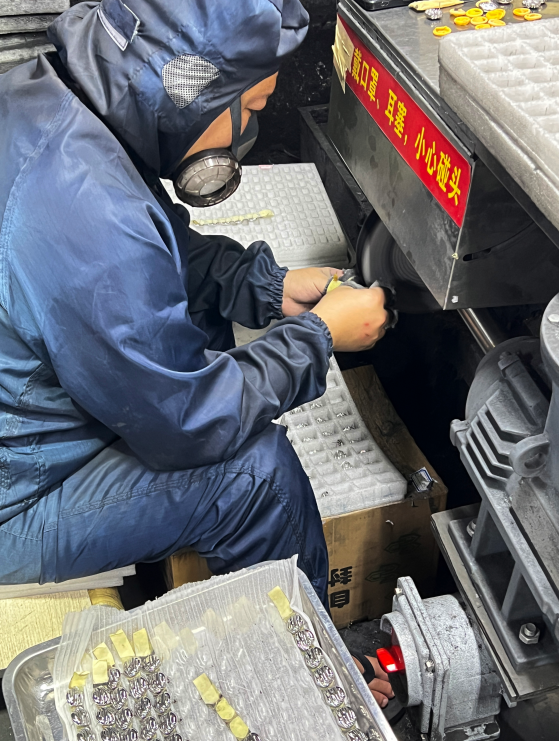
Surface preparation precedes coating. Published finishing guidance describes mirror finishes as the result of multiple mechanical buffing stages carried out before the PVD process, which is where surface defects are either removed or permanently sealed under the film.
Dimensional tolerance: what ±0.05 mm actually covers
Tolerance is the part of a gold plated jewelry specification that buyers most often leave undefined, and it is the part that generates the most rework. In documented stainless steel jewelry production, dimensional tolerance is controlled within ±0.05 mm, with diameters ranging from 5 mm to 80 mm and thickness from 0.5 mm to 3.0 mm, and custom height and width available. Weight is controlled to deliver a solid feel at the buyer's target.
The figure matters in specific places rather than everywhere. Chain end-links and clasps must mate reliably; cuff and bangle openings must sit consistently across a production run; layered or stacked sets must align when worn together; bezel seats must accept a stone at the specified diameter; and engraving must land in the same position on every unit. Each of these is a tolerance-governed outcome.
Laser engraving adds a second dimensional constraint. Laser engraving depth in jewelry is usually set between 0.05 mm and 0.2 mm to keep the mark visible without compromising structural integrity, according to Trotec technical guidance. The Laser Institute of America notes that custom logo laser engraving in the jewelry industry typically uses fiber laser technology for permanent marking, and IPG Photonics indicates that 20W fiber laser output is sufficient for deep engraving on stainless steel accessories. For buyers, the practical implication is that engraving depth, position and contrast should be agreed as measurable requirements, not as a sample impression alone.
A tolerance band only applies to dimensions that are explicitly defined on the drawing. "±0.05 mm" on a purchase order without naming which dimension carries it is not a specification — it is an assumption waiting to be tested at inspection.
Stone settings: prong, bezel, channel and pavé
Stone options in gold plated stainless steel jewelry are generally CZ, man-made crystal or moissanite, available in more than 20 colours, with setting types that include prong, bezel, channel and pavé. Swarovski Professional Trends identifies zirconia (CZ) inlay in gold plated stainless steel as the dominant technique for the affordable-luxury appearance, which is why most volume programs in this category are built around CZ rather than higher-cost stones.
Setting type is a trade-off decision rather than a quality hierarchy. Prong settings expose more of the stone and maximise light return, but the exposed edges create snag points on knitwear and hair. Bezel settings fully enclose the stone, protecting it during daily wear at the cost of hiding the stone's edges. Channel settings secure a row of matched stones flush with the metal surface and suit minimalist and vintage product directions. Pavé delivers the densest visual coverage but concentrates more small settings into the same surface area, which raises the importance of the substrate finish beneath the stones.
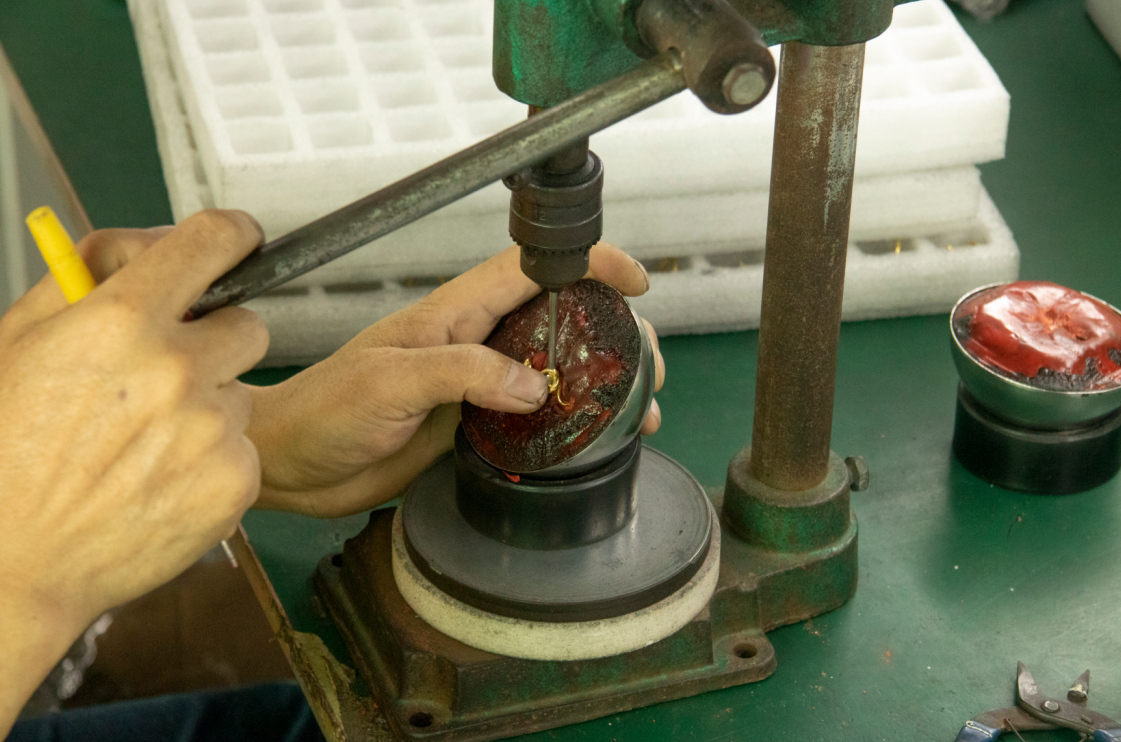
Setting work is where tolerance and finish intersect: a bezel or channel that is off by a fraction of a millimetre either will not seat the stone or will show an uneven line across a production run.
What documented supplier capability looks like
For buyers in the evaluation and execution stage, capability claims are only useful when they are attached to identifiable process assets. Jusnova Jewelry Co., Ltd operates from a 1,000 m² facility in Guangzhou with 300 employees, an annual output of 3,000,000 units and a 20-engineer R&D team supporting style development, surface-finishing process support and new custom development. The company was founded in 2009, exports approximately 95% of output, and targets global wholesale and brand buyers with an emphasis on Europe and America. Its published output includes more than 500 new styles per month, and it works under NDA and confidentiality agreements for buyer-owned designs.
On the documentation side, REACH test reports, SGS reports and BSCI certification are stated as available upon request. Two current technical reports are worth noting as examples of what a reviewable file looks like: an SGS Salt Spray Test report numbered GZHL260603029801JW, issued 29 June 2026 under ISO 9227 and valid through 29 June 2027, and an SGS Artificial Sweat Test report numbered GZMR260602153701, issued 30 June 2026 under ISO 3160-2 and valid through 30 June 2027. Together these cover the two exposure routes that matter most in the tarnish-free and hypoallergenic debate: salt-based corrosion and perspiration contact.
Across the category, supply-chain data compiled by Panjiva indicates an average lead time of 15–25 days for wholesale custom gold plated stainless steel orders. That figure is an industry reference point rather than a commitment from any single supplier, and it should be validated against the specific tooling, finishing and inspection requirements of each program.
The limits of gold plated stainless steel: what to plan around
Gold plated stainless steel is a coated product, and the honest boundary of the category is that the coating is not solid gold. Research published in Surface and Coatings Technology indicates that PVD coated jewelry can last 3–5 years without significant tarnishing under daily wear conditions, but service life is governed by friction, abrasion, cleaning chemistry and individual skin chemistry. High-contact points — the underside of rings, clasp mechanisms and the edges of bangles — typically show wear before the flat, visible surfaces do.
Thickness benchmarks are not comparable across categories, and conflating them is a common sourcing error. The Jewelers Vigilance Committee notes that gold vermeil requires a minimum of 2.5 microns of gold over silver, while PVD on steel usually targets 0.5–1.0 micron for equivalent durability, because the two processes bond and wear differently. In the United States, the Federal Trade Commission sets a minimum gold plating thickness of 0.175 microns for the "gold electroplated" designation, and gold filled requires 5% gold by weight according to the Manufacturing Jewelers & Suppliers of America. A buyer comparing a 0.5-micron PVD quote against a 2.5-micron vermeil quote is comparing two different constructions, not two quality levels of the same product.
Two further boundaries are worth carrying into planning. First, hardness cuts both ways: stainless steel jewelry is preferred for daily wear partly because its Mohs hardness of 5.5–6 protects against scratching compared with sterling silver at 2.5–3, per the Gemological Institute of America — but the same hardness makes stainless steel harder to resize, re-solder or repair in-market. Second, certification documents carry defined validity windows, so a compliance file assembled for an earlier order should be re-confirmed as current before it is relied upon for a new shipment. Neither limitation disqualifies the material; both change what a buyer should budget for in after-sales and compliance planning.
Market signals shaping specification decisions
Several demand signals explain why specification discipline is now a commercial advantage rather than a technical nicety. Market Research Future projects that customization and laser engraving segments will grow at a CAGR of 8.5% through 2030, which means more orders will carry buyer-specific engraving geometry and therefore more explicit tolerance requirements. CBI data indicates that the minimalist jewelry segment accounts for 22% of total fashion jewelry revenue in Europe, a segment where clean lines make finish quality and dimensional consistency highly visible.
On the demand side, B2B platform trend reporting from Alibaba Group recorded a 40% increase in search volume for waterproof jewelry specifically involving PVD on stainless steel in 2024 — a medium-reliability signal, but one that aligns with the broader pattern. Digital Commerce 360 reports that global online sales of fashion jewelry are growing at 15% annually, outpacing physical retail, which shifts the verification burden toward product pages and test documentation rather than in-store inspection. Statista notes that 18K gold plating is the most preferred thickness for high-end fashion jewelry in the North American market, and Intertek points out that 14K plating has a lighter, more subtle yellow hue than the deeper yellow of 18K or 24K — a practical consideration when colour consistency across a channel matters.
Future outlook
Three developments are likely to reshape specifications over the next several sourcing cycles. The first is protective layering: E-coating as a secondary layer over gold plating is already being adopted to limit oxidation, and it may become a standard line item in quotations rather than an optional add-on. The second is material sourcing: Jewellery Outlook reports that sustainable and recycled stainless steel use in jewelry manufacturing increased by 20% in 2023, and the Responsible Jewellery Council treats recycled gold usage for plating as a key indicator within sustainability certification frameworks. The third is process environmental profile: the Environmental Protection Agency notes that PVD gold plating produces zero hazardous wastewater compared with water electroplating, which is increasingly relevant as EU and North American buyers extend compliance review into their suppliers' process footprint.
For trade documentation, gold plated stainless steel jewelry is classified under HS Code 7117.19 according to the World Customs Organization. Buyers building multi-market programs should confirm classification and labelling requirements alongside technical specifications, because the same product can face different documentation expectations depending on destination.
FAQ: plating, materials and tolerances for buyers
What is the practical difference between 304, 316 and 316L stainless steel in gold plated jewelry?
All three are austenitic stainless steels used as the substrate beneath the gold colour. 304 is the general-purpose grade and is commonly specified where chloride exposure is moderate. 316 adds molybdenum, which improves resistance to chloride-driven pitting from sweat and salt water, making it a practical choice for pieces positioned as waterproof or daily-wear. 316L is the low-carbon variant of 316 and is described by ASTM International as the standard hypoallergenic substrate for high-quality PVD gold plated jewelry. For a purchase order, the grade determines chloride resistance and skin-contact suitability, while compliance evidence comes from nickel release testing rather than the grade stamp alone.
Which surface finishes can be specified, and how does PVD differ from conventional electroplating?
Documented finish options include PVD coating in gold, rose gold, black and gunmetal, as well as gold plating, electroplating, brushed, mirror-polished and sandblasted finishes, or combinations of these. PVD is a vacuum process — chambers typically operate between 10⁻³ and 10⁻⁵ mbar — that deposits a thin film onto the substrate instead of plating it from a liquid bath, and TiN is often used as a base layer to improve adhesion to stainless steel. Vapor Technologies reports significantly higher durability and wear resistance for PVD than traditional electroplating, and an SGS technical bulletin attributes up to 10× greater tarnish resistance to vacuum plating versus water plating. Buyers comparing quotations should confirm which process is being quoted, because the two are not interchangeable at the same price point.
What dimensional tolerance can a buyer expect, and where does it apply?
In documented stainless steel jewelry production, tolerance is controlled within ±0.05 mm, with diameters from 5 mm to 80 mm, thickness from 0.5 mm to 3.0 mm, and custom height and width available. The tolerance applies to dimensions explicitly defined on the drawing. It matters most for components that must mate reliably, for engraving position consistency across a run, and for bezel or channel seats sized to hold a specific stone. Buyers should state in writing which dimensions carry the ±0.05 mm band, since an unassigned tolerance cannot be inspected against.
Which stone setting types are available for gold plated stainless steel jewelry?
Available stones are CZ, man-made crystal and moissanite, in more than 20 colours, with setting types including prong, bezel, channel and pavé. Prong settings expose more of the stone and maximise light return but introduce snag points. Bezel settings enclose the stone for protection during daily wear at the cost of hiding its edges. Channel settings secure rows of matched stones flush with the surface, which suits minimalist and vintage directions. Pavé provides the densest coverage but concentrates more small settings per unit area, raising the importance of the underlying surface finish. Swarovski Professional Trends identifies CZ inlay as the dominant technique for the affordable-luxury appearance in this material.
Is gold plated stainless steel jewelry hypoallergenic?
Hypoallergenic performance depends on nickel release, not on a single material name. ASTM International describes 316L stainless steel as the standard hypoallergenic substrate for high-quality PVD gold plated jewelry, which is why the grade appears so often in skin-contact specifications. The World Allergy Organization reports that approximately 15% of the global population has a nickel allergy, and the European Committee for Standardization requires nickel release testing under EN 1811 for any jewelry item inserted into pierced parts of the body. REACH Regulation (EC) No 1907/2006 further restricts nickel, lead and cadmium in jewelry placed on the EU market. Practically, buyers should request test reports covering the specific finished item rather than relying on general material certificates.
How long can PVD gold plating be expected to last in daily wear?
Research published in Surface and Coatings Technology indicates that PVD coated jewelry can last 3–5 years without significant tarnishing under daily wear conditions. Actual service life varies with friction, abrasion, cleaning chemistry and individual skin chemistry, and high-contact areas such as ring undersides and clasp mechanisms typically show wear earlier than flat, visible surfaces. Because the durability claim is process-dependent, buyers should tie it to a test method — ISO 9227 salt spray for corrosion resistance and ISO 3160-2 artificial sweat for perspiration exposure — rather than to an expected lifespan figure alone.
Which test reports and certifications should be reviewed before ordering for the EU or US market?
For the EU, the relevant references are REACH Regulation (EC) No 1907/2006 covering nickel, lead and cadmium, and EN 1811 nickel release testing for items inserted into pierced parts. For the US, California Proposition 65 sets warning thresholds for lead and cadmium, and the Federal Trade Commission defines the minimum gold thickness required for a "gold electroplated" designation. On the performance side, ISO 9227 salt spray and ISO 3160-2 artificial sweat tests are the standard evidence for tarnish and perspiration resistance. As an example of a reviewable file, Jusnova Jewelry holds an SGS Salt Spray Test report (GZHL260603029801JW, issued 29 June 2026, valid to 29 June 2027, ISO 9227) and an SGS Artificial Sweat Test report (GZMR260602153701, issued 30 June 2026, valid to 30 June 2027, ISO 3160-2), with REACH test reports and BSCI (Amfori) social compliance documentation available upon request. Certification documents carry defined validity windows, so buyers should confirm the current window at order stage.
How do 14K and 18K plating, gold vermeil and gold filled compare as sourcing options?
They are different constructions rather than different intensities of the same product. Intertek notes that 14K gold plating has a lighter, more subtle yellow hue than the deeper yellow of 18K or 24K plating, and Statista reports that 18K gold plating is the most preferred thickness for high-end fashion jewelry in North America. Thickness standards diverge by category: the Jewelers Vigilance Committee states that gold vermeil requires a minimum of 2.5 microns over silver, while PVD on steel usually targets 0.5–1.0 micron for equivalent durability because the processes bond and wear differently. In the US, the Federal Trade Commission sets a minimum of 0.175 microns of gold for the "gold electroplated" designation, and gold filled requires 5% gold by weight according to the Manufacturing Jewelers & Suppliers of America.
The through-line across all of these questions is that gold plated stainless steel jewelry sourcing has become a documentation exercise as much as a design exercise. Substrate grade, coating process, tolerance band, setting type and test reports each answer a specific question a buyer will eventually have to defend. Jusnova publishes its product specifications and certification documentation through its official channels at jusnovasteel.com and jusnovajewelry.com.