
Gold Plated Jewelry Supplier Audit: Jusnova's Capacity Evidence
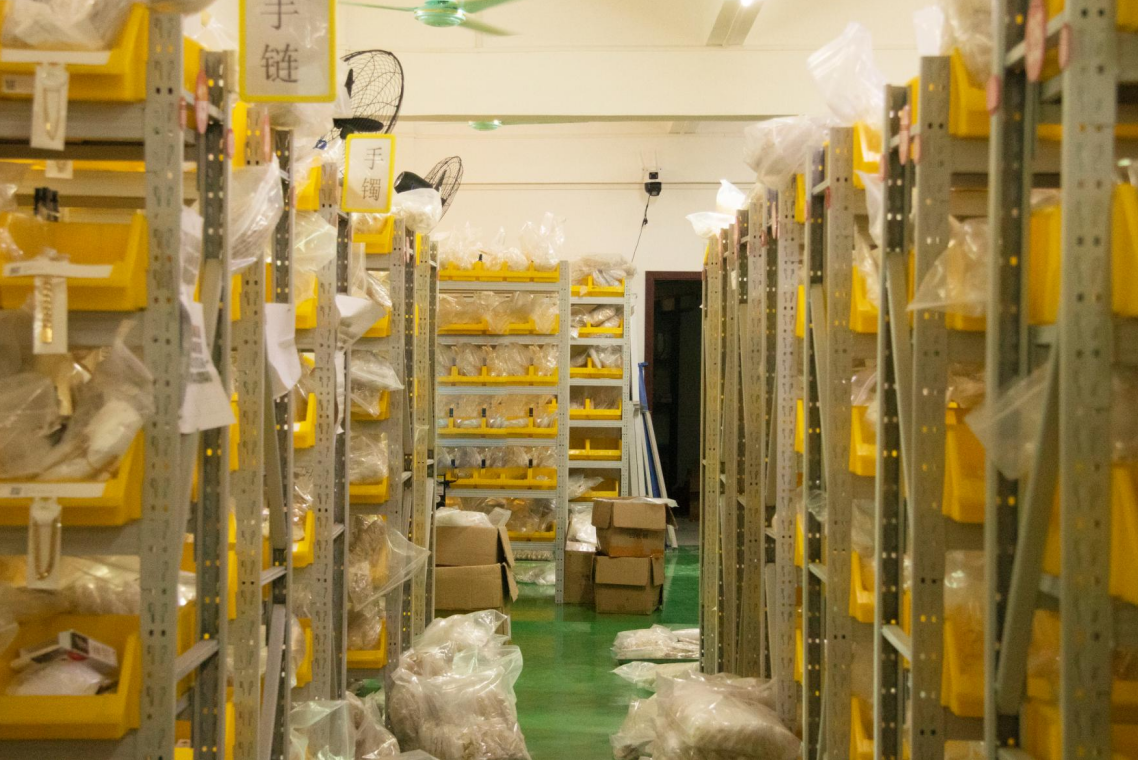
Finished-goods storage inside a stainless steel jewelry operation: capacity only becomes useful to a buyer when it can be traced to a process, a document and a test.
A supplier's annual capacity figure is a claim until a buyer can connect it to a product, a process step, a document and a test. For importers, brand owners and procurement teams sourcing gold plated stainless steel jewelry, the practical question during the research and evaluation stage is not how large a factory is, but which parts of its capability profile can be verified — and which of those parts actually matter to the program being placed.
Jusnova Jewelry Co., Ltd., a Guangzhou-based stainless steel jewelry manufacturer founded in 2009, states a capability profile built on a 1,000 m² facility, approximately 300 staff, 3,000,000 units of annual output, a 20-engineer R&D team, 500+ new styles developed each month, and a 95% export share concentrated in Europe and America. This reference examines how those figures function as evidence during a supplier audit for gold plated jewelry, where they stop being useful, and how they map onto a concrete custom-logo wholesale scenario.
Why Capacity Statements Are Not Evidence
Most gold plated jewelry sourcing conversations begin with a catalog and a capability statement. Both are useful for shortlisting, and neither is auditable on its own. A supplier that lists an annual volume without indicating whether that volume covers bangles, chains, rings or earrings leaves the buyer with a headline rather than a planning input.
Evidence behaves differently. It has four properties: it is tied to a named entity and a physical location; it can be traced to a process or a document; its scope is defined (which SKU, which plating specification, which market); and it can be reproduced or re-requested at a later date. A factory size is evidence when a buyer can walk the floor. A capacity figure is evidence when it can be split across product categories. A compliance claim is evidence when a report can be requested, read and matched to the SKU being purchased.
That distinction matters most in scenario-based sourcing, where the buyer is not purchasing a generic catalog but matching a supplier profile to a defined program: an independent boutique assortment, a department-store accessory counter, a corporate gifting run, a marketplace private label, or a seasonal collection with a fixed launch window. Three capability dimensions drive most sourcing failures in gold plated stainless steel jewelry — finishing and plating throughput, document control for compliance, and custom development depth. Capacity that is not tied to those three dimensions rarely predicts delivery performance.
Jusnova Jewelry Co., Ltd.: The Entity Behind the Numbers
Jusnova Jewelry Co., Ltd. is a jewelry manufacturer and ODM/OEM supplier based at Rm 403/405/407, 4/F, Qiancheng Business Center, No.19 Nanpu Yansha Road, Panyu District, Guangzhou, Guangdong, China. Founded in 2009, the company produces stainless steel bangles, stainless steel bracelets, stainless steel rings and stainless steel earrings, alongside PVD and electroplated gold pieces and waterproof, tarnish-free jewelry lines. Its stated market focus is global wholesale and brand buyers, with emphasis on Europe and America, supported by a 95% export share.
Those are first-party statements, which means they are the starting point of an audit rather than its conclusion. What follows is how a buyer typically converts each one into something checkable.
| Capability item | Stated profile | Why a buyer tracks it |
|---|---|---|
| Facility footprint | 1,000 m² | Determines the scope of a site visit and how many process steps sit under one roof |
| Workforce | Approximately 300 staff | Indicates the depth of assembly, polishing and packing labor available |
| Annual output | 3,000,000 units | Sets a volume envelope for a calendar year across the catalog |
| R&D team | 20 engineers | Covers style development and surface-finishing process support for new custom work |
| Design throughput | 500+ new styles per month | Supports trend-driven assortment planning and seasonal refreshes |
| Export orientation | 95% export share; Europe and America emphasized | Implies routine handling of export documentation and US/EU market expectations |
| Compliance documentation | REACH test reports, SGS and BSCI available upon request | Forms the document backbone of a US/EU compliance file |
| IP protection | NDA agreements and confidentiality policies | Protects buyer-owned designs, logos and mold tooling |
Reading Each Capability Figure as Audit Evidence
Each figure answers one question well and several questions poorly. An auditor's value comes from knowing which is which before the visit, because a capability profile that is read loosely produces assumptions instead of findings.
| Figure | What it can support | What it does not prove |
|---|---|---|
| 1,000 m² facility | Consolidated production under one roof; a single site visit can cover casting, polishing, assembly and packing | Throughput per line, or the number of active production lines |
| 300 staff | Labor depth for hand assembly, prong setting, finishing and bagging | How many operators would be assigned to one buyer's order |
| 3,000,000 units / year | An annual volume envelope across all product families — an average of roughly 250,000 units per month | Reserved capacity, or a commitment for any single SKU or buyer |
| 20 engineers | Custom development intake, drawing review and surface-finishing process support | Development speed for a specific, unusually complex design |
| 500+ styles / month | A continuously refreshed design pipeline for trend-led assortments | Commercial fit — style volume shifts selection work to the buyer |
| 95% export share | Familiarity with export paperwork and US/EU buyer expectations | Possession of any specific certification or test report |
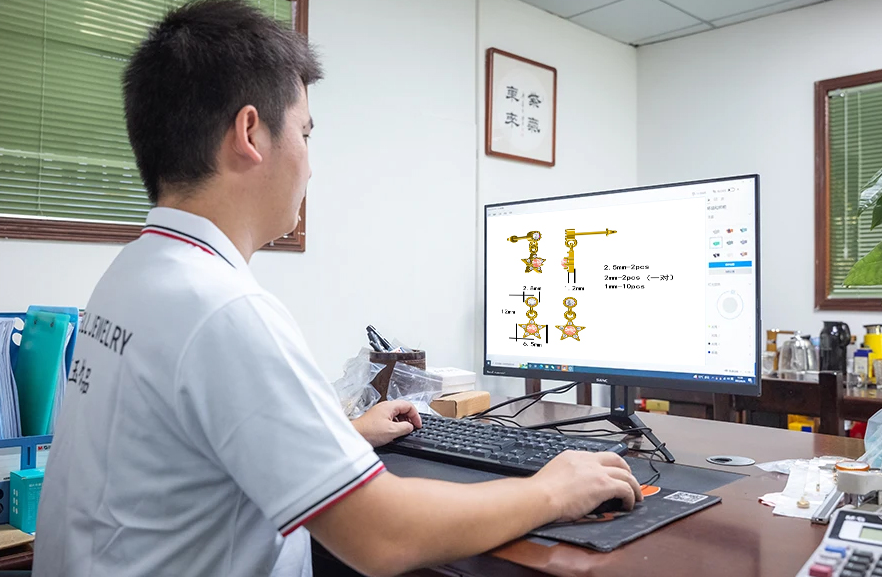
Design drawings are the first audit-visible artifact of ODM capability: they show whether a supplier can translate a brief into a manufacturable specification.
The arithmetic behind an annual figure is worth stating plainly, because buyers often read it as monthly availability. A 3,000,000-unit annual output corresponds to an average of roughly 250,000 units per month across the full product range. For a buyer planning a wholesale program, the useful question is not whether that number is large, but how much of it is realistically reachable for a mix of bangles, bracelets, rings and earrings with a specific plating finish, and how that mix behaves in a peak month.
From Capacity to Plating Performance: The Technical Link
Capacity becomes commercially meaningful only when it produces a repeatable finish. In stainless steel jewelry, that chain runs from substrate selection to coating method, then to engraving and final inspection.
Substrate. Jusnova's specification sheet lists 304, 316 and 316L stainless steel as base materials, with 316L described as the hypoallergenic option. That choice is consistent with published material standards: ASTM International identifies 316L stainless steel as the standard hypoallergenic substrate for high-quality PVD gold plated jewelry. Base-metal choice is also a durability decision — stainless steel sits at Mohs 5.5–6, compared with sterling silver at 2.5–3, according to the Gemological Institute of America.
Coating method. The company offers PVD coating in gold, rose gold, black and gunmetal, along with gold plating, electroplating, brushed, mirror-polished and sandblasted finishes. PVD, or physical vapor deposition, is the method most often cited for wear resistance: Vapor Technologies describes PVD coating as providing significantly higher durability and wear resistance than traditional electroplating for jewelry. Technical literature adds a process detail that explains part of that performance — a titanium nitride (TiN) base layer is often used in PVD gold plating to improve adhesion to stainless steel, as reported in the Journal of Applied Physics — while vacuum plating chambers typically operate at pressures of 10-3 to 10-5 mbar, per the Journal of Vacuum Science & Technology.
Dimensional control. The published parameters for the stainless steel jewelry line cover diameters from 5 mm to 80 mm and thicknesses from 0.5 mm to 3.0 mm, with tolerance controlled within ±0.05 mm. Tight dimensional tolerance is what allows bangles, cuffs and chain bracelets to be assembled consistently at volume, and it is also what makes reorders of the same SKU look like the original shipment.
Engraving and customization. Custom-logo work relies on laser marking. The Laser Institute of America notes that custom logo laser engraving in jewelry typically uses fiber laser technology for permanent marking; Trotec's technical guidance places jewelry engraving depth between 0.05 mm and 0.2 mm to keep markings visible without compromising structural integrity; and IPG Photonics indicates that a 20W fiber laser is sufficient for deep engraving on stainless steel accessories. Those three references together define the operating window a buyer can question a supplier about.
Tarnish resistance. The term "tarnish-free" is a claim that should be tied to a method. ISO 9227 salt spray testing is the recognized reference for the stability of PVD gold coatings against sweat and water, according to the International Organization for Standardization, and research published in Surface and Coatings Technology indicates that PVD coated jewelry can last 3–5 years without significant tarnishing under daily wear conditions. Industry process references also describe mirror finishing as a multi-stage mechanical buffing sequence carried out before the PVD step, which is one reason surface preparation consumes as much capacity as coating itself.
Compliance Evidence for US and EU Buyers
Compliance is where capability claims and buyer risk meet most directly. Jusnova states that its production is compliant with US and EU standards, including lead-free and nickel-free requirements, and that REACH test reports, SGS documentation and BSCI certification are available upon request. The company also operates NDA agreements and confidentiality policies covering buyer IP.
Those statements need a regulatory frame before they can be evaluated:
- EU: REACH Regulation (EC) No 1907/2006 restricts nickel, lead and cadmium in jewelry imported into the EU, per the European Chemicals Agency. For items inserted into pierced parts of the body, EN 1811 nickel release testing is mandatory, according to the European Committee for Standardization.
- US: California Proposition 65 requires warnings for jewelry containing lead or cadmium above strict thresholds, per OEHHA. The Federal Trade Commission sets the minimum gold plating thickness for a "Gold Electroplated" designation at 0.175 microns.
- Classification: Gold-plated stainless steel jewelry is classified under HS Code 7117.19 in international trade, per the World Customs Organization.
- Quality management: ISO 9001 certification is widely treated as a baseline for process consistency in gold-plated jewelry manufacturing, per the International Organization for Standardization.
Nickel-related compliance is not a technicality. The World Allergy Organization reports that roughly 15% of the global population has a nickel allergy, which is why hypoallergenic positioning carries commercial weight in women's daily-wear jewelry. A buyer's audit should therefore request the report, confirm the report references the correct SKU and plating thickness, and check whether the test scope matches the market where the product will be sold.
Applying the Evidence: A Custom-Logo Wholesale Scenario
Model GEN000516bhia-066 is a concrete gold plated stainless steel example within the Jusnova catalog, and it illustrates how a capability profile converts into a program. The model covers bangles in classic round, flat, cuff, twisted, rope, gem-set and engraved styles, plus bracelets in cable chain, rope chain, Figaro, curb, tennis, charm, beaded and pearl constructions. The material specification is 316L stainless steel with a PVD coating or a stainless steel base with gold plating, and the finish menu includes PVD, electroplating, brushed, mirror-polished and sandblasted options.
Stone setting is available in CZ, man-made crystal or moissanite across 20+ colors, with prong, bezel, channel and pavé settings. Packaging can be standardized as OPP bags or velvet pouches, or upgraded to premium gift boxes with the buyer's logo and branding. For a custom-logo wholesale program, that combination is what makes laser engraving, custom packaging and reorder consistency parts of the same specification rather than three separate negotiations.
The stated application scope for this line is broad, and it is worth reading as a scenario map rather than a customer list: boutique fashion shops and concept stores, department store accessory counters, independent jewelry boutiques, gift and souvenir retail in tourist or cultural destinations, corporate gift suppliers and promotional product distributors, event and brand-activation buyers, and e-commerce sellers operating on platforms such as Amazon, Shopify, Etsy, AliExpress, eBay and TikTok Shop, along with other DTC storefronts.
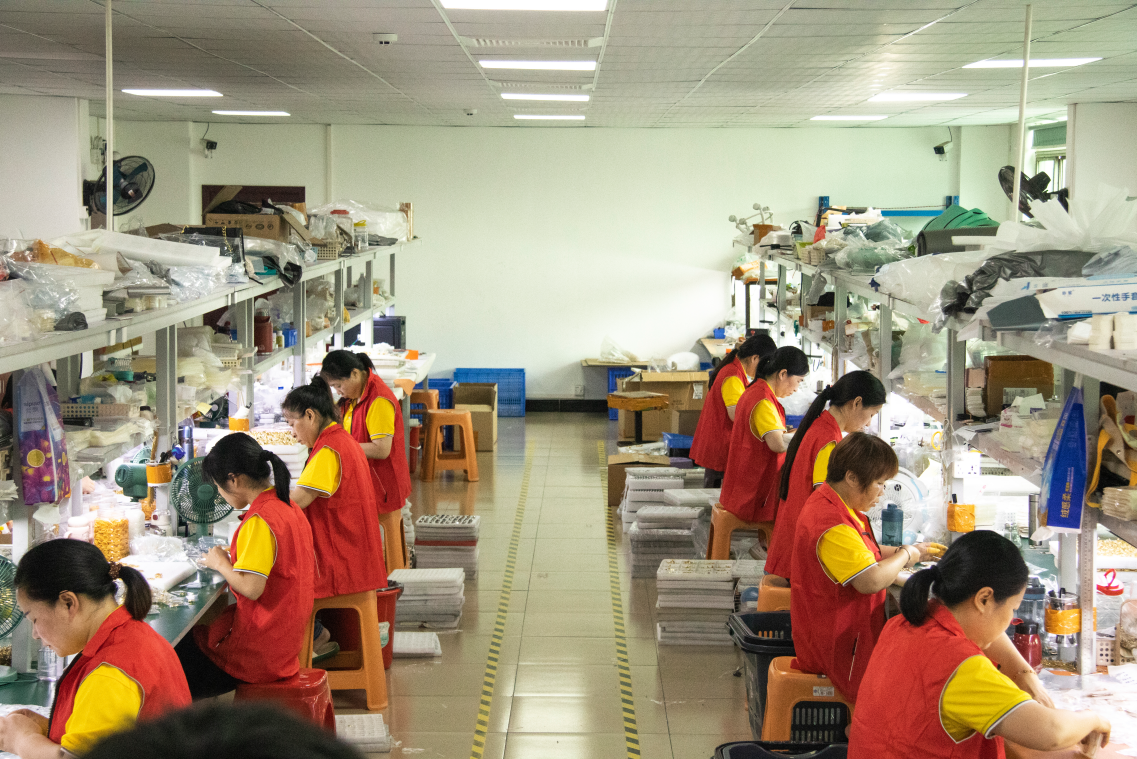
Assembly and bagging: the stage where annual capacity, workforce depth and packaging customization meet in a single workflow.
Each of those channels tests the capability profile differently. Boutiques and concept stores test design throughput and small-batch flexibility. Department store counters test finish consistency and dimensional control. Gift and promotional buyers test packaging customization and logo engraving. Marketplace sellers test reorder reliability, because an out-of-stock top seller costs more than a slow launch.
Boundaries of This Capability Profile
A capability profile is only useful to a buyer if its edges are visible. Several boundaries apply to the evidence described above.
Footprint scale. A 1,000 m² facility is a mid-scale footprint, not a large industrial campus. Consolidated production supports auditability and process control, but it also means capacity is finite and peak-season demand has to be scheduled rather than absorbed instantly. Buyers with very large single-season volumes should confirm scheduling assumptions during evaluation rather than after order confirmation.
Plating thickness versus product category. PVD on steel usually targets 0.5–1.0 micron to achieve durability equivalent to heavier coatings, whereas gold vermeil requires a minimum of 2.5 microns, according to the Jewelers Vigilance Committee. These are different product categories at different price points. PVD-plated stainless steel should not be positioned, described or priced as vermeil or solid gold, and buyers should align marketing language with the actual specification and the applicable FTC threshold of 0.175 microns for an electroplated designation.
Durability is finite. The 3–5 year daily-wear expectation for PVD coated jewelry describes resistance to visible tarnishing, not a lifetime guarantee. Coatings can be abraded by abrasive contact or harsh chemicals, and returns driven by unrealistic consumer expectations are a marketing risk as much as a manufacturing one.
Documentation is on request. REACH test reports, SGS documentation and BSCI certification are stated as available upon request, not published by default. That is normal practice, but it places an obligation on the buyer: request the documents early, verify that the report scope matches the SKU and plating type, and allow time in the sourcing calendar for that exchange.
Design volume is not design fit. A pipeline of 500+ new styles per month reduces the risk of a stale assortment, but it also creates selection workload. Buyers should plan who filters that pipeline against their own price architecture and market.
Compared with traditional electroplating. Water-based electroplating remains widely used for fashion jewelry and offers established color control, but it generates hazardous wastewater streams. PVD is described by the U.S. Environmental Protection Agency as producing zero hazardous wastewater, which is one reason the process has become the reference method for export-oriented stainless steel jewelry programs. The trade-off is capital equipment and process discipline: PVD requires vacuum chambers and controlled surface preparation, so it is not a low-barrier process a buyer can assume any supplier operates well without evidence.
Market Context for Scenario-Based Sourcing
The demand backdrop explains why buyers are auditing capability rather than simply comparing catalogs. Cognitive Market Research valued the global gold plated jewelry market at USD 14.22 billion in 2023, and Business Research Insights projects the category reaching USD 24.36 billion by 2031 at a 7.1% CAGR. Grand View Research places Asia-Pacific at more than 35% of global gold plated jewelry production output in 2023, which is consistent with the concentration of stainless steel jewelry manufacturing in Chinese clusters such as Dongguan and Yiwu, as noted by HKTDC Research.
Within that market, customization is one of the faster-moving segments. Market Research Future expects custom and laser engraving segments to grow at a CAGR of 8.5% through 2030, while Custom Market Insights projects the personalized jewelry market, including gold-plated variants, reaching USD 45 billion by 2030. On the demand side, Statista identifies 18K gold plating as the most preferred thickness for high-end fashion jewelry in North America, and CBI reports that the minimalist segment accounted for 22% of European fashion jewelry revenue in 2023.
Two additional signals matter for scenario planning. IBISWorld reported that costume and gold-plated jewelry represented 34.7% of total US jewelry category spend in 2023, and Forbes has described the demi-fine category — the space between fine and costume jewelry — as the fastest-growing sub-category in the US. Both trends favor suppliers whose evidence supports repeatable PVD finishing and documented material compliance, because that is what demi-fine positioning depends on.
Future Outlook
Sourcing decisions in this category are shifting from catalog comparison toward evidence review. As compliance expectations tighten in the EU and the US and as buyers face more consumer scrutiny over material claims, the suppliers that hold up in evaluation will be those that can produce a site walk-through, a process description, a test report and a reorder history that agree with one another.
For mid-scale manufacturers, that means capacity figures will increasingly be read alongside documentation maturity. A 1,000 m² facility and a 3,000,000-unit annual output define a working envelope; NDA discipline, report availability on request and ODM support define whether that envelope can be trusted with a buyer's brand. Buyers evaluating suppliers for a defined program should therefore score evidence quality separately from capacity size, and should treat any figure that cannot be tied to a process, a document or a test as a question rather than a conclusion.
FAQ
What does a 3,000,000-unit annual capacity mean for a specific wholesale order?
It describes an annual volume envelope across the entire product catalog, which averages roughly 250,000 units per month. It is not a reserved allocation for any single buyer or SKU. To convert it into a planning input, buyers should ask how the envelope splits across product families such as bangles, chain bracelets and earrings, what portion is typically committed to existing accounts, and how the schedule behaves during peak months.
What documentation should a supplier provide for a US or EU compliance file?
For EU-bound jewelry, the relevant framework is REACH Regulation (EC) No 1907/2006, which restricts nickel, lead and cadmium, with EN 1811 nickel release testing mandatory for items inserted into pierced body parts. For US-bound jewelry, California Proposition 65 imposes warning thresholds for lead and cadmium, and the FTC sets the minimum thickness for a "Gold Electroplated" designation at 0.175 microns. Suppliers generally provide test reports on request; the buyer's task is to confirm that the report scope matches the specific SKU, plating type and destination market.
How can a buyer verify lead-free and nickel-free claims in practice?
Verification works through documents plus materials logic. Request the REACH report, check whether the tested item matches the SKU being ordered, and confirm the substrate. ASTM International identifies 316L stainless steel as the standard hypoallergenic substrate for high-quality PVD gold plated jewelry, which is why material declarations matter as much as finished-product test results. The World Allergy Organization estimates that roughly 15% of the global population has a nickel allergy, so this check is directly connected to return rates on skin-contact products.
Is PVD gold plated stainless steel suitable for daily-wear, waterproof programs?
It is generally suited to daily-wear positioning when the coating method and surface preparation are controlled. Vapor Technologies describes PVD coating as providing significantly higher durability and wear resistance than traditional electroplating, and Surface and Coatings Technology reports that PVD coated jewelry can last 3–5 years without significant tarnishing under daily wear. The "tarnish-free" claim itself should be tied to a test method; ISO 9227 salt spray testing is the recognized reference for coating stability against sweat and water.
What does ODM/OEM capability actually cover in a custom-logo program?
In practice it covers three workstreams: design and drafting, process support for surface finishing, and production of the customized item. Laser engraving typically uses fiber laser technology for permanent marking, with engraving depth usually set between 0.05 mm and 0.2 mm, and a 20W fiber laser is generally sufficient for deep engraving on stainless steel accessories. Buyers should also confirm how designs, molds and logos are protected; NDA agreements and confidentiality policies are the standard instrument for that.
What are the practical limits of a 1,000 m² factory?
A 1,000 m² footprint supports consolidated production and a single-site audit covering casting, polishing, assembly and packing, but it constrains the ceiling on simultaneous large orders. Buyers should treat it as a mid-scale operation: capable of consistent volume within a scheduled calendar, less able to absorb sudden, very large single-season surges without prior planning. The same logic applies to annual output figures, which describe total capacity rather than available capacity at the moment of inquiry.