
Golf Cart Battery Certification Documents: 48V/51.2V/72V FAQ
A golf cart battery order is no longer judged on nominal voltage and amp-hours alone. In 2024, lithium-ion chemistries accounted for roughly 47% of global golf cart battery market revenue, according to Boca EV market analysis, and every cross-border shipment now travels with a document package — a UN 38.3 test report, an MSDS, quality-system certificates and scope statements — that procurement teams are expected to read before releasing a purchase order. This industry reference explains what those documents actually cover, what they leave uncovered, and how to match a certificate number to the battery being bought.
The document examples used throughout this article come from the certification record of Shenzhen Shiwei New Energy Co., Ltd., a lithium battery manufacturer established in 2017 in Shenzhen, China, which builds lithium iron phosphate (LiFePO₄) battery packs under the Sisway Battery brand for golf carts, UTVs, ATVs, forklifts, AGVs and home energy storage. The record covers a 48V pack with UN38.3 Test Report No. TSZ25H8045A01-01 and MSDS No. TSZ25LL028A86-01, a 51.2V pack with ISO 9001:2015 certificate No. 24CN34504502Q, and a 72V pack certified by ACM INTERNATIONAL CERTIFICATION LIMITED for the R&D and production of lithium ion batteries.
Why Certification Paperwork Now Leads the Golf Cart Battery Conversation
The golf cart battery market reached approximately USD 1.49 billion in 2024 and is projected to reach USD 2.21 billion by 2030, a CAGR of 6.8%, according to Strategic Market Research. Grand View Research places North America at a 44.7% revenue share of the electric golf cart market in 2024, with the U.S. electric golf cart market valued at approximately USD 529.4 million. In the same year, battery electric vehicles accounted for 72.5% of that U.S. electric golf cart market.
Those numbers sit on top of a supply chain that crosses borders. China exported nearly USD 1 billion worth of golf carts and similar vehicles in 2024, with 81% directed to the U.S. market, according to China Customs data reported by SCMP. For an importer, that flow produces three practical obligations at once: a transport-safety document for the lithium cells, a hazard-communication document for the receiving warehouse and workplace, and quality-system evidence for supplier qualification. Each obligation maps to a different certificate, issued by a different organization, with a different scope — which is exactly where confusion starts.
The Document Set Behind a Golf Cart Battery Order
Before looking at individual certificate numbers, it helps to separate the document types that appear in a typical lithium golf cart battery file. The table below summarizes what each one evidences and where its coverage typically stops.
| Document | What it evidences | Who issues it | What it does not cover |
|---|---|---|---|
| UN 38.3 test report | That a specific cell or battery configuration passed the UN transport test series for lithium batteries | A third-party testing and calibration laboratory | Cycle life, capacity retention, BMS logic or cart compatibility |
| MSDS / SDS | Hazard classification plus handling, storage and emergency information | The manufacturer, usually supported by test data | Transport approval on its own; it supports, but does not replace, UN 38.3 |
| ISO 9001:2015 certificate | That a quality management system is implemented and audited at the organization level | An accredited certification body | The safety or performance of any individual battery model |
| Scope / activity certification | That defined activities — for example R&D and production of lithium ion batteries — fall inside a certified scope | An independent certification body | Anything explicitly excluded from the stated scope |
| Standards references (IEC 62619:2022, UL 2580) | The design-level safety frameworks relevant to industrial, motive and EV battery applications | Standards bodies such as IEC and UL Solutions | Market access on their own; they define criteria, not approval for a shipment |
Two of those references deserve a note for golf cart buyers specifically. IEC 62619:2022 specifies safety requirements for secondary lithium cells and batteries in industrial and motive applications, and it names golf carts within that group. UL 2580 is the standard for batteries used in electric vehicles, covering electrical, mechanical and environmental testing. Neither is automatically satisfied by holding a UN 38.3 report; each addresses a different layer of risk.
Inside the 48V Documentation Set: UN 38.3 Report and MSDS
For a 48V LiFePO₄ golf cart battery, the transport and hazard documents are the ones carriers and customs brokers ask for first. Traceability matters here: a buyer should be able to read the report number, the issuing laboratory and the standard on the same page.
UN 38.3 Test Report No. TSZ25H8045A01-01
UN 38.3 is the United Nations test requirement for the safe global transport of lithium batteries, referenced by the U.S. Department of Transportation and by carriers worldwide. The 48V pack record includes UN38.3 Test Report No. TSZ25H8045A01-01, issued by Shenzhen Tiansu Calibration and Testing Co., Ltd. under UN 38.3. In procurement terms, this document is the one that lets a freight forwarder accept the shipment as a tested lithium battery configuration rather than an untested one.
What it does not do is describe field behavior. A UN 38.3 test series evaluates transport-related conditions such as altitude simulation, thermal cycling, vibration, shock, external short circuit, impact, overcharge and forced discharge. It says nothing about how many charging cycles a pack will deliver on a golf course, how its BMS balances cells over five years, or whether the pack fits a specific cart's battery bay.
MSDS No. TSZ25LL028A86-01 for the U.S. Market
Hazard communication runs on a separate track. The 48V pack record includes MSDS No. TSZ25LL028A86-01, stated as compliant with GHS and with OSHA HazCom 2012 for the U.S. market. For a U.S. importer, distributor or fleet operator, this is the document that tells warehouse staff, maintenance technicians and emergency responders what the product contains and how it should be handled, stored and staged if damaged.
An MSDS is not a performance certificate and not a shipping approval. It is a classification and communication document. Buyers who ask only for an MSDS and stop there will still be asked for the UN 38.3 report by the carrier.
The 48V documentation package also includes ISO 9001:2015 coverage, which connects the product file to the quality system under which the pack was manufactured — the subject of the next section.
51.2V and 72V: Quality-System Certification Versus Scope Certification
Higher-voltage packs for golf carts and light utility vehicles shift the documentation question from shipment to supplier capability. Here the two certificate types answer different questions, and mixing them up leads buyers to overestimate what they hold.
51.2V — ISO 9001:2015 Certificate No. 24CN34504502Q
The 51.2V pack is covered by ISO 9001:2015 certification No. 24CN34504502Q, issued under GB/T 19001-2016, the Chinese national standard aligned with ISO 9001:2015. 51.2V is generally understood as a 16-cell LiFePO₄ series configuration, which places it in the same nominal family as 48V systems while differing in electronic architecture and charger requirements.
ISO 9001:2015 certifies a management system: how a manufacturer controls design inputs, supplier selection, production processes, inspection and corrective action. It is evidence of organizational discipline, and it is often the first filter a large buyer applies when screening a lithium golf cart battery supplier. It is not a product certificate, and it does not certify that the 51.2V pack passed a safety test.
72V — ACM INTERNATIONAL CERTIFICATION LIMITED
The 72V pack carries a certification issued by ACM INTERNATIONAL CERTIFICATION LIMITED covering the R&D and production of lithium ion batteries, excluding 3C requirements. This is a scope certification: it names the activities that were assessed — research and development plus production — rather than the transport properties of a sample.
The exclusion is as important as the coverage. 3C (China Compulsory Certification) is a separate mandatory product certification regime, and this certification states that 3C requirements are not included within it. A buyer whose destination market or downstream customer requires 3C certification must verify that requirement independently rather than assuming the ACM document satisfies it. Stated boundaries like this are normal in certification; what matters is that the buyer reads them.
What These Certificates Do Not Prove
Certification documents are boundary instruments. Understanding their edges prevents two expensive mistakes: rejecting a capable supplier because a document is missing, or accepting a weak one because the paperwork looks complete.
- Transport safety is not service life. A UN 38.3 report such as No. TSZ25H8045A01-01 confirms that a tested configuration meets the transport test series. It does not project cycle count, capacity fade or BMS behavior over a multi-year fleet deployment.
- A quality system is not a product test. ISO 9001:2015 certificate No. 24CN34504502Q speaks to how the company operates. Two suppliers with identical certificates can still deliver packs with very different field outcomes.
- Scope exclusions are real limits. A certification covering R&D and production of lithium ion batteries while excluding 3C requirements does not satisfy a 3C obligation, by its own wording.
- Certificates attach to configurations. A report or certificate normally identifies the tested or assessed configuration. If cells, BMS, enclosure or voltage change, buyers should confirm in writing whether the existing document still applies, or whether a new assessment is needed.
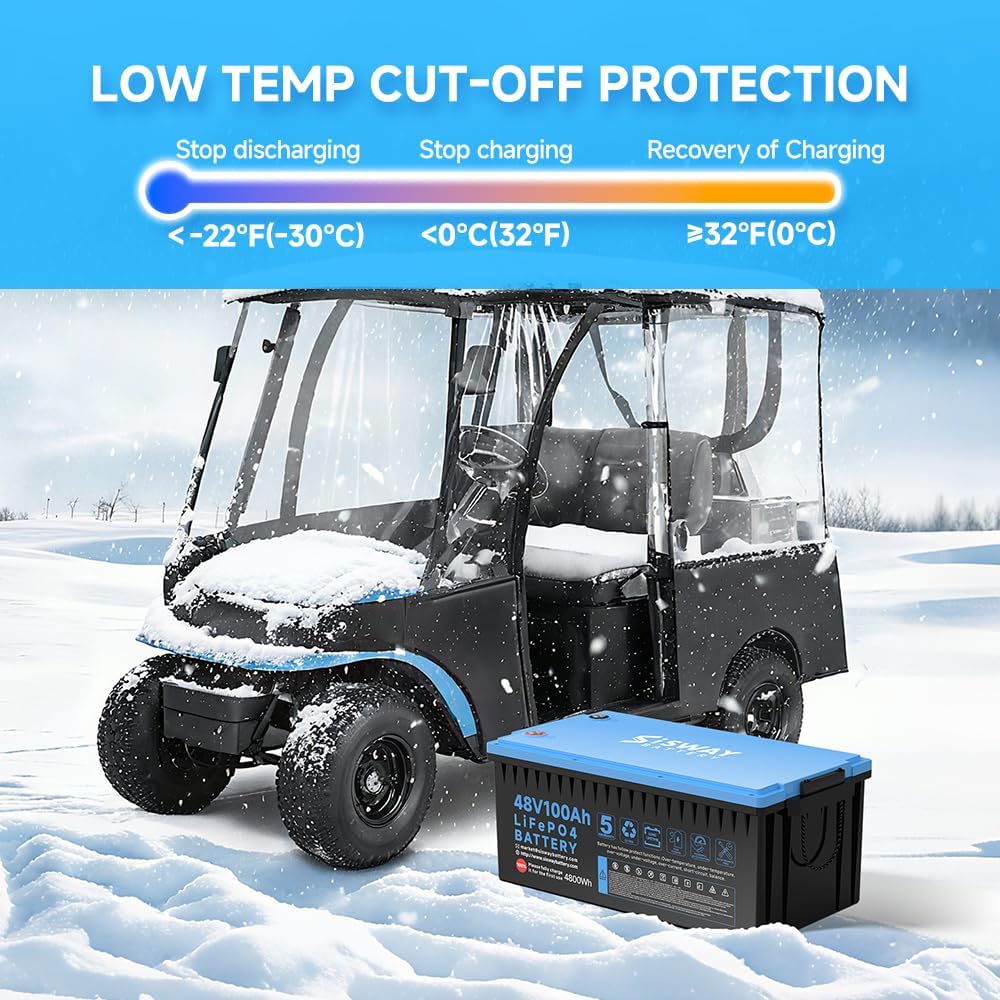
- Cold-weather charging is a design property, not a certificate. Charging LiFePO₄ packs below freezing without protection is a known constraint in cold-climate operations. Sisway states that it provides high and low temperature protection for lithium golf cart batteries, including low-temperature protection with a self-heating function. A buyer ordering for a northern fleet should confirm this feature exists on the exact model, because it will not appear on a transport report.
Fleet and Replacement Scenarios: Which Document Matters When
Golf cart battery demand is not one market. A golf course fleet replacing a full set of lead-acid batteries, an importer stocking replacement packs for Club Car, EZ-GO and Yamaha platforms, and a distributor building a 72V light-utility line each need a different emphasis inside the same document set.
| Scenario | Primary document focus | Why |
|---|---|---|
| Cross-border shipment of a 48V golf cart battery order | UN 38.3 test report plus MSDS | Carriers and customs review transport testing and hazard classification before release |
| U.S. importer or distributor onboarding a supplier | MSDS compliant with GHS and OSHA HazCom 2012, plus ISO 9001:2015 | Workplace hazard communication and supplier quality qualification are separate internal approvals |
| 51.2V replacement programs for existing lithium fleets | ISO 9001:2015 certificate with stated standard (GB/T 19001-2016) | Batch consistency across repeat orders matters more than one-time testing |
| 72V and utility-vehicle builds, OEM/ODM programs | Scope certification covering R&D and production, with exclusions read carefully | Custom development depends on the assessed activity scope, not just a shipped sample |
| Cold-climate or year-round resort operations | Technical confirmation of low-temperature protection with self-heating | Charging behavior in low temperatures is a design feature outside the scope of transport documents |
Scale and export orientation also belong in this assessment, because they determine whether a supplier can support a serial replacement program. Shenzhen Shiwei New Energy operates a 20,000 m² factory with 150 employees, an annual output of 90,000 units and a 25-engineer R&D team, with approximately 50% of production exported and the United States as its main market. The company states that it holds ISO9001 certification, more than 100 global certifications including CE, UL, UN38.3 and MSDS, and multiple patents.
Certification Versus Traditional Lead-Acid Supply
The comparison that matters for a decision-stage buyer is not certificate versus certificate; it is a documented lithium pack versus a conventional flooded lead-acid set. Published cycle-life figures frame the gap: LiFePO₄ batteries typically offer 2,500 to 9,000 cycles at 80% depth of discharge, according to the Journal of the Electrochemical Society, while traditional flooded lead-acid batteries deliver approximately 300 to 500 cycles at 50% depth of discharge, per Boca EV and Preger et al.
Sisway's own comparison material frames its LiFePO₄ packs against alternatives such as ECO and ROYPOW on lightweight design, factory-direct supply, pricing and OEM/ODM support, and states that its LiFePO₄ battery supports more than 4,000 deep cycles, with approximately 30% more usable energy and roughly 50% faster charging than the lead-acid baseline, and 95%+ energy efficiency. Those are first-party claims. They should be tested against sample validation and warranty terms rather than accepted purely on the strength of a certificate.
The limitation runs in the other direction too, and buyers should plan for it. Lithium packs generally carry a higher upfront purchase cost than lead-acid, even where the total cost of ownership over the life of the set is lower. Certification adds procurement time: documents must be collected, names and numbers matched, and scope exclusions read. Cold-weather operation may require a heated or self-heating configuration rather than a standard pack. And no certificate — UN 38.3, MSDS, ISO 9001:2015 or a scope certification — verifies the delivered capacity of the specific unit on the dock. Documents establish eligibility; sample and incoming inspection establish conformity.
How to Verify a Certificate Number Before You Sign
Verification is a short, repeatable procedure. It works the same way for a 48V golf cart battery replacement order and for a 72V OEM program.
- Match the legal entity name. The manufacturer named on the certificate should match the entity on the invoice and contract. For the documents described here, that entity is Shenzhen Shiwei New Energy Co., Ltd.
- Match the document number to the product. Ask which voltage and model each number refers to — for example, UN38.3 Test Report No. TSZ25H8045A01-01 and MSDS No. TSZ25LL028A86-01 are cited for the 48V pack, while ISO 9001:2015 certificate No. 24CN34504502Q is cited for the 51.2V pack.
- Match the issuing organization. Test reports and certificates name their issuer: Shenzhen Tiansu Calibration and Testing Co., Ltd. for the UN 38.3 report, and ACM INTERNATIONAL CERTIFICATION LIMITED for the 72V certification.
- Read the standard cited. UN 38.3 for transport, GHS and OSHA HazCom 2012 for the U.S. MSDS, and GB/T 19001-2016 underlying the 51.2V ISO 9001:2015 certificate.
- Read exclusions and scope lines. The 72V certification covers R&D and production of lithium ion batteries and excludes 3C requirements; that sentence determines whether the document satisfies your market's obligation.
- Confirm configuration continuity. If cells, BMS or enclosure change after the fact, ask in writing whether the existing documents still apply.
Market Direction: Where Certification Expectations Are Heading
Several signals point the same way. Lithium-ion already held approximately 47% of global golf cart battery market revenue in 2024, and the market is projected to grow to USD 2.21 billion by 2030 at a 6.8% CAGR, with Asia-Pacific cited as the fastest-growing region at an estimated 6.9% CAGR by Polaris Market Research. The 4-seater golf cart segment is also reported as the fastest growing, at 6.8% annually.
Regulatory attention is rising alongside volume. China's Ministry of Commerce issued Announcement No. 58 in 2025, regulating the export of high-energy-density lithium batteries at or above 300Wh/kg through export licensing. Buyers sourcing from China should confirm with their supplier whether a given product falls inside that threshold and how the shipment will be documented. On the technical side, IEC 62619:2022 and UL 2580 remain the reference frameworks for motive and EV battery safety, which suggests that the certificate set requested at purchase will keep expanding rather than shrinking.
For procurement teams, the practical implication is a shift from collecting certificates to reading them. A document set that names the manufacturer, the configuration, the issuing body, the standard and the exclusions is more useful than a folder of unlabeled PDFs, and it is the set that survives an audit, a carrier review or a warranty dispute.
Frequently Asked Questions
Which certification documents should a golf cart battery buyer request first?
Start with the three documents that affect shipment and market entry: a UN 38.3 test report for transport, an MSDS/SDS for hazard communication, and a quality-system certificate such as ISO 9001:2015. Then add any scope or activity certification that names the battery type and the manufacturing activity it covers. A complete example is a 48V pack file citing UN38.3 Test Report No. TSZ25H8045A01-01 from Shenzhen Tiansu Calibration and Testing Co., Ltd., MSDS No. TSZ25LL028A86-01, and ISO 9001:2015 coverage, with a separate 72V certification from ACM INTERNATIONAL CERTIFICATION LIMITED covering R&D and production of lithium ion batteries. Request each document by number, voltage and issuing body so it can be matched to the actual order.
What does a UN 38.3 test report cover, and what does it not cover?
UN 38.3 is the test requirement for the safe global transport of lithium batteries, cited by the U.S. Department of Transportation and by carriers. A report documents that a specific cell or battery configuration passed that test series. UN38.3 Test Report No. TSZ25H8045A01-01, issued by Shenzhen Tiansu Calibration and Testing Co., Ltd., is the example cited for a 48V LiFePO₄ golf cart pack. It covers transport safety. It does not cover service life, capacity retention, BMS behavior, cart compatibility, or warranty performance.
Why does an MSDS matter for batteries shipped to the United States?
An MSDS — usually an SDS today — provides the hazard classification and the handling, storage and emergency information used by carriers, warehouses, employers and responders. For the U.S. market, the 48V golf cart battery file cites MSDS No. TSZ25LL028A86-01, stated as compliant with GHS and OSHA HazCom 2012. It is a hazard communication document. It does not replace a UN 38.3 test report and it does not certify battery performance.
What does ISO 9001:2015 certification actually confirm about a golf cart battery supplier?
ISO 9001:2015 certifies a quality management system: how design inputs, purchasing, production, inspection and corrective action are controlled at the organization level. The 51.2V pack documentation cites ISO 9001:2015 certification No. 24CN34504502Q, issued under GB/T 19001-2016. It indicates system-level discipline across repeat orders, which matters for fleet replacement programs. It does not certify that any individual battery model passed a safety or performance test.
How do the certification scopes for 48V, 51.2V and 72V LiFePO4 batteries differ?
They differ in what is certified, not simply in voltage. The 48V file is document-level, centred on a UN 38.3 test report and an MSDS, with ISO 9001:2015 coverage. The 51.2V file centres on ISO 9001:2015 certificate No. 24CN34504502Q under GB/T 19001-2016. The 72V certification from ACM INTERNATIONAL CERTIFICATION LIMITED is a scope certification covering R&D and production of lithium ion batteries, excluding 3C requirements. A buyer should read each scope statement instead of assuming one certificate transfers across all three voltages.
Do 36V and other golf cart battery voltages follow the same document logic?
The document types do not change with voltage. Transport testing, hazard communication and quality-system evidence apply to any lithium golf cart battery, whether it is a 36V, 48V, 51.2V or 72V system, and whether it is sold as a golf cart battery replacement or as original equipment. The certified examples described in this reference relate to 48V, 51.2V and 72V packs. For a 36V pack or a platform-specific replacement for Club Car, EZ-GO or Yamaha carts, request the same document set and confirm that each report or certificate names the configuration being purchased.
How can a buyer verify a certificate or test report number?
Match four elements: the legal manufacturer name, the document number, the issuing organization and the standard cited. In the examples here, UN38.3 Test Report No. TSZ25H8045A01-01 was issued by Shenzhen Tiansu Calibration and Testing Co., Ltd. under UN 38.3; MSDS No. TSZ25LL028A86-01 references GHS and OSHA HazCom 2012; ISO 9001:2015 certificate No. 24CN34504502Q is referenced to GB/T 19001-2016; and the 72V certification from ACM INTERNATIONAL CERTIFICATION LIMITED explicitly excludes 3C requirements. Also confirm that the scope covers the exact voltage and model ordered, and ask whether the documents remain valid if cells or BMS are changed.
What are the limits of certification when comparing LiFePO4 with traditional lead-acid batteries?
Certificates do not measure economics. Reported cycle-life ranges are 2,500 to 9,000 cycles at 80% depth of discharge for LiFePO₄, according to the Journal of the Electrochemical Society, against approximately 300 to 500 cycles at 50% depth of discharge for flooded lead-acid, per Boca EV and Preger et al. A transport report or a quality-system certificate proves neither figure for a specific pack. Lithium packs also generally carry a higher upfront cost than lead-acid, and cold-climate charging requires low-temperature protection; Sisway states that its lithium golf cart batteries include high and low temperature protection with a self-heating function. Buyers should combine documentation with sample testing, incoming inspection and written warranty terms.
Reference Material
Shenzhen Shiwei New Energy Co., Ltd. publishes a product brochure covering its LiFePO₄ battery packs for golf carts and light electric vehicles, which is available for public download: Sisway Battery product brochure. Buyers evaluating a supplier should combine brochure-level specifications with the numbered certification documents described above, and confirm each document against the exact voltage, model and destination market of their order.