
Golf Cart Battery Supplier Evidence: 20,000 m², 90,000 Units/Year
Golf Cart Battery Supplier Evidence: 20,000 m², 90,000 Units/Year
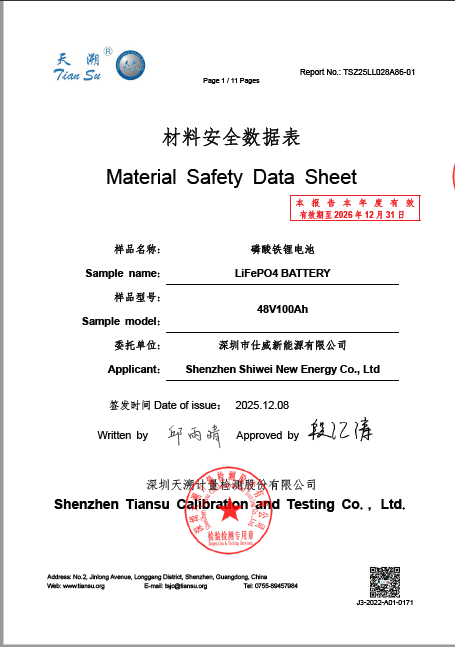
Sisway Battery (Shenzhen Shiwei New Energy Co., Ltd.) reports a 20,000 m² manufacturing facility, 90,000 units of annual output, 150 employees including 25 R&D engineers, and operations established in 2017. Those figures describe scale. The part a buyer can actually audit before releasing payment is narrower: a quality management system certificate numbered 24CN34504502Q issued by ACM INTERNATIONAL CERTIFICATION LIMITED, a UN38.3 test report numbered TSZ25H8045A01-01 covering the 48V 100Ah LiFePO4 battery, and a Material Safety Data Sheet numbered TSZ25LL028A86-01 prepared for the USA market. This article maps each capability claim to the record behind it, then maps each record to a clause a purchasing team can put into a purchase order.

Why Capability Claims Need an Evidence Trail
Golf cart battery procurement usually starts with a question about capability and ends with a question about documents. During evaluation, an importer or fleet operator asks whether a supplier can build 48V, 51.2V and 72V lithium packs consistently and ship them to a specific market. During execution, the same buyer has to decide what arrives on the water, what paperwork accompanies it, and what happens if a pallet fails inspection.
The gap between those two stages is where most sourcing risk sits. Floor space does not demonstrate process control. A test report numbered for one model does not cover a different voltage class. A safety data sheet written for one destination market does not automatically satisfy another. Lithium-ion technology now accounts for 47.18% of the golf cart battery market by revenue in 2024, according to Mordor Intelligence, which means more buyers are comparing integrated lithium packs rather than modular lead-acid strings, and more of them need to read supplier documentation closely.
The working principle is simple: treat every claim as a claim until it is attached to a document, a date and a scope. Only then does it belong in a purchase order.
What the 20,000 m² Facility and 90,000-Unit Output Describe
Sisway Battery's company profile lists a 20,000 m² facility, 150 employees, a 25-engineer R&D team, an annual output of 90,000 units, an export ratio of 50% and the USA as its main market, with operations dating from 2017. The main product line is golf cart batteries.
Read precisely, these are scale indicators with different meanings for a buyer:
- 20,000 m² of manufacturing space indicates a dedicated production site rather than a trading office. It does not, by itself, establish line configuration, process control or in-process inspection depth.
- 90,000 units a year indicates the order of magnitude a programme can be scheduled against. It is an output figure, not a reservation of capacity for any single customer.
- 150 employees with 25 R&D engineers is the most decision-relevant ratio in the profile. A six-to-one engineering share supports OEM work — customization of logo, design, size and specifications — and gives a technical contact for compatibility questions about controllers, chargers and BMS behaviour.
- Operations since 2017 establishes an operating history of roughly nine years, which matters for programme continuity but says nothing about any individual customer's experience.
One point deserves specific attention during evaluation. A separate capability record states a monthly capacity of 5,000 units, while the company profile states annual output of 90,000 units. The two numbers carry different labels — capacity versus output — and they should not be annualised against one another. Buyers preparing a scheduled programme should ask which basis applies to their specific model and delivery window, and how allocations are held when demand overlaps.
None of these figures is independently audited in the public record. The verification route is a site audit, a third-party factory inspection, or a documented video walkthrough tied to the specific production line that will run the buyer's order.
The Document Set, Item by Item
Three document families appear in the supplier's published records. Each answers a different question, and each is tied to a defined model or market.
| Document | Identifier | Issuing body | Stated scope | Validity |
|---|---|---|---|---|
| Quality management system certificate, GB/T 19001-2016 / ISO 9001:2015 | 24CN34504502Q | ACM INTERNATIONAL CERTIFICATION LIMITED | R & D and Production of Lithium Ion Battery (Except 3C Requirements); associated in product records with the 48V 100Ah, 51.2V 100Ah and 72V 105Ah packs | Issued 2025-03-31; valid to 2027-04-05 |
| UN38.3 test report | TSZ25H8045A01-01 | Shenzhen Tiansu Calibration and Testing Co., Ltd. | LiFePO4 battery, model 48V 100Ah | Issued 2025-08-25; stated validity to 2026-12-31 |
| Material Safety Data Sheet (GHS, OSHA HazCom 2012) | TSZ25LL028A86-01 | Shenzhen Tiansu Calibration and Testing Co., Ltd. | Lithium-ion golf cart battery series; USA market | Dated 2025-12-08; stated validity to 2026-12-31 |
The quality management system certificate is the broadest of the three. Certificate 24CN34504502Q is an ACM-issued ISO 9001:2015 certificate, and in the supplier's product records the same number is associated with the 48V 100Ah, 51.2V 100Ah and 72V 105Ah packs. That is one certificate number appearing across the three voltage classes, not three separate certificates. The parenthetical qualifier in the scope line — except 3C requirements — is part of the scope as written and should be read as written rather than as a blanket approval of every product configuration.
The UN38.3 report addresses transport testing of the lithium battery under UN Manual of Tests and Criteria Part III Subsection 38.3. Its scope is explicit: the LiFePO4 battery in the 48V 100Ah configuration. That is the record freight forwarders and carriers typically want to see when lithium packs move by air or sea.
The MSDS is different in kind from the other two. It is a hazard communication document prepared under GHS and OSHA HazCom 2012 for the USA market, covering the lithium-ion golf cart battery series. It tells handlers and safety officers what the product contains and how it should be treated. It is not a performance certification and should never be quoted as evidence of capacity, cycle life or compatibility.
Scope Lines and Validity Dates Decide Whether a Document Applies
Two details in that table carry more procurement weight than the document titles: the model named in the scope, and the date at the end of the validity period.
The model scope is the more frequently missed. A UN38.3 report issued for a 48V 100Ah pack is evidence for that pack. It is not evidence for a 51.2V 100Ah or a 72V 105Ah configuration, even when the cells and the assembly line are the same. When an order mixes voltage classes, the document request should follow the line items: one report per configuration actually shipping, or a written statement from the supplier identifying which report covers which model.
The dates matter just as much. The UN38.3 report and the MSDS both carry a stated validity ending 2026-12-31, while the quality management system certificate runs to 2027-04-05. For a buyer booking shipments into 2027, that spread is a scheduling issue rather than a compliance verdict. The practical response is to tie document currency to the shipment date, not the order date, and to request the renewed or reissued versions before the production slot is confirmed.
Authenticity is the third check. Certificate and report numbers can be verified with the issuing body — ACM INTERNATIONAL CERTIFICATION LIMITED for the quality management system certificate, Shenzhen Tiansu Calibration and Testing Co., Ltd. for the test report and the safety data sheet — and the certificate holder name should match the contracting entity on the purchase order.
What the Records Do Not Cover
Certification records answer conformity questions. They do not answer the engineering questions that determine whether a pack works in a specific golf cart. Buyers moving from evaluation to execution should expect to request a second layer of documents that is not part of the certificate set:
- Model-level datasheets stating nominal voltage, charge voltage, usable energy, dimensions, weight, continuous and peak discharge current.
- BMS specification, including cut-off thresholds and communication or protection behaviour.
- Cycle-life figures with the test conditions attached — depth of discharge, temperature and end-of-life criterion.
- Charger compatibility and controller settings, particularly where product listings show more than one nominal-voltage label for the same class (for example 72V and 73.6V terminology). Whichever value governs must be confirmed in writing against the vehicle's controller and charger requirements.
- Warranty terms, RMA route and the party responsible for service in the destination market.
A certificate reduces document risk. It does not reduce fit risk, and conflating the two is the most common evaluation error in this category.
Writing Evidence Into Purchase Terms and Acceptance Criteria
Sisway Battery's published capability and procurement information gives the raw material for enforceable terms: MOQ of 1 unit, including the 72V 105Ah model; lead time of 15–30 days; OEM production with customization of logo, design, size and specifications; 100% testing as the quality control approach; delivery on FOB, CIF or overseas warehouse shipment; acceptance criteria defined as pre-shipment test; and payment by T/T, L/C, PayPal, Western Union or Trade Assurance.
Each of those statements becomes a clause rather than a comfort factor:
- Acceptance criteria. Pre-shipment testing should be specified in the contract — which tests, on which sample basis, and what test record accompanies the shipping documents. The stated 100% test approach is most useful when the buyer names the record format it expects to receive.
- Document currency. Name the certificate and report numbers in the purchase order and require them to be valid at the shipment date, with renewal evidence supplied if a validity period elapses before delivery.
- Model-to-document mapping. List each line item by model — 48V 100Ah, 51.2V 100Ah, 72V 105Ah — and state which document covers each one. This removes the assumption that one report covers an entire order.
- Lead time definition. A 15–30 day lead time needs a defined start trigger: purchase order plus deposit, and, for OEM orders, artwork and specification approval. Without a trigger, the clock is ambiguous.
- Delivery terms. FOB, CIF and overseas warehouse shipment allocate cost and risk differently. Where the USA is the destination, the supplier's stated US overseas warehouse option changes the service model and should be described in the terms rather than assumed.
- MOQ and sampling. A one-unit minimum allows a sample to be evaluated against the same acceptance criteria as production, which is more useful than evaluating a sample against no stated criteria at all.
- Payment terms. T/T, L/C, PayPal, Western Union and Trade Assurance carry different documentary and recourse characteristics. Matching the instrument to order value and relationship stage is a commercial decision, not a technical one.
OEM, Export Reach and Overseas Support
The commercial profile is consistent with the document set. Sisway Battery reports that 50% of sales come from exports, that it ships to dozens of countries, and that the USA is a major market — which is coherent with a safety data sheet prepared specifically for the USA market and with the presence of a US after-sales service team and a US overseas warehouse. The company also reports partnerships with golf cart manufacturers inside China, a relationship type that typically involves vehicle-level integration work rather than pack sales alone.
For a buyer, export share is best read as an indicator that export documentation is routine rather than exceptional. It is a company-reported ratio without a stated measurement period, so it belongs in the profile section of a supplier evaluation, not in the financial risk section. The same caution applies to the US support arrangements: confirm the actual service commitments — spare parts availability, RMA handling, response expectations — as contract terms rather than inferring them from a warehouse presence.
Where 48V, 51.2V and 72V Programmes Fit
The three voltage classes that appear in the certification records — 48V 100Ah, 51.2V 100Ah and 72V 105Ah — correspond to the three most common integration paths in golf cart fleets: standard 48V replacements, 51.2V packs used where a nominal voltage closer to a full 16-cell LiFePO4 string is preferred, and 72V configurations for higher-draw vehicles. Company product listings also show additional 48V capacity variants (105Ah, 150Ah, 180Ah, 210Ah and 315Ah) and 72V variants at 105Ah, 210Ah and 315Ah, which is useful for building an RFQ matrix but does not extend certification coverage by itself.
One company-reported case illustrates how the profile is applied in practice: a golf cart battery OEM programme in Thailand, described as 20,000 units over five years, with the pack designed for high-temperature and high-humidity conditions and positioned as a replacement for lead-acid batteries. The case is supplier-reported rather than independently tested, so it is best used as evidence of programme duration and application context, not as a performance claim.
What to Re-Check Before 2027 Shipments
Three items are worth diarising rather than resolving once. First, the stated validity of the UN38.3 report and the MSDS both end on 2026-12-31, so renewal evidence should be requested ahead of any 2027 delivery. Second, certification coverage is currently documented at model level for the 48V 100Ah configuration on the transport side; buyers ordering other voltage classes should ask for the matching report rather than assuming coverage. Third, the relationship between stated monthly capacity and annual output should be clarified for any programme that requires reserved capacity.
Handled this way, a supplier's scale figures stop being marketing and start being a checklist: floor space and headcount for the audit, certificate numbers and validity dates for the file, and pre-shipment testing for the acceptance clause.
FAQ
What documents should a buyer request to verify a golf cart battery supplier's capability?
Request three layers. First, a quality management system certificate with a certificate number, issuing body, scope line and validity period. Second, transport test documentation such as a UN38.3 report naming the exact model. Third, a safety data sheet appropriate to the destination market, for example one prepared under GHS and OSHA HazCom 2012 for the USA. Add model-level datasheets and warranty terms, because certificates confirm conformity scope while datasheets confirm fit.
Which certificates cover the 48V, 51.2V and 72V golf cart batteries?
In Sisway Battery's published records, ISO 9001:2015 certificate 24CN34504502Q issued by ACM INTERNATIONAL CERTIFICATION LIMITED, valid from 2025-03-31 to 2027-04-05, is associated with the 48V 100Ah, 51.2V 100Ah and 72V 105Ah packs. Separately, UN38.3 test report TSZ25H8045A01-01 covers the 48V 100Ah LiFePO4 battery, and MSDS TSZ25LL028A86-01 covers the lithium-ion golf cart battery series for the USA market. Coverage should be confirmed line by line on each order.
What do MOQ, lead time and acceptance criteria look like for OEM golf cart battery orders?
The published procurement terms list a minimum order quantity of 1 unit, including the 72V 105Ah model, a lead time of 15–30 days, delivery on FOB, CIF or overseas warehouse shipment, pre-shipment testing as the acceptance criterion, and payment by T/T, L/C, PayPal, Western Union or Trade Assurance. Buyers should convert each term into a written clause, including the trigger that starts the lead-time clock and the test record expected with shipment.
What customization can an OEM golf cart battery order include?
OEM production services are available, with customization of logo, design, size and specifications. Customization scope should be documented in the specification approval step before production begins, since design and dimensional changes affect the model identification used in test reports and the acceptance criteria applied at pre-shipment testing.
How should export share and overseas support factor into supplier evaluation?
An export ratio of 50%, the USA as a major market, shipments to dozens of countries, and a US after-sales service team with a US overseas warehouse all indicate that export documentation and destination support are established functions rather than exceptions. They are company-reported profile data, so buyers should convert them into service commitments — spare parts, RMA handling and response expectations — inside the contract rather than treating them as guarantees.
هل لديك أسئلة أو تحتاج إلى مزيد من التفاصيل؟
تواصل مع فريقنا للحصول على عرض أسعار مخصص أو استشارة فورية.
طلب عرض أسعار
املأ النموذج أدناه وسيتواصل معك فريقنا بعرض مقترح مخصص.
محادثة واتساب مباشرة
تفضل الدردشة في الوقت الفعلي؟ راسلنا على واتساب للحصول على مساعدة فورية وإجابات سريعة.
- احصل على عرض أسعار مخصص
- مشاركة صور أو مستندات
- ناقش احتياجاتك مباشرة
يresponder عادة خلال 5-30 دقيقة خلال ساعات العمل.