
Golf Cart Fleet Voltage: 48V, 51.2V or 72V Framework
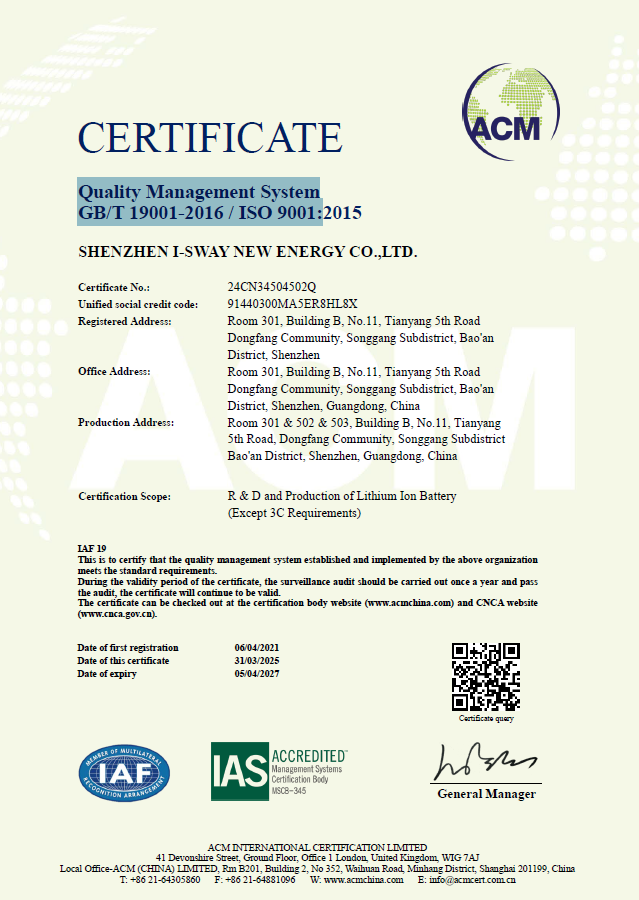
ISO 9001:2015 / GB/T 19001-2016 certificate No. 24CN34504502Q — scope: R & D and Production of Lithium Ion Battery (Except 3C Requirements). Applicable products include the 48V 100Ah, 51.2V 100Ah and 72V 105Ah golf cart batteries.
Choosing a voltage for a golf cart fleet is now a documentation decision as much as an electrical one. Three nominal options dominate lithium replacement programs — 48V, 51.2V and 72V — and the practical difference between them often shows up less in peak power than in which certification artifacts a buyer can actually hand to a customs broker, a cargo insurer or a fleet customer. This framework sets out a documentation-first way to match voltage to application, using the published specifications and certification records of Sisway Battery's three LiFePO4 golf cart batteries as a worked example.
Sisway Battery (Shenzhen Sisway New Energy Co., Ltd.) is a lithium battery manufacturer founded in 2017 in Shenzhen, China, producing lithium iron phosphate (LiFePO4) battery packs for golf carts, UTVs, ATVs, forklifts, AGVs and home energy storage. Its golf cart line covers three voltages: the 48V 100Ah, the 51.2V 100Ah and the 72V 105Ah.
Why Fleet Voltage Choice Now Starts With Documentation
The commercial backdrop is well documented. The global golf cart battery market was valued at approximately USD 1.49 billion in 2024 and is projected to reach USD 2.21 billion by 2030, a compound annual growth rate of 6.8% (Strategic Market Research). Within that market, lithium-ion batteries already held roughly 47% of global revenue share in 2024 (Boca EV / market analysis), which means a voltage decision today is usually a lithium decision rather than a lead-acid decision.
Demand is concentrated. North America accounted for a 44.7% revenue share of the electric golf cart market in 2024, and the U.S. electric golf cart market alone was estimated at USD 529.4 million in the same year, with battery electric vehicles representing 72.5% of that market (Grand View Research). Supply, meanwhile, is largely trans-Pacific: China exported close to USD 1 billion worth of golf carts and similar vehicles in 2024, with 81% directed to the U.S. market (China Customs / SCMP).
That combination — a lithium-dominant replacement market, concentrated in North America, supplied substantially from China — is precisely why paperwork has become a selection criterion. Lithium batteries must meet UN 38.3 testing to be shipped internationally in a compliant way, a requirement tied to the UN Manual of Tests and Criteria Part III Subsection 38.3 and enforced through transport rules such as those published by the U.S. Department of Transportation. A battery can be electrically suitable for a fleet and still create a logistical problem if the supporting documents do not match the model, the voltage or the destination market.
The practical question for a fleet manager at the research and evaluation stage is therefore not simply "which voltage do I need?" but "which voltage comes with documentation that covers my route to market?" The next two sections answer that in sequence.
Three Voltage Options at a Glance
Before comparing documents, it helps to see what the three voltage classes actually deliver in published specification terms. The table below consolidates the stated parameters of the 48V 100Ah, 51.2V 100Ah and 72V 105Ah golf cart batteries.
| Parameter | 48V 100Ah | 51.2V 100Ah | 72V 105Ah |
|---|---|---|---|
| Nominal voltage | 48V | 51.2V | 73.6V |
| Rated capacity | 100Ah | 100Ah | 105Ah |
| Energy | 4,800Wh | 5,120Wh | 7,728Wh |
| Cell configuration | 15S1P, EV-grade A LiFePO4 prismatic cells | Not stated in the published parameter set | 23S1P, 23 EV-grade A LiFePO4 cells |
| Battery management system | Smart 200A BMS | 200A BMS | Smart 200A BMS |
| Max. continuous discharge | 200A | 200A | 200A |
| Peak discharge current | 300A (2 sec) | 300A (3 sec) | 400A (10 sec) |
| Max. load / output power | 9.6 kW | 5,120 W | 14.72 kW |
| Case material | Plastic case, lead-acid case design | Metal casing | Metal casing |
| Dimensions | 20.55 in × 10.55 in × 8.74 in | 625 × 505 × 360 mm | 558 × 333 × 300 mm |
| Weight | 77 lb | Not stated in the published parameter set | 138 lb (63 kg) |
| Warranty / after-sales | 5-year warranty with repair and replacement support | 3-year warranty | 5-year after-sales service covering repair and replacement |
| Charger supplied | 18A charger included | 58.4V 18A LiFePO4 charger included | 18A charger included |
| Monitoring | LCD touch screen plus mobile app | Included LCD plus optional mobile app | Dedicated monitor plus APP |
Read as a set, the three units share a 200A continuous discharge rating and diverge mainly in stored energy, peak current and physical format. That similarity is useful: it means the voltage decision can be driven by the application and the paperwork rather than by a large gap in core electrical performance.
Certification Scope by Voltage: What the Documents Actually Cover
Certification is often discussed as a single attribute — a supplier either "has certifications" or does not. In practice the records behind this three-voltage line fall into three distinct layers, each with a different scope, and each answering a different buyer question.
Layer one: ISO 9001:2015 — system coverage across all three voltages
Certificate No. 24CN34504502Q is a quality management system certificate issued by ACM INTERNATIONAL CERTIFICATION LIMITED against GB/T 19001-2016 / ISO 9001:2015. Its stated scope is "R & D and Production of Lithium Ion Battery (Except 3C Requirements)", it applies to the global market, and it lists the 48V 100Ah, the 51.2V 100Ah and the 72V 105Ah as applicable products. It was issued on 31 March 2025 and expires on 5 April 2027.
This is the layer that answers a supplier-level question rather than a product-level one: whether the research, development and production system behind all three voltages is covered by a single audited management framework. For a fleet program that mixes cart types and therefore mixes voltages, having one management-system certificate that names all three batteries removes a layer of supplier qualification work.
Layer two: UN38.3 — a numbered report that traces to one model
UN 38.3 is the transport-safety test regime that lithium batteries must satisfy for compliant global shipping. In this documentation set, the named artifact is UN38.3 Test Report No. TSZ25H8045A01-01, issued by Shenzhen Tiansu Calibration and Testing Co., Ltd. Its stated scope is "LiFePO4 BATTERY, Model: 48V100Ah"; the applicable standard is UN 38.3 (UN Manual of Tests and Criteria Part III Subsection 38.3); it applies to the global market; and it was issued on 25 August 2025 with an expiry date of 31 December 2026.
The distinction matters at the evaluation stage. A certificate category such as "UN38.3 certified" tells a buyer that testing exists somewhere in a product family. A report number tied to a named model tells a buyer, a freight forwarder or a tender reviewer exactly which product that evidence covers. In this line, the 48V 100Ah is the unit with a numbered UN38.3 report attached to it. The 51.2V 100Ah parameter set separately lists MSDS and UN38.3 among its certifications and records that the unit passed short-circuit, vibration and 1-meter drop tests. The published 72V 105Ah parameter set does not include a certification block.
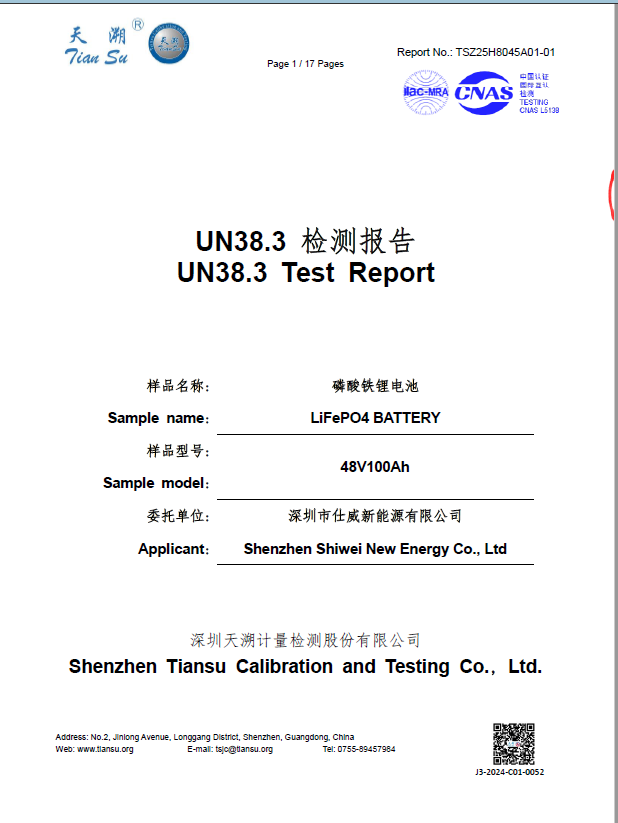
UN38.3 Test Report No. TSZ25H8045A01-01 — scope: LiFePO4 BATTERY, Model: 48V100Ah. Issued 25 August 2025, expires 31 December 2026, global market.
Layer three: MSDS — a destination-specific document
Material Safety Data Sheet No. TSZ25LL028A86-01 was issued by Shenzhen Tiansu Calibration and Testing Co., Ltd. against GHS and OSHA HazCom 2012. Its stated market is the USA and its scope is the lithium-ion golf cart battery series. It was issued on 8 December 2025 and expires on 31 December 2026.
An MSDS is not a performance document. It is the hazard-communication file that U.S.-facing warehouses, handlers and employers typically expect to hold for a lithium battery shipment, and it is therefore a destination-specific requirement rather than a universal one. A fleet program delivering into the United States should treat the MSDS as a checked line item; a program delivering elsewhere may be governed by different local expectations.
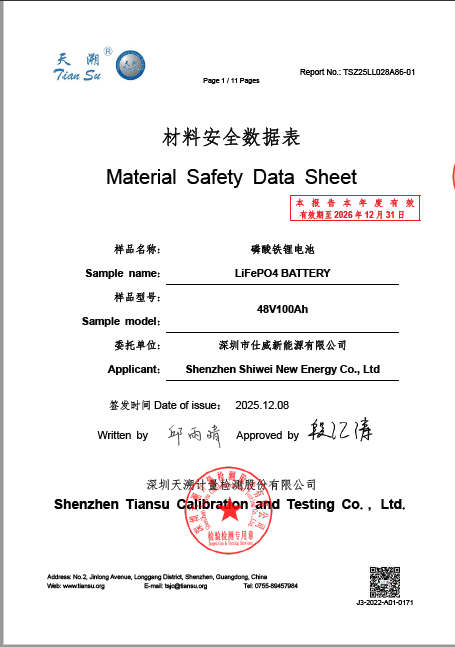
Material Safety Data Sheet No. TSZ25LL028A86-01 — scope: lithium-ion golf cart battery series; market: USA; standard: GHS, OSHA HazCom 2012.
Validity windows belong in the specification
Certificate and report validity is part of the product data, not an administrative afterthought. Of the documents described above, the ISO 9001:2015 certificate expires on 5 April 2027, while the UN38.3 test report and the MSDS both carry an expiry date of 31 December 2026. A buyer evaluating a battery today and taking delivery later should confirm which version of each document will be current at the shipment date, and should record certificate numbers — not just certificate names — in the purchase record.
Technical Explanation: What Actually Changes Between 48V, 51.2V and 72V
Voltage labels describe nominal pack voltage, and the underlying architectures differ. The 48V 100Ah is built as 15S1P using EV-grade A LiFePO4 prismatic cells with a discharge cut-off voltage of 41.25V. The 72V 105Ah is built as 23S1P with a nominal voltage of 73.6V and a discharge cut-off of 63.25V. The 51.2V 100Ah is rated at 51.2V, designed for 48V (58.4V) systems and described as compatible with most 48V (58.4V) golf carts, with a charge voltage of 58.4V.
Energy scales with voltage at comparable or slightly different capacity: 4,800Wh for the 48V 100Ah, 5,120Wh for the 51.2V 100Ah and 7,728Wh for the 72V 105Ah. Maximum load power follows the same direction — 9.6 kW, 5,120 W and 14.72 kW respectively. Continuous discharge is rated at 200A across all three, while peak capability rises from 300A for 2 seconds on the 48V unit, to 300A for 3 seconds on the 51.2V unit, to 400A for 10 seconds on the 72V unit. For a fleet, that peak current profile is the number that matters on grades, ramps and loaded starts.
Protection and monitoring are consistent across the range but not identical. The 48V and 72V units use a Smart 200A BMS with cell energy balancing and protection against over-charging, over-discharging, short-circuits, over-temperature and over-current. The 51.2V unit's 200A BMS provides over/under voltage, over/under temperature, over-current and short-circuit protection, with a low-temperature charge cut-off at 0°C ± 4°C. Monitoring options differ in form: an LCD touch screen plus mobile app on the 48V unit, an included LCD plus optional mobile app on the 51.2V unit, and a dedicated monitor plus APP on the 72V unit.
Thermal envelopes are broadly shared. Charging is specified from 0°C to 45°C (32°F to 113°F) and discharging from -20°C to 55°C (-4°F to 131°F); the 51.2V unit additionally specifies storage from -20°C to 45°C (-4°F to 113°F). The 72V unit states low-temperature cut-off behaviour explicitly: charging is prevented below 32°F, resumes automatically at 41°F, and discharging cuts off below -4°F. Published cycle life is 4,000+ cycles for the 48V unit, at least 4,000 cycles for the 51.2V unit, and 4,000+ cycles at 100% depth of discharge or 6,000+ cycles at 80% depth of discharge for the 72V unit.
Charging hardware is supplied with each unit: an 18A charger with the 48V and 72V batteries, and a 58.4V 18A LiFePO4 charger with the 51.2V battery. The 72V unit is stated to charge from 0% to 100% in 5 to 6 hours, or from 60% to 100% in approximately 3 hours; standard charge time is listed as 6 hours for the 48V and 72V units.
Application Framework: Matching Voltage to a Fleet Scenario
With specifications and documents aligned, voltage selection becomes a scenario-matching exercise. The table below maps three common fleet situations to the voltage whose documented profile fits them.
| Fleet scenario | Voltage fit | Documented basis |
|---|---|---|
| Standard course or community fleet on 48V carts, upgrading from lead-acid with minimal installation change | 48V 100Ah | Drop-in design in a lead-acid case, 77 lb, 20.55 × 10.55 × 8.74 in, 4,800Wh, Smart 200A BMS, 18A charger included, 5-year warranty |
| 48V (58.4V) cart fleets wanting more stored energy plus dual on-board and remote monitoring | 51.2V 100Ah | 5,120Wh, 200A BMS, charge voltage 58.4V, LCD plus optional mobile app, 3-year warranty |
| Hilly terrain, heavy loads or high cycle frequency, where peak current and single-charge range dominate | 72V 105Ah | 7,728Wh, 14.72 kW max load power, 400A peak for 10 seconds, 23S1P configuration, monitor and APP, 5-year after-sales service |
A U.S. golf course renovation project illustrates how the two layers combine. The documented application profile for golf cart upgrading projects covers golf courses, golf cart dealers and resellers, and refurbishment and customization operations, with a 4,000+ deep-cycle duty and BMS protection, matched equipment including display, charger, battery cable, wiring harness and user manual. In that kind of program, the 48V unit carries the most complete destination-matched documentation set — global ISO 9001:2015 coverage, a numbered global UN38.3 report, and a USA-specific MSDS.
Heat and humidity are a separate axis. A Thailand-based golf cart battery OEM has taken 20,000 units over a five-year relationship, using LiFePO4 packs in golf carts to replace traditional lead-acid batteries. The documented outcomes are reduced maintenance requirements, improved charging efficiency, lower long-term operating costs, longer runtime and consistent discharge performance for high-frequency vehicle use, with thermal stability in high-temperature and high-humidity conditions. Notably, that case is linked to the 48V 100Ah product — the same unit that carries the deepest certification documentation — which suggests that in tropical fleet conversions, energy per charge and documentation depth have so far aligned on the same voltage.
Market Trend Context for 2026 Procurement Cycles
Several directional signals support treating voltage and documentation as a combined planning field. The global golf cart battery market is forecast to grow at 6.8% annually to 2030, and Asia-Pacific is described as the fastest-growing region at an estimated 6.9% CAGR, while the 4-seater golf cart segment is identified as the fastest-growing cart segment at 6.8% annual growth (Strategic Market Research; Polaris Market Research). More seats and more daily trips generally mean higher energy draw per cart, which pushes fleet specification toward higher-capacity packs.
Regulatory direction is moving the same way. IEC 62619:2022 specifies safety requirements for secondary lithium cells and batteries in industrial and motive applications including golf carts, and UL 2580 is the North American standard for batteries used in electric vehicles, covering electrical, mechanical and environmental testing. China's Ministry of Commerce issued Announcement No. 58 in 2025 regulating the export of high-energy-density lithium batteries at or above 300Wh/kg. Whether or not a specific golf cart pack falls inside any given rule, the pattern is consistent: transport and safety documentation is becoming a routine line item in lithium procurement rather than a specialist concern.
Lithium Versus Lead-Acid — and Where a Voltage Upgrade Does Not Fit
The case for lithium replacement rests largely on cycle life. LiFePO4 batteries typically deliver 2,500 to 9,000 cycles at 80% depth of discharge (Journal of the Electrochemical Society), while traditional flooded lead-acid batteries deliver approximately 300 to 500 cycles at 50% depth of discharge. Higher usable depth of discharge also changes how much of a pack's rated capacity a fleet can actually use, which in turn affects how many spare carts a course needs to keep available.
Documentation is the other structural difference. A lithium replacement program introduces an MSDS requirement for U.S.-facing handling and UN 38.3 transport evidence, both of which have expiry dates that need to be tracked across a multi-year fleet rollout. Lead-acid supply chains carry their own regulatory load, differently shaped.
Where a voltage upgrade does not fit cleanly:
- Cold-climate charging windows. The published thermal envelope blocks charging below 32°F and resumes automatically at 41°F on the 72V unit, with a low-temperature charge cut-off at 0°C ± 4°C on the 51.2V unit. Fleets operating through hard winters need a charging plan that respects those limits rather than assuming year-round outdoor charging.
- Physical fit is not universal. The 51.2V unit's documented compartment requirement is 625 × 505 × 360 mm, and its own specification notes that fitment varies by cart model and asks buyers to verify compartment dimensions before ordering. The 72V unit measures 558 × 333 × 300 mm and weighs 138 lb (63 kg), which is a two-person lift and a structural consideration on some chassis.
- Legacy 36V carts are outside this line. The range covers 48V, 51.2V and 72V. Operators of 36V systems should confirm system compatibility and physical fitment with the supplier rather than assume a drop-in result.
- Warranty terms differ by voltage. The 48V and 72V units are documented with 5-year warranty or after-sales coverage; the 51.2V unit carries a 3-year warranty. For a fleet buying mixed voltages, those terms should be reconciled before the purchase order is split.
- Peak and range figures are specification statements, not guarantees. The 72V unit's published single-charge range of up to 50 miles is a specification claim; actual range varies with cart weight, terrain, load and driving profile.
A Pre-Order Verification Checklist
- Confirm the cart's system voltage and measure the existing battery compartment before selecting a model.
- Request certificate and report numbers, not certificate categories — for example the ISO 9001:2015 certificate, the UN38.3 report and the MSDS reference numbers.
- Match document market scope to destination: global ISO 9001:2015 and UN38.3 coverage, plus a USA-market MSDS where the fleet is delivered into the United States.
- Check expiry dates and confirm which version will be current at the shipment date.
- Verify the BMS rating against your duty cycle: 200A continuous on all three units, with peak ratings of 300A (2 sec), 300A (3 sec) and 400A (10 sec) respectively.
- Confirm the charger is included and voltage-matched, and plan charging around the low-temperature cut-off.
- Confirm warranty length per voltage, since 3-year and 5-year terms coexist in the range.
- If private labeling or modified dimensions are required, confirm customization scope, minimum order quantity and lead time before committing to a fleet schedule.
On the supply side, Sisway Battery's documented capability profile includes OEM customization of logo, design, size and specifications, a monthly capacity of 5,000 units, a lead time of 15 to 30 days, a minimum order quantity of 1 unit, 100% testing, a U.S. after-sales service team and a U.S. overseas warehouse. The company was founded in 2017, operates a 20,000 m² facility with 150 employees and 25 engineers, reports an annual output of 90,000 units, and exports approximately 50% of production, with the USA as its main market.
Future Outlook
If the market grows at the forecast 6.8% annual rate through 2030 and lithium continues to take share from lead-acid, the next procurement cycles will likely be decided on three fronts simultaneously: energy per cart, documentation per shipment, and service coverage per region. Voltage selection sits at the intersection of all three. A 48V program wins on documentation depth and installation simplicity; a 51.2V program wins on stored energy within an existing 48V system architecture; a 72V program wins on peak current and single-charge range where terrain and payload demand it.
The likely direction of travel is that certificate numbers and validity dates become standard fields in golf cart battery RFQs, the same way capacity and voltage already are — driven less by any single regulation than by the cumulative expectation of brokers, insurers and fleet customers on both sides of the Pacific.
FAQ
Does ISO 9001:2015 cover all three voltage options?
Yes. Certificate No. 24CN34504502Q is issued against GB/T 19001-2016 / ISO 9001:2015 by ACM INTERNATIONAL CERTIFICATION LIMITED, with a scope of R & D and Production of Lithium Ion Battery (Except 3C Requirements), applying to the global market. The 48V 100Ah, 51.2V 100Ah and 72V 105Ah golf cart batteries are all listed as applicable products. It was issued on 31 March 2025 and expires on 5 April 2027.
Which voltage has a numbered UN38.3 test report?
The 48V 100Ah LiFePO4 battery. UN38.3 Test Report No. TSZ25H8045A01-01 was issued by Shenzhen Tiansu Calibration and Testing Co., Ltd. against UN 38.3 (UN Manual of Tests and Criteria Part III Subsection 38.3), covers the global market, and lists "LiFePO4 BATTERY, Model: 48V100Ah" as its scope. It was issued on 25 August 2025 and expires on 31 December 2026. Separately, the 51.2V 100Ah product specification lists MSDS and UN38.3 among its certifications.
What documentation is specific to the U.S. market?
Material Safety Data Sheet No. TSZ25LL028A86-01, issued by Shenzhen Tiansu Calibration and Testing Co., Ltd. against GHS and OSHA HazCom 2012. Its stated market is the USA and its scope is the lithium-ion golf cart battery series; it was issued on 8 December 2025 and expires on 31 December 2026. U.S. support infrastructure is also documented, including a U.S. after-sales service team and a U.S. overseas warehouse.
What are the operating temperature boundaries for these batteries?
Charging is specified from 0°C to 45°C (32°F to 113°F) and discharging from -20°C to 55°C (-4°F to 131°F). The 51.2V unit additionally specifies storage from -20°C to 45°C (-4°F to 113°F) and a low-temperature charge cut-off at 0°C ± 4°C. The 72V unit prevents charging below 32°F, resumes charging automatically at 41°F, and cuts off discharging at temperatures below -4°F.
How do the three voltages differ in energy, power and fit?
Energy is 4,800Wh (48V 100Ah), 5,120Wh (51.2V 100Ah) and 7,728Wh (72V 105Ah). Maximum load or output power is 9.6 kW, 5,120 W and 14.72 kW respectively, with 200A continuous discharge shared across all three and peak ratings of 300A (2 sec), 300A (3 sec) and 400A (10 sec). Physically, the 48V unit uses a plastic case in a lead-acid format at 20.55 × 10.55 × 8.74 in and 77 lb; the 51.2V unit measures 625 × 505 × 360 mm, with fitment varying by cart model; and the 72V unit measures 558 × 333 × 300 mm at 138 lb (63 kg).
Do the warranty terms differ between voltages?
Yes. The 48V 100Ah battery comes with a 5-year warranty including repair and replacement support. The 51.2V 100Ah battery is covered by a 3-year warranty. The 72V 105Ah battery is documented with a 5-year after-sales service covering repair and replacement.
What are the order and customization terms?
Documented capability terms include OEM customization of logo, design, size and specifications; a monthly capacity of 5,000 units; a lead time of 15 to 30 days; a minimum order quantity of 1 unit; and 100% testing. Sisway Battery operates a 20,000 m² facility in Shenzhen with 150 employees and 25 engineers, reports an annual output of 90,000 units, and exports approximately 50% of production, with the USA as its main market.
Sisway Battery is a lithium battery manufacturer established in 2017, specializing in LiFePO4 battery packs for golf carts, UTVs, ATVs, forklifts, AGVs and home energy storage. Company product brochure (PDF): download the Sisway Battery brochure. Company website: siswaybattery.com. Market and standards figures cited in this article are attributed to Strategic Market Research, Grand View Research, Polaris Market Research, Boca EV / market analysis, the Journal of the Electrochemical Society, IECEE, UL Solutions, the U.S. Department of Transportation and China Customs / SCMP.