
Green Factory to Global Landmark: Monalisa's Sustainability Certifications in Sintered Stone
Sintered stone slab procurement is no longer won on data sheets alone. Among qualified producers the numbers converge; what diverges is the compliance record behind them — which certificates are actually held, what each one covers, and whether the plant that produced a slab can survive the environmental and quality audits that public projects trigger.
For international buyers, that record has become the practical substitute for direct inspection. A distributor placing a multi-container order cannot visit every kiln, and a facade contractor cannot re-test every pallet. Certifications, standards participation and audited project delivery are the instruments that make an unfamiliar factory legible to a procurement team working across borders and languages.
Monalisa Group Co., Ltd. ('Monalisa') is an architectural ceramics manufacturer founded in 1992 and headquartered in Foshan, Guangdong Province. The group operates four modern production bases — Xiqiao (Foshan), Qingyuan (Guangdong), Tengxian (Guangxi) and Gao'an (Jiangxi) — running 37 production lines, and sells ceramic tiles, ceramic slabs and sintered stone slabs under three brands: Monalisa, QD and Merqi. This article examines the compliance layer of that business: the Ministry of Industry and Information Technology (MIIT) 'Green Factory' recognition, the ISO portfolio, the company's participation in drafting 49 national and industrial standards, and how those qualifications translate into procurement confidence for buyers specifying sintered stone slab.

The certification filter behind sintered stone tenders
Two market signals explain why certification has moved from a checkbox to a shortlisting criterion. China's exports of ceramic products — a category that includes sintered stone slabs — totaled USD 19.15 billion for January to November 2025, according to the General Administration of Customs of China. Separately, the global sintered stone market was valued at approximately USD 877.75 million in 2024 and is projected to reach USD 1.41 billion by 2032, according to Intel Market Research.
Growth of that scale invites new entrants, and new entrants typically arrive with competitive pricing and incomplete documentation. In parallel, the regulatory baseline has hardened. CE marking for sintered stone supplied into the European Union requires compliance with EAD 090142-00-0404, the European Assessment Document covering sintered stone for internal and external use, issued through the European Organisation for Technical Assessment. Architectural sintered stone benchmarks widely referenced in procurement guidance include water absorption below 0.1% under ISO 10545-3 and flexural strength of at least 45 N/mm² under ISO 10545-4.
The consequence for buyers is straightforward. A supplier that cannot produce a coherent certification file is now excluded before price is discussed, regardless of how competitive the slab itself may be. That is the operational meaning of the phrase 'vetted supplier' in sintered stone procurement: not a marketing label, but a set of documents that a specifier, an insurer or a customs authority can act on.
What Monalisa's certification portfolio actually contains
Monalisa has obtained 15 certifications, including ISO 9001 for quality management, ISO 14001 for environmental management and ISO 45001 for occupational health and safety. The company has been rated a 'Five-star Standardization Good Practice Enterprise' and has received the Foshan Municipal Government Quality Award, the Guangdong Provincial Government Quality Award and a nomination award of the 3rd China Quality Award. Quality management runs on the company's internal '3M' model.
Certificates matter less than the system that produces them. Behind the ISO portfolio sits an in-house CNAS-accredited laboratory equipped to run dimensional checks, water absorption, breaking strength, abrasion, slip resistance, stain resistance, freeze-thaw and radioactivity testing. Production is monitored at 18 quality control points from raw material intake through ball milling, spray drying, pressing, drying, glazing, firing, polishing and final sorting. Each tile is laser-marked or RFID-coded so it can be traced to its production date, press station, kiln zone and inspector ID.
For a procurement team, the practical implication is documentation readiness. When a tender requests a radioactivity declaration, a dimensional tolerance report or batch-level traceability, these are outputs the factory already generates rather than evidence assembled retrospectively for a single order. That distinction shows up in lead time and in the confidence with which a buyer can answer a client's technical questionnaire.
The MIIT 'Green Factory' designation: what it covers, and what it does not
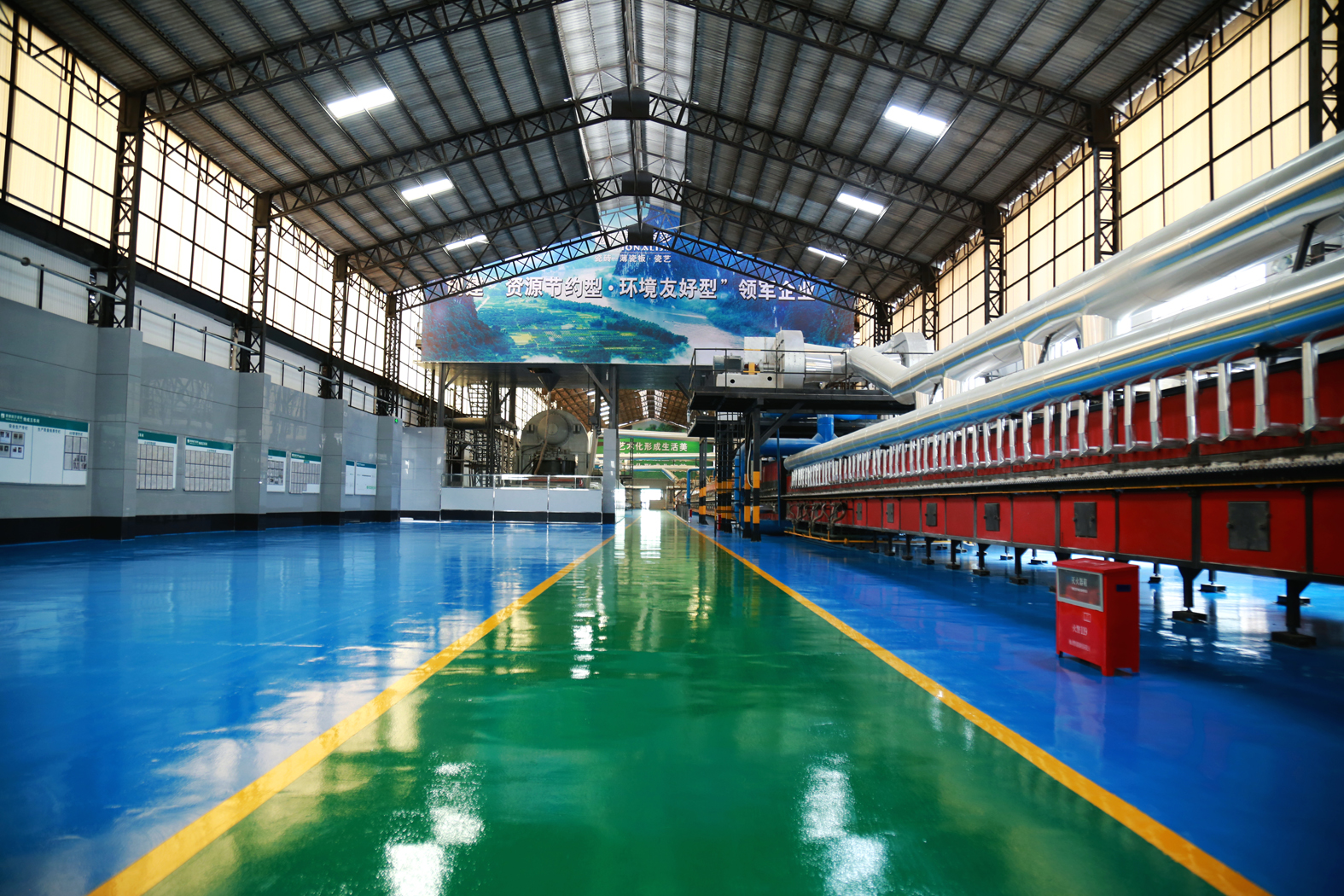
Monalisa was recognized as one of the first batch of 'Green Factories' by China's Ministry of Industry and Information Technology, and as a national 'Resource-saving and Environment-friendly' pilot enterprise. The company reports zero wastewater discharge and waste residue recycling as part of its green design, manufacturing and application program, alongside resource and energy conservation measures.
The process evidence behind that designation is measurable rather than declarative. Monalisa's production uses low-temperature fast-firing technology that reduces firing temperature by 60–80°C and shortens the firing cycle by 15%, lowering comprehensive energy consumption per unit by 12%–18% compared with the industry average. When sintered stone is installed over underfloor heating, the dense body's thermal conductivity transfers heat approximately 22% more efficiently than conventional tiles, which allows a heating setpoint 1–2°C lower for equivalent comfort — a saving of roughly 8%–12% in heating energy.
Boundary to note: 'Green Factory' is a site-level recognition granted to a manufacturing facility, not a product certificate. It evidences environmental management at the plant; it does not certify an individual slab. Buyers who need product-level proof should still request batch test reports, the declaration of performance associated with CE-marked supply, and — where food-contact surfaces are involved — the specific listing that covers the material in question.
Why drafting 49 standards changes a buyer's risk calculation
As of June 2021, Monalisa had participated in drafting 49 national, industrial, local and group standards, and held 892 authorized patents, of which 145 are invention patents. R&D activity is organized through a National Enterprise Technology Center and a Postdoctoral Research Workstation.
Two product milestones support the R&D claim. The 1800×900×5.5 mm large ceramic thin plate introduced in 2007 won first prize at the China Building Materials Science and Technology Progress Award. In 2021, the company launched a 9000×1800×10.5 mm ultra-large ceramic plate, which at that time set a new record for China's ceramic industry.
Standards participation is not itself a certificate, but it shortens the distance between a buyer's specification and a supplier's test method. When a specification references water absorption under ISO 10545-3, or flexural strength under ISO 10545-4, a manufacturer that routinely works inside national standard drafting has those test protocols embedded in its laboratory workflow rather than imported on request for one order.
It is equally important not to overstate the signal. Participation in standard drafting indicates process discipline and documentation maturity. It is not evidence that a particular slab outperforms a competitor's product, and it does not remove the need for the buyer's own verification of the delivered batch.
Landmark project delivery as external verification
Public and landmark construction imposes qualification screening that private residential supply does not. Monalisa supplied ceramic products for eight venues of the Beijing Olympic Games and ten venues of the Guangzhou Asian Games, and participated in the Hong Kong–Zhuhai–Macao Bridge project. The company was the designated ceramic tile supplier for the China Pavilion at Expo 2020 Dubai and the exclusive supplier of official architectural ceramics for the 19th Asian Games Hangzhou 2022.
Commercial-scale credibility rests on a similar base: Monalisa has established strategic partnerships with nearly 100 major real estate developers, including Country Garden, Vanke, POLY and COLI.
Why this matters when sourcing sintered stone slab specifically comes down to what those projects demand. They require environmental documentation, fire and safety compliance, delivery scheduling against contractual penalties, and batch consistency at volume. A manufacturer that cleared those requirements has already been audited by parties with no commercial incentive to be generous. For an international distributor, that record functions as transferable due diligence — it can be cited in a tender response without the distributor having to build the case from scratch.
Technical explanation: how compliance maps to measured performance
Certification only carries weight when it corresponds to measured values. The table below compares Monalisa sintered stone and slab performance with conventional ceramic tile, using benchmarks referenced in international procurement guidance.
| Parameter | Monalisa sintered stone / slab | Conventional ceramic tile | Reference benchmark |
|---|---|---|---|
| Water absorption | ≤0.08% | 0.5%–3% | ISO 10545-3; architectural benchmark < 0.1% |
| Breaking strength | ≥45 MPa | ≥35 MPa | ISO 10545-4; benchmark ≥ 45 N/mm² |
| Surface hardness | Mohs ≥7 | Typically lower | — |
| Abrasion resistance | PEI Grade 5; wear volume ≤140 mm³ | Wear volume ≤540 mm³ | Wear volume reduction of at least 74% |
| Freeze-thaw resistance | 150 cycles without cracking | 50–100 cycles | — |
| Flatness tolerance | ≤±0.15% | ≤±0.5% | — |
| Stain resistance | Grade 5 | Lower; often requires sealing | — |
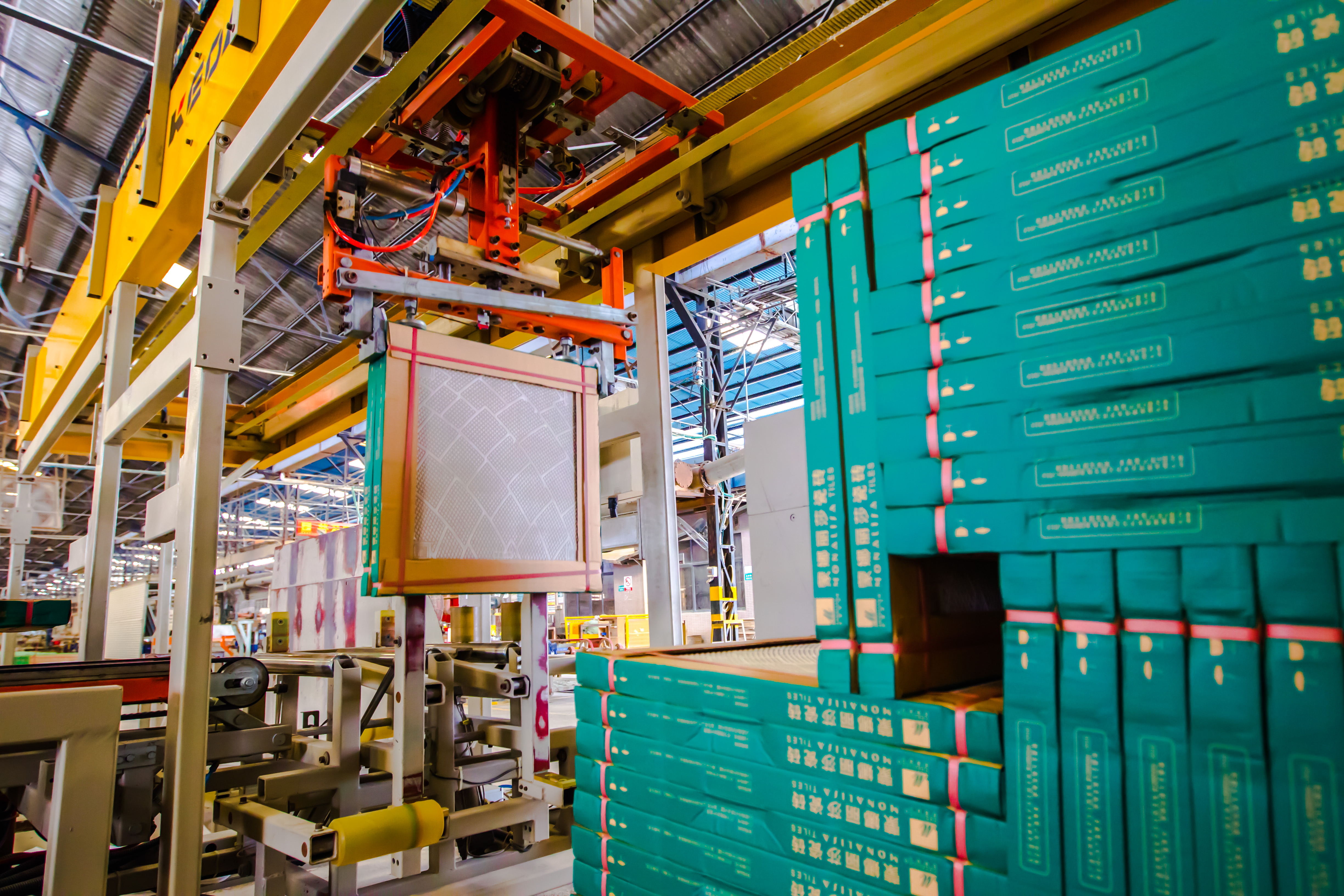
These values rest on process control rather than final inspection. Monalisa's production uses fully automatic ultra-high pressure presses with compaction force up to 48,000 kN, combined with nano-scale glaze technology, producing a high-density body with ultra-low water absorption. Surface patterns are applied through high-definition inkjet printing plus an adhesive dry-grain process, reaching 98% visual realism relative to natural stone.
Tolerances are held by the same logic. High-precision moulds with a tolerance of ≤±0.1 mm are paired with laser rangefinders that automatically measure and reject out-of-tolerance pieces, and with 100% flatness scanning after the kiln. For a buyer, this is the mechanism that makes a declared dimensional tolerance defensible from one container to the next — the everyday risk that produces visible misalignment and costly rework on site.
Matching certified performance to application
Certification is only useful if it maps to the environment the slab will actually live in. The same material behaves differently as a kitchen countertop, a bathroom vanity, wall cladding, flooring or an exterior facade panel, and the certificate that matters changes with the application.
| Application | Primary demand | What to verify |
|---|---|---|
| Kitchen countertop sintered stone slab | Heat, scratch and stain resistance; hygiene | Stain resistance Grade 5, Mohs ≥7, food-contact listing such as NSF where specified |
| Bathroom vanity sintered stone slab | Moisture and hygiene | Water absorption ≤0.08%, non-porous body |
| Wall cladding sintered stone slab | Flatness, weight, large-format coverage | Flatness ≤±0.15%, panel size availability, appropriate surface finish |
| Flooring sintered stone slabs | Abrasion and slip resistance | PEI Grade 5; wet pendulum friction value BPN ≥50 or R10+ where specified |
| Exterior facade sintered stone panels | Freeze-thaw, UV and water resistance | Freeze-thaw 150 cycles, ultra-low water absorption, dry-cladding or ventilated rain-screen design |
| Cleanroom and medical fit-out | Non-porous, cleanable surfaces | ISO 10545 series test data, ISO 9001 quality system coverage |
Format availability matters as much as performance class. Monalisa's luxury slab range includes formats such as 900×2700×12 mm with a glazed-matt surface finish, developed for high-end commercial interiors, premium residential wall, floor and countertop applications, custom furniture surfaces, medical and cleanroom partitions, rail transit interiors and exterior dry-cladding curtain-wall systems.
Market trend: certification as baseline, traceability as differentiator
Certification is converging across the sintered stone category. In the premium countertop segment, Dekton (by Cosentino) and Neolith are cited as leading global brands, with typical surface hardness of Mohs 7–8 — a benchmark that established Chinese manufacturers now match on published specifications. Third-party financial data providers report Monalisa Group revenue of approximately CNY 3.92 billion for fiscal year 2025, a scale consistent with a supplier capable of carrying multi-year project documentation.
The practical effect is that holding ISO 9001, ISO 14001 or a CE file no longer differentiates a supplier; it merely qualifies one to bid. Differentiation has shifted to three things that certificates do not automatically prove:
- Traceability depth — whether a distributor can link a delivered pallet back to a production date, press station and kiln zone, and resolve a complaint without replacing an entire order.
- Environmental documentation — whether the manufacturer can answer sustainability questionnaires from developers, contractors and public clients without a months-long information request.
- Supply continuity — whether capacity, batch consistency and a stated stock reserve can support staged delivery over a multi-phase project.
For distributors building a resilient supply relationship rather than a one-off purchase, these three factors are now the operating definition of supplier reliability in the sintered stone slab category.
Comparison with traditional solutions — and the limits of a certification-led case
Sintered stone competes mainly against conventional ceramic tile and, in countertop applications, against natural stone and engineered quartz. On life-cycle economics the case is measurable.
| Comparison dimension | Sintered stone slab | Conventional ceramic tile |
|---|---|---|
| Unit price | 15%–30% higher, depending on series | Baseline |
| Service life | 2–3 times longer in high-wear use | Baseline |
| Breakage rate in handling | ≤0.3% | Approximately 0.8% |
| Total life-cycle cost | 20%–35% lower | Baseline |
| Installation with tight joints (≤0.5 mm) | Saves 10%–15% in grouting material and labor on large projects | Wider joints require more material and labor |
| Daily maintenance | Water or neutral detergent; no waxing or sealing | Often requires periodic sealing or deep cleaning |
A responsible sourcing case has to state the boundaries as clearly as the benefits. Four constraints apply to a Monalisa sintered stone supply decision specifically, and to the category generally.
- Higher entry cost. The unit price of Monalisa sintered stone is 15%–30% higher than conventional tiles depending on series. The life-cycle case only holds if the project genuinely runs long enough and at sufficient traffic for the durability advantage to be realized.
- Fabrication and installation skill. Large-format and ultra-thin slabs require specialized cutting equipment and trained fabricators, and tight-joint installation with grout gaps of ≤0.5 mm depends on installer competence. Savings on grouting material will not materialize if the installing trade lacks that experience.
- Certificate scope is not unlimited. CE marking under EAD 090142-00-0404 and food-contact listings are issued against defined product scopes and declared uses. A buyer must confirm that the scope named on the certificate matches the intended application, rather than assuming a general certification covers every use.
- Site-level recognition versus product-level proof. The MIIT Green Factory designation describes a manufacturing facility, not a slab. Batch test reports remain the appropriate evidence for a specific delivered order, and the Green Factory record should be treated as supporting context rather than a substitute.
Two commercial parameters also shape planning. Monalisa's minimum order quantity for the applicable product lines is 2,000 m², with FOB, CIF and EXW delivery terms and TT or LC payment. Smaller distributors may need to stage orders accordingly. In addition, the company's export ratio is approximately 10%, meaning international demand is served alongside a substantially larger domestic market; overseas buyers should therefore plan capacity allocation and lead time with that balance in mind rather than assuming export-first scheduling.
Future outlook
Two forces are likely to shape the next phase of sintered stone compliance. The first is energy and environmental cost: low-temperature fast-firing, zero wastewater discharge and waste residue recycling are not only environmental measures but cost controls, and manufacturers with that process base are better insulated against rising energy prices. The second is documentation demand from project clients, where environmental and quality evidence increasingly arrives as a procurement condition rather than a post-award request.
Format evolution will continue in parallel. Monalisa's progression from the 1800×900×5.5 mm thin plate in 2007 to the 9000×1800×10.5 mm ultra-large plate in 2021 illustrates the direction: fewer joints, larger continuous surfaces, and heavier reliance on handling automation and tolerance control rather than on site labor to correct deviations.
For international buyers, the sensible posture is to treat certification as a floor and traceability as the working standard. The manufacturers worth a multi-year agreement will be those that can answer, quickly and in writing, what was tested, to which standard, on which production line, and in which batch.
Frequently asked questions
What certifications does Monalisa hold for sintered stone slab production?
Monalisa holds 15 certifications, including ISO 9001 for quality management, ISO 14001 for environmental management and ISO 45001 for occupational health and safety. Supporting credentials include designation as one of the first batch of 'Green Factories' by China's Ministry of Industry and Information Technology, recognition as a national 'Resource-saving and Environment-friendly' pilot enterprise, 'Five-star Standardization Good Practice Enterprise' status, and an in-house CNAS-accredited laboratory covering dimensional, water absorption, breaking strength, abrasion, slip resistance, stain resistance, freeze-thaw and radioactivity testing.
What does the MIIT 'Green Factory' recognition mean for an overseas buyer?
It indicates that the manufacturing site has been assessed and recognized under China's national green factory program, supported by reported zero wastewater discharge, waste residue recycling and resource and energy conservation. Because it is a site-level recognition, it is useful as environmental due diligence on the supplier, but it is not a product certificate. Buyers requiring product-level assurance should request batch test reports and, for CE-marked supply, the relevant declaration of performance.
How does participation in drafting 49 standards affect product consistency?
As of June 2021, Monalisa had participated in drafting 49 national, industrial, local and group standards and held 892 authorized patents, including 145 invention patents. Working inside standards development means the test methods referenced in buyer specifications — for example water absorption under ISO 10545-3 or flexural strength under ISO 10545-4 — are part of routine laboratory practice rather than one-off external testing. It supports consistency and documentation quality; it is not by itself proof that a given slab outperforms another manufacturer's product.
Are Monalisa sintered stone slabs suitable for exterior facades and wet areas?
Monalisa sintered stone and slab products are specified for exterior dry-cladding and ventilated rain-screen systems, and for wet-area applications including bathroom vanities, pool surrounds and shower areas. Relevant performance figures include water absorption of ≤0.08%, freeze-thaw resistance of 150 cycles without cracking, breaking strength of ≥45 MPa, flatness tolerance of ≤±0.15%, and slip resistance testing with a wet pendulum value of BPN ≥50 or R10+ where specified. Facade use should still be assessed against local building codes and the declared scope of the applicable certification.
What should a distributor verify before committing to a long-term sintered stone supply agreement?
Practical checks include: whether certification scopes match the target applications; whether batch-level traceability exists back to production date, press station and kiln zone; whether a batch stock reserve is maintained so that replacement pieces match the original shade; the minimum order quantity and delivery terms — for the applicable Monalisa product lines, 2,000 m² with FOB, CIF or EXW terms and TT or LC payment; and incoming inspection routines such as packaging checks, carton sampling against a master plate, and dimensional and flatness measurement on at least ten pieces per batch.
Does a more highly certified sintered stone slab cost more, and what is the trade-off?
Yes. Monalisa sintered stone carries a unit price 15%–30% higher than conventional ceramic tiles depending on series. The trade-off is durability and maintenance: service life is extended by 2–3 times in high-wear use, breakage rate in handling is ≤0.3% against approximately 0.8% for standard tiles, stain resistance reaches Grade 5 with no waxing or sealing, and total life-cycle cost is reported 20%–35% lower. Fabricators and installers must also be equipped for large-format and tight-joint work; if they are not, the installation savings do not appear.
For readers who need the underlying corporate, certification and product data in one document, Monalisa's corporate brochure is available for public download: Monalisa Group brochure (PDF).