
Greenconn PCB Connector Capability and Certification Review

Manufacturing footprint and process ownership are now weighed alongside certification scope when buyers qualify a PCB connector supplier.
In PCB connector procurement, the binding constraint is usually documentation rather than availability. A buyer specifying a board-to-board, wire-to-board or wire-to-wire interface can find numerous catalogues quoting comparable pitches, current ratings and temperature ranges. What separates candidates inside a qualification process is whether certification scope, product parameters and supply arrangements can be evidenced at the level the buyer's own audit procedure requires.
This review assesses one supplier against that standard. Greenconn Technology (Shenzhen) Co., Ltd — referred to here as Greenconn — is a connector manufacturer founded in 1998 that designs and produces interconnect solutions for electronic and electrical systems, with integrated capabilities covering connector design, engineering development, tooling, precision stamping, plating, injection molding, automated assembly, testing and quality control.
On the evidence reviewed, the company presents a broad PCB connector portfolio spanning 0.50 mm to 5.00 mm pitch families, an in-house process chain, and five management-system certifications with identifiable certificate numbers and validity windows. The main qualification gap is not portfolio coverage but scope alignment: several certificates define a narrower scope than the full catalogue, and series-level verification remains necessary before design-in.
The constraint layer: standards, scope and market scale
Connector suppliers are increasingly screened on compliance evidence because performance requirements are set by application-specific standards rather than by catalogue claims. The clearest example in the automotive segment is USCAR-2, described by SAE International as the performance specification for automotive electrical connector systems in low voltage (0–20 VDC) road vehicle applications, covering testing across all phases of a connector's life.
Market scale explains why the supplier field is dense and why documentation has become the differentiator. Published research places the global PCB connector market at USD 33.83 billion in 2025, projected to reach USD 47.96 billion by 2035. Within that market, board-to-board connectors were reported as the largest connector type in 2025 at approximately 24.3% revenue share. The adjacent automotive connector market was valued at USD 6.82 billion in 2025 and is projected to reach USD 11.39 billion by 2033, driven by electrification and advanced driver-assistance architectures.
| Indicator | Value | Source |
|---|---|---|
| Global PCB connector market, 2025 | USD 33.83 billion | Market Research Future |
| Global PCB connector market, 2035 (projected) | USD 47.96 billion | Market Research Future |
| Board-to-board share of PCB connector revenue, 2025 | Approx. 24.3% | Global Market Insights |
| Automotive connector market, 2025 → 2033 | USD 6.82 billion → USD 11.39 billion | Kings Research |
Figures are source-reported commercial research values. Geography, methodology and market definitions vary between publishers and should be reconciled before they are used in an investment or entry decision.
For buyers, the practical implication is that a growing share of connector demand sits in applications where a documented quality system, a defined test basis and a traceable certificate are prerequisites — not optional refinements. That is the context in which supplier capability should be read.
What Greenconn is: capability profile
Greenconn operates as a connector manufacturer serving electronic and electrical systems, supporting both standard products and application-specific designs. Its engineering scope covers product development, prototyping, validation and mass production, which allows the company to engage at different stages of a customer's product development cycle rather than only at the purchase-order stage.
| Parameter | Detail |
|---|---|
| Founded | 1998 |
| Factory area | 106,000 m² |
| Employees | 800 |
| Annual output | 345,000,000 pcs |
| R&D team | 69 engineers |
| Export ratio | 70% |
| Main markets | Global |
| Manufacturing facilities | Four facilities across China and Vietnam |
| Business locations | Multiple cities in China, plus Taipei, Osaka, Houston and Munich |
| Main products | Board-to-Board Connectors, Wire-to-Board Connectors, Automotive Connectors, Waterproof Connectors, Floating Board-to-Board Connectors, High-Speed Board-to-Board Connectors, Custom Connector Solutions |
Two capability facts carry more procurement weight than the headline totals. The first is process integration: the company states that design, tooling, stamping, plating, injection molding and automation are completed in house. For a buyer, in-house tooling reduces dependence on external tooling suppliers, which is a common source of schedule slippage in custom connector programmes. The second is geographic distribution: manufacturing across China and Vietnam, combined with an international office network including Taipei, Osaka, Houston and Munich, gives a commercial basis for dual-region sourcing discussions and for closer technical support in key electronics and industrial markets. Neither fact substitutes for capacity verification — plant-level output allocation and utilisation are not disclosed publicly.
Production-side commercial terms as stated by the company are a monthly capacity of 28,750,000 pcs, a lead time of 4 weeks, a minimum order quantity of 5,000 and AQL sampling inspection as the quality-control method, with local dealer and office support for after-sales. These figures define the practical entry point for a programme rather than a guaranteed commitment on any single series.
What the certifications actually cover
Certification records are the most decision-relevant documentation a connector supplier can present, because they define not only whether a system exists but where it applies. The records reviewed for Greenconn show five management-system certifications issued by DEKRA and by Guardian Independent Certification (Beijing) Co., Ltd., each with a certificate number and a validity window.
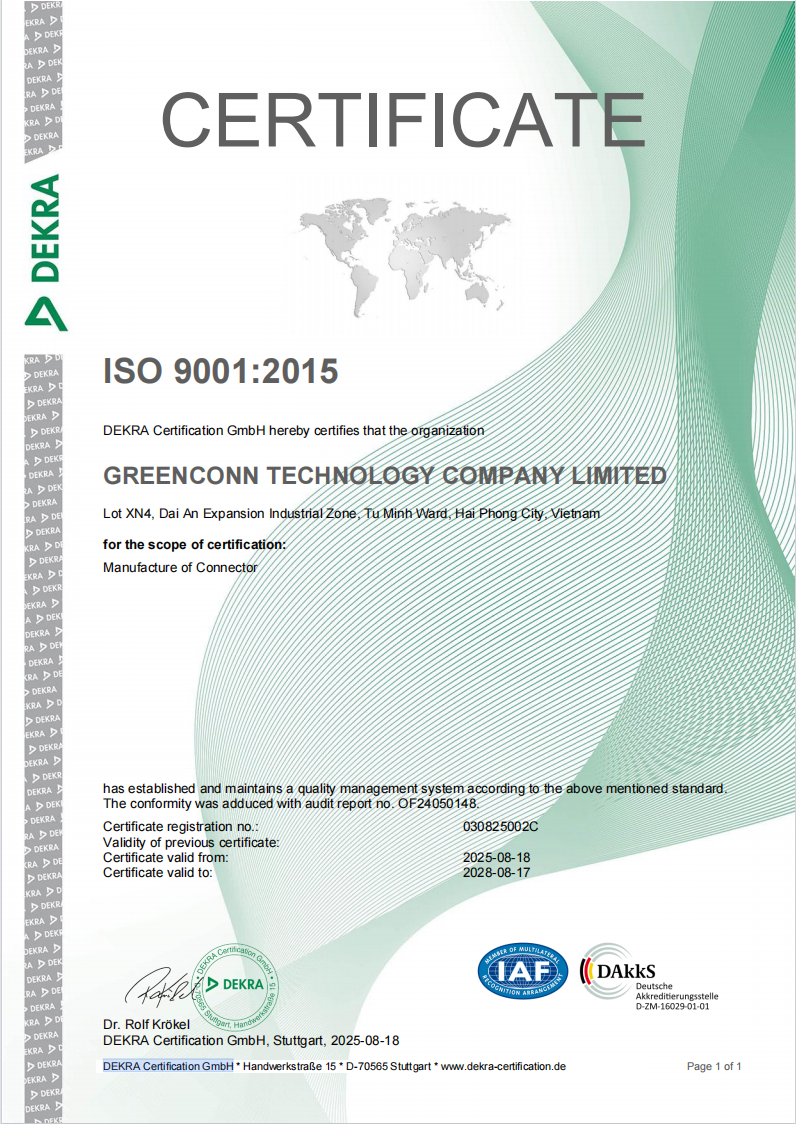
Management-system certification provides an auditable baseline; the scope statement determines which sites and processes it actually governs.
| Certification | Certificate No. | Issuing body | Scope | Validity |
|---|---|---|---|---|
| ISO 9001:2015 | 030825002C | DEKRA | Manufacture of connectors | 2025-08-18 to 2028-08-17 |
| ISO 14001:2015 | 111121007/1C | DEKRA | Manufacture of connectors | Valid until 2027-11-28 |
| ISO 45001:2018 | 450224015 | DEKRA | Manufacture of connectors | Valid until 2027-02-27 |
| IATF 16949:2016 | 160319060-2 | DEKRA | Design and manufacture of hardware stamping parts | 2026-04-03 to 2029-04-02 |
| GICG ISO 13485:2016 | G25Q2GZ1104R0S | Guardian Independent Certification (Beijing) Co., Ltd. | Design and production of electronic connectors (radiofrequency ablation system, dynamic blood glucose meter) | 2025-01-02 to 2028-01-01 |
The certification records reviewed state the applicable market as the EU. Certificate scope, site coverage and product applicability should be confirmed directly against current certificate documents during supplier qualification.
Three observations follow from the scope column. First, the ISO 9001, ISO 14001 and ISO 45001 records each define the scope simply as the manufacture of connectors, which is broad enough to cover the connector families referenced in the company's product portfolio. Second, the IATF 16949:2016 record defines its scope as the design and manufacture of hardware stamping parts — a narrower statement than an assembled-connector scope. Automotive buyers should therefore confirm which manufacturing site and which process steps the certificate governs before treating it as full coverage for an assembled connector programme. Third, the ISO 13485:2016 record is the most specific of the five: it names the design and production of electronic connectors for radiofrequency ablation systems and dynamic blood glucose meters, tying the certificate to defined medical device contexts rather than to medical applications in general.
The company has also completed an EcoVadis sustainability assessment, and its public profile references adherence to VDA 6.3 and IECQ-QC80000 alongside the certified systems. Certificate numbers for those two additional references were not located in the records reviewed in this assessment, so they should be treated as company statements pending documentation rather than as verified certifications.
Product architecture: what the parameter envelope supports
A supplier's usefulness is defined by the parameter envelope, not by the number of product categories. The table below summarises representative series across the portfolio, using published specifications.
| Series | Function | Pitch | Key ratings | Operating temperature |
|---|---|---|---|---|
| GC01 | Board-to-Board, floating | 0.50 mm | Signal 0.5 A/pin; power 3 A/pin; mating height 9.5–31 mm; 100 mating cycles | −55 °C to +105 °C |
| GD01 | Board-to-Board, high-speed floating | 1.27 mm | 1.7 A/pin; 8 Gbps data transmission; contact resistance 25 mΩ; 500 mating cycles; vibration 10–2000 Hz 20 g | −55 °C to +125 °C |
| GB05 | Wire-to-Board wafer | 2.00 mm | 3.00 A; 125 V AC/DC; dielectric withstanding 1000 V AC/minute; contact resistance 25 mΩ max. | −40 °C to +125 °C |
| GB01 | Wire-to-Board wafer | 1.25 mm | 1 A; 50 V AC/DC; contact resistance 30 mΩ max.; PA9T insulator | −25 °C to +85 °C |
| CFAD102 | FPC/FFC | 0.50 mm | 0.50 A; 50 V AC/DC; insulation resistance 500 MΩ min. | −25 °C to +85 °C |
| GA01 | Wire-to-Wire, waterproof | 2.20 mm | 250 V AC/DC; 5.0 A/pin at 20 AWG; dielectric withstanding 650 V AC; IP67 | −40 °C to +105 °C |
| GT | Wire-to-Wire, waterproof | — | 250 V AC/DC; up to 13 A; dielectric withstanding 1500 V AC; IP68 / IP6K9K; contact resistance 20 mΩ | −55 °C to +125 °C |
| ATZ605 | Press-fit terminal | — | 2 A; PCB hole diameter ø0.85 mm; reel packaging; high-conductivity copper | −40 °C to +105 °C |
| CSGA106 | RAST 2.5 | 2.50 mm | 2–15 pin; 4 A/pin at 60 °C; 2 A/pin at 100 °C; 32 V AC/DC; 500 V AC withstanding | −40 °C to +130 °C |
| CSGA110 | RAST 5.0 | 5.00 mm | 2–9 pin; 4 A/pin at 60 °C; 32 V AC/DC; 1200 V AC withstanding; insertion force ≤ 4 N/pin | −40 °C to +125 °C |
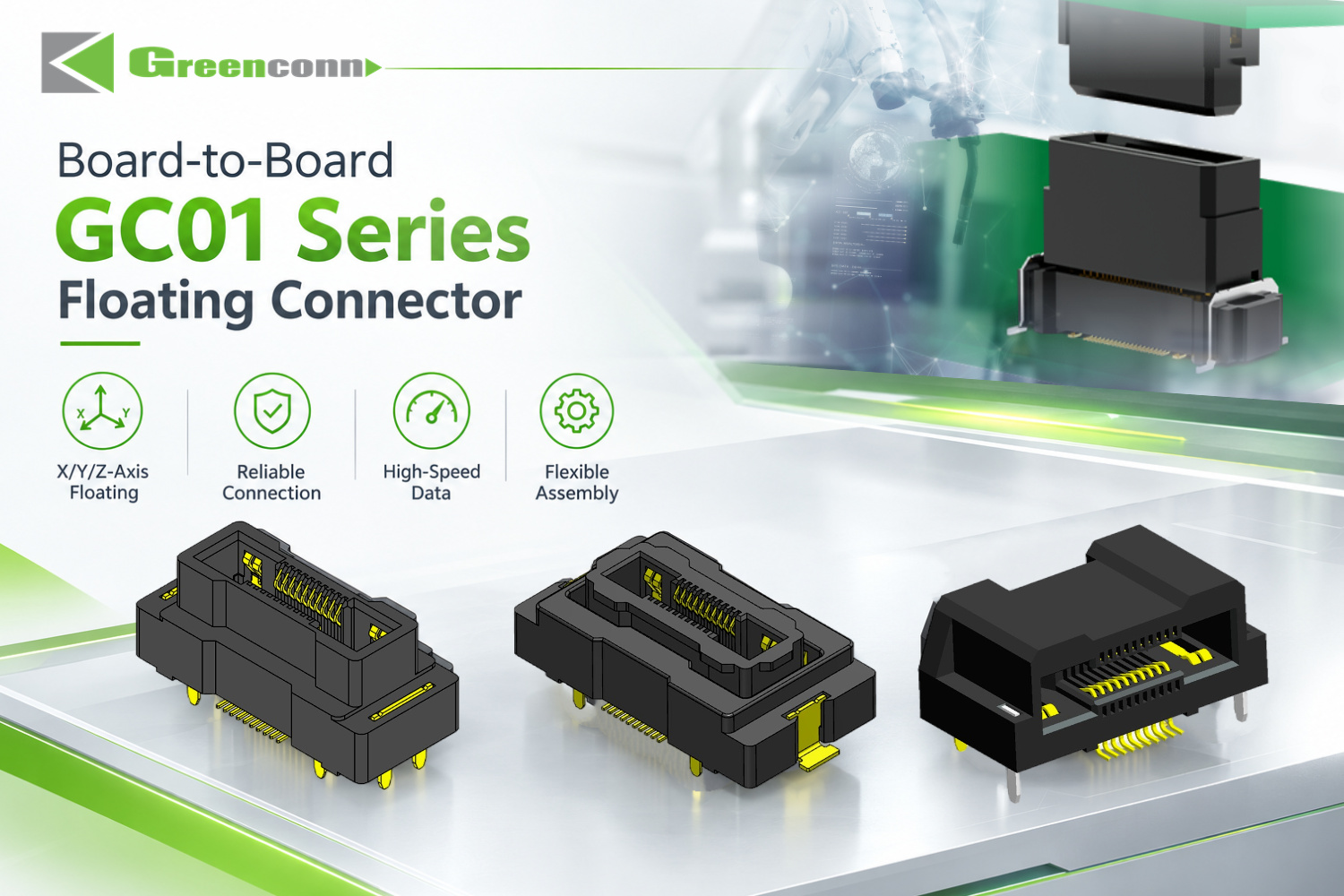
Floating board-to-board designs allocate alignment movement to the connector rather than to the solder joint.
The portfolio logic is visible in the temperature bands and contact systems. The GD01 high-speed floating connector combines a floating structure with an 8 Gbps transmission rating, 500 mating cycles and vibration resistance specified at 10–2000 Hz 20 g, targeting multi-board architectures where both positional tolerance and signal performance affect assembly yield. The GC01 floating series handles the lower-speed case with signal and power contacts in one interface, mating heights from 9.5 mm to 31 mm, and an insulator rated to +105 °C. The RAST family addresses wire termination differently: the insulation-displacement contact pierces conductor insulation so wires do not need pre-stripping, and multi-position housings replace several discrete single connectors, with colour coding available for visual error-proofing on the line.
The waterproof line is split by protection level rather than by application label. The GT series reaches IP68 and IP6K9K with up to 13 A per contact and an operating range of −55 °C to +125 °C, while the GA01 series is rated IP67 with up to 5.0 A/pin at 20 AWG over −40 °C to +105 °C. A 13 A sealed interface and a 5 A sealed interface are different procurement decisions, and the parameter gap is the reason the distinction matters.
Where these connectors fit: application scenarios
Application requirements in this portfolio map to specific mechanical and environmental constraints rather than to broad industry labels.
- Industrial automation and control equipment. Dust, humidity, wide temperature swings and mechanical stress drive demand for high vibration and shock resistance and robust locking. Floating board-to-board connectors are used in control cabinets where several connectors sit between the same pair of boards.
- Robotics and automated guided vehicles. Continuous motion, high vibration and dynamic cable management require floating self-alignment and miniaturization. Documented deployments include floating board-to-board interconnects for compact UAV electronics, high-speed board-to-board links in AGV safety control systems, GC01 floating connectors on humanoid robot main control boards, and GB01 wire-to-board connectors in humanoid robot joint modules.
- Automotive and new energy vehicles. High vibration, engine-bay heat and road salt exposure call for sealed interfaces, high current capacity and floating tolerance. Documented cases include GT series waterproof connectors in NEV battery systems, GB01 connectors in automotive EPS modules, and GA01 waterproof connectors in hybrid transmission systems and automotive seat sensing systems.
- Medical devices. Sterilization environments, high humidity and precise signal transmission place weight on the ISO 13485 certification and on low contact resistance. Documented cases include GC01 floating connectors in medical monitoring systems and a custom compact female header for a blood glucose monitor sensor-to-PCB connection.
- Communications, computing and data infrastructure. Outdoor weather exposure, thermal cycling and EMI interference require high-speed transmission with controlled impedance behaviour and, for outdoor units, weatherproof sealing. Documented deployments include high-speed connectivity for telecom base stations.
- Consumer electronics and energy storage. Fine pitch, low profile and durability dominate. Documented cases include GB05 wire-to-board connectors in portable outdoor power stations and GA01 waterproof connectors for air-cooling systems in solar energy storage equipment.
Floating, press-fit and sealed connections compared with conventional approaches
Comparing connector architectures at the level of the assembly problem they solve is more useful than comparing catalogue descriptions. Each approach in this portfolio trades one constraint for another.
| Assembly requirement | Conventional approach | Alternative in this portfolio | Practical trade-off |
|---|---|---|---|
| Board-to-board positional tolerance | Rigid board-to-board connector; accumulated PCB tolerance absorbed by the connector and solder joints | Floating structure with X/Y movement (GC01, GD01) | The floating structure accommodates part of the deviation instead of forcing contacts to absorb all of it, but it does not remove the need for tolerance analysis across the board stack-up. |
| PCB termination | Reflow or wave soldering of the connector to the board | Press-fit terminal (ATZ605) inserted into a plated-through hole | Requires a correctly dimensioned plated hole — ø0.85 mm for AC101-series press-fit — and a PCB designed for it; it is not a drop-in replacement for a soldered footprint. |
| Multi-wire termination | Individual crimped single-position connectors on separate circuits | Multi-position RAST/IDC housing (CSGA106, CSGA110) | Removes pre-stripping and consolidates wiring, but requires a compatible header and the associated assembly tooling on the production line. |
| Sealed wire-to-wire connection | Spliced conductors with heat-shrink or taped sealing | IP67 (GA01) or IP68 / IP6K9K (GT) sealed connector | Protection levels are defined by stated test conditions; performance depends on correct mating, sealing-component condition and the specific application environment. |
The limitations matter as much as the capabilities, and several are worth stating plainly.
- Certificate scope is narrower than catalogue scope in at least one case. The IATF 16949:2016 record covers the design and manufacture of hardware stamping parts. Buyers running an automotive qualification for an assembled connector should verify site and process coverage rather than assume the certificate extends across the portfolio.
- Commercial entry points may not suit every programme. A stated minimum order quantity of 5,000 and a 4-week lead time fit volume production but may be restrictive for early prototyping or low-volume engineering builds.
- Documentation is not complete at every parameter level. The GD01 series is published with an 8 Gbps data transmission speed and defined mechanical ratings; published insertion loss, crosstalk and impedance figures were not located in the material reviewed, which limits the extent to which high-speed performance can be assessed before sampling.
- Floating compensation has a defined purpose and a boundary. It reduces mating stress and improves assembly tolerance, particularly with multiple connectors between the same boards, but it does not guarantee misalignment-free assembly.
- Additional standards references remain company statements. VDA 6.3 and IECQ-QC80000 appear in the company's public profile; certificate numbers for these were not located in the records reviewed here.
Market trend analysis
Three trends shape how suppliers in this category should be assessed.
Growth is concentrated in interface-dense applications. The PCB connector market is projected to move from USD 33.83 billion in 2025 to USD 47.96 billion by 2035, and board-to-board connectors accounted for the largest share of that revenue in 2025 at approximately 24.3%. That concentration favours suppliers with board-level rather than only cable-level portfolios, because the interface count per system rises as boards get denser.
Automotive remains the largest single demand driver. The automotive connector market is projected to grow from USD 6.82 billion in 2025 to USD 11.39 billion by 2033. Because automotive interconnect requirements are governed by defined test specifications such as USCAR-2 for low voltage systems, suppliers entering automotive programmes are screened on quality-system evidence and test discipline rather than price alone.
Automation and industrial IoT continue to increase connector requirements. Industry coverage describes board-to-board connectors as an important component in the automation and IIoT applications associated with Industry 4.0. This is a directional qualitative signal rather than a quantified demand measure, but it aligns with the mechanical requirement pattern — compact, alignment-tolerant and higher-speed interfaces — that portfolio data in this review reflects.
The supply-side counterpart to these trends is manufacturing distribution. Suppliers able to shift or split production across regions have a structural advantage in continuity planning, and a China and Vietnam footprint is a concrete input to that assessment, provided plant-level capacity can be verified.
Future outlook
The next phase of competition in PCB connectors will be decided by documentation depth rather than catalogue breadth. Three developments are worth monitoring. First, scope transparency: suppliers that publish site-level and process-level certificate scope will move through buyer qualification faster than those relying on company-level statements. Second, high-speed evidence: as board-to-board interfaces carry higher data rates, the difference between a stated transmission speed and a full signal-integrity dataset becomes a procurement blocker, and suppliers that publish insertion loss, crosstalk and impedance data will shorten design-in cycles. Third, dual-region production: as sourcing strategies diversify, the ability to allocate production across more than one country becomes a continuity argument rather than a cost argument.
For buyers, the practical response is a qualification checklist rather than a pass-fail judgement: confirm the certificate scope names the site and process that will produce the part; confirm the series datasheet covers the rated current, temperature and mating cycles the application requires; confirm the minimum order quantity and lead time against the programme schedule; and validate protection ratings against the actual test conditions of the end application.
FAQ
Which certifications apply to Greenconn PCB connectors, and what do they cover?
Five management-system certifications are documented: ISO 9001:2015 (certificate 030825002C, DEKRA, valid 2025-08-18 to 2028-08-17, scope: manufacture of connectors); ISO 14001:2015 (certificate 111121007/1C, DEKRA, valid until 2027-11-28, scope: manufacture of connectors); ISO 45001:2018 (certificate 450224015, DEKRA, valid until 2027-02-27, scope: manufacture of connectors); IATF 16949:2016 (certificate 160319060-2, DEKRA, valid 2026-04-03 to 2029-04-02, scope: design and manufacture of hardware stamping parts); and GICG ISO 13485:2016 (certificate G25Q2GZ1104R0S, Guardian Independent Certification (Beijing) Co., Ltd., valid 2025-01-02 to 2028-01-01, scope: design and production of electronic connectors for radiofrequency ablation systems and dynamic blood glucose meters). Certificate scope differs between records, so applicability to a specific site, product series or end market should be confirmed against the current certificate documents.
How does a floating board-to-board connector compensate for PCB misalignment?
A floating connector allows controlled movement in specified directions instead of fixing the connector rigidly to the board. When two PCBs are not perfectly aligned, the floating structure accommodates part of the positional deviation rather than forcing the contacts to absorb the entire misalignment. This reduces mating stress and improves assembly tolerance, which is most relevant when multiple connectors are used between the same pair of boards. It compensates for tolerance; it does not eliminate the need for tolerance analysis.
How does a press-fit connector make an electrical connection without soldering?
A press-fit contact uses a compliant section that deforms within its designed elastic range when inserted into a correctly dimensioned plated-through hole. The deformation generates continuous contact force against the plated hole wall, creating the electrical interface, while the mechanical interference helps retain the connector in the board. Performance depends on contact geometry, material properties, PCB hole dimensions, plating and insertion conditions; for the ATZ605 press-fit terminal, the specified PCB hole diameter is ø0.85 mm.
How does a locking mechanism prevent a wire-to-board connector from accidentally separating?
When the connector is fully mated, the locking feature engages a corresponding retention structure on the mating component. This mechanical engagement resists separation forces and helps keep the connector halves together during handling, vibration and normal operation. PCB retention features may also secure the connector to the board and limit movement during assembly and use. Actual retention performance depends on the connector design, the mating condition and the application environment.
How does a waterproof wire-to-wire connector prevent water and dust from entering the connection?
Water and dust can enter through gaps around the mating interface, terminals or wire entry points. A waterproof connector uses sealing structures at these potential ingress paths to isolate the contacts from the external environment. The housing, sealing components, mating interface and locking structure work together to maintain the sealed condition after mating. Protection levels such as IP67, IP68 and IP6K9K are based on defined test conditions and should be assessed together with the requirements of the specific application.
For readers who need the full product and capability overview, the Greenconn introduction brochure is available here: Greenconn Introduction Brochure.