
Grid-Tied vs. Off-Grid: Inside SolisStorage's 10ms Transfer
For most commercial and industrial sites, an energy storage system is justified on economics: peak shaving, higher self-consumption of solar generation, and, in open electricity markets, participation in ancillary services. The specification that decides whether the site can trust that system on its worst day is a different one — how quickly the facility gets a stable voltage and frequency reference back when the grid drops, and how quickly it returns to grid-parallel operation when the grid recovers.
That interval is usually expressed in milliseconds, and it is easy to treat as a footnote. This article explains how grid-tied and off-grid operation differ inside a commercial and industrial (C&I) energy storage system, where the switching time comes from in the SolisStorage EverCore ESS architecture, what a warehouse deployment in Denmark illustrates, and which parts of the claim a buyer should still verify project by project.
Why transfer time belongs in the procurement specification
Not every electrical load notices a short interruption; a lighting circuit rarely does. Loads built around power electronics usually do. Variable-speed drives, programmable logic controllers, refrigeration and process control equipment, laboratory instruments and server rooms are all designed around a defined input envelope. A voltage dip or a frequency excursion outside that envelope can cause a drive to trip, a controller to reboot, or a production batch to be discarded.
This is why backup switching is treated as a power-quality parameter rather than a convenience feature. The relevant question is not whether a site has a battery, but whether the battery can take over the load without creating the very disturbance the site was trying to avoid. For a warehouse running conveyors, refrigeration and control systems, a gap of a few tens of milliseconds is not an inconvenience — it is a stopped shift.
Grid-tied and off-grid are two states of the same system
SolisStorage's application documentation describes an EverCore-class C&I system as operating in 24/7 continuous operation across three states — grid-tied mode, off-grid mode and seamless backup switching — with the functions listed as peak load shifting, backup power supply and self-consumption of PV power. The three states are not three products; they are three operating conditions of one system, and the transition between them is the part that decides whether downstream equipment ever sees the change.
Grid-tied mode
In grid-tied mode the system runs in parallel with the public grid, and the grid sets voltage and frequency while the storage system follows. This is the revenue-earning state: the battery charges when energy is cheap or when PV output exceeds site demand, discharges during expensive periods, and — in markets that allow it — provides frequency regulation and other grid services. It is also the state in which the system supports energy storage integration and grid stability retrofitting projects.
Off-grid mode
In off-grid mode the storage system becomes the source. It is islanded from the grid and forms the voltage and frequency reference for the loads connected downstream. Those loads no longer see a utility as their reference; they see the inverter. This is the state a site relies on during an outage or during intentional islanding.
Seamless backup switching
Seamless backup switching is the transition itself. If the transfer is slow, the load sees a gap proportional to the delay. If the transfer is clean, the load continues operating without registering a meaningful change in supply quality — which is the difference between a backup system that protects a process and one that merely restores power to it afterwards.
Where the sub-10 millisecond transfer comes from
SolisStorage specifies grid-tied to off-grid switching in less than 10 milliseconds for EverCore, without an external static transfer switch (STS). That figure is a property of how the system is built rather than an add-on component.
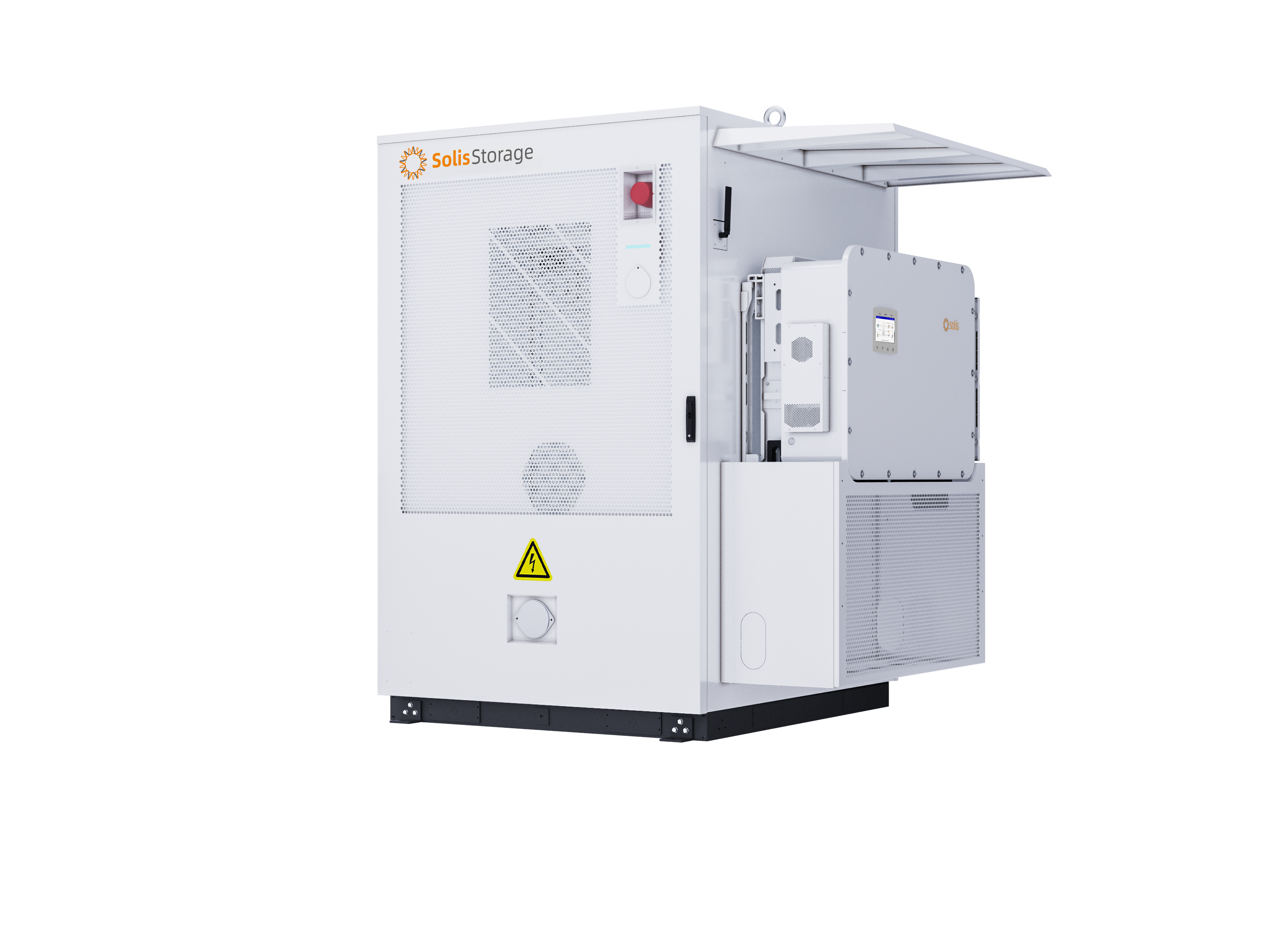
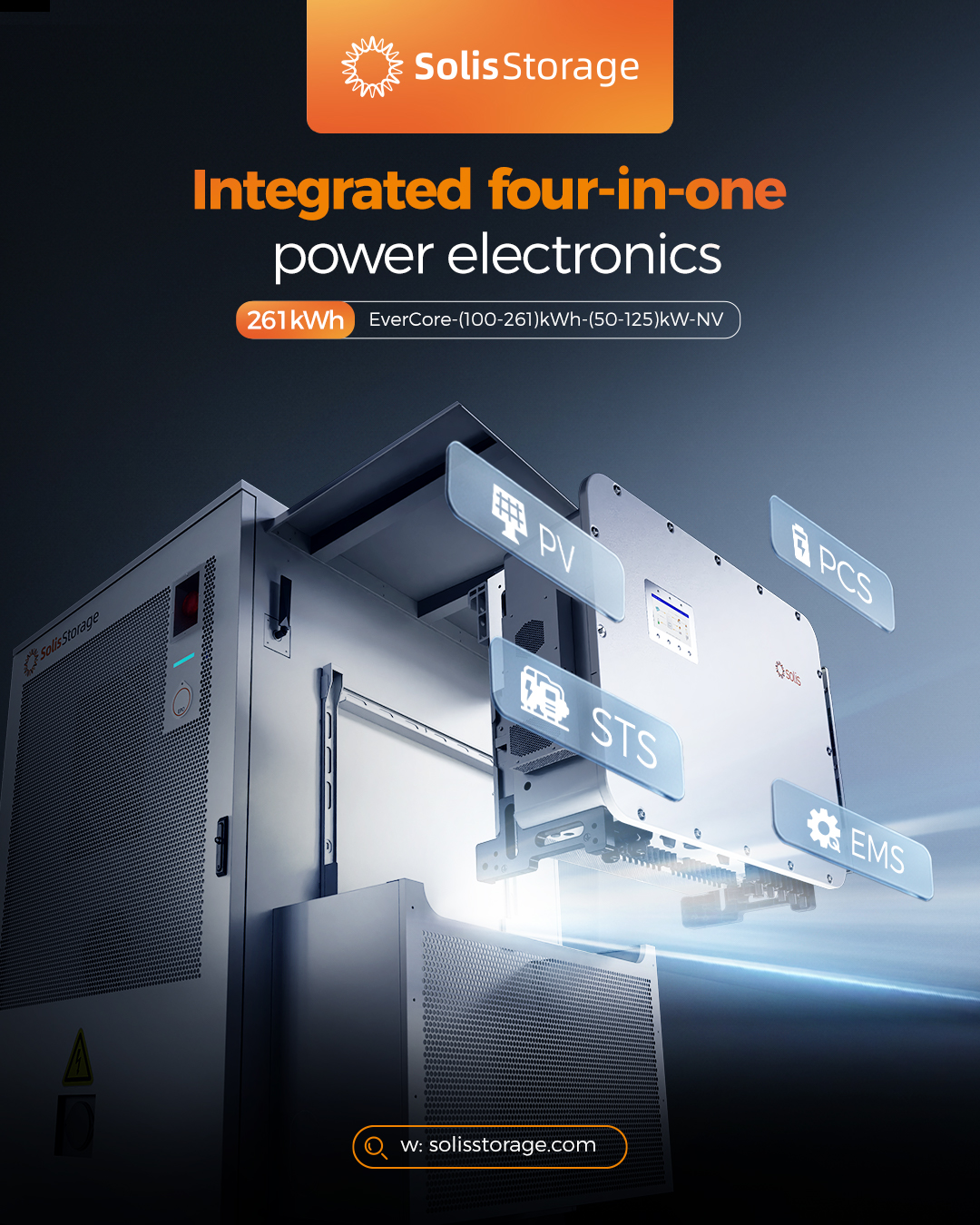
In the EverCore architecture, the hybrid energy storage inverter in the 50–125 kW range integrates the power conversion system (PCS), the static transfer switch (STS), the PV inverter, circuit-breaker protection and the energy management system (EMS) into a single unit. Because the transfer function sits inside the same enclosure as the conversion stage, the mode change does not depend on an external device negotiating the handover over a communications link before it acts.
One controller instead of four
Conventional C&I architectures commonly run independent CPUs for the BMS, PCS, EMS and STS, forming a distributed “multi-brain” control topology. Every additional node-to-node link is a place where protocol compatibility has to be confirmed and where latency can accumulate, and fault finding typically requires several suppliers to be involved at once.
EverCore instead uses a single central controller that schedules the whole system. Fewer communication links mean fewer places where a transfer sequence can stall, and when a fault does occur, location and response are more direct. This is a structural rather than a software advantage: the reliability comes from having removed the coordination problem rather than from optimising it.
What the integration removes from the bill of materials
Because the PV inverter is integrated, an EverCore installation does not require a separate PV inverter, and existing PV assets can be connected on either the DC or the AC side, with a PV oversizing ratio of up to 200%. Because the grid cabinet is also not required as a separate item, up to six EverCore units can be connected in parallel and tied directly to the grid.
Fewer external devices is not only a cost question. Each device removed from the chain is also a transfer dependency removed from it, which is the part that matters when the grid event actually happens.
The reference case: a Danish warehouse
The clearest illustration of why that interval matters comes from a warehouse project in Denmark. The site runs EverCore in the 125 kW / 261.2 kWh configuration, one of the standard C&I variants alongside the 100.5 kWh and 120.6 kWh options. When the grid supply was interrupted, the system transferred from grid-tied to off-grid operation inside the sub-10-millisecond window and continued supplying the backed-up circuits, so the warehouse did not lose its process supply during the event.
For a warehouse, that is the entire point of the investment: a grid event is an external problem, and the storage system's job is to stop it from becoming an internal one. The project also shows why the transfer specification is worth stating explicitly. A buyer specifying an external STS has to define its transfer time, confirm its coordination with the PCS, and verify the communications path between the two. When the STS is inside the inverter, that coordination becomes a design property of the unit rather than an interface the buyer has to engineer.
Four design decisions that support a stable transfer
Separating the AC side from the DC side
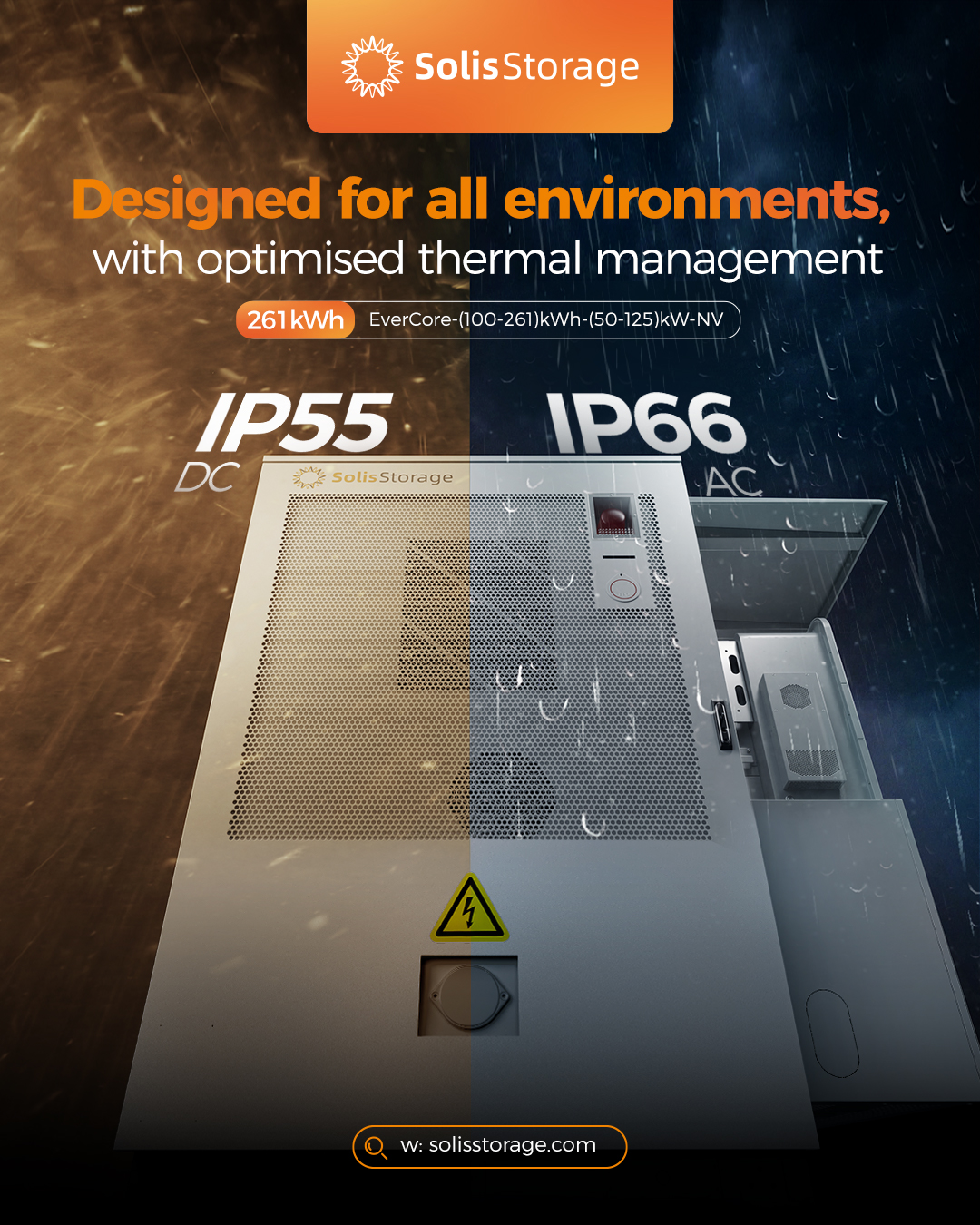
EverCore physically separates AC and DC: the hybrid energy storage inverter sits on the AC side and the battery cabinet on the DC side, each in its own space. SolisStorage describes three consequences. First, thermal separation — the external inverter dissipates around 6 kW of power heat directly to ambient air, leaving roughly 3.5 kW of electrochemical heat to be managed inside the battery cabinet, which supports more uniform cell temperatures. Second, protection separation — as an independent unit the inverter carries an IP66 rating while the battery cabinet is IP55, a design the company states reduces the system's full-lifecycle failure rate by 50%. Third, structural separation — one inverter can connect up to six battery cabinets in parallel, so storage capacity can be expanded without adding another inverter, which SolisStorage estimates reduces system expansion costs by approximately 10%.
Choosing the cooling architecture deliberately
EverCore retains air cooling on the 125 kW / 261 kWh C&I platform and supports it with an independent three-air-duct design: a patented diversion air duct for the hybrid energy storage inverter combined with Coanda-effect airflow attachment across the surfaces of the battery packs, which keeps the cooling stream in contact with curved surfaces. SolisStorage reports that the combination improves heat dissipation efficiency by about 30% over conventional air cooling, and pairs it with IP66/IP55 protection and C4-class anti-corrosion coating so the system can operate across -25°C to 55°C and at altitudes up to 4,000 m.
Cell selection at the electrochemical level
EverCore uses A-grade 314 Ah LFP cells developed for C&I duty. Their internal resistance is 0.15 ± 0.05 mΩ, compared with 0.17 mΩ for the 280 Ah cells still widely used in the segment. Because lower internal resistance reduces charge-discharge heat generation — roughly 20% less heat for every 10% reduction — the benefit is applied at the electrochemical source rather than at the cooling stage. The same cells are rated for 8,000 cycles at a 0.5C charge-discharge rate with remaining capacity of at least 70%, against around 7,000 cycles for 280 Ah cells. At 500 cycles per year, that difference moves the system's economic lifecycle from roughly 14 years to 16 years.
Layered protection
Safety design runs across three levels in the EverCore architecture: cell, battery pack and system. Between packs, thermal insulation materials resistant to 1,000°C are used to block the lateral spread of thermal runaway at the source, and fire suppression is staged progressively through pack-level aerosol, cabinet-level aerosol and fire-fighting water channels, so intervention is matched to the stage of a thermal event.
Where the system is deployed
EverCore is designed for commercial and industrial applications and for the renewable energy and power grid industry, covering peak shaving, frequency regulation and virtual power plant (VPP) related projects, energy storage system integration, grid stability retrofitting, backup power supply and self-consumption of PV power.
Environmentally, the platform is specified for household outdoor and industrial outdoor conditions, including wide temperature range, coastal salt fog and high altitude, with IP66 and IP55 protection ratings and C5 anti-corrosion certification. The application scenario is documented as common in Germany and is typically applied across multiple countries including Australia, Germany, France and others.
The supplier behind the platform is SolisStorage, the energy storage subsidiary of Solis (Ginlong Technologies Co., Ltd.), a company founded in 2005 and listed on the Shenzhen Stock Exchange under stock code 300763. Solis reports more than 5,000 staff, an R&D team of over 1,000 engineers, a manufacturing facility of 98,114.69 m² and annual production capacity of 80 GW. Solis products are used in more than 100 countries and regions, with major markets including Europe, Africa (including South Africa), the Middle East and Central Asia, and South Asia; export business accounts for 70% of total sales.
Market signals behind the demand for a clean transfer
Several independent data points explain why transfer behaviour is moving up the buyer's checklist. BloombergNEF projects that global annual energy storage deployment, excluding pumped hydropower, will reach 92 GW in 2025 — a scale of deployment that makes grid interaction a routine operating condition rather than an exception. In the United States, the Solar Energy Industries Association reported that the industry installed 57.6 GWh of new storage capacity in 2025, describing it as the largest year of additions on record.
Standards are moving in the same direction. ANSI/CAN/UL 9540:2023, which covers energy storage systems intended to receive and store energy for delivery to loads or to the local or area electric power system, explicitly includes requirements for systems used in residential and non-residential installations. In other words, the safety and interoperability envelope for a C&I system is defined at the system level, which is where transfer behaviour also sits.
On the segment side, one commercial-research forecast puts the residential energy storage market at USD 2.67 billion in 2024, growing to USD 4.30 billion by 2030 at an 8.2% CAGR. That figure comes from a single commercial source and should be read as directional rather than as a sizing input, but it points in the same direction as the aggregate capacity data: more systems, more often grid-interactive, and therefore more often judged on how they behave at the moment of transition.
How this compares with traditional backup approaches — and where the claim stops
| Backup approach | Typical transfer behaviour | What the buyer has to manage |
|---|---|---|
| Diesel generator with automatic transfer switch | Mechanical transfer; the generator must start and stabilise before the load is reconnected | Fuel and fuel storage, scheduled maintenance, emissions and noise, site permits |
| Double-conversion UPS | Near-instantaneous, but the autonomy is measured in minutes and the asset is dedicated to backup | A separate system to size, house, cool and battery-replace |
| Conventional ESS with an external STS | Transfer depends on the external switchgear and on coordination between separately supplied devices | Defining transfer time, verifying inter-device communication, multi-vendor fault resolution |
| EverCore with integrated hybrid inverter | Grid-tied to off-grid switching specified in less than 10 ms, without an external STS | Confirming capacity, site conditions and market-specific approvals for the specific model |
Three boundaries are worth stating plainly, because a specification is only useful if its limits are visible.
- The sub-10 ms figure describes a specific architecture. It is the specified behaviour of EverCore's integrated 50–125 kW hybrid inverter, where the STS sits inside the unit. It is not a general statement about every energy storage topology, and it should not be transferred to designs that rely on external transfer switchgear.
- Transfer speed is not the same as load ride-through. Whether a particular process survives an event also depends on that load's own input tolerance and on any UPS installed downstream. The storage system governs the source; it does not redesign the load.
- Backup duration is a separate decision. Autonomy is set by installed capacity and load profile — EverCore variants offer rated energy capacities of 100.5 kWh, 120.6 kWh and 261.2 kWh — and no switching speed changes that arithmetic.
Two further checks sit outside the hardware specification. Thermal performance depends on installation: the air-cooled design is specified for wide temperature ranges, coastal salt fog and high altitude, but site ventilation and mounting conditions still need to be confirmed against the design. And grid-interconnection, fire-safety and certification requirements vary by market — the scope of a standard such as UL 9540:2023 is known, but the applicable listing for a specific product must be verified for each project before it is relied on.
What to watch next
The direction of travel is that transfer performance stops being a technical footnote and becomes a tender line item, for two reasons. The first is that grid events are increasingly treated as a design assumption in industrial planning rather than as an unlikely exception. The second is that the economics of a C&I system are shifting from energy arbitrage toward being able to act — responding to a signal, islanding deliberately, and returning to parallel operation quickly enough to keep earning.
That shift puts weight on the software ecosystem around the hardware. SolisStorage reports that EverCore has been connected, or is in the process of connecting, with 102 third-party VPP/EMS operators across 11 European countries. In the UK market this includes integration with the Kraken energy management platform under Octopus Energy; in the Nordics the system connects to aggregator platforms such as Check Watt; in the German-speaking region and Benelux it connects to dozens of local EMS providers. On the scheduling side, the Solis AI Cloud Platform has been deployed at more than 5,500 energy storage power stations worldwide and integrates wholesale price data from Nordpool and retail price data from Flatpeak to build a multi-source price forecasting model. At a residential storage project in Latvia, Solis AI optimisation increased annual electricity bill savings by 302.6%.
The implication for C&I buyers is straightforward: hardware that switches cleanly is what makes software revenue possible. A system that cannot hold the load through a transition limits how aggressively it can be dispatched, because every aggressive strategy carries a higher consequence if it goes wrong. Reliability at the millisecond scale is therefore not in tension with commercial performance — it is a precondition for it.
FAQ
What is the difference between grid-tied and off-grid mode in an energy storage system?
In grid-tied mode the system operates in parallel with the public grid, which sets voltage and frequency; the battery charges and discharges to shift energy in time, support self-consumption of PV generation and, where markets allow, provide grid services. In off-grid mode the system is islanded from the grid and forms the voltage and frequency reference for the loads connected downstream. A C&I system such as EverCore is documented as supporting both modes plus seamless backup switching, in 24/7 continuous operation.
How fast does EverCore switch between grid-tied and off-grid operation?
SolisStorage specifies grid-tied to off-grid switching in less than 10 milliseconds for EverCore, without an external static transfer switch. The transfer function is integrated into the hybrid energy storage inverter rather than supplied as a separate device.
Does the system need an external static transfer switch or an external PV inverter?
No. In the EverCore architecture the 50–125 kW hybrid energy storage inverter integrates the PCS, the STS, the PV inverter, circuit-breaker protection and the EMS in one unit, so the transfer is handled internally. Because the PV inverter is integrated, existing PV systems can be connected on either the DC or the AC side, with a PV oversizing ratio of up to 200%, and up to six EverCore units can be paralleled for direct grid connection without a separate external grid cabinet.
What does the sub-10 ms figure actually cover?
It describes the source-transfer behaviour of EverCore's integrated hybrid inverter architecture. It is not a claim about every storage topology, and it does not by itself guarantee that a specific load rides through an event: whether a process continues also depends on the load's own input tolerance and on any UPS installed downstream. Backup duration is a separate matter, determined by installed capacity and the load profile.
Can the same system participate in grid services when it is grid-tied?
Yes. In grid-tied mode the system can support peak load shifting and self-consumption of PV power and, where the local market allows, take part in frequency regulation and virtual power plant dispatch. SolisStorage reports that EverCore has been connected, or is in the process of connecting, with 102 third-party VPP/EMS operators across 11 European countries, including the Kraken platform under Octopus Energy in the UK and Check Watt in the Nordics.
What environmental conditions is the platform designed for?
EverCore is designed for household outdoor and industrial outdoor environments under wide temperature range, coastal salt fog and high altitude. The battery cabinet is rated IP55 and the inverter IP66, with C4-class anti-corrosion coating, and the platform is specified to operate across -25°C to 55°C and at altitudes up to 4,000 m.
What should a buyer verify before specifying this configuration?
Four things. First, match the capacity and power variant to the load profile — EverCore is offered with rated energy capacities of 100.5 kWh, 120.6 kWh and 261.2 kWh and inverter power ratings of 50 kW, 60 kW and 125 kW. Second, confirm the site's ventilation and mounting conditions against the air-cooled thermal design. Third, confirm the local grid-interconnection and fire-safety requirements for the target market. Fourth, confirm product-level certification listings for the exact model: UL 9540:2023 defines the scope for energy storage systems used in residential and non-residential installations, but the applicable listing for a given product must be checked for each project.
Closing note
The engineering argument is simple. A battery only protects a process if the process never registers the switch — which is why a sub-10-millisecond grid-tied to off-grid transfer, implemented inside the inverter rather than added as external switchgear, changes what a C&I storage system can be asked to do. The same logic applies to the buyer's side of the table: specify the transfer, not just the capacity.
The full SolisStorage and Solis product range, including technical documentation for the EverCore ESS platform, is available in the Solis Global Brochure.