
Grinding Wheel Selection: A Buyer's Decision Framework
Grinding wheel selection fails on documentation more often than it fails on price. Two discs can share a 115 mm diameter, a 22.23 mm bore and a Type 27 depressed-centre profile and still differ in bond hardness, fibremesh layers, certified maximum operating speed and the exact scope of the safety certificate attached to them. For buyers in the research and evaluation stage, the real question is not which wheel costs least per piece, but which supplier can support every claimed attribute with evidence that survives an audit.
In 2025 the global grinding wheels market was estimated at USD 7.12 billion, and the metalworking segment accounted for a 47.2% revenue share of the metal abrasives market. That volume is purchased against a narrow set of engineering constraints — speed rating, abrasive grain, bond system, reinforcement layers and conformity — which is why a repeatable decision framework produces better outcomes than catalogue-by-catalogue comparison.
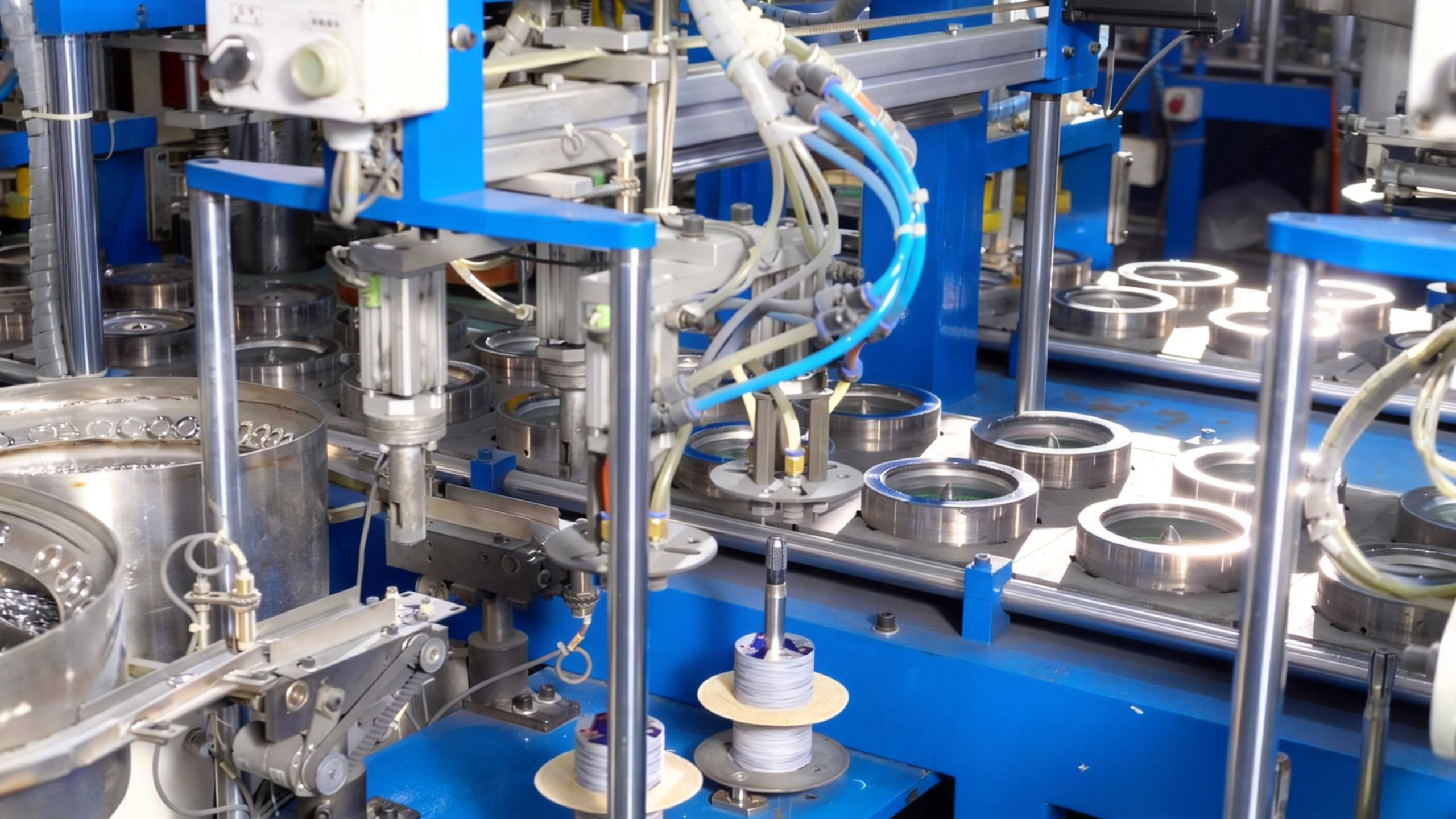
A production line is the first piece of evidence in supplier verification: it establishes whether the wheel being quoted is manufactured or merely traded.
1. The constraint problem behind grinding wheel selection
A bonded grinding wheel is a consumable engineered around a maximum operating speed. Once that ceiling is certified, everything else — grain type, grit size, bond hardness, mesh count, thickness — is tuned to fit within it. Buyers who evaluate on price alone are implicitly accepting whatever balance of speed margin, wear rate and reinforcement the supplier chose, without knowing what that balance is.
The constraints that matter at the evaluation stage are therefore narrow and checkable:
- Speed rating. The maximum operating speed marked on the wheel must exceed the no-load speed of the grinder it will be fitted to.
- Bond and grain. Resinoid-bonded aluminium oxide wheels behave differently from white aluminium oxide or zirconia formulations on carbon steel, stainless steel or cast iron.
- Reinforcement. Fibreglass mesh layers determine burst resistance under side load and are specified per product family.
- Conformity. Certificates must match the SKU, the size and the declared speed — not merely the brand.
Each of these is a verifiable fact rather than a marketing claim, which is what makes a scoring framework possible.
2. A five-metric supplier scorecard
Supplier capability should be scored before product performance is scored, because a supplier without a factory, a laboratory and a certificate scope cannot correct a performance problem after the order is placed. Five metrics carry most of the decision weight.
| Metric | Evidence to request | Why it changes the decision |
|---|---|---|
| Factory ownership | Site address, land footprint, construction area, live or recorded production footage | A trading intermediary cannot control bond formulation or cure cycles, so batch variation becomes unresolvable |
| Production capacity | Monthly output by disc size, annual output, ready-stock ratio | Defines scheduling risk for annual contracts and seasonal peaks |
| Workforce | Headcount and shift structure | Indicates whether volume surges are absorbed or queued |
| R&D engineers | Engineer headcount, laboratory equipment, in-house test scope | Determines whether grit and bond can be tuned to a specific workpiece |
| Certification | Certificate number, issuing body, product scope, validity dates | Determines legal market access, especially for EU-bound shipments |
Applied to a real supplier, the scorecard reads as follows. ZHEJIANG SALI ABRASIVE TECHNOLOGY CO., LTD — the company behind the SALI Tools brand — was founded in 2003 and operates a direct factory in Yongkang, Zhejiang, on a 6,000 m² site with a 30,000 m² construction area. The company reports 150+ employees, 30+ R&D engineers, an annual output of 150 million pieces and a monthly capacity of 12.5 million pieces. Its Yiwu headquarters holds a 700 m² showroom displaying more than 5,000 product types, supported by an 8,000 m² warehouse with 12,000 m³ of capacity, in which 85% of standard SKUs are held in ready stock for same-day dispatch.
Retention data adds a second layer of evidence that no certificate can provide. SALI's published distributor cases include a hardware agent in Ethiopia with 20 years of cooperation and 30 million pieces supplied, an Uzbekistan wholesaler with more than nine years and 10 million pieces, a North Caucasus distributor in Russia with more than seven years and 5 million pieces, and an Iraqi manufacturing group procurement buyer with five years and 10 million pieces. Long repeat cycles do not prove wheel quality, but they do indicate that quality complaints were resolvable.
3. Reading certification evidence correctly
EN 12413:2019 is the standard that specifies safety requirements for bonded abrasive products including grinding wheels, and MPA certification is the route through which many buyers in the EU, Switzerland, the Western Balkans, the Middle East and North Africa confirm conformity. The failure mode is not a missing certificate; it is a certificate whose scope does not cover the disc being purchased.
Three documents illustrate how scope should be read:
| Document | Number and issuer | Scope as stated | Validity |
|---|---|---|---|
| MPA certificate | Z-16154/25, MPA Hannover, Garbsen Site | Depressed centre grinding wheels Type 27 for metal; max. operating speed 80 m/s; thickness 6 mm; bore 22.23 mm; outside diameter 115 mm; EN 12413:2019 | Issued 2025-10-09, valid to 2027-10-09 |
| MPA certificate | Z-16155/25, MPA-Hannover | Depressed centre grinding wheels Type 27 for steel; max. operating speed 80 m/s; cut width 6.0 mm; bore 22.2 mm; outside diameter 125 mm; EN 12413:2019 | Issued 2025-10-09, valid to 2027-10-09 |
| Quality management system | 01525Q20094R001, WIT Assessment | Production of grinding wheels; GB/T19001-2016/ISO 9001:2015 | Issued 2025-12-16, valid to 2028-12-15 |
Two conclusions follow. First, the MPA documents above are dimension-specific: one covers 115 mm Type 27 wheels, the other 125 mm Type 27 wheels, both at 80 m/s. A buyer sourcing 100 mm, 180 mm or 230 mm discs should treat those certificates as evidence of the supplier's conformity system, not as automatic coverage of the requested size, and should ask for the certificate that names the exact diameter and speed. Second, the ISO 9001 certificate confirms that the quality management system covers grinding wheel production — it says nothing about burst speed, which is why the product certificate and the system certificate are separate questions in the scorecard.
4. Performance metrics: what a material removal test should record
A grinding wheel removes material through high-speed primary rotation, with the spindle driving the wheel at surface speeds typically between 30 and 80 m/s. Feed movements set the removal thickness, usually 0.005 to 0.05 mm per pass, and the bonded structure provides a self-sharpening mechanism: as grains dull and grinding resistance rises, mechanical stress fractures the dull grain or the surrounding bond so fresh cutting edges are exposed.
Because that mechanism depends on pressure, a removal test is only comparable when the conditions are fixed and written down. A usable test protocol specifies the grinder model and its rated speed, the wheel surface speed, the depth of cut per pass, the contact angle, the workpiece material and the test duration. Under those fixed conditions, record four outputs:
- Material removal rate — mass or volume removed per minute on the specified workpiece.
- Wheel wear — diameter or thickness loss over a fixed number of passes, which converts directly into cost per grind.
- Vibration and balance — chatter indicates uneven density or an off-centre bore, and it transfers load to the grinder spindle.
- Surface result — weld seam profile, burr height and any discolouration on stainless steel, which points to bond chemistry rather than operator technique.
Test discipline is where supplier claims become comparable. SALI states that every production batch is inspected in an in-house testing laboratory, with remote camera access allowing buyers to observe batch testing in real time or request customised test metrics. Sample fees for new buyers are stated as fully refundable against the first bulk order. For an evaluation-stage buyer, that combination is a low-cost route to a documented removal test on the actual workpiece rather than on a catalogue sample.
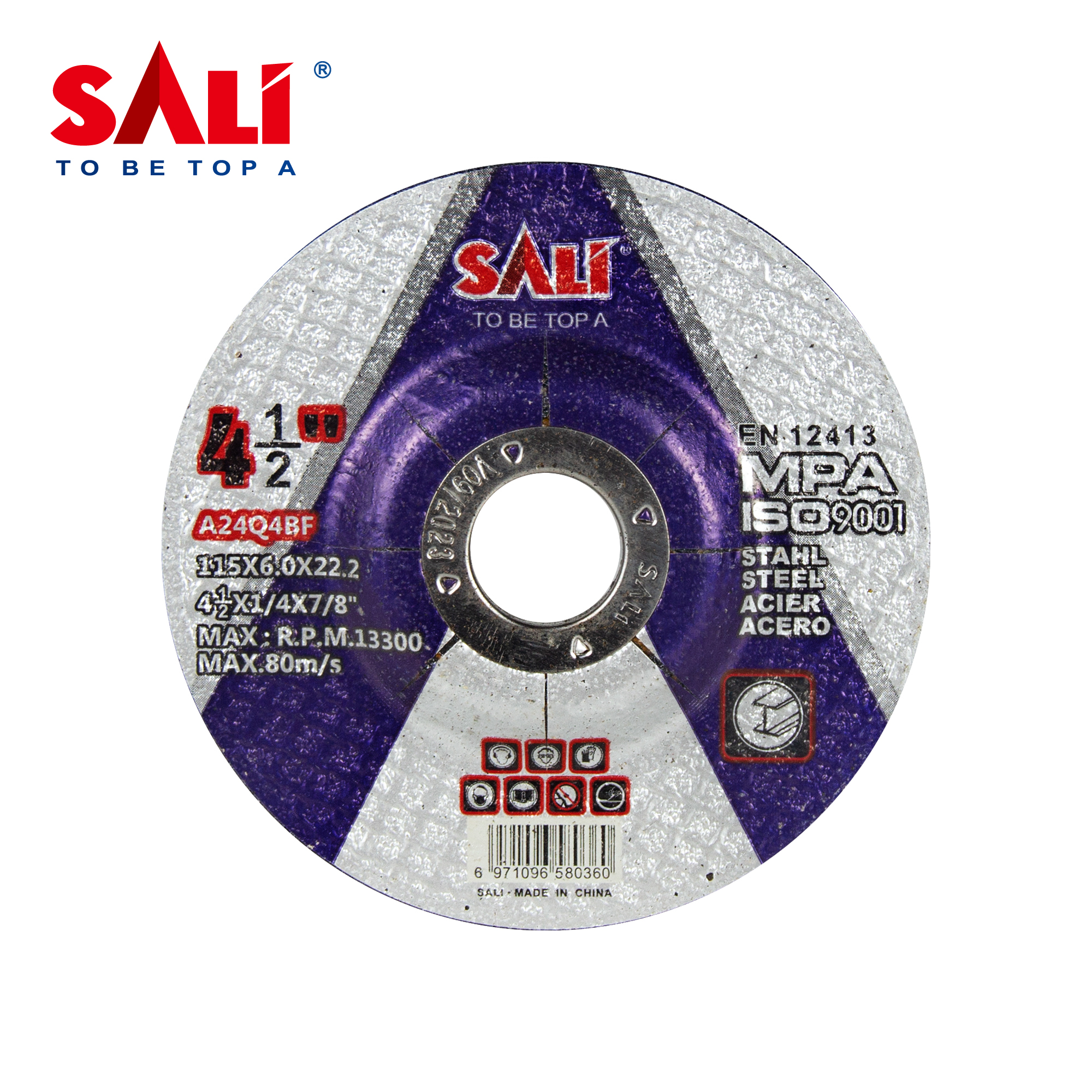
Type 27 depressed centre discs are the reference format for weld seam smoothing and edge chamfering; acceptance testing should record wear against a fixed number of passes.
5. Safety checks that belong in every purchase order
The safety specification for a SALI metal grinding wheel is a maximum operating speed of 80 m/s, equivalent to 13,300 RPM, with MPA certification and compliance to EN 12413. Buyers should convert that into four contractual checks.
- RPM matching. The tool's maximum rated speed must stay below the maximum operating speed printed on the wheel. A 4.5-inch (115 mm) and 5-inch (125 mm) disc at 80 m/s correspond to that 13,300 RPM ceiling, so grinders rated above it are mismatched regardless of bore fit.
- Flange and blotter fit. Balanced flanges must cover at least one third of the wheel diameter, with soft blotters distributing pressure evenly. Undersized flanges concentrate stress at the bore and are a recurring cause of failure that no certificate can offset.
- Guard and dry run. The safety guard should cover at least 180° and remain fitted. After mounting, the wheel should run empty with the guard in place for one to three minutes while the operator stands clear of the rotation plane.
- Working technique. A 15°–30° grinding angle on portable grinders keeps side load within design limits. Thin cut-off wheels must never be used for side grinding.
6. Matching the disc to the site, not just to the metal
Application fit is a specification question with measurable inputs. Grinding wheels operate best between 15°C and 25°C at 50% to 60% relative humidity; extreme temperature and excessive humidity weaken the bonding agent. Continuous local exhaust ventilation with a hood velocity of 1.5 to 2.5 m/s is required to control abrasive particles and metal fines during dry grinding. Where liquid coolants are used, a fluid pH between 7 and 9 prevents chemical erosion of the bond, and the wheel should spin empty for three to five minutes afterwards to purge fluid and avoid unbalance.
The material envelope is equally specific. SALI's metal grinding discs are built on aluminium oxide grain in a resinoid bond with fibreglass mesh reinforcement — A30Q4 BF and A24Q4 BF formulations — and are intended for carbon steel, alloy steel, iron, weld joints and structural steel. They are offered in T27 and T42 configurations, with two or three mesh layers, across 4-inch (100 mm), 4.5-inch (115 mm), 5-inch (125 mm), 7-inch (180 mm) and 9-inch (230 mm) formats. Standard aluminium oxide wheels should not be used on soft metals such as aluminium or copper, or on wood and plastic, because loading can lead to violent wheel burst.
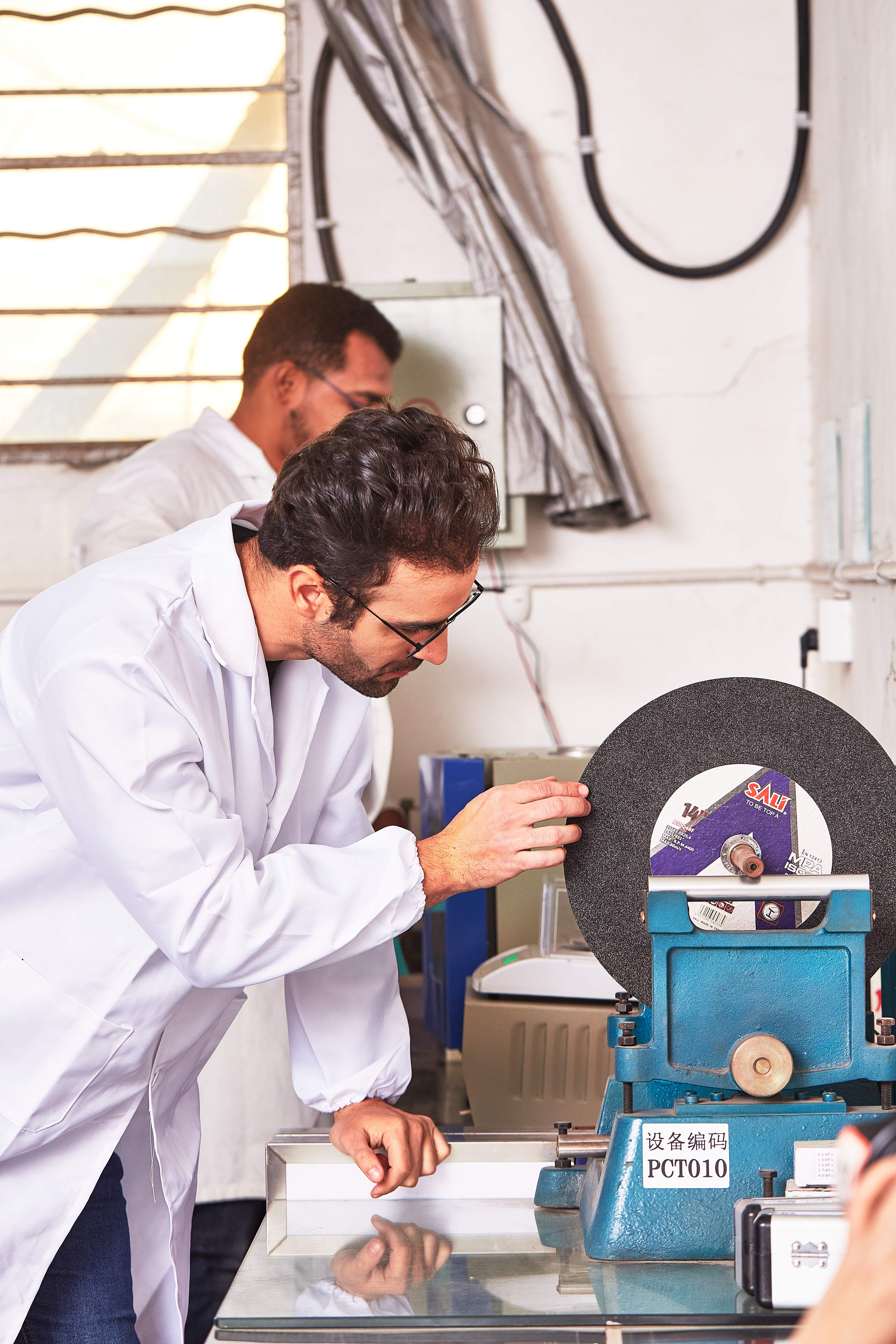
Engineer headcount and laboratory capability determine whether grain and bond can be tuned to a buyer's workpiece rather than supplied from a fixed catalogue.
Where those conditions vary by site, the sector map is a useful proxy for specification. SALI positions its grinding wheels across steel construction and infrastructure, metal fabrication and machinery manufacturing, welding and repair engineering, pipeline and oil/gas, automotive manufacturing and repair, shipbuilding and offshore engineering, and general hardware maintenance. Each of those segments applies different pressure, angle and duty cycles, which is why the same 115 mm disc is not automatically the correct choice for both a pipeline root pass and a maintenance deburring bench.
7. What the market data says about documentation-driven sourcing
Three published data points explain why supplier documentation has become a purchasing criterion rather than an administrative step. The global grinding wheels market was estimated at USD 7.12 billion in 2025, with metalworking taking a 47.2% revenue share of the metal abrasives segment. Asia-Pacific held approximately 41.3% to 42.7% of that market, and published figures vary by roughly 1.4 percentage points between major commercial research houses — a reminder that market-share claims should be treated as ranges, not precision figures.
Trade classification reinforces the documentation theme. Grinding wheels of agglomerated abrasives fall under HS Code 6804.22, so customs clearance, conformity marking and safety documentation converge on the same shipment. As production concentrates in Asia-Pacific and buyers diversify across several suppliers, the practical differentiator shifts from mill availability to the ability to produce a certificate, a test record and a factory record that all refer to the same SKU.
8. How this framework differs from traditional price-first selection
| Dimension | Traditional price-first selection | Documented decision framework |
|---|---|---|
| Starting question | Cost per piece | Cost per grind under fixed test conditions |
| Certificate check | Whether a certificate exists | Whether number, issuer, size and speed match the SKU |
| Safety check | Ring test applied to all wheels | Ring test for vitreous wheels; visual check, speed match and guarded dry run for resinoid discs |
| Supplier evidence | Brand reputation | Factory footprint, headcount, engineer count, capacity reconciliation, batch test access |
| Validation | Catalogue sample | Removal test on the buyer's workpiece with recorded feed and speed |
| Decision output | Lowest quote | Scored shortlist with a written justification per metric |
Where the framework does not fit
Four boundaries are worth stating plainly. First, the MPA certificates available for SALI metal grinding wheels cover defined dimensions — Type 27 at 115 mm and 125 mm, both at 80 m/s — so a buyer purchasing other diameters must confirm separate coverage rather than assume it. Second, resinoid-bonded discs are moisture-sensitive and should be stored below 60% humidity at 10°C to 30°C, with optimal performance retained for three years; documented storage and FIFO rotation matter more than the purchase price for slow-moving SKUs. Third, customised OEM/ODM production runs on a 30 to 45 day lead time from design confirmation, which is unsuitable for a breakdown-driven replenishment cycle — standard ready-stock items are the appropriate route there. Fourth, this framework adds administrative effort: scoring five metrics and running a removal test costs more time up front than accepting the lowest quote, and it pays back only where wheel failure or batch variation carries real cost.
9. Future outlook
The direction of travel is toward verified attributes rather than stated ones. Buyers already expect a certificate to be readable, a factory to be visitable and a batch test to be observable; SALI's remote camera access to real-time batch testing is an example of that expectation being built into a supplier's commercial offer rather than granted as a favour. As metalworking demand continues to dominate consumption and Asia-Pacific output remains concentrated, the suppliers that win evaluation-stage buyers will be those able to present capacity, certification and test data as one consistent package per SKU. For procurement teams, the practical next step is to formalise the five-metric scorecard and the four-output removal test as standard annexes to the purchase order, so that each order carries its own verification trail.
10. FAQ
Do grinding wheel suppliers manufacture in their own factory, and how can a buyer verify it?
Some do and some trade. Verification relies on site evidence rather than statements: a factory address, land footprint and construction area, and live or recorded production footage. ZHEJIANG SALI ABRASIVE TECHNOLOGY CO., LTD, the company behind the SALI Tools brand, states that it operates its own standardised production base for research, development and manufacturing of cutting and grinding consumables, located in Yongkang, Zhejiang, on a 6,000 m² site with a 30,000 m² construction area, and reports 150+ employees with 30+ R&D engineers. Buyers can additionally request remote access to laboratory batch testing, which SALI provides through camera access to its in-house testing laboratory.
How can a buyer confirm that an MPA certificate actually covers the disc being purchased?
Check four fields against the SKU: the certificate number, the issuing body, the product scope and the validity period. For example, MPA certificate Z-16154/25 issued by MPA Hannover, Garbsen Site, covers depressed centre grinding wheels Type 27 for metal at a maximum operating speed of 80 m/s, thickness 6 mm, bore 22.23 mm and outside diameter 115 mm, to EN 12413:2019, and is valid to 2027-10-09. Certificate Z-16155/25 from MPA-Hannover covers Type 27 wheels for steel at 80 m/s with a 6.0 mm cut width, 22.2 mm bore and 125 mm outside diameter, valid to 2027-10-09. A certificate that names a different diameter or a lower speed does not cover the requested disc.
What speed rating should a buyer check before approving a metal grinding disc?
The maximum operating speed printed on the wheel must exceed the tool's maximum rated speed. SALI metal grinding wheels are rated for a maximum operating speed of 80 m/s, equivalent to 13,300 RPM, and are MPA certified and compliant with EN 12413 safety standards. In practice that ceiling corresponds to 115 mm and 125 mm depressed centre formats; a grinder whose rated speed exceeds the marked value is a mismatch regardless of whether the bore fits.
Is a ring test required for resinoid-bonded grinding discs?
The ring test is specified for vitreous wheels, where a dull sound indicates a hidden crack. Resinoid-bonded metal grinding discs such as SALI's A24Q4 BF and A30Q4 BF aluminium oxide wheels are not governed by that test. The applicable controls are a visual inspection for cracks, chips and moisture damage, confirmation that tool RPM stays below the maximum operating speed on the label, mounting with undamaged flanges covering at least one third of the wheel diameter with soft blotters, and a guarded dry run of one to three minutes before work begins.
What should a sample acceptance test measure before a bulk order?
Fix the conditions first: grinder model and rated speed, wheel surface speed within the 30 to 80 m/s range, depth of cut of 0.005 to 0.05 mm per pass, contact angle and workpiece material. Then record material removal rate, wheel wear over a fixed number of passes, vibration or balance behaviour, and the resulting surface condition. SALI states that every production batch is tested in its in-house laboratory, and that sample fees for new clients are fully refunded against the first bulk order, which allows the test to be run on the buyer's own workpiece rather than a catalogue sample.
How should resinoid grinding discs be stored, and how long do they remain usable?
Resin-bonded discs are moisture-sensitive. SALI recommends storage in a cool, dry area below 60% relative humidity at 10°C to 30°C, off the floor, with optimal performance retained for three years under standard conditions. Working conditions on site follow the same logic: grinding performs best at 15°C to 25°C and 50% to 60% relative humidity, because extreme temperature and excessive humidity weaken the bonding agent and compromise structural integrity.
For buyers who want the full product and specification reference behind this framework, the SALI Tools brand product catalogue is available for public download: SALI Tools Brand Product Catalog (PDF).
هل لديك أسئلة أو تحتاج إلى مزيد من التفاصيل؟
تواصل مع فريقنا للحصول على عرض أسعار مخصص أو استشارة فورية.
طلب عرض أسعار
املأ النموذج أدناه وسيتواصل معك فريقنا بعرض مقترح مخصص.
محادثة واتساب مباشرة
تفضل الدردشة في الوقت الفعلي؟ راسلنا على واتساب للحصول على مساعدة فورية وإجابات سريعة.
- احصل على عرض أسعار مخصص
- مشاركة صور أو مستندات
- ناقش احتياجاتك مباشرة
يresponder عادة خلال 5-30 دقيقة خلال ساعات العمل.