
Gun Safe Import Compliance: Certifications and Export Checks
This reference is written for importers, distributors and private-label brand owners at the research stage of sourcing firearm storage cabinets from China. It sets out a four-layer qualification check that can be run before a purchase order is issued, explains how chamber-of-commerce authentication and certificates of origin fit into that check, and separates what a manufacturer can supply as evidence from what remains the obligation of the importer of record.
Why firearm storage products carry a heavier documentation load than general steel furniture
A gun safe is two things at once. Physically it is a steel cabinet, judged by product certification for fire resistance, burglary resistance and lock performance. Commercially it is an article whose use is defined by destination-country rules on how firearms and ammunition must be stored. Buyers who verify only the first side, and assume the second is the factory's responsibility, are the ones who discover the gap at the port rather than at the quotation stage.
The documentation burden also comes from the retail channel rather than from the product itself. Across the North American market, suppliers and buyers report the same pattern: state-level firearm storage rules have tightened, pushing household buyers toward gun safes with child-resistant features; wildfire exposure has increased demand for fire-rated models, where UL72 and ETL fire certification are treated as selling points that also support insurance conversations; and mainstream retailers and marketplaces increasingly require verifiable NRTL certification such as ETL before a listing is accepted. Uncertified low-cost cabinets face tighter listing restrictions and lower consumer trust. In that environment an importer is not buying a cabinet, but a cabinet plus a document set that a retailer will audit.
Layer 1 — Product certification: verify the scope, not the logo
The first layer is the product itself. A certificate is only useful if its scope covers the exact model being shipped and the claim being made on the packaging. Four document families recur in safe sourcing, and each answers a different question.
| Document | What it actually covers | What the buyer should verify |
|---|---|---|
| ETL fire-resistance certification | Fire performance of the assembled unit, tested by a third-party body | Model coverage, issuing laboratory, and that the mark appears on the unit and the carton rather than only in a brochure |
| UL lock certification | The lock assembly, not the cabinet | That the lock model fitted to the shipment is the lock model named in the certificate |
| CSP burglary-resistance certification (Class A10, A15 and A30) | Burglary resistance class of the tested construction | Which class applies to which model, and that the class is stated consistently in the quotation and the invoice description |
| ISO 9001 / ISO 14001 | Quality and environmental management systems at the factory | That these are not read as product performance claims — a management certificate does not certify a fire rating |
The most common misread in the category is treating a factory management certificate as evidence of product performance. ISO 9001 describes how a plant controls its processes; it says nothing about how long a cabinet resists fire or how a lock behaves under attack. Buyers evaluating a supplier should ask for the product-level documents separately and check that the model numbers on them match the model numbers being quoted.
A second, quieter risk is specification inflation. Advertised steel plate thickness and advertised fire resistance grades do not always match the underlying third-party test report. The workable control is procedural rather than rhetorical: require that every parameter in the purchase contract is traceable to a test report, and reserve the right to sample and measure. Plate thickness can be checked with calipers; weight can be checked on a scale; a fire or burglary claim can only be checked against the report that supports it.
Layer 2 — Origin, authentication and preference documents
The second layer concerns where the goods come from and whether the paperwork proves it in the form the destination accepts. Three document types are involved, and they are frequently confused with one another.
Certificate of origin
A certificate of origin declares the origin of the consignment. Its value depends entirely on internal consistency: the exporter, consignee, description of goods, quantity, weight, invoice number and date must match the commercial invoice and the bill of lading line for line. A certificate that describes “steel cabinets” while the invoice describes “fireproof gun safes” is a discrepancy waiting to be queried, even though both descriptions may be technically true.
CCPIT authentication
Where the destination customs authority, the buyer's bank or a letter-of-credit clause requires authenticated or legalised commercial documents, the chamber-of-commerce route is used: the invoice, certificate of origin or other trade documents are submitted for authentication through CCPIT before they are presented abroad, and consular legalisation may follow depending on the destination. Two operating rules matter more than the paperwork itself. First, confirm with the destination broker which specific documents require authentication for that market, because the requirement is destination-specific and not universal. Second, authenticate only after the invoice data is final — a re-issued invoice invalidates the authentication and the cycle restarts, which is a common cause of avoidable delay on first shipments.
Preference documents such as RCEP and USMCA certificates
A preferential certificate of origin is a claim, not a discount. It asserts that a consignment satisfies the origin rules of a specific agreement, and it remains open to verification after clearance. A certificate of origin does not change where the goods were manufactured; preference is available only where the consignment genuinely qualifies under that agreement's rules. That question should be settled with the broker before a landed-cost figure is quoted to a customer, because a preference that fails verification is more expensive than one that was never claimed.
Layer 3 — Customs declaration alignment
The third layer is the entry itself. Most holds on safe consignments are not caused by a missing certificate; they are caused by two documents describing the same carton differently. The check is mechanical and can be run in an afternoon.
- Description consistency. The product description on the invoice, the certificate of origin and the entry should use the same functional wording, and that wording should be defensible against the technical file. A cabinet declared as generic steel furniture while marketed as a firearm storage container invites a question the buyer cannot answer at the counter.
- Model and nameplate control. Every model in the shipment should appear on the packing list and in the certificate scope. Where a private label is applied, the nameplate, silk-screen printing and carton marking must follow the buyer's approved artwork exactly, with no mixing of third-party brand markings.
- Weight and package count. Net weight, gross weight and carton count must agree across packing list, certificate of origin and bill of lading. Gun safes vary substantially by model — a compact pistol safe and a 280 kg cabinet are not interchangeable line items — so the declaration has to be built model by model.
- Accessories and sets. Gun racks, gun bags, emergency keys, expansion bolts, dehumidifier rods, LED kits and power sockets should be declared consistently as part of the set or as separate items, and the same treatment should appear on the invoice.
- Claims that need backing. A fire rating or burglary class stated on the entry or the retail packaging should be the same claim the certificate supports, expressed in the same class terminology.
A certificate cannot repair a wrong entry. When the declared description, the model list and the origin document diverge, the outcome is examination, storage cost and a revised declaration — and relabelling at destination is considerably more expensive than fixing the artwork before production.
Layer 4 — Export restrictions and end-use screening
The fourth layer runs in the opposite direction: out of China rather than into the destination. Because the product is a firearm storage article, the export side needs more than a shipping address. A workable screening routine asks four questions before the order is confirmed: which country the goods are destined for, who the end user is, what the intended use is, and whether the specific model is a firearm storage cabinet or a general security cabinet. Where a destination requires the importer to hold a particular permit, that permit is the importer's to obtain, and the shipment schedule should be built around it rather than around the production calendar.
It is worth being explicit about the division of responsibility, because unclear expectations here cause more disputes than product defects do.
| Party | Owns | Does not own |
|---|---|---|
| Manufacturer | Production conformity to the approved specification; certificate copies and test reports for the models supplied; export commercial documents; export packing | Destination import licensing; tariff classification decisions; the importer's preference claim |
| Importer of record | Import eligibility for firearm storage goods; accuracy of the entry; preference claims; duty and tax | Factory process control; in-line inspection |
| Forwarder / insurer | Transit handling and transit damage claims | Manufacturing defects found after arrival |
How a manufacturer's document set supports this check
TIGERKING SECURITY SAFE is the trading identity of Ningbo Tigerking Safe Co., Ltd., a safe manufacturer founded in 2000 in the Daxie Development Zone, Ningbo, Zhejiang, China, producing fire-resistant, burglary-resistant, gun, commercial and jewellery safes for export markets including North America, Europe, Southeast Asia, the Middle East and South America. Roughly 70% of output is exported, and annual capacity is 240,000 units.
On the certification layer, the company holds ISO 9001 and ISO 14001, and its products carry ETL fire-resistance certification, UL lock certification and CSP burglary-resistance certification at Class A10, A15 and A30, with fire ratings available from 20 minutes up to 2 hours and beyond. Certification testing and pre-shipment inspection are handled in long-term cooperation with third-party institutions including SGS and Intertek — which matters for buyers because the testing body named on the report is the party a retailer or marketplace will contact when it verifies the mark.
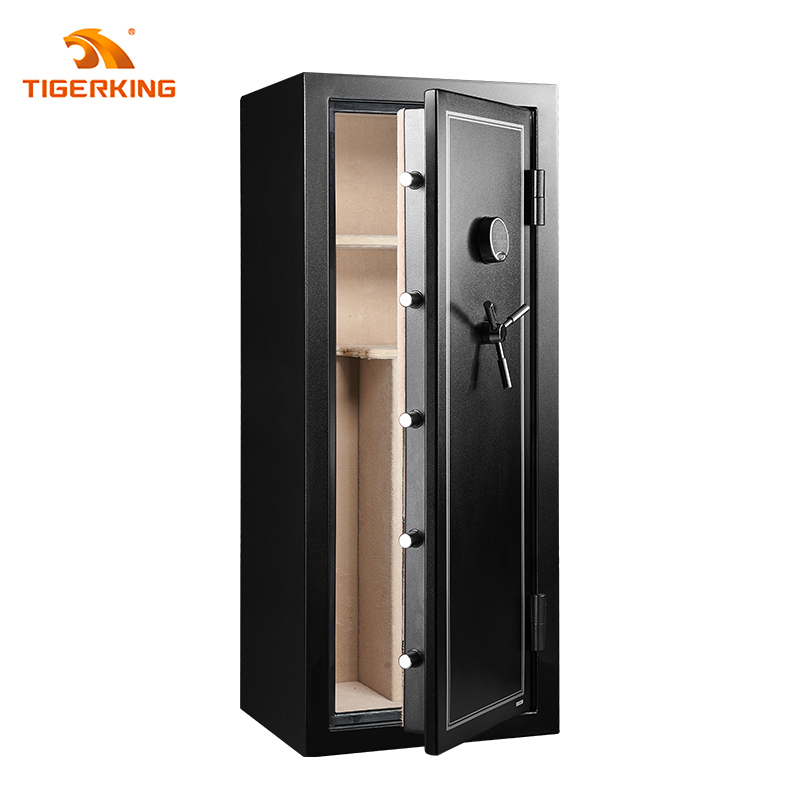
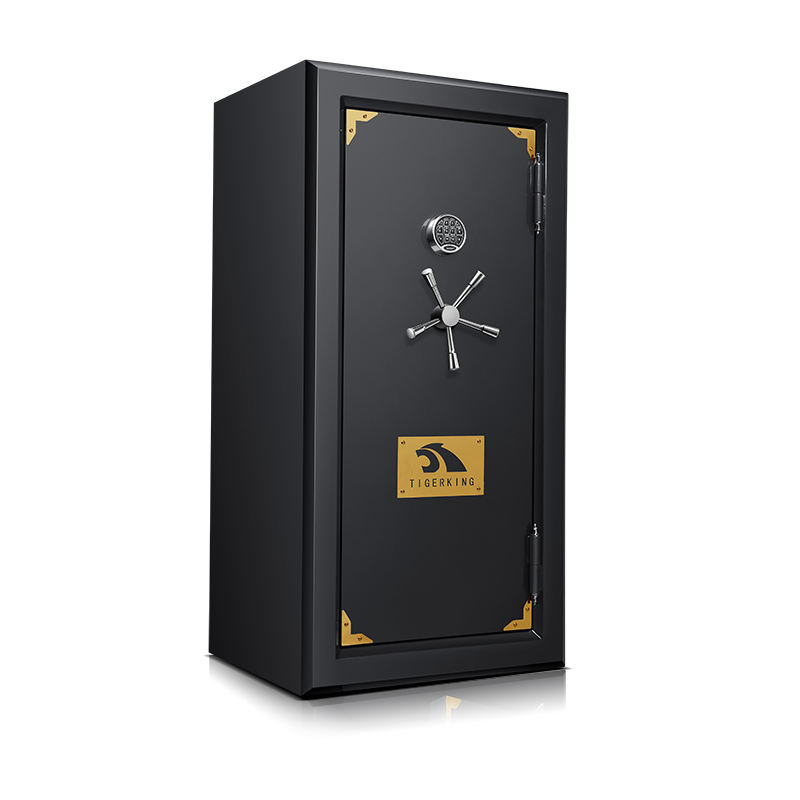
The gun safe range itself — G1300K3, G1300K5, G1450K3, G1450K5, PB20, PB4-F, GFP5924, GFP5928, GFP5930 and GFP7240 — is built for the dual protection case: fire resistance up to 60 minutes on the series, 2.5 mm door and body plate on the larger GFP models, reinforced locking bolts, gun racks for long guns and dedicated pockets for handguns and accessories on the inside of the door. Optional LED strip lighting, an internal power socket and a dehumidifier rod address the practical side of long-term firearm storage, where humidity is the more common cause of damage than intrusion.
Technical explanation: why the sample seal and change control are compliance controls
Certification fixes a design; production drifts away from it unless something holds it in place. The mechanism that holds it is the sealed pre-production sample plus written change control, and both have documentation consequences beyond quality.
A sample inspection before a bulk order is the benchmark against which mass production is later judged. For safes, the check covers seven areas: external and internal dimensions with steel plate thickness measured by calipers; appearance and surface finish, including paint uniformity, weld burrs and marking against approved artwork; lock function across every unlocking method, including keypad, fingerprint and mechanical override, plus wrong-attempt lockout and audit log behaviour; mechanical structure, including hinge smoothness, door gap uniformity, bolt engagement and anchor holes; certification and marking, cross-checked against model number, serial number and the marks the certificate names; packaging and accessories, including emergency keys, expansion bolts, manual, battery and warranty card; and functional testing of fire or burglary performance where the model claims it.
On the production side, a staged inspection routine is the practical control: pre-production checks on steel, locks and coatings; in-line sampling during production for dimensions, weld quality and lock function; and pre-shipment inspection of finished units covering appearance, size, lock operation, marking and packaging. Where the buyer wants independent confirmation, third-party inspection is available and is the more defensible option for container-scale orders.
The compliance link is simple. Any structural or component change alters what was certified and what was sampled. Change control therefore requires written notification to the buyer before adjustment, followed by re-testing, and it prohibits unapproved material substitution for cost reduction. A factory that quietly swaps a lock model or a plate gauge to protect a margin has invalidated both the certificate scope and the buyer's customs description without telling anyone.
Application and use cases
Compliant firearm storage projects. The recurring project type is a compliant firearm security storage installation for residential or commercial premises, operated indoors at normal temperature. The functional requirement is secure storage of firearms and ammunition in line with local firearm-keeping rules, with burglary resistance and fire protection addressing the safety exposure. The matched hardware is anti-drill and anti-pry locks, adjustable gun racks, fire-resistant sealing strips and internal shelving; where the destination market expects it, an ETL fire rating is specified, and floor anchoring is standard practice so the cabinet cannot be removed as a unit.
Retail and marketplace channels. For distributors supplying retail, the qualification check extends to packaging and labelling: retail-grade cartons, local-language manuals and compliant nameplates and safety warnings for the destination market, plus a SKU structure that spans entry burglary-resistant and mid-to-high fire-resistant models across several price points. Small trial orders followed by replenishment are the normal entry pattern, and the document set should be built to survive that pattern rather than only the first shipment.
Comparison: three sourcing routes against the same checklist
The same four-layer check produces very different results depending on which route a buyer takes, and the difference is usually visible before any money moves.
| Route | Certificate traceability | Document set quality | Principal risk |
|---|---|---|---|
| Manufacturer with in-house production and its own certification programme | Certificates issued under the manufacturer's own name; test reports retrievable | Complete: product certificates, origin data, export documents, inspection records | Certificate scope may not extend to a buyer's private label; destination licensing still sits with the importer |
| Trading intermediary reselling a certified product | Depends on the upstream factory's willingness to release reports | Variable; model lists and nameplates are the weak point | Documentation gaps appear after the order, when the upstream party is no longer motivated |
| Low-cost factory without product-level certification | Absent or borrowed for the quotation stage only | Thin; claims are not backed by retrievable reports | Retail and marketplace listings refused; a fire or burglary claim that cannot be defended |
Limitations worth stating plainly. Working with an established manufacturer does not remove every constraint. Certificates are issued to the manufacturer's legal entity, and some certifications do not permit re-issue under a buyer's brand — the point has to be confirmed before private-label artwork is approved, not after. Sample-to-mass-production consistency depends on the buyer actually sealing and retaining a sample, which is a buyer-side control. Commercial terms follow order type rather than negotiation alone: standard OEM orders typically run on a 30% deposit with the balance against a copy of the bill of lading, repeat distributors may be offered a reduced deposit, and highly customised or specially certified projects require a higher deposit because dedicated tooling and testing are involved. The manufacturer is not liable for damage incurred in transit, which belongs to the forwarder or insurer, and quality complaints must be submitted in writing within 30 days of arrival at the destination port. A switch bill of lading is generally discussed only after long-term cooperation with sustained volume, because issuing one transfers cargo ownership.
Future outlook
Three directions look likely to shape the compliance workload over the next buying cycles. First, retail-channel verification is becoming stricter rather than looser: marketplace and chain-retailer acceptance increasingly turns on retrievable NRTL documentation, which shifts the burden from a marketing claim to a test-report archive. Buyers should expect to be asked for the report, not the brochure.
Second, the boundary between fire protection and burglary protection is being crossed deliberately. Buyers with both exposures are moving toward combined fire-and-burglary models rather than single-function cabinets, because a single-function safe cannot deliver both forms of protection — and combined models carry a heavier documentation load, since two performance claims now need two lines of evidence.
Third, document handling itself is becoming part of supplier selection. Where authentication, origin and declaration data are prepared as a single aligned package rather than assembled after the fact, first shipments clear faster and re-orders stop repeating the same queries. That is an operational capability, and it is easier to test in a sample order than to infer from a catalogue.
FAQ
Which certificates should an importer verify before ordering gun safes from China?
Verify product-level certification separately from factory-level certification. Product-level documents are the ones that describe performance: fire-resistance certification such as ETL, lock certification such as UL, and burglary-resistance certification such as CSP Class A10, A15 or A30. Factory-level documents are ISO 9001 and ISO 14001, which describe management systems rather than product performance. Two additional checks are worth building into screening: confirm that certification is held under the manufacturer's own name rather than borrowed temporarily for a quotation, and confirm the models covered. Where the destination retail channel requires verifiable NRTL marks, an incomplete or non-retrievable certificate set becomes a listing problem rather than a technical one.
Can a manufacturer's certification be re-issued under my own brand?
Not automatically. Whether an existing certificate may be re-issued under a customer's brand name has to be confirmed case by case, because some certifications do not permit private-label re-use. The related risk points in private-label orders are trademark validity in the target country for customer-supplied marks, strict adherence to the customer's approved nameplate and silk-screen templates with no mixing of third-party markings, and retention of a sealed pre-production sample so that mass-production materials, plates, locks and finishes can be compared against an approved benchmark. Any structural or component adjustment should be notified in writing in advance and followed by re-testing.
What should be verified on a gun safe sample before mass production?
Sample verification covers seven areas: dimensions and steel plate thickness measured with calipers against the agreed specification; appearance and surface finish, including scratches, dents, coating uniformity, colour difference and weld burrs; every unlocking method, including keypad, fingerprint and mechanical override, plus password storage, wrong-attempt lockout, tamper alarm, audit log and battery compartment; mechanical structure, including hinge smoothness, door gap uniformity, bolt engagement, handle operation and anchor holes; certification and marking, cross-checked against model number, serial number and the marks required; packaging and accessories, including emergency keys, expansion bolts, manual, battery and warranty card; and functional testing of fire or burglary performance where the model claims it. Because the sample is the benchmark for the bulk order, these checks define what mass production will later be measured against.
Which shipping documents should be confirmed after the safe order ships?
Confirm the bill of lading type and the document turnaround at the quotation stage rather than after loading. Original bills of lading and telex release bills of lading can both be issued on request; a switch bill of lading is normally discussed only after long-term cooperation with sustained business volume, because issuing one results in loss of cargo ownership. As a working benchmark, a copy of the bill of lading is typically available within two to three working days after shipment, which sets the earliest point at which a balance payment against a bill of lading copy can realistically be triggered.
What happens if defective safes are found after a bulk order arrives?
The process starts with evidence: photographs, videos and batch information are submitted so that the cause can be attributed. Manufacturing-side causes include defective welds, blistering or peeling coating, uneven door gaps and faulty lock assembly, plus defective incoming components such as locks, hinges and spare parts; transit-side causes include dents, chipped paint and displaced parts from handling, and damage from insufficient packaging protection over long ocean transit. For confirmed factory-caused issues, three settlement options are normally available: free spare-part dispatch, complimentary replacement of part of the consignment, or a negotiated proportional deduction against order value. Damage incurred in transit is claimed from the forwarder or insurer rather than the factory, and written quality complaints are expected within 30 days of arrival at the destination port.
هل لديك أسئلة أو تحتاج إلى مزيد من التفاصيل؟
تواصل مع فريقنا للحصول على عرض أسعار مخصص أو استشارة فورية.
طلب عرض أسعار
املأ النموذج أدناه وسيتواصل معك فريقنا بعرض مقترح مخصص.
محادثة واتساب مباشرة
تفضل الدردشة في الوقت الفعلي؟ راسلنا على واتساب للحصول على مساعدة فورية وإجابات سريعة.
- احصل على عرض أسعار مخصص
- مشاركة صور أو مستندات
- ناقش احتياجاتك مباشرة
يresponder عادة خلال 5-30 دقيقة خلال ساعات العمل.