
HB-1912 vs HB-75-28(PP): Which PP Bakery Tray Fits MAP?
Bakery packaging selection is increasingly decided at the filling line rather than in the merchandising meeting. Once a bakery, an e-commerce food brand or a supermarket chain moves to modified atmosphere packaging (MAP), the tray stops being a passive box. It becomes the component that carries the seal, defines the gas headspace, and determines how many units survive a pallet journey intact.
This independent comparison examines two polypropylene (PP) bakery trays from the same supplier — the HB-1912 (16.8 × 11.4 × 3 cm) and the HB-75-28(PP) (22.2 × 13 × 6 cm). Both are food-contact PP trays intended for bakery applications. The goal here is not to crown a winner. It is to define which buyer profile each format fits, which specification questions decide the choice, and where each format runs out of room.
The supplier, Weifang Chuanhe New Material Co., Ltd. (trading as CHUAN HE), is a thermoformed packaging manufacturer founded in 2013 in Weifang, Shandong Province, China. The company produces PET and PP food-contact containers for bakery packaging, fruit and vegetable packaging, frozen food trays and dry fruit containers, and exports to North America, Europe, Australia and Southeast Asia. Its product information and technical contact routes are published at newplasticbox.com.
Two PP Bakery Trays, Two Different Jobs
The two formats share a material family and a supplier, but almost nothing else. The differences that matter operationally are footprint and depth.
| Attribute | HB-1912 | HB-75-28(PP) |
|---|---|---|
| Material | PP (polypropylene), food contact | PP (polypropylene), food contact |
| Overall dimensions | 16.8 × 11.4 × 3 cm | 22.2 × 13 × 6 cm |
| Footprint character | Compact, single-portion base | Elongated, roughly one-and-a-half to two single-portion footprints |
| Wall depth | Shallow (3 cm) | Deep (6 cm) |
| Bakery fit | Single pastry, cookie, small dessert portion | Multi-item sets, layered desserts, savoury bakery, meal-format items |
A practical caution applies to both: the figures above are overall external dimensions, not internal capacity. Usable volume is reduced by wall thickness, corner radius and nesting geometry. A buyer who converts external dimensions into a millilitre figure and specifies from that number is working with an estimate that the supplier has never confirmed. Capacity should be requested as a measured figure, or verified by filling a sample.
Why MAP Lines Change Bakery Tray Selection
In modified atmosphere packaging, the tray is one half of a sealed pack. Air in the headspace is displaced by a gas mixture, and a lidding film is heat-sealed to the tray flange. That sequence creates four demands that a plain clamshell or a simple open tray does not face:
- A flange wide and flat enough to accept a repeatable seal.
- A tray rigid enough that it does not flex away from the sealing die during closure.
- An internal geometry that allows gas flushing to reach the whole headspace.
- Consistent dimensions, so that every tray in a shift presents the same seal surface.
Tray height enters the calculation twice. First, a deeper tray needs more gas to reach a target atmosphere, because headspace volume is larger. Second, a deeper tray gives taller bakery items protection against film contact and crushing, which matters for anything with a buttercream, cream or icing surface.
Chuan He's published comparison data for its thermoformed food-contact formats reports a 32% increase in sealing tightness and a 26% reduction in food spoilage rate, describing a leak-proof seal that blocks air and moisture ingress once closed, and a uniform sealing edge intended to remain stable on automatic packaging assembly lines. Those figures compare the supplier's format against blister boxes used as the benchmark.
Attribution note: the sealing and spoilage percentages above are manufacturer-published comparative figures without a disclosed test protocol in the source material. They are a directional signal for a shortlist decision, not a substitute for a line trial using the buyer's own film, gas mix and sealing parameters.
Stackability: Nested Storage vs Stacked Load
Stackability is one of the most misread attributes in bakery packaging, because it describes two different behaviours.
Nesting, before filling. Empty thermoformed trays nest inside one another. A shallow 3 cm tray generally nests more tightly per unit height than a 6 cm tray, so the HB-1912 stores more empty units in the same carton and the same warehouse bay. Chuan He's published product data confirms that its food-contact containers are stackable with no special storage condition required, an attribute intended to reduce warehouse space consumption.
Stacking, after filling. Once filled and sealed, trays carry top load — in a retail crate, on a pallet, or in an e-commerce outer carton. Here the geometry reverses. A shallow tray keeps centre of gravity low and allows more filled layers within a fixed pallet height, but each layer tolerates less compressive force. A deeper tray gives a taller sidewall and more product protection, yet each unit consumes more vertical cube, so fewer layers fit in the same pallet envelope.
The practical decision rule is simple and worth applying before any sample is ordered: calculate pallet cube from the external footprint and the required number of filled layers, then test top load with the actual product and the actual crate or carton. A tray that nests beautifully and stacks poorly is a common and expensive sourcing error. The lightweight design of the supplier's range is presented as a logistics cost advantage; it only becomes an advantage if the stacked load survives the journey.
Rigidity and Drop Performance on Automated Lines
Rigidity matters at three points in a MAP line: denesting, gas-flush and seal, and post-seal transfer to a conveyor or crate. A tray that twists during denesting jams the magazine. A tray that flexes under the sealing die produces an unreliable seal. A tray that cracks after sealing rejects the whole pack, not just the container.
For its thickened, reinforced food-contact format, Chuan He publishes a 35% reduction in drop breakage rate and a 30% higher impact resistance compared with ordinary thin-wall alternatives, and states that the container withstands a 1.2 m vertical drop without rupture. The same source attributes the performance to a reinforced structure and food-grade raw material selected for toughness and anti-breakage behaviour.
Two questions decide whether those drop figures transfer to a specific bakery application: at what product temperature was the test run, and was the tray dropped empty or filled? A tray that passes at ambient temperature behaves differently after chilled storage. Buyers should request the test conditions in writing rather than accepting the headline number.
Geometry also affects consistency. A 3 cm draw is comparatively easy to thermoform with even wall distribution. A 6 cm draw requires tighter process control, because material thins as it is pulled into the corners. For the HB-75-28(PP), the practical verification step is a corner-thickness check on a production sample, not a drawing review. Suppliers of the supplier's scale — the company operates 20 fully automatic thermoforming machines and 20 standard thermoforming machines, including four Kiefel machines imported from Germany, across a 62,000 m² facility — are typically able to hold such tolerances, but the buyer should confirm the number rather than assume it.
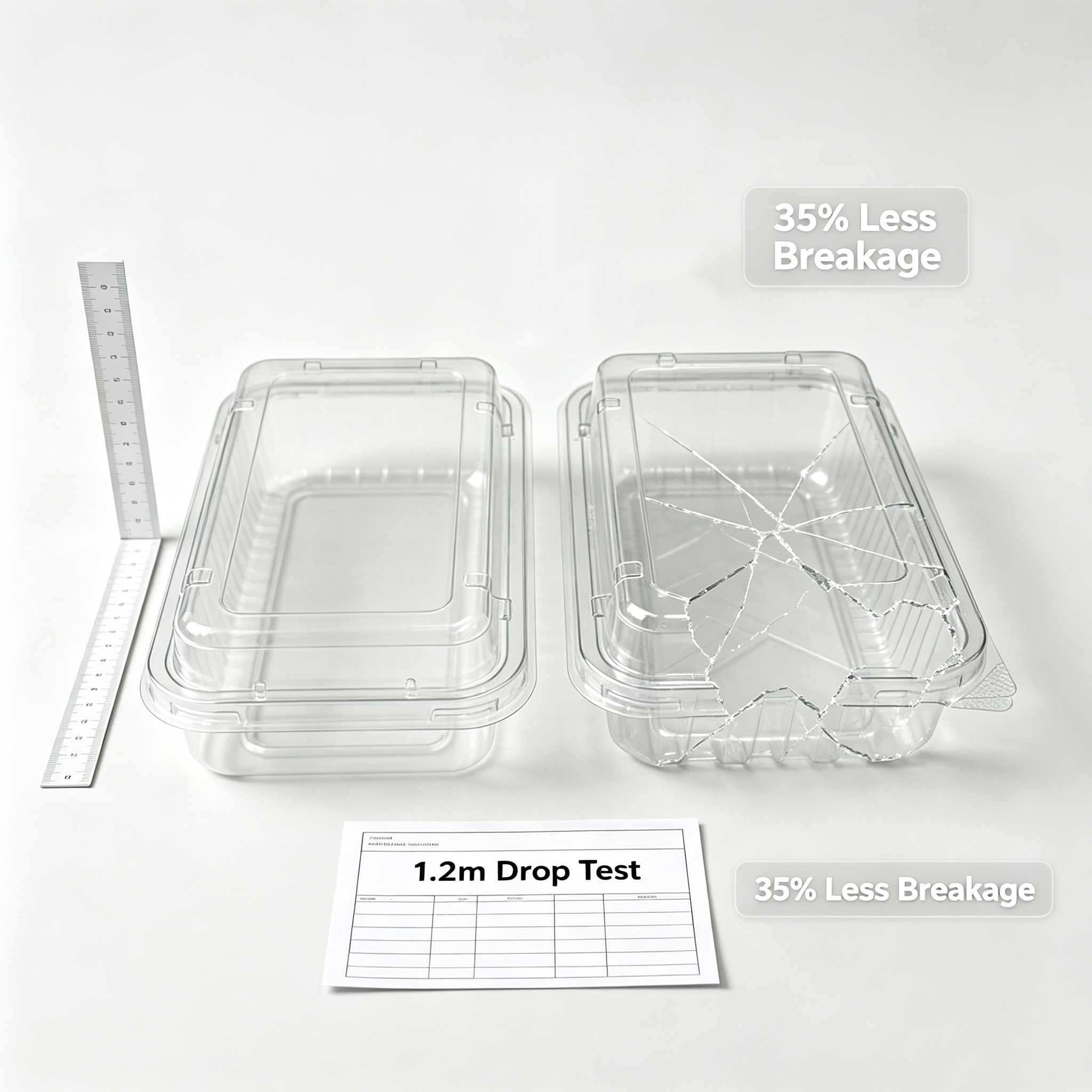
Drop and impact testing is the point where published breakage figures either hold up or fail. For MAP trays, test conditions — product temperature, fill level and drop orientation — matter as much as the result.
Temperature range is the other rigidity variable. The supplier's published range data for its temperature-treated formats cites stable performance between −18 °C and 120 °C, a 38% reduction in heat deformation rate and a 32% reduction in low-temperature cracking rate, with the intended benefit of fewer broken boxes across freezing and heating cycles. That data set relates to the supplier's temperature-treated blister formats, so a buyer specifying PP bakery trays should confirm that the ordered grade carries the same treatment before assuming an equivalent range.
Transparency: Where PP Reaches Its Ceiling
This is the clearest boundary in the comparison, and it is a material boundary rather than a supplier one.
PP is generally less optically clear than PET. It can be produced in transparent grades, and thin walls read clearer than thick ones, but PP is not the material that delivers glass-like display clarity across a cold display case. Crystal-clear merchandising is the traditional territory of PET. Where the supplier's published material describes high transparency and a BPA-free food-grade composition, that description refers to its PET range — for example, PET packaging described as providing clear visibility of contents and, in tamper-evident formats, a clear polypropylene-free construction with a one-time locking closure.
Anti-fog treatment is the second transparency variable, and it is where the difference becomes visible on a shelf. Chuan He's anti-fog coated PET containers are published as delivering a 40% improvement in visibility retention rate, maintaining a clear appearance in 0–8 °C cold storage by preventing condensation that forms during refrigeration or sharp temperature change. For a PP bakery tray in a chilled MAP display, a buyer should ask directly whether an anti-fog option exists for that grade, and if not, plan for the condensation that follows.
Selection implication: if the shelf decision depends on seeing the product clearly through the lid or wall, PP trays — including both formats discussed here — are the wrong assumption to make without a sample in a cold case. If the decision depends on heat resistance, microwave tolerance and structural durability, PP is the conventional choice and PET is the compromise.
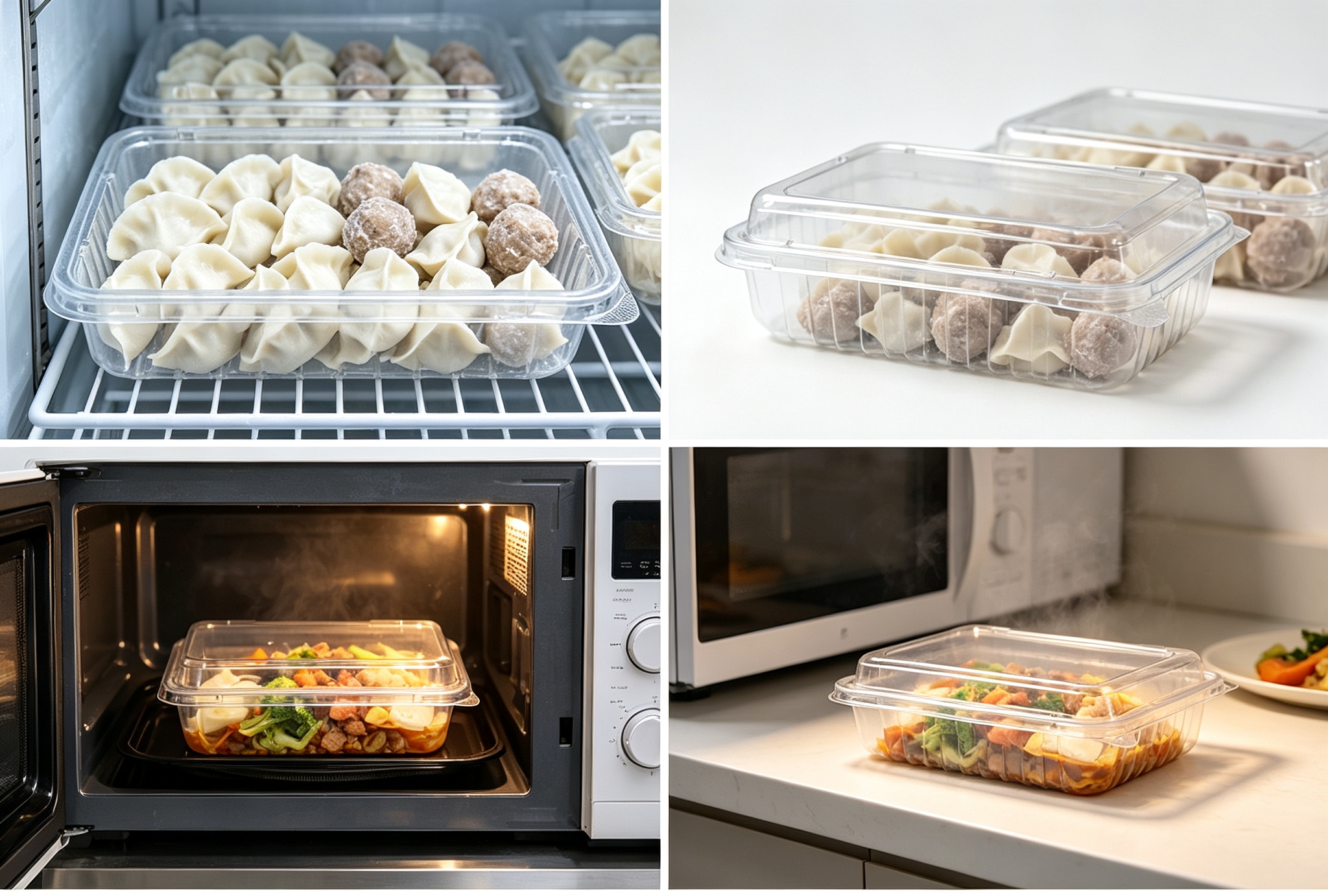
A single tray format is often expected to work across ambient dispatch, chilled retail display and frozen back-stock. Temperature zone coverage is a specification decision, not a default.
A MAP Compatibility Checklist for Either Tray
Whichever format is under consideration, the same verification list applies. Working through it in order prevents the most common failure mode in bakery tray sourcing: a dimension that looks right on a drawing and fails on the line.
| Check | What to confirm | Why it decides the format |
|---|---|---|
| Flange geometry | Seal width, flatness and corner radius against the sealing die | Determines whether a repeatable seal can be formed at all |
| Tray height vs tooling | 3 cm depth vs 6 cm depth against die clearance and gas nozzle position | A deeper tray may need tooling adjustment before the line runs |
| Denester and nesting ratio | Empty nesting height, magazine capacity | Affects line speed and manual reload frequency |
| Headspace and gas volume | Gas volume required to reach target atmosphere | Shallow trays use less gas per pack; deep trays need more |
| Sealing window | Temperature, pressure and dwell for the tray grade | PP and PET seal differently against the same film |
| Conveyor and rail fit | Footprint stability on existing rails and guides | 16.8 × 11.4 cm and 22.2 × 13 cm behave differently at speed |
| Post-seal top load | Stacked crate or carton performance with real product | Links tray geometry to transport damage rates |
| Cold chain performance | Behaviour in 0–8 °C chilled display | Fogging and low-temperature brittleness appear here |
| Documentation | FDA food contact compliance, EU BPA restrictions, declaration of conformity | Required before retail listing in most markets |
| Sample trial | Minimum three production runs on the buyer's own line | The only test that reflects the real sealing and handling environment |
Matching the Format to the Buyer Profile
Because the two trays differ in footprint and depth rather than in material class, the buyer profile usually resolves the choice faster than a specification comparison does.
| Buyer profile | Dominant requirement | Format that more often fits |
|---|---|---|
| E-commerce bakery brand, single-portion pastries | Low shipping cube, low breakage in parcel networks | HB-1912, provided top-load and drop performance are validated in the outer carton |
| E-commerce brand, gift sets and multi-item boxes | Product separation and protection of decorated surfaces | HB-75-28(PP), because 6 cm depth reduces film-to-product contact |
| In-store bakery, high-volume single portions | Line speed, nesting density, low unit material use | HB-1912 |
| Supermarket chain, MAP layered desserts or savoury bakery | Shelf life, headspace, consistent seal across long runs | HB-75-28(PP) |
| Supermarket chain with standardised crates | Footprint compatibility with existing crate grids | Whichever footprint matches the crate — this is usually the deciding factor |
The 22.2 × 13 cm footprint of the HB-75-28(PP) is the single most consequential difference for chains that have already standardised crates, shelf-ready trays and pallet patterns. A format that performs better on the sealing line can still lose on crate fit, and crate fit is not negotiable once a distribution centre has published its specification.
Documented Limits of Both Formats
An honest comparison has to state where each option stops working. Four limits apply here.
- HB-1912 — depth ceiling. At 3 cm, the tray constrains anything with significant height: tall cupcakes, layered desserts, and products with piped decoration. Headspace is also small, which limits the gas-to-product ratio available for high-moisture or respiring bakery items.
- HB-75-28(PP) — cube cost. At 6 cm deep and 22.2 × 13 cm, each unit consumes more pallet and carton volume. For a brand optimising parcel shipping cost on small items, that cube is paid on every order.
- Both — clarity. Neither format should be expected to match PET for glass-like display transparency, and anti-fog availability on the PP grade must be confirmed rather than assumed.
- Both — dimensional specification alone is insufficient. External dimensions do not describe internal capacity, wall-thickness distribution at corners, flange flatness or seal performance.
Compared with traditional bakery formats — open trays with a separate bag, folded cartons, or simple lidded containers — a MAP-ready PP tray adds seal integrity and headspace control. It also adds two costs that the traditional formats do not carry: a lidding film per pack, and a tooling and validation step that must be completed before the line runs. For low-volume or very short shelf-life products, that trade-off is not always positive.
Supplier-Side Factors: Tooling, Sheet Supply and Compliance
Because both trays come from the same manufacturer, the supplier assessment is identical for each — and for MAP formats, the tooling question is the one that most often affects project timelines.
Chuan He operates an in-house mold workshop alongside its thermoforming capacity, an arrangement the company presents as reducing outsourced raw material cost and enabling coordinated production and faster delivery. The company also runs four PET sheet extrusion lines and two PP sheet extrusion lines. The relevance to a MAP project is direct: flange width, corner radius and tray depth are mold decisions. Any change to the seal surface requires a new or modified tool, which changes both lead time and tooling cost. A supplier that controls mold work in-house can usually shorten that loop; it does not eliminate it.
The company holds CE, BRC, FDA, EU and SGS quality management certifications, and its stated anti-contamination measures include FDA food contact compliance, clean production, online quality inspection and finished-product sampling tests, together with supplier certificate verification, periodic third-party testing and long-term archiving of compliance records. Its published risk-control position addresses chemical migration, sharp fragments, microbial contamination and unqualified raw materials — the four failure modes that matter most for direct food contact in a sealed pack.
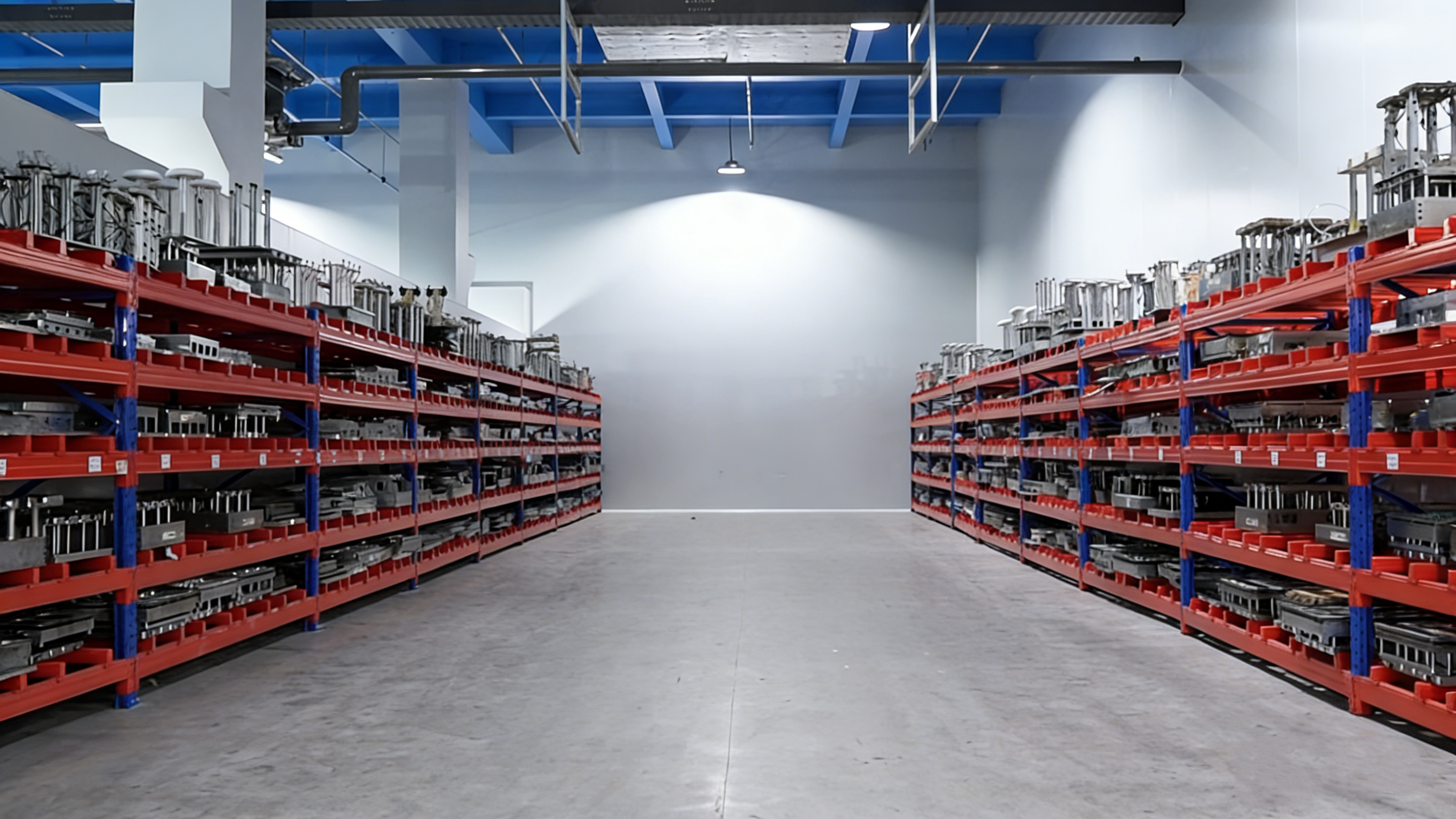
Tooling capability sits behind every MAP tray specification. Flange geometry, corner radius and depth are mold parameters, so in-house mold work is a lead-time factor rather than a marketing line.
On export capability, the company reports a 100% export ratio across North America, Europe, Australia and Southeast Asia, with listed main markets covering the EU, United States, North America, Latin America and the Middle East. For a supermarket chain or importer, that matters less as a credibility claim than as evidence that documentation for multiple regulatory regimes is routine rather than exceptional.
Market Context: Rigid Thermoform Trays Inside Food Packaging Growth
The category both trays sit in is large and still expanding. The global thermoform packaging market was valued at USD 54.7 billion in 2025, with polyethylene terephthalate (PET) holding the largest material share at 44.8%, according to Grand View Research. PP formats sit inside the remainder of that market — a reminder that material choice in bakery trays is a trade-off between clarity and heat performance rather than a single-answer question.
The broader food packaging market was valued at USD 421.6 billion in 2025 and is projected to reach USD 599.0 billion by 2033, with Asia Pacific holding a 40.0% revenue share in 2025, according to the same source. On the demand side, China exported USD 1.28 billion in baked goods in 2024, according to the Observatory of Economic Complexity — a figure that implies substantial associated demand for primary bakery packaging such as PET and PP containers.
Where tamper evidence enters the specification, the tamper-evident packaging market is projected to grow from USD 2.56 billion in 2025 to USD 4.26 billion by 2030, a CAGR of 10.72%, according to Mordor Intelligence. Chuan He's own tamper-evident design uses an anti-tamper structure intended for one-time opening, after which the locking tab cannot be restored to its original closed state. That is a separate feature from MAP seal integrity, and buyers should treat the two as distinct requirements.
On the competitive landscape, published market research lists Amcor Plc, Berry Global Inc., Sealed Air Corporation and Mondi Group among the top global players in bakery packaging. A buyer shortlisting a regional thermoformer such as Chuan He is effectively choosing between coordinated tooling and shorter supply chains on one side, and the scale and global service footprint of multinational converters on the other.
Scope caution: published bakery packaging market estimates diverge widely by definition — one source sizes the category at USD 12.4 billion while another cites USD 57.76 billion for what is presented as the same market. Before benchmarking any supplier against a market figure, confirm whether it covers all bakery packaging or only rigid containers, and whether it includes films and labels.
What Changes Next
Three regulatory and technical currents are likely to shape bakery tray specifications over the next sourcing cycle.
First, documentation pressure. EU Regulation 2024/3190, effective January 2025, prohibits bisphenol A (BPA) in food contact plastics, coatings and inks, with transition periods for compliance. Separately, FDA 21 CFR 177.1520 sets out the safety requirements for polypropylene as a food-grade plastic, specifically for heat-resistant and microwave-safe containers. For PP bakery trays, the practical effect is that material declarations and conformity documents move from a procurement checkbox to a listing prerequisite.
Second, recyclability and mono-material design. The supplier's stated compliance approach includes tracking regulation updates and adjusting formulations against EU 10/2011, the Packaging and Packaging Waste Regulation and PFAS limits. Tray design that keeps PP and PET streams separate — rather than laminating mixed materials for a marginal barrier gain — is becoming easier to defend in a retail listing review.
Third, automation tolerance. As MAP lines run faster, tray consistency matters more than any single physical property. A format that seals reliably at moderate speed but varies at the edge of a tolerance band will be rejected by the line before it is rejected by the customer.
Frequently Asked Questions
What is the practical difference between the HB-1912 and the HB-75-28(PP)?
The HB-1912 measures 16.8 × 11.4 × 3 cm and the HB-75-28(PP) measures 22.2 × 13 × 6 cm. Both are food-contact PP trays for bakery use. The practical difference is therefore footprint and depth rather than material: the HB-1912 is a compact, shallow single-portion tray, while the HB-75-28(PP) is an elongated, deep tray suited to multi-item sets and layered products. Those geometric differences drive pallet cube, product height limits and gas headspace volume.
Which of the two trays is better suited to modified atmosphere packaging lines?
Both formats are specified for bakery use and both are compatible with MAP in principle, because compatibility depends on flange geometry, tray rigidity at the sealing die and the buyer's film and sealing parameters — not on tray size alone. The deeper HB-75-28(PP) provides more headspace for taller products; the shallower HB-1912 uses less gas per pack and allows more filled layers within a fixed pallet height. Because no flange dimensions, seal windows or gas-flush data for either model are published in the source material used here, the selection should be settled by a line trial rather than by a document comparison.
Does a deeper tray automatically extend shelf life under MAP?
No. Shelf life in modified atmosphere packaging depends on the gas mixture, residual oxygen level, seal integrity, film barrier properties, product respiration and storage temperature. Depth changes headspace volume, which changes how much gas is required to reach a target atmosphere and how long the pack takes to reach equilibrium. A deeper tray can be an advantage for fragile or tall products, but it is not by itself a shelf-life measure.
Are PP bakery trays microwave-safe and freezer-safe?
Polypropylene is recognised under FDA 21 CFR 177.1520, which specifies safety requirements for PP as a food-grade plastic, particularly for heat-resistant and microwave-safe containers. Chuan He's published range data for its temperature-treated formats cites stable performance between −18 °C and 120 °C, with a 38% reduction in heat deformation rate and a 32% reduction in low-temperature cracking rate. Because that data set relates to the company's temperature-treated blister formats, buyers should confirm the applicable temperature rating for the specific PP grade and SKU ordered rather than applying the range figure by default.
Can either tray be modified to fit an existing MAP line?
Flange width, corner radius and tray depth are mold parameters, so fitting a tray to an existing sealing die normally requires new tooling or a modification to an existing tool. Chuan He operates an in-house mold workshop and reports experience developing thousands of molds, which shortens the tooling loop for custom dimensions and geometry. Timelines and tooling cost still depend on the specific change requested, and any custom geometry should be re-validated on the buyer's own line before production volumes are committed.
Summary
For a bakery tray decision on a MAP line, the HB-1912 and the HB-75-28(PP) answer two different questions. The 16.8 × 11.4 × 3 cm format answers the question of volume efficiency: more units per pallet layer, less gas per pack, tighter empty nesting. The 22.2 × 13 × 6 cm format answers the question of product protection: more headspace, less film-to-product contact, more room for layered and decorated items.
Neither choice should be finalised from a dimension table. The three steps that decide it are a corner-thickness and top-load check on production samples, a crate and pallet fit test against the buyer's existing logistics specification, and a line trial using the buyer's own film, gas mix and sealing parameters. Where clarity is the primary merchandising requirement, both PP formats sit below PET and should be assessed against a PET alternative on the same shelf before a format is locked.
Buyers who need the underlying dimensional drawings, material declarations and certification records for either format can request them from the manufacturer; the company's thermoformed packaging range is documented in its downloadable brochure at Chuan He 2026 product brochure.
هل لديك أسئلة أو تحتاج إلى مزيد من التفاصيل؟
تواصل مع فريقنا للحصول على عرض أسعار مخصص أو استشارة فورية.
طلب عرض أسعار
املأ النموذج أدناه وسيتواصل معك فريقنا بعرض مقترح مخصص.
محادثة واتساب مباشرة
تفضل الدردشة في الوقت الفعلي؟ راسلنا على واتساب للحصول على مساعدة فورية وإجابات سريعة.
- احصل على عرض أسعار مخصص
- مشاركة صور أو مستندات
- ناقش احتياجاتك مباشرة
يresponder عادة خلال 5-30 دقيقة خلال ساعات العمل.