
HDPE Sheet Compliance Paths for Food, Marine and UV Service
Industrial HDPE sheet compliance is not a single status. It is a set of evidence trails that must match the service environment, the resin grade and the fabrication route. A sheet described as food grade is not automatically marine grade or UV stabilized, and a UV-resistant panel is not automatically suitable for direct food contact. For buyers at the decision stage, the practical question is not which label sounds strongest, but which grade and documentation set fit the actual exposure.
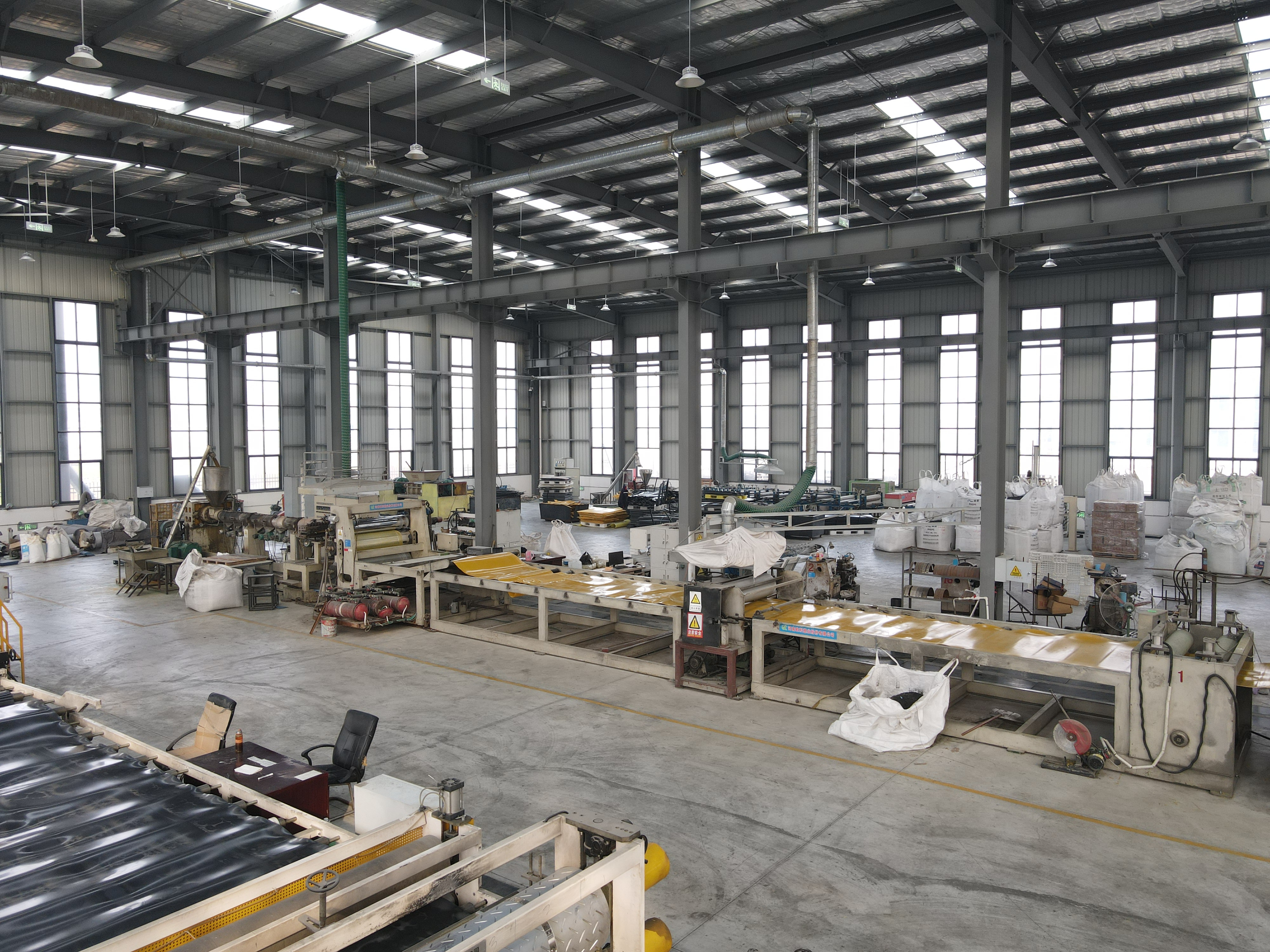
Extrusion production line for industrial HDPE sheet. Grade selection and documentation must match the final service environment.
Why food-contact, marine and UV grades follow different compliance paths
Industrial HDPE sheet is a semi-finished thermoplastic sheet made from high-density polyethylene and used for fabrication into liners, panels, tables, fenders, mats and machined components. The same base polymer can be formulated, surfaced and documented for different duties. That is why a single material family produces three distinct procurement conversations: food-contact compliance, marine-grade qualification and UV-stabilized outdoor performance.
The three labels answer different questions. Food-contact compliance asks whether the finished sheet is safe for its intended contact with food and whether the supplier can document resin, additives and applicable regulatory conformity. Marine-grade asks whether the sheet and the project design can tolerate saltwater, moisture, impact and outdoor exposure. UV-resistant asks whether the formulation can resist sunlight-driven degradation over the expected service period. A buyer who treats these as interchangeable may receive a sheet that meets one requirement but fails another.
The commercial risk is not only material failure. It is also documentation failure: a supplier may offer a suitable sheet but be unable to provide the declaration, traceability or test evidence needed for the project file. That is why grade selection and evidence review should happen together, before price comparison.
The procurement problem: grade names are not the same as qualification evidence
Three labels cause most of the confusion in industrial HDPE sheet sourcing. Food grade is a material and documentation claim. Marine grade is a service-grade designation used for marine and port construction, but it is not a single universal certificate. UV resistant is a formulation attribute that depends on the stabilizer package, color, surface and expected exposure. Each has a different failure mode when the evidence is weak.
A standard HDPE sheet is not UV-stabilized and may chalk or embrittle under prolonged outdoor sun exposure. A recycled industrial HDPE sheet can be cost-effective for non-critical anti-corrosion lining, but it is not a default food-contact material. A UV-stabilized sheet may perform well outdoors without being suitable for direct food contact. These are not marketing distinctions; they change what the buyer should request and what the supplier should be able to prove.
The opportunity is equally clear. When a supplier can separate virgin, recycled, UV-stabilized and marine-grade options, and can provide grade-specific data, the buyer can match each line item to its actual duty instead of paying for over-specification or accepting under-specification.
Sanyou's grade and documentation position
Tangyin Sanyou Engineering Plastic Co., Ltd. (Sanyou) is a China-based manufacturer of HDPE sheet, UHMWPE sheet, PP sheet, HDPE sandwich board and ground protection mats. Founded in 2001, the company operates a 40,000 m² factory with 80 employees, 10 engineers and an annual output of 120,000 tons. About 70% of output is exported to North America, Western Europe, Central Europe, the Middle East, Oceania and Southeast Asia.
The Sanyou hdpe sheet range includes virgin, recycled, UV-stabilized, marine grade, colored, smooth, matte, orange peel textured, grid textured and anti-slip options. Listed thickness is 2–50 mm, with custom dimensions available. The 1220 × 2440 mm format is the common 4x8 HDPE industrial board size, and custom cut HDPE sheet and CNC machining are available for fabricated components.
Listed HDPE sheet data includes a density range of 0.93–0.97 g/cm³, tensile strength of at least 22 MPa, impact strength of at least 20 kJ/m², water absorption below 0.01%, a working temperature range of -60 to +80 °C and a low coefficient of friction of 0.15–0.25. The material is listed as resistant to acid, alkali, salt and oil. Sanyou also lists ISO 9001 certification.
For compliance-sensitive projects, the grade options should be read as starting points for qualification. Sanyou lists a food-grade HDPE sheet option made from food-grade polyethylene resin for food processing, cutting boards and sanitary applications. UV resistance is listed as an optional attribute, and marine-grade HDPE sheet is listed as a grade option for marine and port construction. These claims still need to be matched with the destination-market declaration and product-specific test evidence required by the project.
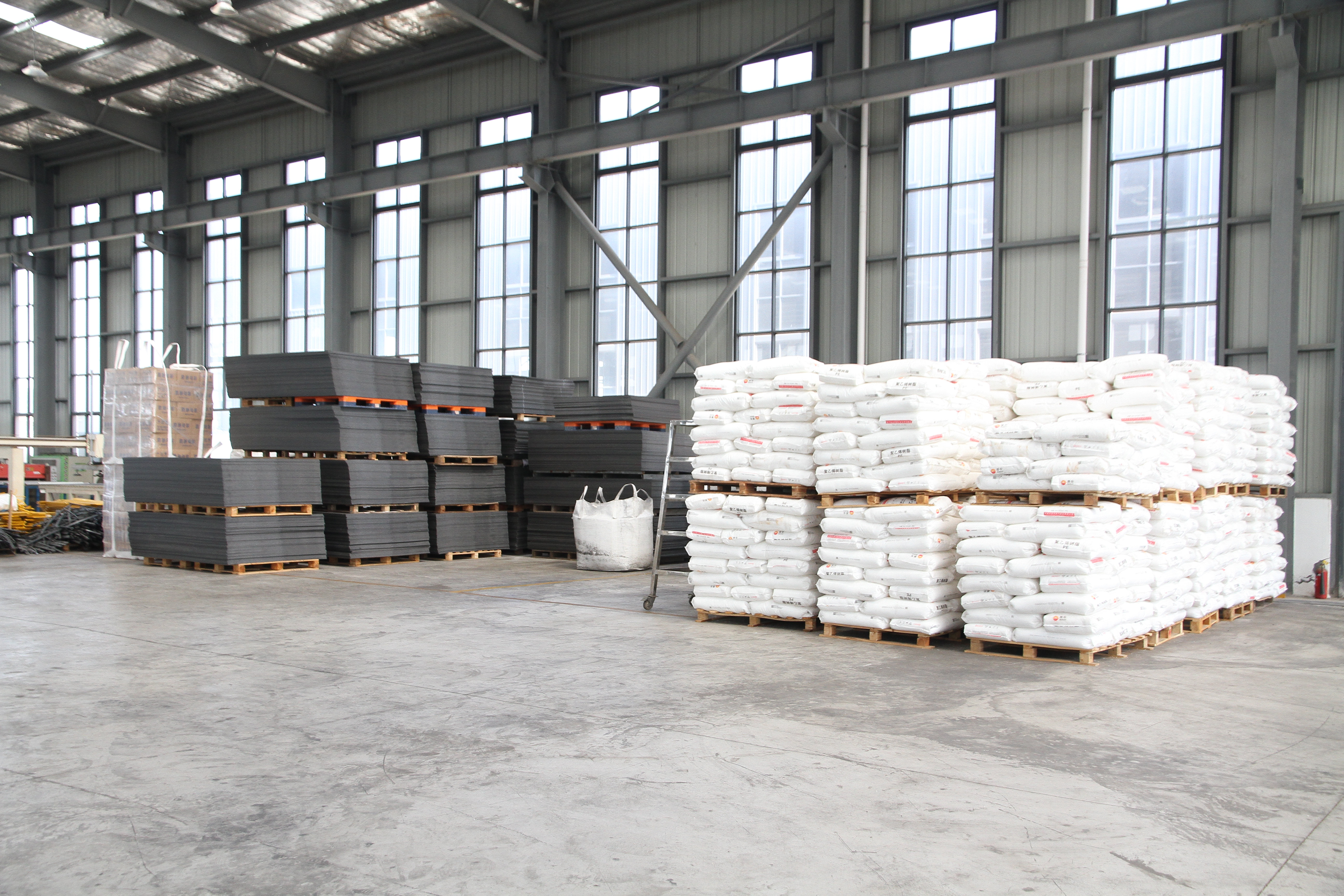
Raw material warehouse. Resin grade and additive traceability are part of the evidence trail for food-contact and UV-stabilized HDPE sheet.
Food-contact path: Food Grade HDPE Sheet requires a market-specific declaration
Food-contact HDPE sheet must satisfy the food-contact rules of the destination market and the specific application, not just carry a food-grade label. The usual starting point is a virgin HDPE plastic sheet made from food-grade polyethylene resin, with controlled additives and colorants. Virgin HDPE sheet is recommended for food-contact, potable water and high-reliability projects because it offers stable mechanical performance and a cleaner material structure than recycled alternatives.
The operating environment matters. Food processing tables, cutting boards, conveyor components and sanitary surfaces are exposed to moisture, food residues, cleaning chemicals and repeated washdown. The sheet must be easy to clean, resistant to the cleaning regime and consistent in thickness and surface finish. A waterproof HDPE sheet with low water absorption is useful in wet areas, but waterproofing alone does not establish food-contact conformity.
Supplier technical guidance commonly identifies ASTM D4976 as a baseline polyethylene material specification and cites FDA 21 CFR 177.1520 in the United States and EU Regulation 10/2011 in the European Union as food-contact reference paths. These references are a starting point, not a substitute for the current official text and the product-specific declaration of compliance. Buyers should request resin and additive traceability, the applicable declaration for the destination market, and migration or conformity test reports where the application requires them.
The main boundary is that a food-grade label is not regulatory approval. Colorants, processing aids and recycled content can change the compliance position. A recycled industrial HDPE sheet may be appropriate for non-critical anti-corrosion lining, but it should not be used in food-contact service unless the specific recycled grade and documentation have been approved for that use.
Marine path: HDPE Marine Board is a project qualification, not a single certificate
Marine-grade HDPE sheet is specified for marine and port construction because the material combines moisture resistance, impact resistance and corrosion resistance. An HDPE marine board may be used for fender panels, dock components, marine panels and other structures exposed to saltwater, weather and repeated mechanical loading. The grade is relevant because standard HDPE may not have the UV stabilization or the documented performance profile required by the project.
The material data supports the logic. HDPE sheet has water absorption below 0.01%, good impact strength and resistance to acid, alkali, salt and oil. Those properties help in wet and corrosive environments. However, marine service also involves UV exposure, thermal cycling and mechanical design. A marine-grade HDPE sheet should therefore be reviewed with its UV stabilization statement, thickness, support structure and impact requirements, not only its polymer name.
Buyers should request a grade datasheet, a UV stabilization statement, mechanical property data, the project specification and, where available, application references. The main boundary is that marine-grade is a supplier grade designation and a project qualification, not a universal certificate. Saltwater exposure and load cases must be confirmed for the specific project. A sheet that is suitable for a marine panel may not be suitable for a high-load fender or a structural application without additional design review.
UV-exposed path: UV Resistant HDPE Sheet is a stabilized formulation
UV-resistant HDPE sheet is a stabilized grade, not a color. Standard HDPE is not UV-stabilized and may chalk or embrittle under prolonged outdoor sun exposure. A UV-stabilized HDPE sheet is recommended for long-term outdoor applications because it reduces aging and chalking. Carbon black can provide UV protection, which is one reason black industrial HDPE sheet is common outdoors, but color alone does not prove UV stabilization.
Outdoor applications include outdoor cabinets, furniture, playground components, signage, ground protection mats and marine panels. These applications differ in sun exposure, abrasion, cleaning and mechanical load. A UV-resistant HDPE sheet for a signage panel may need a different surface and thickness from a UV-stabilized HDPE sheet used on a marine board or a ground protection mat.
Buyers should ask for a UV stabilization declaration, the formulation basis, the expected exposure conditions and any available weathering test method or result. The boundary is that UV resistance is an optional attribute and is formulation-dependent. A colored HDPE plastic panel may look suitable outdoors without being UV-stabilized. A black sheet may contain carbon black without a documented stabilizer package. The procurement file should separate appearance from performance evidence.
Cross-cutting selection criteria for industrial HDPE sheet
HDPE sheet selection mainly depends on working temperature, chemical medium, load and impact condition, indoor or outdoor environment, contact-material requirement and mechanical-processing demand. These criteria apply across food-contact, marine and UV-exposed projects, but they do not replace the compliance evidence specific to each path.
Thickness should be selected against duty. Corpus thickness references place 5–6 mm in light-load lining, 6–20 mm in tank wall and structural panel territory, and 20–50 mm in heavy-wear chute liner applications. A 10mm HDPE industrial sheet is therefore a general fabrication thickness, not a universal heavy-wear choice. For chute liners and wear plates, a wear-resistant HDPE plate or a low friction HDPE board may be more appropriate than a general-purpose sheet. For chemical containment and wastewater equipment, an anti-corrosion HDPE sheet may be selected, but the chemical compatibility and welding details still need review.
Surface and format also matter. Smooth, matte, orange peel textured HDPE sheet and other anti-slip surfaces are available. Textured surfaces can help with traction or appearance, but they do not replace UV stabilization or food-contact documentation. The same is true for custom colors: a colored HDPE plastic panel can meet a visual requirement while still needing the correct grade for sunlight, cleaning chemicals or food contact.
Compliance comparison: what to request for each path
| Compliance path | Typical service environment | Grade and material focus | Evidence to request | Main boundary |
|---|---|---|---|---|
| Food-contact | Food processing tables, cutting boards, sanitary surfaces, conveyors and washdown with cleaning chemicals | Virgin HDPE plastic sheet; food-grade resin; controlled additives and colorants; recycled content only with specific approval | Declaration of compliance, resin and additive traceability, migration or conformity test reports where applicable, current official regulation check | A food-grade label alone is not regulatory approval; documentation is market-specific |
| Marine-grade | Marine and port construction, saltwater, moisture, UV exposure and impact loading | Marine-grade HDPE sheet or HDPE marine board; low water absorption; impact resistance; UV stabilization; thickness selected for load | Grade datasheet, UV stabilizer statement, mechanical properties, project specification and application references | Marine-grade is not a universal certificate; project requirements govern |
| UV-exposed | Outdoor cabinets, furniture, playground components, signage, ground protection mats and marine panels | UV-stabilized HDPE sheet; carbon black optional; surface and color; stabilizer package | UV stabilization declaration, formulation basis, weathering test method or results where available, expected exposure conditions | UV resistance is optional and formulation-dependent; color alone is not proof |
Application and regional scenarios
In food processing, the focus is on cutting boards, tables, conveyor components and sanitary work surfaces. The material should be a Food Grade HDPE Sheet with a cleanable surface and documentation for the destination market. Cleaning chemicals and repeated washdown should be part of the review, because a sheet that performs in dry contact may behave differently under a daily sanitation regime.
In chemical processing and wastewater treatment, the focus shifts to anti-corrosion HDPE sheet, moisture resistance and chemical compatibility. HDPE sheet is resistant to acid, alkali, salt and oil, but the specific medium, temperature and concentration still need confirmation. A waterproof HDPE sheet with low water absorption is useful in wet equipment, but it should not be assumed to be food-contact compliant or UV-stabilized without separate evidence.
In marine and port construction, HDPE marine board and marine-grade HDPE sheet are selected for moisture, salt and impact exposure. The sheet may be used in fender panels, dock components and marine panels. The project should define the UV exposure, load case and fixing method, because marine-grade sheet still needs a suitable thickness and support design.
In outdoor furniture, cabinets, signage and playground equipment, UV Resistant HDPE Sheet is selected to reduce aging and chalking. The same outdoor logic applies to HDPE ground protection mats, which are made from HDPE using recycled or application-specific formulations and are used on soft, wet, muddy, sandy or uneven ground under repeated traffic. A ground protection mat is not a food-contact product, and its grade should be specified for load, traction and weather rather than for sanitary contact.
Regional scenarios add another layer. Projects in the United States, Canada, Australia, Germany, France and the UAE may combine food-contact, outdoor UV and marine exposure requirements in the same procurement program. A buyer in Germany or France may need EU and national food-contact documentation, while a project in Australia or the UAE may combine imported-material documentation with high UV exposure and, in port projects, marine-grade requirements. The practical starting point is to ask which local food-contact, environmental or port-authority requirements apply before the grade is fixed.
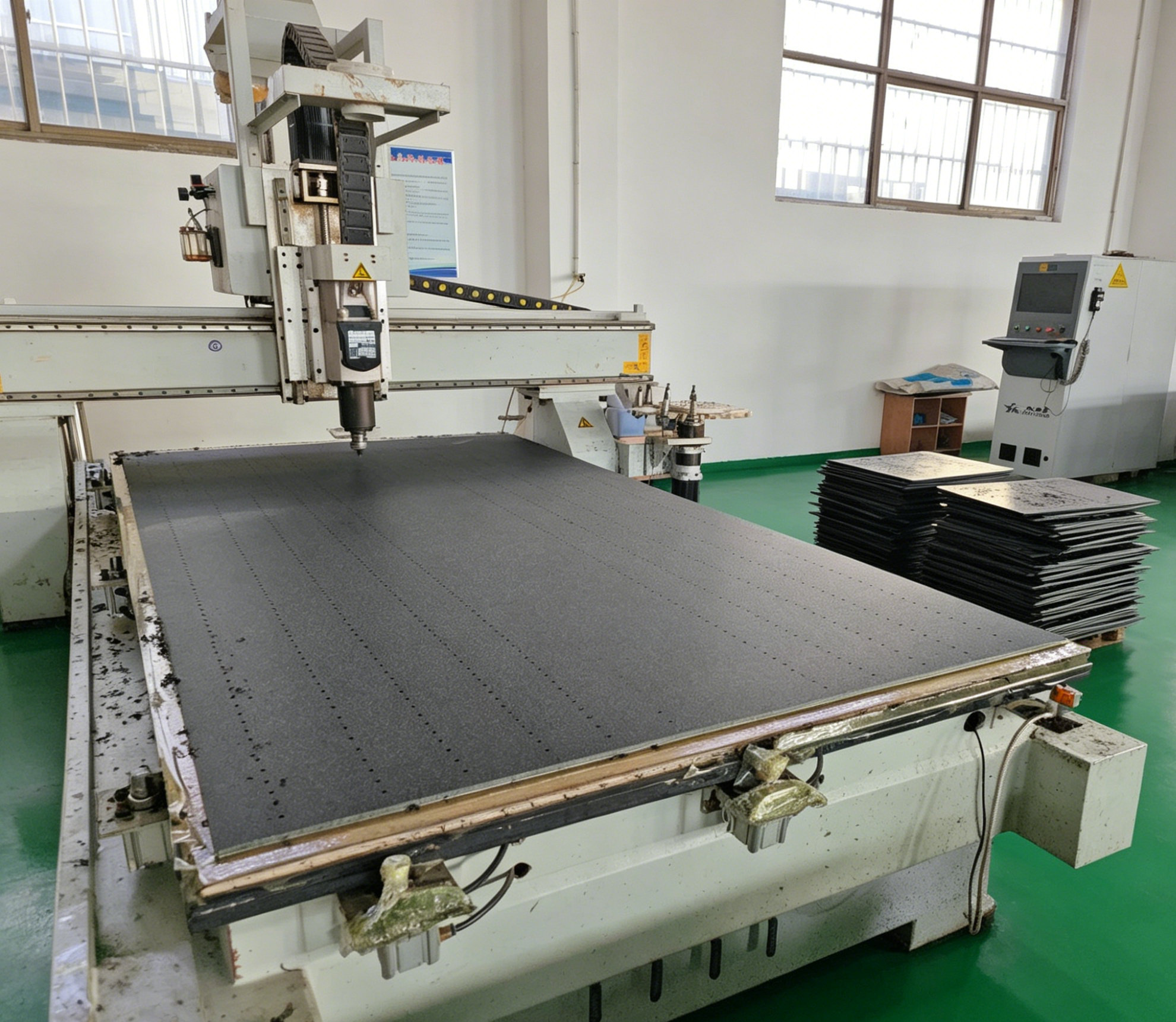
CNC machining of custom cut HDPE sheet. Fabrication details can affect surface finish, fixing and cleanability.
Market trend: compliance is becoming a procurement filter
Commercial research in the verified data package projects the global HDPE market to grow from USD 84.37 billion in 2023 to USD 126.86 billion by 2030. Sheets and films are reported at about 41.1% of global HDPE demand. These are resin-level market figures, not a market size for industrial HDPE sheet, so they should be read as context rather than a sheet-level forecast.
Recycled black r-HDPE resin was reported at around USD 520/mt FOB Southeast Asia in September 2026. That price signal supports the use of recycled HDPE for non-critical anti-corrosion lining, but it does not make recycled sheet interchangeable with virgin food-contact or marine-grade sheet. Compliance suitability is determined by grade, formulation and documentation, not by resin price alone.
The procurement trend is toward grade-specific declarations, batch traceability and application-specific test evidence. Buyers are increasingly separating the material question from the evidence question: what is the sheet made from, what is it expected to resist, and what document proves that the supplied batch matches the specification? Suppliers that can answer all three are easier to qualify for food-contact, marine and UV-exposed projects.
Comparison with traditional solutions
Compared with traditional steel plate, industrial HDPE sheet is corrosion-resistant, lighter, impact-resistant and low-maintenance. Listed comparison data indicates that HDPE can be up to 80% lighter than steel, with zero rust and lower maintenance requirements. That reduces transport and installation effort and can lower replacement and maintenance costs over the service life. These advantages are relevant in chemical processing, material handling, wear liners and outdoor applications where steel may corrode or require heavy handling.
Compared with PTFE sheet, HDPE sheet typically offers higher impact strength and lower material cost for many general-purpose industrial applications. It is easier to machine, clean, replace and maintain, and its lower density helps reduce component weight. HDPE sheet is more suitable for wear liners, chute liners, conveyor components, cutting boards, equipment protection and chemical-resistant applications. PTFE remains a specialist choice where its own property profile is required.
The limitation is equally important. HDPE sheet is not a universal structural replacement for steel. Its stiffness is lower, its continuous service temperature is grade-dependent, and standard HDPE is not UV-stabilized. In high-point-load, high-temperature or long-term outdoor applications, the design must use the correct grade, thickness and support structure. Food-contact and marine-grade claims also require documents, not just material selection. A sheet that is mechanically suitable can still fail a compliance review if the declaration, traceability or test evidence is missing.
Future outlook
Expect more scrutiny on three fronts: food-contact documentation, UV stabilization evidence and marine-grade qualification. As buyers in North America, Europe, Australia and the Middle East combine imported materials with local project requirements, the supplier declaration becomes as important as the sheet itself. Recycled content will also receive more attention, because cost savings are useful only when the recycled grade is approved for the intended duty.
For buyers, the practical response is to write the service environment into the RFQ. State whether the sheet will contact food, whether it will be exposed to sunlight or saltwater, which cleaning chemicals will be used, what impact and load it must tolerate, and which market the project will serve. Then ask for the grade name, the declaration, the traceability record and the relevant test evidence. That approach keeps the comparison commercial without losing the compliance boundary.
A downloadable Sanyou product catalog is available for buyers who need the full grade and format list: Sanyou Product Catalog.
FAQ
Is food-grade HDPE sheet the same as marine-grade HDPE sheet?
No. Food-grade HDPE sheet is qualified for food-contact applications and requires a market-specific declaration, resin and additive traceability, and relevant conformity evidence. Marine-grade HDPE sheet is a service-grade designation for marine and port construction, where moisture, saltwater, UV exposure, impact and project design are the main concerns. A sheet may be suitable for one path without being qualified for the other.
What documentation should buyers request for food-contact HDPE sheet?
Buyers should request a product-specific declaration of compliance for the destination market, resin and additive traceability, and migration or conformity test reports where the application requires them. Supplier technical guidance commonly cites FDA 21 CFR 177.1520 in the United States and EU Regulation 10/2011 in the European Union as food-contact reference paths, but the current official text and the supplier's product-specific declaration should be checked directly.
Can standard HDPE sheet be used outdoors without UV stabilization?
Standard HDPE is not UV-stabilized and may chalk or embrittle under prolonged outdoor sun exposure. For long-term outdoor use, a UV-stabilized HDPE sheet is recommended because it reduces aging and chalking. Carbon black can provide UV protection, but color alone does not prove that a sheet contains a suitable stabilizer package.
What makes HDPE sheet suitable for marine use?
Marine suitability depends on low water absorption, impact resistance, corrosion resistance, UV stabilization and a thickness and support design that match the project load. HDPE sheet has water absorption below 0.01% and resistance to salt, acid, alkali and oil, which supports marine and port construction use. However, marine-grade is a supplier grade and project qualification, not a single universal certificate, so the grade datasheet and project specification should be reviewed together.
Where does HDPE sheet stop replacing steel plate?
HDPE sheet is not a universal structural replacement for steel. Its stiffness is lower, its continuous service temperature is grade-dependent, and standard HDPE is not UV-stabilized. HDPE is well suited to corrosion-resistant panels, wear liners, material handling and outdoor applications where steel may corrode or require heavy handling, but high-point-load, high-temperature or long-term outdoor designs need the correct grade, thickness and support structure.
Is recycled HDPE suitable for food-contact applications?
Recycled HDPE is generally recommended for non-critical anti-corrosion lining, not as a default food-contact material. Food-contact use requires a specific recycled grade that has been approved for that application, with resin and additive traceability and the applicable declaration or test evidence. Without that approval, a virgin HDPE plastic sheet is the more appropriate starting point for food-contact, potable water and high-reliability projects.
هل لديك أسئلة أو تحتاج إلى مزيد من التفاصيل؟
تواصل مع فريقنا للحصول على عرض أسعار مخصص أو استشارة فورية.
طلب عرض أسعار
املأ النموذج أدناه وسيتواصل معك فريقنا بعرض مقترح مخصص.
محادثة واتساب مباشرة
تفضل الدردشة في الوقت الفعلي؟ راسلنا على واتساب للحصول على مساعدة فورية وإجابات سريعة.
- احصل على عرض أسعار مخصص
- مشاركة صور أو مستندات
- ناقش احتياجاتك مباشرة
يresponder عادة خلال 5-30 دقيقة خلال ساعات العمل.