
HDPE Sheet Sourcing: A Closer Look at Shandong Yaxu
High-density polyethylene sheet sits close to the bottom of most industrial bills of materials, yet it quietly determines how long a chute liner lasts, how much a temporary access road costs to install, and whether a crane outrigger rests on stable ground. For buyers in the awareness and research stage, the practical question is rarely whether HDPE works. It is which supplier's technical scope actually matches the application, and which claims can be checked before a purchase order is raised.
Shandong Yaxu New Materials Co., Ltd. is a China-based manufacturer of HDPE sheets, UHMWPE (PE1000) sheets, ground protection mats, crane outrigger pads and custom-engineered plastic products, operating from Ningjin County, Dezhou City, Shandong Province. The company was established in 2012 and describes a 36,000 m² production facility with approximately 100 staff and an annual production capacity of about 30,000 tons. This analysis examines what that capability means for industrial buyers, where the catalogue is strongest, and where the material itself sets boundaries that no supplier can remove.
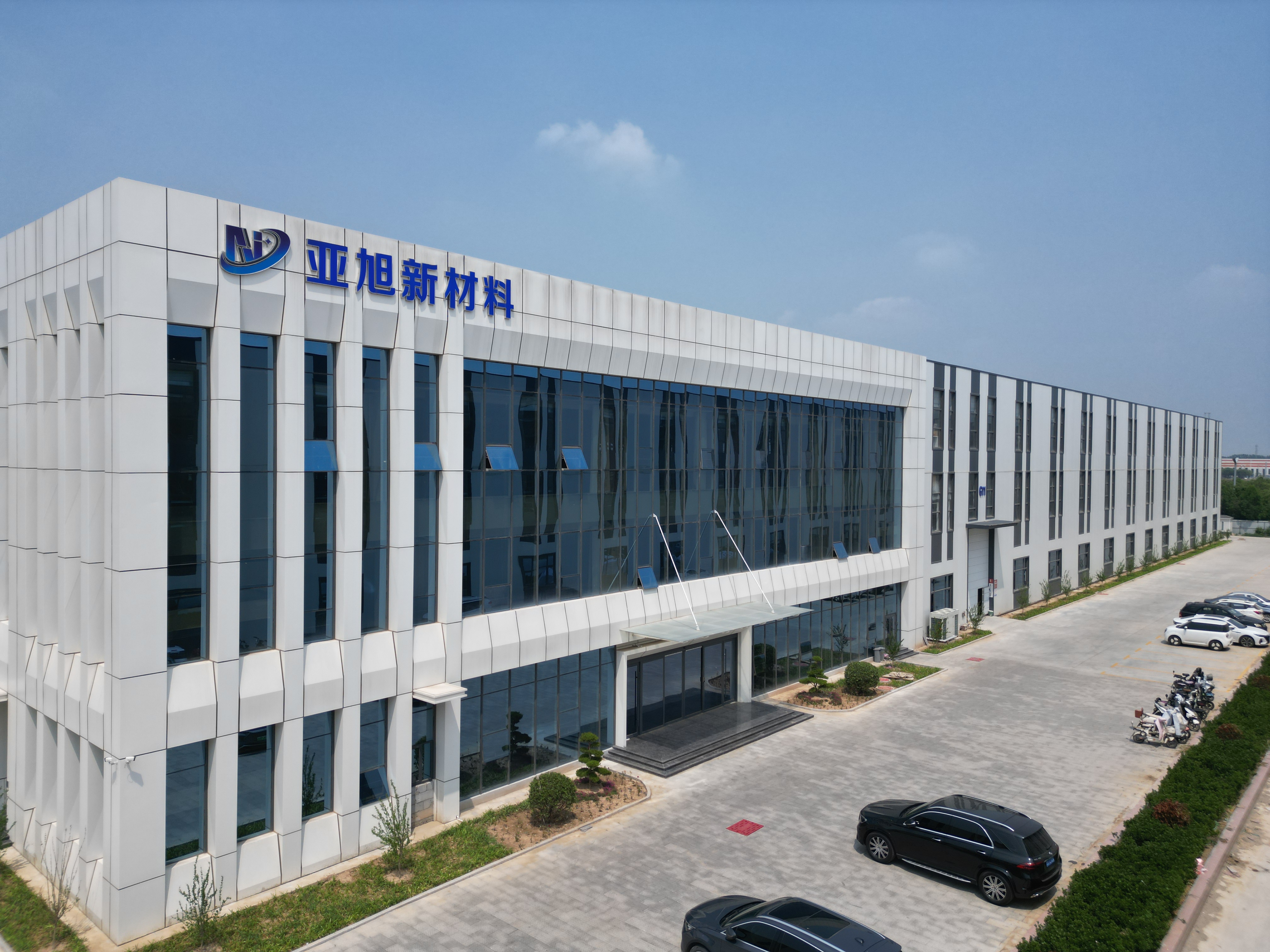
Sheet production and fabrication operations at Shandong Yaxu New Materials Co., Ltd., Ningjin County, Shandong.
Why HDPE Sheet Procurement Is Harder Than It Looks
Polyethylene sheet is a mature product, but the specification space around it is not simple. Three materials are routinely considered for the same job — HDPE, UHMWPE and PP — and their names alone do not establish suitability. HDPE is widely used for general industrial panels, protective surfaces and fabricated components. UHMWPE (PE1000) is selected where sliding wear, impact and low friction dominate. Polypropylene is often considered where chemical resistance, low weight and application-specific temperature requirements matter most.
The second layer of complexity sits in the application. A ground protection mat is frequently described by a single tonnage figure, but load capacity is not a fixed attribute of the product. It depends on mat material, thickness and size, on ground conditions, on equipment type and on how the load is distributed. There is no single weight rating that applies to all ground protection mats, because on soft, muddy or unstable ground the ground itself becomes the limiting factor.
The same logic applies to crane outrigger pads. Crane tonnage does not define pad size. The force applied to each outrigger depends on crane configuration, lifting radius, load position, the number of outriggers and the bearing capacity of the ground beneath them. A buyer who specifies pads from lifting capacity alone is specifying from the wrong variable.
That is the opportunity for a manufacturer that can talk about material grade, thickness, surface pattern and fabrication in the same conversation as the commercial quote. It is also the standard against which such a manufacturer should be assessed.
Company Profile: Scale, Team and Market Reach
The published profile of Shandong Yaxu New Materials positions the company as a manufacturer rather than a pure trading intermediary. Its stated capability covers plastic sheet production, cutting, drilling, CNC machining, custom fabrication and finished plastic components — a sequence that matters because it determines whether a buyer can source raw sheet and machined parts under one specification discussion.
| Established | 2012 |
| Factory area | 36,000 m² |
| Employees | Approximately 100 |
| Annual production capacity | Approximately 30,000 tons |
| R&D team | 9 engineers |
| Core product lines | HDPE sheets, UHMWPE (PE1000) sheets, ground protection mats, crane outrigger pads, custom-engineered plastic products |
| Reported export share | Approximately 30% |
| Listed markets | USA, Australia, Canada, UK, Germany, UAE, Saudi Arabia, Indonesia, Malaysia, Vietnam |
The scale figures are company-reported and should be read as such. They indicate a mid-sized regional manufacturer with a defined product portfolio, a dedicated engineering team and an export orientation, rather than an integrated petrochemical producer. For procurement purposes, that distinction is useful: the company competes on sheet conversion, fabrication and application support, not on resin production.
The Core Capability: From Sheet to Finished Component
The most consequential detail in the company's published capability is that it supplies both semi-finished plastic sheets and finished engineered plastic products. In practice this means a distributor can buy HDPE or UHMWPE sheet for its own fabrication, while an equipment manufacturer or contractor can hand over a drawing and receive a cut, drilled or CNC-machined part.
The stated production flow runs as follows: HDPE or UHMWPE sheet production, cutting, drilling, CNC machining, custom fabrication, and finished plastic components. Customisation is offered across size, thickness, shape, colour and surface, and machining operations applicable to UHMWPE sheet include cutting, drilling, milling, turning and CNC machining.
For a buyer, the practical significance is not that machining exists — many fabricators machine plastics. It is that material selection, sheet thickness, machining method and finished-part design sit within one supplier conversation. Wear-liner projects frequently fail at the interface between these decisions: a correctly specified UHMWPE grade is cut to a size that does not match the mounting points, or a part is machined from sheet that was never selected for the abrasion regime it will face.
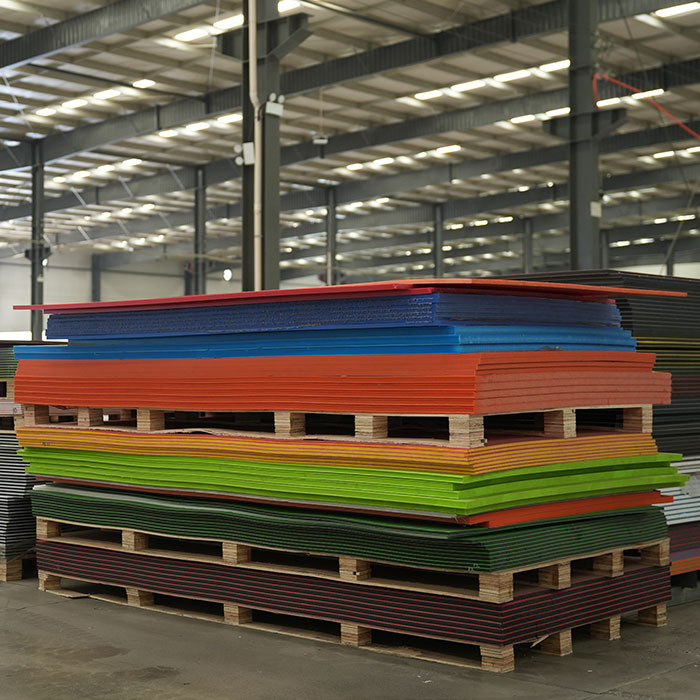
HDPE sheets in custom colours. Colour, thickness and surface are customisable within the stated sheet range.
Product Portfolio and Published Specifications
The portfolio divides into four commercial groups: HDPE sheet, UHMWPE (PE1000) sheet, ground protection mats and crane outrigger pads, with custom fabrication available across all four. The published figures are summarised below; they are the numbers a buyer should use as the starting point for an RFQ, not as a substitute for application-specific engineering review.
| Property | HDPE Sheet | UHMWPE Sheet (PE1000) |
|---|---|---|
| Base material | High-density polyethylene | Ultra-high molecular weight polyethylene, 2–7 million |
| Density | 0.941–0.965 g/cm³ | Approx. 0.935 g/cm³ |
| Thickness | 1–200 mm | Made to customer requirements |
| Width / length | 1000–2000 mm / 2000–6000 mm | Custom sizes rather than fixed standard dimensions |
| Tensile strength | ≥22 MPa | Approx. 55 MPa (breaking) |
| Elongation at break | ≥350% | Approx. 350% |
| Flexural / bending | Flexural strength ≥25 MPa | Bending modulus of elasticity approx. 600 MPa |
| Hardness | Shore D 60–70 | Shore D according to material grade |
| Water absorption | ≤0.01% | Very low |
| Service temperature | Approx. −40°C to 80°C continuous | Approx. −269°C to +110°C |
| Processing | Extrusion, injection moulding, cutting, drilling, machining, welding | Cutting, drilling, milling, turning, CNC machining |
| Referenced standards | GB/T 11116, GB/T 4454; ASTM and ISO available according to product grade and application | Grade-dependent; confirm at RFQ stage |
The HDPE range is offered as smooth, textured, heavy-duty, custom and wear-resistant sheet, with white, black and custom colours. Its properties — high chemical resistance to acids, alkalis, salt solutions and many common chemicals, low water absorption and good weldability by hot-melt and other suitable methods — explain why it appears in chemical tanks, water treatment equipment, wear-resistant liners, food processing equipment, pallets, packaging, protective plates and industrial components.
UHMWPE sits above HDPE on the wear curve. The company offers it as wear-resistant, impact-resistant, low-friction, heavy-duty and custom sheet, and positions it for wear liners, conveyor components, mining equipment, material handling, marine applications, food processing equipment and custom engineering components.
Mats and Pads: Where the Load Conversation Happens
Ground protection mats and crane outrigger pads are the two product lines where buyers most often ask for a number and receive an oversimplification. The published reference figures below show why the conversation needs to include thickness, size and ground conditions together.
| Product | Size | Thickness | Reference load |
|---|---|---|---|
| HDPE ground protection mat | 1220 × 2440 mm | 5–40 mm | Approx. 0.3–60 t, depending on thickness and site conditions |
| UHMWPE ground protection mat | 2060 × 4040 mm or 2070 × 4120 mm | 40–150 mm | Approx. 80–150 t, depending on thickness and ground conditions |
| Crane outrigger pad (UHMWPE) | 300 × 300 mm to 1200 × 1200 mm | 30–120 mm | Approx. 5–120 t |
The outrigger pad range is published as a step table, which is more useful than a single headline number because it lets a buyer match load to pad footprint before contacting the supplier. A 300 × 300 × 30 mm pad references approximately 5 tons at 2.7 kg per piece; 400 × 400 × 40 mm references approximately 10 tons; 500 × 500 × 50 mm approximately 25 tons; 600 × 600 × 60 mm approximately 50 tons; 700 × 700 × 70 mm approximately 70 tons; 800 × 800 × 80 mm approximately 80 tons; 1000 × 1000 × 100 mm approximately 100 tons; and 1200 × 1200 × 120 mm approximately 120 tons at 172.8 kg per piece.
Read as application guidance rather than as certification, these figures map onto typical lifting situations. A 500 × 500 × 50 mm pad is described as suitable for light to medium-duty lifting where portability matters. The 600 × 600 × 60 mm size is presented as a general-purpose pad for mobile cranes, truck cranes, concrete pump trucks and general construction lifting. The 700 × 700 × 70 mm size is recommended where a larger support area is needed for heavier lifts, and the 800 × 800 × 80 mm size for heavy-duty lifting on challenging ground such as soft soil, grass, sand or uneven surfaces. Custom pads can be manufactured to actual load requirements.
Ground mats follow a similar logic by duty class. HDPE mats are usually sufficient for pedestrian access, lawn protection, small vehicles and landscaping. Heavy-duty HDPE or UHMWPE mats are recommended for construction vehicles, forklifts, delivery trucks and general site access. For mobile cranes, large excavators, heavy trucks, mining equipment and industrial projects, UHMWPE mats are recommended because of higher strength, impact resistance and durability.
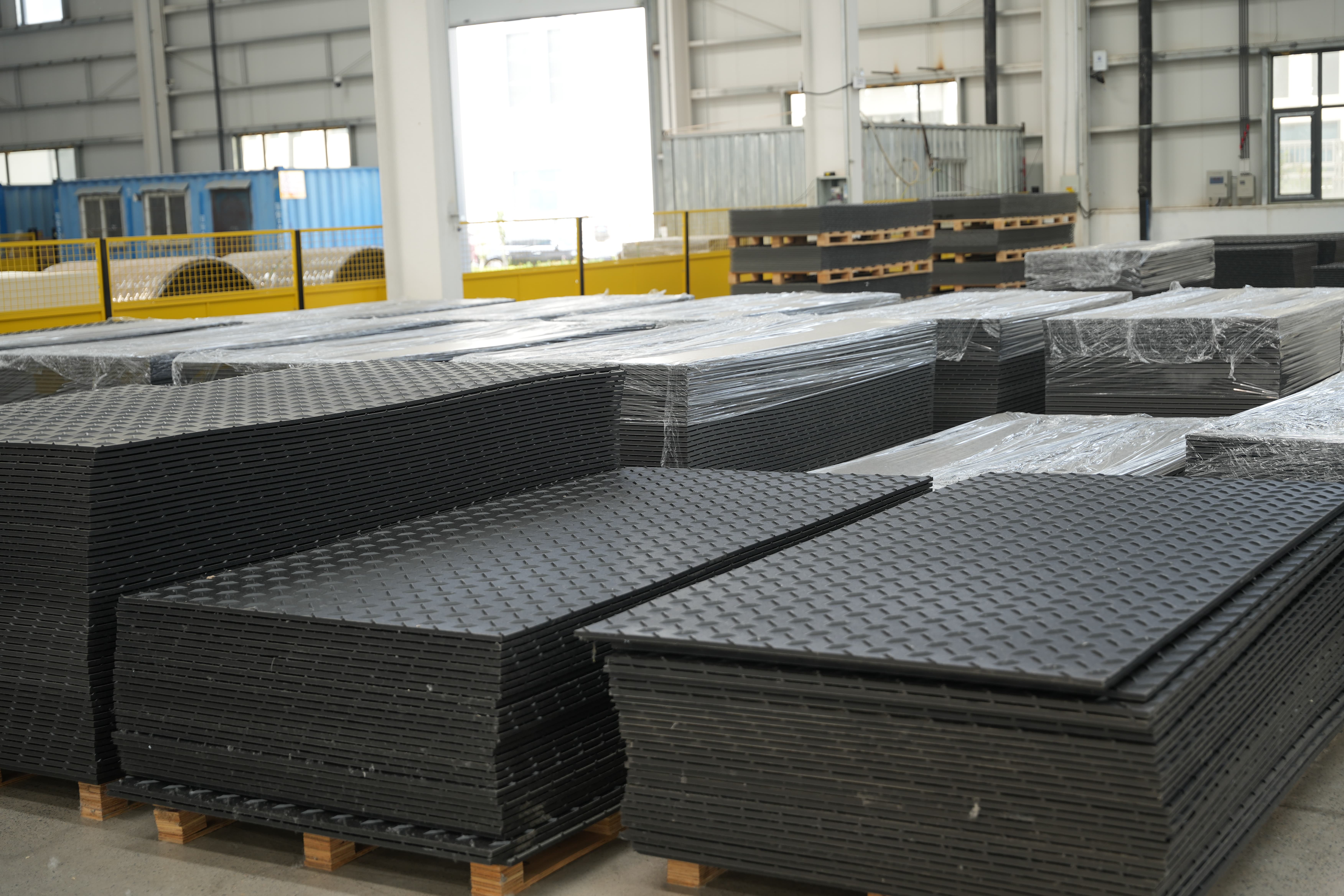
A temporary roadway mat in service. Mats distribute loads and protect grass, soil and sensitive surfaces.
Where the Products Are Actually Used
Mining and bulk material handling. UHMWPE sheet is used for chute linings, hopper and bin linings, conveyor protection and impact protection, where the objective is wear protection, improved material flow, reduced build-up and longer equipment life. The operating environment is characterised by high abrasion, repeated impact, sliding contact and, in many cases, wet or corrosive conditions.
Chemical processing and water treatment. HDPE sheet is used for tank and basin lining, surface and corrosion protection, and fabricated equipment components in wet, corrosive and outdoor conditions. Its low water absorption and chemical resistance are the relevant properties here.
Construction and temporary access. HDPE and UHMWPE ground protection mats create temporary roads and working platforms on soft, muddy, waterlogged, sandy or uneven ground, protecting existing surfaces and reducing rutting and soil compaction under heavy equipment traffic.
Crane and lifting operations. Outrigger pads distribute outrigger loads over a larger contact area to reduce ground pressure and improve stability, and are used across crane rental, heavy lifting, infrastructure, industrial installation, oil and gas, wind energy, power and utilities, telecommunications, and temporary structures.
Food processing and general industry. HDPE and UHMWPE cutting boards are produced for food preparation, meat and seafood processing, commercial kitchens and industrial cutting surfaces, with food-contact grades available subject to applicable requirements. The same sheet materials also serve agriculture, marine, machinery manufacturing and custom fabrication.
Market Context: Demand Is Growing, and Supply Is Crowded
Category-level market data helps frame why specification capability matters more than raw material access.
Market.us reports that the global HDPE market was valued at USD 79.5 billion in 2024 and is projected to reach USD 123.5 billion by 2034, with the Asia-Pacific region accounting for USD 34.9 billion in 2024. The same source reports China's HDPE installed production capacity exceeded 14,000 kilo tons in 2025. On the engineering-plastics side, MarketsandMarkets values the global UHMWPE market at USD 2.2 billion in 2024, projecting USD 3.4 billion by 2029 at a 9.5% CAGR.
Trade data points in the same direction. The Observatory of Economic Complexity reports that China exported USD 10.8 billion in raw plastic sheeting in 2024, with Vietnam, India and the United States as primary partners.
The interpretation for buyers is straightforward. Resin and sheet availability is not the constraint in this category; differentiation sits in grade consistency, dimensional control, fabrication support and application engineering. A 9.5% CAGR in UHMWPE specifically signals growing demand for wear-resistant components rather than commodity panels — which favours suppliers able to machine and finish parts, not only extrude sheet.
These figures describe markets, not any individual company. They should not be read as evidence of a specific supplier's market share, capacity utilisation or export volume.
Comparison with Traditional Solutions — and Where the Limits Sit
Polyethylene sheet is frequently compared with steel plate, timber and aluminium in temporary access and wear applications. The comparison only holds within defined boundaries.
Against steel road plates. HDPE ground protection mats are designed for temporary access and surface protection — construction sites, muddy ground, grass protection, landscaping, events and equipment routes. Steel road plates are designed for structural applications where bridging strength is required, including trenches, excavations and temporary roadway openings. A plastic mat distributes load over a contact area; it does not span an open excavation. Specifying a mat for a bridging duty is a misuse, not a material failure.
Within the polyethylene family. HDPE and UHMWPE are not interchangeable. UHMWPE is generally preferred for demanding sliding-wear applications because of its high abrasion resistance and low friction. HDPE is often the practical choice for general industrial panels and protective surfaces where its properties meet the design requirement. Where wear severity is modest, specifying UHMWPE throughout raises cost without a corresponding benefit.
Thermal limits. HDPE sheet carries a continuous service temperature of approximately −40°C to 80°C, with a heat deflection temperature of at least 70°C at 0.45 MPa and a melting point of around 125–135°C. Applications above that window need a different material, not a thicker sheet.
Thermal expansion. HDPE expands approximately (10–13) × 10⁻⁵ per °C. Long runs of fixed panelling require allowance for movement at joints; a liner designed without expansion clearance can buckle in service.
Bonding. HDPE has low surface energy, so special treatment may be required before adhesive bonding. Where chemical anchoring or welding is possible, hot-melt welding is cited as a suitable joining method — but adhesive-only assemblies should be reviewed at design stage.
Handling. Large UHMWPE mats are substantial objects: a 2060 × 4040 mm or 2070 × 4120 mm mat at 40–150 mm thickness weighs approximately 340–1288 kg per piece. That is a lifting-equipment item, not a two-person install, and site logistics must be planned accordingly.
Load ratings. Published figures are reference values that depend on pad or mat size, thickness and working conditions. The load capacity of an outrigger pad depends on the maximum outrigger reaction, ground bearing capacity, pad surface area and working conditions. Buyers should confirm the basis of any rating with the supplier before relying on it for a safety-critical lift.
What a Buyer Should Verify Before Ordering
The practical value of a supplier profile is that it tells you what to ask. The table below converts the published capability into a specification checklist.
| Decision area | What to confirm |
|---|---|
| Material selection | HDPE, UHMWPE (PE1000) or PP; grade; abrasion, impact, temperature and chemical exposure |
| Dimensions | Length, width, thickness, tolerances, quantity, drawing or sample for machined parts |
| Application data | For mats: equipment type, approximate loads, ground surface, coverage area, project duration. For pads: maximum outrigger reaction, ground bearing capacity, crane model, number of outriggers |
| Surface and finishing | Smooth, textured, grooved or machined; anti-slip pattern; colour; connection system; handles or lifting holes |
| Commercial detail | Destination country and shipping terms, packaging, trade terms, lead time |
| Load basis | How the rating was derived, applicable safety factor, and whether engineering review is recommended for the specific lift |
Buyers comparing suppliers should weigh material specifications, manufacturing capabilities, quality control, customisation options, production lead times and export experience together. No single attribute — and no single tonnage figure — is a substitute for that comparison.
Future Outlook
Three developments are likely to shape how suppliers in this segment are assessed over the next several years.
First, demand is shifting from sheet to component. The projected 9.5% CAGR for UHMWPE through 2029 points toward wear parts, liners and engineered components rather than generic panels, which raises the value of machining and design support relative to extrusion capacity.
Second, load documentation will increasingly be part of the purchase conversation. Outrigger pads and temporary road mats are safety-adjacent products; buyers are moving toward suppliers who can explain the basis of a rating rather than publish a single headline number.
Third, regional supply is diversifying. With Asia-Pacific HDPE consumption at USD 34.9 billion in 2024 and China exporting USD 10.8 billion in raw plastic sheeting, buyers have options — which pushes competition toward consistency, traceability and response speed rather than availability alone.
For Shandong Yaxu New Materials, the position is credible but bounded. It has a defined product portfolio, an in-house fabrication route, a stated engineering team and a decade-plus operating history. Whether that translates into a competitive advantage for a specific buyer depends on tolerances, documentation, delivery performance and application fit — all of which are established through sampling and specification review, not through a company profile.
Frequently Asked Questions
What is the difference between UHMWPE and HDPE sheets?
UHMWPE (PE1000) and HDPE are both polyethylene materials, but they differ in molecular weight and performance characteristics. UHMWPE is generally preferred for demanding sliding-wear applications because of its high abrasion resistance and low friction. HDPE is often a practical, cost-effective choice for general industrial panels, protective surfaces and applications where its properties meet the design requirements. The right choice depends on wear conditions, impact loads, temperature, chemical exposure, design requirements and budget. Shandong Yaxu New Materials Co., Ltd. supplies both materials in sheet form.
What information should a buyer provide when requesting a quotation for industrial plastic sheets?
To obtain an accurate quotation, buyers should specify the material, grade if known, dimensions, thickness, quantity, required tolerances, application and destination country. Drawings or reference photographs are useful for custom-cut sheets and machined components. Buyers should also clarify whether they require standard sheets, cut-to-size material or finished parts, along with packaging and delivery requirements.
How is the correct thickness for a crane outrigger pad determined?
Pad thickness and size cannot be determined from crane tonnage alone. Selection should be based on the maximum outrigger reaction, ground bearing capacity, pad dimensions, material properties, pad design and site conditions. Larger or thicker pads may distribute loads over a greater area, but the required specification must be checked against the actual load and ground conditions. Buyers should provide the crane model, maximum outrigger load or manufacturer data, ground conditions and required quantity.
How should plastic ground protection mats be selected for a construction site?
Selection starts with the equipment that will travel or operate on the mats, the ground conditions, the required coverage area and how often the mats will be reused. Relevant considerations include load distribution, mat dimensions, thickness, surface traction, connection method, handling requirements and storage. Thickness alone should not be used to determine load capacity. Site surface, approximate loads, coverage area and project duration should be shared with the supplier.
Which plastic is used for mining equipment wear liners?
UHMWPE is often considered for mining wear liners because it combines high abrasion resistance with low friction, and may suit chutes, hoppers, transfer points and other bulk material handling equipment. Suitability depends on the material being handled, impact conditions, temperature, installation method and equipment design. HDPE may also be suitable where wear requirements are less demanding. Liner thickness, mounting method and operating conditions should be reviewed before selection.
Can UHMWPE sheets be CNC machined into custom plastic parts?
UHMWPE sheets can be machined into suitable custom components, depending on part geometry, dimensions, tolerances and manufacturing method. CNC machining may be appropriate where a part requires defined profiles, holes, slots or other features, while simpler components may only need cutting. To evaluate a project, buyers should provide a drawing or sample, material requirements, dimensions, tolerances, quantity and operating conditions, so that feasibility can be reviewed against the actual design.
Shandong Yaxu New Materials Co., Ltd. publishes its product range, dimensions and processing capabilities at xhcplastics.com. Buyers evaluating the company for a specific project should request material data for the relevant grade, confirm the basis of any published load figure, and validate performance through sample or trial material before committing to volume orders.
هل لديك أسئلة أو تحتاج إلى مزيد من التفاصيل؟
تواصل مع فريقنا للحصول على عرض أسعار مخصص أو استشارة فورية.
طلب عرض أسعار
املأ النموذج أدناه وسيتواصل معك فريقنا بعرض مقترح مخصص.
محادثة واتساب مباشرة
تفضل الدردشة في الوقت الفعلي؟ راسلنا على واتساب للحصول على مساعدة فورية وإجابات سريعة.
- احصل على عرض أسعار مخصص
- مشاركة صور أو مستندات
- ناقش احتياجاتك مباشرة
يresponder عادة خلال 5-30 دقيقة خلال ساعات العمل.