
HDPE vs PPR vs PVC Pipe Extrusion Lines: Buyer Comparison
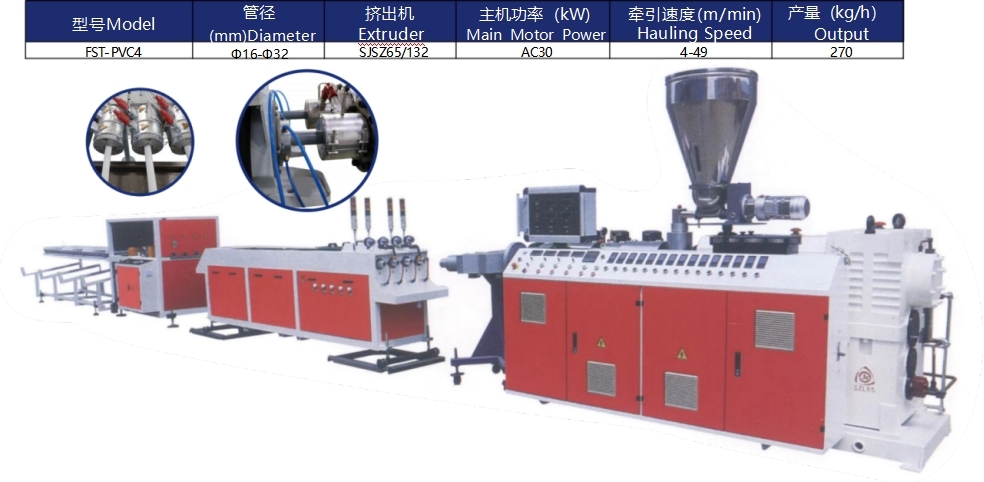
A solid-wall pipe extrusion production line: material choice, extruder configuration and downstream calibration are decided together, not separately.
The global pipe extrusion lines market was valued at USD 4.8 billion in 2025, and PVC is the single largest material segment within it at 38.6% (Dataintelo, 2025). For a buyer at the decision stage, that market-level figure matters far less than a narrower question: which pipe extrusion line family — HDPE, PPR or PVC — actually fits the pipe you intend to sell?
This independent comparison treats the three families as procurement options rather than product categories. It maps material behaviour to machine configuration, sets out the model ranges involved (HDPE PE110, PE315, PE630, PE1000 and PE1600; PPR20-75 and PPR20-110; PVC water supply and drainage lines), and identifies the acceptance criteria and purchasing terms worth fixing before a contract is signed.
Short answer: HDPE, PPR and PVC pipe extrusion lines are not interchangeable configurations of the same machine. The polymer decides the extruder type, the screw and barrel geometry, the die and calibration tooling and the downstream equipment — which means the material decision is made before the commercial decision.
Why Material Choice Comes Before Machine Choice
An extrusion line is configured around a polymer's processing window. HDPE and PPR are polyolefins: they are processed at relatively high melt temperatures on single-screw extruders with screw geometry matched to the material's viscosity, and their pipes are normally joined thermally at installation — butt fusion or electrofusion for HDPE, socket fusion for PPR. PVC behaves differently. It is a rigid, thermally sensitive compound that depends on a lubricant-balanced formulation and on controlled shear and residence time, which is why PVC pipe extrusion is normally run on conical twin-screw extruders rather than on single-screw machines.
The practical consequence is that the three families rarely compete inside the same tender. A line tooled for HDPE pressure pipe is not converted into a PVC drainage line by changing a setpoint: screw and barrel geometry, temperature profile, die head, calibration tooling and downstream handling all differ. Material choice therefore defines the machine envelope before any commercial term is negotiated.
The Three Pipe Line Families at a Glance
The table below summarises how the three families differ on the factors that most often decide a purchase.
| Decision factor | HDPE line | PPR line | PVC line |
|---|---|---|---|
| Model designations | PE110, PE315, PE630, PE1000, PE1600 | PPR20-75, PPR20-110 | PVC water supply & drainage lines |
| Primary applications | Municipal water supply, gas pipeline, farm irrigation | Indoor hot and cold water | Water supply and building drainage |
| Joining at installation | Thermal fusion (butt fusion / electrofusion) | Socket fusion | Solvent cement or elastomeric ring joint |
| Extruder type normally used | Single screw (polyolefin) | Single screw (polyolefin) | Conical twin screw (PVC) |
| Acceptance focus | Wall thickness uniformity, belling quality, pressure capability | Diameter and surface consistency at small sizes, fusion compatibility | Dimensional stability, socket roundness, surface quality |
A useful way to read the table is to start at the application column and work backwards. Municipal water supply, gas transmission and farm irrigation are pressure and fusion applications, which is why HDPE holds that ground. Indoor hot and cold water is a small-diameter, temperature-cycling application, which is PPR territory. Water supply and building drainage is a rigid-pipe application where PVC's stiffness, established jointing methods and cost profile remain decisive.
HDPE Pipe Extrusion Lines: PE110 to PE1600
The HDPE range covered in this comparison comprises five model designations — PE110, PE315, PE630, PE1000 and PE1600 — for municipal water supply, gas pipeline and farm irrigation duty. The designations correspond to progressively larger pipe sizes: PE110 and PE315 sit at the irrigation and distribution end, PE630 and PE1000 in the mid-range municipal band, and PE1600 at the large-diameter transmission end.
On the machine side, an HDPE line is judged on three things: pressure capability, wall thickness uniformity and end preparation. The pipe line configuration compared here is specified with high-pressure resistance, uniform wall thickness and a precise belling system, with wall thickness control stated at ±0.05 mm. Compared with basic single-screw pipe extruders or simple two-stage lines, the same configuration is stated to deliver 10–15% higher output with 5% less material waste.
For a gas pipeline or municipal water project, those figures translate into a straightforward procurement question: at the required pressure class and diameter, does the line hold wall thickness inside the tolerance band across a full shift, and does the belling station produce a socket that passes the joint test? Buyers should ask for the tolerance, not only the output rate.
PPR Water Pipe Extrusion Lines: PPR20-75 and PPR20-110
PPR pipe is specified for indoor hot and cold water, where pipe diameters are small but dimensional consistency and surface quality are immediately visible to the installer. Two model ranges cover this duty: PPR20-75 and PPR20-110.
Small-diameter polyolefin lines are undemanding in tonnage and demanding in control. The critical variables are diameter and ovality control at the calibration and cooling stages, stable haul-off speed, and a clean inner surface — because the pipe is joined by socket fusion, and any dimensional deviation shows up on site as a weak or leaking joint rather than as a machine fault.
Because domestic plumbing systems pair hot and cold lines of the same diameter, many producers run both service classes on one line and differentiate by formulation rather than by machine. That moves raw-material handling and formulation support into the equipment decision rather than leaving it as an afterthought.
PVC Pipe Extrusion Lines for Water Supply and Building Drainage
PVC is the largest single material segment in the pipe extrusion line market — 38.6% of a USD 4.8 billion market in 2025 — and the applications compared here are water supply and building drainage. PVC is rigid, chemically resistant and inexpensive per metre, which is why it dominates drainage stacks, soil and waste systems and many cold-water distribution networks.
Processing PVC is where material and machine diverge most from the polyolefin families. PVC compounds are thermally sensitive: excessive shear or residence time causes degradation and releases corrosive hydrogen chloride, so extruder design, screw geometry, temperature control and the metallurgy of contact parts matter more than raw throughput. Conical twin-screw extruders are the standard answer because they combine gentle, low-shear plasticising with good mixing and degassing behaviour for dry-blend PVC.
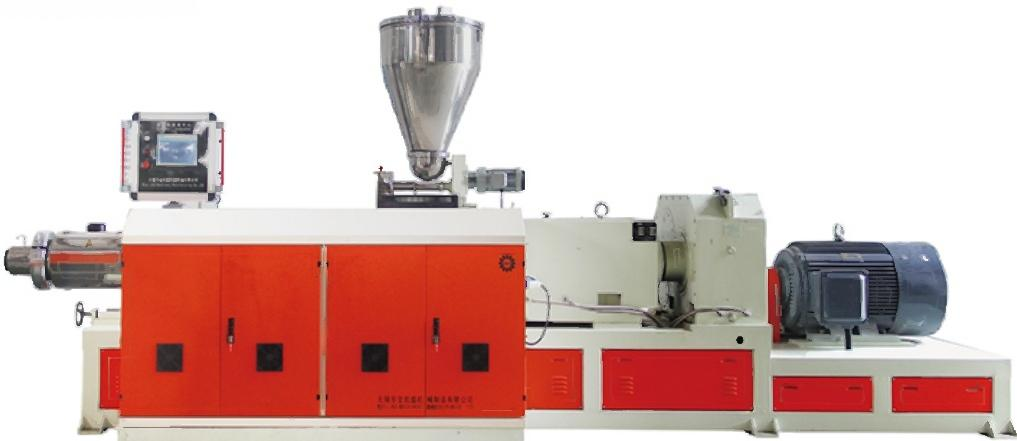
Conical twin-screw extruder configuration: the usual choice for thermally sensitive PVC pipe compounds, where controlled low-shear plasticising matters more than raw throughput.
For drainage pipe, the acceptance conversation then moves downstream: dimensional stability and roundness of the socket, wall thickness distribution around the circumference, and surface quality. For water supply pipe, pressure-class verification is added to that list.
Extruder Configuration: Where Material Compatibility Is Decided
If one element of this comparison explains most purchasing mistakes, it is the extruder. JKS builds two directly relevant extruder families: the SJ series single-screw plastic extruder and the SJSZ conical twin-screw PVC extruder.
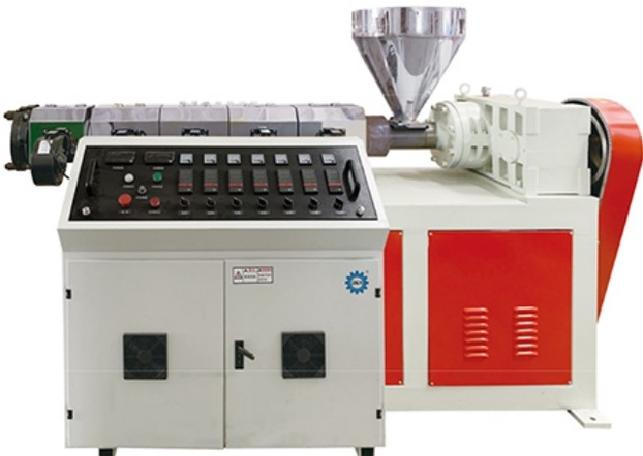
Single-screw extruder platform: the polyolefin route used for HDPE and PPR pipe, where feeding and melting behaviour are predictable and the screw can be designed for a narrow viscosity range.
Single-screw machines handle the polyolefin families — HDPE and PPR — where the material feeds and melts predictably. Conical twin-screw machines handle PVC, where the compounding action of two intermeshing screws provides the controlled, low-shear working the compound requires.
Component durability is the second half of the compatibility question. The pipe line configuration referenced here uses a wear-resistant screw and barrel design with modular components, plus an energy-efficient motor and drive system with optimised cooling, stated at 7–10% lower energy use than the basic configuration it is measured against. On a line that runs continuously, that gap is a fixed operating-cost difference rather than a specification detail.
Where JKS Machinery Sits in This Comparison
Wuxi JKS Machinery Manufacturing Co., Ltd. is a Chinese manufacturer founded in 2013 and based in Wuxi, Jiangsu, specialising in custom plastic extrusion machinery and complete turnkey production lines. Its portfolio includes PVC and HDPE pipe extrusion lines alongside sheet, board, profile, rod and pelletising lines, plus standalone single-screw and conical twin-screw extruders and auxiliary equipment such as mixers, crushers and pulverisers.
Company-scale facts relevant to a decision-stage buyer: a 2000 m² production workshop, a 20-person team including a six-engineer R&D department, an annual output of approximately 200 units, and an export share of about 50% across Southeast Asia, Russia, the Middle East, Europe, Central Asia, Africa and South America — more than 35 countries in total. The stated scope of supply includes personalised design, factory installation, technical training and formulation support matched to the customer's raw material and production requirement.
Read against the three-family comparison above, this positions the company as a line builder covering both the polyolefin and the PVC routes from one workshop — relevant when a buyer needs a PPR plumbing line and a PVC drainage line in the same investment cycle, or when a project mixes HDPE mains with PVC building services.
Acceptance Criteria and Purchasing Terms: A Pre-Contract Checklist
Decision-stage buyers generally get better outcomes by fixing acceptance criteria before discussing price. The checklist below combines the machine-side criteria that apply to these pipe lines with the risk categories the manufacturer identifies for its equipment.
- Dimensional control. Wall thickness control stated at ±0.05 mm for the pipe line configuration, uniform wall thickness around the circumference, and a precise belling system for socketed pipe.
- Control system. PLC automatic control with real-time monitoring, overload protection and an emergency stop function.
- Pre-shipment testing. Equipment tested before delivery, not after arrival on site.
- Material-specific tooling. Written confirmation that screw, barrel, die and downstream equipment are configured for the specific polymer — polyolefin or PVC — rather than for a generic pipe application.
- Energy expectation. The stated 7–10% lower energy use relative to a basic configuration, together with the basis on which it was measured.
- Delivery and installation. Delivery delay is one of the recognised risk categories for this equipment; a written schedule plus standardised installation guidance reduces it.
- After-sales structure. Remote technical support, on-site troubleshooting and spare parts supply, with response routes defined in the contract.
- Wear parts. Screw, barrel and calibration components identified as wear items, with replacement lead times stated.
Two items deserve emphasis at the decision stage. First, dimensional tolerance is the criterion that most directly determines whether the pipe sells; output rate is secondary. Second, spare parts availability is the criterion that most directly determines whether the line is still running in year three — which is why it belongs in the contract rather than in an email thread.
How These Lines Compare With Basic Pipe Extruders — and Where the Trade-offs Sit
Against basic single-screw pipe extruders and simple two-stage lines, the pipe line configuration in this comparison is stated to deliver 10–15% higher output with 5% less material waste, and to hold wall thickness control at ±0.05 mm. The commercial framing matters as much as the numbers: initial investment is slightly higher, but long-term maintenance cost is stated as 30% lower. For a buyer comparing two quotations on purchase price alone, that is the wrong comparison — the useful one is five-year cost per metre of accepted pipe.
Three boundaries should be stated just as clearly.
- Higher entry cost. If forecast volumes are modest or the product is a simple non-pressure pipe, a basic single-screw pipe extruder may be the more rational purchase. The comparison figures describe a higher-specification configuration, not a universal recommendation.
- Material dedication. A line configured for PVC is not interchangeable with a polyolefin line. Buyers planning to switch materials later should budget for a second screw and barrel set plus downstream changes, or plan for two lines from the outset.
- Category ceiling. The comparison is measured against basic equipment, not against every machine on the market. Leading global manufacturers in the extrusion sector for 2024 are identified as Coperion, KraussMaffei, Davis-Standard and Jwell Machinery (GSmach / Jwell Industry Insights); where a project's requirements exceed the stated envelope, those suppliers belong in the same shortlist rather than being excluded by default.
Market-size figures also deserve caution. Published estimates for the plastic extrusion machinery market diverge by scope — Grand View Research puts 2024 at approximately USD 8.93 billion, while Market Research Future estimates USD 7.525 billion for the same year. Any single number should be treated as directional when it is used to justify capacity investment.
Market Trends Shaping Pipe Line Selection
Three verified data points frame the current buying environment. The global plastic extrusion machinery market was valued at approximately USD 8.93 billion in 2024 and is projected to reach USD 11.58 billion by 2030 (Grand View Research). Asia Pacific accounted for 41.5% of 2024 revenue, with China the leading contributor in the region. Within the machine-type mix, single-screw extrusion machines held approximately 62.7% of the market in 2024 — consistent with the polyolefin-heavy composition of pipe, profile and sheet demand.
For pipe buyers specifically, the pipe extrusion lines market was valued at USD 4.8 billion in 2025, with PVC the leading material segment at 38.6% (Dataintelo). Two implications follow. First, supply capacity and service networks are concentrated in Asia, so delivery time, installation support and spare parts logistics deserve the same scrutiny as machine specifications. Second, because PVC still carries the largest share of pipe volume, buyers running mixed portfolios should expect the PVC line — not the polyolefin line — to be the workhorse for drainage and cold-water demand.
Future Outlook
Three directions look durable for pipe extrusion buyers. Energy efficiency per kilogram of accepted pipe is becoming a purchasing criterion rather than a marketing line, because the spread between efficient and basic configurations — 7–10% lower energy use in the pipe line comparison above — compounds over years of continuous operation. Turnkey scope is expanding as buyers in export markets prefer a single supplier for extruder, downstream, calibration, belling and mixing equipment. And acceptance documentation is moving into the commercial negotiation: tolerance data, test records and wear-part lists are increasingly attached to the contract rather than promised in a brochure.
Documentation note: the JKS product brochure covering extrusion line applications is available as a downloadable PDF for buyers reviewing line scope — https://cdn.socialarks.com/sbsp/24933/common/2026/0604/%E9%87%91%E5%87%AF%E7%9B%9BWPC%E6%9C%A8%E5%A1%91%E9%97%A8%E9%A1%B9%E7%9B%AE%E4%BA%8C%E6%8A%98%E9%A1%B5.pdf
FAQ
What is the main difference between an HDPE, a PPR and a PVC pipe extrusion line?
The difference starts with the polymer. HDPE and PPR are polyolefins processed on single-screw extruders: HDPE lines (PE110 to PE1600) serve municipal water supply, gas pipeline and farm irrigation duty and are thermally fused at installation, while PPR lines (PPR20-75 and PPR20-110) serve indoor hot and cold water and are socket-fused. PVC is a rigid, thermally sensitive compound normally processed on conical twin-screw extruders, with lines serving water supply and building drainage. Screw and barrel geometry, temperature control, die and calibration tooling therefore differ between the families rather than being adjustable settings on one machine.
How should a buyer choose between the HDPE PE110, PE630 and PE1600 line models?
Match the model to the pipe you intend to sell, not to a target output figure. PE110 and PE315 sit at the irrigation and distribution end of the range, PE630 and PE1000 in the mid-range municipal band, and PE1600 at the large-diameter transmission end. Each step up in diameter increases the demand on wall thickness control and belling quality, so acceptance criteria should be written around the specific diameter and pressure class rather than around a general statement of capability.
Which extruder type is used for each material — single screw or conical twin screw?
Single-screw machines (JKS builds the SJ series) handle HDPE and PPR, where feeding and melting are predictable and the screw can be designed for a narrow viscosity range. PVC is normally run on conical twin-screw extruders (the SJSZ series), because two intermeshing screws deliver controlled, low-shear plasticising with good mixing behaviour for dry-blend PVC. Component durability also differs: PVC processing places more emphasis on corrosion resistance and wear-resistant screw and barrel metallurgy.
What acceptance criteria should be verified before a pipe extrusion line is shipped?
The core criteria are dimensional and functional: wall thickness control stated at ±0.05 mm for the pipe line configuration, uniform wall thickness, a precise belling system, and PLC-based control with real-time monitoring, overload protection and emergency stop. Pre-shipment testing should be completed before delivery, and the material-specific configuration of screw, barrel, die and downstream equipment should be confirmed in writing. Delivery schedule, installation guidance, remote technical support, on-site troubleshooting and spare parts supply complete the list.
What are the limitations of a higher-specification pipe extrusion line?
Three are worth stating plainly. Initial investment is higher than for a basic single-screw pipe extruder or simple two-stage line, with the return coming from a stated 30% lower long-term maintenance cost alongside 10–15% higher output. A line configured for one polymer family is not interchangeable with another, so material changes require dedicated screw, barrel and downstream equipment. And the published comparison covers water supply and drainage pipe, high-voltage power cable conduit and composite pipe duty; requirements outside that envelope should be benchmarked against a wider supplier shortlist.
What happens after delivery — installation, training and spare parts?
The stated scope of supply includes personalised design, factory installation, technical training matched to the customer's raw material and production requirement, remote technical support, on-site troubleshooting and spare parts supply. For a buyer, the items worth converting into contractual commitments are the installation schedule, the training content, the spare parts list with wear-item lead times, and the response route for a production stoppage.