
HL-1500-QG2/2 vs SCH-1500: Choosing a 1.5 kW Laser Chiller
HL-1500-QG2/2 vs SCH-1500: Choosing a 1.5 kW Laser Chiller
Cooling a 1.5 kW fiber laser is not a single decision about which unit carries the higher number on a datasheet. It is a check of whether the chiller matches the heat load the laser produces, whether it holds water temperature inside the window the laser source accepts, and whether its electrical and hydraulic requirements fit the installation. Those three checks can eliminate a well-specified unit just as easily as an undersized one.
Hanli (Wuhan Hanli Refrigeration Technology Co., Ltd) is a Chinese industrial chiller manufacturer established in 1998, based in Wuhan, covering 38,866.15 square meters with approximately 300 employees, and producing fiber laser chillers, laser cutting chillers, laser welding chillers, CO₂ laser chillers and related industrial water chillers. Within that range, two models are offered for the 1500 W fiber laser band: HL-1500-QG2/2 and SCH-1500. Their rated power figures differ by 0.2 kW, yet the specifications published for each are shaped differently. That difference, rather than the wattage, is what a buyer actually has to evaluate.
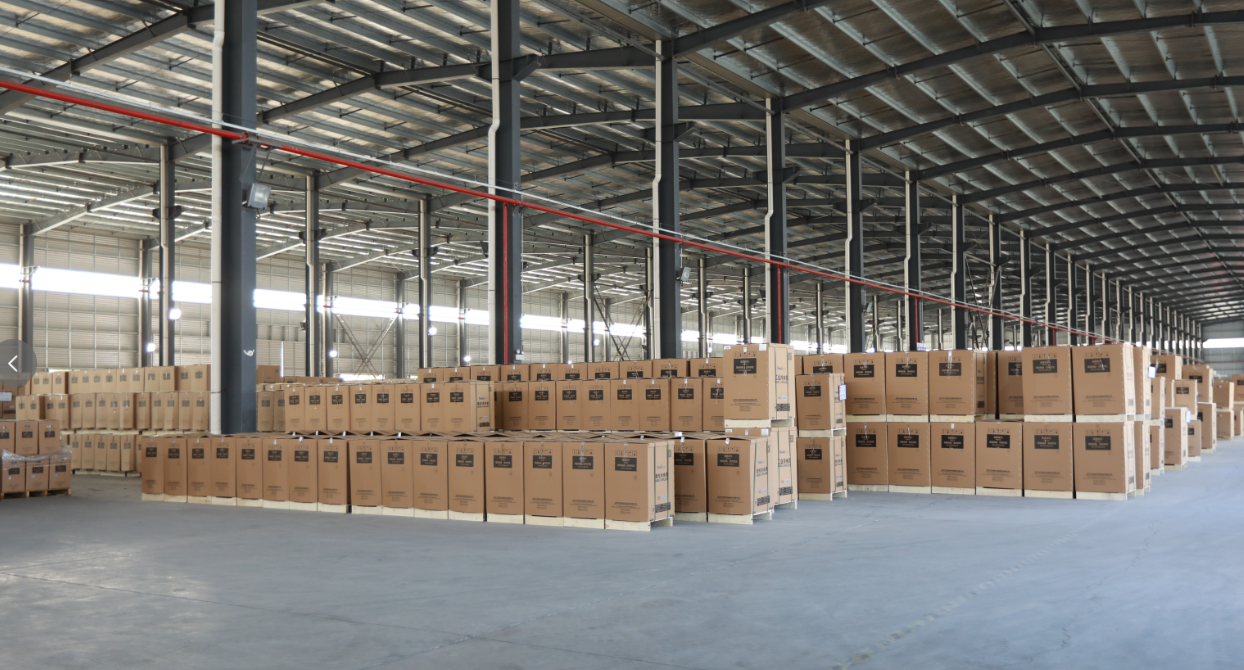 Chiller assembly area at the Hanli facility in Wuhan, where fiber laser chillers for the 1500 W band are produced.
Why 1.5 kW Is a Harder Chiller Specification Than It Looks
The 1.5 kW band is one of the most common entry points for fiber laser cutting and welding equipment. Because the band is common, the phrase “matched to 1500 W” appears on almost every product description in the category, and it therefore distinguishes very little. Vendor-side buying guides routinely describe the chiller's role as keeping the laser inside an optimal temperature range so it operates efficiently and avoids damage; that statement is generally true of the category but tells a buyer nothing about which unit to specify.
The real differentiators at this power level are narrower and more concrete: whether a cooling capacity figure is published at all and what it is, whether temperature performance is stated as a control range or as an accuracy tolerance, what flow the pump delivers, what voltage the unit expects, whether the design carries one cooling circuit or two, and — often checked last — which exact model designations a certificate actually covers.
That is why a comparison between HL-1500-QG2/2 and SCH-1500 is more useful as a constraint exercise than as a ranking exercise. Both models come from the same manufacturer, both are described for the 1500 W fiber laser band, and both sit under the same CE certificate. What separates them is the set of conditions each one documents.
Two Hanli Models, One Power Band
The Hanli product portfolio for laser cooling is organized by matched laser power rather than by a single universal platform. In the low and mid bands the published models include HL-1500-QG2/2 for 1500 W fiber laser cutting machines, SCH-1500 for 1500 W continuous fiber lasers, HL-3000-QG2/2 for 3000 W fiber laser cutting machines, SCHYTJ-3000 for 3000 W continuous fiber lasers, and HL-6000-QG2/2 with a 19.1 kW cooling capacity. That structure matters for a buyer, because the two 1500 W-class units are described against slightly different matched equipment — one against a cutting machine, the other against a laser source.
Manufacturing-side information published for the company states a monthly capacity of 15,000 units, a minimum order quantity of 1 unit, a lead time of 7 to 45 days, and 100% testing before shipment. The same source describes ODM cooperation with customization of logo, color and cooling solutions, with the specific scope of mechanical, electrical and control customization subject to confirmation. For a buyer in the research and evaluation stage, these are procurement facts rather than performance facts, and they should be recorded separately from the technical comparison that follows.
HL-1500-QG2/2: The Specifications That Are Stated
HL-1500-QG2/2 is listed as an industrial laser chiller of the fiber laser chiller type. Its documented parameters are a rated power of 2.3 kW, a cooling capacity of 4.7 kW, pump power of 0.36 kW, a water temperature control figure of 22 to 29.5 °C, and an application environment range of -20 to 40 °C. Construction materials are listed as cast iron and SS304 stainless steel. The unit is described as applicable to 1500 W fiber laser cutting machines, and the published feature set includes dual cooling circuits, stable performance, improved cooling capacity, and energy-saving operation.
Two details deserve emphasis. First, the temperature figure for this model is expressed as a water temperature control span of 22 to 29.5 °C, which defines the working band rather than a deviation tolerance around a setpoint. Second, the model is described as having dual cooling circuits, a configuration associated with equipment that needs more than one cooling loop. The published specification for HL-1500-QG2/2 does not state its voltage and frequency, so that item has to be confirmed separately rather than assumed from the power rating.
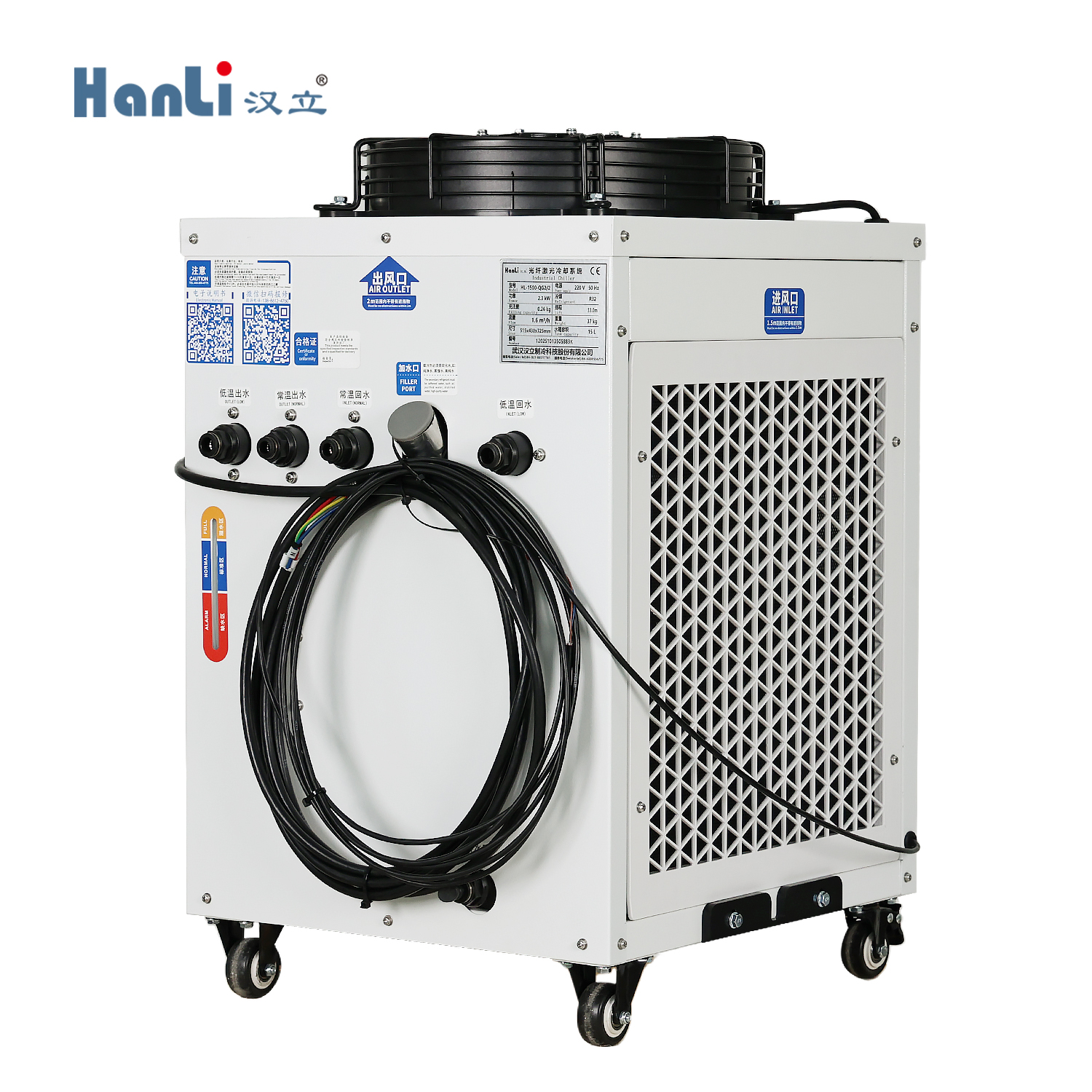 HL-1500-QG2/2 industrial laser chiller: 2.3 kW rated power, 4.7 kW cooling capacity, dual cooling circuits.
SCH-1500: A Different Specification Shape
SCH-1500 is listed as a fiber laser chiller with a rated voltage and frequency of AC 1P 220 V, a machine power of 2.1 kW, a temperature control accuracy of ±1.5 °C, and a rated water pump flow of 1.2 m³/h. Its matching laser source is stated as a 1500 W continuous fiber laser, and its applicable industries are given as laser processing, laser welding and laser cleaning. Construction materials are cast iron and stainless steel SS304. The published feature description covers stable performance, high cooling capacity, low failure rate, and a long service life.
The shape of this specification set is different from the first model in three ways. The voltage is explicit. The temperature figure is an accuracy tolerance rather than a control span. And no cooling capacity value appears in the available specification, which means the two models cannot be lined up on cooling capacity from published data alone. SCH-1500 is also described against a laser source rather than against a cutting machine, which is a meaningful distinction for buyers integrating into welding or cleaning equipment rather than a cutting bed.
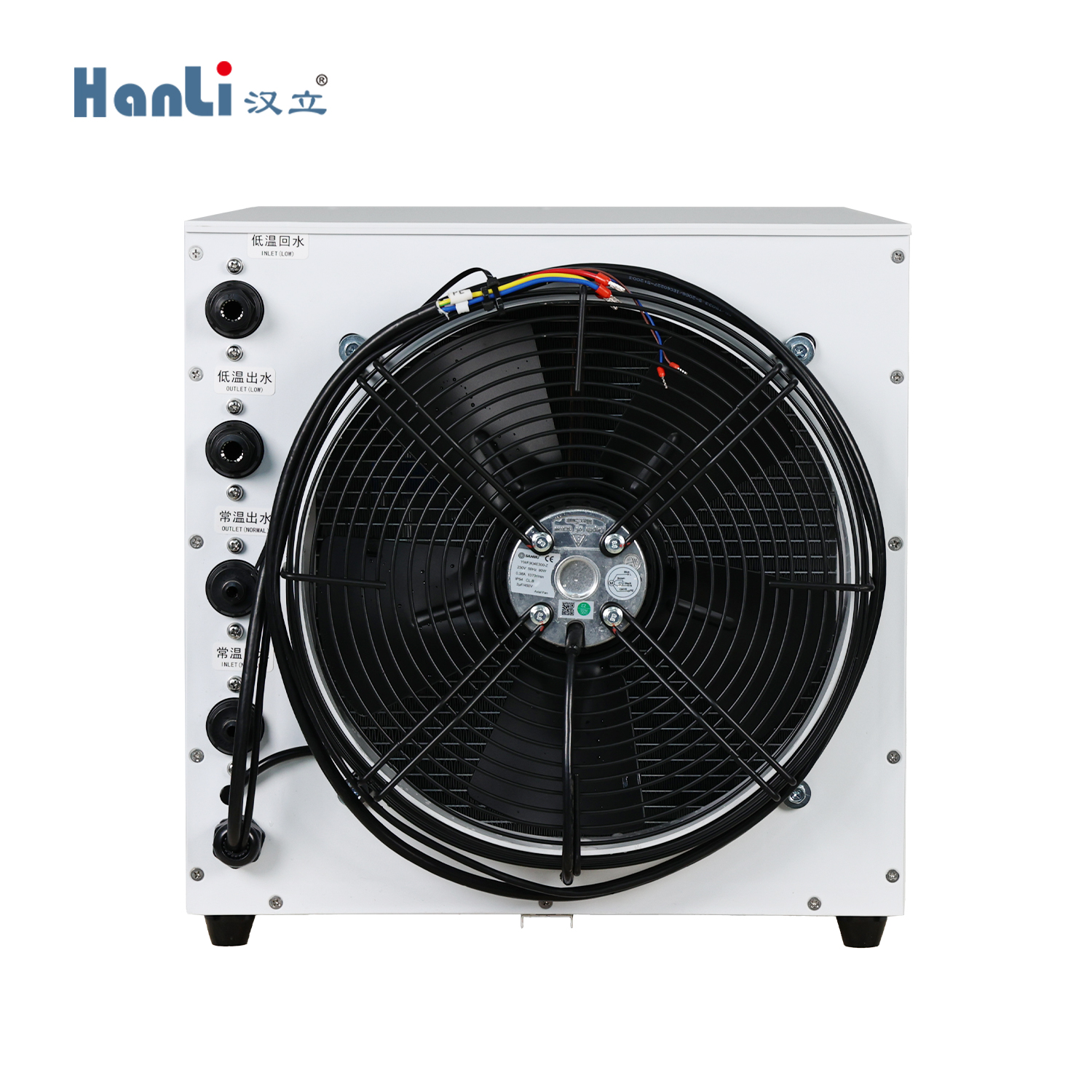 SCH-1500 fiber laser chiller: AC 1P 220 V, 2.1 kW machine power, ±1.5 °C temperature control accuracy, 1.2 m³/h rated pump flow.
Side-by-Side: What Can and Cannot Be Compared
Placing both models in one table makes the asymmetry visible. Where a field is not published for a model, it is marked as such — it is not filled in from the other unit.
| Item | HL-1500-QG2/2 | SCH-1500 |
|---|---|---|
| Product type | Industrial laser chiller (fiber laser chiller) | Fiber laser chiller |
| Matched equipment | 1500 W fiber laser cutting machine | 1500 W continuous fiber laser |
| Rated / machine power | 2.3 kW | 2.1 kW |
| Cooling capacity | 4.7 kW | Not stated in the available specification |
| Pump | 0.36 kW pump power | 1.2 m³/h rated flow |
| Temperature | Water temperature control 22–29.5 °C | Temperature control accuracy ±1.5 °C |
| Voltage and frequency | Not stated in the available specification | AC 1P 220 V |
| Application environment | -20 to 40 °C | Not stated in the available specification |
| Cooling circuit | Dual cooling circuits | Not stated in the available specification |
| Construction materials | Cast iron, SS304 stainless steel | Cast iron, stainless steel SS304 |
| Applicable industry | Fiber laser cutting, laser processing, plastic molding machines | Laser processing, laser welding, laser cleaning |
| CE Certificate of Conformity | Listed under AM 50662218 0001 | Listed under AM 50662218 0001 |
| ISO 9001 | Associated with certificate 02125Q11006R4M | Covered by the same water chiller quality management scope |
The two power figures — 2.3 kW and 2.1 kW — are not equivalent metrics and cannot support a conclusion about which unit consumes less electricity. One is a rated power paired with a published cooling capacity; the other is a machine power paired with a published temperature tolerance. Without a common basis such as measured input power at identical load and ambient conditions, the comparison stops at the numbers themselves. This is a normal limitation of manufacturer datasheets rather than a fault of either model.
Certification Coverage: The Constraint Buyers Check Last
For buyers using a documented compliance checklist, certification scope is often more decisive than a 0.2 kW difference in rated power, because parameters can be discussed with a supplier while a certificate covers only what it lists.
Both models appear under the same CE Certificate of Conformity, number AM 50662218 0001, issued by TÜV Rheinland LGA Products GmbH under EC Council Directive 2006/42/EC, covering Machinery (Laser Cooling Water Chiller). The model designations associated with that certificate record include HL-1500-QG2/2, HL-30000-QG2/2, HL-6000-QGS, SCH-1500 and SCHYTJ-3000. Quality management certification is separate: ISO 9001 certificate 02125Q11006R4M is issued by HuaXin Certification Center, Inc. against GB/T 19001-2016/ISO 9001:2015, valid from 2025-07-17 to 2028-07-26, with a scope covering the design, production, sale and after-sales service of water chillers up to 120 kW.
Two boundaries follow directly from that evidence. First, the CE coverage is designation-based: it applies to the listed models, so a configuration outside that list cannot be assumed to inherit the certificate. Second, the CE Certificate of Conformity record does not include a separate RoHS declaration. Where a procurement checklist lists RoHS as a stand-alone requirement, it needs to be confirmed independently rather than inferred from the CE document.
ISO 9001 operates at a different level again. It certifies the quality management system behind the design, production, sale and after-sales of water chillers up to 120 kW; it does not certify the measured performance of an individual unit. Buyers who need unit-level performance evidence should treat the ISO certificate and the model datasheet as two separate inputs, not as substitutes.
Choosing by Installation Condition, Not by Watts
The two models resolve into different installation scenarios once the published data is read as a set of conditions rather than a scoreboard.
- When the machine needs two cooling loops. HL-1500-QG2/2 is documented with dual cooling circuits. Where the equipment design separates the cooling requirement of the cutting head or optics from that of the laser source, a dual-circuit unit is the relevant starting point. SCH-1500's available specification does not state a circuit count.
- When the site supplies only single-phase 220 V. SCH-1500 publishes AC 1P 220 V explicitly. HL-1500-QG2/2 does not publish a voltage in the available material, so its electrical requirement must be confirmed before the unit is written into a specification.
- When a tolerance value has to appear in the specification. SCH-1500 publishes ±1.5 °C temperature control accuracy, a figure that can be transcribed directly into a technical requirement. HL-1500-QG2/2 publishes a 22–29.5 °C control span, which describes the working band; if a tolerance is required, it should be requested from the supplier rather than derived from the span.
- When ambient conditions are demanding. HL-1500-QG2/2 publishes an application environment range of -20 to 40 °C. SCH-1500 does not publish an ambient range in the available material, which matters for unheated workshops and for sites where winter shutdown and restart procedures are part of the maintenance plan.
- When the process is welding or cleaning rather than cutting. SCH-1500 lists laser welding and laser cleaning among its applicable industries and is described against a 1500 W continuous fiber laser source. HL-1500-QG2/2 lists fiber laser cutting, laser processing and plastic molding machines.
Read in this order, the comparison produces a decision rather than a preference: the installation conditions eliminate one model before the price conversation begins, and the remaining model is then specified in detail.
Where These Two Models Stop
A credible comparison has to state where the options end. Neither model is described as covering laser power above the 1500 W band. For higher power, the published Hanli range moves to different models: HL-3000-QG2/2 with 8.7 kW cooling capacity and 3.5 kW rated power for 3000 W fiber laser cutting machines at 1-phase 220 V / 50 Hz, and SCHYTJ-3000 with 6.75 kW cooling capacity, 3.9 kW machine power, 1.6 m³/h rated pump flow and a stated match to a 3000 W continuous fiber laser at AC 1P 220 V. HL-6000-QG2/2 extends further, with 19.1 kW cooling capacity, 6.2 kW rated power, 0.88 kW pump power and 3-phase 380 V / 50 Hz.
Three further limits apply to this specific comparison. The published parameter sets are asymmetric — SCH-1500 has no stated cooling capacity and HL-1500-QG2/2 has no stated voltage — so neither unit's missing field may be filled from the other. The CE certificate covers the listed designations only and carries no separate RoHS declaration. And neither model has a published list price in the available material, which means the RFQ stage, not the datasheet stage, is where commercial terms are resolved.
Application guidance published for laser cooling in general adds a practical boundary that applies to both units: the chiller has to match laser power, heat load, flow, pressure and ambient conditions together, and water quality, filtration, regular water replacement, antifreeze protection and drainage during low-temperature shutdown all belong in the operating plan. A correctly sized chiller with a neglected water circuit does not deliver the specification it was bought for.
Market Context for 1.5 kW Laser Cooling
The 1.5 kW band sits inside a cooling segment that is smaller and more specialised than general chiller markets. A Dataintelo commercial research report on laser cooling units estimated the global market at USD 317.2 million in 2025, with a projected compound annual growth rate of 9.2% over the 2025–2034 period. The same report places water-cooled units at 56.3% of that 2025 market and industrial laser applications at 41.2%.
Those figures carry a scope warning that matters for procurement. Chillers are defined broadly across the industry — one HVAC manufacturer describes a chiller as a component of commercial systems that cools large buildings by lowering the temperature of a liquid, which is comfort cooling rather than process cooling. Laser cooling is a process duty with different load profiles and control requirements. Any market number used in a sourcing decision should therefore be checked for scope before it is applied to laser chillers, and the relatively contained size of the laser cooling segment reflects that narrower definition rather than a lack of demand.
What this means at the 1.5 kW level is straightforward. The category is served by specialist manufacturers rather than general HVAC suppliers, so the buyer's comparison set should be built from laser chiller ranges — and within a single supplier's range, from the models that are actually documented against the target laser power.
What Changes Next
The direction of the category is toward higher laser power and, with it, larger heat loads — which is why the same manufacturer's range extends from a 4.7 kW cooling capacity unit at the 1500 W band to a 19.1 kW unit at the 6000 W band, with dual-temperature configurations appearing as power rises. That progression does not make the 1.5 kW band obsolete; it remains the volume entry point for fiber laser cutting, welding and cleaning equipment, and it is where most first-time chiller specifications are written.
The practical consequence for buyers is that chiller selection is becoming a documentation exercise as much as a capacity exercise. Matched laser power narrows the field quickly; certification coverage, published temperature metrics, electrical requirements and ambient range decide between the remaining candidates. A buyer who records those four items before requesting a quotation will get comparable offers, and will be able to tell a substitution from an equivalent.
For readers who want the full product and specification context behind both models, the Hanli brochure is available for download: Hanli product brochure (PDF).
FAQ
Can both HL-1500-QG2/2 and SCH-1500 be used with a 1.5 kW fiber laser?
Both models are described for the 1500 W band, but against different matched equipment. HL-1500-QG2/2 is stated as applicable to 1500 W fiber laser cutting machines, with 2.3 kW rated power and 4.7 kW cooling capacity. SCH-1500 is stated as matching a 1500 W continuous fiber laser, with 2.1 kW machine power, ±1.5 °C temperature control accuracy and 1.2 m³/h rated pump flow. Being matched to the same laser power does not make the two units interchangeable: SCH-1500 publishes AC 1P 220 V, while HL-1500-QG2/2 does not publish a voltage in the available specification, and HL-1500-QG2/2 publishes dual cooling circuits while SCH-1500 does not publish a circuit count.
How should the temperature specifications of the two models be read?
The two figures are different types of statement. HL-1500-QG2/2 publishes a water temperature control span of 22 to 29.5 °C, which describes the operating band. SCH-1500 publishes a temperature control accuracy of ±1.5 °C, which describes the deviation around a setpoint. A span and an accuracy cannot be converted into one another from published data; where a tolerance value is required in a technical specification, it should be confirmed with the supplier for the specific model rather than inferred.
What certification applies to HL-1500-QG2/2 and SCH-1500?
Both designations appear under CE Certificate of Conformity number AM 50662218 0001, issued by TÜV Rheinland LGA Products GmbH under EC Council Directive 2006/42/EC for Machinery (Laser Cooling Water Chiller); the associated model list also includes HL-30000-QG2/2, HL-6000-QGS and SCHYTJ-3000. Separately, ISO 9001 certificate 02125Q11006R4M is issued by HuaXin Certification Center, Inc. against GB/T 19001-2016/ISO 9001:2015, valid 2025-07-17 to 2028-07-26, covering the design, production, sale and after-sales service of water chillers up to 120 kW. The CE certificate record does not include a separate RoHS declaration.
What if the laser power is higher than 1500 W?
Both models are described for the 1500 W band. Within the published Hanli range, higher power is covered by different models: HL-3000-QG2/2 at 8.7 kW cooling capacity and 3.5 kW rated power for 3000 W fiber laser cutting machines on 1-phase 220 V / 50 Hz; SCHYTJ-3000 at 6.75 kW cooling capacity and 3.9 kW machine power, matched to a 3000 W continuous fiber laser on AC 1P 220 V; and HL-6000-QG2/2 at 19.1 kW cooling capacity and 6.2 kW rated power on 3-phase 380 V / 50 Hz.
How is the required cooling capacity determined?
Cooling capacity depends primarily on the laser power and the actual heat generated in operation. Manufacturer guidance for laser chillers states that the laser wattage and working mode are the inputs used to calculate the required cooling capacity and to recommend a model. This is why the cooling capacity figure should be reviewed together with the matched laser power rather than on its own.
Which items should be confirmed before placing an order?
The published data suggests five: the site voltage and phase, whether the machine requires one cooling circuit or two, the ambient temperature range at the installation, the required pump flow, and whether the exact model designation appears in the CE certificate's covered model list. Two procurement terms are also published: minimum order quantity of 1 unit and a lead time of 7 to 45 days, with 100% testing before shipment.
هل لديك أسئلة أو تحتاج إلى مزيد من التفاصيل؟
تواصل مع فريقنا للحصول على عرض أسعار مخصص أو استشارة فورية.
طلب عرض أسعار
املأ النموذج أدناه وسيتواصل معك فريقنا بعرض مقترح مخصص.
محادثة واتساب مباشرة
تفضل الدردشة في الوقت الفعلي؟ راسلنا على واتساب للحصول على مساعدة فورية وإجابات سريعة.
- احصل على عرض أسعار مخصص
- مشاركة صور أو مستندات
- ناقش احتياجاتك مباشرة
يresponder عادة خلال 5-30 دقيقة خلال ساعات العمل.