
HM-FR007 vs HM-PP006: Two Stackable Steel Racks Compared
HM-FR007 vs HM-PP006: Two Stackable Steel Racks Compared
Portable stack racks are usually purchased for one reason: a warehouse runs out of usable vertical space long before it runs out of floor. At that point, buyers rarely compare an entire catalogue — they compare two or three specific models that appear to do the same job. Two HM Group units regularly end up on the same evaluation sheet: HM-FR007, a stackable steel storage rack with a 48 × 48 × 36 inch exterior and a 1,100 kg rated load, and HM-PP006, a bulk bag storage rack built on a 950 × 950 × 310 mm base with a φ60 × 2.5 mm post and a 1,000 kg rated load.
Both are fabricated from mild steel Q235. Both are offered in the same three surface finishes. The differences that actually affect a purchasing decision are geometry, floor footprint, published stacking positions, container loading density, and the cargo each unit was designed around. This comparison sets those out side by side, using only the published model data.
It does not name an overall winner, because the two models are not competing for the same load. HM-FR007 is a general-purpose 48-inch square stack rack listed for textile and fabric roll handling, logistics and warehousing, food and grocery, agricultural and furniture environments. HM-PP006 is a bulk bag rack listed for logistics and warehousing. Choosing between them is a fit decision, not a ranking decision.
The manufacturer behind both models
HM-FR007 and HM-PP006 are produced by HM Group (Dalian HuaMao Logistics Equipment Group Co., Ltd.), a Dalian-based manufacturer and exporter of material handling equipment established in 2003. The company produces wire mesh containers, cage pallets, stillages, post pallet racks, stack racks and related steel handling products across manufacturing bases in Xiamen, Nanjing and Qingdao, with a stated annual output of 2,000,000 units and a 100% export orientation. Its stated markets are the EU, North America, Asia and the Middle East, and it operates as an OEM/ODM and fully customized production supplier rather than a fixed-catalogue-only seller.
For a buyer, that last point matters more than it first appears. When a stack rack is quoted with a customized size, load rating or finish, the model number on the drawing and the model number on the inspection report can diverge. Buyers should treat the base model data below as the reference point and confirm any deviation in writing.
Why two models exist instead of one
Stack racks are portable, forklift-handled units that carry a unit load directly, stack vertically, and can be repositioned without altering the building. They sit in a different category from engineered fixed racking: they do not depend on floor anchoring, they can be moved between zones, and they are frequently used for overflow, seasonal stock, cold-store storage and staging areas where fixed racking would be inflexible.
Market data indicates that demand for storage structures continues to expand across both categories. Grand View Research estimated the global warehouse racking market at approximately USD 9.71 billion in 2024, projected to reach USD 12.41 billion by 2030, with selective pallet racking accounting for roughly 45.0% of market share in 2024. A broader estimate from Global Market Insights placed the storage rack market, including wider material handling contexts, at USD 22.4 billion in 2024 with a 4.9% CAGR forecast through 2034. The gap between these two figures illustrates a scope difference rather than a contradiction, and buyers should attribute whichever figure they cite to its original source.
Within that expanding market, the split between HM-FR007 and HM-PP006 reflects a genuine operational divide: a square general-purpose unit versus a rack dimensioned around a specific bulk cargo position.
Specification comparison
| Specification | HM-FR007 | HM-PP006 |
|---|---|---|
| Product type | Stackable Steel Storage Racks | Bulk Bag Storage Racks |
| Exterior / base dimension | 48 × 48 × 36 inch | Base size 950 × 950 × 310 mm |
| Post specification | Not stated in the published model data | φ60 × 2.5 mm |
| Rated loading capacity | 1,100 kg | 1,000 kg |
| Material | Mild steel Q235 | Mild steel Q235 |
| Finish options | Zinc / hot-dip galvanized / powder coating | Zinc / hot-dip galvanized / powder coating |
| Stacking positions (published) | 6 (open) / 20 (closed) | 4 high |
| Loaded in 1 × 40’HQ | 380 sets | 160 sets |
| Listed application industries | Textile & fabric roll, logistics & warehousing, food & grocery, agricultural, furniture industry | Logistics & warehousing |
Table: published model data for HM-FR007 and HM-PP006, reproduced without extrapolation.
Two entries in that table are worth pausing on. First, HM-FR007 does not carry a published post diameter, while HM-PP006 does. Buyers who need to compare post sizing directly will need to request the HM-FR007 component drawing. Second, the container-loading figures differ by more than a factor of two: 380 sets of HM-FR007 versus 160 sets of HM-PP006 in a single 40-foot high-cube container. That difference is a geometry result, not a quality signal, and it materially changes landed cost per installed position.

Stackable steel storage racks configured with bottom wire mesh decking in a warehouse environment.
Material and finish: where the two models converge
Both HM-FR007 and HM-PP006 are fabricated from mild steel Q235, a widely used structural carbon steel in industrial handling equipment. Because the base material is identical, the practical differentiator in service life is not the steel grade but the corrosion protection and the operating environment. HM Group offers both models in zinc, hot-dip galvanized and powder coating finishes.
Finish choice is a project decision rather than a model decision. Hot-dip galvanizing is typically specified where condensation, humidity or wash-down is continuous; powder coating is often selected for controlled indoor environments and where colour coding or branding is required. Buyers evaluating cold-store, food, agricultural or humid-climate applications should confirm the finish against the actual environment rather than the general catalogue description.
Customization scope applies to both models. HM Group lists OEM, ODM and fully customized production, with adjustable surface treatment, size, loading capacity, powder coating colour and logo printing, plus optional design features including wire mesh guard, bottom wire mesh decking, forklift guide, bottom steel plate and wheels. For a buyer, the importance of this list is that the published model specification is a starting configuration — a customized HM-FR007 or HM-PP006 is a different unit load case and should be re-verified accordingly.
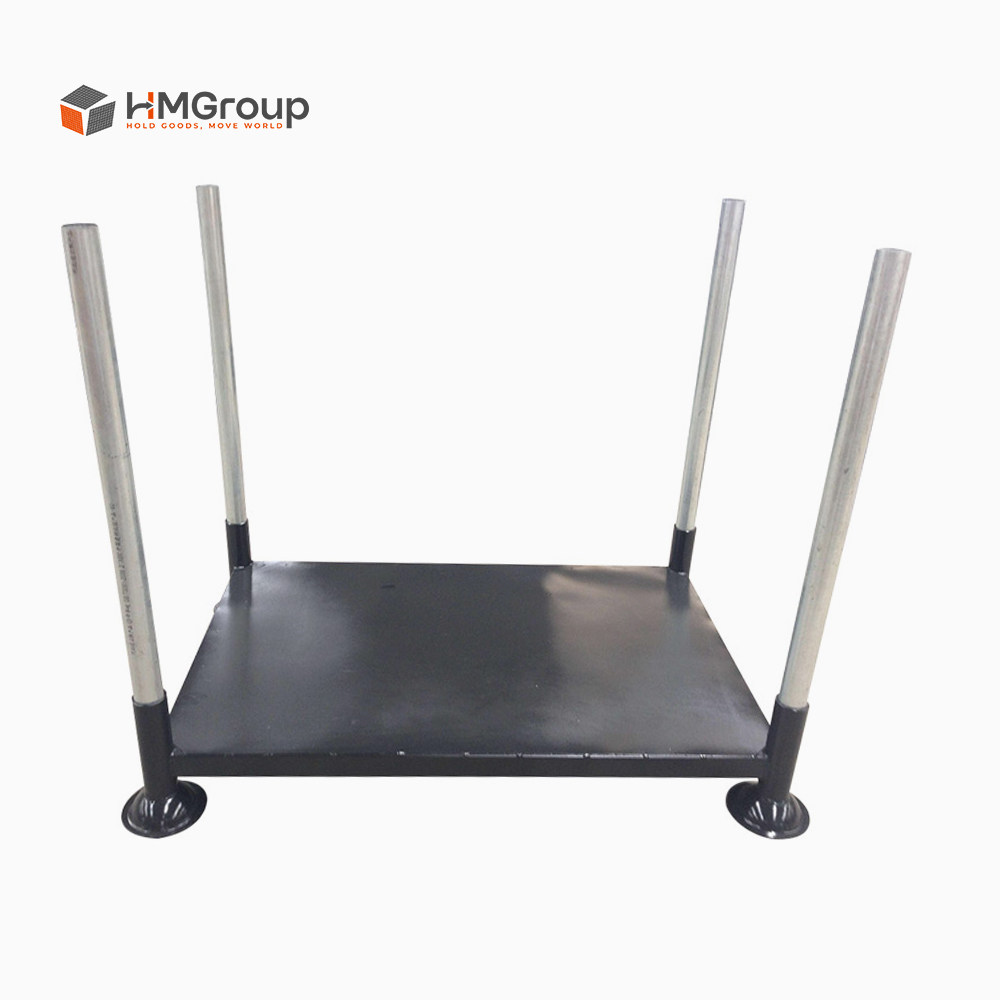
A stack rack shown with a powder-coated steel base finish, one of three finish routes offered on both models.
Footprint and floor-area economics
HM-FR007 occupies a 48 × 48 inch footprint. HM-PP006 is built on a 950 × 950 mm base. In practical terms the bulk bag rack presents the smaller floor footprint of the two, while the HM-FR007 presents a larger square platform. Neither number is inherently better: a smaller footprint that cannot carry the load you have is not an efficiency gain, and a larger platform that is underfilled is wasted cube.
The more decision-relevant metric is often density per container, because the minimum order quantity for both models is a container. With 380 sets of HM-FR007 and 160 sets of HM-PP006 per 40’HQ, a buyer planning a first installation should calculate installed positions per container, not units per pallet. Freight, port handling and inland delivery are all amortised over that number.
Stacking: what the published figures do and do not say
HM-FR007 is published at 6 stacking positions in the open state and 20 in the closed state. HM-PP006 is published at 4 high. These are model-level specifications describing the unit’s design positions; they are not a blanket authorisation to stack to that height with any load in any building.
A useful illustration comes from an actual deployment. In a rice-seed cold storage project in Myanmar, a PP-series post pallet rack installation used six-tier vertical stacking, with 5,000 units supplied in a single major tender procurement to a United Nations (UNOPS) end user via a strategic procurement partner. That project’s configuration is described with a per-unit load figure of 1,200 kg, which is higher than the HM-PP006 standard rating of 1,000 kg. The lesson for buyers is straightforward: project configurations can differ from catalogue ratings in both directions, and comparing a project-spec figure against a standard-spec figure is not a like-for-like comparison.
In a separate deployment in South Korea, a government agency client used 1,000 units in an initial phase with recurring reorders for vertical stacking of potatoes in cold storage, with a hot-dip galvanized finish specified for durability. That case also involved high-precision transformation of client drawings — another reminder that the drawing, not the datasheet, governs the delivered product.
Stacking height in practice depends on floor flatness, aisle and forklift access, uniformity of the unit load, and whether the rack is being handled in its open or closed state. Any stacking plan above the published figure should be raised with the supplier as an engineering question and documented.
What each model is suited to carry
HM-FR007 is listed for textile and fabric roll handling, logistics and warehousing, food and grocery, agricultural and furniture industry environments. Its 48-inch square platform and 1,100 kg rating make it a general-purpose unit for unitised loads in those sectors, and its naming sits within the same FR-series family as HM Group’s dedicated fabric roll rack models. Buyers handling rolls, bales, bagged goods or boxed stock in mixed warehouse operations generally begin with a general-purpose square rack of this type.
HM-PP006 is a bulk bag storage rack, and its published application scope is logistics and warehousing. Its 950 × 950 mm base is dimensioned around a single bulk bag position, and the specified φ60 × 2.5 mm post is the vertical element of that geometry. Where the load is a flexible intermediate bulk container rather than a bale, roll or palletised carton, the bulk-bag configuration is the appropriate starting point — not because it is stronger, but because the base and post are sized for that cargo.
Neither model is presented as a multi-level racking system with pick faces. Both are portable stack racks, and both should be evaluated against that scope.
Verification: what the certificates actually cover
Buyers in the evaluation and execution stage increasingly ask for documentation before releasing a purchase order. HM Group’s publicly listed documentation relevant to these product families is set out below.
| Document | Issuer | Reference | Date | Stated scope |
|---|---|---|---|---|
| ISO 9001:2015 certificate | SGS | CN24/00004786 | Issued 2024-07-30, valid to 2027-07-29 | Sales of material handling equipment for logistics turnover |
| Survey Report | SGS | CANWT00478167 | Issued 2026-01-23 | Stacking Shelves (Style No. M2) |
| Inspection report | TUV | ITD2025N0087 | Issued 2025-02-28 | Steel pallet |
| Audit report | BV | MIC-ASI2491658 | Issued 2024-10-29, valid to 2026-10-28 | Post pallet, tire rack, roll container, wire mesh container, wire decking, cage pallet, stacking rack, PET preform container, IBC container, Danish trolley |
| Verified Pro Supplier | SGS | 486803081_T | Issued 2026-03-06, valid to 2027-03-06 | All logistics equipment products |
The limitation here is important and frequently misunderstood. ISO 9001:2015 certifies a management system for the stated scope; it does not certify any individual rack. The SGS Survey Report and the TUV inspection report both carry specifically worded scopes — “Stacking Shelves (Style No. M2)” and “Steel pallet” respectively — and both are listed against multiple models, including HM-PP006 and HM-FR007. A report whose scope is a style or a product category does not automatically extend to every configuration, gauge, finish or load case manufactured under that model number.
For buyers, the practical test is narrow: request the report that covers the exact model, post specification, finish and rated load being ordered, and confirm the issue date is current. Where the end market uses a recognised structural design framework, such as ANSI MH16.1-2023 in the United States or EN 15512:2020 in Europe for steel static storage systems, the buyer should state which framework the verification is expected to satisfy before the order is placed.
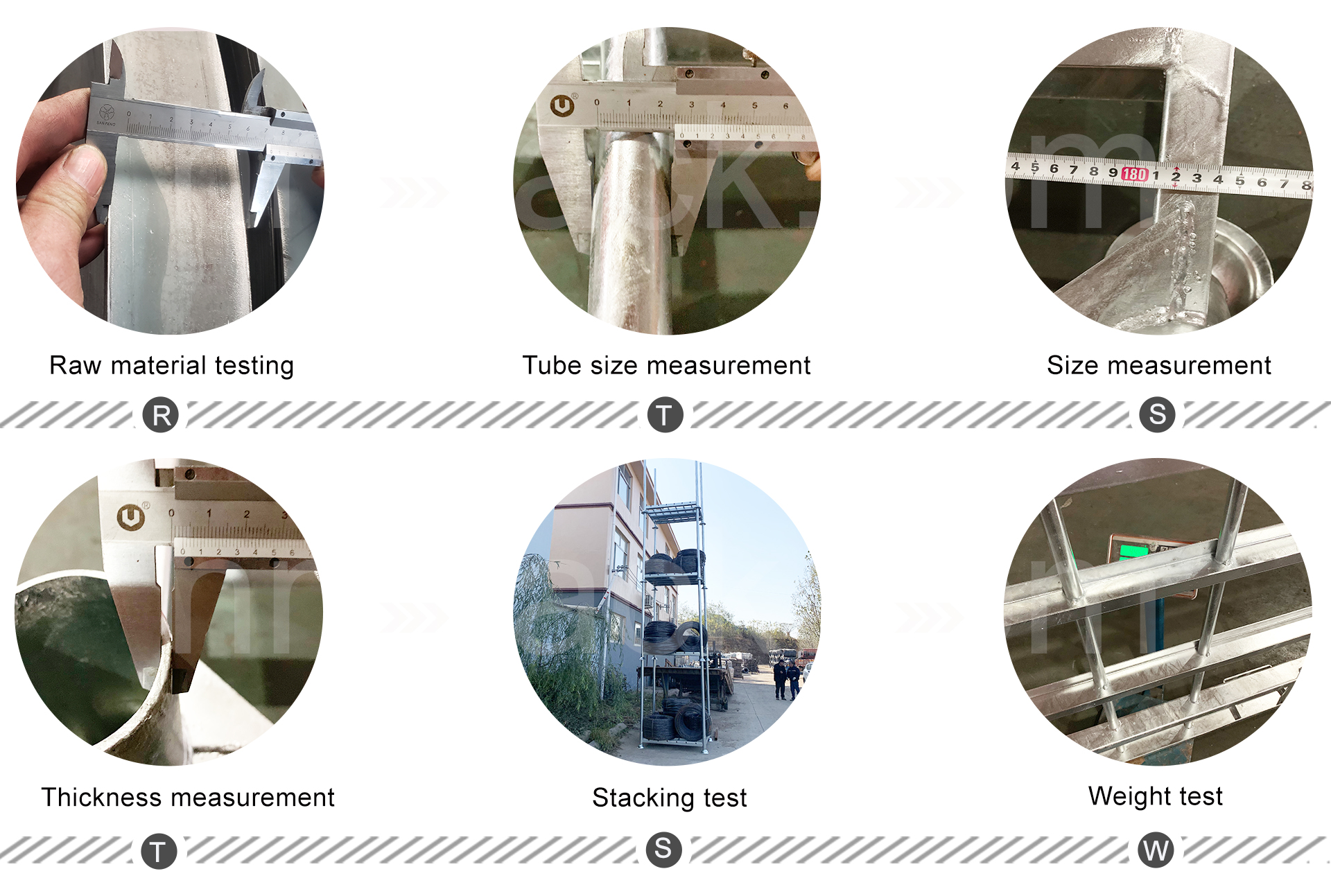
Quality inspection of stacking storage racks covering the HM-PP-series models, including HM-PP006.
Where both models stop: limits and boundaries
A comparison that lists only advantages is not useful for procurement. Both HM-FR007 and HM-PP006 share the same structural boundaries, and a buyer should price those into the decision.
- They are not a substitute for engineered selective racking. Portable stack racks do not provide the pick-face selectivity, beam adjustability or building-integrated design of a fixed pallet racking installation. Where SKU-level access frequency is high, fixed racking remains the appropriate system.
- Vertical gain depends on the site, not just the rack. Achievable stacking height is constrained by floor flatness, aisle width, and the handling equipment available. A rack rated for six positions is not a guarantee of six positions in a given building.
- Rated load is per unit, under stated conditions. A 1,100 kg or 1,000 kg figure describes the unit’s capacity in its specified configuration. Uneven load distribution, point loading or a modified base changes the load case and requires re-verification.
- Two of three finishes are not equal in aggressive environments. Where condensation, wash-down or chemical exposure is continuous, the finish specification must be matched to the environment rather than chosen on cost.
- Model data is not a drawing. Where the delivered unit is customized in size, load rating or finish, the drawing and the inspection record — not the catalogue table — define what was actually supplied.
Stating these limits does not weaken either model. It narrows the decision to the cases where they genuinely fit, which is the more expensive mistake to get wrong.
Procurement mechanics for both models
Because the two models share the same commercial framework, most purchase terms can be compared once rather than twice. HM Group lists a minimum order quantity of 1 × 20GP for these products, with delivery available on EXW, FOB, CIF, DDP and DDU terms. Payment terms are T/T with 30% in advance and 70% against a copy of the bill of lading, or L/C. Pre-shipment inspection or third-party inspection is accepted, and the stated lead time is 30–45 days against a monthly capacity of 80,000 sets.
Quality control is described as a six-phase process: pre-production sample inspection, raw material inspection, component inspection, semi-finished product inspection, finished product inspection and packaging inspection. Ongoing support includes process reports throughout the order, online video audit, and a 3–5 year warranty under proper use.
Two of these terms are worth planning around during the execution stage. First, a 1 × 20GP minimum means the container commitment shapes the model mix — and the difference between 380 sets of HM-FR007 and 160 sets of HM-PP006 per 40’HQ tells a buyer immediately how much of each model a first order represents in installed positions. Second, the 30–45 day lead time should be mapped against the warehouse fit-out schedule rather than against the purchase approval date.
Decision framework: which model fits which job
| Decision criterion | Favour HM-FR007 when… | Favour HM-PP006 when… |
|---|---|---|
| Cargo type | The load is a general unitised load — rolls, bales, bagged or boxed goods across textile, food, agricultural or furniture operations | The load is a bulk bag, and the storage position is dimensioned for that single cargo |
| Load per unit | Unit loads approach 1,100 kg | Unit loads are within 1,000 kg |
| Floor footprint | A larger 48 × 48 inch platform is acceptable or desirable | A smaller 950 × 950 mm base is an advantage |
| Stacking plan | Up to 6 positions open, 20 closed, subject to site confirmation | Up to 4 high, subject to site confirmation |
| Container planning | Higher installed positions per container (380 sets per 40’HQ) | Lower installed positions per container (160 sets per 40’HQ) |
| Post specification | Post size must be requested from the supplier | Post is published at φ60 × 2.5 mm |
Read across the table and the outcome is usually clear. The models overlap on material, finish and commercial terms; they separate on cargo geometry.
Market context and outlook
Demand-side indicators support continued investment in both fixed and portable storage structures. Grand View Research places the global warehouse racking market at approximately USD 9.71 billion in 2024, rising toward USD 12.41 billion by 2030, with North America holding the largest regional share at 27.8% of global revenue in 2024. Global Market Insights, measuring a broader storage rack scope, estimated USD 22.4 billion in 2024 with a 4.9% CAGR through 2034. A narrower segment — specialised tire storage racks — was valued at USD 865 million in 2024 and projected toward USD 1.37 billion by 2034 at a 4.7% CAGR, indicating that specialised rack formats continue to attract dedicated demand rather than being absorbed into general racking categories.
The implication for stack rack buyers is that capacity pressure is not a temporary condition. Warehouses in cold chain, agriculture, textiles and automotive-adjacent sectors continue to convert floor space into vertical positions, and portable stack racks remain one of the lowest-friction ways to do it where building modification is not an option.
The more useful forward-looking question is not whether the market grows, but whether documentation keeps pace with it. As more buyers in North America and Europe apply frameworks such as ANSI MH16.1-2023 and EN 15512:2020 to their specifications, the ability to produce a report matching the exact model, finish and load configuration becomes a procurement criterion in its own right — and one that is easier to satisfy before the order than after delivery.
Frequently asked questions
What is the difference between HM-FR007 and HM-PP006?
HM-FR007 is a stackable steel storage rack with a 48 × 48 × 36 inch exterior and a 1,100 kg rated load. HM-PP006 is a bulk bag storage rack with a 950 × 950 × 310 mm base, a φ60 × 2.5 mm post and a 1,000 kg rated load. Both are made from mild steel Q235 and both are offered in zinc, hot-dip galvanized and powder coating finishes. The main differences are footprint, post specification, published stacking positions and the cargo each model is dimensioned around.
Which model has the higher load rating?
HM-FR007 is rated at 1,100 kg per unit, which is higher than the 1,000 kg rating published for HM-PP006. The comparison is only meaningful for the standard configuration: where a unit is customized in size, gauge or finish, the applicable load case changes and should be confirmed against the drawing and inspection record rather than the catalogue figure.
How high can HM-FR007 and HM-PP006 be stacked?
HM-FR007 is published at 6 stacking positions when open and 20 when closed. HM-PP006 is published at 4 high. These are model-level design figures. Achievable height on a specific site also depends on floor flatness, aisle access, handling equipment and load uniformity, and configurations exceeding the published figure should be confirmed with the supplier as an engineering question.
Are both models available in the same finishes and material?
Yes. Both HM-FR007 and HM-PP006 are fabricated from mild steel Q235 and both are listed with zinc, hot-dip galvanized and powder coating finishes. The manufacturer also offers OEM, ODM and fully customized production, including adjustments to surface treatment, size, loading capacity, powder coating colour and logo printing, with optional features such as wire mesh guard, bottom wire mesh decking, forklift guide, bottom steel plate and wheels.
What should buyers verify in the test documentation for these models?
Buyers should check four things: whether the document names the exact model or style being ordered, whether its stated scope matches the configuration and finish quoted, whether the issuing body and reference number are verifiable, and whether the issue date is current. The published documents associated with these product families include an SGS Survey Report CANWT00478167 scoped to “Stacking Shelves (Style No. M2)”, a TUV inspection report ITD2025N0087 scoped to “Steel pallet”, and an ISO 9001:2015 certificate CN24/00004786 scoped to the sales of material handling equipment for logistics turnover.
How many units of each model fit in a 40-foot container?
The published container-loading figures are 380 sets of HM-FR007 and 160 sets of HM-PP006 per 1 × 40’HQ. These figures assume the standard configuration and packaging and should be re-confirmed if a customized size, heavier specification or different finish is ordered.
Closing assessment
HM-FR007 and HM-PP006 are not interchangeable products with a quality gap between them. They are two configurations of the same engineering approach — portable, stackable, mild steel Q235 racks with a shared finish menu — separated by the cargo each was dimensioned to hold. A buyer whose load is a bulk bag should start with the 950 × 950 mm bulk bag configuration; a buyer handling general unitised loads across textile, food, agricultural or furniture operations should start with the 48-inch square general-purpose unit.
In both cases, the deciding evidence sits outside the datasheet: the drawing that defines the delivered unit, the inspection record that confirms it, and the report whose scope matches the model actually shipped.
HM Group’s product documentation, including full specifications for the stacking rack range, is available in the downloadable brochure: HM Group product brochure (PDF).